Client Research Before a Sales Call: How AI Builds the Brief for You
Before every call, AI puts together a dossier on the person: who they are, what they actually want, where it hurts, which objections they'll bring, and which offer will close them. You sit down for the conversation prepared instead of starting from a blank page. Six ready prompts, a live before-and-after, a one-click template, and the rule for what you can feed the AI about a client and what you must never touch.
Client research before a sales call is the prep work AI does for you. You hand it the person's intake form, your chat, and a link to their socials, and it returns six short documents: a client profile, the real request behind the facade, a list of objections with ready answers, questions for the call, an offer hypothesis, and a cheat sheet for the call itself. The brief takes 15 minutes instead of an hour of manual prep, and your call-to-sale conversion climbs 1.5 to 2 times, because you speak about the client's pain in their own words.
Someone books a call. You open the conversation and spend the first twenty minutes figuring out who they even are, what they do, and why they came. While you're getting your bearings, they cool off. You offer help on a hunch, miss the real request, hear a polite "let me think about it," and hang up feeling like you just lost a warm lead. Every time.
I run four client projects and do dozens of these calls a month. I walk into each one with a ready dossier that AI put together while I was making coffee. I know the name, the niche, the revenue, the main pain, and the three objections the person will bring. The conversation is on point from minute one. This article is the whole system, with prompts you'll copy straight from here.
It's an 18-minute read. You set it up once. After that, AI builds every client brief in the time it takes you to pour a cup of tea.
What's inside
- What client research before a sales call is, and why deals die without it
- The six documents AI puts together
- Where to get the data, and what you can't feed the AI
- Document 1. Client profile
- Document 2. The real request behind the facade
- Document 3. Objection map with answers
- Document 4. Diagnostic questions
- Document 5. Offer hypothesis and price ladder
- Document 6. The call cheat sheet
- Build the whole brief in one click with Claude Projects
- A live before-and-after example
- 5 mistakes that make the brief useless
- Launch checklist
I build these briefs in Claude – it holds long context best and doesn't invent facts. If you're outside the US or EU, note that Anthropic restricts a handful of regions, so check that Claude is available where you are or use a supported location. Sign up at claude.ai. The exact same workflow runs in ChatGPT if that's more familiar to you.
Section 01What client research before a sales call is, and why deals die without it
Diagnosis in sales is the moment you understand what a person actually needs before you offer them anything. A doctor doesn't prescribe from the doorway. They ask where it hurts, how long, what you've already tried. Selling works the same way. Until you've understood the request, any offer is a shot in the dark.
The problem is that live diagnosis on the call eats your time. You have 40 minutes, and half of it goes to introductions: who you are, what you do, your revenue, what you've tried. The person answers in generalities, you nod, and the real request surfaces at minute 35, when it's too late to close. The client is tired, you ran out of time, and you both leave with nothing.
Client research before a sales call moves that work to before the call. AI gathers everything you can learn about the person from their request and public sources, builds theories about their pain, and hands you questions that go straight to the point. You walk into the call already knowing more about the client than they share in the first few minutes. And you spend all 40 minutes on what they came for – their result.
What a ready brief does, in numbers
- Call-to-sale conversion goes up. On my projects, a prepared brief lifts it 1.5 to 2 times. You hit the pain from minute one, and the person feels understood.
- Higher average deal. When you see the true size of the client's task, you offer a solution that fits it, not the cheapest plan just in case.
- Fewer warm leads lost. You've already read the person's objections in their own posts and chat. On the call, they don't catch you off guard.
- Time saved. An hour of manual prep per client turns into 15 minutes of checking a ready dossier.
Next, let's break down what that dossier is made of, where the AI gets its data, and how to build each of the six documents. Every prompt works – copy and paste them for yourself.
Section 02The six documents AI puts together
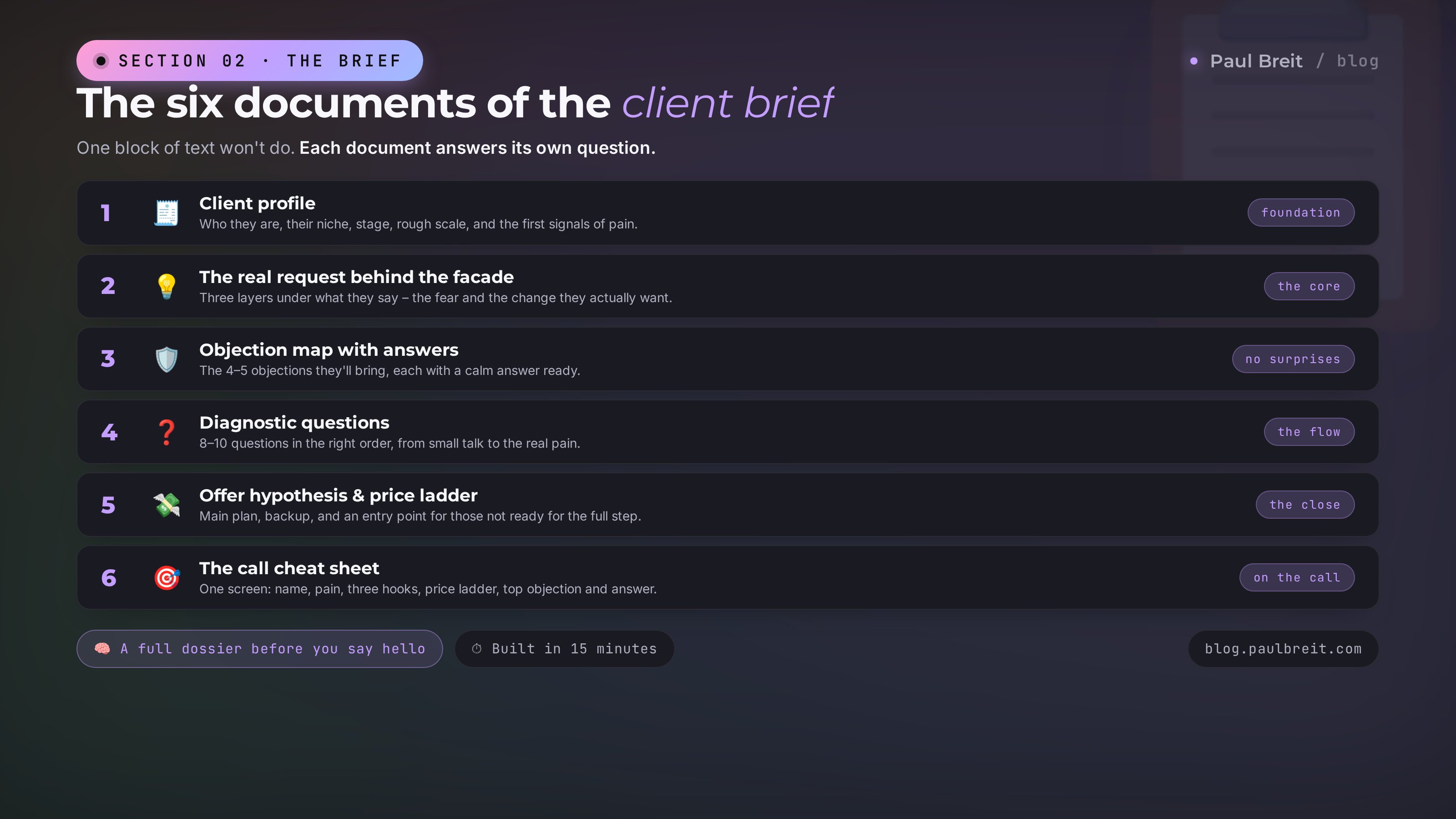
A full client brief is made of six short documents. One solid wall of text doesn't work here: each document answers its own question and prepares you for its own part of the conversation. On their own they're useful; together they give you the full picture of the person before you've ever heard their voice.
Client profile
The dry facts: who they are, what they do, what stage they're at, their rough revenue, where they run their audience. The foundation everything else sits on.
The real request behind the facade
In the form, the person writes "I want more clients." Behind that there's almost always something else: burned out on manual selling, scared to raise the price, tired of the instability. The AI builds theories about the true pain.
Objection map with answers
The three to five objections the person will bring to the call, and a ready answer for each. Too expensive, I need to think, my case is different, I already tried it and it didn't work.
Diagnostic questions
Eight to ten questions in the right order, leading the person from the general to the pain and from the pain to a readiness to change something. No interrogation, in plain language.
Offer hypothesis and price ladder
What to sell this client and in what price range. Which plan to offer as the main one, which as the backup, and where the smaller entry point sits.
The call cheat sheet
One page you keep in front of you during the conversation. Name, pain, three hook questions, the price ladder, the main objection and its answer. Everything you need on a single screen.
Next – each document with its prompt. But first, the key thing: where the AI gets its data on a person at all, and where the line is that you don't cross.
Section 03Where to get the data, and what you can't feed the AI
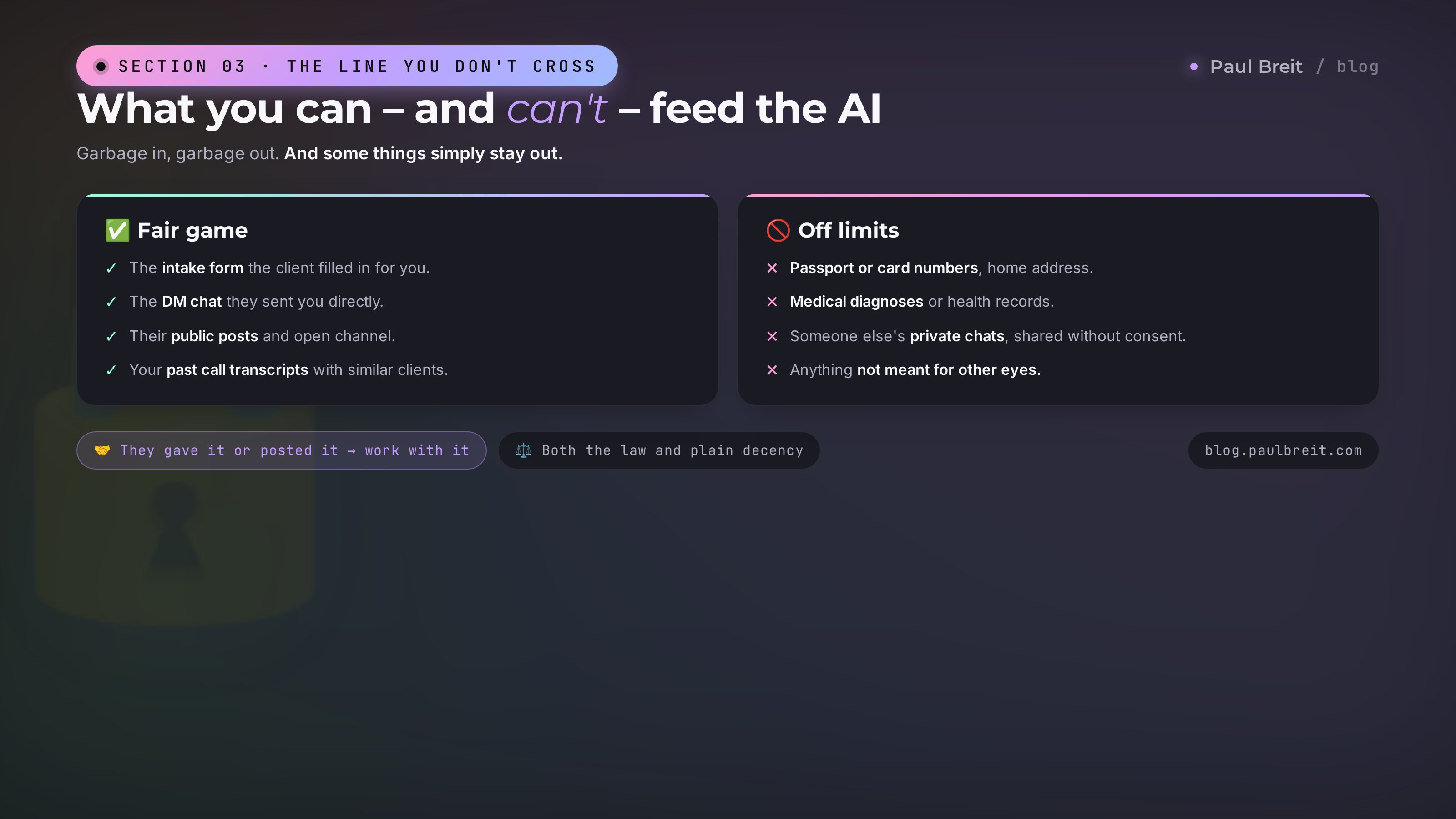
The quality of the brief depends on what you give the AI up front. Garbage in, garbage out. The good news: you almost always already have enough data, it's just scattered in different places.
Where the material comes from
- The intake form before the call. Your main source. When someone fills out a form with 5 to 7 questions, you get their niche, stage, request, and expectations straight from their own hands. There's a separate piece on working with calls that covers how to build such a form.
- The chat in direct messages. How a person frames the problem in a chat is often more honest than the form. Copy the conversation and hand it to the AI.
- Their public channel or profile. A person's last 20 to 30 posts are a map of their pains, values, and the way they talk. You can give a web-enabled AI the link, or copy the text by hand.
- Your past calls with similar clients. If you've already worked with people in this niche, transcripts of past conversations help the AI build sharper theories.
You can't feed the AI someone else's personal data that the person didn't give you for analysis. ID and card numbers, home addresses, medical diagnoses, someone else's private chats without their knowledge – all of that stays out. Work only with what the client left in the form, wrote to you directly, or published openly. It's both the law and plain decency.
The rule is simple: if the person gave you the data themselves or put it out in the open, you work with it. If it's something you learned by accident or that wasn't meant for other eyes, you leave it alone. The brief exists to help the client better, not to dig through their pockets.
Document 01Client profile
The first document is the dry facts about the person, gathered into one card. For now it's just the foundation for the analysis ahead. The AI takes the form, the chat, and the posts, and sorts everything onto shelves: who, what, what stage, what revenue, where it hurts by the first signs.
The point is that 30 seconds before the call you can refresh in your head who's coming your way. No scrolling through the chat, no "give me a second to remember."
Prompt for the client profile
You are my assistant for prepping sales calls.
I'm a specialist; I help [your niche, e.g. help experts
build sales funnels with AI]. Below is data on a client
who booked a call with me.

DATA:
[paste the intake form, the direct-message chat,
the text of the client's recent posts]

Build a profile card in this structure:
1. Name and how to address them
2. Niche and what exactly they do
3. Stage: beginner / has a product but few sales /
   sells steadily and wants to grow
4. Rough revenue or scale (if it's visible in the data;
   if not, write "unclear, clarify on the call")
5. Where they run their audience and roughly how big it is
6. How the person talks: dry, emotional, with humor,
   cautious (useful for matching your tone)
7. The first three signals of pain visible already

Keep it short and factual. Where data is missing,
honestly mark it "clarify" – don't make things up.The point about how the person talks usually gets skipped. But it matters: with a cautious client you keep the conversation gentle and don't push; with an energetic one you keep the pace up. The AI reads speaking style from posts and chats better than you can on the fly right before a call.
You get half a card of text you can read in half a minute. That's the warm-up before the main event – the real request.
Document 02The real request behind the facade
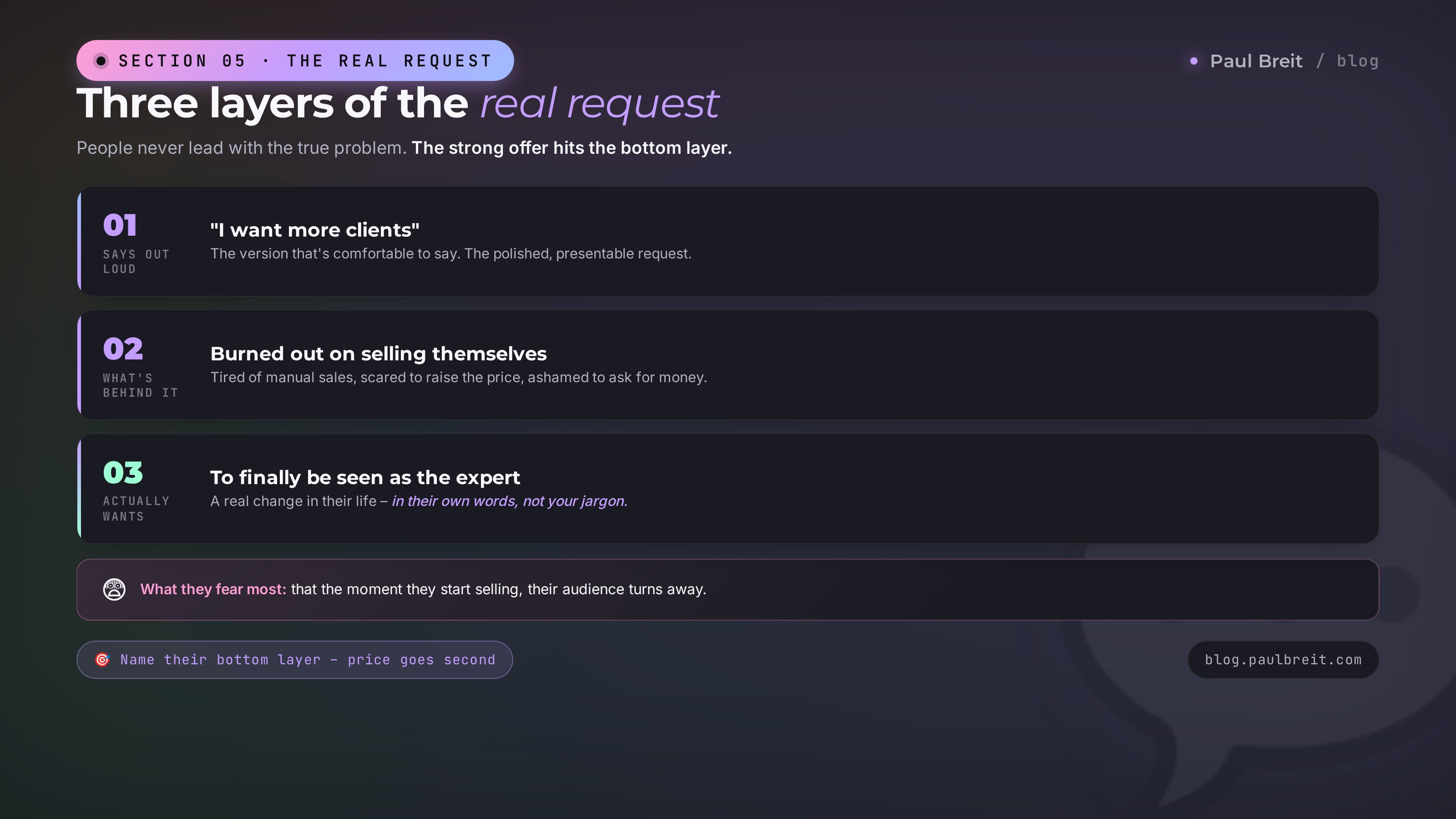
The most valuable document in the brief. A person almost never shows up with their real problem. They show up with what's acceptable to say out loud. "I want more clients" sounds fine. Behind it sits: I'm tired of selling myself, I'm ashamed to raise my price, I'm afraid that going back to a job would mean I failed.
The AI's job is to build theories about what the person feels and fears deep down. These are versions to test: you'll confirm them on the call with questions – nobody's handing down a verdict here.
Prompt for the real request
Based on the client profile and their data above,
build theories about their REAL request.

Lay it out in three layers:
1. What the client says out loud (their wording
   of the request)
2. What sits behind it on a human level: what fatigue,
   what fear, what desire they don't say directly
3. What result they actually want – describe it as
   a change in their life, without technical words
   (example: behind the word "funnel" sits the wish
   to "stop depending on manual selling and finally exhale")

Give 2 to 3 versions of the real request, from most
likely to least likely. For each, note what to watch
for in their words to know whether you're right.

Add a "what they fear most" block –
one main sentence.

Don't invent facts. Build theories only from
what's actually in the data.
The three layers are the key. The top layer the person will say themselves. The middle one you pull out with questions. The bottom layer is what they came for in the first place, and that's exactly where a strong offer lands. When you name a client's bottom layer in their own words, they feel they've found their person. After that, price is secondary.
Says: I want to package my expertise and start a blog. Behind it: they know they can do a lot but can't explain it clearly, and that makes them feel like an impostor. Actually wants: to finally be recognized as an expert and stop being seen as a freelance doer. A call with this client is built around recognition, not around the word "blog."
Document 03Objection map with answers
Objections on a call are almost always the same ones. Too expensive. I need to think. My situation is specific, this won't fit me. I've tried something like it and it didn't work. Now's not the time. The problem is that they catch you off guard, and you answer on the spot, unconvincingly.
From the profile and the request, the AI predicts which objections this particular person will bring, and prepares an answer for each in advance. You read the map before the call, and on the call the objection stops being a surprise. It's just a point you're ready for.
Prompt for the objection map
Based on the client's profile and real request, build
a map of the objections they're most likely to bring
to the call.

For each objection give:
- The wording as THIS client would say it
  (accounting for their speaking style)
- What's really behind the objection
  (fear, past experience, a misunderstanding)
- My answer: calm, no pressure, through a question
  or through the example of a client in a similar spot
- What NOT to do in the answer (what would push
  them away)

Give the 4 to 5 most likely objections,
from common to rare.

Tone of the answers: a confident expert who helps
the person decide calmly, without any arm-twisting.
No manipulation, no fake urgency.When you defend the price right after "too expensive," the person digs in harder. When you ask "expensive compared to what?" or "what would feel like a fair price for that result?", they talk themselves into the value. It works more gently and more honestly. You'll find ready phrasing for these answers in the piece on the sales-call script.
The objection map removes the main fear of any call – the fear of being backed into a corner by a question you can't answer. With a ready map, that moment simply never comes.
Document 04Diagnostic questions
On a call, questions decide everything. The right order of questions leads the person from the general to the pain, from the pain to a sense of its scale, from the scale to a wish to change it. The wrong order turns the call into an interrogation you want to flee.
The AI prepares eight to ten questions tailored to the specific client, in a logical order, in plain language. The questions are aimed right at their niche and request; generic lists off the internet don't help here.
Prompt for the diagnostic questions
Write 8 to 10 questions for a diagnostic call with
this client. The order should lead the person:
big picture → current situation → where the block is →
what they've already tried → what they want to reach →
the cost of doing nothing → readiness to act.

Requirements for the questions:
- Open, not answerable with "yes"
- In plain, conversational language, as if a person
  is asking, not a form
- Tailored to their niche and request, no generic filler
- Among them, 2 questions that help the person
  realize the scale of the problem themselves
- 1 question about the cost of doing nothing: what
  happens if nothing changes for another year

For each question, add a short note in parentheses:
what I'm trying to pull out with it.

At the end, give one backup question for when the
person is closed off and answers in one word.
The question about the cost of doing nothing is the most underrated one. People pay to make the bad stop. That drives harder than a promise that things will get better. When a person says out loud that another year without a system is another year of feast-or-famine, they sell themselves on the change. All that's left for you is to offer the path.
Ten questions in a row with no reaction is a form, not a conversation. After each answer, reflect back what you heard: "so, if I've got this right, it drives you crazy to have to hunt for clients from scratch every time?" The person feels heard and opens up further. The AI prepares the questions; you add the live reaction.
Document 05Offer hypothesis and price ladder
By the end of the call you have to offer something. The fifth document prepares that in advance: what to sell this client, in what price range, which plan is the main one and which is the backup for those not ready to go all in.
A hypothesis, because you'll assemble the final offer as the conversation goes, once you hear their live answers. But walking into the call with a ready ladder is a lot calmer than scrambling to invent a price in the last five minutes.
Prompt for the offer hypothesis
Based on the profile, the real request, and the
objections, build an offer hypothesis for this client.

Give:
1. What result to sell them on
   (phrased in their words, from the real request)
2. Main option: what I offer, at what price,
   why this specifically fits them
3. A smaller backup option: for when the main one
   seems expensive or the person isn't ready to go all in
4. An entry point: the smallest first step
   they could start with (if they're really not ready)
5. One sentence that ties their pain to my solution
   (the bridge from request to offer)

Take prices from my price list:
[paste your plans and prices]

Don't lowball or overreach. Offer what actually
closes their request, not the most expensive plan.When you have only one plan, the conversation breaks down to yes or no. When you have a main option, a backup, and an entry point, the person chooses among three yeses of different depth. That sharply lowers the odds of "let me think about it." How to build the offer people actually pay for is covered in the piece on the sales-call script.
Document 06The call cheat sheet
Five documents is a lot of text. Reading them during the call is impossible. So the last step is to pull everything into one page you keep in front of you. Only the essentials, in big points, so you can catch them at a glance.
Prompt for the cheat sheet
Pull everything above into one cheat-sheet page for
the call. Format: short blocks I can catch at a glance
during the conversation, without reading paragraphs.

Structure:
🧑 CLIENT: name, niche, stage (one line)
🎯 REAL REQUEST: one sentence
😨 MAIN FEAR: one sentence
🎣 THREE HOOK QUESTIONS: three short questions
   I open with
🛡️ MAIN OBJECTION + ANSWER: one line each
💸 LADDER: main plan / backup / entry point
🌉 BRIDGE TO THE OFFER: one sentence tying pain to solution

Everything must fit on a single phone screen.
No long paragraphs.
You keep this page open on a second screen during the call. A glance – and you remember where you're steering the conversation. The client sees a confident expert who gets them. And you just prepared well.
Section 07Build the whole brief in one click with Claude Projects
Six prompts in a row is fine the first time, to get the logic. But copying them by hand every time gets old fast. From there, the whole thing assembles in one click with Claude Projects – a folder where the AI keeps your context on hand permanently.
What you put in the project once
- Who you are and what you sell. Niche, product, who it's for, what result it delivers.
- Your price list. Plans, prices, what's included in each.
- Three to five client cases with numbers. The AI will reference them in the objection answers.
- The brief instruction. All six steps from this article, glued into one text: build the profile, then the request, then the objections, questions, offer, cheat sheet.
After that, every new brief launches with a single command.
New client for a call. Data below – intake form
and chat. Build the full brief per our instruction:
profile, the real request, the objection map, questions,
the offer hypothesis, and the call cheat sheet.

CLIENT DATA:
[paste the intake form and chat]
The AI runs all six steps on its own, remembering your product, price list, and cases. The output is a ready dossier in a couple of minutes. To make the prompts inside the project sharper, take a look at the piece on how to write prompts.
Without a project: you copy six prompts, explain who you are and what you sell every time, and spend 20 minutes. With a project: one command, two minutes, and the whole context is already baked in. Setup takes an hour, once – it pays off by the third client.
Section 08A live before-and-after example
Let me show on a real person how the conversation changes. The name and details are changed, the situation is real.
The request that came in
Marina, a nutritionist. In the form she wrote: I've run a blog for two years, 4,000 followers, I want to sell mentoring but I don't understand how to move from free advice to paid work. I've tried launching – two people bought.
How the call would look with no prep
You: tell me what you do. Marina talks for ten minutes. You: and what have you tried? Another five minutes. You: well, let's try to build you a funnel. Marina: that's expensive, let me think about it. The end. You never understood what was really holding her back, and you offered a solution that missed the request.
What the AI put together in 15 minutes before the call
Profile: nutritionist, 2 years blogging, 4K followers, has expertise and a loyal audience but no sales system. Talks warmly, emotionally, with a lot of care for people. The issue isn't traffic – the audience is there. Sales are low because she's scared to sell.
The real request (three layers): says – I want to sell mentoring. Behind it – she feels awkward charging for something she loves, and it seems to her that selling means pushing. Actually wants – to give herself permission to earn from her craft and stop feeling guilty about the price. Main fear: that followers will turn away once she starts selling.
The main objection she'll bring: I'm not comfortable pressuring people. Answer through an example: show how a peer of hers sells through care and usefulness, and followers only thank her.
Hook question: Marina, what do you feel in the moment you have to name a price? That question goes straight to the real pain.
How the call went with the dossier
You, from minute one: Marina, I looked at your blog – you have a very warm audience and strong expertise. I can see sales are low. Let's be honest: you can build the funnel; the real question is that naming a price feels scary, right? Marina exhales: yes, exactly. And from there the whole conversation is about how to sell through care and stay yourself. You never even touch funnel mechanics. By the end she buys, because for the first time she felt understood.
The difference isn't the script or the pressure. The difference is that you walked into the conversation already knowing the person. That's what client research before a sales call is.
Section 095 mistakes that make the brief useless
Giving the AI too little data
One line from the form, and the AI starts filling in the blanks. The dossier comes out generic and off. Give it everything you have: the form, the chat, the posts. The more live material, the sharper the theories.
Treating theories as facts
The AI builds versions, it doesn't hand down a verdict. Walk into the call sure that you know everything about the person, and you can easily push them into someone else's pain. Test the theories with questions, don't impose them.
Reading the cheat sheet out loud
The dossier is prep, not a script to recite. If the conversation sounds like reading off a page, the person feels it. Keep the cheat sheet in your side vision, and speak in your own words.
Building the brief but not listening on the call
Sometimes a specialist falls so in love with the ready dossier that they stop hearing the live person. And that person is saying something entirely different on the call. The dossier is a support, but the client always beats the paper.
Feeding in what you shouldn't
The temptation to dump everything into the AI is strong. But someone else's personal data, medical details, and anything the person didn't give you stay out. Cross that line once and you lose trust for good.
Section 10Launch checklist
Build your own research system step by step. Set it up once – after that it works on every client.
- ✅ Made an intake form with 5 to 7 questions the client fills out before the call
- ✅ Set up Claude Projects: loaded the niche, product, price list, and 3 to 5 cases
- ✅ Glued the six prompts into one brief instruction inside the project
- ✅ Ran a first client through it and checked each document for sanity
- ✅ Held the call with the cheat sheet in front of me
- ✅ After the call, checked where the theories landed and where they missed, and fixed the instruction
- ✅ Confirmed I'm not feeding the AI any extra personal data
Research prepares you for the conversation. The next step is learning to run the call itself so the person arrives at the decision on their own. That's in the piece on the sales-call script. And if you want to unpack what went wrong on past calls, take a look at the piece on analyzing sales calls with AI.
Client research before a sales call isn't about tricks or scripts. It's about respect for the time of the person who came to you. When you prepare, the conversation stays on point, the client feels they've found their expert, and the decision to buy is born on its own. The AI just takes the routine of prep off your plate, so you can do the real work – people.
📌 The whole path in a minute
- Client research before a sales call is a dossier on the client, built before the call.
- Six documents: profile, the real request, an objection map, questions, an offer hypothesis, a cheat sheet.
- Data comes from the intake form, the chat, and public posts. You don't touch anyone else's private material.
- The real request comes in three layers: what they say, what's behind it, what they actually want.
- Assemble it all in Claude Projects – after that the brief launches with a single command.
- On the call the dossier is a support, but the live person always beats the paper.
FAQFrequently asked questions
How long does it take to research one client?
Once Claude Projects is set up, 2 to 5 minutes to generate plus 10 minutes to check and edit. That's about 15 minutes against an hour of manual prep. Your first brief without a set-up project takes longer, around 30 minutes, while you run the six prompts one by one.
Which AI is best for researching a client?
Claude – it holds a long context better and invents fewer facts, which matters when you're building a theory about a person. ChatGPT works too if it's more familiar to you. Free open-source models handle a basic profile but are weaker at the fine wording of pain points.
What if there is almost no data on the client?
Work with what you have and ask the AI to honestly flag the gaps with the word clarify. The unknowns then become questions for the call. Another option is to add a couple of open questions to the intake form so the person gives you more to work with.
Won't the client mind that I analyze them with AI?
You're analyzing what the person gave you themselves: the intake form, your chat, their public posts. It's ordinary meeting prep, the same as reading their channel by hand. The key is to never feed the AI someone else's personal data or anything not meant for other eyes.
Can I trust the AI's theories about the client's pain?
As versions, yes; as a finished diagnosis, no. The AI highlights likely pains, and you test them with questions on the call. Walk in with I know everything about you and you can easily push someone into a problem that isn't theirs and lose their trust.
Does this work for cold outreach, not just inbound leads?
It works best for warm leads, because the person has already left their details. For cold outreach the only source is public posts and their profile, so there are fewer theories and they're rougher. But even a basic profile before a cold call beats going in blind.
How much does it cost to build this system?
The only paid part is an AI subscription: Claude Pro is about $20 a month, or an equivalent. Everything else – the intake form, the prompts, the project setup – is free and done in an evening. The system pays for itself on the very first client you close thanks to the prep.