The Sales Funnel for Experts with AI: From Subscriber to Sale on Full Autopilot
A done-for-you AI sales funnel for experts – five stages from lead magnet to onboarding. The full structure of a three-video mini-course, a nurture sequence in Telegram and email, a sales webinar, an offer with triggers, and onboarding to keep clients. With ready-made prompts for every stage and a weekend launch plan. No marketing department, no expert burnout.
You know the picture: an expert posts reels, runs the occasional live, keeps a Telegram channel going. The audience grows, reach holds steady, sales stay stubbornly low. Every launch is a month of prep, burnout, then silence. And every time it feels like – "just a little more and it'll all click." It won't. Without a working funnel, an expert is in a state marketers call clinical death: alive only while the algorithm feeds them, and crashing the moment the algorithm shifts.
I run four client projects and a personal channel of 20,000 subscribers. With no marketing department. With one machine – an automated funnel plus AI – five stages placed in the right order. This article is the whole system, end to end, with ready-made prompts for every stage.
You'll read it in 25 minutes. You'll launch it over a weekend. Within 30 days you'll see your first automatic sales – without you personally handling every deal.
What's inside
- What an expert funnel is (a quick intro)
- Stage 1. Lead magnet – a 3-video mini-course
- Stage 2. Nurture – an automated 5-message sequence
- Stage 3. The conversion event – a webinar or a call
- Stage 4. The offer and the sale
- Stage 5. Onboarding – keeping the client
- Traffic into the funnel: where to find people
- Breaking down the numbers so the funnel works
- A funnel over a weekend – the hour-by-hour plan
- 5 mistakes and how AI fixes them
- The launch checklist
Section 01What an expert funnel is (a quick intro)
A funnel is the path a subscriber takes from the first touch to the purchase and beyond. For an expert it's built like this. Cold audience falls in at the top from ads and organic reach. At each level below, some drop out and some stay, and at the very bottom one or two out of a hundred subscribers buy the flagship product. If the funnel is set up well, the rest don't leave – they become a loyal base, buy something smaller, or come back later.
The three stages of the customer journey
- Opt-in. A person hands you their contact in exchange for value – grabs the lead magnet, follows the channel, fills out the form on the landing page.
- Nurture. A series of touches in which you move them from "interesting" through "I get the problem" to "I see the solution and want to try it."
- Closing the sale. A specific offer with a deadline, a guarantee, and proof. The purchase.
Five steps inside
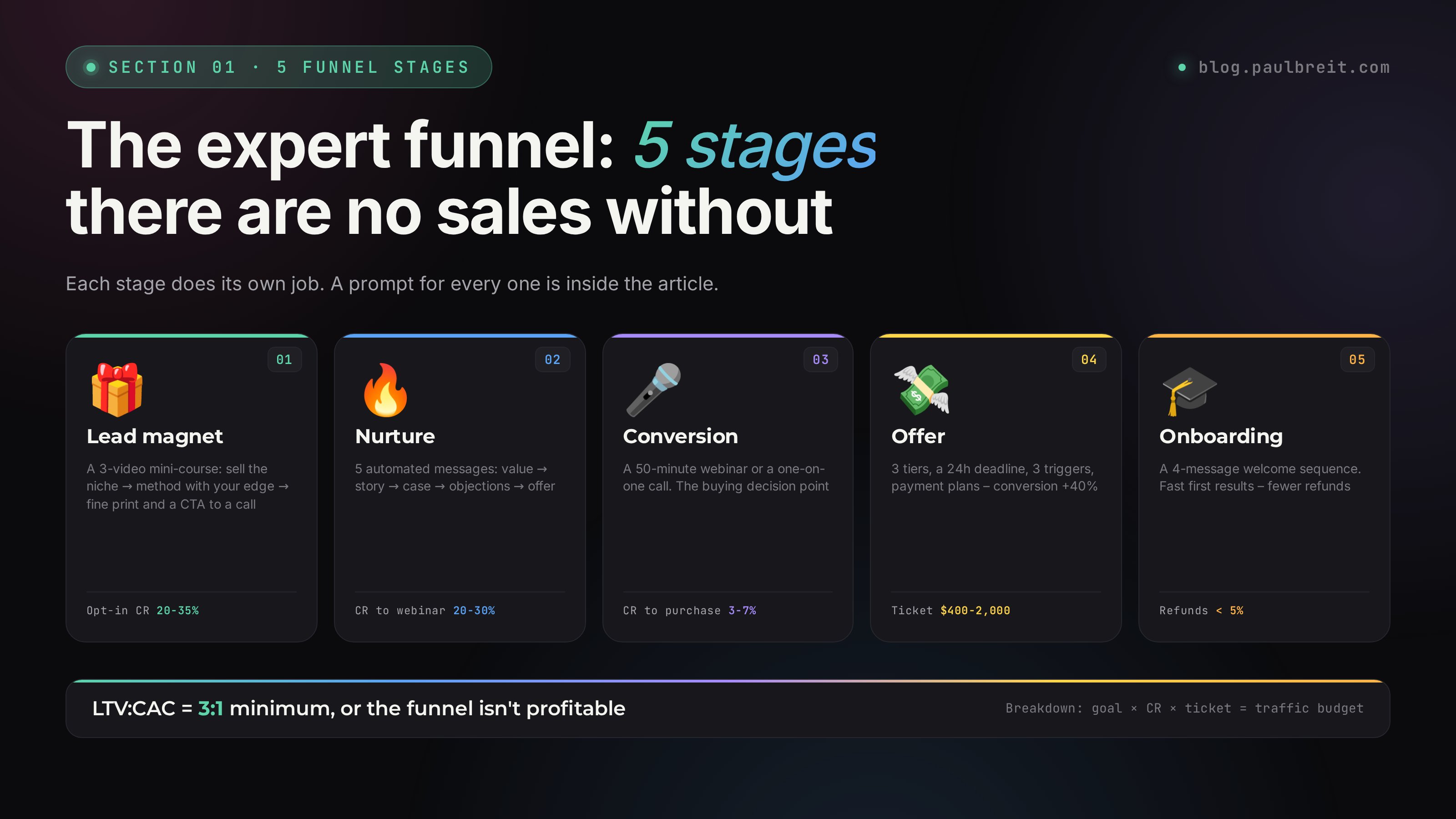
Inside those three stages runs the classic five-step formula:
- Lead magnet – free value that captures the contact
- Nurture – a sequence of 3-5 automated messages with value, stories, and cases
- Conversion event – a webinar, workshop, or free call
- Offer – a sales message with a deadline, tiers, and a guarantee
- Onboarding – fast first results so the client doesn't ask for a refund
The offer ladder
A product logic runs in parallel. An expert needs several rungs so a person can come in at any level of readiness:
- Lead magnet – free. The main job is to build the list and show your approach.
- Tripwire – $15-40. A micro-product with a fast result. It turns a "subscriber" into a "buyer" – handing over the first dollar is psychologically harder than every dollar after it.
- Flagship – the core course or mentorship. $400-2,000. The main cash flow.
- VIP – one-on-one mentoring, a private group, custom work. $2,500 and up. A small stream of clients, a big ticket.
LTV:CAC must be at least 3:1. If acquiring a client costs you $150 and on average you earn less than $400 from them over the whole relationship, the funnel isn't profitable. You either raise the price, lower the cost of acquisition, or add repeat sales (tripwires and upsells do exactly that).
5 funnel archetypes – which to pick
There's a useful classification of five funnel archetypes. Each has its own job and its own pitfalls:
- Basic. Ad → landing page → application → sales call → payment. Fastest to launch, good for services and one-on-one work. The catch – you need a strong closer.
- Webinar. Ad → landing page → webinar → application → sales team → payment. The main funnel for info-products. Converts better than basic, but it demands regular webinars.
- Auto-webinar. You record your best webinar and it runs every day. Fully automated, saves hours. The downside – conversion is lower than a live one.
- Challenge/launch. A series of webinars over 3-7 days, building tension toward the finale. High conversion, but draining. Great for launches 1-2 times a year.
- Warm (creator-led). Traffic from your own channel → nurture in stories and posts → a sales window. Converts best of all, but only scales as far as your audience does.
For an expert just starting, I recommend beginning with the webinar funnel. Once the first cohort runs, record your best webinar and move part of the audience onto an auto-webinar. That frees up your time and scales the funnel.
Stage 01Lead magnet – a 3-video mini-course
The most common expert mistake is making the lead magnet a 60-page PDF. Nobody reads it. A strong lead magnet solves one specific problem in 10 minutes, or shows a method that leaves the person wanting to work with you.
In my funnels one format beats all the others – a mini-course of three videos. 5-8 minutes each, free, unlocked through a bot after opt-in. This format beats PDFs, checklists, and even free consultations, because it shows you as a person and your method as a system.
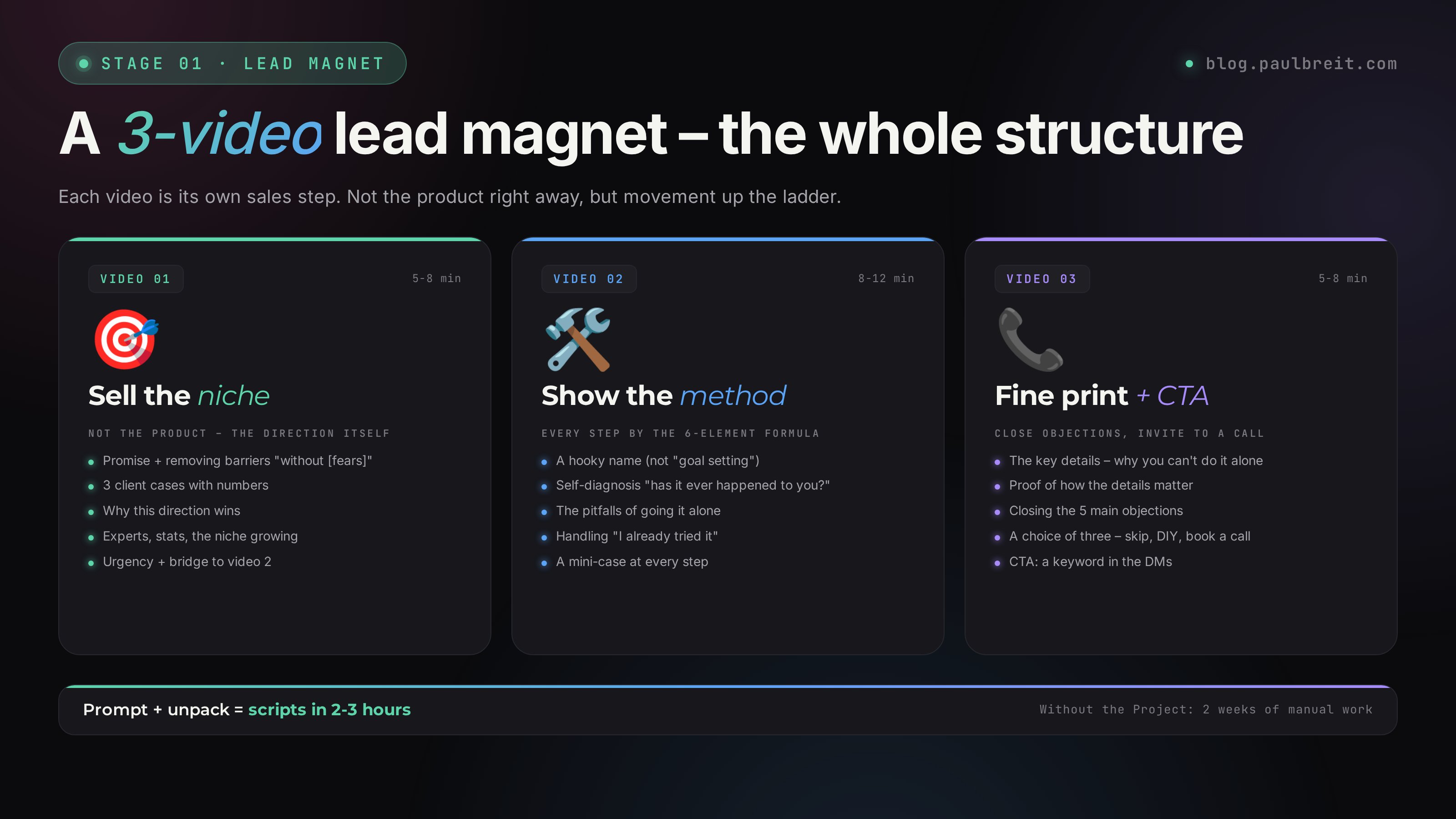
The logic of the three videos
Each video does its own job – it sells the next step. Not the product right away, but movement up the ladder.
Sell the niche
The main job isn't to sell your product, it's to sell the niche itself as a way to solve the problem. So the person walks away thinking: "Okay, this direction actually works, I need this." They're not ready for your product yet.
A 12-step structure:
- Greeting: who I am, who I help, toward what result
- The course promise: "In this free course we'll break down how to [main result]"
- Removing barriers: "And all of it without [the audience's fears]"
- Client cases from the core product (at least 3, different situations)
- Removing barriers again
- Intrigue: "What's the secret? I'll tell you in a moment"
- About me – 60 seconds of high-impact facts, not a biography
- Why this direction beats the alternatives
- Reinforcement: experts and statistics
- Reinforcement: the niche is growing, a window of opportunity
- Urgency: "It won't always be this way"
- Bridge to video 2: "How exactly? I'll break it down next"
Show the method, with your edge
This is the heart of the lead magnet. The main job is to show the path so the person believes the path is possible, and at the same time sees: without an experienced guide, they'll get lost on it.
Every step of your method follows a strict formula. If even one element is missing, the step doesn't move the needle on conversion.
| Step element | What it does |
|---|---|
| A hooky name | Not "goal setting," but "the goal-truth test – the factor that keeps 90% of goals from ever happening" |
| Why the step matters | Sell the idea of doing it. 2-3 self-diagnosis questions: "Has it ever happened to you that...?" |
| Negative consequences | What happens if they ignore it. Sell the idea of taking action |
| Pitfalls | What they'll hit trying it on their own. The thought: I need a guide |
| Handling objections | "I already tried it and it didn't work." Explain why it didn't, and why it will with this approach |
| Mini-case | A specific client with numbers – proof across different situations |
The fine print and the invitation to a call
The third video closes the remaining objections and invites them to a free call or the conversion event.
- Greeting + ask them to watch videos 1 and 2 first
- The important details – what people miss doing it on their own
- Proof of how those details affect the result
- Handling objections about the details – "it won't work for me because X"
- "Account for every detail and the result is guaranteed" + cases
- Urgency – you need to act now
- FAQ – how much time, money, and effort it takes
- A choice of three: do nothing, figure it out alone, book a call
- CTA – a keyword in the DMs or a link to the form
- Reinforce the CTA – "free, no obligation, takes a minute"
Six lead-magnet rules it won't sell without
These rules are the distilled version of what I've learned over ten years in this business and 80+ courses I've studied. Every violation costs you conversion:
- No "my signature method." The method gets packaged into a branded concept with a unique name. "The Plate Method," "The Health Triangle," "The Readiness Gauge" – anything but "my system."
- No clichés. SMART goals, the wheel of life, the Eisenhower matrix – only to tear them apart or give them your own twist. The viewer should think: "You could do it that way? This is exactly what I was looking for."
- Your edge in every step. Not "run ads," but "run ads with the specific angle from my objections table." The person has to see: with a guide the result is guaranteed, without one it's unlikely.
- Sell every step through its name. "Asset analysis – the move that made my client $3,400 in a single day" – not "list your strengths."
- Don't pitch the product head-on. "With me you'll get..." triggers resistance. "When a client comes to me, I start with..." triggers the question "How do I work with you?"
- At the start – a keyword in the DMs, not a form. A form cuts conversion in half. You turn the form on when you have too many applications.
How AI speeds up the lead magnet
Without AI, writing the scripts for three videos takes an expert a week or two. With AI – two or three hours, if you already have your expertise unpacked (see the article on 10 AI prompts, prompt 1).
The key prompt for generating the scripts is below. Put this whole set of instructions into the Project Instructions, and the AI will factor in all six rules automatically.
Based on my expertise unpack and product description,
write the scripts for three lead-magnet videos.

Video 1 "Sell the niche" – a 12-step structure:
1. Greeting: who I am, who I help
2. The course promise
3. Removing barriers
4. Client cases
5. Removing barriers again
6. Intrigue
7. About me (60 seconds of high-impact facts)
8. Why this direction wins
9. Experts and statistics
10. The niche is growing
11. Urgency
12. Bridge to video 2

Video 2 "Method with your edge" – every step by formula:
- A hooky name (not "goal setting,"
  but "the goal-truth test")
- Why the step matters + 2-3 self-diagnosis questions
- The negative consequences of ignoring it
- The pitfalls of doing it on your own
- Handling the "I already tried it" objection
- A mini-case

Video 3 "Fine print + CTA" – 10 steps:
greeting -> details -> proof -> objections ->
cases -> urgency -> FAQ -> a choice of three ->
CTA "a keyword in the DMs" -> reinforce the CTA

DON'TS:
- No "my signature method / my system"
- No cliches (SMART goals, the wheel of life)
- The method must live in a BRANDED concept
  with a unique name
- Name the steps to sell ("Asset analysis - the move
  that made a client $3,400 in 1 day")
- Don't pitch head-on ("with me you'll get"),
  only through "my clients get"

Give me bullet points for each slide (1 idea = 1 slide),
not verbatim text. The expert fills it in their own words.Your expertise unpack (unpack.md), a description of your flagship (product.md), 5 client cases with numbers (cases.md), a list of objections (objections.md). That's the input material. After generation – 30-40 minutes of manual editing for hooky names and stripping out clichés.
Stage 02Nurture – an automated 5-message sequence
The person watched the three videos, hit the button, and landed in your bot. Now the nurture begins – an automated sequence of messages that moves them from "that was interesting" to "I want to buy." Without it, the lead magnet runs at 30% of its potential.
Where to build the nurture
- ManyChat – the go-to for Telegram and Instagram DMs. A flow builder, tags, A/B tests, payments. Free up to a starter tier, then from around $15 a month.
- Email tools (ConvertKit, MailerLite, ActiveCampaign) – the backbone if your audience lives in their inbox. Cheap to start, scales with the list.
- Customer.io, Klaviyo – all-in-one platforms if you're running several channels at once.
The structure of the 5-message sequence
You don't send every day. The sequence stretches over 7-10 days, so the person has time to think and doesn't see you as pushy. Each message does its own job.
Value
One small but useful insight on the topic. It doesn't repeat the lead magnet – it gives something new. The job is to lock in the feeling "there's value here, I was right to sign up."
A personal story
How you walked this path yourself. The mistakes, the turning point, the price of learning. Not "look how great I am," but "I was in the same hole you're in now, and here's what pulled me out." It builds an emotional connection.
Social proof
A specific client case with numbers and a scene. Not "many of our clients," but "Mike from Ohio, an expert in X, did Y within two months." The more specific, the stronger it lands.
Handling objections
Close 2-3 typical fears. "I don't have time." "I can't afford it." "This only works for creators with a million followers." You address each one honestly, with a specific example.
The offer
A direct invitation to the conversion event or to the product. With a deadline and a "why now" reason. This is the first message in the sequence with a direct pitch.
A prompt for generating the nurture sequence
From my unpack and product description, generate
a sequence of 5 automated messages to nurture
lead-magnet subscribers.

Goal of the sequence: carry the reader from the
first touch to the purchase.

Structure:
Message 1 (1 hour after opt-in) - VALUE.
   One small but useful insight on the topic.
   It doesn't repeat the lead magnet, gives new.

Message 2 (the next day) - PERSONAL STORY.
   How I walked this path - the mistakes, the turning point.

Message 3 (a day later) - SOCIAL PROOF.
   A specific client case with numbers and a scene.

Message 4 (a day later) - HANDLING OBJECTIONS.
   Close 2-3 typical fears, drawing on the audience file.

Message 5 (a day later) - THE OFFER.
   A direct invitation to a call / into the product
   with a deadline and a "why now" reason.

Every message:
- 800-1500 characters, fits a DM
- a personal tone, like talking to a friend
- ends with a bridge to the next ("Tomorrow I'll tell you...")
- a CTA in every one except the first
- no AI tells, no markdown

Draw on the unpack and the voice file.
Don't repeat yourself across messages.A sequence of one email – "Thanks for signing up, here's my product" – isn't nurture, it's a slap. The person opted in for the lead magnet, watched three videos, and immediately gets hit with "buy now." Conversion through the floor. At least three touches between the lead magnet and the offer – non-negotiable.
Stage 03The conversion event – a webinar or a call
Nurture brought the person to the point of readiness. Now you need an event where the decision happens. Most often – a webinar or a live call. This is where conversion to a sale jumps from 0.5% to 3-7%.
Three formats for the conversion event
- A sales webinar – 50-90 minutes. Value + the pitch at the end. The main funnel for online schools.
- A workshop – 2-3 hours. Deeper than a webinar, with homework. Good for higher-ticket products from $1,500 up.
- A free call – a one-on-one call, 30-60 minutes. Highest conversion of all (up to 30-50%), but it doesn't scale – at volume it burns the expert out.
The structure of a sales webinar (50 minutes)
| Block | Minutes | Job |
|---|---|---|
| Hook + the big promise | 5 | Hold them in the first 3 minutes |
| A personal story of pain | 5 | Build an emotional connection |
| The method step by step, with your edge | 20 | Show the path without giving away the details |
| A demo of the result | 5 | "Here's what my clients get" |
| The offer with a deadline and tiers | 10 | The decision point |
| FAQ – answers to the 5 main objections | 5 | Close the remaining doubts |
The awareness ladder on the webinar
The audience shows up at different levels of readiness. Some don't even realize yet that they have a problem. Some are already comparing solutions. A good webinar walks the person up the whole ladder in 50 minutes:
- Unaware – "you have this problem, and here's how it shows up"
- Problem-aware – "here's what it leads to"
- Solution-aware – "there are several approaches, here are their pros and cons"
- Choosing a solution – "my approach solves X better than the rest, because Y"
- Purchase – "here's the offer, here's the guarantee, here's the deadline"
What AI generates for this stage
A webinar isn't one talk, it's a whole kit of materials: a landing page, an invitation email series, a slide deck, a script, an FAQ, the offer, the sales message after. AI assembles the whole kit in 1-2 hours instead of two weeks of manual work.
From my method, product description and blog audit,
assemble the kit for a 50-minute sales webinar.

Give me:
1. The webinar structure by block with slide bullets
   (hook -> story of pain -> method -> demo -> offer -> FAQ)
2. 15 headlines for the webinar landing page
3. A landing page for the chosen headline (1500 chars:
   the first screen with date, form, expert photo;
   a 5-point agenda; 3 cases; FAQ)
4. A series of 3 email invitations
   (7 days out / 1 day out / 1 hour before start)
5. An offer script with three tiers (basic/standard/VIP),
   a deadline (24 hours after the webinar) and a guarantee
6. An FAQ of 7 questions (the audience's typical objections)

Draw on the unpack, the voice file,
the objections file, the cases file.On the webinar, the main value comes in the first 30 minutes – the audience has to get value before you start selling. Flip it and sell right away, and conversion drops 2-3x. Value → trust → sale. Only in that order.
Stage 04The offer and the sale
The person watched the webinar. Now they have 24-48 hours to decide. This is the most delicate spot in the funnel – conversion is won or lost here.
The offer formula
A strong offer is built on a simple formula: result + timeframe + minimal effort + proof + guarantee. If even one element is missing, the offer is weak.
- Result. Not "improve your funnel," but "get an automated funnel that generates 100 leads a week"
- Timeframe. "In 90 days" – not "in a couple of months"
- Minimal effort. "I give you the templates and walk you through it, you need 1 hour a day"
- Proof. 3 cases with numbers, client photos, screenshots of reviews
- Guarantee. "If you don't get a result, I'll refund you, no questions asked"
18 sales triggers
A trigger is a psychological lever that speeds up the decision. You don't use all 18, you pick 3-4 for your specific audience. For an expert, these usually work:
- Scarcity – "5 spots left in the group"
- Social proof – "27 people already in, 3 cases with numbers"
- Authority – "the method is proven across 4 businesses"
- Loss aversion – "after midnight the price goes up 1.5x"
- Exclusivity – "this package was only on this launch"
- Reciprocity – "I gave you 3 videos and ran a webinar, now it's your move"
At least 3 tiers
If you have one product at one price, you lose two-thirds of your potential sales. The basic tier captures the budget-conscious, 70% take standard, VIP gives you outsized profit from the premium audience. Without a premium tier you lose your highest-paying clients – they won't go for the top package unless it makes them feel a special status.
| Tier | What's inside | For whom |
|---|---|---|
| Basic | Course access, a support chat, minimal feedback | The self-driven, budget up to $400 |
| Standard | Course + weekly live calls + personal reviews | Most people, $400-1,000 |
| VIP | Everything in standard + 1:1 mentorship + a direct chat with you | Premium, $2,000-4,000 |
Payment plans – a must
Offering payment plans through Stripe (or Afterpay / Klarna at checkout) lifts conversion to a sale by up to 40%. The client sees a "comfortable monthly payment" – you get the full amount up front. Without plans you lose the entire segment that can't pull $1,000 out of the budget in one transaction, but will happily set aside $100 a month for 12 months.
A prompt for the offer message
Generate a sales message for DMs/email after the webinar.

Use the offer formula:
- Result + timeframe + minimal effort from the client
- Proof (3 cases with numbers)
- A refund guarantee if there's no result

Include 3 triggers from the list (pick for my audience):
scarcity, social proof, authority,
loss aversion, reciprocity, exclusivity.

Message structure:
1. A hook reminding them of the webinar
2. What the client gets in the product (5-7 points)
3. Cases from 3 different clients with numbers
4. Tiers: basic, standard, VIP - with specifics
5. A deadline trigger (price goes 1.5x after midnight)
6. A refund guarantee
7. CTA - a link to pay

Length: 2500-3500 characters, fits a DM.
In my voice, no AI tells.
Stage 05Onboarding – keeping the client
The sale isn't the finish line, it's the start. If the client doesn't see a first result in the first 7 days, they ask for a refund or just vanish from the chat. Refunds eat your margin faster than CAC – and they don't show up in most reports.
A 4-message welcome sequence
The welcome sequence fires automatically after payment. Its job is to give the client a quick micro-result and lock in the feeling "I made the right call."
Congrats and access
Where to log in, what to click first, where to find answers. No fluff – specific links and a 5-minute set of instructions.
The first micro-task
A 15-minute task with a guaranteed result. The goal is to give the client the feeling "it's already working," not "I have to wade through a whole course."
Checklist and support
"By now you should have this and this. If something's unclear, message the chat – a coach replies within an hour."
A survey to gather feedback
"How's it going? What's in the way? What do you like most?" It gathers feedback for the next modules and for upsells.
A prompt for the welcome sequence
From my product description, build a welcome sequence
of 4 messages for a new client.

Goal: deliver quick first results in the first 7 days,
so the client sticks and doesn't ask for a refund.

Message 1 (right after payment): congrats,
   where to log in, what to do as the first step

Message 2 (after 1 day): the first micro-task,
   15 minutes, with a quick guaranteed result

Message 3 (after 3 days): a checklist "by now you
   should have this" + support from a coach

Message 4 (after 7 days): a survey "how's it going,
   what's in the way, what do you like" - feedback
   for the next touches

Every message warm, human, in my voice.
No formal "Greetings, we are delighted to welcome you."
Section 02Traffic into the funnel: where to find people
The funnel is empty until people start flowing into it. The core principle – not one channel, but a mix of several. A single source is always fragile: the algorithm shifts, the ad account gets banned, the bid climbs – and the flow drops to zero. An expert with one channel lives launch to launch.
I don't believe there's one universal "best" channel. For an expert, a mix of four blocks works. Below – in order of priority across my projects.
Paid traffic – three key channels
Google Search and Display ads
The main paid channel for an expert in 2026. High-intent traffic – the person is searching for a solution right now, and you simply show up at the right time in the right place. If search is expensive in your niche, you pair it with a warm channel on Meta – retargeting and lookalikes, the playbook in the guide on 300 leads at $0.03 each. A search campaign + the Google Display Network + retargeting people who already hit the landing page.
Budgets – from $400/month at the start, higher at scale. It pays back even at small volumes if the keyword list is built right. For an expert you assemble a hundred search queries in the niche, and retargeting pulls back the people who hesitated.
Buying placements in Telegram channels
You buy sponsored posts from topical channels in your audience, using marketplaces and analytics tools. The key metric when picking a channel is ERR (Engagement Rate by Reach) above 15%. Lower than that – the audience is padded and the placement won't pay off.
Price – from $3 per subscriber in niche channels. The big advantage – you tap into the trust already built around someone else's channel. The subscriber arrives "pre-warmed."
The principle: one post in one channel is an experiment. To get real data, you test 3-5 channels at once with the same creative, then pour more budget into the winner.
Meta ads (Instagram and Facebook)
The workhorse for paid reach – huge audience, mature targeting, and creative that you fully control. Run leads or traffic objectives into the landing page, then retarget warm viewers. A good moment is whenever your niche's auction isn't yet saturated.
Start small, test 3-5 creatives in parallel, then scale the winner. Same principle as Telegram – watch the metrics, kill the losers fast.
Additional paid channels
- Telegram Ads – the official ad platform. Minimum budget from around $300 a month. Works well for scaling after successful placements in channels. Not the first channel to start with.
- YouTube ads – not a cure-all, the way many describe it. Works best in niches with an active, engaged audience: psychology, wellness, parenting, local services. Weaker in B2B and serious expert niches. If you tried it and it didn't take off, it doesn't mean the funnel is bad – it may just not be your channel.
- Influencer ads – a brief in 4 blocks (requirements, don'ts, script, KPIs), a check of the creator's ERR, payment per lead or a flat fee. "Pocket creators" (UGC creators without a personal brand) are cheaper than the famous ones and shoot to your script.
Organic – the engine of long-term growth
15 ways to generate leads through content, the priorities for an expert:
- Reels and Shorts – the main mass-organic channel. One reel that takes off – 1,000 followers. The content engine from the article on 10 AI prompts lets you ship reels daily without burning out.
- A Telegram channel – an engine for nurture, not acquisition. The channel works your loyal base; new people arrive through reels and paid placements. How to build that channel from zero to its first thousand real people – in a separate guide on your first 1,000 followers across four platforms.
- YouTube – a long investment, but one video can bring traffic for years. The best format for higher-ticket products from $1,500 up.
- Guest posts, collaborations, podcasts – you reach someone else's audience through expert content. Free, but it takes time and connections.
- SEO + a blog on your own domain – the slowest, but the cheapest channel over the long run. This article and the whole blog are part of an SEO strategy.
- Live streams, challenges, masterclasses – personal engagement, the highest conversion into lead magnets.
- A referral program – 10-20% per referred client. Works once you already have a loyal base.
- Commenting in other channels – expert replies under posts in big channels in your niche. One or two comments a day bring 50-100 targeted followers in a month.
Underrated channels
- Marketplaces like Craigslist and Thumbtack. Therapists, coaches, tutors, lawyers, nutritionists. Leads with no traffic spend – a sharp sales listing, tracking your responses, and AI to write the listing copy.
- Google Business Profile and Maps. If you have a registered business, set up a profile. Inbound inquiries with no ad budget. Especially strong for therapists, coaches, and any consulting services.
- Cross-promo with other experts. Swapping audiences – one post on your channel about a peer, one post on theirs about you. Zero budget, targeted traffic. The best channel at the 1,000-5,000 follower stage.
- Partnerships and audience swaps. A $0 launch is done through partnerships, cross-posts, and guest streams. You can get your first sales with no traffic budget at all.
Channel growth stages and where to buy at each
The big mistake experts make is trying to run organic on a channel with zero followers. It doesn't work. Each stage has its own acquisition channel:
| Channel size | What works | What doesn't |
|---|---|---|
| 0-1,000 followers | Buying from creators and channels – 1-2 placements a week, testing 3-5 channels in parallel | Organic – nothing to show, the algorithm won't push it |
| 1,000-5,000 | Cross-promo with similar experts, guest streams, organic starting to kick in | Paid ads without a fully built funnel – burns budget |
| 5,000-20,000 | The full mix: Google ads + channel placements + organic reels + blog + SEO | One channel – a crash risk, you need diversification |
| 20,000+ | Scaling the best channel + Telegram Ads + influencer ads + community | Manual guesswork without analytics – at this scale you need a team or a metrics system |
The client box – 32 ways to find leads
There's a useful idea called the "client box" – 32 ways to find clients. The core principle: not one stream, but a constantly running system of 5-7 channels at once. If one channel brought in leads today, that's no reason to shut off the rest. If one dips, the others keep you fed.
For an expert at the start, it's enough to assemble 3-5 channels and run them in parallel. Once at least one delivers a steady flow, you add the next, without dropping the current ones.
AI for ad creative
The one thing an expert really controls in paid traffic is the creative. Algorithms run the bids and the targeting; your job is the headline, the offer, the image. Creatives burn out every 2-3 weeks, so you need fresh ones.
AI generates 15 headline variants for one ad in 3 minutes – instead of two hours of manual work. Use prompt 6 from the article on 10 AI prompts, adapting it for ad hooks. At the start of each campaign – 3 creatives in parallel with different angles (a number, a provocation, a story); a week later you see what hit and scale the winner.
Section 03Breaking down the numbers so the funnel works
Without numbers, a funnel is just hope. With numbers, it's a system you can steer.
Working backward from the goal to the numbers
Say you want to do $13K a month on a flagship priced at $650. You break it down:
| Step | What we count | Number |
|---|---|---|
| Goal | Revenue per month | $13,000 |
| Ticket | Average product price | $650 |
| Sales | How many clients you need | 20 |
| CR to purchase | Conversion from the webinar | 5% |
| Webinar registrations | Registrations needed | 400 |
| CR to registration | From traffic to the landing page | 20% |
| Traffic | Unique landing-page visitors | 2,000 |
| CPC | Cost per click on Meta | $0.40 |
| Budget | How much to put into traffic | $800 |
You get a simple formula: to make $13K, put $800 into Meta ads. ROMI = 16:1. If conversion dips at any step, you see exactly where to fix it.
Unit economics and the metrics you have to track
- CAC – cost to acquire a client. In our example: $800 / 20 = $40.
- LTV – how much a client brings over their lifetime. With upsells and repeat sales: $650 + $400 (the earlier tripwire) + $250 (a follow-up offer six months later) = $1,300.
- LTV:CAC = $1,300 / $40 = 33:1. The benchmark is 3:1; we're well above it. You can scale traffic aggressively.
- CPL – cost per lead (a lead-magnet opt-in). The benchmark is $1-3 for an expert, up to $6 in expensive niches.
- ROMI – return on marketing investment. In our example: ($13,000 − $800) / $800 = 15.25. That means about $16 of revenue for every $1 of ad spend.
- Completion rate – the share of clients who finish the program. High – onboarding works; low – you need to tune the motivation points inside the product.
- NPS – willingness to recommend. The key loyalty metric. A high NPS means LTV grows on its own through referrals.
Product-Market Fit is the moment a product starts selling itself through referrals. The signs of PMF: NPS above 50, a "came by referral" share above 20% of new clients, churn below 10%. If all three hold, you can scale the funnel aggressively without fear of "burning out" the audience. If not, you fix the product first, then scale the marketing. The other way around, money burns fast.
A prompt for funnel analytics
I'll upload my funnel metrics for the last month:
traffic, registrations, conversion to the webinar,
conversion to purchase, average ticket, CAC, LTV,
ARPU, revenue.

Do this:
1) Find the funnel's bottleneck - where the biggest
   drop-off is versus market benchmarks
2) Give 5 concrete hypotheses for improving that step
3) Break it down: if I want to double revenue,
   which funnel steps need tuning and by how much
4) Unit economics - LTV:CAC, whether the ads pay back,
   when it's worth scaling

Back every number with reasoning, no guessing.
Section 04A funnel over a weekend – the hour-by-hour plan
Launching a working funnel from scratch in 2 days is realistic, if you follow the plan and don't try to make it "perfect." After that, you optimize against live numbers.
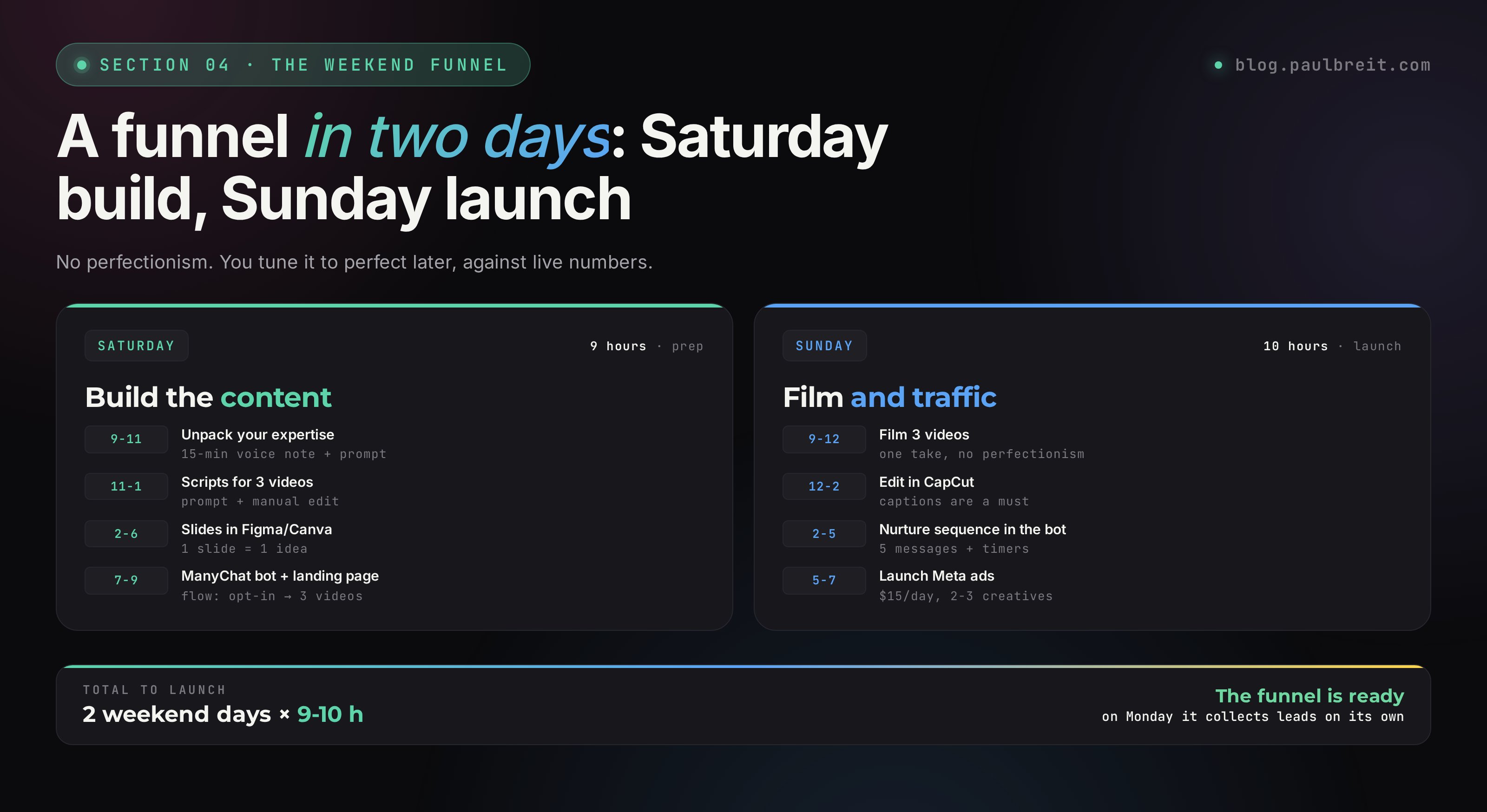
Saturday
Record a 15-minute voice note, run it through prompt 1 from the article on 10 prompts
The output is an unpack.md file with your method, focus, and cases. It's the source material for everything else.
Run the prompt from Stage 1, get draft scripts
Then 1 hour of manual editing – hooky names, your own voice, a check against the 6 rules. The slide bullets are ready.
One slide = one idea
You can grab ready-made templates. What matters – a black background, large white text, minimal decoration. 8-12 slides per video.
Flow: opt-in → 3 videos → into the nurture
The landing page is a one-pager on Carrd or Webflow. A headline + 3 "what's inside" points + a form with a "Get the free course" button. Two hours to build.
Sunday
One take per video, no perfectionism
A phone on a tripod, natural light from the window, a $20 lav mic. If you stumble, you reshoot only that thought, not the whole video.
CapCut or AI editing with Vrew, Pictory
Minimal cuts, captions (a must – 80% watch with the sound off), an ending with a CTA to the next video. Upload, publish.
Run the nurture prompt, load the 5 messages into the bot
Set the timers: 1 hour, +1 day, +1 day, +1 day, +1 day. Done.
Meta ads at $15 a day for a test
Two or three creatives, different hooks, a minimal budget. After a day you see what's landing – scale it or swap it.
A free three-video mini-course, an opt-in landing page, a ManyChat bot with the nurture, and live Meta ads. The funnel runs, collects leads, and nurtures them without you. After that – two weeks of watching and tuning the bottlenecks.
Section 055 mistakes and how AI fixes them
You build the product from your own wishes, not the audience's pain
The expert sat down and dreamed up a course because "it'd be cool to make this." Nobody buys. The fix: audience research with AI. The prompt: "analyze the comments under the last 30 posts in my channels and my competitors' channels, pull out the recurring pains, fears, and exact phrasings." You get a map of the market's real pain.
"My signature method" instead of a branded concept
Boring, like every other expert. The fix: the prompt "package my method into a branded concept with a unique, hooky name." If the niche is still "expert in everything," no branded concept will save you – start with the 5 steps to a tight expert niche. Not "a weight-loss method," but "The Clean Plate Method." Not "a program for leaving your job," but "The Transition Map" or "The Positioning Ladder."
A lead magnet "about everything" instead of one specific pain
A 60-page PDF, "everything about marketing for experts." Nobody finished it. The fix: the one-pain rule. The lead magnet solves one specific question in 10 minutes. The prompt: "from all my audience's pains, pick the THREE biggest, and for each propose a lead magnet that reads in 10 minutes."
No automated nurture – one offer right after opt-in
Signed up → got "buy the course." Conversion through the floor. The fix: 5 automated messages between the lead magnet and the offer. The prompt in this article handles it in 10 minutes.
No numbers – the funnel works "somehow"
The expert doesn't track CAC, LTV, or conversions – just feels like "it kind of pays off." In a downturn, that gut feeling is the first to fail you. The fix: the breakdown and the analytics prompt. Once a week you export the metrics, run them through AI, and spot the bottleneck.
Section 06The launch checklist
Print it out. Check the boxes as you go. While all eight are checked, the funnel runs at full power.
- Your expertise unpack is ready and sitting in the Project (prompt 1 from the article on 10 prompts)
- The 3-video lead magnet is recorded, published, and the bot collects opt-ins through the landing page
- The 5-message nurture sequence is loaded into ManyChat / your email tool with timers
- The conversion event is scheduled: a webinar every 2 weeks or automated calls
- The offer message is ready, tiers are laid out, payment plans are set up through Stripe
- The welcome sequence fires automatically after payment
- A traffic source is running: Meta ads / Google ads / Telegram placements / Reels
- Metrics are tracked weekly: CAC, CR, LTV. LTV:CAC ≥ 3:1
A funnel isn't a one-time launch. It's a system you build once and tune against live data for months. One expert, with no marketing department, can run a funnel that brings in 50-200 leads a week – if 10 prompts from this machine handle the grunt work, while they make the decisions and bring their expertise to camera.
How this connects to the earlier articles
The funnel is "where" people go. The content engine from the previous article is "how" the daily material that feeds the top of the funnel comes to be. Protecting your client base, from the article on AI hacking, is "how" you safeguard the asset the funnel produces. Three articles – one system.
FAQFrequently asked questions
How many subscribers do you need for the funnel to pay off?
The funnel works from about 100 people in traffic per week. Below that, manual selling through consultations is more profitable.
Which lead magnet converts best?
A mini-course of 3 short videos, 5-7 minutes each. Opt-in conversion is 25-40%, and 50-60% go on to consume the nurture sequence.
Where do you find traffic for the funnel in 2026?
Telegram Ads, Meta ads, paid placements in Telegram channels, and search ads. Pick a few channels and run them in parallel rather than betting on one.
Can you launch the funnel without a webinar?
Yes. The conversion event can then be a live session in a Telegram channel or a sales sequence of 3 emails. Conversion is lower, but you launch faster.