Choosing your niche: how to stop being the "expert at everything" and start earning
If your profile reads "consulting, mentoring, audits, strategy, copywriting, diagnostics" – you look like a cafe with a sign that says "coffee, sushi, tacos and massage." Nobody walks in, because it's unclear what they actually do well here. 5 steps to your niche, the real case of Anna the therapist with $3.7K from her first launch, and a 5-question checklist.
90% of experts who "seem to do everything right" but don't earn – write about everything. Consulting? Yes. Mentoring? That too. Audits, strategy, copywriting, diagnostics – you can do it all and you talk about all of it.
Now picture this: you walk into a cafe. The sign reads "Coffee, sushi, tacos, massage and shoe repair." Would you go in? Probably not. Because it's unclear what they actually do well. Your potential client feels the exact same thing when they land on your blog. The content is good. Expert. Sharp. But the only DMs you get are "hey, can I get a free consultation?" – and your reach keeps dropping.
* The problem isn't the content, not the algorithm, not that you "don't post enough." The problem is that you have no clear niche – people don't understand why they need you. Below: 5 steps to fix it, a 5-question checklist, a breakdown of 3 typical mistakes, and the real case of Anna the therapist with $3.7K from her first launch after sharpening her positioning.
What's inside
- The cafe metaphor: why the "expert at everything" loses
- Step 1. Dump everything you can do – no filter
- Step 2. Cross out what drains you
- Step 3. Keep what you've already been paid for
- Step 4. Describe your best client
- Step 5. Write one single sentence
- Case study: Anna the therapist, from 0 sales to $3.7K per launch
- 3 positioning mistakes that kill your results
- Checklist "is your niche right" – 5 questions
- 10 micro-niches for different fields
- When to broaden back out: the rule of 3 launches
- What to do right now in 30 minutes
Section 01The cafe metaphor: why the "expert at everything" loses
The cafe in the metaphor isn't made up – places like that really do open and close within six months. The owner thinks: "the more services, the more money." In reality it's the opposite. Nobody walks into a cafe that does "coffee and tacos and massage" – because the human brain can't build a picture of what they truly do well here.
An expert in this situation acts like that owner. "I can run a consultation, write a strategy, audit a funnel, train a team, do diagnostics and provide mentoring." It sounds powerful. On a landing page it's impressive. In the client's head it's a blurry smudge. The client doesn't remember who they came to. And they leave for someone clearer.
What happens in the client's head
When you write "expert in business and personal growth" – the client doesn't understand what you apply to. When you write "I help experts in soft niches package an offer that sells without pushing" – the client either recognizes themselves right away, or they don't. In the first case they keep reading. In the second they leave without wasting your time.
The positioning paradox: the narrower the niche, the wider your reach inside it. A narrow message is easier to remember, easier to pass along, easier to spread by word of mouth. A broad message drowns in the general noise of "just another expert in something."
"If I say I help everyone, everyone will come to me." In reality – nobody does. Because "everyone" is an abstraction. A specific person responds only to a specific message. By narrowing your niche you don't lose your audience – you gain it. The one that pays.
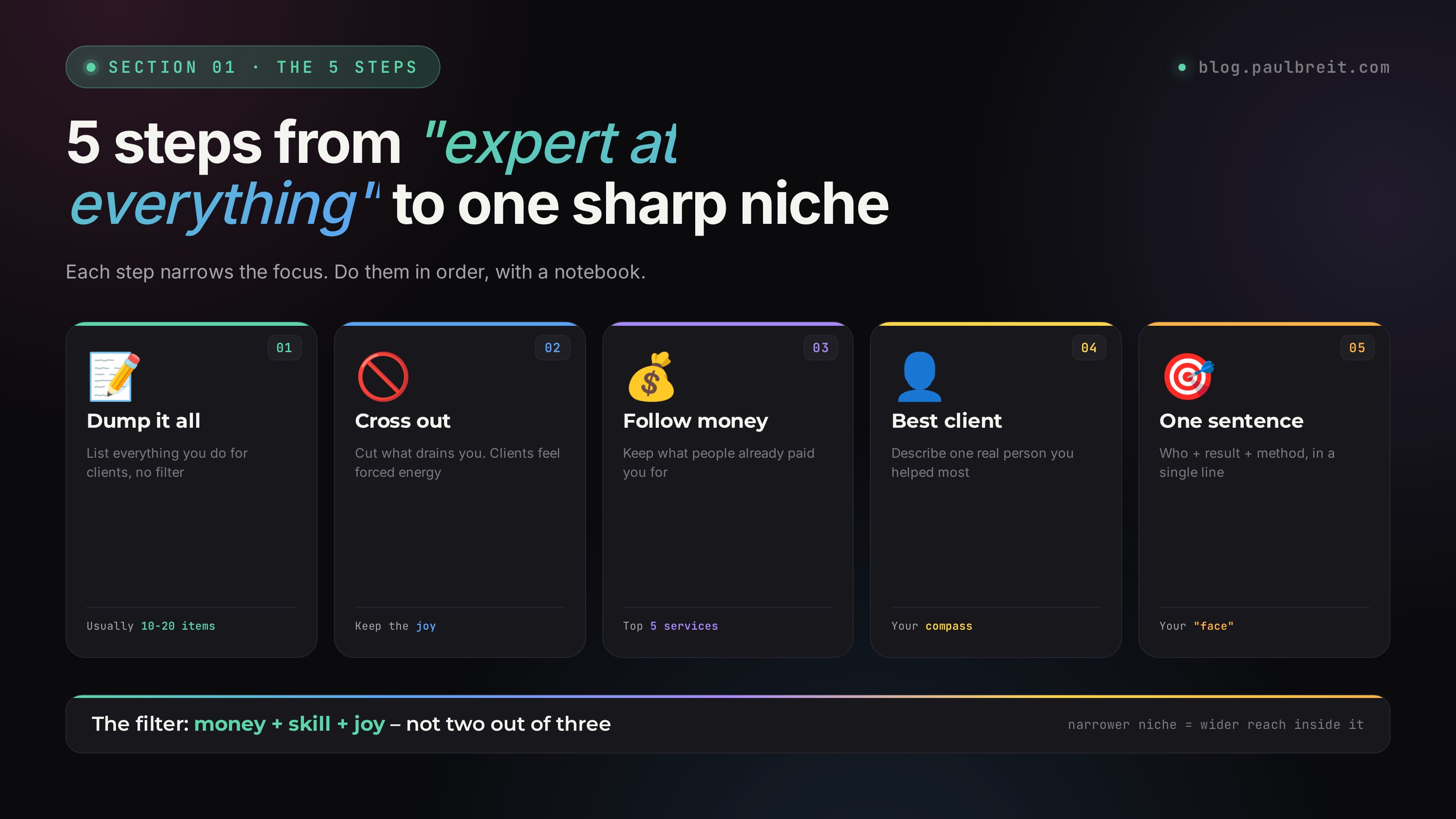
Step 1Dump everything you can do – no filter
Grab a notebook or open your notes app and write a list of everything you can do for clients. No judgment. No "this is too much." Just a stream.
Consultations, courses, mentoring, audits, strategy, copywriting, diagnostics, reviews, team training, 1-on-1 work, group formats, chatbots, landing pages, ad campaigns, therapy, coaching, family systems work – write down everything that comes to mind.
You usually end up with 10–20 items. That's normal. Don't stop until you've dumped it all. This stage is therapeutic. You'll see for yourself just how broadly you position yourself.
Why this dump matters
Without it you won't see the scale of the problem. While you keep your "do-it-all" range in your head, it feels normal. The moment you write it on paper, it becomes obvious why clients get confused.
I went through this myself back in 2018. I wrote down 23 services I "could offer." 23. After that it was impossible to keep pretending my positioning was "just fine."
Step 2Cross out what drains you
Seriously. If you do something by force, the client feels it. You know that feeling when the phone rings and you think "ugh, this again"? Those services – cross them out without mercy.
Energy isn't woo-woo, it's a readable signal
What the client picks up in the first 5 minutes of talking to you is your state. If it lights you up, you're on fire, you're convincing, you're contagious. If it's forced, you're mediocre.
This isn't an insult, it's honest. Nobody can be equally passionate about all 23 services. Any attempt to fake passion you don't have falls flat, because the client reads it in the tone of your voice.
The "Monday at 9 a.m." test
Picture it: Monday, 9:00, you have 5 meetings on the calendar today. Which of these meetings would you choose to run if you had the choice? Which would you push to "someday later"?
What you want to run – keep. What you want to push off – cross out. Not "might come in handy later," but cross it out now.
Services they took "because they paid," with no interest in the process. Corporate training when their heart is in 1-on-1 work. Therapy with teenagers when adults are what drives them. Legal consulting for one industry when they'd rather only handle business disputes. There's always something specific – you just have to look honestly.
Step 3Keep what you've already been paid for
This is the key filter. Not "I think I could." But real money, real results, real clients.
Why payments specifically
The market has already voted with its wallet. You don't have to guess whether people need it – they've already proven they do. If you spent 3 years working with entrepreneurs and they paid you, that's your niche. Even if it feels like you're "not an expert yet."
Money talks louder than impostor syndrome. If people paid for a service 50 times, it's in demand. If they never paid for it, they may want it but won't buy it – no matter how brilliant it seems to you.
Add up your top 5 paid services
Open your payment records for the last 12 months. Write out the top 5 services by total revenue and number of orders. That's your real portrait: not the one you painted in your head, but the one people actually paid you for.
It often turns out that 80% of your income comes from 2–3 services, and the other 20% are random side earnings. The case where Pareto's law works literally: 20% of services bring 80% of the income.
Step 4Describe your best client
Not an abstract "target audience." Not "women 30–45, mid income, have kids." But one specific person you helped the most.
6 questions about a real client
- What's their name? (A real name, not "Jane")
- How old are they?
- What do they do? (Specifically: "practicing therapist in Chicago," not "works with people")
- What did they come with? (The exact request, in the client's own words)
- What did they get out of it? (Numbers, changes, facts)
- How did their life change? (The emotional shift, not just the result)
Why this matters
This isn't an exercise for the sake of an exercise. It's your compass. When you write content, build an offer, run a consultation – you're talking to this person. Not an avatar from a marketing textbook. A living person you actually helped.
I open my notebook and read a client description: "Steve, 38, owns a dental practice in Austin, came in because revenue had been stuck at $11K/month for 2 years; we built an automated funnel through a chatbot, and within 6 months he grew revenue to $32K." When I write a new post about automated funnels, I'm writing for Steve and people like him. Not for "all experts."
You might have several of these "best clients." That's fine. Then you pick 1 of them as the main one – the one you most want to keep working with. The rest become secondary segments you also fit, but you don't position yourself around them.
Step 5Write one single sentence
Pull it all together into one formula:
"I help [exactly who] get [a specific result] through [a specific method]"
Real examples of phrasings
- "I help therapists reach a steady $4K/month through a sales system on Telegram"
- "I help experts in soft niches package their experience into a clear offer that sells without pushing"
- "I help entrepreneurs lower their anxiety so they make decisions faster and calmer"
- "I help dentists automate patient acquisition through chatbots and grow revenue from $11K/month to $27K+"
- "I help freelance designers leave their day job and build a steady client flow at $2.7K monthly revenue"
The main rule
One sentence. No "and I can also...". No "as well as...". One. If you can't fit it into a single phrase, the niche isn't narrowed yet – go back to steps 2–3.
Test: read your phrasing out loud 3 times. If you stumble every time or want to add a qualifier, rewrite it. If it rolls off easily and carries a clear meaning, lock it in. This is your "face."
Section 02Case study: Anna the therapist, from 0 sales to $3.7K per launch
This isn't a made-up story or an example from a book. Anna is a real therapist who went through a positioning review with me in early 2026.
Point A: a blurry blog for 3 years
Anna ran a blog for 3 years. She wrote about everything within her competence: anxiety, relationships, self-esteem, childhood trauma, burnout. That kind of "blur" is well exposed by analyzing your channel through Claude with 5 prompts – it spots the blind spots and the scattered focus faster than the author can. The content was good. Expert. Sharp.
What was actually going on:
- Reach dropped every month – not because of the algorithm, but because of unclear positioning
- Subscribers didn't buy – they didn't understand what exactly to sign up for
- The only DMs were "hey, can I get a free consultation?" – the ones who come for "free" are the ones who don't see value in paid
- Over a year – 6 paying clients, $3.2K total revenue. Less than $400/month
Working through the 5 steps
We sat down for the review. We went through the 5 steps above. On step 3 (what you've already been paid for) it turned out:
- Of the 6 paying clients, 5 were entrepreneurs
- The main request from all 5 was anxiety that got in the way of making business decisions
- All 5 actually grew their revenue after working with Anna – not as a side effect, but as a direct result
On step 5 the phrasing came out: "I help entrepreneurs lower their anxiety so they make decisions faster and scale without burning out".
Point B, two months later
What happened after she sharpened her positioning:
- The content got pointed – every post hit one pain ("Why an entrepreneur can't make a decision in a crisis") – following the framework in "The Meaning Pyramid" with 6 levels of a selling post
- 400 new subscribers came in, who knew exactly why they subscribed
- Her first group program closed at $3,700 in 3 weeks
- The DMs started reading: "It's like you described my exact situation"
Anna didn't get worse as a therapist. She didn't drop her other skills – she still works with relationships and self-esteem too. But she positions herself around one topic. The people who came in with anxiety later come back with other requests too – but the first contact happened through a narrow door.
Section 033 positioning mistakes that kill your results
Before you run off to change your profile bio – read this.
Mistake 1. Choosing a niche "with your head," not your experience
"I heard there's a lot of money in finance – I'll go there." "AI is booming right now – I'll position myself around AI." This is a road to nowhere.
A niche isn't a market opportunity on a chart. It's the intersection of three things: your experience + your energy + real demand. If there's only demand (but no experience and no joy), you'll burn out in 3 months and decide the "niche didn't work." When the problem wasn't the niche, but the fact that you climbed into someone else's garden.
Mistake 2. Switching niches every 3 months
"It didn't take off – I'll try something else." It sounds like flexibility, but really it's an inability to wait for a result.
3 months is far too little to know whether the positioning works. You need at least 3–6 months of consistent work in one direction. In that time you manage to:
- Publish 30–50 posts in the new niche
- Gain your first 200–500 targeted subscribers
- Run 5–10 sales calls and learn the real objections
- Polish the offer and the packaging around the result
Jumping between niches sooner is like planting a tree, digging it up a week later, and saying "it's not growing, I'll plant another one."
Mistake 3. Confusing narrowing with limiting
Narrowing isn't a cage. It's a flashlight. You can still do everything. But you shine on one spot – and people see you.
Then, once they come in and get to know you better, you can help them with any request. First become visible. Then broaden out.
Experts often fear "missing a client who'd be a fit for another one of my services." In practice, you miss 100 times more clients because of unclear positioning than because of being "too narrow." The ones who'd fit your other service will learn about it after the first contact – and you won't get that first contact without a narrow niche.
Section 04Checklist "is your niche right" – 5 questions
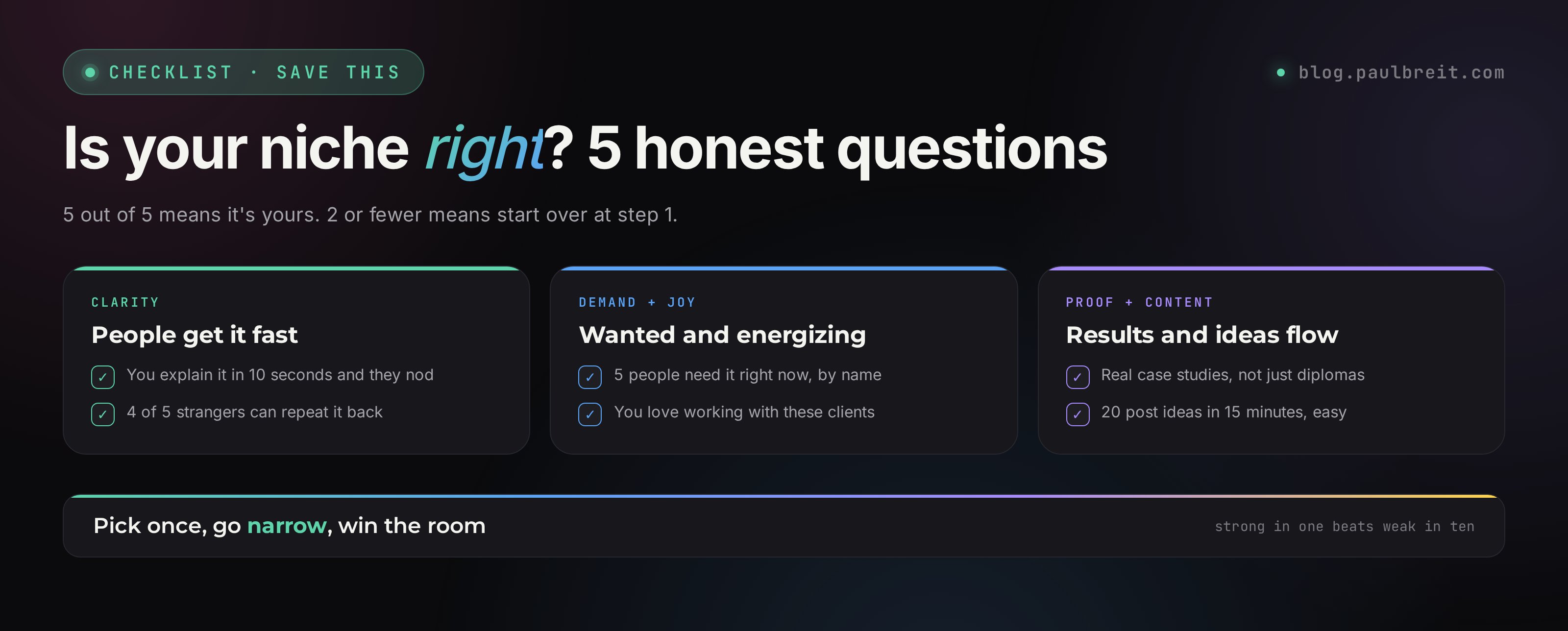
Run through this checklist. Honestly, no "well, kind of." Each item is a specific test.
Can you explain what you do in 10 seconds – and the person nods
They don't ask again. They don't put on a polite face. They actually get it. The test: tell your phrasing to 5 random acquaintances (not from your niche). If at least 4 out of 5 nod and can repeat it back – the niche is clear. If they ask again – it's blurry.
You know at least 5 people who need what you do right now
Not "in theory it could be useful," but specific people with a specific pain. Names, situations, what they're trying to solve right now. If you can name 5 – the niche exists. If fewer – the niche is hypothetical.
You love working with these clients
You don't count the minutes until the session ends. You think about their problems in the shower and at dinner. If you catch yourself thinking "when will this be over" – the niche isn't yours, no matter how well it sells.
You have real results in this topic
Not certificates. Not diplomas. Case studies. At least 5 people who got better thanks to you, with specific changes (numbers, facts, before/after). Without case studies people will read you – but they won't pay.
You can write 20 post topics in 15 minutes
Because you know your audience's pains by heart. They show up in your dreams. If topics come with effort and most of them are "generic" – you're still in someone else's garden. In your own niche, topics are born on their own, because you regularly run into your clients' specific situations.
5 out of 5 – the niche is definitely yours, go strengthen your content
4 out of 5 – on the right track, fix the weak item
3 out of 5 – there's a seed but it's blurry, run through the 5 steps above again
2 or fewer – the niche wasn't chosen from your real experience, start at step 1
Section 0510 micro-niches for different fields
To catch the rhythm of narrow positioning, here are examples of micro-niches in different fields. Don't copy them, but use them as a reference for the level of specificity.
Therapists
- Anxiety in entrepreneurs that gets in the way of scaling
- Recovery after divorce for women 35+
- Teen aggression in families with two children
Marketers
- Sales funnels for online schools with 50+ clients
- Social media for local beauty salons in smaller towns
- B2B paid search for IT companies
Trainers and coaches
- Strength training for women 40+ without injuries
- Career coaching for IT specialists before a job change
- Public speaking prep for startup founders
The narrowing principle
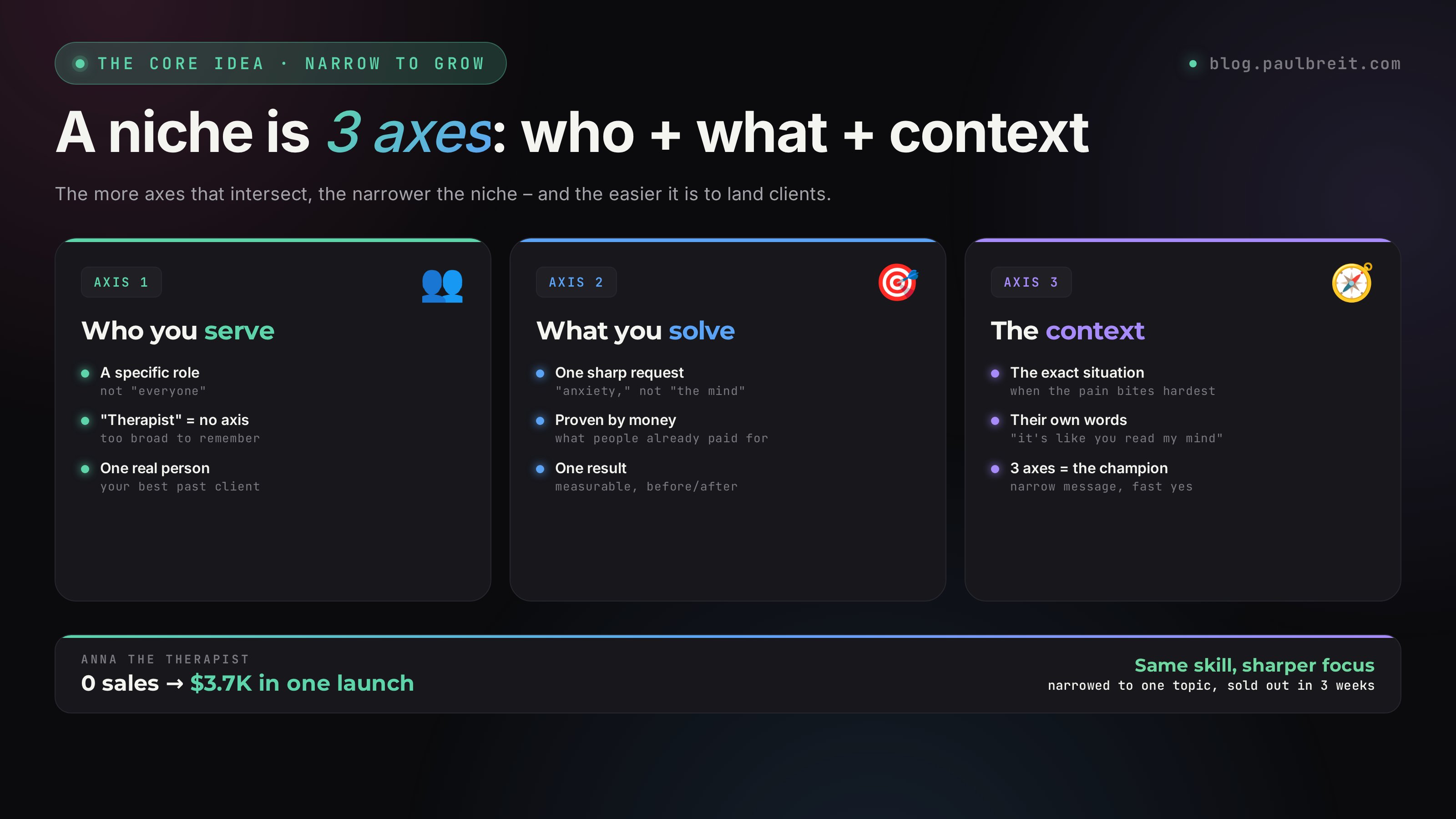
Each micro-niche is an intersection of three axes: who (demographic/role) + what (a specific request) + context (the situation they're in). The more axes that intersect, the narrower the niche and the easier it is to land clients in it.
"Therapist" – no axes. "Anxiety therapist" – 1 axis. "Anxiety therapist for entrepreneurs" – 2 axes. "Anxiety therapist for entrepreneurs whose anxiety gets in the way of scaling decisions" – 3 axes. The third version is the champion.
Section 06When to broaden back out: the rule of 3 launches
Narrowing is a tool, not a life sentence. The question "when do I broaden out" usually comes up after 6–12 months of work in a narrow niche.
The rule of 3 launches
Broaden out when you've had at least 3 successful launches of a program in the narrow niche, with $4K+ revenue from each, and a steady flow of leads without your active promotion effort.
Before 3 launches – keep narrowing. Narrow positioning isn't for a month. In the starting phase, broadening kills your results, because you:
- Blur the marketing message that just started working
- Knock the audience off the path – "oh, now he writes about that too"
- Try to compete in broad fields where you haven't built authority yet
How to broaden out the right way
Not "now I also do X." But "launched a new product for those who've already solved the main problem." You logically extend the client's path: first anxiety – then scaling – then building a team – then reaching a new level.
Every expansion is the next step in the client's logic, not a "different niche." It's packaged as a "second program," not as "now I do this too."
Section 07What to do right now in 30 minutes
If you've read this far, the topic struck a nerve. It means you feel that something's off in your positioning. And that's already half the solution. Here's what we do next.
Grab a notebook and run through the 5 steps from this article
Right now, not "later." "Later" means never, and you know it. Half an hour of being honest with yourself, and you'll clearly see what's been blurry for months.
Write your offer in a single phrase
Write it down. Read it out loud. If it sounds blurry, narrow it. If it fits without an "and also...", lock it in.
Write 3 posts for this narrow niche
Based on your new phrasing. Each post hits a specific pain of your audience. Publish them within a week and watch the reaction: the number of DMs, shares, leads. To avoid getting stuck staring at a blank screen, use the pipeline of 10 prompts for experts that turns one voice note into a week of content.
Update your profile bio and pinned post
In the bio – your offer in one phrase. In the pinned post – a detailed breakdown of exactly who you help and with exactly what method.
In 2 weeks – review your metrics
Compare with the previous period: reach, DMs, conversions to paid. If it went up, keep narrowing even more. If it stalled, go back to the 5 steps and check whether your niche is really narrowed or you stopped halfway.
A strong expert in one topic always earns more than a weak expert in ten. This isn't about modesty or self-limitation. It's about the math of attention: people don't remember "generalists," people remember "the best at something specific." And to become the best, you first have to be in one thing.
You can still do everything – but say it not through "I can do it all," but through "I'm the best at this, and I also do a few other things." The difference in word order changes the result by orders of magnitude.
FAQFrequently asked questions
What if I really am good at many things and don't want to choose?
Nobody is stopping you from being good at many things. But sell one thing publicly. The rest is personal expertise that surfaces with clients once you're working together.
How do I know I picked the right niche?
Use the 5-question checklist in the article: you've already been paid for it, you have case studies, you don't burn out, you see a path to $4K+/month, and you understand the audience.
Can I switch niches after a year of work?
You can and should, if the first one didn't land. The biggest mistake is clinging to a niche that isn't working because you've "already invested the time."
What if the niche is narrow and the audience is small?
A narrow niche means a high ticket and word of mouth. 50 paying clients a year at a $4K ticket is $200K. You don't need a million-person reach.