10 prompts to find hundreds of ideas for content that hooks, engages and sells
A ready-made pipeline: one 5-minute voice memo turns into a week of content across five platforms. Unpack your expertise, produce content daily, turn client objections into posts, and adapt a single post for Telegram, Meta, Threads and more. Comes with full prompt text, examples, and a step-by-step guide to set it all up in a ChatGPT or Claude Project.
You're the expert. You run clients, take meetings, build the product, train the team. The content sits in your head like a rock. Sitting down to write a post takes two hours. You don't have two hours, and you never will. And every time you think: "I wish someone would do this for me. Not so it comes out as generic AI mush. But the way I write it myself – just without me."
I run four client projects and a personal channel of 20,000 followers. In 2024 I wrote all my content myself and spent 600+ hours a year on it. In 2025 I built a system of 10 prompts, and that dropped to 80 hours. The content got better – because I finally had time for ideas instead of drafts.
This isn't another "best ChatGPT prompts" listicle. It's the working pipeline I use every day. Ten prompts, lined up in the right order, across four levels of work. You'll read it in 20 minutes. You'll set it up in a weekend.
What's inside
- The main thing I learned in two years of working with AI
- What Projects are and how to build yours in 10 minutes
- Article map: 10 prompts in four blocks
- Block 1. Foundation (prompts 1-3)
- Block 2. Production (prompts 4-8)
- Block 3. Sales (prompt 9)
- Block 4. Distribution (prompt 10)
- A day in the life of an expert on the pipeline
- 5 signs of AI fingerprints in your text
- Setup checklist
Section 01The main thing I learned in two years of working with AI
Most experts start at the wrong end. They open ChatGPT and immediately type: "Write me a post about delegation." They get a generic text you could hand to any consultant in the country. And they conclude: "Well, AI can't write like me."
It can. If you give it a foundation.
Here's the right order. First you help the AI understand who you are, where your expertise lies, how you write, what hooks your audience responds to. Only after that does content production begin. Without that foundation, AI writes like anyone. With it, AI writes like you.
Second key thing. In 2024 everyone copied a giant prompt in full every single time. In 2026 people work through Projects in ChatGPT and Claude (Projects, Custom GPTs) – a workspace where you load your files and instructions once, and from then on every request automatically draws on them. The prompt shrinks to a short phrase: "Write a post about X." What this is and how to build your own, we'll cover in detail in the next section.
Third, and the most uncomfortable. Every AI article screams: "You never have to write again!" That's a lie. AI doesn't replace the expert. AI frees the expert from the craft. From the draft, the headlines, the adaptation, the formatting. Meaning, insight, your personal voice – those stay with you. Delegate the meaning and you get an empty text. Delegate only the craft and your head is free for what matters.
Worth signing off on before you read further.
Section 02What Projects are and how to build yours in 10 minutes
If you haven't heard the word "Project" in the context of AI before, that's fine. The feature is relatively new and not everyone has tried it yet. So let's start with what it is and why you need it. Without it, every prompt that follows works at half strength.
What it is
A Project (or a Custom GPT in ChatGPT, a Project in Claude) is a workspace inside the AI where you load your files and a general instruction once, and from then on every request inside that space automatically draws on the loaded data. Think of it as a folder of rules that stays in the AI's head the whole time you're talking.
How it changes the work
How it used to be. For every request you'd paste a giant prompt into the chat: "I'm Paul, I run a channel of 20K followers, my style is this, my audience is that, my best posts look like this, now write a post about delegation." Two hundred lines of instructions for every question. Ten messages in, the chat "forgot" who you were, because the context got eaten up by the conversation.
How it is now. You create a "Content Pipeline" project once, load a few files about your expertise, and write a general instruction. From then on you open any chat inside the project and type a short phrase: "Write a post about delegation." The AI already knows who you are, how you write, and what you publish.
Where to find it
From $20 a month
Go to chatgpt.com with an active Plus subscription. In the left panel you'll find the "Projects" section and a "New project" button. Give it a name, for example "Content Pipeline." Inside the project there are three key areas:
- Files – upload PDF, MD, TXT, DOCX here. Limit: up to 20 files per project.
- Instructions – a general instruction that applies to every chat inside the project. For example: "You're my editor and copywriter. Draw on the uploaded files. Write without AI fingerprints. Use a short dash, not a long one."
- Chats inside the project – all of them automatically have access to the files and the instruction.
From $20 a month, same logic, slightly nicer interface
Go to claude.ai with a Pro subscription. On the left, the "Projects" tab → "Create project" button. Inside there are equivalent areas:
- Project Knowledge – upload your files. The limit is more generous than ChatGPT's, so you can load a lot of documents at once.
- Project Instructions – general working rules for every chat inside the project.
The logic is the same as ChatGPT. Which platform to pick is a matter of taste. I work in both, but I keep the content pipeline in Claude – it holds long context better and loses the thread less often after 50 messages.
What to put in the Project (the pipeline foundation)
Six files, and nothing more. All of them are the outputs of the first three prompts in this article. So you don't need separate work to create them – they appear naturally as you move through the pipeline.
unpacking.md– the output of prompt 1 about your expertise and methodcompetitors.md– the output of prompt 2 with the strengths matrixposts_30.md– your last 30 posts with metrics (the source for the audit)comments.md– the comments under your last 10 posts (the source for audience analysis)style_and_audience.md– the output of prompt 3 (blog audit + feedback analysis)top_hooks.md– the first 1-2 lines clipped from your 20 best posts
Plus a separate "Platforms" folder – 3 samples of your texts from each of the 5 platforms, for prompt 10. That part gets assembled when you plug in distribution.
The main project instruction
In Project Instructions, put a short instruction that runs at all times. Here's the one I use:
You're my editor and copywriter.
Treat the uploaded files as the source of truth
about my style, audience and expertise.

Don'ts:
– no AI fingerprints: "however," "moreover," "therefore"
– no empty phrases: "wonderful," "amazing," "invaluable"
– no symmetrical triads "No X. No Y. No Z."
– no long em dashes – only the short one (–)
– no numbered lists 1) 2) 3) inside prose

Style: conversational, direct, with specifics and numbers.
End every text with an action, not a pep talk.

If the files don't have enough data, ask clarifying questions,
don't make things up.
The Project is built once and updated once a month (new posts into the audit, new strong hooks into the bank). After that, all 10 prompts in this article work as short phrases: "Write a post about X," "Give me 15 headlines," "Adapt for the platforms." No need to paste long instructions every time. That's where the real time savings come from.
Section 03Article map: 10 prompts in four blocks
The ten prompts are laid out as a logical flow. Not a "list of hacks," but a pipeline where each step prepares the input for the next.
- Foundation (prompts 1-3). So the AI understands you as an expert. Done once and works for months.
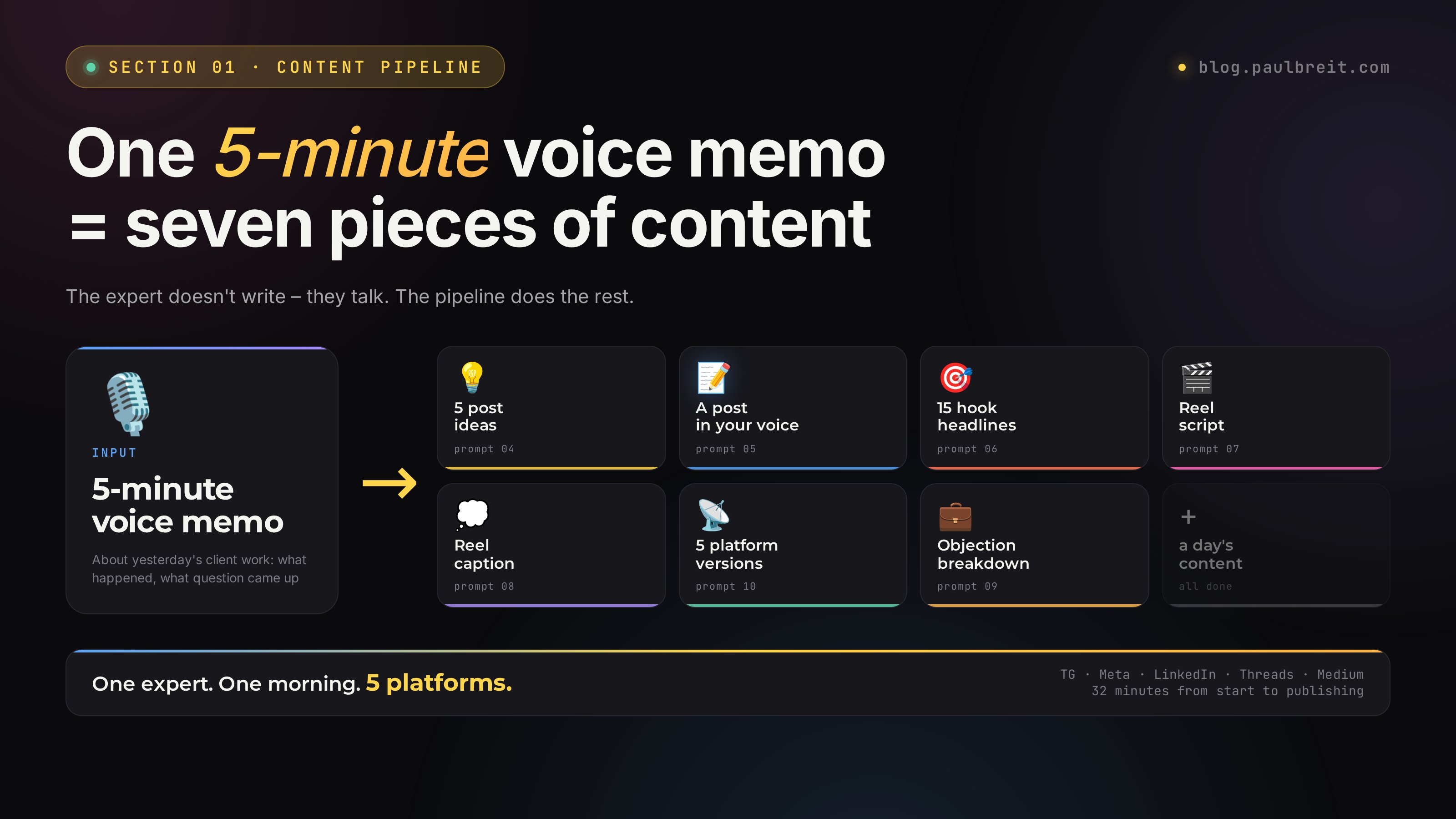
- Production (prompts 4-8). The daily pipeline: voice memo into ideas, ideas into a post, post into a reel, reel into a caption.
- Sales (prompt 9). Real client objections turn into breakdown posts.
- Distribution (prompt 10). One piece → five platforms: Telegram, Meta, Threads, LinkedIn, Medium.
Each block has: when to use it, the full prompt (copy and use it), what to put in the Project, an example output, what to fine-tune by hand, and how long it takes.
Block 01Foundation
Without a foundation, the AI writes "correctly" but not "like you." All three prompts in this block are done once every six months – and after that they save you time every single day.
Turn "I do something with clients" into a clear structure
When to use it. Once every six months to a year, or after a big stretch of work – a closed course, a new product, a rebrand. When you feel: "I'm an expert, but I can't put it into words."
Before running the prompt, record a 10-15 minute voice memo on three things: three cases you're proud of (with specifics), what you do the same way across different projects (your method), and what you flatly refuse to do. If your niche is still fuzzy and the unpacking keeps coming out "about everything," first walk through the 5 steps to a narrow expert niche.
You're an interviewer-copywriter who helps experts unpack
their expertise for positioning and content.

I'll upload a transcript of my voice memo – I'll talk through
three cases, my method and my principles.

Extract and structure:
1) Profile: who I am, who I help, what transformation I deliver
2) Method: what I do the same way across different projects
3) Principles: what I do and what I flatly refuse to do
4) Narrow focus: the combination of skills that's rare in my niche
5) Strengths via comparison with typical competitors

Don't use marketing clichés or generic phrases.
Only what actually follows from my words.
If any data is missing, ask 5 clarifying questions
before the final structure.
What to put in the Project. Save the finished output as a file called unpacking.md in the project root. Every prompt that follows will draw on it. Without this file the AI writes like anyone; with it, it writes like you.
Before: "I'm a business coach."
After: "I help online school founders step out of day-to-day operations in 90 days through delegation and a KPI system. A rare combination – owner psychology plus marketing metrics. Almost no one covers that overlap."
Fine-tune in 3 minutes. Read the output out loud. Anything that grates? Anything too generic? Rewrite it in your own words – but only a couple of phrases, not the whole structure. This is your expert passport for the next few months.
Understand where you actually differ from competitors
When to use it. Before launching a new product. During a rebrand. When you feel: "I do the same thing everyone does – why should they pick me?"
Before you run it, build a list of the 5 main competitors in your niche. Not "globally," but at your scale. Links to their channels, sites, products.
Based on my expertise unpacking and public information
about 5 competitors in my niche (I'll give names and links),
build a matrix of three blocks:

1. What all of us have (common to the niche)
2. What only I have (my unique strengths)
3. What competitors have and I don't (my weak spots)

For each block, give 3 concrete phrasings
I can use in my positioning.

No fluff. No fancy words.
If there isn't enough data, say so – don't make it up.
What to put in the Project. Add competitors.md with the list of 5 names and links to the unpacking file. This is the second layer of the foundation.
Example output. The AI returns: "You have a personal media channel of 20K – your competitors don't. Three of your competitors have packaged courses at $700-1,000 – you don't. All of you offer mentorship, and the prices are comparable."
Fine-tune in 3 minutes. The key check: is what's labeled "your strength" actually a strength, or just something others haven't done yet? If a competitor can copy it in a week, it's not a strength. A strength is what took you years to build and can't be reproduced quickly.
A mirror of your channel and training material for every other prompt
When to use it. First time – before you start the pipeline. Without this prompt, prompt 5 will write "correctly" but not "like you." After that – once a month, to see where your audience is moving.
Export your last 30 posts with the numbers ahead of time: views, reactions, comments, shares. Plus the comments under your last 10 posts, as a separate file.
== Part 1, audit ==

I've uploaded 30 channel posts with metrics.

Extract:
1) Top 5 topics by reach
2) Hook types that work and ones that flop
3) The text rhythm that lands – length, structure, paragraph format
4) 5 patterns in my best posts that the flops don't have

Explain with concrete examples from my texts.
Quote the phrases – don't paraphrase.

== Part 2, feedback ==

I've uploaded the comments under my last 10 posts.

Extract:
1) Recurring audience pains
2) Recurring objections
3) Ideas for next posts based on readers' questions

Group by meaning. Don't repeat the same thing in different words.
What to put in the Project. Two files: posts_30.md and comments.md. Save the audit output as style_and_audience.md – prompt 5 will reference it every day.
"Topics about stepping out of operations get 3x more reactions than posts about marketing. Hooks with a number in the first line work; philosophical ones sag. Your ideal length is 800-1,200 characters. Over the past month, the comments asked about delegation 14 times – and there isn't a single post on the topic."
After an audit like that you instantly see what to write about for the next month. Not from your head – from live demand.
Fine-tune in 3 minutes. Look over the top posts yourself. What do they share beyond the formal signals? Often it's a feeling the AI won't catch – a personal pain, a specific place, a real person. Add that to the style file.
Block 02Production
This is the heart of the daily pipeline. Five prompts that turn one voice memo into a finished set – a post, a reel, a caption.
Topics from real work, not from your head
When to use it. Every day or every other day. In the morning, in the first 10 minutes after your coffee. The ideas don't come from your head – they come from your current work. Record a 5-minute voice memo: what happened with clients yesterday, what question came up, what objection you heard, what mistake you spotted.
I recorded a 5-minute voice memo about my current work.
Transcript attached.

Extract 5 post ideas. For each:
1) Topic in one sentence
2) Angle: story / breakdown / provocation / insight / checklist
3) Hook in the first line (up to 12 words)
4) Why my audience cares
   (draw on the style and audience file)

The ideas have to be different.
Not five variations of one thought.
What to put in the Project. The unpacking and the audit are already there. The AI draws on them automatically.
Example output. Voice memo: "A client said in March he couldn't step out of operations. In April he left for a month. The business grew 20%."
5 ideas: this client's story, a breakdown of the first delegation mistake, the provocation "why aren't you delegating even now," an insight about the fear of losing control, a delegation-readiness checklist.
Fine-tune in 3 minutes. Pick one idea right away. The other four go into the idea bank. Don't use more than one idea from a voice memo per day. Otherwise every post ends up being about the same thing.
The heart of the daily pipeline
When to use it. Every time you've picked a topic from the ideas. This prompt matters most for quality. It decides whether you sound like yourself or speak in someone else's words.
Write a post about [X] in my voice.

Draw on:
– my expertise unpacking
– the style and audience file (my rhythm, length, typical hooks)
– my 5 best posts as a tone sample

Structure:
– a hook that grabs in the first 2 lines
– a personal scene or concrete example
– a turn in the thought via "but"
– an action ending (short, simple, no pep talk)

Banned moves:
– "however," "moreover," "therefore," "allow me"
– numbered lists 1) 2) 3) inside the text
– pretty empty phrases ("wonderful," "amazing," "invaluable experience")
– philosophical intros with no action in them

Typography:
– only the short dash "–," never a long one
– no markdown, no bold, no subheads

Length: 800-1,200 characters for Telegram.
What to put in the Project. The unpacking plus the style file plus your 5 best posts in full as a sample. This "sample set" is your main asset. It accounts for 80% of the quality.
Before (how AI writes with no foundation): "Delegation is an important skill for business growth. Many entrepreneurs are afraid to delegate because they don't trust their team..."
After (with a foundation): "A client told me in March: I can't step out of operations, I live in them. In April he left for a month. The business grew 20%."
The difference isn't style. The difference is that the first one is a textbook summary. The second one is a living person.
Fine-tune in 3 minutes. Read it out loud. Find the one phrase that sounds "not yours." Rewrite it in your own words. That's enough 90% of the time. If you have to rewrite half the post, your style file is weak. Go back to prompt 3.
The headline decides whether they read at all
When to use it. After the post is done, before publishing.
Give me 15 hook options for this post.

Sort them by type, 3 options per type:
1) With a number or specifics
2) With a provocation
3) With an audience pain question
4) With a story hook ("A client told me...")
5) With a promised result

Requirements:
– stops the scroll in 1 second
– no longer than 12 words
– no loud empty words: "incredible," "shocking," "amazing"
– reproduces the structure of my best hooks from the style file
What to put in the Project. A separate file top_hooks.md – the first 1-2 lines clipped from your 20 best posts. It works as a template library, not as ready-made answers.
Example output. 15 options, from "A client said 'I can't step out of operations' – a month later he was gone" to "$1.5M in revenue, and my deputy made a decision without me for the first time."
Fine-tune in 3 minutes. Pick one in 30 seconds. If it takes longer, you're choosing between bad ones. Run the prompt again with a note: "All 15 are weak. Give me 15 new ones, using hook number 7 as the model."
A ready 60-second monologue
When to use it. After the post is done, if the topic is visual and fits a 60-second video. Not every post is a reel. If there's no concrete scene or result inside the story, the reel comes out flat.
Turn this post into a 60-second reel script.

Structure:
– hook in the first 3 seconds (1 line that stops the scroll)
– problem (5-10 seconds)
– a turn or insight (30-40 seconds)
– CTA action (5 seconds)

Write only what I'll say on camera.
No editing notes. No scene numbers. No on-screen text.

Speaking style: conversational, with beat-pauses,
no polite phrasing and no filler.

Read it out loud – it should fit in 60 seconds
at a normal speaking pace.
What to put in the Project. 3-5 transcripts of your best reels as samples. Without them the AI writes "cinematic." With them it writes the way you talk to camera.
Example output. An 800-character post turns into a 50-55 second monologue that actually sounds like you. Not "hi everyone," but straight in: "My client left for a month, and his business grew 20 percent. Here's why."
Fine-tune in 3 minutes. Read it out loud with a stopwatch. If you don't fit in 60 seconds, cut the weakest sentence, not the longest one. The weakest one shows itself on the second read.
Not a recap, but a separate angle
When to use it. After the reel is done. The caption doesn't repeat the video; it comes in from another side. Viewers only bother reading what wasn't on camera.
Write a caption for this reel, for Reels or Shorts.

Structure:
– a pain or hook (1 short paragraph)
– a turn via "but" (1 paragraph)
– the way out via action (1 paragraph)
– ending – a simple action in 3-5 words

Don'ts:
– don't repeat phrases from the reel itself
– use verbs, not nouns
   ("screw up, get up" instead of "failure is part of the path")
– no pretty empty phrases

Length: 3-4 short paragraphs.
Each thought is its own paragraph.
Let the thoughts breathe.
What to put in the Project. 3-5 of your best reel captions as a tone sample.
Example output. A reel about delegation (about a specific client and the "grew 20%" fact). The caption doesn't repeat the story; it comes in from another side: "Knowing weighs on you. Heavier than any weight at the gym. But move one step and the pressure eases. Just start."
Fine-tune in 3 minutes. Open it and compare with the reel. Any matching phrases or wording? Rewrite. The caption has to stand on its own, apart from the video.
Block 03Sales
Content born from real conversations with the market
When to use it. After every client conversation where an objection came up. Don't let it slip – turn it into content right away. This is the only prompt that produces content not from your head but from real conversations with the market. That's why it beats all the others on conversion.
Save the conversation to a file (a voice-memo transcript works). Strip the client's personal details, keep just the exchange. Where to get conversations like that in volume – through sales calls run on a 7-block script, where the audience says their objections out loud themselves.
I'm sending a conversation with a client where an objection came up.

Do this:
1) Phrase the objection itself in one line, the way
   any client in my niche would say it
2) Explain the pain behind the objection –
   what the person is actually afraid of or doesn't understand
3) Write a breakdown post about this objection in my voice:
   – hook with the objection itself
   – the story of one client who had the same one
   – a shift in understanding
   – a simple ending

This is a breakdown, not a sales pitch. Not "come to a consultation
and I'll tell you." Give the full answer in the post itself.
What to put in the Project. The unpacking plus the style file. That's enough.
Client objection: "I don't have the money for mentorship."
Breakdown post (excerpt): "When people say 'no money,' they usually mean 'no confidence it'll pay off.' And that's fair. Back in 2018 I skipped mentorship myself, because it wasn't clear what I'd get for $2,500. A year later I'd lost $10K on mistakes a mentor would have stopped in an hour. Money wasn't the problem. The problem was not being able to see the result in advance. The fix is simple: ask the mentor for their clients' results over the last 6 months – not testimonials, numbers. If they won't show you, it really isn't worth it. If they do, the price suddenly makes sense."
Fine-tune in 3 minutes. Check: does the breakdown read like a "sales pitch in disguise"? If the reader senses "buy from me" behind it, it won't work. It has to be honest. The ones who read between the lines will buy.
Block 04Distribution
The biggest multiplier of your time
When to use it. Every time after you've finished a Telegram post. This prompt takes your TG post as the source and adapts it for four other platforms – Meta, LinkedIn, Threads, Medium. The output is publications on five platforms from a single written draft.
I already have a finished post on Telegram – it's published.
Adapt it for 4 other platforms.
Leave the Telegram version alone – it's already in the channel.

1. Meta – expand to 1,500-2,500 characters.
   Structure: a hook subhead, the main text
   with 1-2 dividers for scrolling, and a question for the audience at the end.
   Tone a bit warmer and more detailed than in TG.

2. LinkedIn – rephrase like the TG version, but with a professional tone.
   Emphasis on the idea, not the emotion. Length 600-1,000 characters.

3. Threads – compress to one thought at 280-500 characters.
   Clean conversational language, a provocation is fine.
   One paragraph, no lists or subheads.

4. Medium – expand to 2,500-4,000 characters as a mini-article.
   A title (H1), 1-2 subheads (H2),
   intro, main idea, a concrete example, a conclusion.
   SEO: repeat the topic's key phrase
   3-4 times in natural wording.

All 4 versions in my voice.
Don't just reword the same thing.
Each platform has its own length, rhythm and tone.
What to put in the Project. Add a "Platforms" subfolder to the shared foundation and put 3 of your best texts from each of the four adaptation platforms – Meta, LinkedIn, Threads, Medium. If you don't have those texts on a platform yet because you haven't even started a channel there, begin with the guide on the first 1,000 followers across 4 platforms – Meta, LinkedIn, Threads, Medium. That's 12 files, but it's a one-time job. Without it the AI adapts "by the textbook" (short on Threads, long on Medium) – when what you want is "in your own handwriting on each platform."
A live example: one post becomes publications on five platforms
Take a real post from my Telegram (920 characters). It's the source – we leave it alone, it's already published. Below are four adaptations the prompt produces in one pass. All versions got a minimal manual edit before publishing.
Source: Telegram, 920 characters
A client told me in March: "I can't step out of operations. I live in them."
In April he left for a month. The business grew 20%.
What happened? Nothing magical. He stopped being the only decision point. For the first time, the team closed the quarter on its own. Not better than with him, but not worse.
That's the test. A business that collapses in a month without you isn't a business. It's a job where you're your own employer.
Leaving for a month is a diagnostic. Cheaper than any consultation.
If you're afraid to try, you already know what the result will be.
Meta, 2,150 characters
The test that's cheaper than any consultation
In March a client said a sentence I hear every month: "Paul, I can't step out of operations. I live in them."
I offered him something simple. Leave for a month.
Not a week – anyone survives a week. Not three – three is basically relocating. Exactly a month. Long enough for the team to realize he isn't coming back tomorrow. Short enough that the business won't fall apart if something goes wrong.
⸻
In April he left. No operational contact. Just once a week – a short call with his deputy, no interference in decisions.
By the end of the month the business had grown 20%.
Not because it was better without him. Because the team made decisions on its own for the first time. Imperfectly – but they made them. And they saw the world didn't collapse.
⸻
That's the test. If a business collapses in a month without you, it isn't a business. It's a job where you're your own employer and your own subordinate.
Leaving for a month is the most honest diagnostic of what you've built. Cheaper than any audit, any consultation, any mentorship.
And the main thing: if you're afraid to try, you already know what the result will be. You just don't want to see it confirmed.
Have you ever stepped away from your business for more than a week? What happened?
LinkedIn, 780 characters
One of my clients said in March he couldn't step out of operations – "I live in them."
In April he left for a month. No operational calls, just a weekly check-in with his deputy.
The business grew 20%. Not because it was better without him. Because the team made decisions on its own for the first time.
That's the honest test of a business's maturity. If it collapses in a month without you, you built a job, not a system.
Leaving for a month is the cheapest diagnostic there is. Any audit will cost you more.
Threads, 380 characters
Client in March: "can't step out of operations, I live in them."
In April he left for a month.
The business grew 20%.
If you're afraid to try, you already know what the result will be. You just don't want to see it confirmed.
Medium, 3,100 characters – a mini-article
Leave for a month: the most honest diagnostic of a business
Most entrepreneurs work inside their own business 12 hours a day and call it success. I call it a job where someone is their own employer and their own subordinate – and can't tell the two apart at all.
The sentence I hear every month
One of my clients said in March: "I can't step out of operations. I live in them." It's the classic line of a founder who grew into millions in revenue but never built a system. Every decision routes through him. His managers run everything past him – from signing a contract to picking a courier. Every trip turns into working from the airport.
I suggested he run a simple test.
The test that's cheaper than any consultation
Leave for a month. Not a week – any team survives a week. Not three – three is basically relocating. Exactly a month. Long enough for the team to realize the owner isn't coming back tomorrow. Short enough that the business won't fall apart over mistakes.
In April he left. No operational contact. Just a short call with his deputy once a week – no interference in day-to-day decisions, only a check-in on the key numbers.
The result: 20% growth
By the end of the month the business had grown 20%. Not because it was better without the owner. Because the team made decisions on its own for the first time. Not perfectly, but independently. And it saw the main thing – the world didn't collapse.
That's the test of a business's maturity. If it collapses in a month without you, you built a job, not a business. If it survives and grows, you actually have an asset, not self-employment on steroids.
Leaving for a month is the most honest and the cheapest diagnostic. Any audit, any consultation, any mentorship will cost you more. And they won't show you anything new – they'll only show you what you already know.
The main obstacle isn't operational, it's psychological. If you're afraid to try, you already know what the result will be. And you don't want to see it confirmed.
That's the core of the pipeline. The original Telegram post was written in 7 minutes (prompts 4-6). Adapting it for four other platforms takes another 8-10 minutes. That's 17 minutes instead of hours for five publications.
Fine-tune in 3 minutes. Read each of the four adaptations out loud. If even one sounds like "the same thing in different words," rewrite it. Each platform should have its own rhythm. On Medium you unpack the logic, on Threads you cut to the essence, on Meta you add air and a question at the end.
Section 04A day in the life of an expert on the pipeline
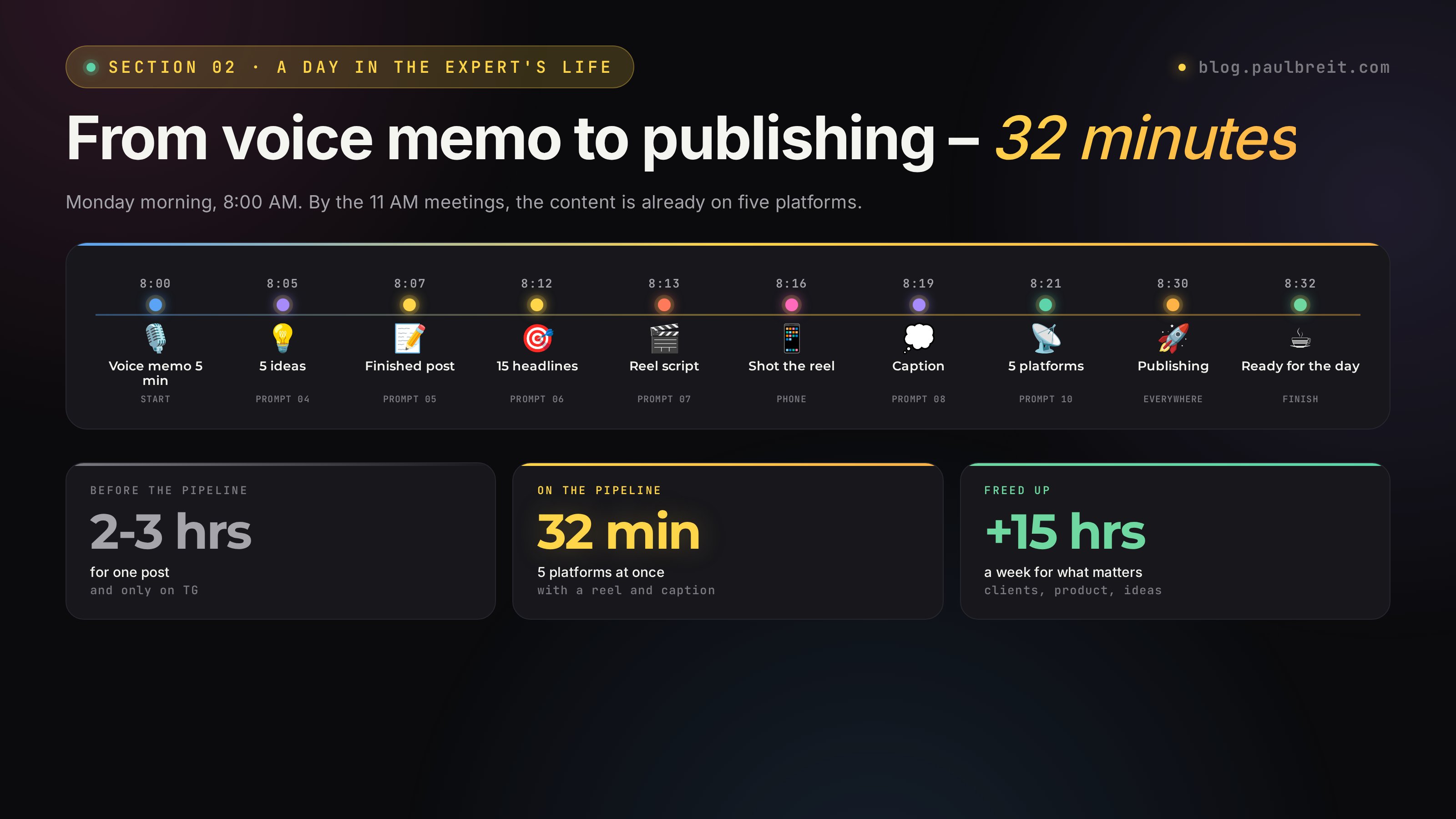
Here's what it actually looks like. Monday morning, I have client meetings from 11. Before them – a day's content for five platforms.
From voice memo to publishing on five platforms
- 08:00 – I make coffee and record a 5-minute voice memo about yesterday's client conversations
- 08:05 – prompt 4. The AI returns 5 ideas. I pick one, about delegation
- 08:07 – prompt 5. A finished post in my voice in 5 minutes
- 08:12 – prompt 6. 15 headlines. I pick one in 30 seconds
- 08:13 – prompt 7. A reel script
- 08:16 – I shoot the reel on my phone. First take. 3 minutes
- 08:19 – prompt 8. The reel caption
- 08:21 – prompt 10. Adapting for Meta, LinkedIn, Threads, Medium. The TG version is already done
- 08:30 – I publish everywhere. Telegram right away, the rest through a scheduler spaced out by the hour
- 08:32 – I close the laptop. Off to prep for my meetings
32 minutes – a day's content for five platforms. Before the pipeline, this took me 4-6 hours. And it often ended up as one post in one channel – I didn't have the energy for the rest.
Section 055 signs of AI fingerprints in your text
When a reader sees these signs, they smell the AI a mile off, even if they can't put their finger on it. Close each one, and the text comes alive instantly.
"However," "moreover," "therefore," "allow me"
Real people don't use these words in real speech. They're filler connectors the AI drops in for "cohesion." You don't need cohesion – you need a living train of thought.
Before: "However, it's worth noting that many entrepreneurs face this problem."
After: "A lot of people get stuck here. I got stuck myself."
Symmetrical triads "No X. No Y. No Z."
The AI's favorite structure – three short parallel sentences in a row. It sounds rhythmic, but it's a machine rhythm. Living text has a different rhythm: long sentence, short, long.
Before: "No fear. No doubt. No looking back."
After: "No fear – and no looking back at the ones who still haven't made the call."
Pretty empty phrases
"Wonderful," "amazing," "invaluable," "truly life-changing." Words with no content. The fix is specifics.
Before: "This experience turned out to be invaluable."
After: "In three months I lost a million dollars and learned more than in the five years before that."
Lists 1) 2) 3) inside prose
The AI loves to structure things. An expert telling a story doesn't structure on the fly.
Before: "I learned three things: 1) the importance of delegation, 2) the role of trust, 3) the need for a system."
After: "I got the main thing: as long as I hold everything, everything holds me."
A pep-talk ending instead of an action ending
The AI ends a text with "The main thing is to believe in yourself!" or "Anything is possible if you put in the effort." A living expert ends with an action.
Before: "The main thing is to never give up, and it'll all work out."
After: "Grab a notebook and write down three tasks you'll delegate by Friday."
Section 06Setup checklist
Print it out and pin it next to your computer. You come back to it every week.
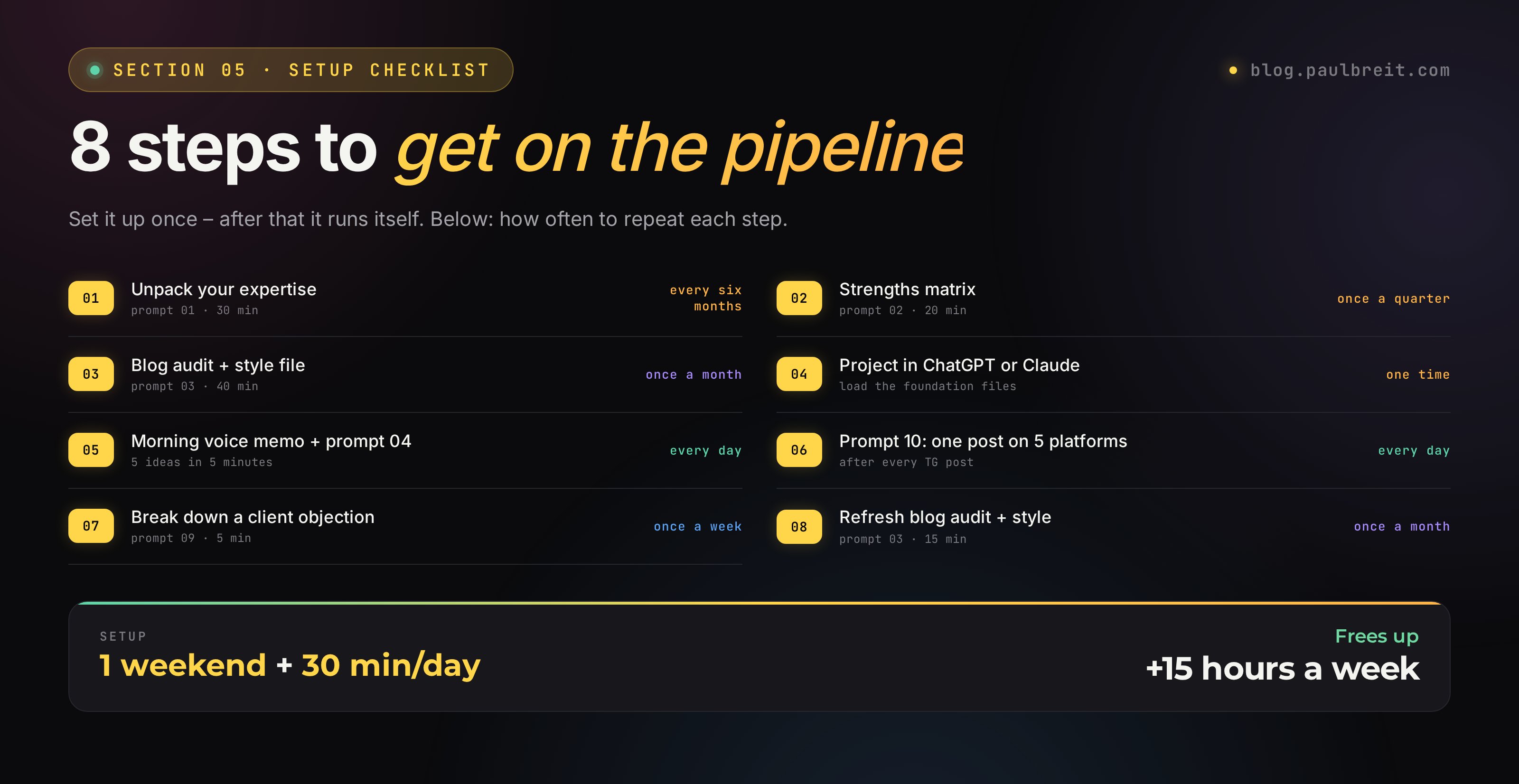
- Recorded and ran the expertise unpacking (prompt 1)
- Built the strengths matrix (prompt 2)
- Ran the audit of the last 30 posts and assembled the style file (prompt 3)
- Created a project in ChatGPT or Claude and loaded all the foundation files
- Every morning I record a 5-minute voice memo and run it through prompt 4
- After every TG post I run prompt 10 across 5 platforms
- Once a week I take one client conversation and make a breakdown post (prompt 9)
- Once a month I refresh the blog audit and the style file (prompt 3)
If all eight boxes are checked, you're on the pipeline. You free up 15-20 hours a week. With those hours you do what the AI can't do for you – think, talk to clients, live your expertise.
If fewer than five are checked, you're still using ChatGPT as a typewriter. That's fine at the start. It's not fine a month in.
Closing
I run four client projects and a personal channel of 20,000 people. The content pipeline freed up 15 hours a week for me – that's a full work week a month. I spend that time thinking, reading, talking to clients, building the product. The content got better, not worse.
AI didn't replace me. It freed me from the craft. Meaning, insight, personal voice – all of that is still mine. The mechanics – the draft, the headlines, the adaptation, the resizing for platforms – the machine handles.
That's the right role for AI in an expert's work. Not "instead of you." Right beside you, on the most boring part of the job.
FAQFrequently asked questions
ChatGPT or Claude – which is better for the pipeline?
Claude tends to write with more life and falls into templates less often. ChatGPT is handier for quick tasks and images. The pipeline works in either one.
What is a Project and why do I need one?
A Project is a workspace inside the AI that remembers you, your clients and your style. Set it up once and your prompts run in context – you never have to explain yourself from scratch again.
How do I avoid that generic AI mush in my writing?
Give the AI 5-10 of your own real posts as samples, explicitly ban filler and stock phrases, and rewrite the final draft by hand for one or two sentences.
How long does it take to set the whole system up?
One weekend. Saturday: build the Project and the first 5 prompts. Sunday: a test run on a real week of content.