Your First 1,000 Followers as an Expert: No Budget, No Bots
Most experts chase 10,000 followers and stay broke. Meanwhile a channel of 1,000 real readers brings in $1,500-2,500 a month from consultations. The difference isn't the number, it's the architecture of your blog. Inside: 5 principles for getting your first 1,000 with no budget and no bots, a comparison of 4 platforms, a breakdown of the main objections, the metrics of "right movement," and a 30-day checklist.
You have expertise. Maybe you already have your first clients. And you understand you need a blog. But the first 1,000 followers feel intimidating: where do you find them with no ad budget, when buying bots is a road to nowhere?
Good news: your first 1,000 doesn't take money. It takes consistency and the right actions every day. In this article: 5 principles that work on any platform, plus a detailed playbook for the four main environments where US experts grow an audience: Telegram, Threads, Facebook, Instagram.
* Inside: the principles, a platform-by-platform breakdown, a 30-day checklist, and a list of what to avoid on each one.
What's inside
- Why the first 1,000 is a special milestone
- 5 principles that work on any platform
- Comparing 4 platforms: where an expert should invest in 2026
- Telegram: the long game with no algorithm
- Threads: a new platform with an open window
- Facebook: algorithms, groups, recommendations
- Instagram: visuals and reach with no budget
- 6 objections that block your first 1,000
- Metrics: how to know you're moving the right way
- 30-day checklist
- What changes after your first 1,000
- Where to start today
Section 01Why the first 1,000 is a special milestone
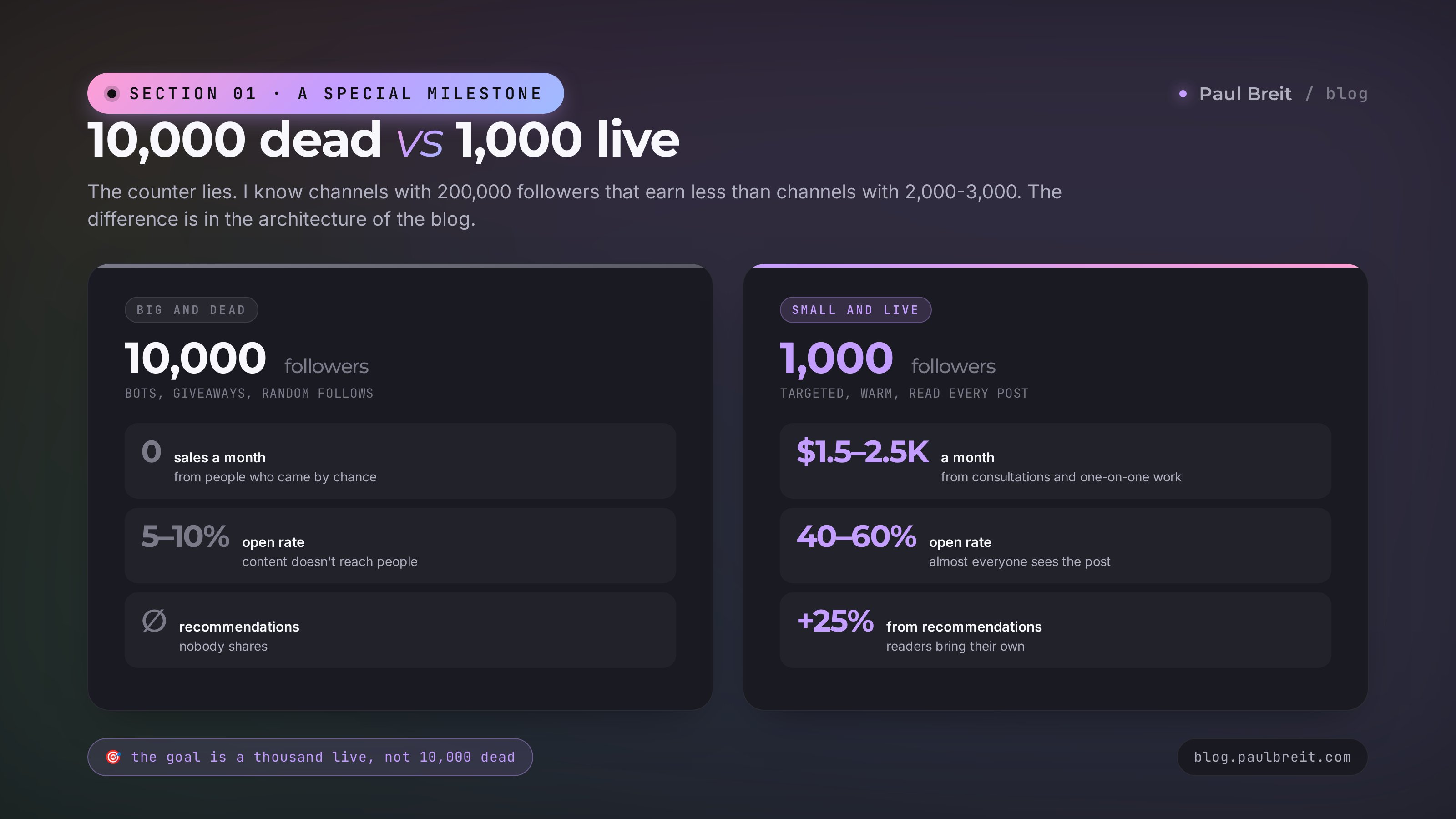
Most experts set themselves a goal of "10,000 followers." And that's the first mistake.
10,000 dead followers won't bring you a single sale. But a thousand live, warm readers who know you from a few posts will bring in your first $1,500-2,500 a month from consultations. I know channels with 200,000 followers that earn less than channels with 2,000-3,000. The big ones simply have no path from post to sale, and the small ones do.
The first 1,000 isn't about the number. It's the mass of people for whom you become "their expert" in the niche. After that, followers come on their own through recommendations, reposts, comments. No budget, no dancing for the algorithms.
You can't "scrape together" this thousand from just anyone. A random follower doesn't read, doesn't buy, doesn't recommend. A hollow follower is worse than no follower at all: they inflate the number, fool you, and bring in nothing.
The job for your first thousand is to gather those exact people. The ones who could potentially become your client. Here's how to do it.
Section 025 principles that work on any platform
The platforms are different, the algorithms are different. But people are the same everywhere. Get these 5 principles and you'll just fine-tune for the specific network. Miss them, and no network will save you.
One person instead of "an audience"
When you sit down to write a post, forget the word "audience." Picture one specific person: age, profession, what brought them here, what hurts. And write to them. One real person responds far harder than dozens of generic "for everyone" phrases.
Spell out exactly who that person is for you. A name, a situation, where they're stuck. A blurry image in your head equals blurry posts equals random follows.
A clear promise in your bio
A person doesn't follow you because you're nice. They follow because in your bio, your pinned post, or your first video they read something that landed right on their problem.
Your bio is one short line: what someone gets if they keep reading you. Not "about marketing and sales," but "I help experts land their first paying clients through a blog in 30 days." A clear promise catches specific people. A vague one catches air.
The follow trigger by niche: 4 examples
The formula for a live bio is always the same: I + for whom + toward what + in what time. Compare the dead descriptions with the live ones, the difference in follows is immediate.
| Niche | Dead bio | Live bio |
|---|---|---|
| Therapist | "Therapist. I help people become happier" | "I help women rebuild themselves after divorce in 3 months" |
| Nutritionist | "Nutritionist. About nutrition and health" | "I help new moms lose weight with no diets and no crashes" |
| Coach | "ICF coach. I help you reach your goals" | "I help founders step out of day-to-day operations into strategic leadership in 60 days" |
| Marketer | "About marketing and sales on social" | "I help experts make their first $1,500-4,000 a month through a personal blog" |
Show your bio to a friend who isn't in your niche. If within 5 seconds they can't say in one sentence "who and what you help with," the bio is dead. Rewrite it so a 12-year-old gets it the first time.
Rhythm beats quality
A lot of people want "one strong post a week." And that kills growth.
Social platforms love it when you post regularly. The algorithm doesn't trust someone who drops three posts, goes quiet for two weeks, then drops three more. It trusts someone with a clear rhythm, where something comes out almost every day.
The minimum for growth is 4-5 posts a week. Not every one has to be a masterpiece. Some can be short observations, thoughts, a breakdown of a single case. The main thing is to keep the feed from going still.
Put a link to your blog everywhere
You have 5-10 places where people see you: posts, comments under other people's posts, talks, webinars, chatbots, DMs. Most of the time, none of these lead anywhere near each other.
Every one of those places should lead to your blog. Your Zoom-room signature, a link in every bio, a mention of your blog at the end of an article or podcast. This isn't advertising. It's simply a way to give the person who just heard you a chance to stick around.
Ask people to share, don't be shy
A lot of people are scared to ask readers to repost or invite friends. It feels pushy.
It isn't advertising. It's perfectly normal to write at the end of a post: "If this hit home today, forward it to a friend going through the same thing." Some people will. That's how you grow better than with any bots, real people arrive on a recommendation, and they're already on your side.
Section 03Comparing 4 platforms: where an expert should invest in 2026
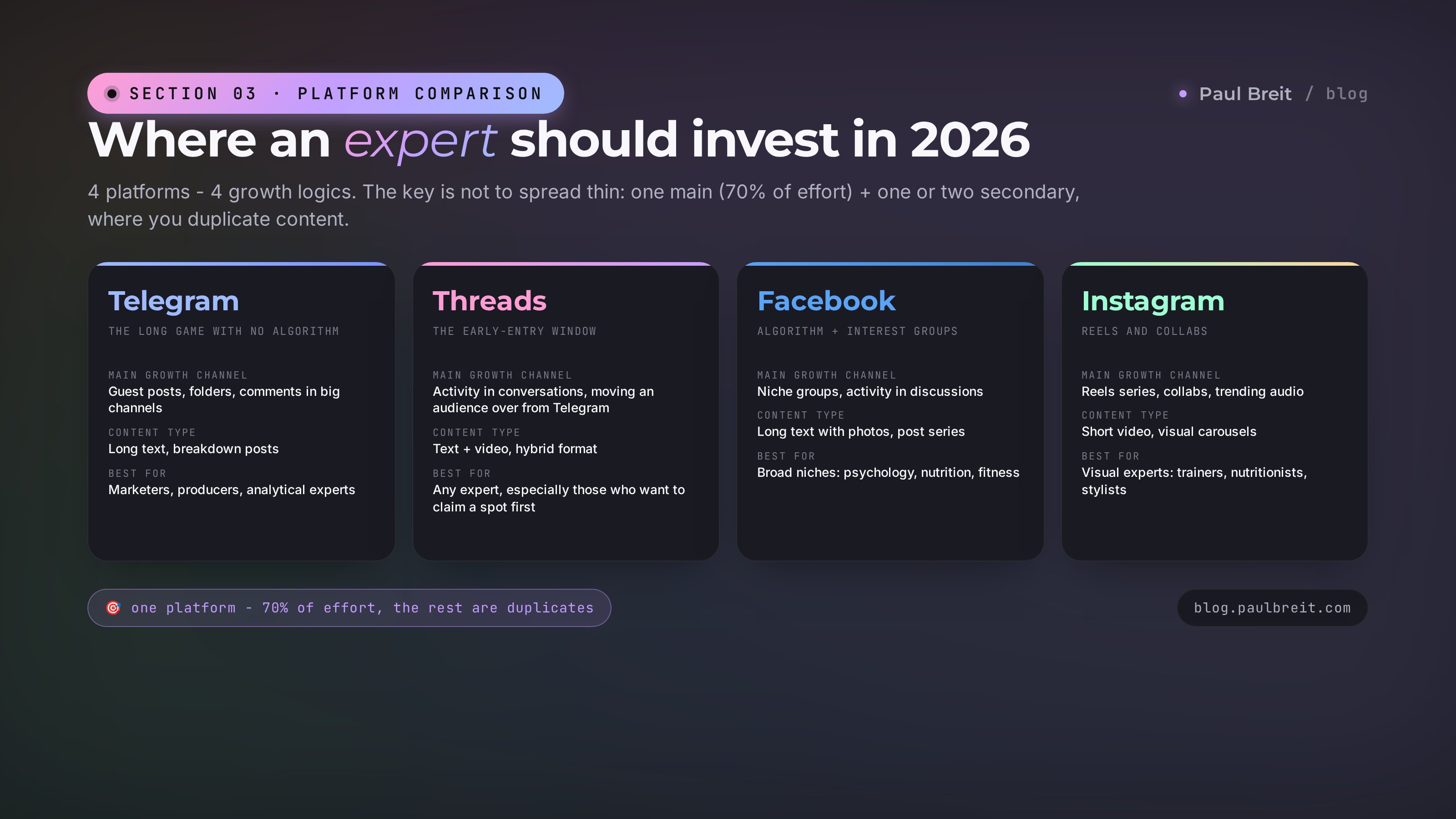
Before we dig into each network, keep their differences in front of you. It makes it easier to decide where to pour the most effort and where to just be present.
| Platform | Feed algorithm | Growth speed | Main growth channel | Content type | Best fit for |
|---|---|---|---|---|---|
| Telegram | None, every follower sees the post immediately | Medium, plateaus around day 60-90 | Guest posts, channel folders, comments | Long text, breakdown posts | Analytical experts, marketers, producers |
| Threads | Young, gives new accounts high reach early on | High in the early-entry window | Activity in conversations, moving an audience over from other apps | Text + video, hybrid format | Any expert, especially those who want to claim a spot first |
| Recommendations + feed, driven by engagement | Medium, spikes on strong posts | Interest groups, activity in discussions | Long text with photos, post series | Experts in broad niches: psychology, nutrition, fitness | |
| Reels and post recommendations, very active | High off a single viral clip | Reels, collabs, trending audio | Short video, visual carousels | Visual experts: nutritionists, trainers, stylists |
Pick one main network, that's where 70% of your effort goes. Plus one or two secondary ones, where you duplicate the same content with light adaptation. Spreading effort across all 4 from scratch is a sure way to never get a single one to 1,000.
Section 04Telegram: the long game with no algorithm
Telegram has no feed algorithm, the post reaches everyone who's subscribed at once. That's both a plus and a minus. The plus: your reach doesn't depend on the algorithm's mood. The minus: people can't stumble onto you by scrolling a feed, you have to bring them in. So Telegram is a long game, and the main bet here is to embed yourself in other people's content.
What actually brings followers for free
The strongest move is guest posts in other people's channels. Find 10-20 channels in your niche roughly your size (the big names are harder to reach). Agree on a trade: "I'll write a post on yours, you write one on mine." People follow more readily from a post like that than from regular ads, because to those readers you're not an ad, you're "a good person their favorite author invited."
Next: genuine comments in big channels. Find 5-7 channels run by niche leaders with open comments. Every day, leave a couple of detailed replies with an example from practice, not "thanks for the post." Some readers will go check out who writes this interestingly. It's a slow method, but it brings the warmest audience, the people who already liked your point of view.
Third: channel folders through a bot. Build an "Experts in X" folder with 8-12 channels on your topic. Agree to have everyone publish the link on the same day. Followers add the folder, and the growth goes to all participants at once, for free.
And fourth: move your audience over from other platforms. If you already have Instagram, Facebook or an email list, add a link to Telegram in your bio, in your last stories, in your email signature. Part of your existing audience will move over on their own, with zero effort.
Don't buy bots or "sleeping" followers, Telegram sees it and rolls out a shadow ban. The channel stops appearing in "Similar channels," both your reach and your search visibility drop. Follow-to-enter giveaways bring freebie-seekers, they unsubscribe the moment the prize is handed out. Be careful with pricey folders too: test the return with small volumes before going in with a big spend.
Section 05Threads: a new platform with an open window
Threads is a young platform from Meta that's been growing fast since 2023. It's tied into Instagram, it has the full weight of Meta behind it, and the feed is still hungry for good text. For an expert that's a window of opportunity: there are still few quality authored accounts, so you can step in and claim the niche as one of the first.
How to catch the early window
First and most important: start an account right now. In 2026, every expert working with a US audience needs a Threads account. It's both insurance for whatever the next platform shift brings and a chance to lock in a spot before everyone shows up. Signup is free, getting started takes half an hour.
Don't write content from scratch. Take your posts from Telegram and lightly adapt them for Threads, with a single prompt using the "adapt one piece for 5 platforms" framework from 10 prompts for experts, 5-10 minutes per post. The account fills up fast and your workload doesn't double. What matters is that anyone who lands sees a live account with a dozen posts, not an empty storefront.
To quickly gather your first core: talk about Threads on your Telegram. "Started a Threads account, follow me if you're already there." Some of your readers are also picking up Threads and will move over. Then new people get pulled toward that core through search and recommendations inside Threads.
And one more thing: reply to questions in conversations on your topic. Threads actively pushes conversation, so jump into 5-10 threads in your niche. Don't spam, just answer to the point on what's being discussed. Right now reach there is good and there are almost no expert authors, visibility is free and at its peak.
Don't start an account "just in case," two posts and forget. Without regular publishing no platform grows, and Threads is no exception. And don't spam in conversations, bans there are quick and recovery is hard. Write like an expert, not like a salesperson.
Section 06Facebook: algorithms, groups, recommendations
Facebook is the largest social network, and the feed algorithm here really works. A strong post can fly into recommendations and reach 10 times more people than you have followers. You pay for that with high competition and a penalty for going silent: disappear for a month and your reach sits at the bottom for a long time.
On Facebook an expert has two surfaces, and you need both. A personal profile and a Page are different stories. Personal posts are seen more by friends and the people you're recommended to as a mutual connection. Page posts land in topic recommendations.
What brings followers on Facebook
Posts in big groups on your topic
Find 10-20 niche groups with an open wall or admins who publish guest material. One post in a group of 50,000 can drive dozens of clicks to your profile, more than a month of regular posts of your own.
Genuine comments in big groups
Facebook loves active users. If you leave 5-10 detailed comments a day in big niche groups, not "agreed" but with an example and a thought, then within a month you start showing up more often in "people you may know." And the traffic comes on its own.
Pairing your personal profile with your Page
On the Page: regular niche posts, an expert format. On the personal profile: real stories, a personal take, cases from practice. That way you catch both the people looking for a specialist and the people interested in the human behind the specialist.
Repurposing Telegram posts for the Facebook format
Facebook loves long posts, especially with photos and broken into blocks. Once your content is on the rails, layer automated outreach and lead targeting on top, and the page starts collecting friend requests at around $0.03 per lead. Take your posts from Telegram, but don't copy them straight across, re-lay them for the visual format of the feed, add an image or a short pull quote.
Don't spam in comments, moderation catches it fast and then comes the shadow ban. Don't buy likes and followers, your reach gets cut for a long time. And the big one: don't go silent. A month with no posts equals reach at rock bottom, and reviving it takes weeks.
Section 07Instagram: visuals and reach with no budget
There's plenty of audience on Instagram, but text posts are nearly dead here. The only thing that really works is reels. The Instagram algorithm does a decent job pushing them to a new audience: one clip that takes off can bring 500-1,000 followers in a week.
What pulls an account up with no budget
Shoot reels regularly, at least 2-3 a week. Not every one will take off, but one in ten hits recommendations, and that's enough for growth. If an expert in 2026 has no reels on Instagram, the account is dead, nothing more to analyze. Alongside reels, it makes sense to immediately launch the format with the strongest engagement, carousels, and build an AI agent that designs and publishes them every morning.
What works best is a series of reels on a single pain point. Not scattered clips, but 5-7 about one specific problem. Whoever got hooked on the first one, Instagram will show them the second, then the third. A series brings far more followers than a dozen clips on different topics.
Growth is sped up a lot by collabs. You agree with an expert in an adjacent topic, shoot a joint reel, and it goes out on both accounts at the same time. If your partner has 10,000-20,000 followers, a single clip can send you a hundred or two real people.
And one more: trending audio under your ideas. Take a popular wrapper and pack your topic's ideas into it. Instagram itself pushes content with hot audio. Just don't drag your feet, two weeks later the sound has cooled off and stops working.
Don't sit on static posts alone with no reels, the account will never grow that way. Don't buy likes through services, you'll catch a shadow ban that's very hard to lift afterward. And don't do "follow-for-follow" swaps, you get junk that later drags down your engagement, and with it your odds of hitting recommendations.
Section 086 objections that block your first 1,000
I hear these objections on almost every consultation. If even one of them is spinning in your head, it slows you down more than the lack of a budget.
"I have nothing to say"
You have 5-15 years of experience in the niche. What's basic to you is a revelation to a client. Open your consultation notes and write out the 20 questions you get asked most. There's your ready-made content plan for 2 months, no brainstorming required.
"I've been at it a year and nothing's growing"
If growth has stalled, one of the 5 principles is broken. In 9 cases out of 10 it's a vague follow trigger. Rewrite your bio with the "I + for whom + toward what + in what time" formula, and you'll see a difference within a month. Without a focal point, no amount of post-marketing fires.
"You can't get your first 1,000 without ads"
The first 1,000 is always slow. Ads can speed it up to 30 days; without ads you collect it in 60-90 days with discipline. After that, ads multiply the effect, but without the principles they'll just burn budget too. System first, money later.
"I'm not a blogger, I'm an expert"
Thank goodness. An expert provides value, sells services at higher prices, and doesn't depend on a trend. A blogger entertains and lives off reach. Don't try to become a blogger, write like an expert who explains to the reader what you'd explain on a consultation. That's your format, and it works at your prices.
"My competitors already have all of this"
Most "niche content" is rewritten courses from five years ago. Show your angle through your own experience, your own mistakes, your own approach to typical cases, and you're already a distinct figure. Uniqueness isn't in the topic, it's in how you unfold it.
"I'm embarrassed to sell in my blog"
A sale is helping a person solve their problem for money. If you're embarrassed to sell, it means you doubt your product. Remove the doubt and selling in posts stops feeling pushy.
Section 09How to know you're on the right track
Follower count is the most deceptive number. It grows slowly, 5-15 a day in the first month, and it feels like the blog is dead. Look at the other metrics, they show the health of your blog more accurately than the follower counter.
| What to watch | Normal for a blog under 1,000 | When to worry |
|---|---|---|
| Who opens posts (open rate on Telegram, reach on Facebook and Instagram) | 40-60% of followers | Under 30%, wrong topics or rare posts |
| Reactions and comments | 1-3% of views | Under 0.5%, posts are dry, no emotion |
| Saves (on Telegram) | 1 save per 50-100 views | Rarer, no practical value |
| Clicks on the link in your bio | 0.5-2% of views of the post that drives there | Near zero, the promise doesn't catch |
| Questions in DMs | 1 question per 200-500 views | Silence, posts don't touch a nerve |
Don't dig into the numbers every day, you'll burn out within a week. Look once a week, judge by the trend over a month. And compare yourself only to your past self. Big channels have a different economy, don't measure against them.
Section 1030-day checklist
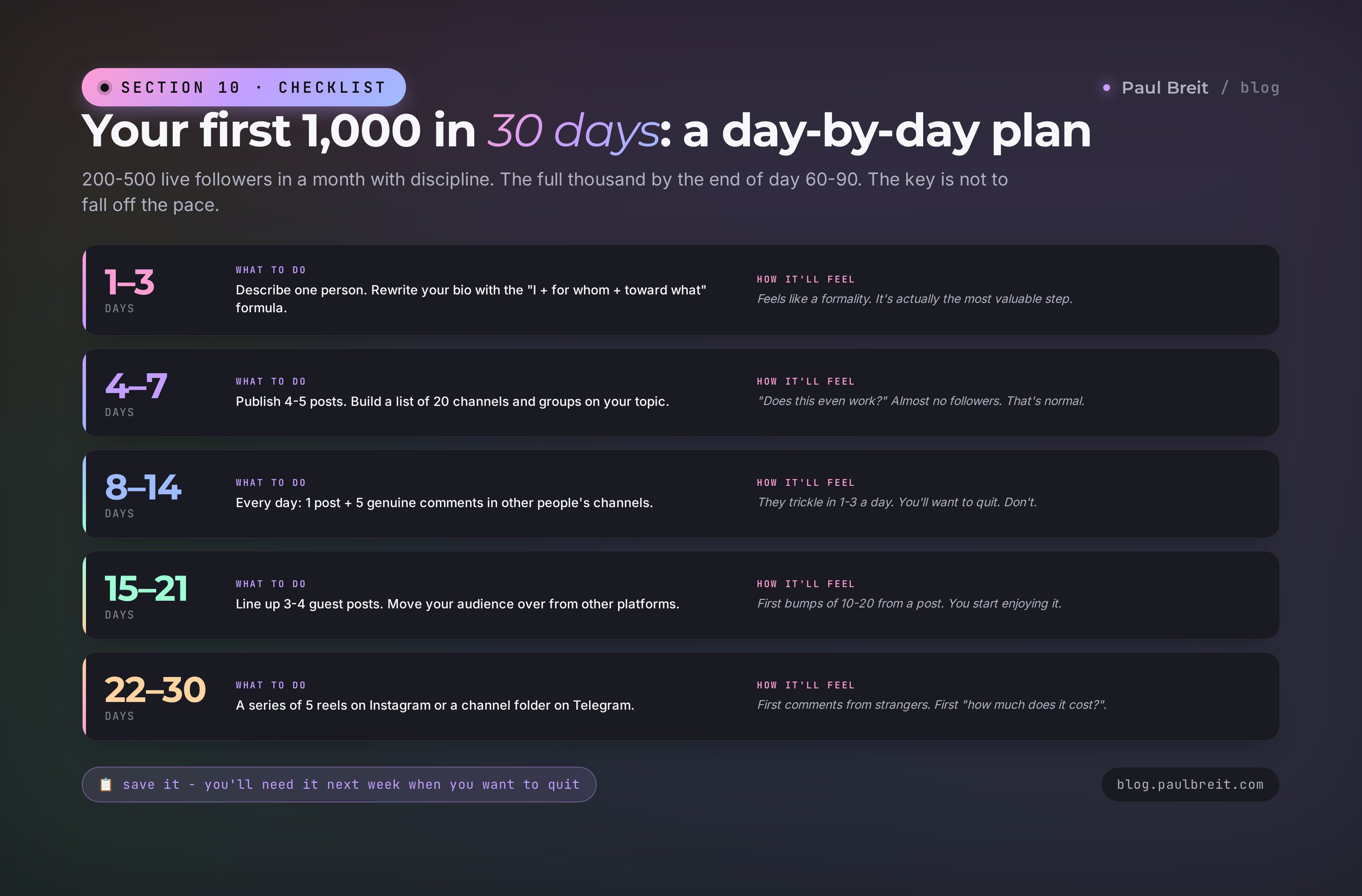
The bare-minimum plan. Do it with discipline and you get 200-500 real followers in 30 days. Your first full thousand lands by the end of day 60-90, if you don't fall off the pace.
| Days | What to do | How it'll feel |
|---|---|---|
| 1-3 | Describe the one person you're writing for. Rewrite your bio with the "I + for whom + toward what" formula. | Feels like a formality. It's actually the most valuable step. |
| 4-7 | Publish 4-5 posts on your main network. Build a list of 20 other channels and groups on your topic. | "Does this even work?" Almost no followers, that's normal. |
| 8-14 | Every day: 1 post + 5 genuine comments in other people's channels. | Followers trickle in 1-3 a day. You'll really want to quit. Don't. |
| 15-21 | Line up 3-4 guest posts. Move your audience over from other platforms. | First real bumps, 10-20 people from a single post. You start enjoying it. |
| 22-30 | Shoot a series of 5 reels on Instagram or build a channel folder on Telegram. | First comments from strangers. First "how much does it cost?" in your DMs. |
The first month is the slowest. In the second, growth speeds up 2-3x because people already recognize you. By the third, they start coming on a recommendation, without you asking. That's the moment your blog turns from "work" into an asset.
Section 11What changes after your first 1,000
A thousand followers isn't the finish line. It's a pass to the next stage. What changes at each one:
| Stage | What becomes possible | Where the focus shifts |
|---|---|---|
| 1,000 followers | 5-10 consultations a month, your first course or one-on-one sales, your first recommendation without you asking | From "how to grow" to "how to sell harder" |
| 3,000 followers | The blog brings $4,000-7,000 a month at the same rhythm. Leads land in your DMs on their own. You can start testing ads on a narrow audience. | To the system: an automated funnel, a lead magnet, sales sequences |
| 10,000 followers | The blog is your main source of clients. You can hire a team. Content spreads to other niches on its own through reposts. | To scale: launches, courses, a flow of one-on-one work |
The principles are the same. Only the depth and the tools change. That's why your first 1,000 isn't a one-off sprint, it's the foundation every following thousand stands on.
Section 12Where to start today
The most dangerous thing here is to close the article saying "I'll sit down and do it later." You won't.
Do three things right now. Open a notebook and describe the one person you'll be writing for. Rewrite the bio on your main network so that one line carries a promise in the "I + for whom + toward what" formula. Write your first post for that person. The whole thing: an hour.
In an hour you'll have the foundation the next 30 days live on. Without it, any post goes into the void, and a month from now you're back to the same question, "how do I get followers." Only now you're not at zero, you're at minus one month.
The first 1,000 doesn't come to those who wait for luck. It comes to those who do the same actions 30 days straight. And who don't quit when the first week is empty.
If you'd rather not assemble the system piece by piece, book a free consultation. We'll get on a call with my team and build a plan for your specific niche.
FAQFrequently asked questions
Which platform should an expert choose in 2026?
If you write, go Telegram. If you film, go Instagram. If you work with a broad audience and video, go Facebook. Threads is a new platform with an open window for anyone ready to experiment.
How many posts per week should you publish?
At least 3-4 posts per week on a single platform. Less and the algorithm forgets you; more and you'll burn out within a month.
Can you run several platforms at once?
You can, but not at the start. Get your first 1,000 on one platform, then repurpose the content to the rest.
What if a month goes by and not a single follower shows up?
Check your positioning (is it clear who you are and who you're for) and your post hooks. Usually the problem isn't volume, it's that it's not clear why anyone should follow.