20 post ideas that will blow up your blog – with Claude
A one-evening playbook. Take your post archive, load it into Claude, and get a map of the gaps in your topics, 30 ready ideas for new posts, and a description of your own voice. You do it all yourself, by hand, in one sitting.
You already have a Telegram channel – 50 posts or more. You want to stop guessing at topics and start leaning on what actually works for your own audience. By the end of this article you'll have five ready Claude prompts and a working list of ideas for the coming month.
If you don't have a channel yet – start one first. Analyzing emptiness gives you nothing.
What's inside
- Why bother analyzing your own channel
- What you get out of it
- Exporting the channel from Telegram
- What's inside the export and how to prep it
- Why Claude specifically, and not other models
- Uploading the file to Claude
- Prompt 1: a full channel profile
- Prompt 2: what hits, what dies
- Prompt 3: blank spots and orphan topics
- Prompt 4: 30 ideas for new posts
- Prompt 5: make Claude write in your voice
- Power move: once a month, on autopilot
Section 01Why bother analyzing your own channel
When you've run a channel for a year, two, three – you stop seeing it. You remember your posts, but you no longer notice the patterns. You don't see that for six months you've been writing about the same thing while never once touching an important neighboring topic. You don't notice that your short posts with a living story pull twice the reach of your long deep-dives. Your eye is glazed over.
An outsider sees better. This work used to be done by a content strategist for $1,000 a month. They'd sit, read three hundred posts, write down what lands, where the holes are, what it's time to write about. Two weeks of work, then a week of enjoying it – and then you hit the wall again, because the strategist still isn't you.
Claude does the same thing in 20 minutes. And it does it more honestly – it has no reason to be polite with you. It reads your archive like a stranger, sees what you stopped seeing, and tells you straight.
And the main thing changes: you stop writing "what should I post today." You start writing into the place where your audience is genuinely hungry – into the topic they've been waiting for while you went months without answering it.
Three years ago, models fell over on a hundred posts – the context wouldn't fit. A year and a half to two years ago, the flagships started making things up after 50 pages of text. Claude Opus 4.7 has a million tokens – it reads 2,000 posts in one go and never loses the thread. The whole channel, with no slicing into chunks.
What the analysis actually gives the channel
- Topics where you have a hole. Followers ask a question – and you've been silent on it for six months. The analysis spotlights it.
- Formats that work. You stop writing what you like and start writing what gets read.
- Your own voice – on paper. Claude writes out your phrasings, your rhythm, your pauses. So that on the days you have no time to write, the AI does it for you – but in your voice.
- A list of ready posts. Not "ideas in a column" but concrete drafts – hook, angle, format. All that's left is to finish them.
- Movement over time. Do this kind of analysis once a month and you see where the channel is growing and where it's stalled.
Section 02What you get out of it
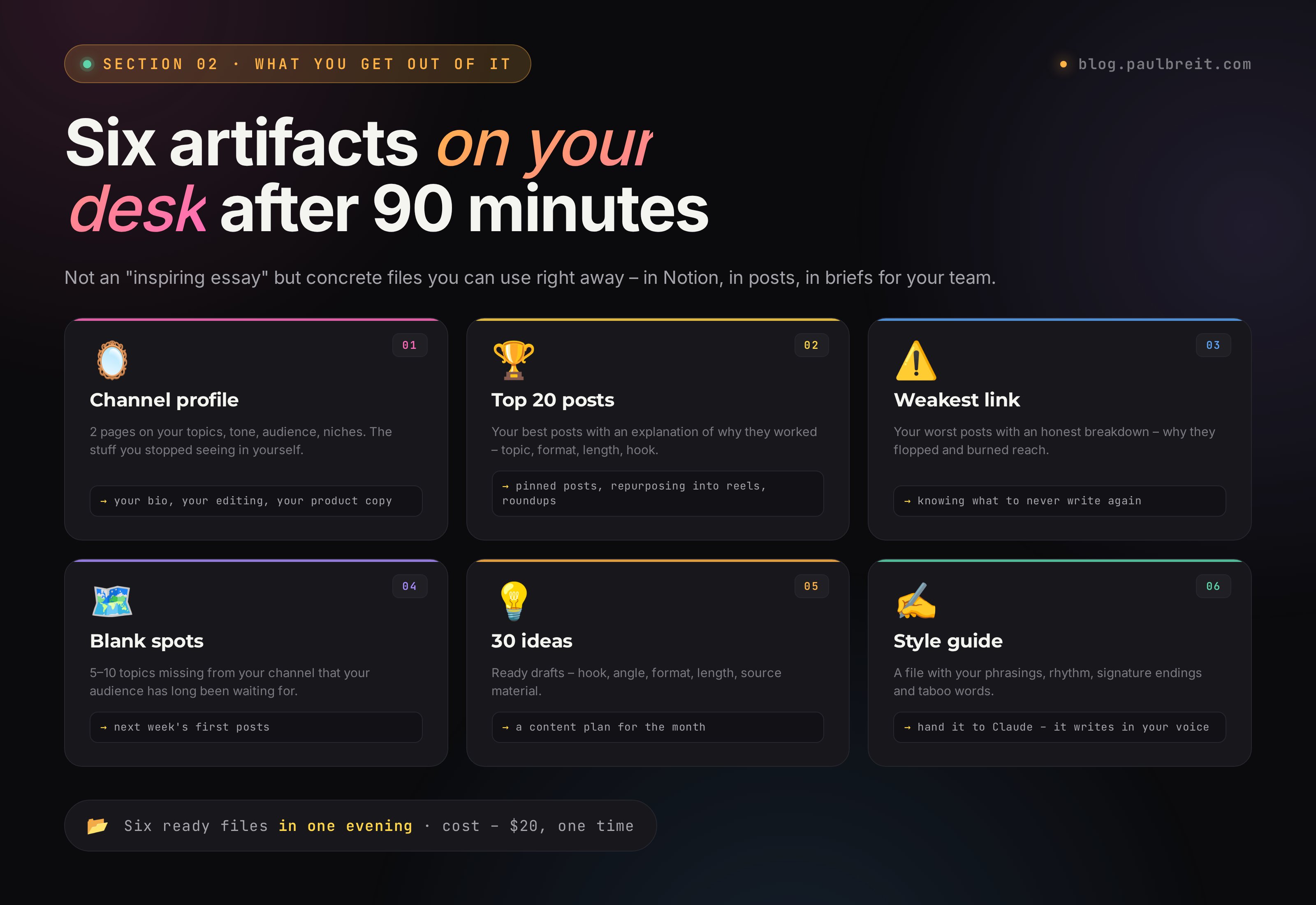
So there's no disappointment – let me show you up front what you'll have on your desk after an hour and a half of work.
| Artifact | What it is | Where to use it |
|---|---|---|
| Channel profile | 2 pages on your topics, tone, audience, niches | Your channel bio, your editing, your product copy |
| Top 20 posts | A list of your best posts with an explanation of why they landed | Pinned posts, roundups, repurposing into reels |
| Weakest link | A list of your worst posts and an honest breakdown of why | Knowing what to never write again |
| Blank spots | 5–10 topics you skipped entirely | The very first posts of next week |
| 30 ideas | A list of ready ideas with hooks and angles | A content plan for the month |
| Style guide | A file with your phrasings, rhythm, rules | Hand it to the AI that will write for you |
This isn't an abstraction. It's what Claude actually hands you – I have the same files for my own channel, I went through this work myself.
This analysis isn't for someone else "to mull over." It's for you. The AI won't replace your instinct – it spotlights it. The decisions stay with you. Only now you're deciding based on numbers and patterns instead of "this is how it feels to me."
Section 03Exporting the channel from Telegram
First move – pull a file with all the channel's posts out of Telegram. Telegram hands it over itself, through the "Export" feature. It's hidden, but it works perfectly.
Export is only available in Telegram Desktop (the app for Windows, Mac or Linux). The mobile app doesn't have this feature. If all you have is a phone – install the desktop version, it's free and takes 10 minutes. desktop.telegram.org
Open Telegram Desktop and go into your channel
Your own channel, the one you admin. You can't export someone else's channel – Telegram won't allow it.
Click the three dots in the top-right corner of the channel
A menu opens. Choose Export chat history.
In the export window, uncheck what you don't need
For the analysis we only need text. Turn off all media – photos, videos, voice messages, video notes, stickers, GIFs, files. Those things weigh gigabytes and add zero value.
Leave the checkboxes only on text. If you want a really light file – uncheck everything except "Messages."
Pick the format: JSON
At the bottom of the window there's a toggle – HTML or JSON. Set it to JSON. Claude understands it perfectly. HTML works too, but there's a ton of extra markup in it.
Click Export and wait
A 500-post channel exports in half a minute. 5,000 posts – about five minutes. The file lands in the Telegram Desktop/ChatExport_[date] folder. Inside there'll be a result.json – that's your archive.
500 text posts – roughly 800 KB. 2,000 posts – 3–5 MB. 5,000 posts – 10–15 MB. Claude accepts files up to 512 MB, so the headroom is enormous. Even if you posted three times a day for five years.
Section 04What's inside the export
You don't need to open and clean the file by hand. At all. You download it and load it straight into Claude – more on that in the next section. But so you understand exactly what Telegram hands over, let me show you quickly.
If you open result.json in a text editor, you'll see something like this:
{
  "name": "Channel name",
  "messages": [
    {
      "date": "2023-01-15T10:30:00",
      "text": "Today I launched a new cohort...",
      "views": 12400,
      "reactions": [
        {"emoji": "🔥", "count": 84},
        {"emoji": "❤", "count": 42}
      ]
    },
    ...
  ]
}
For every one of your posts there's: text, date, views, reactions, forwards. Everything you need for the analysis is already inside. Claude figures out the format on its own – it works out where the text is, where the reactions are, where the metrics are. Your job is simply to hand it the file as is.
Download the file from Telegram – close the folder – open Claude – drag the file into the chat. Three actions. No cleaning, no scripts, no prep.
Section 05Why Claude specifically, and not other models
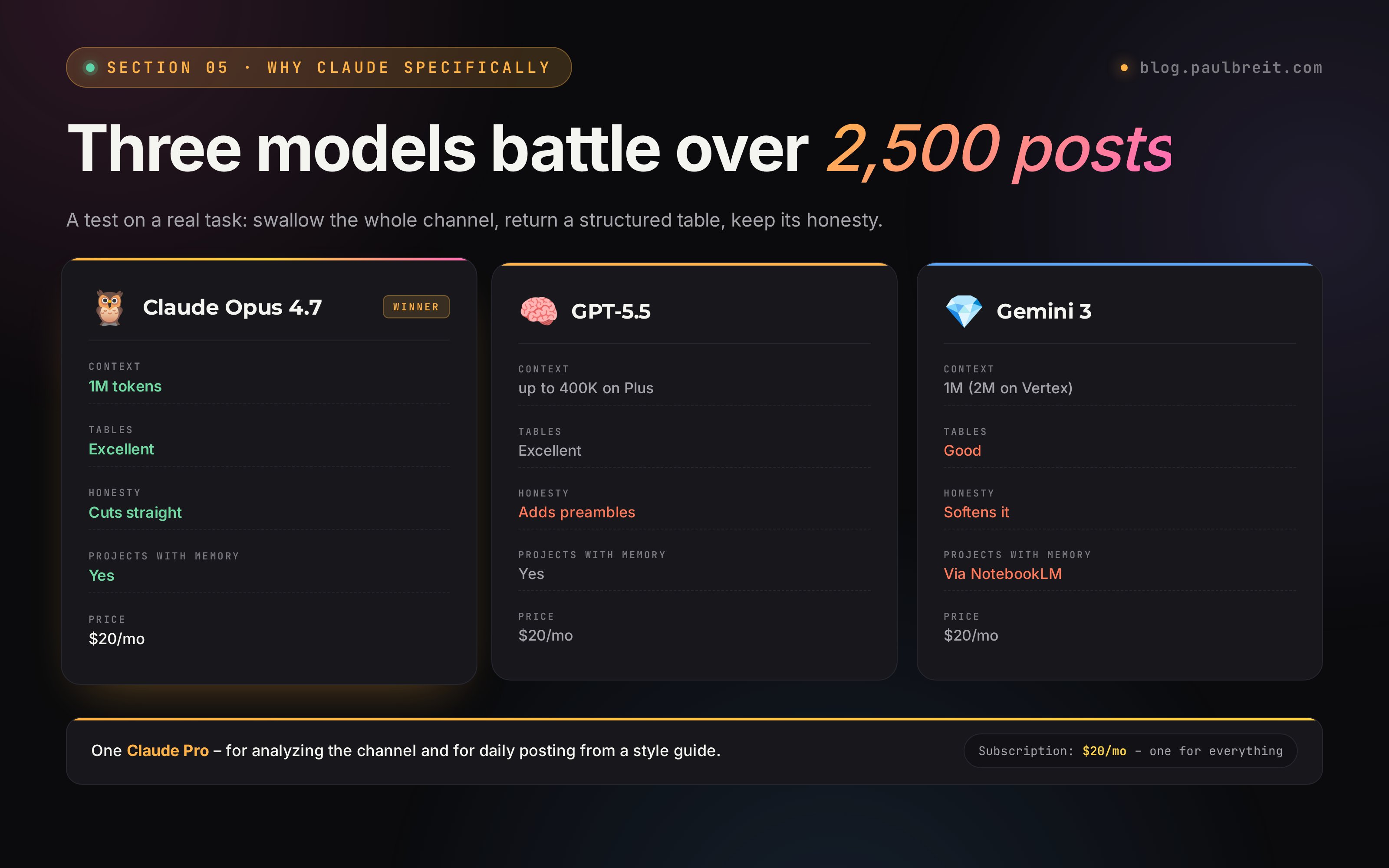
There are three big models right now: Claude Opus 4.7, GPT-5.5 and Gemini 3. They can all read text. For analyzing a channel, Claude is the most convenient. Here's why.
It sees the whole archive at once
The million-token context of Claude Opus 4.7 is about 2,500 posts. You don't chop the file into pieces, you hand it over whole. That matters: analysis done in parts is always worse. The model loses the connections between what happened a year ago and what happened yesterday if you feed it the file in chunks.
It's good with tables
Ask for "the top 20 posts with reasons they landed" and you get a table, not a wall of text. The output is an artifact you can work with, not an "inspiring essay."
It talks straight
Claude doesn't butter you up. If a quarter of your channel's posts are flopping – it'll say so in the first sentence, with no opening "you've got a wonderful channel." For an honest breakdown, that's worth more than compliments.
It has projects
This is the big one. In Claude you create a Project called "Channel analysis," upload the export once – and from then on any new conversation inside the project already knows your archive. You don't have to attach the file again. A month later you export a new version, add it to the same project, and continue working with the same conversation history.
One tool – the whole workflow
On that same Claude you'll later be writing posts from the style guide – via CLAUDE.md and auto-posting. There's a detailed walkthrough of that combo in my guide on auto-posting to Threads with Claude. No need to keep two subscriptions across different models: analyze – train – launch the posting, all inside Anthropic.
| Parameter | Claude Opus 4.7 | GPT-5.5 | Gemini 3 |
|---|---|---|---|
| Context | 1M tokens | up to 400K on Plus | 1M on Pro, 2M on Vertex |
| Tables and structure | Excellent | Excellent | Good |
| Honesty of the breakdown | High, cuts straight | Often adds preambles | Softens it |
| Projects with memory | Yes | Yes | Via NotebookLM, not natively |
| Price | $20/mo ($17 annual) | $20/mo | $20/mo |
For analyzing the channel and for posting from the style guide – it's the same Claude Pro at $20/mo. One tool, one subscription, one workflow. GPT-5.5 is good for quick tasks, Gemini 3 for huge files on Vertex. For your channel and your content – Claude.
Section 06Uploading the file to Claude
The easy part. 2 minutes. But let's do it right, so we don't have to come back and redo it later.
Create a project
In Claude's left sidebar there's a "Projects" section with a "+ Create project" button. Name the project "Channel analysis [your name]." Projects aren't there for looks – inside them, long-term memory works, files live in one place, and any new conversation knows all the previous work. Your workspace for the channel.
Write the project's goal in its settings
In Claude the field is called "Project knowledge / Instructions" – it's the context the model sees in every conversation in the project. Put this there:
I have a Telegram channel. In this project
I'm analyzing my post archive from a JSON export.

Talk to me straight, no diplomacy. If
something in the channel isn't working – explain what's
wrong and how to fix it.

When I ask for a list or a table – make a table.
When I ask for a detailed answer – don't shorten it
and don't give me generic words. Lean on specific
posts from the file – with quotes and dates.
These instructions apply to every future conversation inside the project. Write them once – it works from then on.
Attach result.json to the project
In Claude, inside the project, there's a "Project knowledge" section. You click "Add content" and pick your JSON. A 10 MB file uploads in about 30 seconds. Claude reads it once and from then on knows everything about it. You don't need to attach it to every message – it sits in the project and is available automatically.
Start the first conversation with a check
Let's make sure the model actually sees your file.
Read the attached result.json.
Tell me:
1) How many posts are in the file total?
2) The earliest and the latest date.
3) The average post length in characters.
4) Quote three random posts with dates –
   so I can confirm you're reading my actual
   file and not making things up.
If you see clear numbers and your real posts – it's all working, move on. If it gets confused or writes "I don't see a file" – check that the file is in Project knowledge, not in a separate chat.
Some people attach the file right in the chat via the paperclip – that works too, but only in that one specific chat. The next conversation won't see the file. Put it in Project knowledge – then it's available across all the project's conversations.
Section 07Prompt 1: a full channel profile
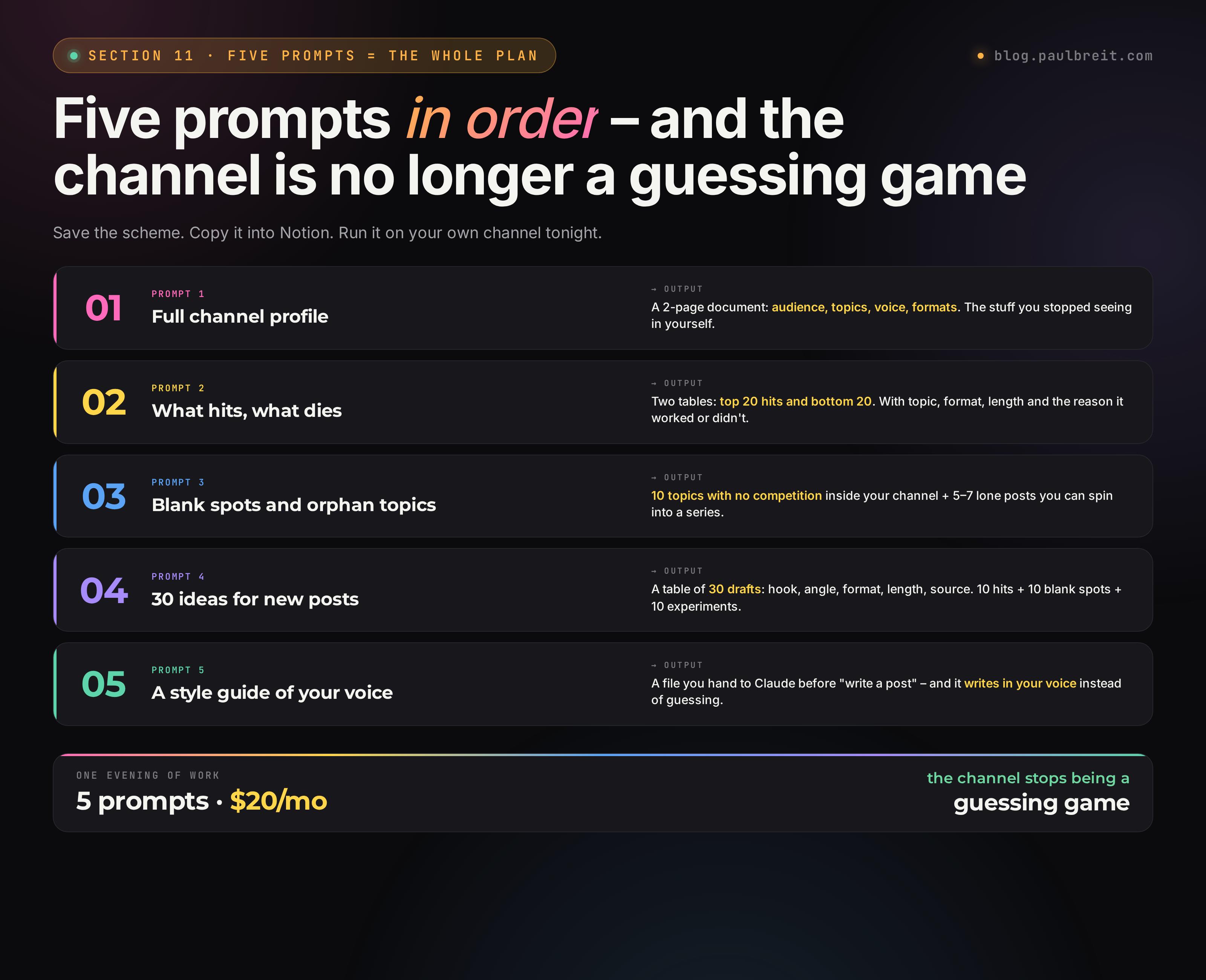
The first breakdown is broad. We look at the channel as a whole, the way an outside reader who doesn't know you would see it. I start every breakdown with this prompt – my own and my clients'.
Read my whole channel and give me its profile.
Not surface-level, but deep – as if
you were a strategist preparing a report for an investor.

Lay the answer out in sections:

1. AUDIENCE
   – Who actually sits in the channel right now
     (reconstruct it from topics, tone, reactions)
   – Their level of expertise
   – Their pains, the ones that show between the lines

2. TOPICS
   – Top 5 recurring topics of the channel
     (what the author writes about most often)
   – Top 5 side topics
     (surface rarely, but with a strong reaction)
   – The ratio: education / personal /
     sales / entertainment (in percentages)

3. VOICE
   – Tone (warm/tough/ironic/neutral)
   – The author's signature phrasings
     (write out 10 of their trademark lines)
   – Average sentence length
   – Favorite metaphors, images

4. FORMATS
   – Which formats they use most often
     (story, opinion, breakdown, list, question)
   – Which ones – almost never

5. THE OFFER ANGLES
   – What the author sells (if it can be figured out)
   – How they do it – directly or through content
   – Frequency of direct selling per month

6. CHANNEL AGE
   – When it feels fresh, when – tired
   – At what point the author seems to have "found their voice"

Back everything with specific quotes and dates.
Length of the answer – at least 1,500 words.
In a minute Claude hands you a multi-page document. Read it slowly. It's a mirror of the channel, and a couple of the observations in there will be new to you – about yourself.
Save the answer in a separate file – call it, say, channel_portrait.md. It'll come in handy at every next step, and later in your work with Claude when you ask it for posts "in my style."
Follow-up questions
After the first answer, ask follow-up questions – Claude answers them in detail and honestly:
I'm looking at your profile. Three follow-up questions:

1) You wrote "the author writes more often about X" –
   but for some reason you didn't mention topic Y. Check,
   is it really rare or did you miss it?

2) About the voice – I need to understand it more precisely. Give me
   5 specific posts that capture my style as accurately
   as possible, and 5 that don't.
   With an explanation of why.

3) You said "the author found their voice in 2024."
   What exactly changed? Compare 3 posts before
   and 3 posts after.
The point of these questions isn't to argue with the model. It's to clarify for yourself how well it actually understood you. After the second round of answers you'll have a solid profile in your hands.
Section 08Prompt 2: what hits, what dies
And here's the most valuable part. We break down which posts of yours took off and which fell flat. We work with views and reactions – Telegram saved them neatly in the file.
Now let's talk metrics.

Make me two lists:

TOP 20 BEST POSTS
   Rank them by the formula:
   score = (reactions × 100) / views + forwards_weight
   where forwards_weight = forwards × 3
   (because a forward is stronger than a like)

   For each post, into a table:
   – Date
   – First 100 characters (the hook)
   – Views
   – Reactions
   – Forwards
   – TOPIC (in one word)
   – FORMAT (story / opinion / breakdown / provocation / list)
   – LENGTH (short up to 300 / medium up to 800 / long)
   – WHY IT LANDED (a hypothesis in 1 sentence)

BOTTOM 20 (the post had lots of views but few reactions)
   That means people read it and weren't gripped.
   The most dangerous posts: they burn reach for nothing.

   Into the table, the same thing, plus:
   – WHY IT DIDN'T LAND

After the two tables – closing conclusions:
   – Which 3 topics work best
   – Which 3 topics the audience is already tired of
   – Which format gives the maximum
     engagement per unit of length
   – At what time of day posts take off more often
     (if you see a pattern in the dates)
   – The length that works optimally
This is the central prompt of the article. After it, you understand what to spend time on – and what to never write again as long as you live. And from there, topics turn into posts, reels and adaptations through the conveyor of 10 prompts for an expert.
How to read the results
Don't rush to rebuild the channel. Check it against common sense. If Claude says "your personal posts don't land" – and you distinctly remember a post that brought you half your followers – ask it a counter-question:
You said my personal posts
don't work. But I remember a specific post
(the date is roughly such-and-such) that pulled
a ton of reactions. Take another look –
maybe you got the categorization wrong?

If you did – admit it and rewrite the conclusion.
If not – show me the post and explain
why you still counted it as a failure.
Claude calmly admits a mistake when you point at it directly. It doesn't go into long apologies – it just says "okay, took another look, here's the new conclusion" and recalculates.
You'll stop agonizing over your "failed" posts. You now have numbers, not feelings. A post with 200 reactions on 30,000 views is 0.67%, a flop. A post with 500 reactions on 12,000 is 4.2%, a hit. And before, it seemed like the first one was "better" because the reach was bigger.
Section 09Prompt 3: blank spots and orphan topics
And now the most unexpected part. We look for what isn't in the channel. This is almost always the moment a person's jaw drops: it turns out they've been steering around topics for years that their followers have long been waiting for.
Look at my channel as a map.

I need to find the BLANK SPOTS – topics that:
1) Logically should be in my niche
2) My followers very likely want to
   read about (you can judge from the questions
   that show through in the comments, from adjacent
   topics, from what colleagues are raising)
3) But I haven't written about, or written very little

Give me a list of 10 such blank spots.

For each spot:
– TOPIC NAME
– WHY I'M AVOIDING IT
  (possible reasons: scared, don't know, forgot,
   think it's obvious – take a guess)
– WHY IT MATTERS TO THE AUDIENCE
– EXAMPLES OF 3 SPECIFIC POSTS I could
  write on this topic right now
  (not abstractly "about the team," but with a concrete
   angle and hook)

Additionally – ORPHAN TOPICS:
this is when I wrote one post on a topic, got
good reactions, and never came back to it.
Find such lonely posts – they're missed
series. Give me a list of 5–7 orphans with a recommendation
on how to spin each into a series of 3–4 posts.
Blank spots are pure money. Every one of those topics has no competition inside your own channel. The audience is waiting, the author is silent. The first post on that topic carries far more reach than an ordinary publication on a well-worn topic.
The common-sense filter
Claude sometimes suggests blank spots that aren't close to you or don't fit your positioning. That's normal. It works with logic, not with your history. You cross out the ones that aren't yours. Out of ten spots, usually five to seven are workable. The rest – a miss.
A blank spot is what's missing from you but should logically be there. "AI agents are trending right now, write about them" is not a blank spot if you're not about that. A blank spot for a psychologist is relationships with parents, if they spent the whole year writing only about anxiety. For a marketer – hiring, if they spent the whole year writing only about traffic. The topic is your own, but forgotten.
Section 10Prompt 4: 30 ideas for new posts
You've already assembled a channel profile, a ranking of post performance, a list of blank spots. All of that is raw material. Time to ask Claude to assemble a working plan for the coming month from it.
Based on all our work (channel profile,
analysis of the top and bottom, blank spots, orphan topics)
give me a list of 30 ideas for future posts.

Not abstract ideas like "about the team."
Concrete drafts.

For each idea:
– HOOK (the first line of the post – the thing that makes
  a person stop scrolling)
– ANGLE (the angle the topic is opened from –
  concrete, not general)
– FORMAT (story / opinion / breakdown / list)
– EXPECTED LENGTH
  (short up to 300 characters / medium 500-800 /
   long 1000+)
– SOURCE (where I draw the material from:
  my own experience / a client case / a breakdown of someone else's /
  observation of the industry)
– CATEGORY (from which bucket:
  filling a blank spot, developing an orphan topic,
  a variation on a successful format, a test balloon
  for a new topic)

Distribute them:
  – 10 ideas – guaranteed hits
    (repeat the patterns of the top 20)
  – 10 ideas – blank spots and orphans
    (expanding topic reach)
  – 10 ideas – experiments
    (new formats, new angles – a bet on growth)

Give it as a single table I can
copy into Notion or Excel.
Claude hands back a 30-row table. You open it – half of them you want to write right away, a third you mark "later," about five you discard entirely. And if you want topics not from your own head but from other people's viral posts, keep the AI hunter that sends you the top 5 ideas from competitors' channels every morning close by. That's fine. Twenty-five workable ideas – exactly what you need for a month with room to spare.
What to do next
By hand – you move the table into Notion (Claude can export straight there via the MCP connector, or you just copy it), put it on a calendar, and go write. One day – one post from the list.
On autopilot – you hand that same table to Claude via its CLAUDE.md and ask: "take one idea from the list and write a post every day at 10:00 in my style from the style guide." I've already written about how Claude does this in the guide on auto-posting to Threads: blog.paulbreit.com/threads-automation-with-claude. The whole scheme is there.
Don't write all 30 ideas back to back like a conveyor belt. That'll burn out both you and the channel. A living author will still slot three or four "off the cuff" posts in between: a reaction to news, a spontaneous story, an opinion on the feed. The list of 30 is a frame, not a prison.
Section 11Prompt 5: make Claude write in your voice
The last and most useful move. Now we make Claude not just analyze, but write – in your voice, following the patterns it found in you.
This is done through one file – style-guide.md. Claude writes it itself, based on all the work we've already done.
Now assemble a full STYLE GUIDE of my channel for me.
This will be a file I'll feed you (or Claude)
before every "write a post" request.

The style guide should have these sections:

1. WHO I AM
   (a short 1-paragraph note: who I am, what I do,
    for whom, how I get results)

2. MY AUDIENCE
   (the profile from section 1 – who sits in the channel)

3. MY TONE
   (how I write: straight/ironic/warm, with what
    level of formality, which emotions I allow
    myself, which I don't)

4. SIGNATURE PHRASINGS
   (write out 20 of my characteristic lines that
    I actually use in the channel)

5. THE STRUCTURE OF MY POSTS
   (how I usually build a post – hook, body, ending.
    What my favorite types of endings are)

6. RHYTHM AND LENGTH
   (short and long sentences, how I alternate them,
    what my average post length is in characters)

7. FORBIDDEN WORDS
   (what I never use – derive it
    from my archive. If in 500 posts there's no word
    "undoubtedly" – that means I avoid it)

8. HOW I END A POST
   (the main 3–5 ending patterns)

9. HOW I INTERACT WITH THE AUDIENCE
   (first-name or formal address, do I ask questions, do I call
    to action, how often)

10. TYPOGRAPHY RULES
    (only short dashes, emoji yes/no,
     caps yes/no, how I format lists)

Length: 2–3 pages. It should be
exhaustive but practical. I'll be
giving this file to another AI
so it writes in my voice.
The output is a ready style guide. Save it as a separate file. This is the main result of the whole breakdown. Now any AI you show it to will stop writing "like an AI in general" and start writing "like you."
Testing the style guide
In that same conversation, run a test right away:
Take your own style guide and write
5 posts on topics from the idea list (any 5).

I'll read them – and tell you whether you hit my voice.
If you didn't – we'll add to the style guide.
Read the 5 posts. If 4 of 5 sound like you – it works. If only 2 do – you fix the guide, tell Claude exactly what's off, and ask it to rewrite. Usually two or three iterations are enough to get the style guide working at about 90%.
When you tell Claude "write like me" – it guesses. With a style guide – it knows. The difference is roughly like that between someone who watches you from the side and someone who has your instructions in hand. The first parodies. The second actually writes in your voice.
Section 12Power move: once a month, on autopilot
Doing the analysis once is already a lot. But it truly works when you do it regularly. A channel is alive: new audience arrives, you try new formats, some topics run their course. A year-old breakdown tells you little by today.
The solution is simple: a ritual. Once a month – a fresh export, a fresh breakdown, an updated plan.
What it looks like
The first of every month:
- You export a new
result.json– the same 2 minutes - You drop it into the same Claude project
- You run one prompt – it hands back everything at once
I have a new channel export in the project
(file result_2026-04.json).

Compare it with the previous one (result_2026-03.json).

Give me, in 5 minutes:

1) WHAT CHANGED
   – Which topics I started writing about more often
   – Which less
   – Average reaction went up or down
   – New formats I tried

2) WINS OF THE MONTH
   – Top 5 posts of the last 30 days
   – Why they worked

3) SURPRISES
   – Posts I didn't expect a reaction from,
     and it came
   – Posts I bet on, and they didn't land

4) PLAN ADJUSTMENT
   – Of the 30 ideas I planned,
     which are still relevant
   – Which 5 new ideas appeared based on
     what happened in the channel

5) SIGNALS
   – Topics that are "waking up" among followers
   – That is, topics getting comments,
     rising response to mentions, getting forwards
   – This is a map of where to steer the channel next month
20 minutes a month – and the channel grows with intent. Not on impulse, but on numbers.
If you have Telegram Analytics (the channel's built-in tool, available from 1,000 followers), you can also export the growth figures, ER, and reach from there. Claude pulls it all together and shows you how your content decisions actually affect the audience. That's already agency-level work that runs $2,000 a month – assembled for $20.
A quarterly slice
On top of this kind of analysis, it makes sense to layer a full automated expert funnel powered by AI. After three months of this work, you open the project and ask:
Pull together all three monthly reports and do
an analysis for the quarter: how I'm moving as an author,
which direction the channel is shifting, what I'm
getting better and better at, what isn't budging.

Final takeaway: the main 3 hypotheses
for the next quarter – topics, formats,
posting rhythms. With reasoning.
And that's no longer a breakdown of posts. It's a channel strategy built on your own data. No person in the world will give you a more precise strategy – because no person remembers your channel down to the comma, and Claude does.
Your channel is a deposit of data. Every post is thousands of signals: what landed, what passed, what people asked, what they forwarded. These signals used to burn up – there was no one to process them. Now one evening and $20 is enough to read your channel deeper than any agency analyst would.
One question remains: will you sit down and do this today or not.
FAQFrequently asked questions
How many posts does a channel need for the analysis to make sense?
50 posts and up. On less than that, patterns don't show. Ideally – a year or more of channel history.
How do I export the post archive from Telegram?
Through Telegram Desktop: channel settings – export history – HTML or JSON format. You upload the file to Claude.
What do I do if the channel is new and has few posts?
Write for at least three months first. Analyzing emptiness gives you nothing – no data, no patterns.
Can I analyze competitors' channels?
Yes, exactly the same way. The prompts are identical. You get a map of a competitor's topics and can move into their blank spots.