The Meaning Pyramid: 6 layers of content that sells without funnels or bots
If you have been writing helpful content for months but clients still aren't coming, the problem isn't your volume or your topics. It's the structure. I broke down 200+ posts from experts with real paying clients and found a pattern: every selling post contains 6 layers of meaning that only work together. Skip one and the post stays interesting but never converts. Inside is the whole pyramid, with hook formulas, breakdowns, and templates.
You have been writing posts for a month, two, half a year. They're good – they have numbers, results, real stories. The reactions are solid, there are comments, people write "thanks for the content." But when it comes to sales – not a soul. I mean, sales happen, but from somewhere off to the side: from old clients, from word of mouth. From your content though? No, those leads don't come.
You look at competitors and see: same format, but people come to them asking "how much do you charge" and "what do I need to do to get started." A thought creeps in: maybe my content is missing the meaning that makes people pay? Spoiler: that thought is correct.
* This article is a full breakdown of the Meaning Pyramid: 6 structural layers that turn helpful content into a content funnel. With hook formulas for different niches, concrete examples, a breakdown of the usual mistakes, and a "what to run through before publishing" checklist.
What's inside
- Why plain helpful content doesn't bring clients
- The Meaning Pyramid: the overall 6-layer structure
- Layer 1. The hook – grabs the right people
- Layer 2. Empathy – builds trust
- Layer 3. The method – shows the path
- Layer 4. Social proof – closes doubts
- Layer 5. The edge – sparks curiosity
- Layer 6. CTA – a soft move to action
- Hook formulas for 8 niches
- 6 common mistakes and how to avoid them
- The "what to run through before publishing" checklist
- How to start applying this today
Section 01Why plain helpful content doesn't bring clients
The main illusion among experts who write: "if the content is helpful enough, people will come and pay on their own." I believed that myself back in 2018. I wrote 3 posts a week, explained funnels, gave concrete steps. Reactions grew, the follower count grew, the thank-yous grew. And sales stayed flat.
Content that brings people in asking "how much do you charge" isn't just useful information. It's content with a funnel built inside it. You have probably heard of AIDA (attention → interest → desire → action). Hearing about it is one thing. Applying it right is another.
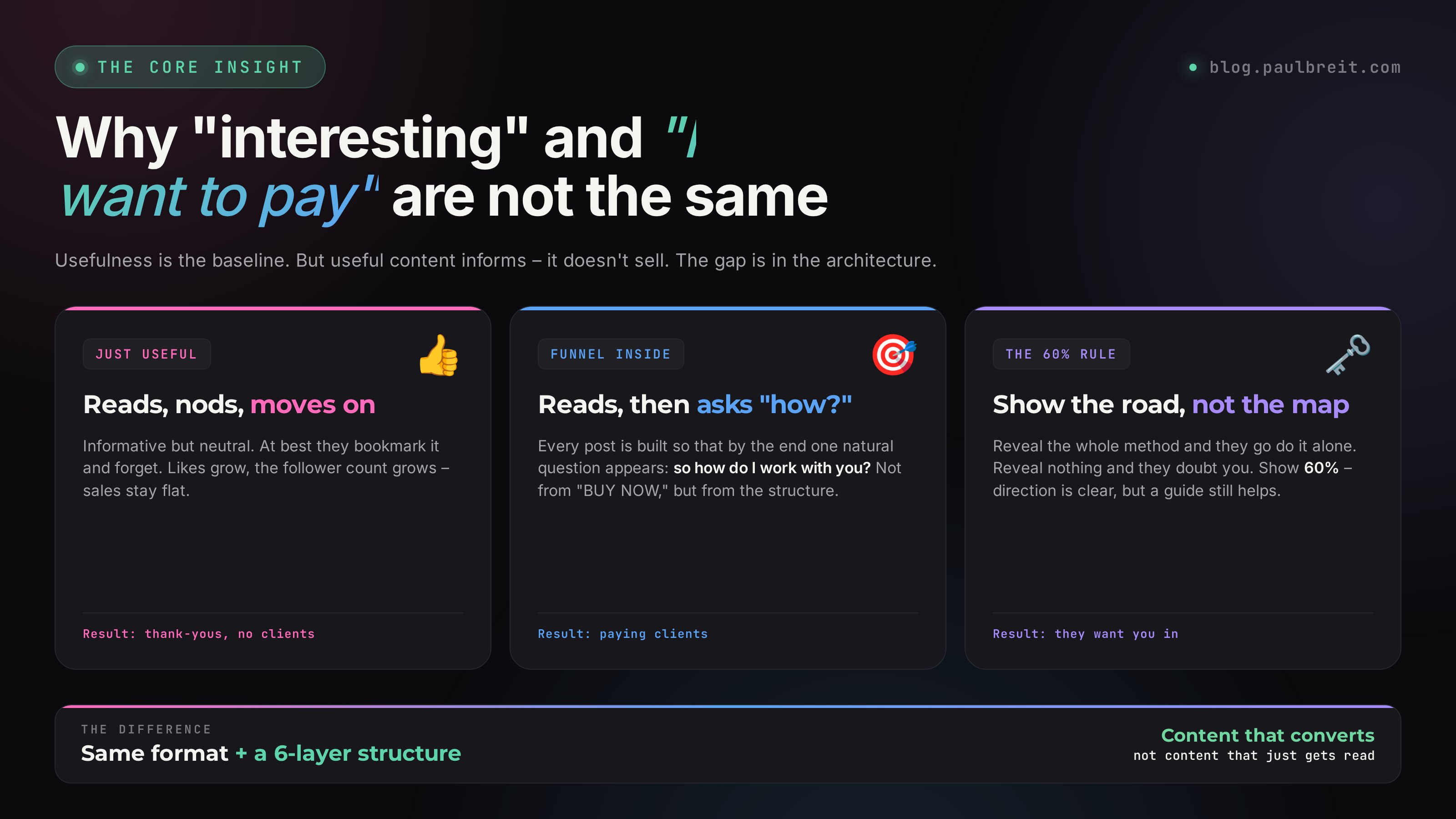
The difference between "interesting" and "I want to pay"
When an expert writes plain helpful content, the result is informative but neutral. A person reads, nods, moves on. At best, they bookmark it and forget.
When an expert writes content with a funnel built in, every post is built so that by the end the reader has a natural question: "So how do I work with you?" Not from an aggressive "BUY NOW," but from the internal logic of the structure that leads the reader to the right place.
Usefulness is the baseline – nothing works without it. But usefulness on its own doesn't sell. The gap between a useful post and a selling post is a gap in architecture. These are different genres with different structures and different outcomes.
Section 02The Meaning Pyramid: the overall 6-layer structure
I broke down 200+ posts from experts who genuinely get well-paying clients from their content. If you want to run the same exercise on your own channel, this breakdown of a channel with Claude that finds your top posts and blind spots will help. Marketers, therapists, nutritionists, mentors, freelancers. And I found a pattern.
Every one of these posts contains 6 layers of meaning that only work in a specific order. Skip one and the post stays interesting but never converts. I named this structure the "Meaning Pyramid."
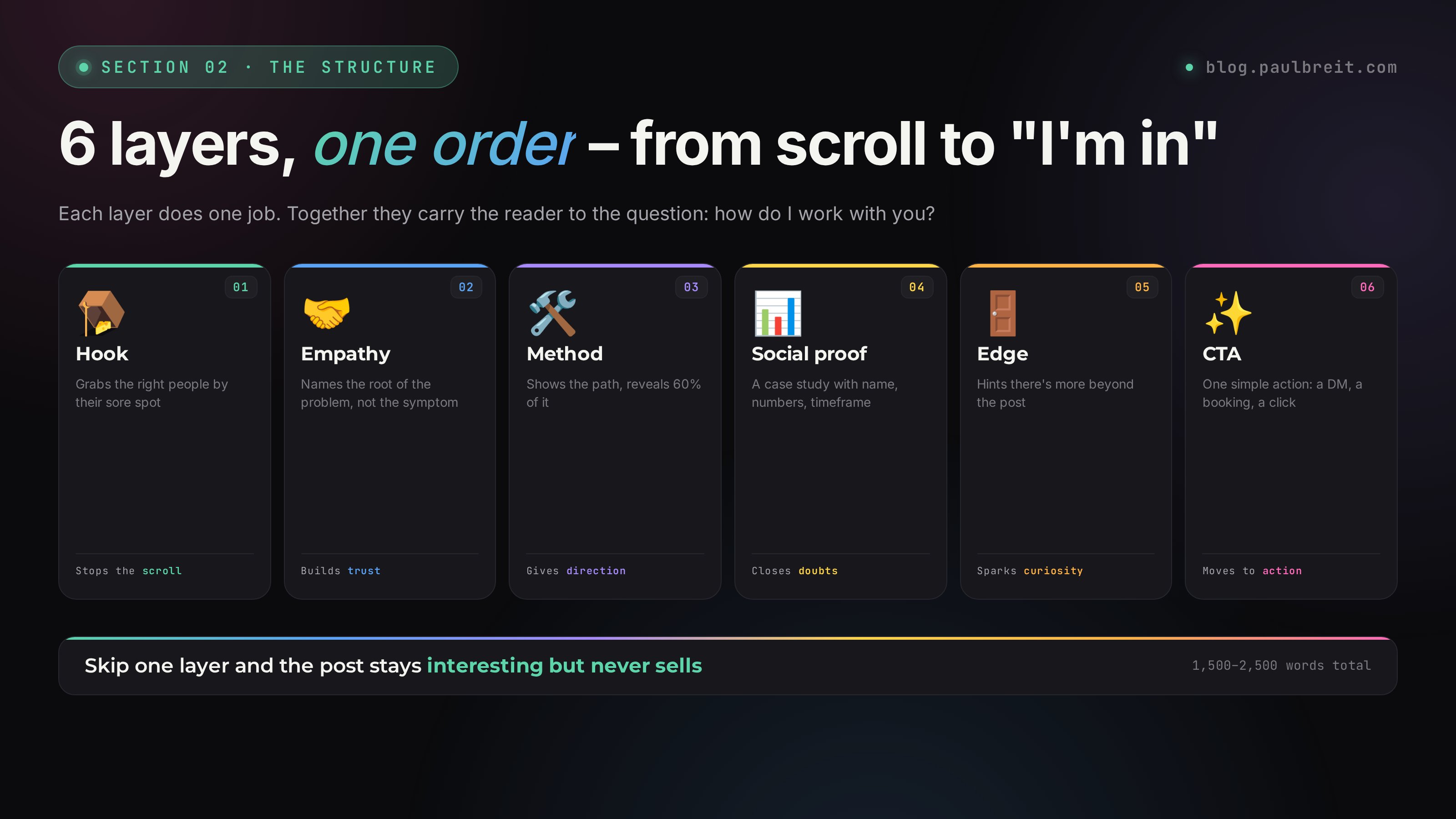
How all 6 layers work together
This is the structure not just of a post, but of a micro-funnel inside a single piece. Each layer does exactly one job – and together they carry the reader from "stumbled onto this post" to "I want to work with you."
| Layer | Job | % of content | Length |
|---|---|---|---|
| 1. Hook | Grab the right people by their sore spot | 10–15% | 100–200 words |
| 2. Empathy | Build trust through a deep grasp of the problem | 30–40% | 300–500 words |
| 3. Method | Show the path to a solution without revealing it all | 30–35% | 500–800 words |
| 4. Social proof | Close doubts with a case study and numbers | 10–15% | 200–400 words |
| 5. Edge | Create a sense of "there's more" and curiosity | 5% | 100–200 words |
| 6. CTA | A soft move into action | 5–10% | 200–300 words |
The total length of a selling post is 1,500–2,500 words. Less and you won't build the whole architecture; more and the reader drops off before the CTA.
Layer 1The hook – grabs the right people
The most important part, because it decides who reads on at all. If the hook is fuzzy, the post will collect "likes from friends and followers too polite not to like it," but the real paying readers will leave on the second paragraph.
The principle: specificity beats universality
Not "10 ways to increase sales" (universal, grabs no one in particular).
But "Why the best experts lose clients in the very first email" (specific, hits the sore spot of exactly those who see themselves as a "top expert" and are losing clients anyway).
4 formulas for working hooks
- Problem-question – "How do you sell when you have no name yet?" Grabs people who are just starting or who feel "I have no name"
- Number + paradox – "100 posts a month, 0 sales." Grabs people who already post a lot and get no results
- Sharp observation – "The smartest people in a niche are the worst at selling." Grabs smart people who feel their intelligence isn't helping them
- Personal story + insight – "I spent $5,000 on ads and earned $2,000." Grabs people who have already burned through a budget
Read your hook and ask: "Is this about me or not?" If you can clearly picture one specific person who'd say "oh, that's me" – the hook works. If the hook fits "everyone," it fits no one.
Layer 2Empathy – builds trust
Once you've grabbed the right person, you need to show that you understand their problem better than they do. This is the layer most experts skip – which is a shame, because it's exactly what creates selling trust.
4 steps to writing the empathy layer
Describe the problem so the reader recognizes themselves
Not "low sales," but "you write great content, people say thank you, but when it's time to pay – silence." A concrete picture in which the reader finds themselves.
Show the root, not the symptom
Not "you need to post more," but "your posts have no built-in logic that leads people to ask – so what should I do?" The root is the cause; the symptom is how it shows up.
Explain why people can't see this problem themselves
"It feels like content is about information. But really, content is about creating the desire to act." This step is key. It shows you can see a blind spot the reader doesn't notice.
Show the cost of doing nothing (gently)
"If you leave it as is, a year from now you'll still be pouring effort into content while random factors bring you clients." Don't scare them – just state the consequences.
Why this works
When you describe the problem so precisely that the person thinks "how does he know this about me" – something shifts. They start to believe you won't teach them things they don't need. A lot of gurus jump straight to "here are 5 steps, go do them." Meanwhile the person sits there asking: "Is this even what I need?" When you start with a deep understanding, the person relaxes. They feel heard.
Layer 3The method – shows the path
Here's the paradox. If you reveal the whole method, the person will try it alone, hit walls, and never pay. If you reveal nothing, they'll think "he doesn't actually know how." The sweet spot: reveal 60% of the method.
The structure of revealing the method
Break your approach into 3–4 components, each 100–200 words:
A name with an insight
Not "Audience analysis," but "Analyzing the people who buy, not the people who read."
The core of the component
1–2 sentences on what it is and why.
Why it matters at exactly this stage
Explain the logic: "without this, the next step is useless, because..."
A real example or your own case
"My client [name] had X, we did Y, and got Z." Specifics always beat abstractions.
The mistake 80% of people make
"Most people do X, and it doesn't work, because..." This gives the reader practical protection – they learn what not to do.
Each component is clear on its own. Together they form the full picture, but assembling it "without you" is hard. That's exactly 60% – the person sees the road, understands the direction, but without a guide they may get lost.
Layer 4Social proof – closes doubts
After the method, the reader thinks: "Sounds logical. But does it actually work in real life?" Social proof answers that question.
Not a testimonial – a structured case study
An emotional testimonial like "Thanks, this helped so much!" doesn't sell. It's touching, but it doesn't prove anything.
What sells is a structured case study following the formula "Who – What it was – What we did – What it became":
Who: [Name], [niche], [context – experience or current level]
What it was: [the specific problem in numbers] "wrote content for 2 months, 0 sales"
What we did: [a short description of the solution] "added a hook and rewrote the empathy layer"
What it became: [the result in numbers and timeframe] "within a week – 3 inquiries, 2 closed at $1,000"
What matters in a case study
- Name – real (with permission), not "Mary from somewhere." Name + link to a profile = trust
- Numbers – "2 months," "3 inquiries," "$1,000." Without numbers a case study reads like a fairy tale
- Short timeframes between before and after – "within a week" beats "within six months." The shorter the timeframe, the stronger the "I can do that too" feeling
- Screenshots of chats or stats – visual proof reinforces the text
Layer 5The edge – sparks curiosity
The most subtle layer. Here you hint that the post reveals the tip of the iceberg – the nuances stayed off-camera. It's not an aggressive "buy now," just a statement: "there's more."
Ways to phrase a working edge
- "But here a nuance appears: this only works if..."
- "On my consultations it turns out that..."
- "In your case there may be an exception – I'll explain why"
- "That's the base logic. Your niche has its own finer points..."
Why this works
The human brain hates the unfinished. Show a door but don't open it, and the brain itself wants to know what's behind it. This is the Zeigarnik effect – we remember and crave to finish an interrupted action more than a completed one.
Not "ALL THE ANSWERS ARE ONLY ON THE CONSULTATION!!!" That scares and annoys. Just "this is where the nuances begin" – a soft signal that the post is far from the whole story. No pressure, but with curiosity.
Layer 6CTA – a soft move to action
The final layer. Here you offer a concrete next step. Not "buy the $1,000 course," but a sign of interest – booking a free consultation, joining your Telegram channel, reading the next article.
The structure of a soft CTA
Tie it back to the problem from the hook and empathy
"If you want to figure out why your content doesn't bring clients while a competitor with the same content gets them – I can help."
What exactly happens on the next step
"On a free consultation we'll find which layer of meaning you're missing. And I'll give you a concrete plan for adding it to your posts this week."
One simple action
"You can book here [link]" or "Send the code word PYRAMID in a DM – I'll send the details."
Why a "code word" works better than a direct link
A direct link is zero engagement. Click and forget. A code word is a micro-commitment. The entire 5-day launch to your own audience runs on this same mechanic – an invite to "DM me START" beats the direct "sign up" button many times over: the person writes to you themselves, takes the initiative. That opens a private conversation, which is 3–5 times easier to sell through than a generic form submission from a website.
Section 03Hook formulas for 8 niches
The most common request from my clients: "Show me hooks for my exact niche." Below is a formula for each of 8 typical fields. Adapt them to your own specifics, but the logic stays the same.
Sales coaches and mentors
"Why the better the expert, the sooner clients leave – before the first meeting even happens"
"100 posts a month, 0 inquiries. What I figured out over 2 years"
Therapists
"How to talk about your help so people realize they have exactly the thing you treat"
"Why 'I'm doing fine' is the most dangerous sentence in a therapist's office"
Nutritionists and fitness trainers
"Why the people ready to train aren't ready to pay a trainer"
"Clean-eating checklists only work for 3% of people. Let me explain what happens to the rest"
Freelancers (designers, copywriters)
"When a client sees the work and thinks 'pretty' – instead of 'I need to pay for this'"
"I made presentations for $400 until I understood one thing. Now I charge $2,000"
Online instructors
"Why a student watches every video but won't pay for the course"
"Free-to-paid conversion is 2%. Here's what the 1 expert in 50 who hits 30% does differently"
Marketers and social media specialists
"The smartest ad buyers lose clients most often. Here's why"
"Ads cost $1,500 and brought in $750. And that's not a failure – it's normal for most people"
Realtors and real estate experts
"Why owners with 10 years of experience take longer to sell than newcomers"
"The hidden reason only 2 in 100 people ever see your listings"
Lawyers and financial advisors
"Why the best lawyers are the worst at selling their own services"
"When a client says 'I'll think about it' – they've usually already decided. Decided what"
Take a strong observation from your own practice – something counterintuitive that isn't obvious from the outside. Phrase it as a question or a first-person statement. Test 5–7 variants and watch your followers' reactions to see which one hits hardest.
Section 046 common mistakes and how to avoid them
Mistake 1. The hook is too broad
❌ "How to find your calling"
✅ "Why, the moment you find your calling, nobody will hire you"
A broad hook grabs no one in particular. A narrow hook hits the sore spot of a specific audience.
Mistake 2. The empathy layer is too short
Many authors jump straight from the hook to the method. The empathy layer should be 30–40% of the text so the person truly feels understood. If there's too little of it, there's no foundation of trust, and the method reads like a pile of advice from a stranger.
Mistake 3. Revealing the method 100%
If you tell everything, the person goes off to do it alone. Instead: the first step in full, the second its gist without details, the third "here are the nuances, depends on the situation." This exact 60% rule is also the basis of a sales webinar built with Claude – the audience buys not the course, but a way to reach the result without unnecessary bruises. The method should give direction, but not walk the whole path for the reader.
Mistake 4. No case studies
You laid out a great method, but the person doesn't believe it works. Add a case study – with a name, numbers, timeframes. Without a case, the method reads like theory.
Mistake 5. The edge is too scary
Not "ALL THE ANSWERS ARE ONLY ON THE CONSULTATION!!!" but simply "this is where the nuances begin." The edge should hint, not push. Pressure triggers defense; a hint triggers curiosity.
Mistake 6. The call to action is too aggressive, or missing
❌ "BUY NOW!!!" – too crude for a content post
❌ "Thanks for reading" – no CTA at all
✅ "If you're curious how this would work in your case – write to me" – soft and precise
Section 05The "what to run through before publishing" checklist
Before you hit "publish," run through this list. If even one item is a "no," the post isn't finished.
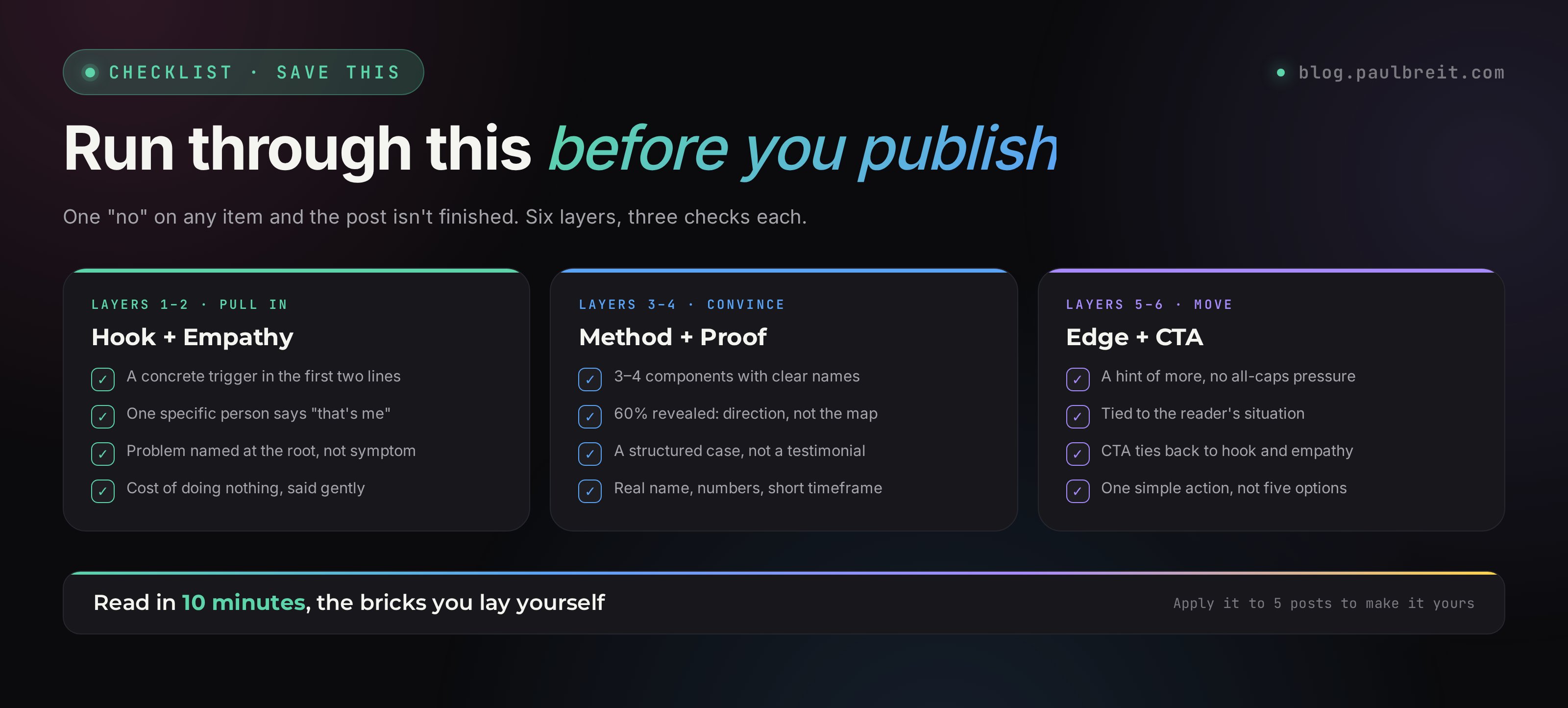
Layer 1. The hook
- The first two lines have a concrete "trigger" – a number, a paradox, a painful question
- You can picture a specific person who'd say "oh, that's me"
- The hook is specific to your niche, not universal
Layer 2. Empathy
- The problem is described so the reader recognizes themselves
- The root is shown, not the symptom
- It's explained why people can't see the problem themselves
- The cost of doing nothing is mentioned gently, without fear-mongering
Layer 3. The method
- 3–4 components with clear names
- Each component has its core, its importance, an example, and a common mistake
- 60% is revealed – there's direction, but you can't walk the whole path without a guide
Layer 4. Social proof
- A structured case study – Who, What it was, What we did, What it became
- Concrete numbers and timeframes
- The name is real (with permission), not "Mary from somewhere"
Layer 5. The edge
- There's a hint that there's more beyond the post
- No aggression or all-caps
- Tied to the reader's specific situation
Layer 6. CTA
- Tied to the problem from the hook and empathy
- It's described what exactly happens after the click / message
- One simple action – a single concrete move, not "pick from 5 options"
Section 06How to start applying this today
Knowing the pyramid without practice is just pretty theory. For the pyramid to start selling, you need to apply it to at least 5 posts. Fewer and you won't manage to find your own style and your own phrasing.
Step 1. Take your strongest post
Open your feed and find the post that got the most reactions. That's a post that already has a seed – the topic, the voice, the point of view. Now you rewrite it along the pyramid.
Step 2. Break it down into the 6 layers
Read your post and mark where you have the hook, where empathy, where method, where the case study, where the edge, where the CTA. Most likely you'll find that 2–3 layers are missing. That's normal – we write it again.
Step 3. Write the missing layers
No hook? Add a strong first line using the 4 formulas above. Empathy too short? Flesh it out with the 4 steps. No case study? Recall one client and describe them with the template. No CTA? Add a soft offer of an action.
Step 4. Publish and compare the result
Publish the updated version (or a new post in this structure – not a duplicate on the feed). Measure: number of DMs with questions, link clicks, consultation requests. Compare it to your usual posts.
Step 5. Repeat 5 times
After 5 posts along the pyramid, you'll develop your own version of the structure – with your voice, your phrasing, your case studies. After that the pyramid becomes automatic – you'll write this way without thinking.
Content isn't entertainment for your followers, and it isn't a display of your knowledge. If you want content that sells, it has to make the reader want to act. When a person finishes your post, they should have one question: "So how do I do this in my case?" That's the difference between interesting content and content that brings clients.
You can grasp the idea in a 10-minute read. Applying it in your niche is another thing entirely: the hook has to be specific, your audience's objections closed, their pains and fears accounted for. The pyramid is a universal frame. The bricks, everyone assembles for themselves.
FAQFrequently asked questions
Can the pyramid be used in short posts?
Yes. 6 layers does not mean 6 paragraphs – in a short 500-character post they compress into 2–3 lines per layer.
Does the pyramid work for reels and stories?
It works, but it gets compressed. In a reel the hook is the first second, the method is 20 seconds, and social proof and CTA are the finale.
How many pyramid posts should I write per month?
1–2 per week is enough. The rest of your posts are normal delivery without all 6 layers. Otherwise your audience gets tired of being sold to.
What if I have no social proof – I barely have clients yet?
Use mini-cases (a one-line testimonial), client results, numbers from your own practice. A full case study is not the only format.