Fast launch to your own audience: 5 days to your first $2K-3K
The simplest way to generate money right now is not to build funnels or buy ads – it's to run a launch to your warm base. 5 posts, DMs to commenters, sales calls. It works even at a combined reach of 50+ people. A ready-made plan with post and message templates.
A launch to your own audience is the most underrated way to make money in an online business. You don't need to write lead magnets, record lessons, build a bot, or buy ads. It's enough to invite people to a free consultation, get on a call, and sell. I have cases where experts made $2K-3K in sales with a combined reach of just 50 people.
Here's what you walk away with. An offer tested on a warm audience. A sales model built around calls. Your first money. An up-to-date list of your clients' objections – which you'll use to build your funnel and content. Plus it's free: if the offer doesn't land, you lose nothing but time.
* Below: the full 5-day launch plan day by day, post and stories templates, the scheme for amplifying through direct messages to commenters, and a ready DM dialogue for turning interest into a call. No fluff.
What's inside
- What you need ready before you start the launch
- One-on-one work or a group – the key decision
- Timeline and parallel platforms
- Day 1. Expose the pain
- Day 2. Show the solution
- Day 3. Your own case
- Day 4. Tease the product idea
- Day 5. Invite to a consultation
- Amplify through DMs: a conversation template
- What to do on the call itself
- 5 mistakes that kill a launch
- What to do after the launch
Section 01What you need ready before you start the launch
Before you sit down to write your first post, check that you have the minimum foundation in place. Otherwise the launch turns into a shot into the void.
Minimum requirements
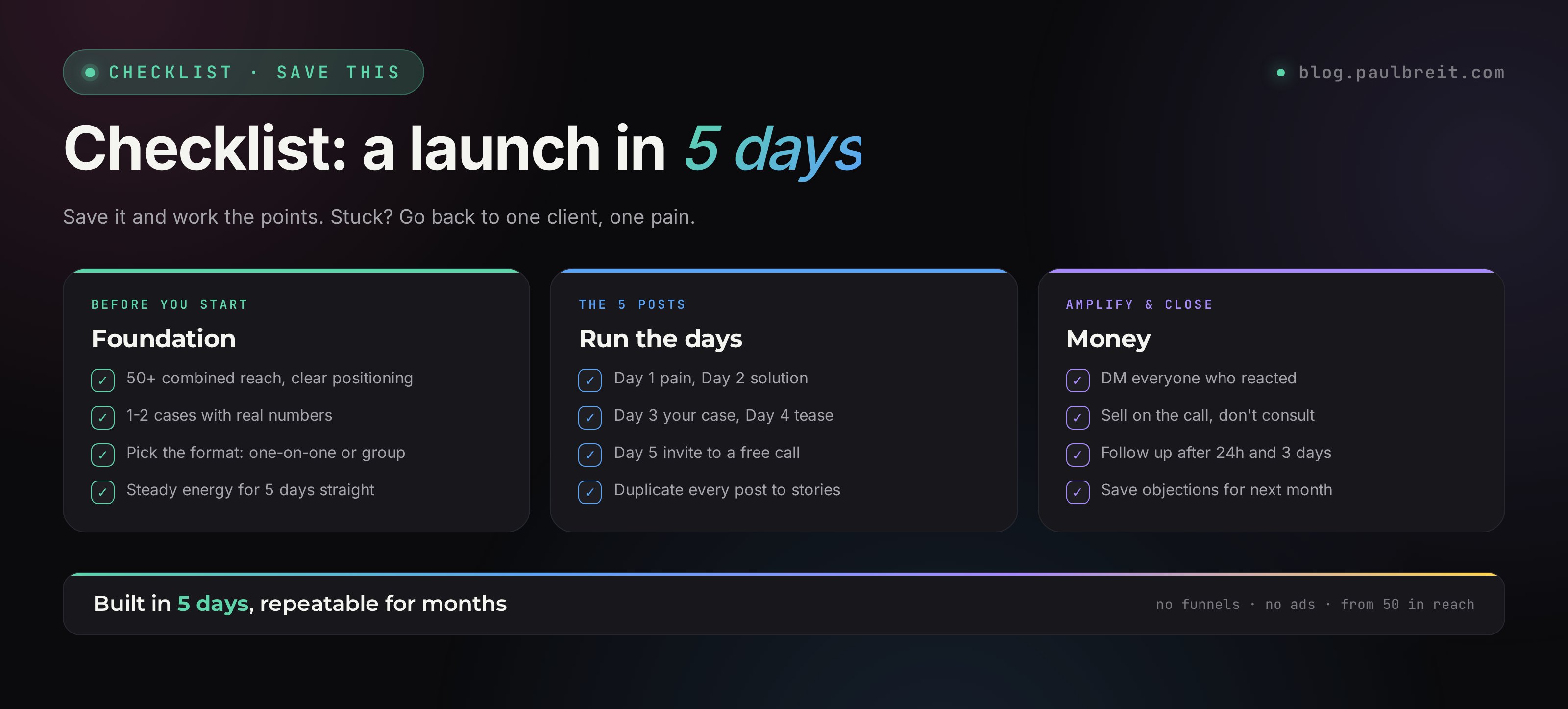
- A combined reach of 50+ people across all your social channels (Telegram + Instagram + Meta). If it's less, the launch will give a symbolic result – better to grow the base first through outreach and active touchpoints
- Clear positioning – one sentence on who you help and to what result. Without it, the very first question ("so what do you sell?") kills the conversation. If you don't have a niche yet, go through the separate guide on choosing a niche
- 1-2 cases with numbers – real clients with a measurable result. This is your ammunition for days two and three of the launch. Without cases, the launch leans only on your authority, which is weaker
- A steady emotional state – launching 5 days in a row takes energy and visibility. If you're burned out or in a crisis, push the launch back 1-2 weeks
At a reach of 50-100, a typical launch result is 1-3 sales at a price of $700-2K. At 500+ reach, 5-10 sales. At 2,000+ reach, 15-30 sales. Don't expect six-figure launches from 50 in reach – but $2K-3K at that reach is a perfectly realistic number if the offer is strong.
Section 02One-on-one work or a group – the key decision
Before you start the launch, decide on the format of your product.
One-on-one work
The simplest format to start with. You can begin working with a client right after payment, with no need to wait for a group to fill. Downside: scaling runs into your own time. At 5-7 parallel clients, that's the ceiling before burnout.
Good if you're just starting out and want to collect cases fast. Price point: $700-3K for 1-3 months of work.
Group format
A cohort of 5-20 people, starting on a specific date. On your calls, you name that date to clients. Downsides: you have to wait for the start date (often 2-4 weeks from when sales close), and clients have time to change their minds. Upsides: scalability, higher total revenue per launch, and easier on burnout (one prep cycle = many clients).
Good if you already have a program or format you've refined. The price per participant is usually lower than one-on-one work ($400-1K), but enough cohorts add up to higher total income.
If you're launching for the first time, sell one-on-one work. Simplicity. If you've already had 5+ paying clients and you can see the patterns, try a group. Don't try to start with a group launch without experience selling one-on-one.
Section 03Timeline and parallel platforms
The launch itself runs for 5 days. Plus 2-3 days to prepare (write post drafts, lock in dates, prepare the offer). Plus time for calls after the launch (usually 1-2 weeks).
When to set the program start date
If you're selling a group format, add 2-3 weeks to today's date and set the start date to either that day or the nearest Monday after it. That's enough for the full cycle: prep → launch → calls → payments → start.
Parallel platforms
Run the launch everywhere you have an audience at once:
- Telegram – posts to your channel. The fastest feedback
- Instagram – feed posts + duplicating to stories. Not everyone reads posts, so stories are a must
- Meta – posts to your page + stories. Same as Instagram. You can also run lead-gen ads in parallel – warm follow requests for a few cents per lead
- Threads – repost if you have an account there
- Live – go live wherever your most active audience is. I host my lives on my Telegram channel
Email / bot broadcast
If you have a subscriber base in a bot or email list, add a broadcast with a link to the post in your channel. Text: "A new post just went up on the blog on this topic, worth reading now – there's a logical follow-up coming." No spammy phrasing – just a useful heads-up.
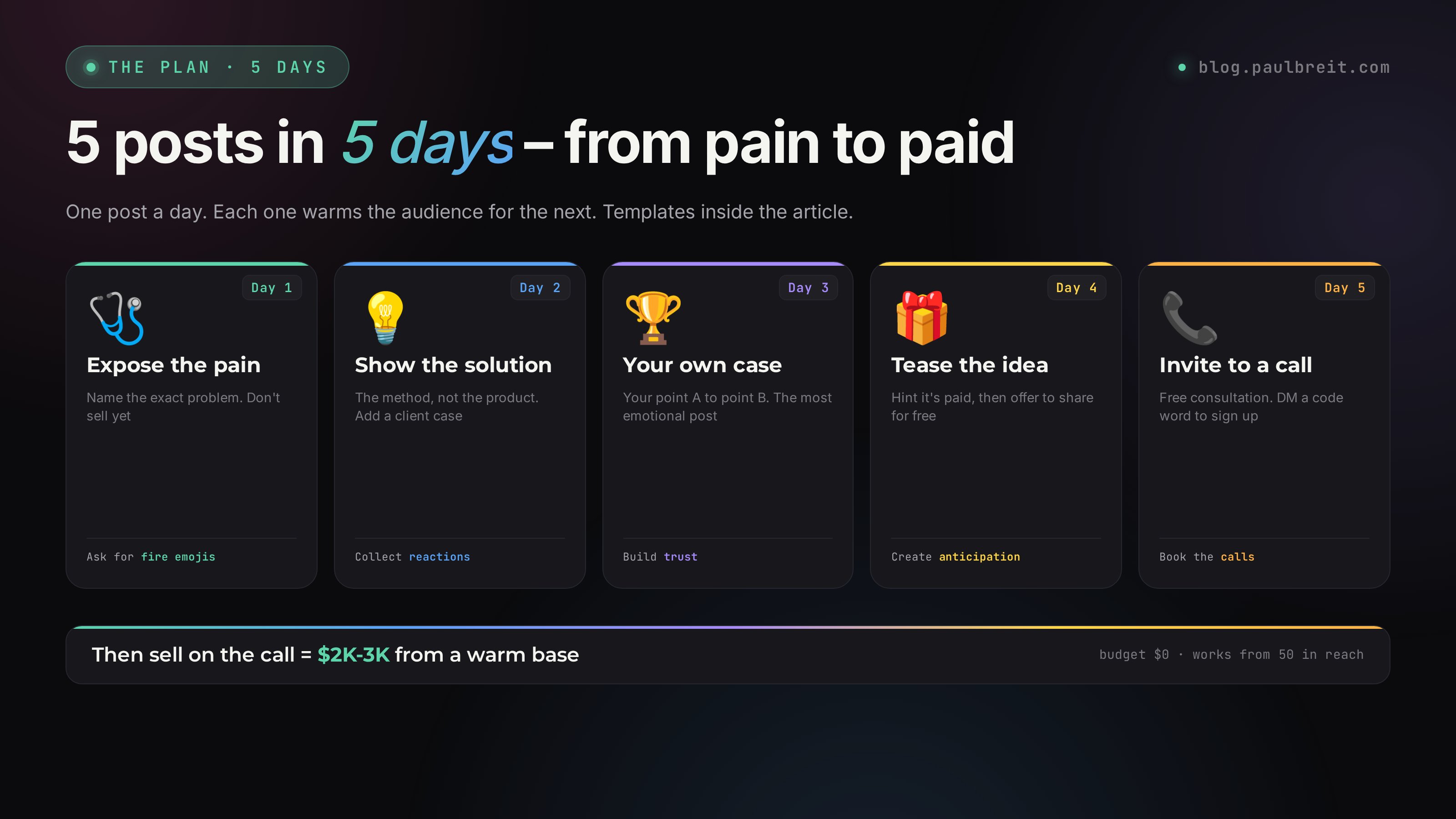
Day 1Expose the pain
The goal of day one is to declare the topic and expose the pain your product solves. Don't sell, don't mention the product. Just show the pain in all its sharpness.
Publication format
A standalone post and/or a stories series. Post length: 800-1500 characters. Stories: 5-8 frames in one series.
Day 1 post structure
A specific pain scenario
Describe the situation your client actually lives in. Not the abstract "no sales," but something concrete: "You've been writing content for 2 years, your reach drops every month, and the only DMs you get are people asking for a free consultation."
What happens if it goes unsolved
Show the cost of inaction. "If you leave it as is, a year from now you'll still be writing, spending time, stressing, and the only thing that will have changed is your burnout. Your income stays the same."
The emotional layer
Highlight the feelings. "It's infuriating. Especially when you see others making sales with the same effort or less." Normalizing emotions is an important part. The client feels "they get me."
A call to drop reactions
"If this resonates, drop some fire emojis. Tomorrow I'll tell you how I pulled myself out of it." This is both a metric of interest and an entry point for amplifying through DMs (days 4-5).
Example topic for day 1
If you're selling a product about ads, write a post about why selling only to your own audience is a problem (it runs out sooner or later), and why depending on a single channel is dangerous, especially broadcasts and outreach (they work worse every month).
If you're selling a product about content, tell the story of how it infuriated you to run a blog consistently and grow followers while making fewer sales than competitors with channels 2-3 times smaller than yours. How it triggered you, how long you tried to figure it out, the consultations you booked, the courses you took. No reveal of the insight – just the pain.
Day 2Show the solution
You've exposed the pain. Day 2 is about showing that you have a solution. But not the product. Just the approach itself, the method, the direction.
Day 2 post structure
Reference yesterday's reaction
"Yesterday you dropped a lot of fire emojis under the post about [pain]. I see the interest – let's keep going." This creates the feeling of a conversation with your audience, not a monologue into the void.
Show the approach (not the product)
"I have a simple model for running a blog day to day that solves [pain from day 1]." No program name, no price. Just the idea of the method.
A client case
If you have one, show 1-2 clients this approach helped. Use the formula "Who – What it was like – What they did – What it became." Not just "here's point A, here's B," but with the nuances: what difficulties they ran into, how they solved them. This builds trust.
Fire emojis again
"Drop a fire emoji if this resonates." We keep collecting the people who react – they'll be our "leads" at the DM stage.
You can skip the case and lean only on your own experience. But then you absolutely have to focus on your story in day 3 (which is exactly about that). Cases give social proof, your personal story gives author authority. One of the two needs to be strong.
Day 3Your own case
Day 3 is your personal story. How you yourself arrived at what you're going to offer. No product announcement yet – just the story.
Day 3 post structure
Your own point A
What your situation was before you found the solution. Specific numbers, specific feelings. "I wrote 3 posts a week for 2 years and made $550/mo. It was infuriating."
The turning point
What you realized / found / bought / tried that changed your approach. "One day I came across model X. At first I didn't believe it. I tried it – it worked."
Point B
Where you ended up after 3-6-12 months of applying the approach. Specific numbers (income, reach, conversion). And the emotional component is a must – the "new state" you arrived at. Not just money, but a sense of freedom / calm / confidence.
The finish – fire emojis
"If what I'm writing resonates, drop a fire emoji. Tomorrow there's something important."
This post is the most emotional in the whole series. Here the reader should feel that you're a real person with a real journey, not a blogger with theory.
Day 4Tease the product idea
Day 4 is a double day. In the morning, a reference to the accumulated interest. In the evening, an announcement that tomorrow you'll cover "how to get this."
Morning post (10:00-12:00)
Reference the reactions
"Over these 3 days, there have been more than [N] fire emojis under the posts. I can see this topic really resonates."
Hint at exclusivity
"All these transformations for me and my clients come from specific knowledge and tools. I only share them with my clients. Paid."
The free idea
"But I'm seeing a lot of interest. I'm thinking I could share a few tips for free. If you're interested, drop a fire emoji."
Evening post (18:00-20:00)
"Thanks for the reactions – there are a lot of them. Tomorrow I'll tell you how to get the distilled version of my experience for free."
This post is short – 200-400 characters. Its job is to raise anticipation for tomorrow's announcement and bring people back.
Day 5Invite to a consultation
Day 5 is the actual announcement of consultations. Here you finally say: "You can book a free call with me."
Day 5 post structure
What the consultation is
"I run a free consultation for anyone who has a need around [the specific pain from day 1]."
The result of the consultation
"In 60 minutes we'll break down your situation and put together a concrete 30-day action plan."
Who it's for
Specific criteria. "It's for you if you're [X], you've already done [Y], and you want [Z]." Not "for everyone" – for a specific type.
Urgency
"Spots are limited – max 7 people this week. Sign up right now."
The action
"DM me the code word START and I'll send the details." A code word works 3-5 times better than a direct link to a form, because it makes the person commit to a micro-action.
Don't send people off to fill out forms. Every extra step at this stage means losing leads. Just have them DM you. From there you'll figure out in the conversation who they are and whether they're a fit to work with.
Section 04Amplify through DMs: a conversation template
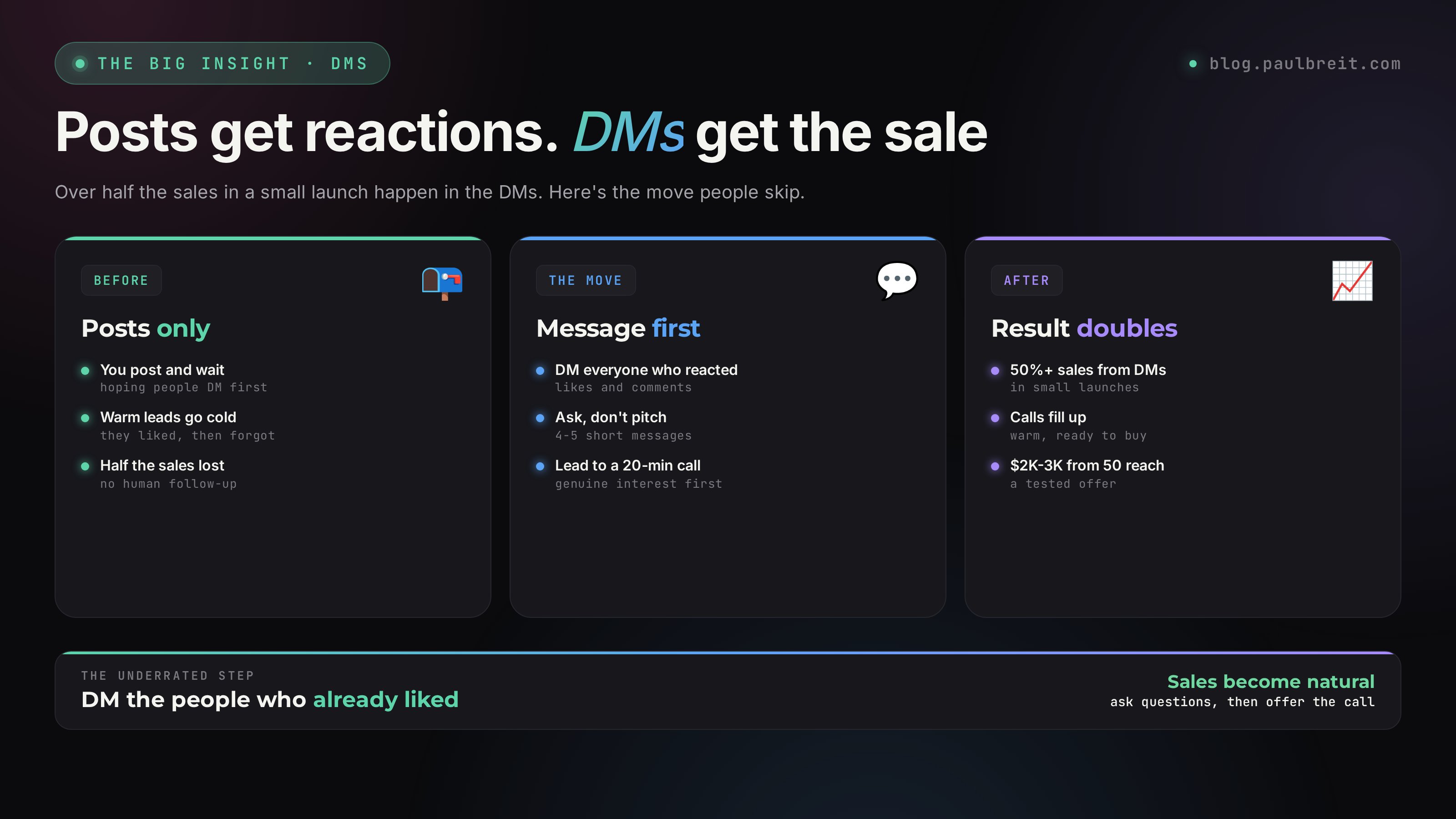
At this point you have your day-5 post and a list of everyone who reacted over the 5 days – dropped fire emojis and commented. Next comes the most underrated step, the one that doubles your launch result.
What to do
DM everyone who liked and commented on your posts during the launch. Don't wait for them to message you first – act first.
Where you can see who liked
- Telegram – you can't see the names of people who reacted to a post. You only see those who commented. Message them
- Instagram – you see everyone who liked and commented. The biggest base for personal touchpoints
- Meta – same as Instagram, you see everyone
- Threads – you see the reactions, you can message everyone
DM conversation template
Starting the conversation
"Hey [name]! I saw you liked the post about the chance to book a consultation with me. Just curious, did you like it casually, or would you actually be interested in getting on a call with me?"
Learn the request
"Awesome! So what do you do? Why did the consultation catch your eye?"
Leading toward a call
"You work with mindset? Love it! I actually just built a funnel for a client in a similar niche, and the result came out really strong. How are your sales set up right now?"
Tying it to the pain
"Through networking? Oh, great tool. I use it too. Have you tried running ads or building funnels?"
The direct offer
"No results from it? Listen, we can hop on a call for about 20 minutes. I'm 100% sure your services can be sold to a cold audience. I built a funnel for a similar field, and it returns 5x on ad spend. On the call I can show you how it works and how to adapt it to you. Does tomorrow at 2pm work?"
This sequence isn't "hard-selling." It's a smooth series of 4-5 short messages with genuine interest in the person. If you ask questions and listen to the answers, the sale becomes natural. If you go straight to "buy a consultation" in the first message, the person shuts down.
Section 05What to do on the call itself
Once a lead agrees to a call, you work through the structure of a sales consultation. A detailed breakdown is in the separate guide. Here's a short checklist in case it's your first time.
Structure of a 60-minute call
- Build rapport – 3 minutes. Ask about their time and how they like to communicate, mention you're recording for your own review
- Uncover the request – 7-10 minutes. What the person wants, in what numbers, by what deadline
- Surface the desires – 15 minutes. Going deeper through "why it matters." Finding the true motivation
- Summarize and make the offer – 15 minutes. Reflect the client's words back + your offer with price and terms
- Close the deal – 10 minutes. A direct offer to pay the deposit, handling objections
- After the call – follow up with a template after 24 hours and after 3 days
The main rule
On a free consultation within a launch, you sell – you don't consult. Don't drift into advice and recommendations – that kills the motivation to buy. The goal of the call is to sell your program, not to "help for free."
Section 065 mistakes that kill a launch
Mistake 1. Announcing the product on day 1
"Hey! I've got a launch coming for program X at $1K, read on." This kills all 5 days in advance. The audience instantly understands "they're selling" and shuts down. The pain and the solution have to be revealed gradually, without pressure.
Mistake 2. Skipping day 4 (the double day)
Day 4 seems unnecessary – "we already had a case in day 2 and my case in day 3, why another day?" Why: to build anticipation. Without day 4, the announcement on day 5 feels like an abrupt jump from "yesterday it was stories" to "today buy."
Mistake 3. Ignoring stories
Part of your audience doesn't read posts but watches stories. If the launch runs only in posts, you lose 30-50% of potential leads. Duplicate every post into stories as a 5-7 frame series.
Mistake 4. Not sending DMs
The most expensive mistake. The leads who dropped fire emojis but didn't come on their own are exactly the ones who need that extra human touch. 50%+ of sales in small launches happen through DMs, not through posts.
Mistake 5. Launching without a niche
If your day-1 post is written for "everyone," your day-2 case is for other people, and your day-5 offer is for a third group, the launch fails. All 5 days have to be built around one type of client and one pain. If you try to sell to everyone, you sell to no one.
Section 07What to do after the launch
The launch is over. Some people bought, some are at the "thinking about it" stage, some didn't react. Here's what to do next.
Follow up with the "thinkers"
For anyone who said "I need to think about it" on the call, send a short reminder after 24 hours about the bonuses and the deadline. After 3 days, one more. If they don't reply, leave them alone – some will come back on their own in 2-4 weeks.
Analyze the objections
Write down every objection you heard on 5-10 calls. This is your gold for next month's content. How to turn each objection into a ready breakdown post – that's prompt 9 from the collection 10 prompts for an expert. Each common objection becomes a separate post where you close it. By the next launch there will be fewer objections.
Turning the launch into a system
One launch is an experiment. A system is created by repeatability. A month later, repeat the launch – on the same scheme, but with an updated case, an updated offer, and new pains from your DMs. After 3-4 launches you'll understand what works for your audience, and you'll be able to build a full auto-funnel based on those observations – it's broken down step by step in the guide to the 5-stage expert funnel.
A fast launch isn't a "temporary solution until I build a funnel." It's a full-fledged sales channel that brings in money for months and years with a warm audience. Many experts live on monthly launches with this scheme without any automation. You can build a funnel on top of launches, but not instead of them – the launch gives you fast feedback and fast money, which you then invest into more complex systems.
FAQFrequently asked questions
How many followers do you need for a launch to work?
From 50 people in total reach. I have cases of experts making $2K-3K in sales with a reach of 50 people.
What should you sell on a launch – one-on-one work or a group?
On your first launch, sell one-on-one work. Higher price point, easier to convey the value, no group needed. You run a group once you already have a waitlist.
And if the offer doesn't land, then what?
You get a current list of your audience's objections for free. You'll use them to build a proper funnel and content.
Do you need to prepare a lead magnet before the launch?
No. There is no lead magnet at all in this approach. You invite people to a free consultation through posts, then sell on the call.