Sales Call Script: how to close at least 6 out of 10 calls
The complete free sales-call script I arrived at over 8 years of working with experts. A 7-block structure, 13 ready-made objection responses, and tips on how to sell at a high conversion rate without burning out. One of the most battle-tested resources from my school.
Below is the complete free sales-call script that works for me and dozens of my clients. I arrived at it after trying dozens of sales models and buying a good ten courses and consultations. One important caveat up front: I don't follow this plan word for word – I adapt the structure to the situation and to what the person in front of me actually wants.
Sometimes people show up who have already studied my blog and my product page inside out and just say they want to buy. Then I simply ask what they do, what they sell, what their goal is, where they're stuck – and if I see that my product fits, I tell them how to work with me. The call takes 20 minutes.
Sometimes people show up who don't understand at all what my method is built on. With them I have to dig deeper – a call like that can run over an hour. And sometimes within the first few minutes I realize the person's request isn't a fit, or that I don't want to work with them. Then I give a couple of recommendations, wish them a good day, and wrap up in 10 minutes.
* What follows is a universal framework. Your job is to adapt it to the situation as the conversation goes. Sometimes you can skip a couple of blocks because they're not relevant for this person. And sometimes you add something of your own if you can see it'll help the sale. Plus a separate section: 13 ready-made answers to the most common objections.
What's inside
- How a person ends up on the call
- How to raise your show-up rate
- Prepping for the call: where, how, in what
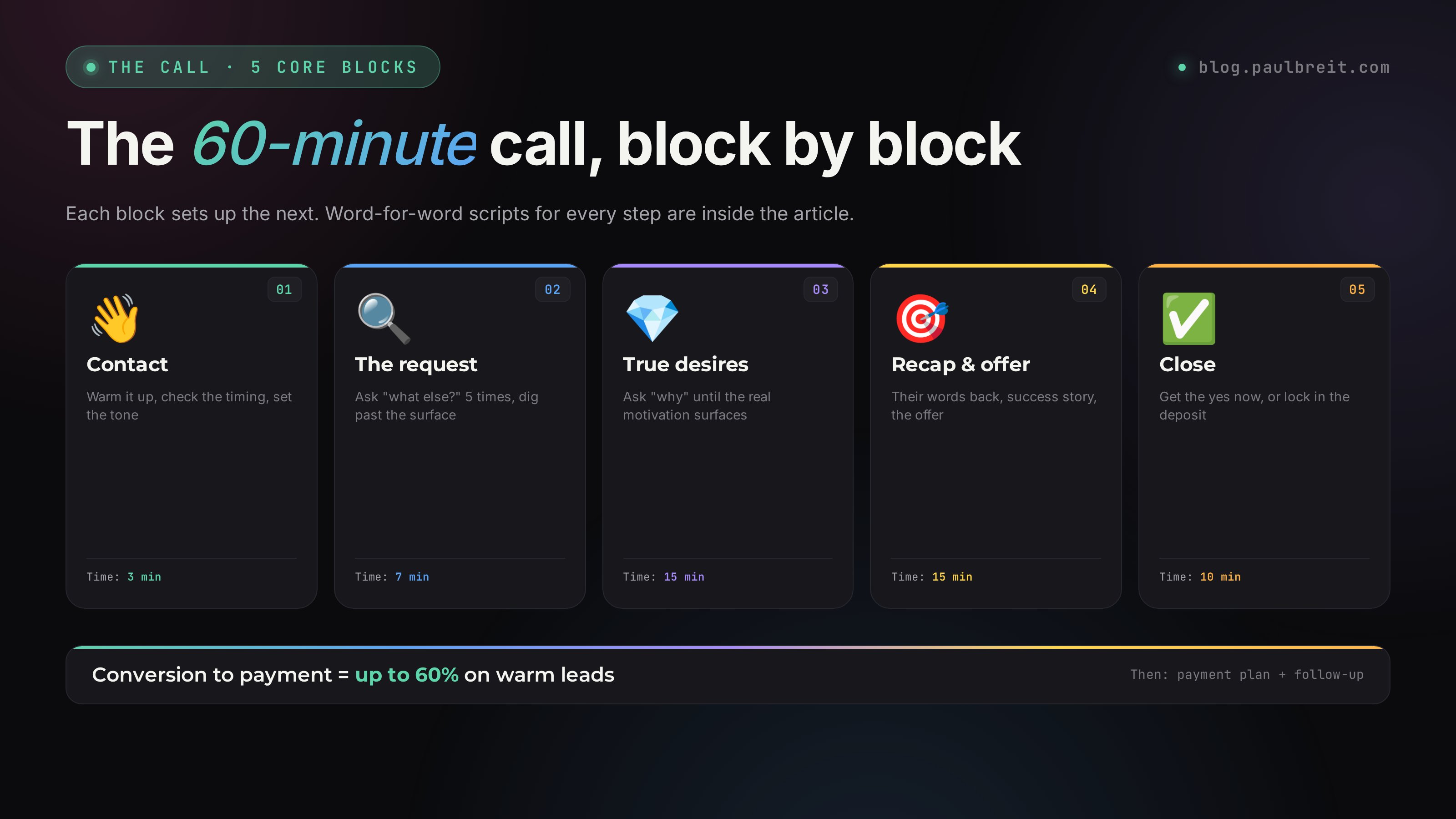
- Block 1. Establishing contact – 3 minutes
- Block 2. Surfacing the request – 7 minutes
- Block 3. Uncovering true desires – 15 minutes
- Block 4. Recap and offer – 15 minutes
- Block 5. Closing the deal and the deposit – 10 minutes
- Block 6. After the call: payment plan, follow-up
- 13 ready-made objection responses
- 7 rules for selling without burnout
- Tools: call log, Notion template, metrics
- The top mistakes experts make on sales calls
- Sales-call FAQ: common situations
- What's next: automation, the warm-up sequence
Section 01How a person ends up on the call
The call itself sits at the very end of the funnel, almost at the finish line. By the time we talk, the person is already warmed up: they saw the ad, watched my lessons, and asked for a session on their own. That's why it sells so easily. Here's the whole path, step by step.
The person sees an ad
Google and search ads, Telegram channel placements, paid social. All of it points to a single landing page.
They click and pick a messenger
They land on the application page, choose a convenient messenger, and activate a bot.
The bot delivers a free lesson series
The bot immediately sends a series of lessons. The person watches them, warms up, and sees what the method can do.
They book a session
Inside the lessons and in the bot's messages there's an invitation to a free session. The person fills out an application form.
We pick a time and sell
We message the person, agree on a convenient time, get on a call – and from there the script takes over, the one I break down below.
The key idea: the person who shows up to the call is a warm lead who already watched the lessons and raised their hand. The funnel before the call does half the work for you.
Section 02How to raise your show-up rate
Some of the people who book never show. And the show-up rate is straight money: the more people who show, the more sales you get from the same ad budget. Here's what lifts it.
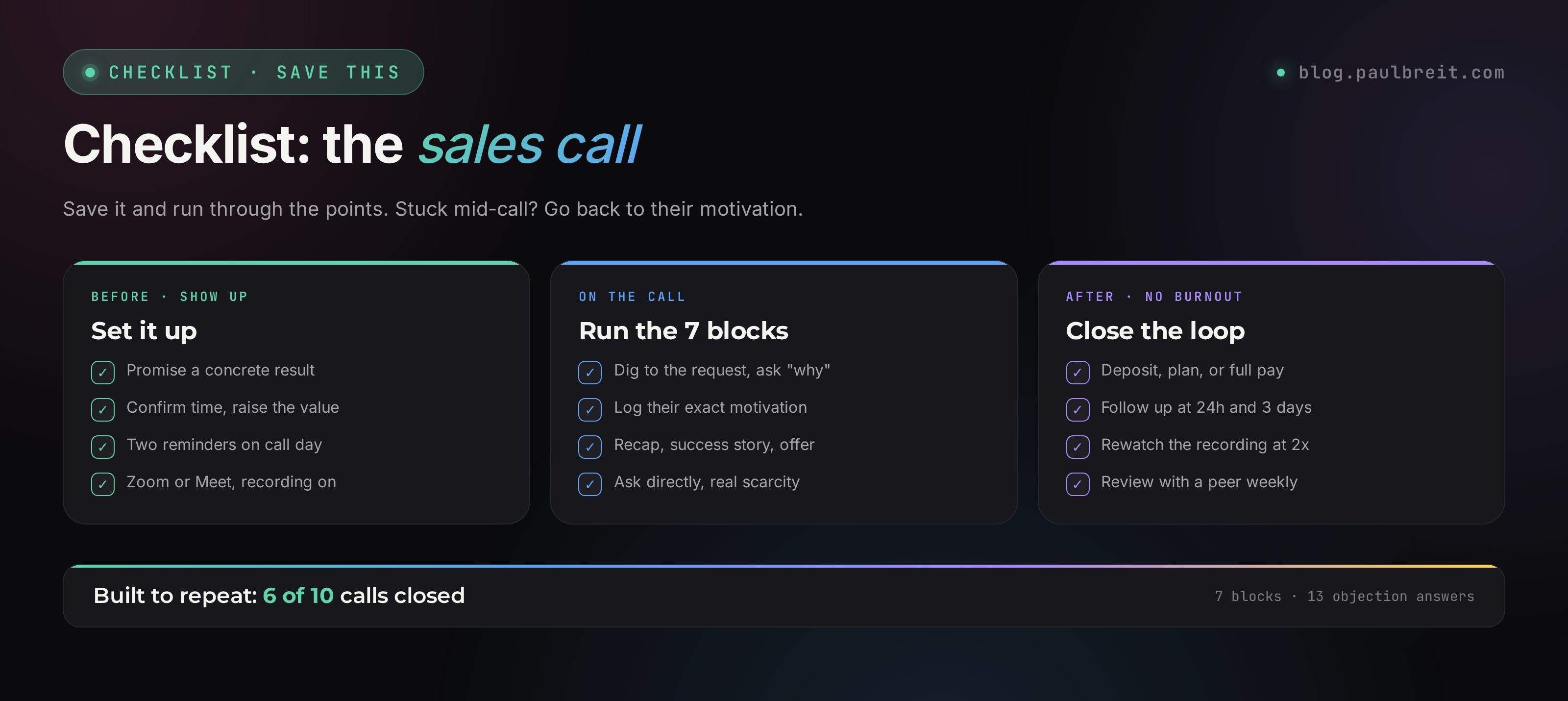
Promise a concrete result
The word "consultation" sounds vague and commits to nothing. So I always spell out in detail what the person gets in the session: a step-by-step action plan for their project, answers to all their questions, a breakdown of their specific situation. The more concrete the promise, the higher the show-up rate.
And I repeat it at every touchpoint: in the lessons themselves (the lead magnet), on the application page, and in the first message I send in DMs right after they sign up.
Lock in the booking and raise its value
Right after they sign up, I message the person: time's confirmed, all set, set a reminder or an alarm. And I add something important – you can get a free session only once; after that it's paid. That raises the value of the meeting, and the person treats it with more care.
Remind them on the day of the call
Always two reminders on call day: in the morning and again an hour before the start. Without them you lose a noticeable chunk of the people who signed up – they simply forgot, got distracted, mixed up the time. A reminder is the cheapest way to raise your show-up rate.
You can sell with this script yourself, or you can hand it to a team – train reps and give them the calls (how to set that up is covered in the section on delegation below). The structure stays the same.
And it works in almost any niche: marketing, hands-on experts, therapists, coaches, tutors, trainers, and so on. The details and examples change; the logic of the conversation stays.
Section 03Prepping for the call: where, how, in what
Before we get into structure – a few words on the technical prep. It matters more than you'd think: first impression, trust, the other person's focus.
What to call on
I run all my calls on Zoom or Google Meet – the two solid options for 2026. Both give stable video, screen sharing, and recording with built-in tools.
Zoom is my main pick. The most stable, easy recording, easy screen sharing. The free 40-minute limit won't cut it for a sales call, but the basic paid plan solves that.
Google Meet works straight from the browser with nothing to download – you just click a link and you're in. Great if the other person isn't tech-confident, since there's nothing to install.
Recording the call is a must. Not as leverage, but for self-review. After the call I rewatch on fast-forward, looking for where I slipped, where I didn't push hard enough, where I handled an objection right. It's the fastest way to learn to sell.
Your look and background
You don't have to look like a YouTube star – but you can't put people off either. Clean shirt, hair combed, in the camera's focus, neutral background. Dusty bookshelves and socks lying around behind you – no.
If the background isn't ideal, Zoom has blur built in. Turn it on with one click. A virtual background is also an option, but it often glitches around the edges, and that's distracting. Blur is better.
What to set up 5 minutes before the call
- Test your camera and mic (Zoom does it automatically, but it's better to see it with your own eyes)
- Open your call log in Notion to take notes (there's a separate section on this below)
- Open your ad account / case-studies page / product landing page in the background – so you're not hunting for it mid-call when you need to show something
- A glass of water nearby – a simple thing, but without it your voice gives out after 40 minutes of talking
- Notifications off, door closed, cats out of the room
Block 1Establishing contact – 3 minutes
Goal of this block: take the edge off, move the conversation into a warm register, find out the timing.
"Hey! Good to meet you. My name's Paul, and you're [NAME], right? Quick one before we dive in – do you have a full hour free for this call?"
Why find out the timing right away
Some people block out only 15-20 minutes for a session. They've got a meeting in an hour, need to pick up a kid from daycare, or have something else pressing. Even when I warn them in advance to "set aside an hour," some still show up with a 15-minute window.
If there's no hour, it's better to reschedule the call. A rushed call rarely ends in a sale: either you don't dig down to the real request, or you don't have time to make a proper offer.
Build the rapport early
The first couple of minutes set the tone. A bit of small talk, a genuine "where are you calling from?", a quick laugh – it lowers the guard. People buy from people they're comfortable with, and comfort starts before you ever talk business. Don't rush past this; just don't drag it out either.
Block 2Surfacing the request – 7 minutes
Goal: understand what the person actually needs. Not what they said in their first sentence, but what's behind it.
"Great. So tell me – what's your request for this call with me? What would you like to figure out or work through? And I'll be taking notes the whole time, so don't be thrown off if I'm typing now and then."
Important: say out loud that you're taking notes in your log. Otherwise the person will think you're getting distracted by your own stuff.
The main rule – dig down to the depth
The person's first 3 answers are usually surface-level, in general terms. "I want more clients," "I want to raise my rates," "I want scale." That's not a request, that's a phrasing of a wish.
You ask "what else matters?" at least 5 times. Each time digging down to specifics:
- "How much do you want to earn?"
- "How many clients do you want to run at once?"
- "At what price point do you want to work?"
- "How many hours a week are you ready to put in?"
- "What result do you want to get your clients to?"
An example of unpacking the request
– I want to make $2K a month.
– Got it. How many people is that, at what price, how much time per client?
– I want 5 people at $400 each.
– Why 5 at $400 and not 3 at $700?
– I believe knowledge should be accessible.
– Got it. And why only 5 hours a week?
– I have 2 kids.
– Got it. What result do you want to get the people you mentor to?
– To earning $1,300+, ideally $2K+.
– Who do you see as your ideal client?
– Single moms.
– Why them specifically?
– I'm raising my kids on my own, and I want to help women in the same spot.
– Does that idea just appeal to you, or does it light you up?
– It lights me up.
By this point I have a picture in my head: $2K of monthly income from 5 clients × $400, a single mom, target audience is moms just like her, and the idea lights her up. Thirty minutes later, at the offer, I'll be able to lean on exactly this – her energizing idea, not the abstract "$2K."
Why the same offer doesn't fit everyone
I dig this deep not out of curiosity. Without it I'd hand the person a solution that only partly fits them. Simple example. I sell sales mentorship for specialists in beauty and wellness. I get on a call with a 60-year-old massage therapist who's never run social media and doesn't want to – I'll offer him one promotion path. And with a 20-year-old nail tech who pumps out reels every day – a completely different one. To avoid pitching reels to the massage therapist and a website with paid search ads to the young woman, you first have to understand what matters to each of them.
I don't argue and I don't push my own view. I don't tell the young woman that design mentorship could sell for $1,300 too. I take her request and adapt my experience to it. At the offer it sounds like this: "Here's the plan we'll use to launch your mentorship and set up ads targeting single moms. You'll be able to steadily take 5 women a month at $400 and help them support themselves and their kids." And the woman replies: "That's exactly what I need." When a person hears their own desire, the sale goes easy.
Block 3Uncovering true desires – 15 minutes
Goal: find the beliefs the person holds onto. Understand what drives them and what I'll be able to hook into at the offer.
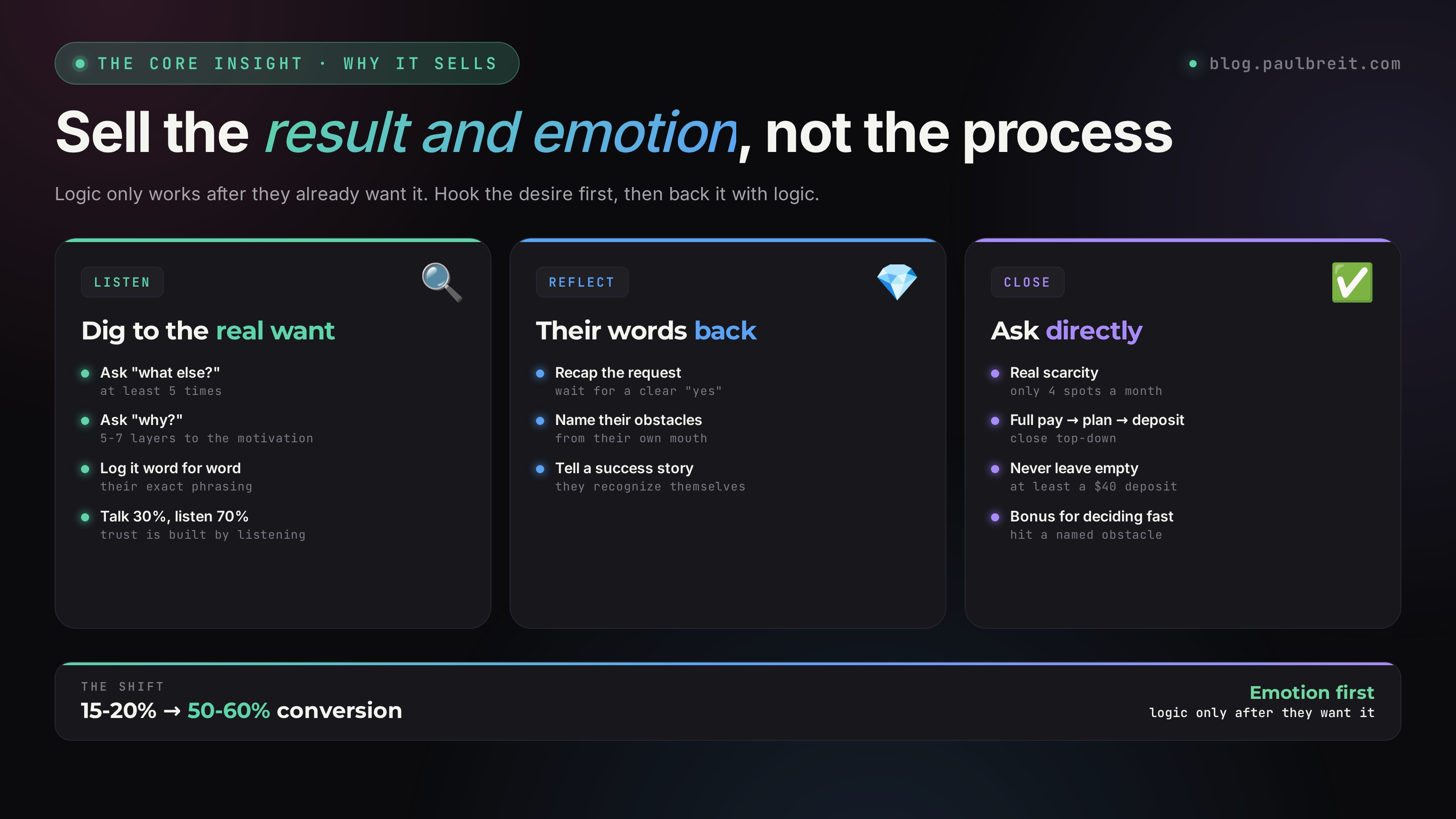
The key here is to ask "why." Not "what," but "why." "Why 5 clients and not 3?", "why $2K and not $1,300?", "why moms and not all women in general?".
Each "why" opens the next layer. After 5-7 "why"s we reach the real motivation – usually either an emotional experience from the past or a dream that lights them up right now.
What to do with the motivation you find
Write the exact wording into your call log. Word for word. In the offer block 30 minutes later you'll come back to that wording: "Remember you said this idea lights you up? Well, my offer helps you do exactly that – help other moms, like you." A hook straight into the heart of the motivation.
For the first couple of years I leaned on logic: I showed the funnel, walked through the process, opened up ad accounts. Conversion stuck at 15-20%. That didn't satisfy me, so I started buying up sales consultations from people who sell at higher prices and better than me – I wanted to understand what they did differently. The answer turned out simple: strong sellers press on the result and on emotion, while all that time I'd been loading the other person up with process and logic. Once I started shifting the emphasis to result and emotion – through stories, through the person's own energizing phrasing, through visualizing their new life a year from now – conversion climbed to 50-60%.
Logic is needed. But it only works after the person already wants it emotionally. First hook the desire, then back it with logic – not the other way around.
Pinning down the ideal path to the result – 5 minutes
Inside the 15-minute desires block there's a separate sub-section – how exactly the person wants to move toward the goal. Not just where, but through which channel.
"Okay. And how would you want to get there? Through a blog, an automated webinar, ads, referrals? How do you want sales to look? Do you run a blog right now? And how do you feel about Telegram – are you up for running a channel?"
Why this matters: sell people what they want. If they're scared of a blog, emphasize the automated funnel. If they already have a school, offer to amplify it, not "rebuild everything from scratch." If they run Instagram and are scared of Telegram, show how one feeds into the other.
– Do you run social right now?
– Yeah, I'm active on Instagram.
– Good. And how do you feel about Telegram?
– Not against it, I just don't get how to attract followers there.
– Got it. So if you solve the follower problem and figure out how to sell through Telegram – you'd basically be up for running it?
– Yeah, of course.
Now you have one more lever for the offer: "Remember you said you'd be up for running Telegram if you solved the traffic problem? Well, I happen to have a working setup for attracting people to TG."
Pinning down the obstacles – 5 minutes
The goal is to get the person to say out loud, to themselves, why they need a mentor. When a person hears their own obstacles from their own mouth, you save 30 minutes of arguing.
"And what's stopping you right now from getting to [result]? What have you already tried? What was the result? What didn't work for you? And where, the way you feel it, do you need help right now?"
– Have you already tried selling mentorship for moms?
– Only consultations.
– Got it. Why?
– I don't know how to sell at a high price.
– Understood. And if you learned that – is there anything else?
– I don't know how to build a program so the women don't drop off.
– Mm-hm. Anything else?
– That's about it.
We got two clear obstacles: doesn't know how to sell at a high price and doesn't know how to build a program with retention. Those are exactly the points you'll hit when you make the offer.
If the person doesn't say why X specifically matters to them, don't assume – ask directly. "And why is this specifically important?" is a normal question. "I'm guessing this matters to you because..." is the road to a miss and to losing trust.
Block 4Recap and offer – 15 minutes
Goal: give the person their own words back, show that you understood, and propose a solution.
Confirming the request – 1 minute
Before you make the offer, replay the person's request in their own words and wait for a clear "yes."
"Okay. Let's recap. Am I right that you want to launch mentorship for moms and help them earn $1,300+ a month, that you want to take 5 students a month, earn $2K, and put in 5 hours a week? You have experience running a blog, you enjoy it, and you're ready to try selling through consultations and run ads to your blog?"
This does two things. The person feels heard – trust grows. And if you got something slightly wrong, they'll correct it now – so you won't build the offer on faulty premises. Wait for the "yes" before moving on. Without confirmation, we don't move.
Confirming the obstacles – 1 minute
Right after the request – just as clearly, replay the obstacles the person named themselves.
"Great. And what's holding you back is that you don't know how to sell at a high price, and you don't know how to build a training program so the women don't drop off. Right?"
Again you wait for a "yes." Now you've got: the request, the motivation, the ideal path, the obstacles. And all of it comes from their words, not your guesses.
Stating your belief in the result – 1 minute
Before moving to the success story and the offer, briefly hand the person your confidence. It's an anchor you'll keep coming back to.
"Honestly, your goals are super realistic and doable. I believe in them 100%."
Short, no fluff. The main thing is that it's true. If the goal is unrealistic (say, "$600K in a month from scratch with no experience"), don't lie – gently adjust: "I think that's realistic in 12 months; in a month it's nearly impossible. Want me to show you how we could build the path there?"
The success story – 10 minutes
This is the heart of the offer. Not a lecture or a presentation, but a story – yours or a client's with a similar situation.
"Got it. Look, right now I've got [the fact that you have what the person wants + the upsides: independence, travel, an inspiring circle of people]. But I started with [a situation similar to the person's current one + the downsides]. Here's what I did: [the path you walked, with emphasis on the investment and the overlap with what they want]. Now I know exactly how to walk that path much faster. And helping my clients walk it is exactly what I do."
The story has 4 points:
- The result you have – the upsides, the lifestyle, the numbers
- Where you started – similar to the person, with the downsides of that state
- The path you walked – emphasizing the moments the person named in their own request
- How much you invested in learning before you found a working setup – this kills the person's fantasy of "I'll figure it out myself for free"
If you don't have personal experience in the person's topic, tell a client's story with the same characteristics. Word for word: "I had a client in a similar spot – two kids, 5 hours a week, a drive to help moms. In 2 months we got her to $2,400 with 6 students. Want me to tell you how exactly?"
Match the hero of the story to the person's niche. On a call with a therapist, I tell the story of my therapist client: what result she has now, where she started, what we did together. The person has to recognize themselves in the hero.
A story sells with emotion, not dry facts. So I paint point A concretely: "it was rough scrimping on groceries, and the fanciest vacation I took was a weekend at a cabin." And the path too: "I burned a ton of money on mentors, courses, and tests until I stumbled onto a working setup." Those details make the story real, and they also kill the person's fantasy of "I'll figure it out myself, for free."
The transition to the sale with limited spots – 1 minute
After the story – a short bridge. Not "so, let's move on to pricing," but a warm, personal offer.
"Look, I happen to have an opening right now to take one client into one-on-one work. I like the problems you're solving, and I'd like to work with you. I'm 100% sure you should go for it – I know exactly how to get you the result."
The limited spots matter here. Not invented – real. If you do one-on-one work, you can physically take, say, 4 people a month. That's what you say. Scarcity isn't manipulation if it's genuine.
Price and payment plan – 3 minutes
"Now I'll tell you how to do this and what it costs.
I work with you for two months. In that time we'll get to [the result the person stated].
The cost of this work is $5,000.
But a couple of things. This price is only good right now – I raise it every 2-4 weeks. And since I personally get involved with each person, I can take a limited number: only 4 people a month. Right now 2 spots are open. I have 3 more calls today and tomorrow.
But you don't need to pay the whole sum up front. You can go on a 24-month plan. In that case it's $210 a month. The first payment is only 30 days after we start. We start working, and you pay it off from money you've already earned.
So – do you think the [result] you'll reach working with me is worth $210 a month?"
Then you wait for their reaction. Usually they answer "yeah, I think so" or "probably, but it's a bit pricey." On a "yes," move to locking in intent and the bonus (see block 5). On "a bit pricey," move to handling objections.
Close in descending order: full payment → payment plan → deposit (booking). Don't offer the deposit first – the person will pick the minimum. Start at the top and only come down if resistance shows up.
The offer structure – the summary
- What working with me includes – specific modules, formats, duration
- What result you'll get – after 1 month / 3 months / the full period
- How it differs from the alternatives – DIY, courses, other mentors
- Social proof – 1-2 cases of similar clients with numbers
- Price – stated upfront, before any discounts
- Payment-plan terms – through a payment processor (see the separate guide) or in-house
- A bonus for deciding fast – an extra module / a money-back guarantee / special terms within 24 hours
In each of the 7 offer points, reference the person's motivation. "Within a month you'll have your first 2 clients from this audience – single moms, just like you described." Not just "you'll have clients," but specifically the clients they told you about.
Block 5Closing the deal and the deposit – 10 minutes
Goal: get a "yes" right now. If you can't get an outright "yes," at least get the deposit.
The direct ask
"Tell me, any remaining doubts or questions about my offer? No? Great. Let me send you the link for the deposit – $40. After the call I'll send the link for full payment and the payment plan. That way you can take your time choosing the option that works – pay the full sum or fill out the application for the plan."
What matters in this moment:
- The deposit is small – $20-40. Psychologically it's easier to "try" than to drop the whole sum at once
- The deposit is refundable if the person changes their mind – be sure to say this
- The deposit locks in the terms – price, bonuses, the timing. It's a "don't miss out" lever
If the person said "yes" – lock in the intent
Got a "yes" – don't pause and don't water down the moment. Offer payment right away and seal it with a bonus for being decisive.
"Awesome. Ready to lock in your intent? Yes? Good. So look – if you pay right now, as a bonus I'll give you access to my mastermind for mentors and experts. In it we [briefly sell the bonus idea: live breakdowns, networking, case reviews in the moment]. What's easier for you – setting up the payment plan or paying the full sum at once?"
The bonus has to hit precisely what the person named as an obstacle. Missing a peer circle – access to the mastermind. Scared of the tech – you promise help from a tech specialist. Doesn't understand how to set up ads – a "we'll set it up with you in the first week" package. The bonus has to be genuinely valuable, or it won't work.
And one more thing: don't let the person leave without a payment, a plan, or a deposit. After the call the emotions cool, and the person flakes with 90% probability. If full payment or a plan won't happen, close on a $40 deposit to lock in the spot, the bonus, and the price.
If the person said "it's expensive" or "I need to think"
The most important thing – don't push and don't lie. An honest conversation beats any manipulation.
"Let's be straight with each other. I'm 100% sure I can help you. But I can see something's bothering you. I won't push, manipulate, or do anything like that. Tell me how it really is – what's stopping you right now?"
After that you play ping-pong: heard the objection – handled it (see the section below) – offered the deposit again. On "I need to think" – "think about what? What else is bugging you? What else?". You don't let them leave without a payment, a plan, or a deposit – in this frame you're helping the person reach a decision, not "grinding them down."
If the person starts to object
Don't panic, don't push. Every objection is a request for more information. Listen – handle it – offer the deposit again.
All 13 typical objections and how to handle them are in a separate section below.
Block 6After the call: payment plan, follow-up
If the deposit was paid on the call, then over messages you send the link for full payment and the payment plan through the payment processor. If the plan isn't approved, the client already has the motivation to look for alternatives (the deposit's paid, after all).
If the deposit didn't happen, you agree to get on a call or message in 1-2 days for a final answer. You warn them upfront: "Keep in mind, the special terms and bonuses for deciding fast are only good today. If you decide in 2 days, they no longer apply."
Follow-up template in Telegram
"Hey [name]! Where are you landing on our talk yesterday? Wanted to remind you that the special terms (extra module / guarantee / discount) are good for another [time]. Happy to answer any questions."
"Hey [name]! Looks like the timing didn't work out for now. If you decide to work together later, message me and we'll go over the standard terms. And just in case, I'll leave a reminder: [a specific case / number / result you discussed]."
Don't send 5 follow-ups in a row – it pressures and kills trust. One at 24 hours, one at 3 days. If they don't reply, leave them alone. Some people come back on their own in 2-4 weeks.
Section 0413 ready-made objection responses
Below are word-for-word templates for the most common objections. Adapt them to your product and tone, but the logic and the structure are tested.
Objection 1. "This is expensive"
Yeah, I get it, the price isn't small. But it's made up of 2 months of one-on-one work + a year of support in a small-group format. If you split it over 12 months, it comes out to [amount]/mo. You'll agree that's not much for working with a specialist who'll get you to $4K+/mo?
And do you think it's fair if you make it back in the first 1-2 months? Great. And if you don't mind me asking, what are you comparing it to right now? Who else are you considering?
How's the format itself for you – if we set the price question aside, does everything fit? Yes? Then here's what we'll do. How do you feel about a setup where we start working first, you see the result, and you pay afterward? The payment is fixed and small – just [amount] a month. That's like a couple of trips to the store, only many times more useful. I can't recall a single case where a client found it hard to make this payment once a month. So I'd suggest setting up a bank payment plan – the same format where we start working and the first payment is only 30 days out.
Objection 2. "I'm against loans and payment plans"
Yeah, I'm against loans myself. But what if this isn't a loan where you pay interest, but a payment plan – no interest, no fees? And it's not buying a new iPhone, it's an investment in yourself that pays back many times over. And the first payment is 30 days out – which means you'll be paying with money you've already earned, without going into debt.
Objection 3. "I don't have 2 hours a day"
Yeah, I understand. I account for that in one-on-one work – I don't load clients up with information they don't need. I give each person only what gets them to the result. That's a huge time savings compared to going through courses or working on your own. 2 hours a day is enough. Can you find them?
Objection 4. "I need to think about it"
Yeah, I totally understand. I don't like making decisions on the spot myself. Let's try to figure out together how well my offer fits you. Tell me, what do you want to think over? Maybe you're comparing me to someone? Or to other formats?
Got it. And what specifically do you like and not like about my offer?
Okay. Look, here's why I use exactly this format and why I think it's better than what you mentioned...
Tell me, any more doubts? No? Great, let's pay the deposit.
The fork, if they still need to think: "No problem at all. Let me send you the link for the deposit. You pay it, I hold the price, the spot, and the bonus. You can think it over calmly, knowing the best terms are reserved for you. If you say 'yes' later, I'll send the link for full payment or the plan, and you pick the option that works."
Objection 5. "I'll do it myself, without a mentor"
Tell me, what pros and cons do you see in doing it on your own? Let's start with the cons.
Right, great, noted. And is there a chance that, working solo, it'll be hard to know whether you're doing it right or not, with nobody to tell you? Does it matter to you to have checkpoints?
Look, if you put DIY with those cons on one side of the scale, and on the other side working with an experienced team where you see results that show up in dollars – which do you choose?
Great. So if the price works for you, you'd be interested in working with us?
Okay, then let me remind you how we help... Any more doubts? No? Great, let's pay the deposit.
Objection 6. "I want to check with my partner"
Yeah, I understand. I have a question. Tell me, was coming to this session your idea or your partner's? And why did it come up? And if your partner says "we don't need this" – what will you do?
It's just that you and I figured out that leaving things as they are isn't an option. In practice, when people go off to "check with someone," they often get a no – because the second person wasn't on the call and didn't see the plan we built. I'd hate for you to drop your plans just because your partner wasn't in the session.
You believe intuitively that together we can get the result, right? Yes? Great. Let's pay the deposit – we lock in the terms, and you can calmly discuss it with your partner, knowing the best terms are reserved for you.
Objection 7. "I'm not confident in myself"
Tell me, what's behind that lack of confidence? Was there a bad experience?
Got it. And what do you think – if my team and I help you solve at least 50% of these tasks + you see that it gives a practical result you can measure quickly, and the price works for you – would you be ready to work?
Okay. Then look, here's how we'll help you make sure you definitely get the result...
Objection 8. "I'll decide in a month"
You know, in my experience the decision to work together usually gets made right away. Time to "think it over" is just a polite form of no. Tell me, how's the format of the work itself for you? Do you at least intuitively believe right now that it could lead to a result?
Great. Here's what we'll do. Put down a small deposit – $40. I'll hold the price and the spot for you. You can think it all over and give a final answer within a week. If you change your mind, I'll refund the money.
Objection 9. "I don't want to lose the bonus, but I'm not ready to decide"
You know, this bonus wasn't dreamed up to grab your money as fast as possible. Its main job is to reward people for being decisive. The hardest part is making the decision and stepping into something new. If you don't do it now, your brain will find a hundred excuses for why you shouldn't.
Tell me, what's behind the decision to put it off? Why are you ready to give up the favorable terms and push the work back by months?
Objection 10. "Sell me one module, not the whole program"
You know, I hear this a lot. Early on I even sold some modules separately, but not a single person got a result. All the modules in my program connect to each other. On their own, they don't work.
But the main thing – this isn't about knowledge. Knowledge you can find for free on YouTube. Watching the free videos, or even my lessons, you'll learn which tools work and how to implement them. But it's not the tools that deliver results, it's the meaning we transmit through them. Without the right meaning, the tools are useless.
The point of working with me is that I first help you unpack and pull out the right meaning, package it, and then transmit it through the tools. Without that, the tools won't work.
Objection 11. "I had a bad experience with other mentors"
Yeah, people come to me with that experience a lot. Most often, those programs hand you spam blasts, cold outreach, and working your existing list. They only talk about systematic, stable, controllable growth in theory. And if something doesn't work out – they say it's on you.
Tell me, was it like that for you?
I understand. Here's what's different about working with me: I only give you systematic, stable, controllable traffic channels that work now, not a year ago. Here are my ad accounts – let me show you how many leads they bring in right now...
And I'm so confident in the product that I can promise a money-back guarantee – if you don't get a result in the first month, I'll refund the money, no questions asked.
Objection 12. "Let me work first, then I'll pay"
Tell me, do you often walk into a store and ask them to give you food for free, on the condition you'll come back and pay in a week if you liked it?
I'm confident in my product and ready to invest 100% in your result, but only if it's a fair exchange. So here's the guarantee I give: if within a month you realize working with me isn't a fit, I'll refund all the money, no questions asked. It's all spelled out in the contract. How do those terms sound?
Objection 13. "I'll think it over and reply later" (over messages after the call)
Got it. I want to make sure we're on the same page – are there questions or doubts left, or do you just need time to process?
If there are specific questions, ask away, I'm ready to dig in. If it's just time – fine, I'll remind you of the terms and bonuses in 24 hours. Just keep in mind – the special terms for deciding fast are good for another [specific window].
Section 057 rules for selling without burnout
Beyond the scripts themselves, there are a few principles that separate the alive, selling experts from the burned-out ones. I wrote them on my wall.
1. Enjoy your calls
For every consultation I set myself the task of "just enjoy the conversation and find something useful for myself." That mindset keeps me from burning out, helps me savor the calls, and surfaces interesting tactics. I'm genuinely curious how others sell, which funnels work, which setups they use. It gives me, and my clients, dozens of ideas.
2. Don't argue and don't try to convince
If during the call you see the person is mistaken about some things – don't argue. Sell them what they want. After the payment, do what needs to be done.
Example. If the person says "Google ads don't work," but they bring me leads just fine – I don't argue. The job isn't to set them straight, the job is to sell. I ask "and what do you think will work for you?". I listen and say "okay, no problem, we'll use that with you." And after payment I steer toward what actually works – the text + video combo.
3. Listen more, talk less
Ask about the request. How much they want to earn, how many clients to run, at what rate, how much time to put in. A sense forms that you want to understand and help – that's the foundation of trust.
And on top of that – you find the levers you can press at payment time. "I want to hit $6-7K so I can go to a conference in 2 months" – toward the end of the conversation the person starts flaking. We press: "You get that if you want to go, you have to act now? A couple of weeks of delay puts the dream at risk."
4. Don't give advice
The main plague of beginner experts. They bury people in advice and recommendations, trying to prove they're not impostors. At the end of the consultation they're told "thanks, that was helpful, I'll think about it." They leave and don't come back. To even get such calls in your first month without ads, there's a 5-day plan for launching to your own audience: posts, DMs, a code word, a call.
We only treat for money. On sales calls we only sell. The best thing you can do for a person is sell them work with you and help them reach a result. That's more useful than giving advice they'll go off to try on their own and fail to execute.
5. Don't fill in the blanks for clients
If the person doesn't say why X specifically matters to them – don't fill it in. Ask directly. "And why is this specifically important?" is a normal question. It gives you precise data, not your guesses.
6. Record every call and rewatch
Zoom has recording built in. Turn it on for every call (with the person's permission – "mind if I record this for self-review?"). After the call, rewatch on fast-forward (2x) and hunt for mistakes. After 2-3 weeks of that, your sales conversion grows 1.5-2x.
7. Once a week, review calls with a peer
Find 1 fellow salesperson and swap call recordings once a week. A fresh set of eyes catches what you missed. Often someone else's call is the fastest source of new techniques.
Section 06Tools: call log, Notion template, metrics
The call log
This is a table where I record every call with the minimum of important information. Without a log it's impossible to track conversion and analyze what works.
Minimum columns:
- Date – when the call happened
- Name – the person
- Source – where they came from (TG / Meta / ads / referral)
- Request – one sentence on what the person wants
- Motivation – the exact wording from the deep request
- Result – paid / deposit / declined / thinking
- Amount – if paid
- Objections – which ones came up, how I closed them
- Recording link – the Zoom recording for rewatching
- Follow-up – reminder date if they're thinking
Where to keep the log
I keep mine in Notion – it has handy filters (show all the "thinkers," everyone who declined on "no time," everyone from a specific channel). Alternatives: Google Sheets, Airtable. The main thing is that it's easy to filter.
Metrics you have to track
- Application-to-call conversion – what % of people who applied actually show up to the call. Norm: 60-80%
- Call-to-payment conversion – what % of calls end in payment. Norm for an expert: 20-35%
- Average payment – important for revenue forecasting
- Return of "thinkers" – % of those who took time after the call and then bought. Norm: 10-20%
- Lead time – how many days pass on average from application to payment
Look at these 5 metrics once a month. If your call-to-payment conversion dropped from 60% to 15% – something changed in the script or in the lead quality. Dig in and find out.
Section 07The top mistakes experts make on sales calls
This isn't theory – these are patterns I see every week reviewing clients' calls.
Mistake 1. A lecture instead of a conversation
The expert talks for 40 of the 60 minutes. They explain how everything's set up for them, what their methods are, what their cases are. The other person listens – but doesn't buy, because the expert never figured out what they actually need.
The rule: talk 30%, listen 70%. If you catch yourself in a 5-minute monologue – stop, hand the initiative back: "What do you make of this?"
Mistake 2. Discounts without a reason
"The program costs $1,300. But for you I'll do $900." With no condition – "because you decide today" / "because you brought a referral from X" / "because you're ready to write a case study." With no condition, you've devalued the product, and the person now sees the "real price" as $900, not $1,300.
Mistake 3. Defending the product instead of understanding the objection
The "it's expensive" objection, and the expert immediately bats it away: "No, it's not expensive! Look, there are 12 modules and...". The person feels unheard and leaves.
The right way: "I understand, the price isn't small. What are you comparing it to?" – first acknowledge the feeling, then dig in. Defense comes after understanding.
Mistake 4. Skipping the "close" step
The expert made a great offer – and forgot to directly ask for payment. They end on "So, that's our terms. If anything, drop me a line." The person "thinks about it" and doesn't come back.
The right way: after the offer – a direct ask, "Let's do the deposit now?" Without that line, the call isn't closed.
Mistake 5. Advertising yourself
"I've worked with experts for 8 years, I've got cases worth tens of millions, my program is the best in the niche...". The person doesn't care about your achievements – what matters to them is how YOU help solve THEIR problem.
You can mention cases and achievements, but only in the context of "here's a client in a similar spot – here's how we solved it." Not "I'm the best." Through stories, not lists.
Section 08Sales-call FAQ: common situations
A few situations that come up with my clients every week. Ready reactions – so you don't get lost in the moment.
The person asks "how much does it cost?" in the first minutes
This is an attempt to immediately reduce the conversation to one parameter – price – and make a decision before you've understood the request. If you give an exact number at the start, every argument of yours afterward will lose to "expensive."
"It starts from [a figure 20-30% above your real top end]. We'll come back to the price a little later – right now it's important to discuss the format and your request, because the price depends on the scope of work. Tell me, what's your request?"
Why name it higher: later, when you state the real price, it'll land as a pleasant surprise. And if the person wants to wrap up on "expensive" right away – don't waste your time. 5-10 minutes and goodbye.
They don't want to turn on the camera
Deals without a camera close worse – the person doesn't see your face, trust builds more slowly. But you can't force it on.
"Tell me, is there any way to turn the camera on? The conversation will go better if we can see each other."
If they decline – don't insist. "Okay, I understand. I'll leave my video on then – it's more comfortable to talk that way." Your camera stays on at all times. That builds trust even one-sided.
Can the calls be delegated?
Yes, but not right away. Up to the first 70-100 consultations sold, the founder runs the calls – that way you see live what works, what doesn't, which objections come up most, who in the audience is "hot" and who's cold.
After 100 calls you can bring in reps. I train 1-2 people and give them 5-10% of the sale (off the net amount). I keep only the promising ones for myself, who pass a short questionnaire when booking the call. That way I cover the top 10% of the potential, and the reps handle the rest.
Give them 20 of your call recordings – have them watch all the way through with notes. Then 5 joint calls in "I run it, you silently listen" mode. Then 5 of "you run it – I only jump in at the offer." Then "you run it fully, I listen to the recording and give feedback." Four weeks – and you've got a working rep.
Section 09What's next: automation, the warm-up sequence
Once the sales-call script runs steadily for you, the next question comes up. How do you scale sales without increasing the number of calls? One expert can physically run 4-6 sales calls a day. That's the ceiling.
Level 1. Warm-up before the call
While the person waits for the call (from booking to the call itself is usually 1-3 days) – send them a series of materials: 1-2 video cases, an article breaking down mistakes, the product page. This series is part of the overall warm-up in the 5-stage AI sales funnel for experts; without it the call turns into a cold introduction. The more context the person gets before the call, the higher the conversion.
On this setup my conversion to payment is 60%+, whereas for those who show up "cold" (just left an application, read nothing) it's around 15%.
Level 2. Email/TG sequence after the call
"Thinkers" automatically get a sequence of 5-7 warm-up materials. Each one is an expanded answer to a typical objection. By the 7th message, some of the "thinkers" come back with payment.
Implementation: a TG bot through BotHelp or ManyChat, the sequence triggered by the "after the call" moment. Set it up once – and it runs by itself.
Level 3. Group sales through webinars
When you're at 30+ calls a week – switch over to webinars. One webinar for 100 people replaces 100 individual calls. The script and deck for a webinar like that come together in 30 minutes – through Claude, on two models, for a high and a low price point. Conversion is lower (5-10% instead of 25-35%), but in absolute numbers there are more sales – because there's more traffic.
A sales-webinar script is already a separate story with a different structure. But the logic is the same: request → uncovering desires → offer → close → handling objections in the chat / afterward.
A sales consultation isn't magic or innate talent. It's a structure you can build, repeat, and improve. 7 blocks, 13 objection templates, 7 rules of conduct. After 30-50 calls on this framework, your own version of the script will take shape – with your tone, your stories, your niche. After that it's a question of call volume and traffic quality.
FAQFrequently asked questions
Does the script work for cold leads?
The script is built for warm leads – the person already knows something about you and came to you on their own. With a cold lead, the first 10 minutes will go to getting acquainted.
How do you handle "it's expensive" and "I need to think about it"?
The article covers 13 typical objections with ready answers. "Expensive" and "let me think" are the first two, broken down in detail with examples.
What do you do if the person goes silent at the end of the call?
Ask directly: "What's holding you back right now?" Silence is almost always an unspoken objection – you need to pull it out and close it.
Can these calls be done over text instead of voice?
Conversion drops 2-3x. Text doesn't let you hear tone or handle an objection in the moment. A voice call is a required part of the script.