How to Show Up in ChatGPT and AI Search: The New SEO
Your client increasingly doesn't go hunting through ten links anymore. They ask an AI and get one finished answer. If your name isn't in that answer, you don't exist to them. Let's break down, in plain English, what AI search optimization is, how ChatGPT and Google's AI decide who to name, and what to do so they name you – with no budget and no developer.
AI search optimization (often called GEO – generative engine optimization) is the work of getting ChatGPT, Google AI Overviews, Perplexity and AI search to name and recommend you when someone asks them a question in your topic. The mechanics rest on three pillars: you give a short, direct answer to the real questions your audience asks, you present the material in a clear structure (question-headlines, lists, tables, an FAQ, Schema.org markup), and you show your name next to your topic across many platforms. All of this the expert does alone, with no developer and no ad budget, and the AI itself helps gather the questions, the answers, and the markup.
A couple of years ago, a person with a question went to Google, saw a dozen links, and chose which to click. You had the top spot in the results, so you had traffic. Today more and more people open ChatGPT or ask Gemini instead and get one short answer that names two or three sources. The other nine links the person simply never sees.
That changes the rules for an expert. Being good and having a website isn't enough. The AI needs to know about you and name you in its answer to your future client's question. The good news: while most people don't even think about this yet, the window is open, and taking a spot in the answers is easier than taking the top of Google was three years ago.
By the end of this article you'll have a clear picture: how the new search works, what signals an AI uses to decide who to cite, and a step-by-step plan for what to do with your blog and your presence online so you land in the answers. No technical background needed – I explain it so any expert who can write posts and use a browser will follow.
What's inside
- People stopped searching – they ask
- AI search optimization in plain terms
- How an AI decides who to name in its answer
- The method: seven steps to land in the answers
- ChatGPT, Google AI, and answer engines – where to aim
- How to check whether you're being shown
- How Claude preps content for AI search
- Five mistakes that keep you invisible
- Where to start this week
Section 01People stopped searching – they ask
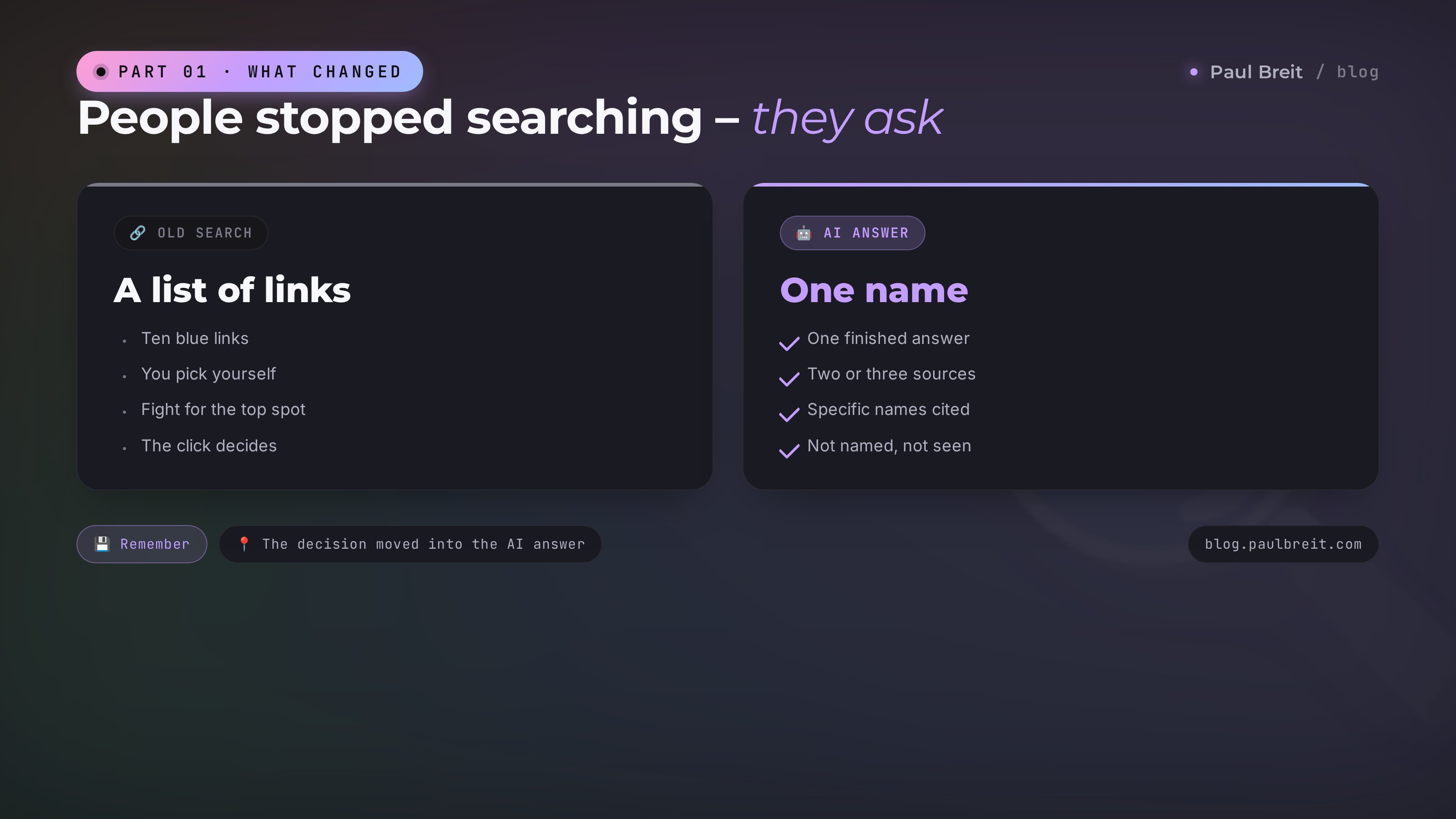
Think back to the last time you picked a service, a book, or a specialist. More and more people do it not through a search bar with ten blue links, but through a conversation with an AI. Someone types into ChatGPT: "recommend who I should learn copywriting from" or "which email tool should a small school pick" – and gets a finished answer with names and a couple of links. They don't scroll the results, they don't compare on their own. The AI made the choice for them and named specific people.
The same thing happens with voice. Someone asks Gemini on their phone while cooking dinner, and it reads out exactly one answer. No list of ten options. There's no "second spot" here to fight for later. There's only the one who got named, and everyone else who didn't.
This shift has a precise name – zero-click, "search without a click." Search used to be a storefront of links, and your job was to rank higher so people clicked you. Now the AI more often answers directly, and the person leaves satisfied without clicking anything. Your page can be brilliant, but if the AI didn't pull the answer from it and didn't name you, that visit simply never happens.
Let's break it down through a real example of how it looks from your future client's side. A woman wants to launch her own online course and doesn't know where to start. Three years ago she'd have typed "how to launch an online course" into Google, opened five articles including yours, and remembered your name. Today she opens an AI and types: "I'm an expert, I want to launch an online course, recommend who to learn from and what to read." The AI hands her three names and two blogs. If you're among them, she comes to you. If not, she'll never learn you exist, because she never even reached the old-fashioned results page with your article on it.
From here the simple conclusion this article was written for. The point where the buying decision gets made has moved. It's no longer only in the search results and no longer only on your blog. It's inside the AI's answer. So that's where you need to promote yourself now – into that answer. How it's done, we cover step by step from here.
Section 02AI search optimization in plain terms
AI search optimization is a set of actions after which AI tools start naming and recommending you when someone asks them about your topic. The goal is one: to get your name, your blog, your product spoken inside the answer ChatGPT, Google's AI, or an answer engine gives to your client's question.
This approach goes by a few names, and they scare a newcomer with how complex they sound. It's useful to simply recognize them so you don't get lost in other people's articles.
- GEO – generative engine optimization. Generative engines are exactly these AI tools that generate an answer instead of handing you a list of links. The most common term for the whole topic.
- AEO – answer engine optimization. Same idea, with the emphasis on the machine delivering a finished answer, and you fighting for a place inside it.
- Answer engine – the class of services that reply with text plus links: Perplexity, Copilot, and the search modes inside ChatGPT.
To keep it straight, hold onto the difference from old SEO. Classic SEO fought for the top line in a list of links: the higher the site, the more clicks. AI search optimization fights for something else – to get the machine to put your name right into the answer text, where there may be no links at all. The tools partly overlap (your own site, texts, mentions), but the weight shifts. Keywords lose their old power. What moves to the front is direct, clear answers, clean structure, and how often and in what company your name shows up online.
Old SEO answered the question "how do I rank higher in a list of links." The new one answers "how do I end up inside the AI's finished answer." The first still works and brings traffic from regular search. The second matters more and more, because that's where a chunk of your future clients moved. It's smart to do both, but ignoring the second in 2026 means calmly watching your audience drift to the people the AI already loves to name.
One more thing that takes the extra fear off. AI search optimization isn't some new magic reserved for marketers with a budget. It's largely the same honest work a good expert should be doing anyway: answering people's questions clearly, running a live blog, showing up where your audience hangs out. It's just that this work now has a powerful new recipient – an AI that reads the internet and then retells it to people. You put your online presence in order, and the AI spreads you across the answers.
Section 03How an AI decides who to name in its answer
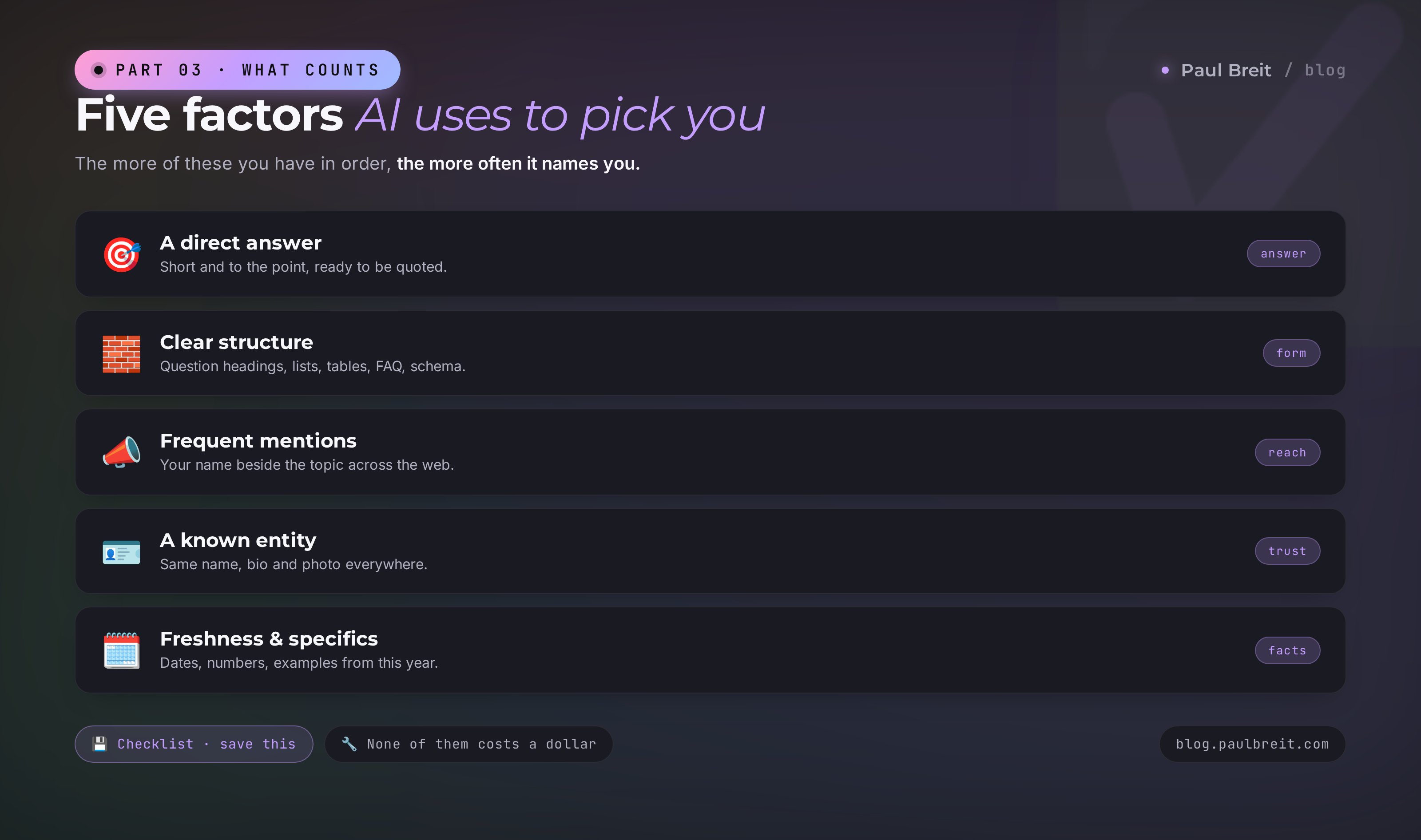
To influence the AI's choice, you have to understand how it makes that choice at all. Let's look under the hood in human terms, no formulas. When an AI answers a question, it leans on five things. The more of them you have in order, the higher your chance of being the one it names.
Do you have a direct answer to this question
The AI looks online for a chunk of text that answers the question directly and briefly. If your page has a clear paragraph "to launch a course, you need to do X, Y, Z," it's easy to grab and cite. If the answer is smeared across three screens of lyricism, the machine finds it simpler to take it from whoever answered head-on.
How clearly the page is built
Question-headlines, short paragraphs, lists, tables, an FAQ block, markup in the code – all of it helps the machine parse your page and pull out the right chunk. A wall of solid text reads fine to people but parses poorly for an AI. Structure is the language you use to tell the machine where everything lives.
How often your name shows up next to the topic
The AI trained on a huge slice of the internet and keeps searching through it. If your name appears dozens of times next to the words of your topic – in a blog, on social, in other people's articles, in reviews, in directories – the machine remembers that pairing and recalls you when answering on the topic. One mention on one site it won't notice. Twenty mentions in different places add up to a steady image of "this person is about this."
How authoritative and recognizable you look
A machine, like a person, trusts more the one who looks whole and confident: a single name, a clear "who I am and what I do," links to real projects, reviews, mentions on platforms with weight. Out of this forms what's called an entity – a recognizable object "Paul Breit, marketer, AI," which the AI holds in its head as a single whole.
Freshness and specifics
Answer engines love fresh pages with dates, numbers, examples. A 2026 piece with concrete figures the machine takes more readily than a nameless article with no date. Specifics like "in 30 days," "up to 5-7 leads a day," "10,000+ graduates" catch both people and the machine, because they're easy to cite as a fact.
Put the five factors together and you get a portrait of the one an AI loves to name. It's an expert who answers real questions directly, formats pages neatly, shows their name next to the topic often, looks whole, and isn't afraid of specifics. Not one of the factors requires money or a developer. Each is a habit you build into your ordinary content work. In the next section we'll turn these five factors into seven concrete steps.
Section 04The method: seven steps to land in the answers
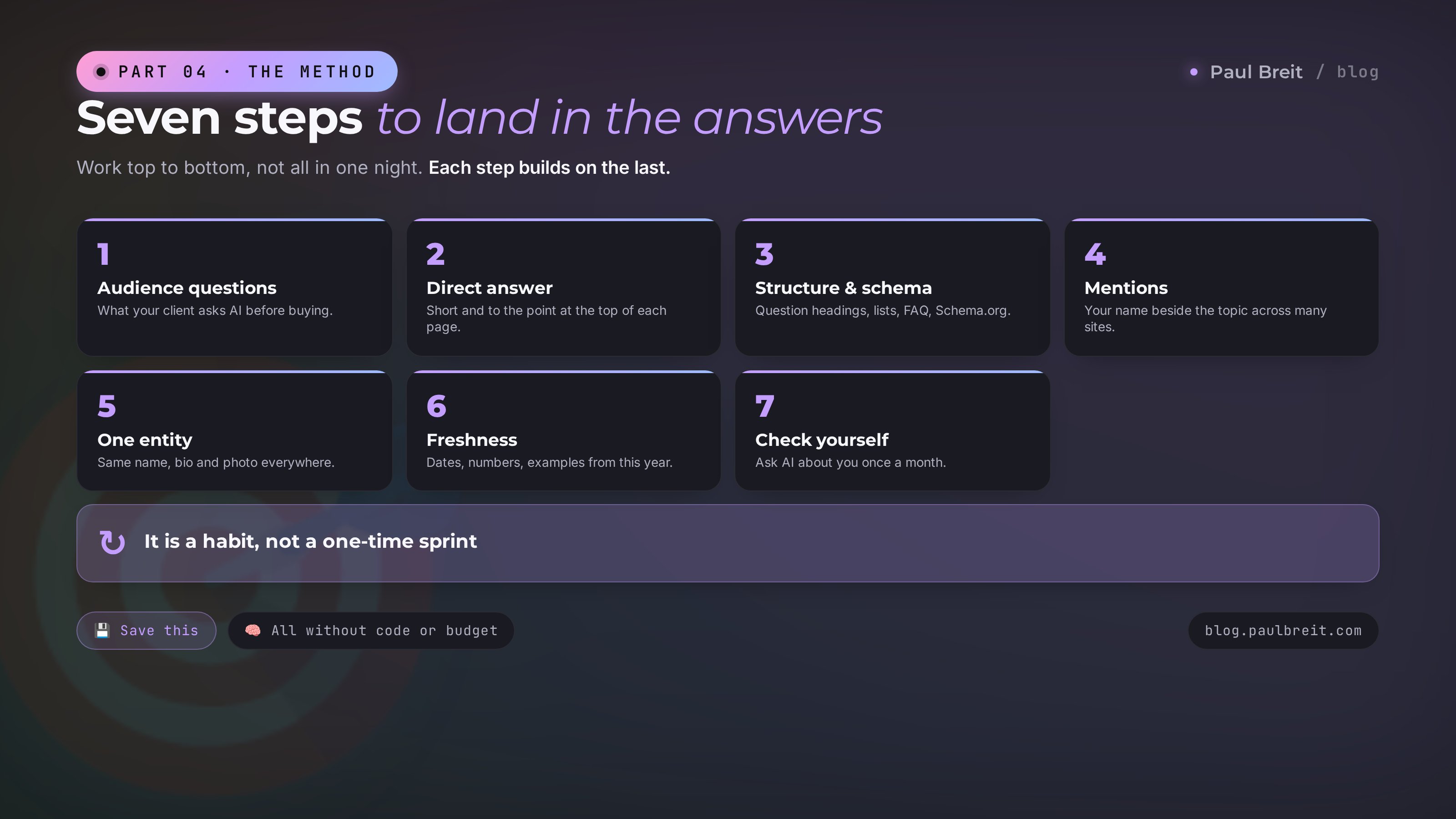
Now the practice. Here's the sequence I use to put an expert's presence in AI search in order. Go step by step, top to bottom, don't try to do it all in one day. Each step reinforces the last.
Gather the real questions your audience asks
It all starts with the questions your client asks an AI before buying. "Where do I start in my topic," "how do I pick a specialist," "how much does this cost," "will this work for me." Write out 30-50 such questions in your client's living voice. Don't invent them from your head – pull them from chats, comments, questions asked on calls. This list is what the AI helps you gather: give it a description of your audience and ask it to generate the questions these people ask before they decide. The list of questions is the map you build all your content on next.
Give a direct short answer at the top of every page
On every important page and in every article, answer its main question first, short and direct, in three to five sentences, with specifics. That's the "short answer" block you saw at the top of this article. It serves two goals at once: the person gets value immediately, and the AI gets a ready chunk that's easy to cite. First the direct answer, then the details, examples, and nuance. That order is the one the machine loves most.
Format the material so it's easy to parse
Turn headlines into questions ("How to get into ChatGPT's answers"), cut the text into short paragraphs, add lists and tables, put a question-and-answer block at the end. Separately – the technical Schema.org markup right in the page code: it tells the machine "this is an article, this is the author, these are the questions and answers." Markup is added once, and the AI will assemble it for you too. The goal of this step is one thing: for the machine to grasp in a second where your answer to the right question sits.
Show your name across many platforms
One site isn't enough. The AI builds its image from many mentions across the web. So your name next to the topic should appear in different places: your own blog, Medium, LinkedIn, Telegram, social, expert directory profiles, client reviews, guest posts, on-point comments in other people's threads. Every such mention is another brick in the "you plus your topic" pairing. No need to spread yourself across everything: pick three or four platforms where your audience actually is, and show up on them regularly.
Make yourself a recognizable entity
Write your name the same way everywhere. Use one and the same short "who I am": for example, "Paul Breit, marketer, teaches experts to promote and automate with AI, the school has trained 10,000+ graduates." The same name, the same description, the same photo across all platforms add up for the machine into a single recognizable object. A mismatch in how you spell your name and phrase things blurs that image, and the AI stops understanding it's all one and the same person.
Keep it fresh and specific
Put dates on your pages, update old material, add fresh numbers and examples from this year. Swap general words for concrete facts: instead of "many clients are happy" – "10,000+ graduates of the school," instead of "fast" – "over a weekend." Specifics the AI cites most readily, because they're easy to serve a person as a fact. And release new material regularly: a live, updated blog the machine values higher than an archive whose last entry is two years old.
Feed the search index and check yourself
Google AI Overviews and Gemini lean on Google's search index, and that's a huge chunk of your audience. Make sure your site is in that index, your pages open without errors, the markup is in place, and the material is fresh. Then close the loop with a check: once a month, ask the AI tools your client's questions yourself and see whether they name you. This turns the work from guessing into a clear cycle of "did it – checked it – tuned it."
Seven steps look like a lot, but in practice this isn't a separate weekend project. It's a habit built into your ordinary content work. Every new piece you now write with a direct answer at the top, clean structure, and specifics. Every week you add a couple of mentions on the right platforms. Once a month you check yourself in the AI tools. After a few months of that rhythmic work you start surfacing in answers where you weren't anywhere before. How to build a first steady stream of attention to your blog, I broke down in detail in the article on the first thousand followers – those mechanics fit step 4 perfectly.
Section 05ChatGPT, Google AI, and answer engines – where to aim
AI tools are built differently, and you get into their answers by different routes. Let's break down the three main types a US expert deals with, and where to put your effort in each.
ChatGPT and trained models
ChatGPT answers partly from what it remembered while training on a huge slice of the internet, and partly from a fresh search when web mode is on. To get it to name you, all five factors work at once, but especially the frequency of mentions across the whole web and the authority of the platforms you show up on. This is the slowest-moving channel: the picture in the model's trained memory changes slowly, over months. But the effect is steady in return. The upside for you as an expert is that clean, structured presence compounds here – once the model has learned to associate your name with your topic, it keeps naming you.
Google AI Overviews and Gemini
For a US audience this is often the biggest chunk. Google AI Overviews and Gemini lean on Google's search index. Which leads straight to the point: it's critical to be in that index and to please it. Your own site with clean Schema.org markup, a tidy page structure, fresh dates – Google sees and weighs all of it. Check separately that your pages load fast and open without errors: a slow or broken site drops out of both people's and the machine's attention. For many experts, investment in a well-indexed blog with schema is the single biggest lever for AI answers.
Answer engines with links
Perplexity, Copilot, and the search modes of the chatbots work differently: right now they go out to the internet, find fresh pages, and cite them with links. This is the fastest-reacting channel. A fresh, well-structured page with a direct answer they pick up within days and weeks after it's indexed. Here the steps about a direct answer, structure, and freshness pay off most: you're literally handing the machine a ready-to-cite chunk.
The practical takeaway for a US expert is simple. Put your main effort into the combo of "your own blog with clean structure and markup, plus presence on a few live platforms, plus mentions." That combo feeds Google's AI Overviews, lands in the fast answer engines, and gradually builds weight in the memory of the big models like ChatGPT. One neatly built blog works on all three types at once. Where to even start building your AI presence, if you're still a beginner, I laid out in the article on what you can do with AI.
Section 06How to check whether you're being shown
Promoting blind is wasted time. Before you change anything and after each round of work, it's worth measuring where you stand right now. It's done by hand in half an hour, and the tool is the AI itself.
Take your list of questions from step 1 and ask the most important ones one by one in ChatGPT, Perplexity, and Google. Phrase them the way a real client asks before choosing, not the way that's convenient for you. Here are working examples for an expert in AI and marketing.
Then look at three things. First – whether you're named at all. Second – if you are, in what form: is the name right, is your topic described accurately, is a link given. Third – who gets named instead of you, if you're absent: those are your benchmarks, and it's worth studying where and how they showed up.
Keep a simple table: the question, the check date, whether you're named, what got named instead. Repeat once a month. After two or three measurements you'll see movement: where the name already surfaces and where it's still empty. That's your work map – it's plainly visible which questions are already closed and for which you still need to give a direct answer and gather more mentions. This check turns promotion from faith in luck into a manageable process.
Don't expect the AI to start naming you first on every question at once. A realistic bar at the start is to land in the answer on at least narrow, specific questions in your niche, where competition is lower. Breaking through on "best marketer" is hard, but on "who teaches an expert to promote with AI for beginners" is quite doable within a couple of months of work. Start with narrow questions, build presence on them, then expand to the more general ones.
Section 07How Claude preps content for AI search
The good news: almost all the routine in the method the AI does for you. For this work I find Claude the most convenient – it holds a long context carefully and writes well. Let me show the concrete tasks you hand it, with ready-made wording. If you don't have access to Claude yet, sign up at claude.ai. From some regions you may need a VPN set to the US or EU to open it.
Gather audience questions. Describe to Claude who your client is, and ask for the list of questions this person asks an AI before buying.
I'm an expert in [your topic]. My audience is [who they are, briefly].
Write 40 real questions these people ask an AI
before they choose a specialist or buy.
Use the client's living voice, no corporate speak. Group by theme.
Write a direct snippet-ready answer. Give it the question and ask for a short direct answer that's easy to cite.
Here's a question from my audience: [question].
Write a direct answer in 4-5 sentences, plain language, with specifics.
The first sentence should answer the question right away,
no wind-up or preamble. This will be the "short answer" block on the page.
Format the FAQ and markup. Claude will assemble the question-and-answer block and the technical Schema.org markup you simply paste into the page code.
From these questions and answers, build an FAQ block in HTML
and, alongside it, FAQPage markup in JSON-LD (Schema.org),
so search engines and AI tools see the questions and answers.
Here are the question-answer pairs: [paste].
Check your own text for machine clarity. Give Claude a finished page and ask whether the answer is easy to pull from it.
Here's the text of my article: [paste].
Rate it through the eyes of an answer engine: is the direct answer
to the main question easy to pull, where is structure missing,
where do question-headlines, lists, and specifics fall short. Give a point-by-point list of edits.
The loop is simple: you describe the task in words, Claude hands you ready pieces, you paste them onto the page and check yourself in the AI tools. The same approach – building a whole library of ready prompts for your tasks – I broke down in detail in the article on 10 prompts for experts. And a general overview of what you can hand an AI without a single line of code is in the article on 10 tasks with no code.
Section 08Five mistakes that keep you invisible
To avoid wasting months, here are the rakes people step on most often. Check yourself against each.
Stuffing keywords like it's 2010
The old trick of "cram the text with as many keywords as possible" works against you today. The AI looks for a clear answer, not a density of the right words. Text packed with repeats of "AI search optimization, AI search optimization" the machine tosses out as junk. Write for a human, answer the question – the keywords fall into place on their own.
Pouring filler with no direct answer
A three-screen article where the answer to the main question is hidden somewhere in the middle between lyrical passages loses to a competitor's short, clear paragraph. The machine has nothing to pull from your filler. Always give the direct answer up top, and save the polish and detail for after.
Sitting on one platform only
A beautiful blog that only the blog itself knows about the machine will barely remember. An expert's image forms from mentions in different places. If you exist only on your own site and nowhere else, you're missing exactly that repetition of your name next to the topic that the third factor rests on.
Writing your name and your bio differently everywhere
Here "Paul Breit, marketer," there "Paul, traffic expert," in a third place just a handle. To the machine that's three different people, and none of them gathers enough weight. Lock in one spelling of your name and one bio and repeat them everywhere, word for word.
Optimizing blind, with no check
Working for months and never once asking the AI about yourself is a sure way to pour effort in the wrong place. Without a measurement you don't know whether you're moving forward or standing still. Checking yourself in the AI tools once a month takes half an hour and shows right away what worked and what didn't.
Notice the common root of all five mistakes. Each is an attempt to trick the machine or skimp on honest work: stuff keywords instead of answering, pour filler instead of value, hide on one site instead of a live presence. AI tools are exactly good at catching those attempts and favor the ones who are genuinely useful and coherently presented. So the most reliable strategy is to be a truly good expert and carefully convey that to the machine, not to look for a shortcut around it.
Section 09Where to start this week
So this doesn't stay interesting theory, here are the first three steps you can actually take in the coming days with no budget and no contractors.
First – check yourself. Today, open ChatGPT and Perplexity and ask them the five main questions your client asks. Write down whether they name you and who they name instead. It takes half an hour and gives you an instant starting point to move from.
Second – put one page in order. Take your most important article or service page and redo it by the method: a direct short answer up top, question-headlines, lists, a question-and-answer block at the end. One neatly built page already starts working for you in the answer engines. From there, use it as the template to tidy the rest.
Third – lock in your entity. Write one short "who I am and what I do" with specifics, and place it, along with your name and photo, identically on every platform you're on. That's the fastest way to help the machine assemble you into a single recognizable image.
And keep the main thought in mind. The place where your client makes their decision has moved inside the AI's answer. That's only scary while you look at it as a new, murky race. Break it into steps and it turns out it all comes down to honest work a good expert does anyway: answer people's questions clearly, live in your blog, show up where your audience hangs out, and talk about yourself consistently and concretely. The difference is that this work now has a powerful new recipient that spreads you across answers to millions of people. While most people don't think about this, you have a head start. Begin with one check and one page this week – and in a few months you'll find your name where only others used to be named.
Once your presence is sorted, the next logical step is to automate the content prep itself, so the direct answers, posts, and mentions go out without hand work every day. How that's done through digital employees, I broke down in the article on AI agents.
RecapThe whole thing in a minute
- Search turned into an answer. The client increasingly asks an AI and gets one answer with a couple of sources. Whoever wasn't named, they didn't see
- AI search optimization (GEO) – the work of getting ChatGPT, Google's AI, and answer engines to name you specifically
- Five choice factors: a direct answer, a clear structure, frequency of mentions, a recognizable entity, freshness and specifics
- Seven steps: audience questions → direct answer → structure and markup → mentions on platforms → a single entity → freshness → self-check
- Where to aim: the combo "a blog with markup + a few live platforms + mentions" feeds Google's AI, the answer engines, and the big models all at once
- Check yourself once a month: ask the AI tools your client's questions and see whether you're named
- All with no code and no budget – the AI itself assembles the questions, answers, FAQ, and markup
FAQFrequently asked questions
What is AI search optimization in plain terms?
It's the work of getting AI tools like ChatGPT, Google AI Overviews and answer engines to name and recommend you when someone asks them a question in your topic. People used to go to Google and choose from ten links. Now they ask an AI and get one finished answer with a couple of sources. The goal of this work is to land inside those sources and inside the answer text itself.
How is this different from regular SEO?
Classic SEO fought for the top spot in a list of links: the higher you rank, the more clicks. Here the fight is to get the AI to put your name right inside its answer, where there may be no links at all. So the weight shifts away from keywords toward direct, clear answers, clean structure, and how often your name shows up across the web.
How do I get into ChatGPT's answers?
ChatGPT builds its answer from what it saw online and what it finds when it searches. To get named you need three things: give a direct answer to the questions in your topic, show your name across many platforms (blog, social, directories, reviews, guest posts), and present material in a structured way with question-headlines, lists, and tables. The more often and more clearly you answer the right question across the web, the higher your chance of landing in the answer.
How do I get into Google AI Overviews and Gemini?
Google AI Overviews and Gemini lean on Google's own index, so being indexed is critical: a site with Schema.org markup, clean page structure, and fresh dates. Make sure your pages load fast and cleanly. A well-built blog with schema is the single biggest lever for showing up in Google's AI answers.
Do I need a developer or a big budget?
No. It's all done by the expert yourself. AI can help you assemble the list of audience questions, the direct answers, the FAQ, and the markup in an evening. Schema.org markup is added to the page code once. The main investment here is consistency, and money is barely needed: answering real questions and showing your name across platforms costs little but adds up over time.
How do I check whether the AI recommends me?
Ask ChatGPT, Perplexity, and Google the same questions your client asks before buying: "who should I learn this topic from", "which service should I pick", "who runs a good blog about this". See whether you show up and in what form. Repeat the check once a month and write down where you're already named and where you're not yet – that's your work map.
How long until I see results?
Answer engines with links (Perplexity, Copilot, ChatGPT search) react fastest – they pull fresh pages within days and weeks after indexing. Trained models like ChatGPT shift the picture more slowly, over months, as they update and your mentions grow. It's a long game: first hits show within a few weeks, a steady effect builds over a few months of regular work.
Can Claude help me prepare content for AI search?
Yes, it's one of its strong tasks. Claude assembles a list of real audience questions, writes short direct snippet-ready answers, formats the FAQ and markup, and also checks your current text for clarity to an AI and suggests what to rewrite. You describe the task in words, it hands you ready pieces you just paste onto the page.