What Is an AI Agent: The Digital Employee That Works While You Sleep
A plain-English explainer with no technical fog. An AI agent is a digital employee: you hand it a task and it does the whole thing itself, on a schedule, around the clock, while you're with clients or asleep. We'll cover how it beats an ordinary chatbot, how it works inside, what expert routine it takes off you, and when you actually need one versus a plain prompt.
An AI agent (also called a neural agent or autonomous agent) is an AI-based program that gets a goal and reaches it on its own: it decides which steps to take, uses tools (reads sites, sends messages, works with files), and acts on a schedule with no human involvement. The key difference from a chatbot: a bot answers your messages and waits for the next one, while an agent runs the task from start to finish itself. Example: a bot suggests a post idea if you ask; an agent brings a finished post every morning while you sleep.
The phrase "AI agent" is everywhere in 2026, and it only breeds more confusion. Some call any button-chatbot an agent. Others picture the Terminator. A third group nods along but honestly doesn't get how it differs from the ChatGPT they already use.
Let's sort it out calmly, in plain terms. No technical fog, no promises that a robot replaces your whole business. The most honest image we'll land on: an AI agent is a digital employee. You hand it a task, and it does it itself, around the clock, while you're with clients or asleep.
By the end you will tell an agent from a bot at a glance, understand how it works inside, and soberly decide whether to build one for a specific task or make do with a plain prompt. No technical background needed - I explain it so anyone who can use a messenger will follow.
What's inside
- A plain definition with no technical fog
- Chatbot vs AI agent – the real difference
- How it works inside: four links
- Three signs it's actually an agent
- What routine it takes off an expert
- Five live agents running in my business
- When you need an agent, when a prompt is enough
- How to build your first agent with no code
- What AI agents can't do yet
- Where to start if the idea grabbed you
Section 01A plain definition with no technical fog
Let's start with an image, not a term.
A regular AI is a very smart conversationalist locked in a room. You ask a question through a slot in the door, it answers, and waits again. It knows almost everything, but it can't leave the room and do anything in the real world. It can only talk.
An AI agent is that same smart conversationalist, handed the keys to the room, a to-do list, and tools. Now it can step out, go where it needs to, take what it needs, do the work, and come back with a result. You set the goal – it figures out how to reach it and reaches it.
Formally: an AI agent is a program with three things. A goal ("every morning, bring me ideas for posts"), access to tools (the ability to read channels, write messages, work with files), and the right to act without you at every step. Hand it a task, and from there it runs on its own.
Think of it as a digital employee. You explain a task to a regular employee and let them get on with it, without standing over their shoulder every minute. An AI agent is the same, except this employee works around the clock, never tires, never gets distracted, and costs pennies. It's no genius and won't replace your head, but the whole monotonous part of the work you're pulling by hand right now, it takes off your plate.
People call it different things: AI agent, neural agent, autonomous agent. Different words, one meaning – an AI that doesn't just talk, but acts.
Why the topic exploded right now. The idea of agents isn't new, but until 2026 it hit a ceiling: models weren't smart enough to reliably plan multi-step tasks, and they had no convenient way to reach tools. Every agent had to be hand-coded, and that cost about as much as a small project. Over the last year and a half, two things came together. Models like Claude learned to reason well enough to carry a task to the end without falling apart. And a standard way to plug tools into them appeared – essentially, a socket the agent plugs its access to Telegram, sites, and spreadsheets into. From that point, building an agent became possible with no developer, in plain words. That's why the topic is on every corner: the barrier to entry collapsed, and what used to be available only to companies with a budget became available to a solo expert.
Section 02Chatbot vs AI agent – the real difference
This is the main question most people open an article like this for. Let's break it down.
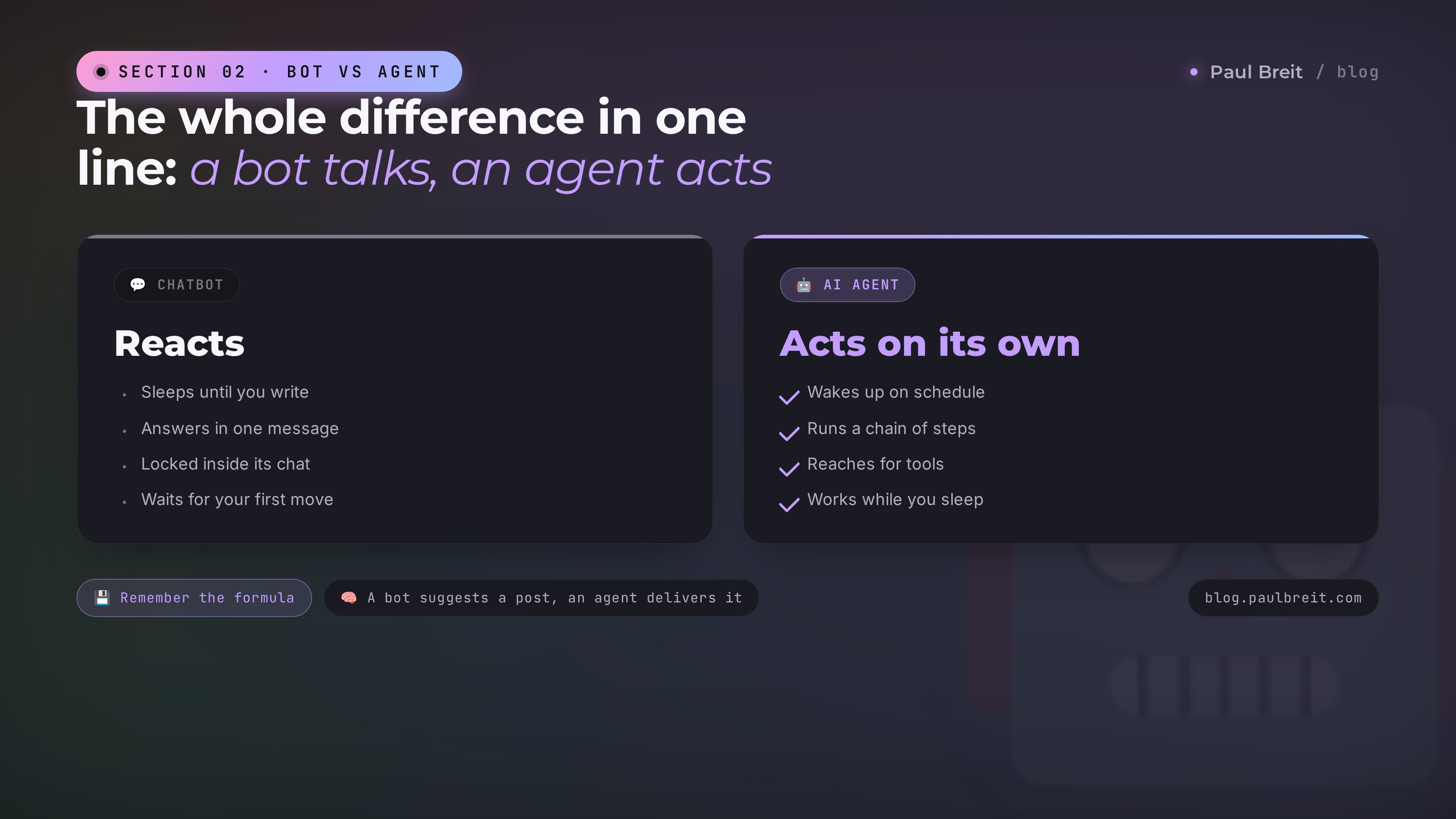
A chatbot reacts. An agent acts on its own initiative
A chatbot is reactive. It sleeps until you write. You write, it answers, it goes back to sleep. A bot's whole life is a "question-answer" chain where the first move is always yours. The ChatGPT you message with is a chatbot – a very smart one, but a chatbot.
An agent is proactive. It gets a goal once, and from there it decides for itself when and what to do. It can wake up at 7 a.m. on a schedule, visit a dozen sources, process the data, and send you the result – while you were asleep and asked for nothing at that moment.
A bot answers in one message. An agent runs a chain of steps
Ask a bot "which of my competitors' posts did well this week" and it will honestly say it doesn't know – it has no access to their channels. Give the same task to an agent, and it will go into those channels itself, read the posts, count the reactions, sort by engagement, and hand you the top. Between the question and the answer, an agent takes dozens of independent actions you never even think about.
A bot lives in one window. An agent reaches for tools
A chatbot is locked in its chat. An agent is wired to the outside world: it can read sites, send messages in Telegram, fill spreadsheets, publish posts, work with your files. Those "hands" are what turn a talker into a worker.
Many confuse an agent with an ordinary chatbot that has buttons and a menu. Familiar scene: you open a store's bot, there are buttons "price," "shipping," "contacts," you tap one, you get a canned reply. That's not an agent. That's a scripted bot: it walks a hard-wired tree of "if button A, show B." No autonomy, no reasoning, just pre-set branches. The difference is like a railway versus a live driver: a scripted bot runs strictly on rails someone laid in advance, while an agent picks the route toward the goal itself. This mix-up is exactly what gets sold: a simple button-bot is called an agent and priced like a smart system. Now you'll spot the swap instantly.
The short formula worth remembering: a bot talks, an agent acts. Everything else is detail on that difference.
Section 03How an AI agent works inside: four links
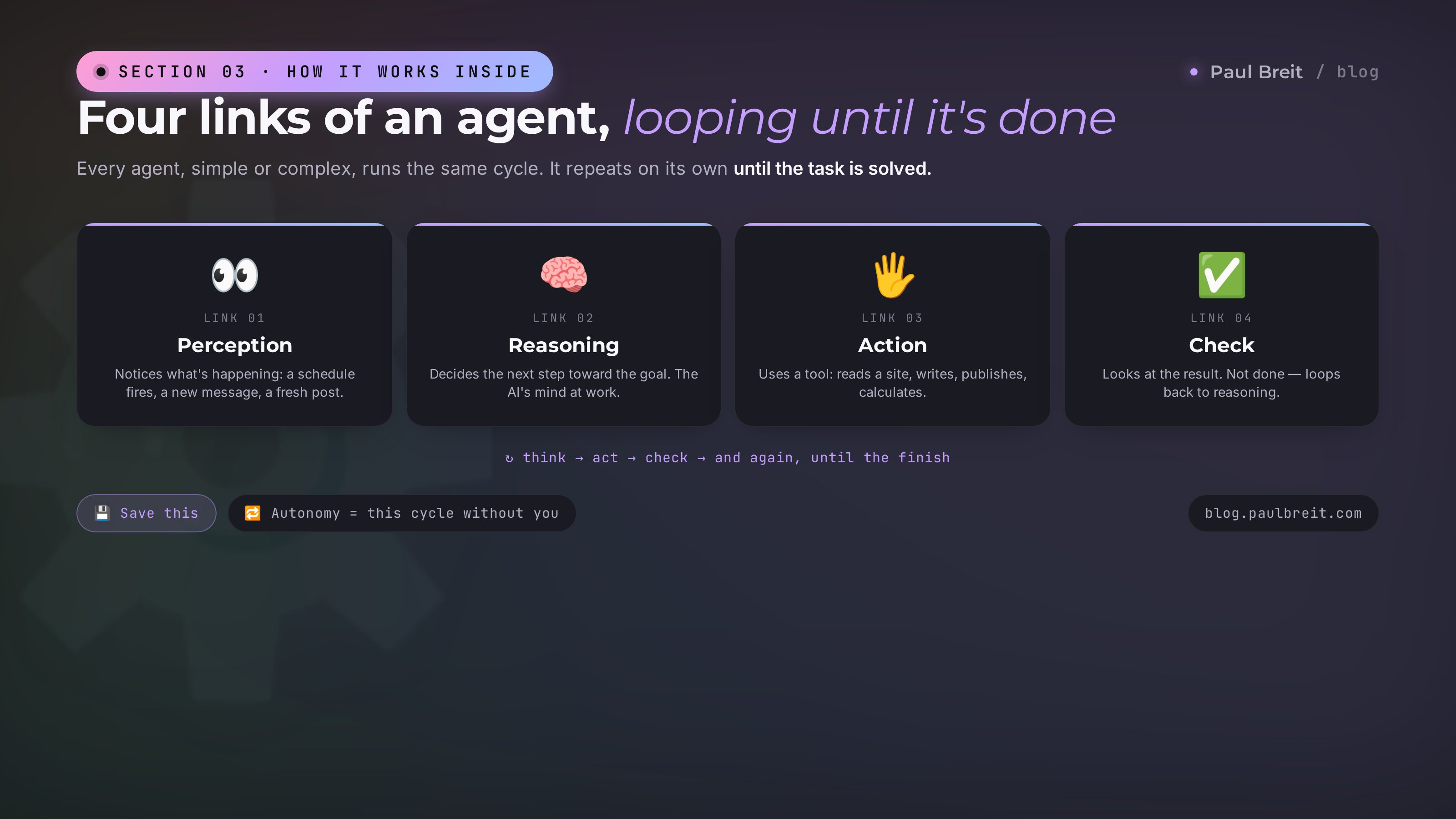
Let's look under the hood, but in human terms, no code. Every AI agent, simple or complex, has four links. They run in a loop until the task is solved.
Perception – the agent sees what's happening
The agent takes in inputs: a new message arrived, a scheduled time came, a fresh post appeared in a tracked channel. These are its "eyes and ears." Without perception it doesn't know it's time to act.
Reasoning – the agent decides what to do
Here the AI itself works, that smart mind. The agent looks at the goal and the current situation and decides the next step: "it's 7 a.m., so I should collect yesterday's competitor posts." The ability to reason and plan is exactly what separates an agent from a simple "if button, then reply" script.
Action – the agent picks up a tool
Decided, done. The agent uses one of its tools: visits a site, sends a message, writes to a spreadsheet, generates text. These are its "hands." The set of tools defines what the agent is even capable of.
Check – the agent looks at the result
Took a step, checked whether it moved closer to the goal. If not, it loops back to reasoning and takes the next step. This "think – act – check" loop runs on its own until the task is solved. That's the whole magic of autonomy: you don't nudge the agent at every step, it drives itself to the finish.
A full loop, for example. Goal: "every morning bring me the top competitor posts." Perception: it's 7 a.m. Reasoning: time to collect yesterday's posts from five channels. Action: went in, read, counted reactions. Check: the top is collected, but there aren't many posts – loop back and pull from two more channels. Action: pulled. Check: done – sending it to your inbox. You wake up and see a finished digest.
Section 04What makes an agent an agent: three signs
To avoid confusion, here's the test. You're looking at a real agent if all three signs are present. Miss even one, and it's just a bot or a plain AI.
Autonomy
The agent works without you at every step. You set the goal, it walks the path itself. If you have to press a button on every action, it's not an agent yet.
Tools
The agent has access to the outside world: sites, messengers, files, spreadsheets, other programs. Without tools an AI only talks. Tools give it hands.
A goal, not a command
An agent is given a top-level goal ("run my content," "watch competitors"), not a step-by-step instruction. How exactly to reach the goal, it decides itself. To a bot you say "do step A, then B." To an agent – "get to result X."
This simple three-sign test saves a lot of time when someone sells you an "agent." Often the word hides an ordinary button-bot. Ask: does it work on its own without me? Does it have access to external tools? Is it given a goal or a step-by-step command? Three yeses – an agent. Otherwise – marketing. The same test helps when you're inventing a task for an agent yourself: if it doesn't have all three signs, you'll likely be fine with a plain prompt or a project, and you'll save time by not building something extra.
Section 05What routine an AI agent takes off an expert
Now to practice. The abstraction about "autonomy" is worth nothing until you can see what an agent actually takes off you. Here's the expert routine AI agents already take over today.
- Watching competitors and the market. Every morning the agent reads competitors' channels and private chats, picks what did well, and brings you a digest: which topics are landing, which pains they press, what they offer. By hand that's hours a week; the agent does it overnight.
- A steady stream of content ideas. The agent tracks viral posts in your niche and, with one tap, turns someone else's winning idea into a post in your voice. The blank page before Monday stops being a problem.
- Client replies to routine questions. An agent on your site or in DMs answers "how much," "how do I pay," "will this fit me" – in your voice, around the clock, walking the person toward an application. It takes off the stream of same-type messages that ate your evenings.
- Publishing content on schedule. The agent writes posts in your style and publishes them to social on a schedule – three posts a day with zero touch from you after setup.
- Parsing and structuring information. The agent takes session transcripts, long documents, data tables, and returns summaries, digests, analysis. No more reading everything by hand.
- Monitoring and reports. The agent watches metrics – sales, leads, reach – and sends a morning report with conclusions: what dropped, what grew, what to look at.
Notice the pattern: an agent takes what repeats, runs on a schedule, and doesn't require your unique expertise. All of it is hours of weekly routine freed up for live work with clients and for strategy.
Section 06Five live agents running in my business
Enough theory. Let me show concrete agents built and running in my work right now. These are templates you can copy.
AI Competitor Spy
Every morning at 7:00 it reads two dozen private chats where my audience sits and sends a report: client pains, plays that work, trends. That reconnaissance used to take me weeks by hand. How it's built – in the article on the AI competitor spy.
AI Client Hunter
Overnight it reads competitors' channels, at dawn it brings the top posts that landed. With one tap it turns someone else's viral idea into a post in my voice. In detail – in the article on the AI client hunter.
AI Consultant
It sits on the site and answers clients around the clock in my voice – closing 30 to 50% of inquiries without me. The build breakdown – in the article on the AI consultant on your site.
Threads Agent
It writes and publishes three posts a day in my style, with no touch after setup. How it works – in the article on Threads automation with Claude.
Site Builder by Voice
I send voice notes in Telegram, and the agent builds and updates the site. The breakdown – in the article on building a site by voice with Claude.
Five agents cover content, research, sales, and production. Not one of them needed a programmer – all built through AI on a clear scheme. And this isn't the ceiling: every expert grows their own set over time, shaped by their own routine.
I wake up – there's already a report from the competitor spy in my inbox: what got discussed in private chats yesterday, which pains repeated, what competitors offered. Next to it, a roundup from the client hunter: five posts that landed, with notes on why each fired. In five minutes over coffee I skim both reports, turn a couple of others' ideas into my own posts with one tap, and the Threads agent has meanwhile already published the morning post on schedule. While I have breakfast, the consultant on the site answers three clients and walks one to a strategy-call application. By the time I actually sit down to work, half the daily routine is already done – by hands that don't tire and don't ask for a salary. That morning used to eat two or three hours. Now it takes the time of one cup of coffee.
Agents can work in a chain. A separate strength is that agents can be linked into a chain where one hands work to the next. The spy collected client pains – those pains automatically go to a content agent as post topics – it writes drafts – a publisher agent queues them up. You get a pipeline where raw material at the input (others' chats and channels) turns into finished content at the output, with no involvement from you in the middle. You don't need to build that chain right away – you come to it once each agent works on its own. But it's useful to understand it's possible from the start: you're building a system that feeds itself over time, not a set of separate toys.
Section 07When you need an agent, and when a prompt is enough
An important sober section that will save you money and nerves. An agent is a powerful thing, but not every task is worth turning into one.
When a plain prompt in the chat is enough. The task is one-off or rare. You initiate it yourself when needed. No schedule or autonomy required. Writing a post, parsing one document, coming up with an offer, making a deck – all of it is done with a direct request to the AI in five minutes. Building an agent here is extra work.
When it's worth building an agent. The task repeats regularly, runs on a schedule, requires going out to external sources, and should work without your involvement. Collecting a competitor digest every morning, answering clients around the clock, publishing content daily – that's agent territory. The sign is simple: if you do the same action every day or every week by hand and it eats time, it's an agent candidate.
The middle option – a project. Between a one-off prompt and a full agent there's a middle ground: a project in the AI where you've put your materials and prompts. It doesn't run on its own on a schedule, but it remembers context and returns results in seconds on your request. For many tasks that's enough, and it's simpler than an agent. On projects in detail – in the article on 10 prompts for experts.
The rule of choice: one-off – a prompt, regular with your involvement – a project, regular without your involvement – an agent. Don't over-complicate early. Many tasks that feel like "I need an agent" are perfectly closed by a project in ten minutes.
One more honest gauge – by money and attention. An agent isn't free: it needs setup, a first few weeks of babysitting, and small ongoing costs for a server and subscription. It pays off only if the task really repeats often and eats noticeable time. If you do something once a month, an agent won't earn back either the build time or the attention to maintain it. The estimate is simple: count how many hours a week go to the task. Under an hour – a prompt or a project. Several hours every week – an agent candidate, and then the evening you invest in setup returns in the first month.
Section 08How to build your first agent with no code
The good news the topic took off on: building an AI agent in 2026 is possible with no programming. What recently needed a developer and a month of work now assembles through AI on instructions.
The general logic of building any agent is this. First – take an AI that knows how to use tools. Claude fits best; it has a built-in mechanism for connecting tools. If you don't have access yet, start at claude.ai. Second – connect the tools you need for the task: access to Telegram, to sites, to spreadsheets. Third – set a goal and a schedule. Fourth – test on real data and refine.
The best part – the commands are written by the AI itself. You describe in words what you want, and Claude builds the agent and explains each step. Your job is to copy, paste, and relay if something goes wrong.
The difficulty depends on the task. A simple agent – a tracker or a helper that lives in the browser – assembles in an evening; the breakdown is in the article on a habit tracker built in one evening. An agent that runs around the clock on its own lives on a rented server abroad – a bit more complex, but also step by step, with no hand-written code. Where to start with AI at all, if you're still a beginner – in the article on the expert content pipeline.
Don't start with the complex. Build a first simple agent for one of your tasks, feel the mechanics, and the next one will go easier.
Section 09What AI agents can't do yet
For an honest picture – the limits. Expectations inflated by hype are the main source of disappointment.
They don't replace your expertise and strategy
An agent brilliantly handles routine, but you make the decisions. It doesn't know your market from the inside, your intuition, your appetite for risk. Where to take the business, what to launch, how to position – stays human.
They don't work perfectly on the first try
A freshly built agent makes mistakes, and that's normal. The first days you need to watch it, catch the misses, and refine. In a couple of weeks it reaches stable work, but "set it and forget it forever" is a myth.
They don't understand what you didn't give them
An agent works with the tools and data you connected it to. It won't telepathically guess your context. The quality of an agent's work equals the quality of its setup.
They don't replace live contact where money and relationships are decided
Closing a high-ticket sale, a hard conversation with a client, working with someone in crisis – you don't hand those to an agent. It prepares the ground, but in the deciding conversation you're needed. A client feels the difference between live attention and its imitation.
One more honest limit: an agent doesn't work where a physical hand or complex live judgment is needed. It's strong in the digital world – text, data, messages, files. Anything requiring physical presence or fine human intuition in an ambiguous situation is beyond it for now. That doesn't mean "useless" – it means the agent's zone is bounded by routine, not creativity or human contact.
The rule is the same as with all AI: an agent takes the repeating routine, you keep the meaning, strategy, and live decisions. In that pairing, an agent is a lever that amplifies the expert, not a crutch that replaces them.
Section 10Where to start if the idea grabbed you
You now understand what an AI agent is and how it differs from a bot. What to do next so it doesn't stay interesting theory.
First step – look at your week and find the routine in it. What do you do by hand regularly, on the same scenario, that eats time: competitor research, gathering ideas, answering routine questions, publishing content. That task is the candidate for your first agent.
Second step – start small. Don't try to build a complex around-the-clock agent right away. Take one task and one simple agent for it. Feel the mechanics, and it goes faster from there.
Third step – learn the basics if you're brand new to AI. Before building agents, it's worth working confidently with the AI itself. How to start – in the article on 10 prompts for experts. What you can hand to AI with no code at all – in the article on what you can do with AI: 10 tasks.
And keep the main thought in mind. Every expert hits the same ceiling – there are 24 hours in a day and two hands. Hiring a team is expensive and a hassle, and without one you become the bottleneck of your own business: everything rests on you, and the moment you stop, everything stops. AI agents are a way to break that ceiling without bloating your headcount. Each agent you build is like another pair of hands that works around the clock, doesn't get sick, and doesn't ask for a salary. Starting with one simple agent for one task, in six months you find half the routine runs itself, while you handle what can't be delegated to anyone – the product, strategy, and live people.
AI agents aren't about the distant future or the Terminator. They're about taking part of the routine off yourself this week and getting back the time for what you're in your business for in the first place.
RecapThe whole thing in a minute
- An AI agent is an AI with a goal, tools, and the right to act on its own. A digital employee that works while you sleep
- A bot talks, an agent acts – the core formula of the difference
- Four links of an agent: perception → reasoning → action → check, looping until the result
- Three signs of an agent: autonomy, tools, a goal instead of a step-by-step command
- Takes the routine: research, content ideas, client replies, publishing, analytics
- One-off – a prompt, regular with you – a project, regular without you – an agent
- Built with no code through Claude, from an evening to a couple of days per task
FAQFrequently asked questions
What is the difference between an AI agent and a chatbot, in simple terms?
A chatbot answers your messages and waits for the next one – it reacts. An AI agent gets a goal and reaches it itself: it decides which steps to take, uses tools, works on a schedule without your involvement. A bot talks, an agent acts. Example: a bot suggests a post idea if you ask; an agent brings a finished post every morning.
Are AI agent, neural agent, and autonomous agent the same thing?
Yes, they're different names for the same thing. AI agent, neural agent, autonomous agent are synonyms. It's about an AI given a goal, tools, and the right to act on its own, not just answer in a chat.
Do I need to know how to program to build an AI agent?
No. In 2026 agents are built through AI with no code: you describe the task in words, Claude writes everything for you and explains the steps. Your part is to copy, paste, and relay an error if one appears. A simple agent assembles in an evening.
How much does it cost to build and run an AI agent?
It depends on the task. A simple browser agent is nearly free, just the AI subscription (around $20/month). An around-the-clock agent on a server adds server rent – roughly $10-15/month more. Against the time it saves, that's pennies.
Will an AI agent replace an employee or contractor?
On routine tasks – largely yes. An agent takes what repeats on one scenario: parsing data, publishing, answering routine questions. But it doesn't replace expertise, strategy, or live selling. Think of an agent as an amplifier that takes the routine and frees your time for what matters.
Is it safe? Won't an agent do things in my name?
An agent does exactly what you connected it to, within the bounds you set. It doesn't step outside its tools. Risks appear if you give an agent too broad access without checks – so you watch a new agent the first few days, and keep access to money and important actions under manual confirmation.
Which agent should an expert start with?
The one that covers your most frequent routine. Drowning in competitor research – start with a research agent. Client replies eating your time – with a consultant. Struggling for content ideas – with an agent that brings posts. Take one task and one simple agent for it, don't try to cover everything at once.