How to Create a Course or Mentorship That Actually Gets Results
A complete guide to the methodology of a strong learning product: how to design a course or mentorship from the outcome, test demand, build the architecture, and make sure people actually reach a result. With an evidence base and practical frameworks.
The results your product gets have nothing to do with how much content you crammed in. They come down to the system. First, a clear outcome you are guiding the person toward. Then proven demand: people have to actually want that outcome and be ready to pay for it. Next, a high density of action with feedback: the person does the work, gets feedback, redoes it. And on top of it all, support that keeps them from quitting. That is the whole secret. Everything else in this article is how to build each of those layers, step by step.
You poured yourself into your product. Recorded the lessons, built the program, set up a beautiful platform. Then you look at the stats and see that only a handful made it to the end, and even fewer got a real result. Sound familiar? It does to me, painfully. I have been building educational products for more than ten years, over ten thousand people have come through my online school, and I stepped on this same rake plenty of times myself before I understood one simple thing.
This is a big guide. Pour yourself some tea, let us go.
What is inside
- Why most courses fail and what fixes it
- The foundation: design from the outcome, not the content
- Setting a goal as a measurable outcome
- Demand first, product second: how to make it wanted
- Product architecture
- How to make your product actually work
- Mentorship, separately
- Quality, trust, and ethics
- AI in 2026: an invisible engine, not a replacement
- Common mistakes: red flags
- Action plan: build your product step by step
- FAQ
Section 01Why most courses fail and what fixes it
Here is how it usually goes. Someone is a good specialist. They genuinely know their field: a coach, a psychologist, a nutritionist, a tutor, a marketer, a master of whatever. And they decide to package their knowledge into a course or mentorship. What do they do? They sit down and start recording everything they know. Module after module, lesson after lesson. It comes out impressive: twenty hours of video, a hundred pages of notes. They are proud of the sheer volume.
And then the sad part begins.
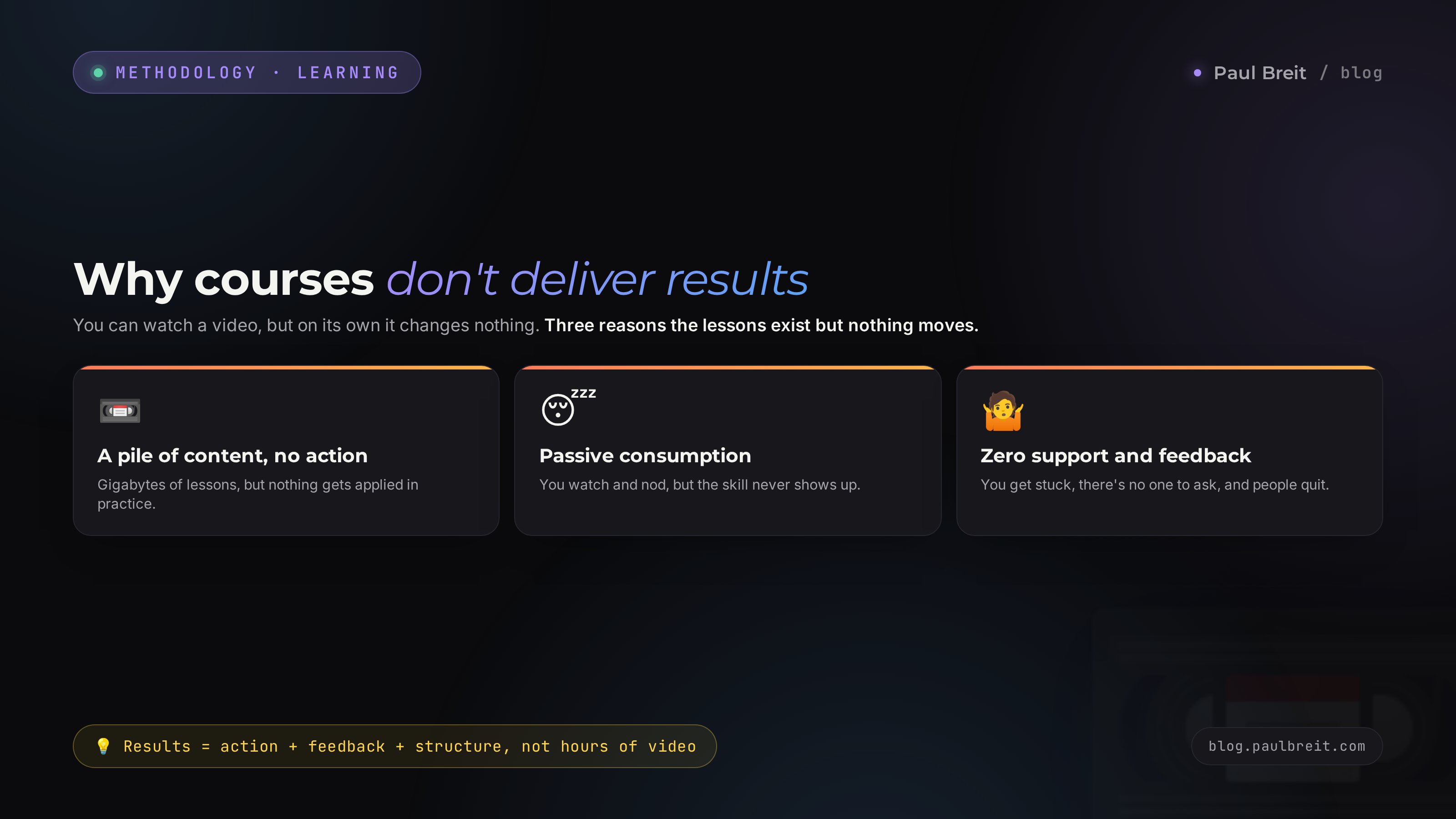
People buy, log into the platform, watch a couple of lessons, and vanish. Research on mass online courses has shown the same stable picture for years: fewer people reach the end than you would think. The median completion rate hovers somewhere around 12 to 13 percent, and if you honestly count everyone who paid or enrolled, completion drops to roughly three percent. More than half never even properly open what they paid for. And it is not because people are lazy or wrong. It is because the product itself is built so that quitting is easier than finishing.
So where is the root of the problem? In three things I call the diseases of courses.
The first is content dumping. The author confuses giving a lot of information with teaching. Those are different things. Information sits online for free in unlimited supply. If people could turn information into results on their own, no course would be needed, they would just google it. But a person drowns in the volume. The more you dump, the less they actually do.
The second is passive consumption. The person watches a video, nods along, everything is clear, everything makes sense. And that feeling of clarity is the sneakiest trap of all. There is a solid study where students were actually taught two ways: some through active work, others through a smooth, clear lecture. The ones who listened passively felt they had learned better and enjoyed it more. In reality they learned worse. The brain loves ease and confuses that was comfortable and clear with I learned this. Passive watching is more pleasant than clumsy practice where you stumble. So people choose the pleasant option and get no result.
The third is zero implementation and support. The person watched, understood something, closed the laptop, and went on with life. Between understood and did it there is a chasm, and almost no one jumps it alone. No one held them accountable for a result. No one helped when they got stuck. There was no one to show them what they were doing wrong.
And here is what matters about the fix. There is one effect that keeps surfacing in research over and over: doing teaches roughly six times more strongly than watching. Not one and a half times, not two, six. People who solve problems, try, fail, and redo move ahead many times faster than those who just watch material on the same topic. And active learning noticeably cuts failure rates: where students work with their hands, the share of those who do not make it drops from about a third to about a fifth.
So the cure is clear. Dump less, make them do more. Less watch the lesson, more do the assignment on your own material and show the result. Less author monologue, more cycles of action then feedback. This whole article is about rebuilding your product from the logic of I will tell you everything I know to the logic of the person walks out with a concrete result in hand. That changes everything: completion, reviews, repeat purchases, and your reputation.
Section 02The foundation: design from the outcome, not the content
Here is the first and most important shift in mindset. Most authors design a product forward: from the first lesson to the last. Where should I start? Probably the basics. Then we go deeper, then another topic, then one more. And that is how a program piles up. The problem is that this way you are stacking up what you know, not what the person needs for a result.
The right approach is called backward design. You start from the end. First you answer: what should the person be able to DO on their own by the end of the product? Then: how will I check it, how will I know they learned it? And only at the very end: what lessons, what theory, what practice are needed to get them there.
The difference is huge. When you design from content, you ask what should I talk about. When you design from the outcome, you ask what will the person carry away. The first fills a course with information. The second turns it into a machine for producing results.
There are two classic sins authors fall into when they do not keep the outcome in mind.
The sin of activities. That is when you invent tasks and exercises because they are interesting or engaging, but they do not lead to any final result. Pretty motion for the sake of motion. The person does something, even enjoys it, but ends up with nothing in hand.
The sin of coverage. That is when you try to cover the entire topic, cram in every nuance, every exception, every rare case. You feel that completeness equals quality. In reality you just overload the person and blur the focus. They cannot tell the essential from the secondary, because you gave everything equal weight.
The cure for both sins is the same: keep the transformation from point A to point B in your head. Who the person is when they arrive and who they are when they leave. What they could not do, and what they can now do with their own hands.
Practical: describe the final result before you record the first lesson
Before you touch a single lesson, sit down and fill this in. One page, no more.
Point A (who the person is when they arrive). Describe it concretely: what they can already do, what they cannot, what hurts, where they are stuck. Not a beginner psychologist, but a psychologist who got the degree but has no idea where to find clients and lives on two consultations a week.
Point B (who they are when they leave). What they can DO on their own by the end. An action verb is mandatory. Not understands how to attract clients, but built and launched a funnel that brings them leads every week.
The final artifact. What the person will physically have in hand on the last day. A finished, assembled website. A recorded and published converter. Their first five payments. A month of meal plans they can build themselves. A portfolio of three pieces. This is the most important field. If you cannot name the final artifact, then your product does not have a result yet, only content.
How I will check. How you will know the person reached point B. They show the finished artifact. They pass the final practical task. They send a screenshot of their first payment.
Once you have filled in this page, and only now, sit down to design the lessons. Test every lesson with one question: does it move the person closer to the final artifact, or is it just fun to talk about? If it is the latter, cut it or move it to bonuses.
Section 03Setting a goal as a measurable outcome
Let us go deeper into the very first line: the goal. Everything else depends on how you phrase the product goal (and each module goal). A vague goal equals a vague product equals a vague result.
The main trouble is with phrasings like the person will understand the basics, will get the hang of the topic, will learn how X works. All these understand, learn, get the hang of are not a result. They are processes in the head that you cannot see and cannot check. I cannot look at a person and say whether they understood or not. But built, launched, wrote, sold, put together are visible. You can touch them.
There is a handy ladder of verbs (people call it Bloom's taxonomy), from simple to complex: remember, understand, apply, analyze, evaluate, create. Weak courses get stuck on the lower rungs: remember and understand. Strong courses lean into the upper ones: apply and create. Your goal should stand on the verbs apply and create, not understand and remember. The person should not know about funnels, they should build their own funnel.
And another important thing about how adults actually learn. It is called andragogy, and it has a couple of principles worth keeping in mind. An adult learns when they see what is in it for me and when they can apply it right now, not someday it will come in handy. They already have experience, and you build on it rather than wiping it clean. And autonomy matters to them: they are not a child led by the hand against their will, they chose to learn. So an adult needs not abstract theory for the future but a solution to their concrete problem here and now. Every lesson of yours should answer the person's silent question: and what do I do with this today?
Practical: the goal formula
Here is a framework you can use to build any goal, for the whole product and for a single module:
By the end, [who] will be able to [action verb] [what exactly / which product] [under what conditions] [to what quality bar].
Let us look at some before-and-after examples.
Weak: "The client will get the hang of content marketing." Strong: "By the end of the module you will be able to write and publish five posts using a working formula, each with a hooky headline and a call to action."
Weak: "The participant will understand the basics of healthy eating." Strong: "By the end of week one you will be able to build a balanced daily menu for your own goal yourself, hitting your target calories and your protein-fat-carb balance."
Weak: "The client will learn how to sell on consultations." Strong: "By the end of the program you will be able to run a sales review from a script and carry it through to payment, at a conversion of at least one sale per five conversations."
See the difference? In the second version it is immediately clear what the person does with their hands, what they will have at the end, and how we will know it worked. You can design from a goal like that. From a vague one, you cannot.
Tip: write a goal like this for the whole product and for each module separately. It will take an evening. And that evening will save you weeks of recording content nobody needs.
Section 04Demand first, product second: how to make it wanted
This is where the most products die. Someone spends six months recording a brilliant course, pours in their soul, releases it, and silence. Nobody buys. Why does that happen? They built the product they wanted to build, not the product people want to buy. They never once tested demand before grinding away.
I have blown that kind of six months more than once in my life. Why would you want to repeat my heroics?
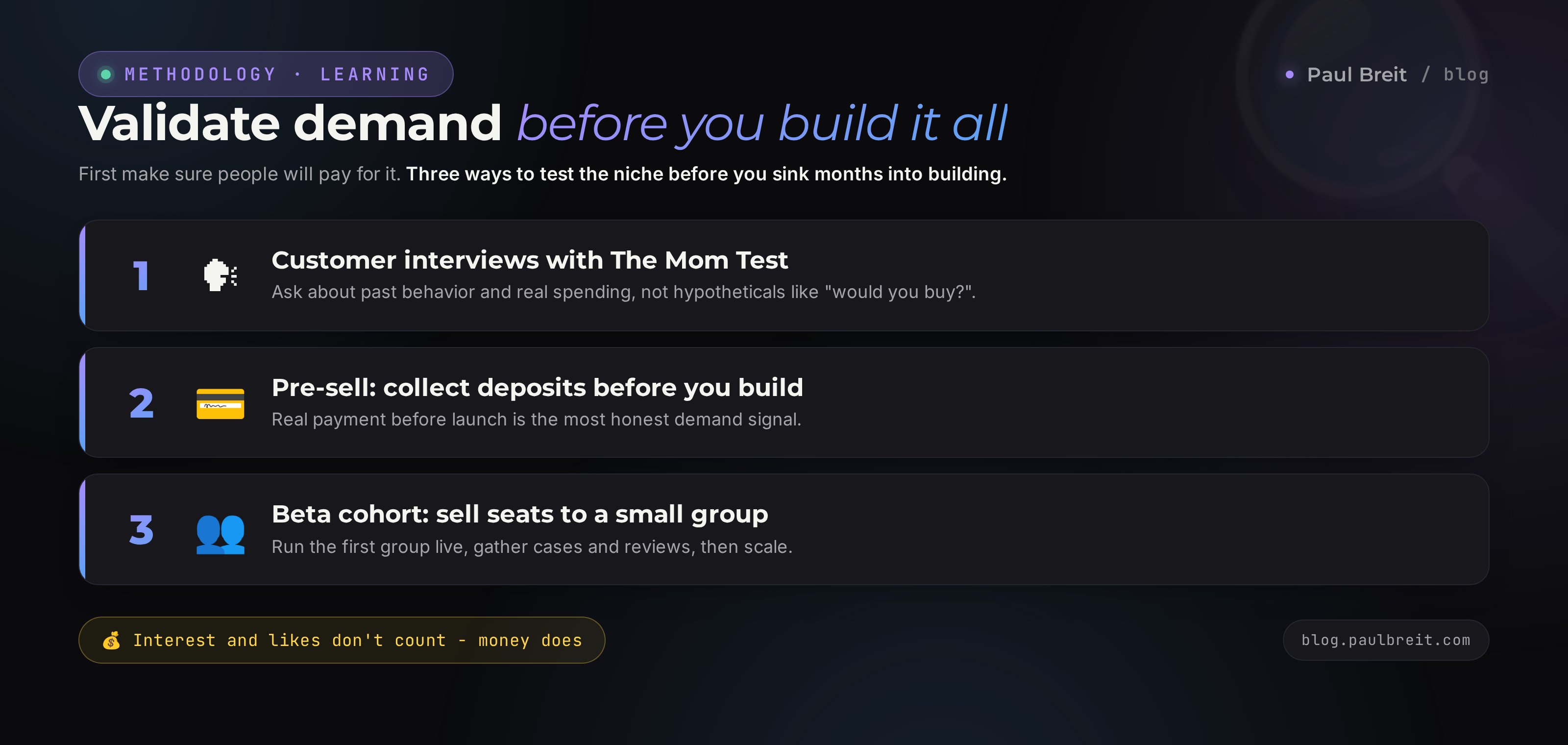
The rule is simple: demand is tested BEFORE production, not after. And it is tested not by likes and not by oh, cool idea, I will definitely buy, but by people's real actions: money, prepayments, waitlist sign-ups. Words cost nothing. People praise any idea out of politeness. You can only trust actions.
People do not buy a product, they buy a result in their life
There is a great framework called the job a product is hired to do. The idea is that a person does not buy a course or mentorship. They hire it to move from their current situation to the one they want. They are not buying ten modules about funnels, they are buying steady leads and peace of mind about tomorrow. You do not need a drill for the drill's sake, you need it for the hole in the wall. And you do not need the hole for the hole's sake, you need it for the shelf that will hold your family photos.
In the move from old to new, four forces act on a person. Two push forward: the pain of the current situation (what they are fed up with) and the pull of the new solution (what beckons). And two hold them in place: anxiety about the new (what if it does not work, what if I get burned) and attachment to the old (habit, sunk effort, the fear of changing everything). For the person to buy, the pushing forces have to outweigh the holding ones. So in the product and the offer you need to both amplify the pain and the pull and, at the same time, relieve the anxiety (here is the guarantee, here is the step-by-step, here I am with you) and pry them off the old.
From this comes the kind of problem that is fit for a product. It has to be threefold: painful (it genuinely torments them), urgent (it needs solving now, not someday), and paid-for (people already spend money to solve it). If people are already spending money trying to fix this pain, that is the best signal of demand there is. It means there is a market.
Sell the transformation and set yourself apart from the real enemy
The core of your offer is the before-to-after transformation, not a list of features. Not the course has twelve modules and forty lessons, but you come in with an empty blog and leave with a system that brings you leads. In the offer, the person is looking for themselves and their result. Let them see point B so clearly that they want to get there.
And right there, the differentiation. Only not from other courses. Your real enemy is usually not a competitor but two other options in the person's head: I will just google it all and figure it out myself and I will do nothing, it is fine as is. That is who you are actually competing with. Your product has to explain why google it myself will not work (they will drown in contradictory information, waste a year, get no feedback) and why do nothing is expensive (another year with no result, money that never came in).
And one more thing about the avatar. It seems like the broader your target audience, the more sales. In reality it is the opposite. The narrower and more specific you describe who the product is for, the more strongly the person feels this is about me and the stronger the pull. A marketing course for everyone hooks no one. How a psychologist can reach ten clients a month through a blog hooks every psychologist who reads it. Narrowing amplifies the pull.
Practical: a demand-validation checklist
Before you record the product, run through this list. Every item is an action, not a thought.
- I have found a concrete segment of people and can name them individually (not entrepreneurs, but nail techs who work for themselves and want to raise their prices).
- I have talked live with at least eight to ten such people using the customer-interview method (see below).
- I have confirmed the problem is painful, urgent, and already paid for (people told me what they had already tried and what they spent money on).
- I have gathered a waitlist or offered a pre-order, and people left their contacts, or better yet, put down a prepayment.
- I have sold a beta version to at least a small group at a discount in exchange for feedback, BEFORE recording the final lessons.
- Only after all that do I sit down to produce the full product.
If even one item is blank, stop, you are not ready to record yet.
Practical: a customer-interview question script
A customer interview is a conversation with potential clients to understand their real pain. There is an ironclad rule (from the approach called The Mom Test): do not ask about the future or hypotheticals, ask about past behavior. Would you buy a course for such-and-such? is a useless question, the person will lie to be polite. Tell me about the last time you tried to solve this problem? is gold, because it is a fact from their life.
Here are the questions that work, ask them in order:
- Tell me how things work for you right now with [topic]? Walk me through an ordinary day.
- What is the most maddening part of it, what annoys you most?
- When did you last hit this problem? What exactly happened?
- What have you already tried to solve it? What of that worked, what did not?
- Did you spend money on it? How much, on what? (This is where you learn whether the market pays.)
- If this problem magically disappeared tomorrow, what would change in your life or work?
- Who else you know is struggling with the same thing? (That is how you find new people to talk to.)
And the end of the conversation is always a concrete commitment, not a thanks, that was interesting. I am actually putting together a group for exactly this, we start in two weeks, it costs such-and-such. Want me to hold you a spot? A yes backed by money or a prepayment is real validation. Oh, I need to think about it is also an answer, which means the pain is not as sharp as it seemed.
Section 05Product architecture
Demand tested, outcome defined. Now we assemble the product's skeleton. The key here is not to confuse the person and not to overload them.
One module, one skill
The main rule of structure: one module equals one skill. Not a module about everything at once, but a module after which the person can do one concrete thing. Break the path into skills and arrange them from simple to complex. First the base the next step stands on, then the layer above. This is called building scaffolding: each new skill rests on the previous one instead of hanging in the air.
And do not overload the person's working memory. Everyone's is small, we hold literally a few new elements in mind at once. So break information into small pieces (this is called chunking). One lesson, one idea, one step, one action. Do not try to hand over five concepts in a single video, the person will not retain it.
Formats fit to the task, and video length
Choose the format to fit the task, not because everyone does it that way. Need to show a process? Record a screen demo. Need to convey a way of thinking? Voice or text will do. Need practice? That is an assignment with a check, not a video. Not everything has to be video. Sometimes a checklist or a template works harder than an hour-long lecture.
There is concrete data on video length. Engagement holds up to about six minutes, then it drops. On videos longer than twelve minutes, people watch about three minutes on average and leave. The takeaway is simple: cut things into short segments of three to six minutes, each about one step. Almost no one will finish a single forty-minute video, but five short six-minute ones get watched far more often.
The MVP course and pre-launch: do not record everything at once
A huge beginner mistake is to sit down and record the entire course, all forty lessons, polish the edit, and then discover the product is off. You spent months on something you may have to redo.
Do the opposite. Put together a minimal working version (that is your MVP) and run the first cohort live, week by week. That way you record only what is really needed, you immediately see where people get stuck, and you fix things on the fly. And the clean, polished recording you make later, once you know for sure what works.
Self-paced, cohort, and hybrid
There are three ways to set up how people go through it, and their completion rates differ wildly.
Self-paced: the person goes at their own pace, whenever they want. The plus, it is convenient and it scales. The minus, completion is low, usually around ten to fifteen percent. Without external structure the person puts it off for later, and later never comes.
Cohort (a stream): the group moves together, on a schedule, with deadlines and live touchpoints. Completion is several times higher. According to a large platform's data, cohort courses carry noticeably more people to the end than the same courses in on-your-own mode, something like two thirds versus about half. And pure self-paced sags even further.
Hybrid: recorded materials plus live touchpoints (reviews, calls, a chat, deadlines). This is the sweet spot. You keep the convenience of recordings and add the structure and support that carries people to a result. For most products, hybrid is what I recommend.
And two more mechanics that help a lot:
Dripped release (people call it drip). Do not open the whole course at once, hand out one module a week. That way the person does not choke, they move in a rhythm instead of gulping down the first evening and quitting.
Deadlines. People are wired so that without a deadline they do almost nothing. A deadline is not cruelty, it is care: it helps the person finally do what they wanted to do anyway but kept putting off.
Practical: the module skeleton
Build every module on the same framework. Works like clockwork:
- Module goal – one sentence in the formula from the goal section (By the end you will be able to...). From second one the person knows what they will walk away with.
- Short content – three to six minutes, to the point. Only what is needed for the action. No filler, no backstory.
- Practice on their own material – the person does not an abstract exercise but work on their real project. Writes their own post, builds their own funnel, plans their own menu.
- Feedback – a check of the result. A curator, a review, self-check against a clear checklist, a group review. Without this step the module does not work.
- Spaced repetition – a few days later the person comes back and applies the skill again, now in a new situation. That locks it in.
Run every module through this framework. If any of them lacks the practice on their own material and feedback steps, it is not a module, it is a lecture.
Practical: an MVP-launch plan
Here is the sequence to launch a product fast and without the risk of recording the wrong thing:
- Put together the offer and describe the transformation (point A to point B).
- Open a waitlist or pre-order, gather people.
- Sell a beta cohort to a small group at a discount, in exchange for feedback and permission to use their testimonial.
- Run the cohort live, week by week: short material, assignment, review. Record the sessions.
- Watch where people get stuck and patch those spots on the fly.
- After the cohort, make a clean recording out of what actually worked.
- Launch the next cohort with the finished recording and the testimonials from the first.
This way you are earning before the product is fully done, and you build it on real people instead of in a vacuum.
Section 06How to make your product actually work
Here we are, at the heart of the whole article. Everything before was foundation. And now, the thing people actually pay for, the thing that separates a product that leaves a result from a product that leaves only watched videos.
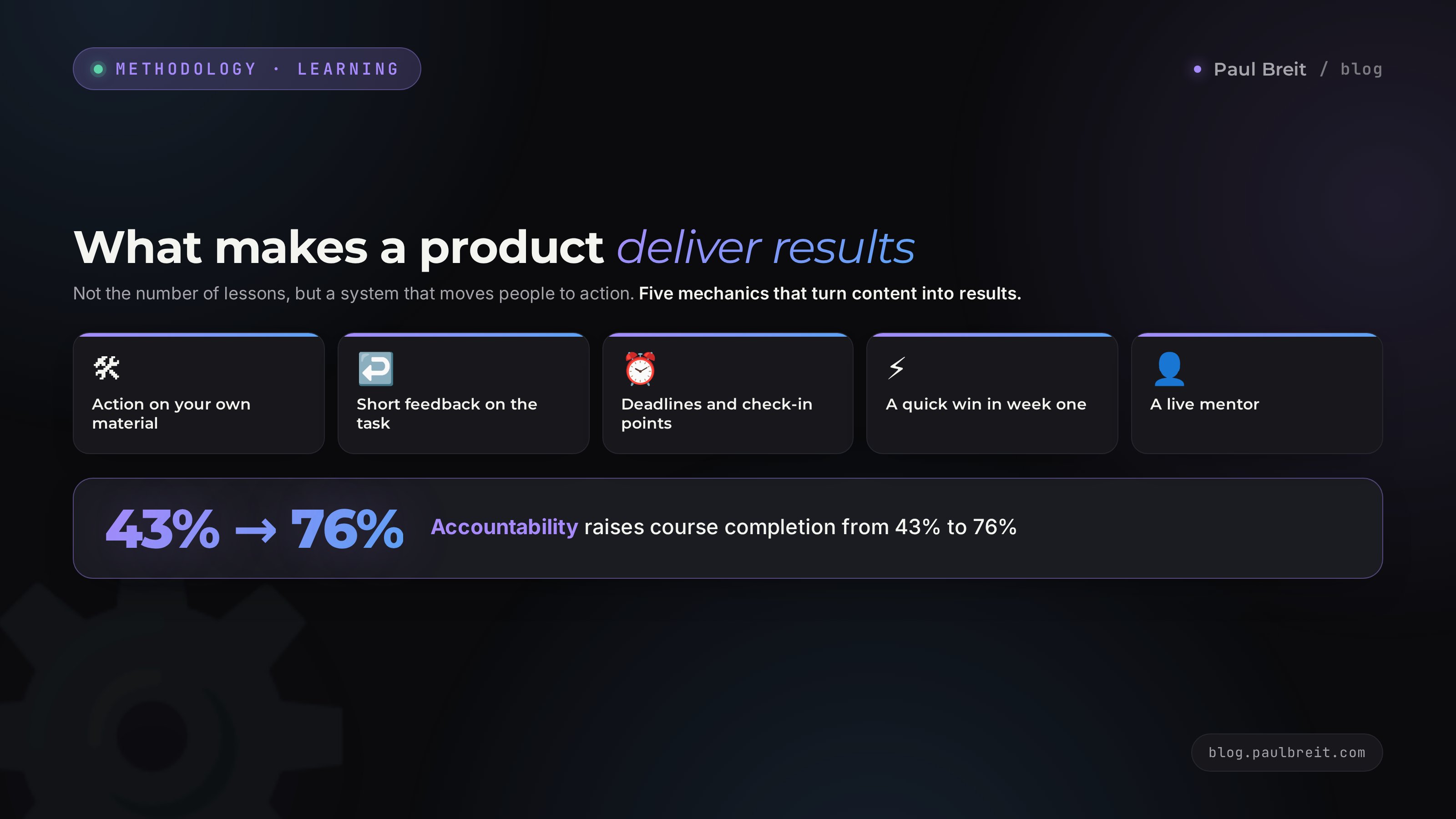
Remember one idea, it is the main one here: a result is born not from consuming content but from the person doing the work, getting feedback, and redoing it. Everything below is the mechanics that make a person act and keep them from quitting.
Doing instead of consuming
I already mentioned the doing effect: practice teaches roughly six times more strongly than watching. So the center of gravity of the product has to shift from video to assignments. Flip the usual proportion.
Here is what that looks like in practice. In an ordinary course, ninety percent is watch the lesson and ten percent is do the assignment. Flip it: let the main event of every module be the person's action, and the video a short lead-in to it. Not a lesson with homework at the end, but an assignment that comes with a short explanation of how to do it.
And assignments have to be on the person's real material, not practice ones. Not come up with an abstract offer for an abstract expert, but write your own offer for your own product right now. Then by the end of the course the person holds not a notebook of exercises but real working things: their site, their funnel, their posts, their first sales.
Short cycles of action then feedback
Feedback is one of the most powerful levers in learning, period. But there is a subtlety here that almost everyone trips on.
Feedback has to be about the task, not the person. This headline has no specifics, add a number and a result and it will hook harder is about the task, and it helps. You are great or well, that is kind of weak is about the person, and it is either useless or actively harmful: the person gets defensive or upset, and what to do about it stays unclear. Praising or scolding the person misses. Showing concretely what to improve in the work and how hits the mark.
And the cycles have to be short. Not do it all in a month, then we will review. But you did a step, got feedback, fixed it, next step. The shorter the loop between action and feedback, the faster the person grows. They do not have time to cement a mistake, they are shown where to steer right away.
Retrieval and spacing
Two more things that really help you remember and learn instead of listen and forget.
Retrieval. A person learns more strongly when they pull knowledge out of their own head rather than reread the ready-made. So not read the notes again, but close everything and try to reconstruct, recall, apply it yourself. Mini-tasks that make you reproduce, questions with no hints, do it yourself from memory work better than passive review.
Spacing. Returning to a skill across gaps of time beats cramming it all in one sitting. The same skill is better applied three times a few days apart than ten times in a row in one evening. So build returns into the product: what the person learned in module one resurfaces in module three in a new context.
I will be honest so you do not overrate the effect: in lab conditions these techniques give a very strong boost, but in a real course, a more modest one. Still, they are free and work in your favor, so it would be a shame not to use them.
External structure: deadlines, check-in points, accountability
This one is an underrated giant. People do not quit products because the products are bad. People quit because no one is holding them.
Look at the number. When a person just keeps a goal in their head, about four out of ten carry it to the end. But when they write the goal down and report their progress to someone weekly, almost eight out of ten finish. That is nearly double. And all it takes is a written goal plus a regular check-in. That costs you as the author almost nothing, and it changes the result dramatically.
Hence the mechanics you need to build in:
Deadlines for every stage. Not whenever you get to it, but by Friday. People are wired this way: with a deadline they pull it together, without one they put it off forever.
Check-in points. Once a week the person shows what they did. In the chat, to the curator, in the group. The mere fact that they will have to report gets people off the couch better than any motivation.
When, where, and how plans. When a person writes out in advance exactly which day and what time they will sit down to the assignment, the odds they actually do it go up noticeably. Not I will work on the funnel this week, but Wednesday from nine to eleven in the morning I am building the first screen of the site. Help people make plans like this right inside the product.
Community and a live curator
A person alone runs out of steam. A person among their own keeps going.
Community is not a nice bonus on top of a course, it is a working mechanic of results. When there are people just like you around, walking the same path, several things happen at once. You see others doing the work and coping, and you do not fall behind. You can ask and get an answer. You do not feel like the one lonely idiot who is the only one stuck here. Learners in a live group reach a result noticeably more often than loners.
A live curator amplifies this even more. Even a little personal support, when there is someone who will ask, encourage, and untangle a sticking point, noticeably lifts both completion and results. It is not about the magic of a live human as such. It is that a live curator closes that very feedback loop and creates that very accountability. They are the carrier of the structure.
A quick win in week one
Now for the most dangerous spot in any product: the start. Most people drop off at the start, in the first week. Here is a number that should shake you: those who actually got going in week one reach the end many times more often than those who put the start off. For fast starters, completion can be several times higher than for people who never touched the product in the first days. Essentially, a client's fate is decided in week one.
The takeaway is ironclad: give the person a fast first result in the very first days. A small win they can really get right away. Not three weeks of theory first with the result at the end, but on the very first session you built and published something alive. The psychologist wrote a first hooky post and got a response. The nutritionist put together a first menu. The beginner assembled the first screen of a site. That first win gives the belief it is working, I can do this, and the person stays.
Onboarding and retention
And the last thing in this section. The person's first contact with the product has to be thought through to the smallest detail. Do not leave them one-on-one with twenty modules and a go on, study. Take them by the hand: where to start, what to do on day one, where to write if they get stuck, where to meet the group. A clear onboarding cuts early drop-off.
After that, retention rests on everything above: rhythm, deadlines, check-ins, support, small wins. Retention is not about entertaining the person, it is about not letting them get stuck and feel abandoned.
Practical: the formula for an effective lesson
Every lesson in an effective product is built on one formula. Memorize it:
Micro-goal, then short explanation, then action on your own material, then feedback, then locking in the result.
- Micro-goal – one sentence, what the person will do right now.
- Short explanation – three to six minutes, only the essentials.
- Action on your own material – the person does it right there on their real project, no delay.
- Feedback – about the task, not the person: a self-check checklist, a review by the curator or the group.
- Locking in the result – the person saves what they did, marks the step done, shows the result.
A lesson without points 3 and 4 is a lecture, not an effective lesson.
Practical: a results-mechanics checklist
Run this list over your product. Check off what you have and what you do not.
- At the center of every module is the person's action, not watching a video.
- Assignments on the client's real material, not textbook abstractions.
- Short cycles of did it, got feedback, fixed it.
- Feedback about the task, not the person.
- There is retrieval (do it yourself from memory), not just rereading.
- Skills come back at intervals instead of being covered once and forgotten.
- Every stage has a deadline.
- There is a weekly check-in point.
- The person writes out when-and-where-I-will-do-it plans.
- There is a live community of clients like them.
- There is a curator or review that closes the feedback loop.
- In week one the person gets a fast first result.
- There is a clear onboarding: where to start on day one.
The more checkmarks, the more effective the product. The empty items are your growth points.
Section 07Mentorship, separately
A course and mentorship are different genres, and you should not mix them up. A course scales and costs less, mentorship is deeper, more personal, and more expensive. Let us take mentorship separately, because it has its own mechanics.
What makes mentorship different
Three things set personal work apart from a course.
Personalization. In a course there is one route for everyone. In mentorship you guide the person through their situation, adjusting the steps to their point A, their niche, their pace.
Feedback. In a course it comes at best from a curator and on a schedule. In personal work it is dense, fast, and targeted, precisely on what the person brought today.
Accountability for the result. This is probably the main thing. In mentorship there is a person who keeps you on your toes and asks: did you do it? why not? when will you? That accountability is half the power of mentorship.
And here is what matters: results in mentorship are higher not because of some magic of the one-on-one format. They are higher because personalization, dense feedback, and hard accountability all come together there. The loop of action, feedback, fix spins fast and on point. Remove the feedback loop and mentorship turns into expensive conversations about nothing.
One-on-one, group, or hybrid
Three formats, each with its own logic.
One-on-one. Maximum personalization and depth. The downside, it does not scale and it eats your time, which is why it costs a lot. It suits complex individual tasks and the premium segment.
Group. People move together, you guide several at once. Cheaper for the client, and you get the power of community and exchange as a bonus. A group often delivers results as good as one-on-one, because the person also learns from other people's reviews.
Hybrid. Group reviews plus a bit of individual contact plus a recorded base. Usually the most sensible option: you get depth, scale, and an affordable price.
Practical: a mentorship-session framework
So a session does not turn into idle chat and actually produces results, run it on one framework. Take a one-hour session:
- Check-in (5 minutes). How are things, what state did they arrive in, what is on the agenda. Keep it short, do not ramble.
- Accounting for last time (10 minutes). What did we agree on last time? What is done, what is not, why. This is where accountability lives. Never skip this block, it is exactly what keeps the person working.
- Working the task (25-40 minutes). We dig into what the person brought. We look at their real material, find the sticking point, show what to fix and how. This is where you give the most value.
- Written agreements (5-10 minutes). Fix it clearly: what the person will do before next time, by what deadline, how they will report. Write it down, do not settle for you get the idea. An agreement that was not written down does not exist.
A framework like this turns a session from a pleasant conversation into a progress machine.
Practical: a boundaries checklist (protection from burnout)
Mentors burn out when they dissolve into their clients with no boundaries. Hold your boundaries and you will last. Run through this list and write out your own rules:
- Availability hours stated in advance (for example, I answer in the chat on weekdays from ten to seven, not on weekends).
- Response time agreed (I reply within a day, not instantly and always).
- Question format set (questions go in the shared chat about a concrete task, not a stream of thoughts in your DMs at three in the morning).
- The number of personal sessions and their length are fixed, overtime costs extra.
- Responsibility for the result is shared: you give the system and the feedback, the person does the work. You cannot do it for them.
- You have the right to say no and end work with a toxic client.
- You have time to recover between cohorts, not an endless race.
Boundaries are not about coldness. They are about having enough of you to go around, for a long time and for everyone.
Scaling through curators and playbooks
The main trap for a mentor is to funnel everything through themselves. Then your income ceiling is the hours in your day, and there is only one road: burnout.
Scaling comes through two levers. The first is curators. You train assistants who run reviews and give feedback by your method. You train the curators themselves, and they guide people. The second is playbooks and systems. Frequent questions get moved into recorded reviews, typical situations into templates and standard procedures, so your live time goes only to what is genuinely complex and individual. You stop answering the same question forty times.
That is how mentorship grows from me and ten clients at the limit of my strength into a system that guides hundreds of people without killing you.
Section 08Quality, trust, and ethics
A product can be effective, but if people do not trust you, they will not buy, and if you promise too much, sooner or later it will come back to bite you. Let us look at how to build trust honestly.
Case studies with a measurable before and after
A case study is the strongest proof that your product works. But a case study only works when it has a measurable before and after and a recorded starting point.
Weak case: "Maria took the course and is very happy, everything is great for her." That says nothing.
Strong case: "Maria came in with a blog of three hundred followers and zero leads. Two months later, on my system, a steady three or four leads a week and her first sales of a certain amount." You can see from where and to where. You can see the scale of the change.
And always record point A at the entrance. Measure the baseline. Otherwise you will not be able to honestly show the shift, and you yourself will not understand what your product really delivered. Write down what the person came in with, on day one.
An important honesty caveat: the top result is not the norm. If out of a hundred clients one hit the moon, showing only them and saying here is what awaits you is deception. Show typical results, not just record ones, and say plainly that a record is a record.
Testimonials: similarity beats star power
There is a non-obvious thing about testimonials. The one that works is not where a mega-star made a million. It is the one where a person similar to your potential client tells their story. Because the reader is looking for themselves in the testimonial. A psychologist will believe a psychologist with a similar start, not a super-entrepreneur with millions. Collect testimonials from a range of typical clients so every new person finds their own and thinks: if it worked for them, it will work for me too.
Practical: the structure of a case study
Build every case study on this structure and it will sell:
- Who – a short portrait of the client (niche, situation) so the reader recognizes themselves.
- Point A – what they came in with, in numbers: this many followers, this many leads, this much income, this specific pain.
- What was wrong – where the real slump was, what was in the way.
- What they did – which of your methods the person put in place (the method is yours, the person applied it to themselves), what steps they went through.
- Point B – the result with numbers and a timeframe: it became this much, in this much time.
- A direct client quote – in their own words, alive, in quotation marks. It adds credibility more than any words of yours.
Ethics: promise effort and skill, not income
Here is the hard and important part. Under FTC guidance you cannot guarantee income or specific earnings from training. Promises like you will earn a fortune after the course are not only an ethics problem, they are a legal risk too. And frankly, it is simply a lie: you do not control whether the person will do what you teach.
What you can and should guarantee: the quality of the training, that you will give a working system and support, that if the person does the assignments they will master a specific skill. A guarantee on effort and on process, not on a dollar result.
And here is another strong move that works against intuition: honestly say who the product is NOT for. It feels like this will scare buyers off. In reality it is the opposite, it raises trust. When you say if you are looking for a magic button and are not ready to do the work, this is not for you, the person sees that you are not pushing it on everyone, and they trust you more. An honest not for everyone cut-off sells better than fits anyone.
A couple of words on the money-back guarantee in numbers, so you are not afraid to offer it. A guarantee usually lifts sales conversion noticeably, by tens of percent. And very few people actually ask for their money back, usually a couple of percent. People value the option to return but rarely use it. So a guarantee is almost always a net plus.
Practical: an ethical way to word a guarantee
Build your guarantee on this framework, honest and legally safe:
What I guarantee: "If you go through the program and do the assignments, you will build [a specific skill or artifact: your funnel / your meal plan / your first product]. I give you a working system, reviews, and support the whole way."
Money-back guarantee: "If in the first [7-14] days you watch the materials, try them, and realize it is not for you, I will refund your money, no questions asked."
What I do NOT promise (an honest cut-off): "I do not promise specific earnings, they depend on your niche, your effort, and how you put the system in place. The product is not for people who are not ready to do the assignments and want a result without doing the work."
Wording like this sells, protects you, and attracts exactly the people you will later enjoy working with.
Section 09AI in 2026: an invisible engine, not a replacement
There are two extremes about AI in education right now. Some think courses are no longer needed, you will just ask the AI. Others are afraid and pretend nothing has changed. Both are wrong. Let me lay out how it actually works.
AI in creating the product
AI genuinely speeds up production. A draft program, offer wording options, sketches of assignments, module structure, email copy, AI puts all of it out in minutes. I work this way myself every day and save a ton of time.
But hold to two rules. First: the AI's first draft is a draft, not a final. You always have to edit it to fit you, add your experience, your examples, your voice. Second, and it follows from the first: there is a risk of sliding into generic content. If you take what the AI produced as the internet average and post it as is, you get a faceless product like thousands of others. The value is in your experience and your concrete examples, which the AI does not know. AI is an accelerator of your thinking, not a replacement for it.
AI in support
Here it gets genuinely interesting. An AI curator can support a person around the clock. Stuck at two in the morning? Ask, get a breakdown. That takes a huge load off the live curator and closes that gap where the person is stuck and the next review is three days away.
But there is a critical condition, and it is backed by research. An AI curator helps most when it walks the person through step by step and nudges them to think for themselves instead of dumping a ready answer. There is a recent experiment where an AI tutor set up to lead the student step by step without a ready solution produced learning roughly twice as strong as a good live, active class. The key is exactly in the delivery: break it down step by step, ask leading questions, make the person get there themselves. If the AI curator just hands over the answer, the person copies and does not learn. If it leads them step by step, they learn faster than almost anywhere else.
Human premium: your value is in what AI cannot do
Since AI has commoditized information itself (it is now free and endless), the question arises: what are people paying you for? The answer is for what AI cannot give.
Your real path and results. The track record of a living person who walked the road themselves. A living connection and support, when someone sees you and believes in you. Transformation through a relationship with a person, not with a program. People pay for having someone nearby who has been where you are headed and will lead you by the hand.
The model of the future is simple: AI hauls the routine and the round-the-clock first line of support, and you give the truly human part, the experience, the taste, the belief, the live breakdown of the hard stuff. And it is not a one-off launch but long work with people who stay with you for a long time, because they get what you cannot buy anywhere. AI is the invisible engine under the hood. You are at the wheel.
Section 10Common mistakes: red flags
A quick rundown of what kills results. Skim it and check yourself.
- You design from content, not from the outcome. What should I talk about instead of what will the person carry away.
- The goal is phrased with will understand and will learn instead of will do and will build.
- You did not test demand before recording. You recorded what you wanted, not what people buy.
- You trust likes and cool idea over prepayments and real actions.
- Content dumping: you unload a mountain of information and confuse volume with value.
- A passive format: nothing but videos, minimal action.
- Assignments are abstract instead of on the person's real material.
- There is no feedback, or it is about the person (good job) instead of the task.
- No external structure: no deadlines, no check-ins, no support.
- No fast result in week one, all the value dumped at the end.
- Weak onboarding: the person is left alone with twenty modules.
- You recorded the whole course at once instead of road-testing an MVP with a live cohort.
- The mentor funneled everything through themselves, with no boundaries and no curators, and is burning out.
- Case studies with no numbers and no point A, testimonials only from stars instead of similar people.
- You promise income in money (breaking the rules and lying).
- You try to fit everyone at once instead of honestly cutting off not for you.
- You post generic AI content with none of your own experience or voice.
Every item here is someone's real story of failure. And almost every one is cured by what is written above.
SummaryAction plan: build your product step by step
Let us pull the whole path into one checklist. Go through it top to bottom and you will end up with an effective product instead of a video warehouse.
- Pick a segment. Concrete people you can name individually. Narrower than feels right.
- Run customer interviews. Eight to ten live conversations from a script about past behavior. Find a painful, urgent, paid-for problem.
- Define the transformation. Point A to point B. What the person could not do and what they now do on their own.
- Describe the final artifact. What the person will physically have in hand on the last day.
- Write the goals in the formula By the end you will be able to [action verb] [product] [to a quality bar], for the product and every module.
- Test demand with money. A waitlist, a pre-order, prepayments. Not likes, actions.
- Build the skeleton: one module, one skill, simple to complex, short videos of three to six minutes.
- Build in the results mechanics: action on your own material, short feedback cycles, deadlines, check-ins, community, a fast result in week one.
- Design the onboarding – the person's first day, step by step.
- Launch a beta cohort at a discount in exchange for feedback. Run it live, patch on the fly.
- Collect case studies and testimonials from the first cohort, with numbers and a point A.
- Make the clean recording out of what worked.
- Set up an ethical guarantee on effort and skill, with an honest who-it-is-not-for cut-off.
- Plug in AI as an accelerator for creation and as a round-the-clock, step-by-step AI curator.
- Launch the next cohort now with the recording, the testimonials, and a tuned system.
Go through these fifteen steps and you will have a product that genuinely carries people to a result. And your clients' results are your testimonials, your repeat sales, and your reputation, which sells for you.
FAQFrequently asked questions
Where do I even start if I have lots of ideas but no product?
Not by recording lessons. Start with a segment and customer interviews. Pick a narrow group of people, talk to eight or ten of them about their real pain and about what they have already paid for. The demand you find in those conversations is your foundation. You build the product later, around confirmed pain, not around whatever you personally find fun to talk about.
How many modules should a course have?
The right question is not how many modules but how many skills does a person need to get from point A to point B. Make that many modules, one skill per module. Usually an effective product is not twenty modules but five to eight dense ones, each with practice and feedback. Less filler, more doing. A bloated program scares and drowns people more often than it helps.
Course or mentorship, which should I choose?
It depends on the task and on your stage. Mentorship is easier to launch early: you do not need a recorded library, you guide a few people live, you charge more, you quickly learn what works, and you gather material for a course along the way. A course scales and costs the client less, but it takes recording and works well once you have already road-tested your method. Many people land on a hybrid: a recorded base plus live reviews. That is both effective and affordable.
How do I validate demand if I have no audience or followers?
You do not need an audience to validate. You need real conversations. Go where your potential clients already are: topic chats, friends, friends of friends, niche communities. Run customer interviews with real people. Offer beta work to a small group for a little money. Eight to ten honest conversations and two or three prepayments will tell you more about demand than ten thousand followers who watch in silence.
Should I record the entire course up front?
No. That is the most common and most expensive mistake. First road-test a minimal version with a live cohort, run it week by week, watch where people get stuck, and fix things on the fly. Do the clean recording later, once you know for sure what works. Otherwise you risk shooting forty lessons you will have to redo.
How do I get people to the finish instead of losing them halfway?
With external structure and support. Deadlines for every stage, weekly check-in points, a live community, a curator or reviews, a fast first result in week one, and a clear onboarding. Remember the number: people who write down a goal and report on it regularly finish almost twice as often as those who just keep the goal in their head. People quit not because the product is bad, but because no one is holding them. Hold them, and they will finish.
Can I promise clients a specific result?
You cannot promise a specific dollar income. It goes against FTC guidance and it is simply dishonest, because you do not control what the person does. Promise what you are actually responsible for: a working system, support, and the fact that if they do the assignments they will master a specific skill and build a specific artifact. A guarantee on effort and process, not on a dollar figure. And be honest about who the product is not for. Strangely enough, that raises both trust and sales.
Do I even need AI in the product, or is it just hype?
You need it, but as an engine under the hood, not as a replacement for you. In creation, AI speeds up drafts and busywork, but you always finish by hand with your own experience, or you will get a faceless generic. In support, an AI curator covers round-the-clock help and walks people through their sticking points step by step, as long as it guides them to think for themselves instead of handing over the answer. Your value stays in what AI cannot do: a real path walked, real experience, belief in the person, and transformation through relationship.