How to build a sales funnel in 3 days with AI
A detailed step-by-step guide. In three days you'll build a funnel that brings in 5-7 leads a day for your services, courses and consultations. No marketing department, no viral social accounts, no technical headaches. AI handles 90% of the work: copy, websites, banners, content and message sequences. After that – every step laid out with ready-to-use prompts and real client cases.
Sound familiar? You shoot reels, write posts, sometimes go live. Followers tick up, reach stays flat, and the leads still aren't coming. Every launch is a month of prep, burnout, then silence. And every time it feels like: just a little more and it'll take off. It won't. Until you have a funnel in place, an expert lives only until the algorithm's next mood swing.
I run a blog with 20,000 followers and I've helped 250+ experts build systematic sales on Telegram, MAX and VK. I've personally done over $1M in sales. And almost all of it rests on one simple funnel that any expert can build in three days.
What follows is the exact framework that's making money for me and dozens of my clients right now. I've broken it into three days so you can work through it point by point and miss nothing. You'll read it in about twenty minutes and build it in three days. Within a month the funnel settles into a steady flow of leads that come in without you being part of every deal. Let's go.
What's inside
Section 01How the funnel works
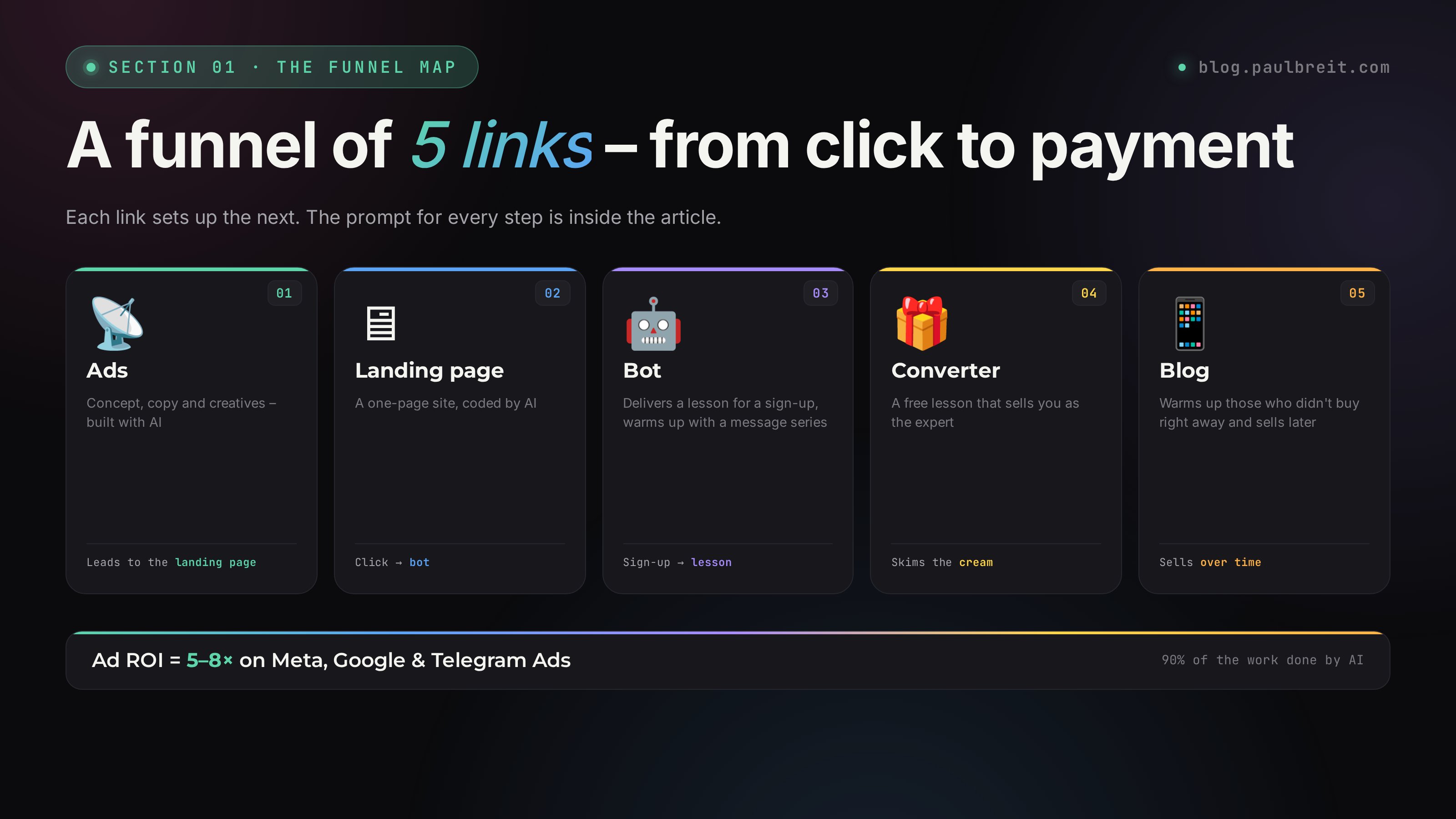
Before you build anything, you need to see the whole picture. A funnel is a chain of five parts that carries a person from a random click on an ad all the way to payment. Each part has its own job and sets up the next one.
The logic is simple. The hottest leads submit a request straight from the converter or the bot and pay back your ad spend on the spot. The rest follow the blog and buy later, once they're ready. That's how you stop depending on a single launch and gain an asset that works better every month: more people trust you, and selling to them gets easier and more profitable.
Three models you can use to build the funnel
At the core there's always a personal blog. I genuinely believe it's the best platform for selling: it lets you methodically convey the value of your offer, builds trust, and handles objections before money ever comes up. You can build a funnel around the blog in three ways.
Through the blog alone
You advertise the blog, post consistently, and sell through content. It couldn't be simpler technically, and with a good blog the leads come right away. There's one downside, but it matters: a blog subscriber acquired without a strong, attention-grabbing hook is expensive.
Through a bot
You advertise something free and useful – a guide, an article, a lesson or a webinar. To get it, the person activates a bot, which then sells through a series of messages, either manually or fully automatically. The upside: sales are automated and ad spend pays back fast. The downside: building a funnel like this is hard without marketing experience and a clear understanding of your audience. I see it all the time in people who come to me after a failed run with a marketer.
Combined
You make a converter that both hooks and sells, and you advertise it. To get the converter, the person activates a bot and follows your blog. The bot sends the link, and the sale happens from three sides at once: through the converter, the bot and the blog. Subscribers usually cost less than with direct blog advertising. The hottest leads buy or submit a request right away and pay back the ad spend on the spot, while the rest warm up on the blog. It's a touch harder than direct advertising, but this model is the strongest of all. That's the one we'll build.
Your product, your ad and your content must all say the same thing. A mismatch between them is mistake number one – it's the thing that kills sales. If your ad promises one thing, your landing page says another and your blog a third, the person gets lost and leaves. From here on, keep this in mind at every step.
Section 02Day 1. Messaging and positioning
Day one – clear head, no tech. This is where you decide what you sell, to whom, and in what words. It's the foundation: get it wrong here and no slick landing page or smart bot will save you later. At each step I give you a ready-made prompt – a line you can copy straight into your AI chat.
Some AI tools like Claude and ChatGPT don't open from certain regions. If that's your case, turn on a VPN with an EU or US location before you start. Reliable options: Proton VPN, Hiddify, AmneziaVPN. Note that Turkey and the UAE won't work – those locations are blocked by Anthropic too.
Define your product and audience
Write down four things: exactly what you sell, at what price, who buys it, and in what life situation a person makes the decision. And separately, think about whether you have a low-cost product that can pay back your ad spend on the spot while the higher ticket warms up. To avoid staring at a blank page, hand this work to AI – it'll pull the answers out of you with questions.
Tell it:
You're an experienced marketer. Help me map out my product and audience.
I'm a [niche, for example: burnout-recovery coach].
Ask me one question at a time: what I sell, at what price,
who needs it, and in what situation a person buys it.
At the end, build a map: product, 3-4 audience segments,
their pains and the triggers that make them ready to pay.
And suggest an idea for a low-cost product to recoup ad spend.
To create a quality product you don't need to be a guru or the best in your niche. It's enough to be able to bring people to the result they want. If you don't have a product yet, the same AI will help you build one from scratch: the program, the contents, and the promise.
Pick the one key action that makes money
The whole funnel leads to one specific step. If you sell services or mentoring, it's a free consultation or strategy call. If you sell a course, it's attending a webinar or another sales event. Pick one action and bend all your content toward it. The most common trouble here is loss of focus – when the blog invites people to ten different steps and they take none of them. One blog – one key action.
Package the blog
Your bio and pinned post should sell one idea – to follow you. Keep the focus on the reader: what they'll get and why they should stick with you right now. The mistake almost everyone makes is writing about themselves. Nobody cares how many degrees you have; they care about what will change in their life. Tell them what they'll find in your blog, and sell the very idea of following.
Tell the AI:
Here's a description of my blog and a couple of posts: [paste them].
Rewrite the bio and the pinned post so the focus is on the reader:
what they get if they follow, and why it matters right now.
No listing of my credentials. Give 5 versions of different lengths.Fill the blog with selling content
A blog sells not with "buy now" posts but with eight messages that handle objections one by one. Here they are:
- Selling the direction. Why what you do matters in the first place.
- You as a person. Who you are, your path, experience and values.
- You as a guide. It's clear you care about your clients' results.
- Your method. What your approach is about and what it rests on.
- Your product. What's inside, what it's made of.
- Client results. Concrete stories and numbers.
- Motivation to change their life. The desire for change plus the idea that a guide is needed.
- Why act now. A reason not to put it off.
Running a blog like this with AI takes 15 minutes a day once it's set up right. Detailed wording for each message is in the breakdown 10 AI prompts for experts.
Tell the AI:
Build a 2-week content plan around 8 messages:
1) why my direction matters, 2) me as a person, 3) me as a guide,
4) the essence of my method, 5) what's inside the product, 6) client results,
7) motivation to change one's life, 8) why act now.
One post per message. Each with a hooking first sentence
and a gentle call to the key action. Write in plain, lively language, no corporate-speak.
By the end of day one you have an audience map, a chosen key action, a rewritten blog package, and a two-week content plan. That's the clarity without which nothing else works.
Section 03Day 2. The core of the funnel
Day two is the densest. We build the three things this was all for: the converter, the landing page and the bot. AI builds each of them for you; your job is to feed it the messaging from day one and check the result.
Build the converter
The converter is the heart of the funnel. It's a free, useful piece that introduces people to you, builds trust, and invites them to submit a request. Most often it's an article or a short lesson of one to three videos. The converter is what skims the cream: the hottest leads buy right after it.
Here's a structure that works. Every block is in its place, and every one does a job:
- A hooking headline that reveals the gist of the guide or plan.
- An explanation of why what comes next matters at all.
- A short rundown of your method's benefits that sells the idea of digging deeper.
- Proof of effectiveness through your result and client cases.
- The essence of the method in broad strokes.
- A transition into the steps – you paint a picture of the journey in the person's mind.
- The steps themselves. Each follows one model: a hooking name, why this step matters, what happens if you ignore it, the pitfalls of doing it yourself, and an objection handled.
- Another confirmation of effectiveness through a result or cases.
- An invitation to message you directly or grab a mini-product.
Tell the AI:
Help me build a script for a free converter lesson with this structure:
hooking headline → why the topic matters → benefits of the method →
my proof and cases → the essence of the method in broad strokes →
4 steps, each on a model (name, why, what happens if you
ignore it, pitfalls of DIY, objection handled) →
proof again → invitation to submit a request.
Here's my methodology and cases: [paste them]. Write the way people talk, no fluff.
Pick the format by your strengths: an article can be written in an evening, a single video takes an hour to shoot, three short videos give the best result. How to build a full converter-webinar I covered in the article on the sales webinar with AI.
Build the landing page
The landing page is a one-page site people reach from your ad. You used to pay a developer for it; now AI hands you a ready, responsive site right in the chat. All that's left is to copy the code and publish. The principle is the same: whatever you promised in the ad goes on the page, word for word.
Tell the AI:
Build a one-page landing for my free lesson.
Ready HTML, responsive for mobile.
Blocks: headline with a promise, 3 benefits, a "Get the lesson" button,
a short about-me block, 2-3 cases, the button again.
Here's the copy and cases: [paste them]. Clean, light style, no stock cliches.
How AI builds sites in your voice without a designer is shown in detail in the article on building sites with AI.
Set up the bot
The bot does two things. First it grants access to the converter in exchange for following your blog. Then it sends a series of follow-up messages that reveal your product and invite people to submit a request. That's how a subscriber warms up while you sleep. AI writes the bot's copy too.
The first message – a request to follow:
The second – the link to the lesson with a little intrigue:
Then comes a series of five messages, a day apart from each other. Each one reveals its own message and gently nudges toward a request:
- Value. "Watched the lesson? Now for something important" – plus a takeaway that deepens the topic.
- Story. Your path and why you do this in the first place.
- Case. A specific client with numbers and a timeframe.
- Objections. You close the three most common ones: "it's too soon for me," "too expensive," "it won't work for me."
- Invitation. A direct call to submit a request or grab a mini-product.
Tell the AI:
Write the copy for a funnel bot:
1) a greeting with a request to follow the blog,
2) a message with the lesson link and a hook,
3) a series of 5 follow-up messages a day apart: value, story,
case, handling 3 objections, invitation to submit a request.
Each message short, lively, with one call to action. Here's the product and cases: [paste them].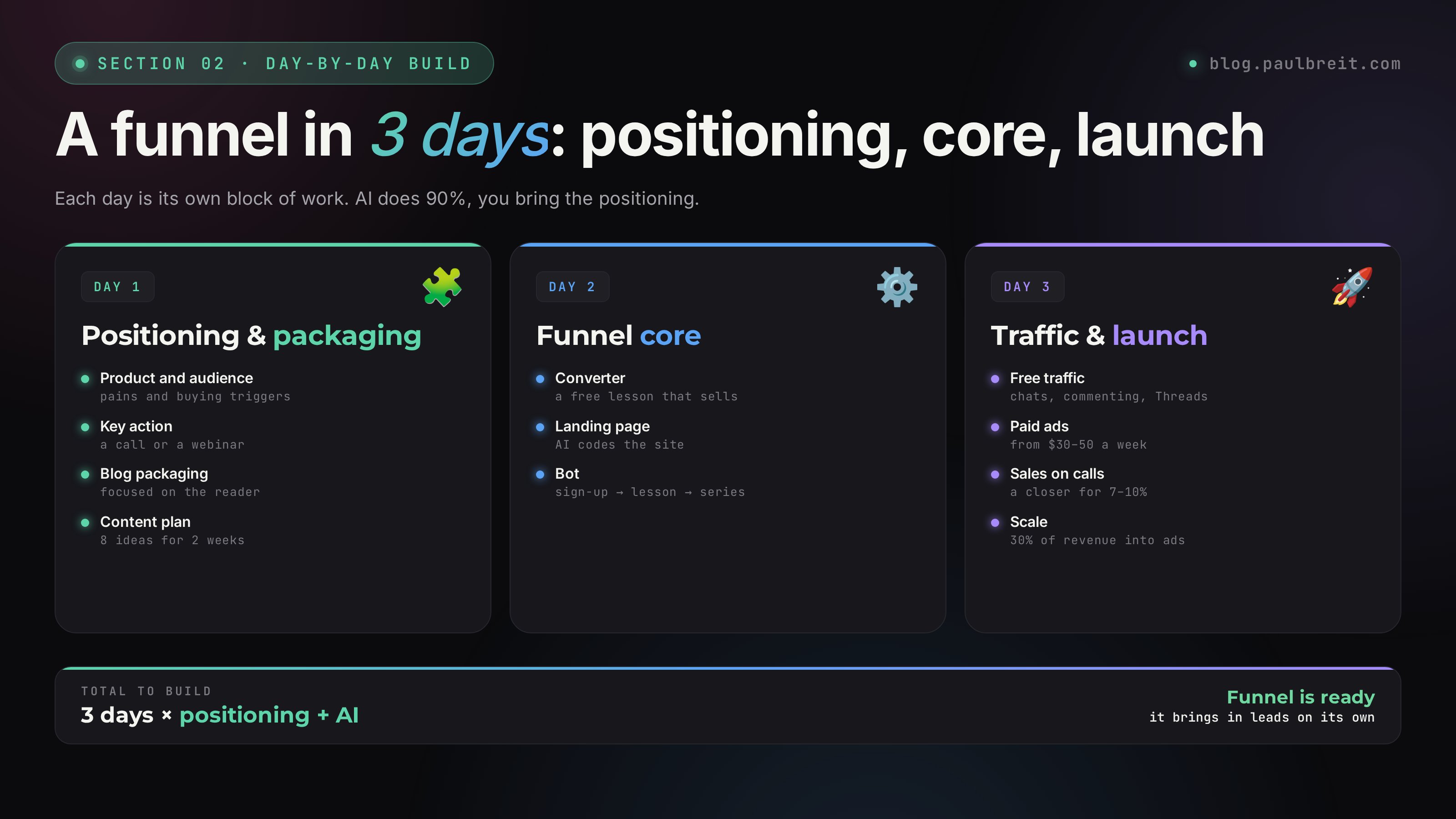
Section 04Day 3. Traffic and launch
Day three – we feed people into the machine you've built. First the free methods, to test the setup without spending, then paid ads, to scale what already works.
Low-cost traffic
While you don't want to spend money yet, drive people in by hand – with AI doing the writing. There are plenty of ways, and AI writes all the copy:
- AI bot in chats. It finds people with your pain in topic-based chats and carefully messages them first.
- Commenting. Thoughtful comments on blogs with the right audience – people notice you and come over.
- Threads. Short, sharp posts that pick up reach easily.
- Pinterest. Visual cards that drive traffic for years.
- Short videos. Reels and clips with a clear first frame.
- Conferences and lives. Joint live streams with experts in adjacent niches and audience swaps.
This is enough to get your first leads and confirm the setup is alive, before the first dollar on ads.
Paid ads
Once the setup brings in its first sales, plug in paid traffic. Pick a platform where your audience hangs out and start with small budgets – it's comfortable to begin with $30-50 a week and scale up with the money you've earned. The creatives – headlines, copy, banners – are made by AI. Don't ask for three versions, ask for fifteen: ad fatigue is real, and you need to refresh them every couple of weeks.
Tell the AI:
Make 15 headlines and 3 ad copies for [platform: Telegram Ads / Meta Ads]
that hook [audience] and lead to a free lesson on [topic].
In each: a hook, a benefit, a call to grab the lesson. No cliches, no corporate-speak.
You match the platform to the niche. Here are three real setups from my clients:
- Ads in blogs. Zita, a goals coach, ran an ad post in topic-based blogs, followed immediately by a post inviting people to DM her. Result – $40K.
- Targeted ads. Nikolai, a fitness trainer for entrepreneurs, set the simplest targeting on entrepreneur blogs and drove people to a post inviting them to a consultation. Result – $6K.
- Search ads. Konstantin, an AI-design expert, ran ads from thousands of sites to a landing page, where the bot delivered a lesson and sold a mini-course for about $25. Result – $10K.
Each person gets their own format, which is why most of my clients recoup their training in the first month. Where to find paid traffic and how to calculate ROI is covered in detail in the article on the expert sales funnel with AI.
Sell on calls
Leads turn into money on a short call with everyone who filled out a form or submitted a request. The expert makes the first sales – it shows you what hooks people and which objections come up. Then you hire an assistant who sells for 7-10% per sale, and you free up your hands. I broke down the structure of a call like this in the sales call script.
Scale
Once the funnel is in the black, put about 30% of revenue back into ads. Every month you earn more, invest more, earn more still. That's controlled growth: you turn the volume knob instead of praying to the algorithm.
A very simple setup that reliably returns 5-8× on ad spend on MAX, Telegram and VK. AI takes 90% of the tasks, contractors run the ads, assistants handle sales. You're left to run your blog and work with clients. It suits both those just starting out and those already selling who want to grow.
Section 05Client case studies
This isn't textbook theory. Dozens of my clients across different niches make money on this very framework. Here's just a sample.
| Client | Niche | What they did | Result |
|---|---|---|---|
| Oleg Zubarev | mentor to marketers | Talked about himself at business breakfasts, invited people to a consultation | $70K |
| Zita Mamitova | goals coach | Ads on search and Telegram channels, invited people to strategy calls through content | $40K |
| Yana Streltsova | sales on Telegram | Rolled out a lead-magnet funnel, launched ads, expanded the product line | $37K |
| Egor Maksimov | construction-business franchises | Built a funnel, launched ads, invited people to strategy calls | $37K |
| Viktoria Nemtseva | sales and mindset | Refined her positioning, built a funnel, ran launches on her blog | $25K |
| Konstantin Spirin | making money with AI design | Search ads to a landing page, a bot with a mini-course for ~$25 | $10K |
| Nikolai Milyutin | fitness for entrepreneurs | Simple targeting on entrepreneur blogs, an invitation to a consultation | $6K |
The spread in the numbers comes from different niches, price points and time worked – not different frameworks. The framework is one. Some start with a thousand followers, some with no blog at all. What unites them is that each one built a funnel and carried a person from the ad all the way to a call.
Section 06Why it doesn't work for everyone
People often come to me after trying dozens of schemes. They've spent months shooting reels that don't take off. They've chased clients through shady tactics like mass invites and cold blasts. They've bought ads that don't work. They've built complex funnels with a pile of variables. And here's what I see over and over.
- They pick complex models with a dozen moving parts instead of a simple setup.
- They sell at a low price point and without an audience that's ready to pay.
- They refuse to sell on calls, even though that's where the money is made.
- They push the wrong message, the wrong ad, to the wrong audience.
To reliably earn upward of $4K a month you don't need overengineered funnels or an audience in the thousands. You need to package your knowledge into an in-demand product, find people ready to pay for it, and convey the value to them. That's it. It's within reach for anyone who sees the whole picture.
And you see the whole picture when there's someone beside you who has built funnels like this dozens of times and already has working setups ready to go. With them you don't waste months testing hypotheses they've long since tested for you – you go straight down the proven route.
Section 073-day build checklist
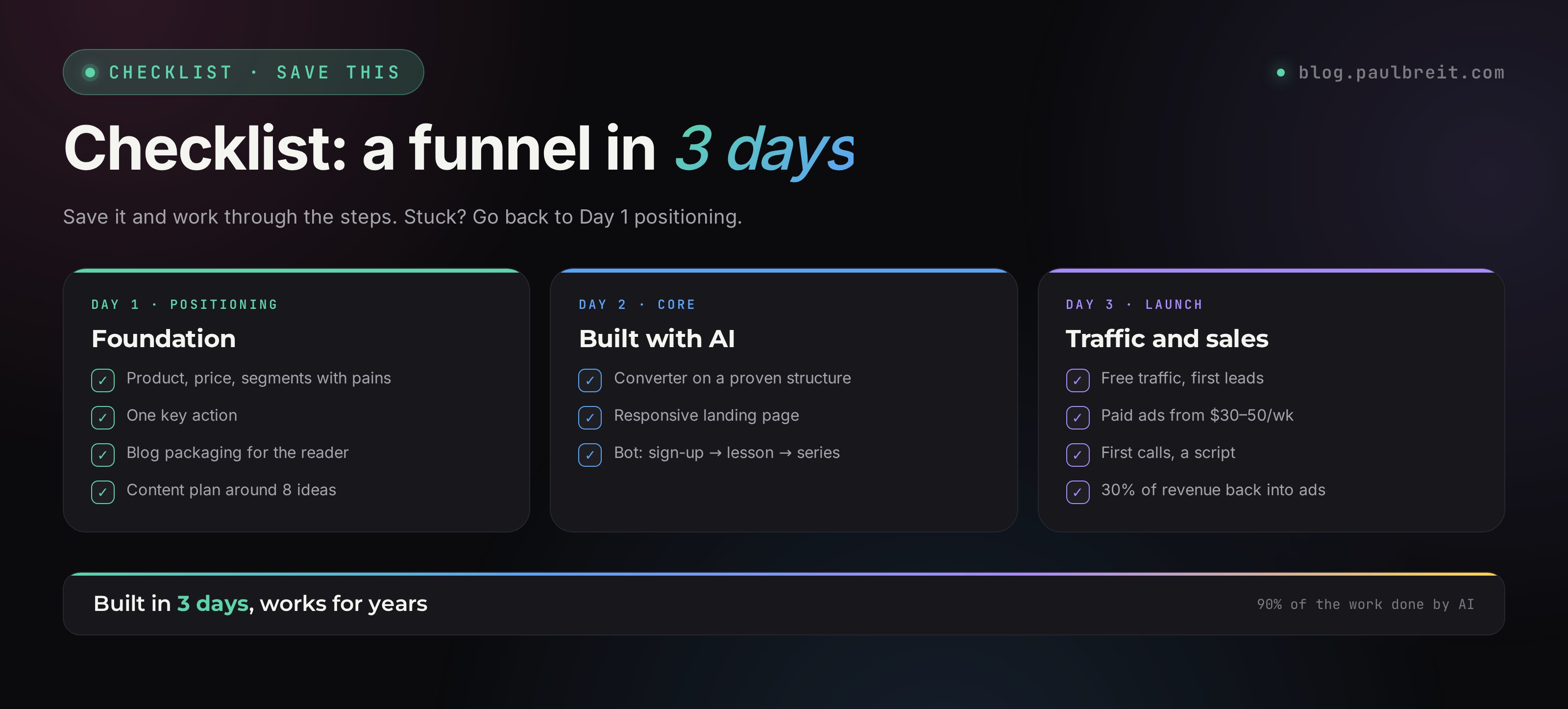
Save it and work through the points. If you get stuck at any step, it means the messaging from day one is unfinished – go back to it.
Foundation
- Product, price and audience segments described, with their pains.
- An idea for a low-cost product to recoup ad spend.
- One key action chosen: consultation, strategy call or webinar.
- Blog package rewritten with the focus on the reader.
- A 2-week content plan around the 8 messages is ready.
Built with AI
- Converter written using the working structure with all blocks.
- Responsive landing page built.
- Bot set up: follow → lesson link → series of 5 messages.
Traffic and sales
- Free traffic launched, first leads received.
- Paid ads plugged in on a budget of $30-50 a week.
- Platform matched to the niche: blogs, targeted ads or search.
- First calls done, sales script dialed in.
- A rule set: 30% of revenue back into ads.
The funnel is built in three days but lives for years. Set the messaging once, and from there AI keeps the content running, ads bring people in, the bot warms them up, and you sell on calls and scale what already works. That's the systematic, steady, controllable sales this was all for.
FAQCommon questions
Can you really build a funnel in 3 days without a marketer?
Yes. Three days is the build, not the theory. One day for messaging, one for the converter with a landing page and bot, one for traffic. AI does 90% of the work: copy, the landing page, banners, message sequences. Your job is to give it the messaging and check the result.
How many followers do you need for the funnel to pay off?
You don't need an audience in the thousands. Some of my clients started with a blog under a thousand followers, or none at all. What matters more is packaging your messaging right and showing it to the audience that's ready to pay.
What AI tools do you need and how much does it cost?
A regular AI chat assistant is enough – it writes copy, content and ads, and builds the landing page. Your main expense is advertising, which you launch on a small budget and scale up with what you've earned. The AI itself costs pennies by comparison.
Which converter should I pick: an article or a video?
An article can be written in an evening and works well if you don't love being on camera. A single video is a fair trade-off between effort and result. Three short videos give the highest conversion, because the person has time to connect with you. AI can write a script for any format.
Can I skip the sales calls?
Early on it's better to sell on calls: conversion is higher and you understand what hooks people. Once the flow of leads grows, you hand sales to an assistant for 7-10% per sale. Without any live conversation, the setup works noticeably worse.