The prompt engineer job: what they do and how much they make
An honest breakdown: who a prompt engineer actually is, what fills their working day, what the pay really looks like in the US and abroad, and how to break into the job from zero – even if you've never written a line of code. No "profession of the future for a million dollars" hype, and no dismissiveness either. Just how the market really looks in 2026.
A prompt engineer is a specialist who can set a task for an AI so it returns a predictable result: they describe the role, context, output format, and examples, then bring the answer to where it needs to be over a couple of iterations. In the US such a specialist earns roughly $70K starting out, $104K-$168K in the middle of the market, and $200K and up on strong teams. Coding isn't required to get in – a working level takes 1-3 months of practice.
Two opposite things get written about prompt engineers at the same time. One camp promises you a fortune for learning to ask ChatGPT nicely. The other says the job is already dead, because AI got smart enough to understand you from half a sentence. The truth sits between those extremes, and almost nobody says it calmly.
I run a blog with 20,000 subscribers and work with AI hands-on every day: I write copy, build bots, and set up agents for real business tasks. Thousands of people who sell services, courses, and consulting have come through my school. Many of them learned to work with AI from a complete zero. So I'll tell you without rose-tinted glasses what this job is, who it fits, and where it's headed.
What follows is a calm, orderly breakdown. Who a prompt engineer is and what they're really busy with. What the pay looks like in numbers, not slogans. Which skills you need and which you don't. How to break in from zero, step by step. And an honest answer to the beginner's biggest fear: will the job vanish in a year. It reads in about eighteen minutes. Let's go.
What's inside
Section 01Who a prompt engineer is, in plain words
A prompt is the request you give an AI. Everything you type into the chat window: "write a post about a course launch," "translate this text into Spanish," "build a table of my expenses." A prompt engineer is someone who can put those requests together professionally. Meaning: so the result comes out right reliably, on the first or second try.
The difference shows in a simple example. A regular user types: "come up with a slogan for a coffee shop." The AI spits out ten clichés about a bright morning. The user sighs and closes the tab. A prompt engineer gives a different request: "You're a brand strategist with fifteen years of experience. A coffee shop for tech workers in an office tower, average check $6, the value is quiet and fast Wi-Fi, not coziness. Give me eight slogans in three tones: buttoned-up, ironic, and bold. For each one, explain which insight it leans on." An answer to that request is something you can already take to a client.
The word "engineer" isn't there by accident. An engineer builds a working structure out of known parts for a specific task, and doesn't rediscover physics along the way. A prompt engineer does the same thing with words: builds a structure that makes an AI produce a stable result. They don't go inside the model or retrain it. They work at the task level: what we want out, and how to explain it to the machine with no ambiguity.
If you want it really short, a prompt engineer is a translator between two worlds. On one side, a person or business that knows what result they need but can't explain it to an AI. On the other, the AI itself, which can do almost anything but does exactly what it was asked, not what you meant. In between stands the specialist who turns a vague "make it nice" into a precise spec for the machine.
An important detail. A prompt engineer doesn't have to be a programmer. The base level of the job is working in plain text in an ordinary AI chat. Code shows up higher, when prompts get wired into apps through an API, but not everyone goes there, and not right away. Most practical business tasks get solved with no code at all.
Section 02What they do: a working day and real tasks
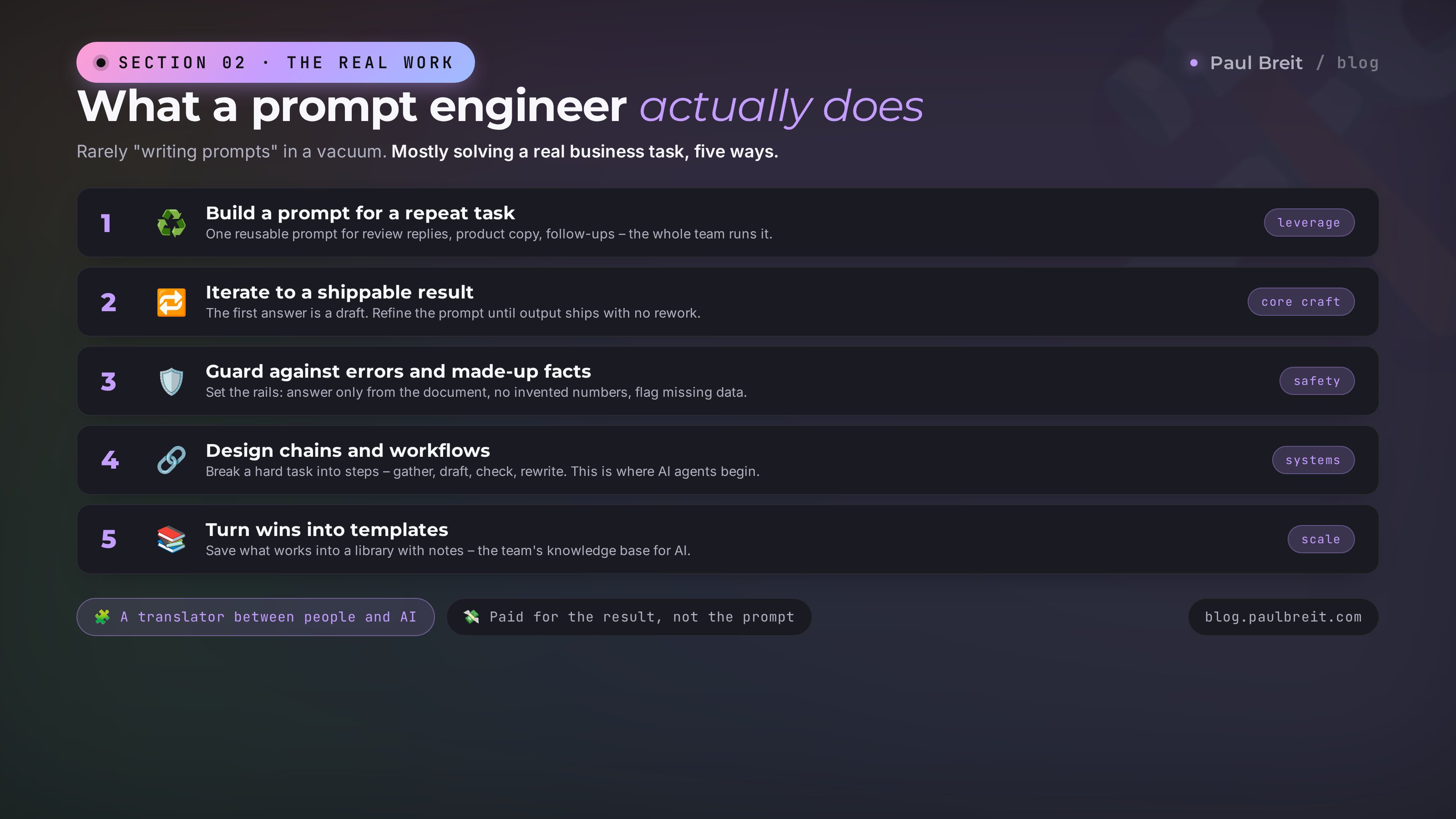
A neat definition is nice, but let's look at what the actual work is made of. A prompt engineer rarely sits and "writes prompts" all day in a vacuum. More often they're solving a concrete business task, and putting the request together is only part of the process. Here's what the work looks like in practice.
Build a prompt for a repeating process. A company writes review replies, product descriptions, and cover letters every day. The prompt engineer builds one request that does this reliably and in the right tone, and then the whole team runs it. One good template saves dozens of hours a month.
Bring the result up to shippable. The AI's first answer is almost never the final one. The specialist looks at what's off: too long, wrong tone, invented facts, format forgotten. And they fix the request until the answer is something you can put to work with no rework. That's the core of the craft – iteration.
Check for errors and made-up facts. An AI confidently states falsehoods if you don't fence it in. A prompt engineer knows these traps and sets the rails up front: "answer only from the attached document," "if there's no data, say so," "don't invent numbers." For a business this is critical – one invented detail in a contract or a client reply costs real money.
Build chains and workflows. A hard task gets broken into steps: first the AI gathers facts, then drafts, then checks it against a checklist, then rewrites. The prompt engineer designs the whole chain, not a single reply. At this level the job blends into building AI agents – programs that run through that kind of workflow on their own.
Turn wins into templates. A found solution can't live in your head. The specialist files working prompts into a library with notes: which task, which request, which pitfalls. The library grows, and every month the team gets faster. In effect the prompt engineer is building a knowledge base for the business on how to work with AI.
Testing deserves its own mention. On serious teams, prompts aren't just "written by feel" – they're checked against dozens of examples and versions are compared: which wording gets the right answer more often. That's closer to the work of a QA tester or an analyst – gather a sample, run it, look at the numbers, pick the best. This is where engineering thinking pays off, not literary talent.
By type of employment, the job splits roughly like this. There are in-house prompt engineers who tune AI for internal processes: support, marketing, documents, analytics. There are freelancers who take projects from different clients. And there's a separate, large group – people who apply prompt engineering inside their own main profession. A marketer who assembles content ten times faster. A lawyer who runs contracts through an AI. A therapist who prepares materials for clients. Formally they aren't called prompt engineers, but they own exactly that skill, and it makes them money directly.
Before and after. The task: reply to an unhappy client whose order was delayed. A beginner writes "reply to the client's complaint." The AI produces a dry brush-off along the lines of "we apologize for any inconvenience." A prompt engineer gives a different request: "You're the head of customer care. A client's order is three days past the promised date and they're upset. Reply warmly and like a human, no corporate-speak. Acknowledge the problem, explain the cause in plain words, and offer a specific make-good – a 15% discount on the next order. Keep it to four short paragraphs." An answer to that request can go to the client with almost no edits. The whole difference rests on one thing: how precisely the task was set.
Section 03What they make: US and global numbers
The most common question, and the most honest answer to it: it depends heavily on experience, niche, and whether it's a staff role or freelance. Let's talk numbers, not promises. I pulled data from US job platforms for 2026 so there's a real benchmark.
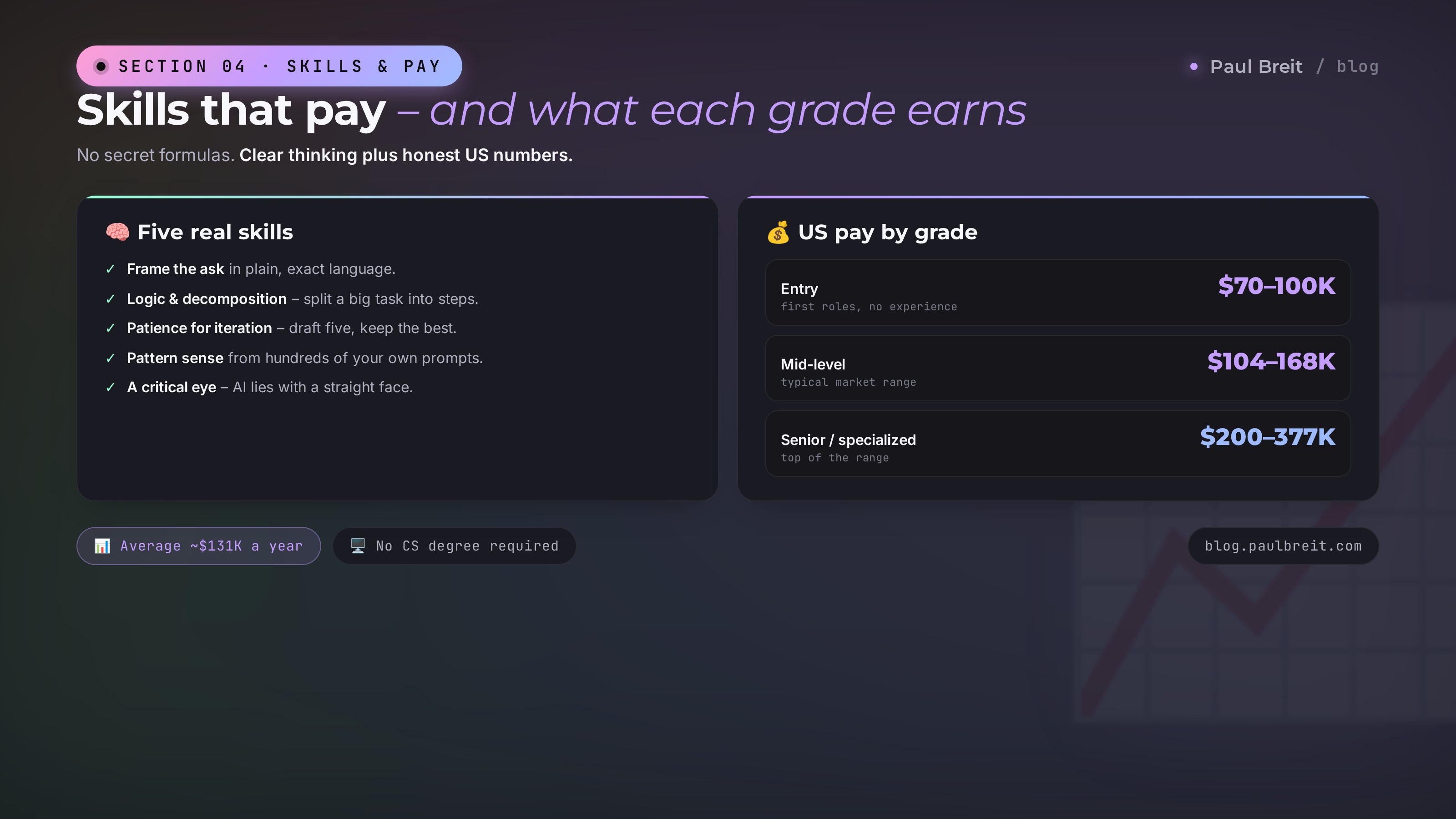
The US, staff roles. The average salary for a prompt engineer sits around $131K a year. The typical range runs from roughly $104K to $168K. Entry-level positions start near $70K, while strong, narrowly specialized roles push past $200K and up to $377K a year at the senior level. That's already comparable to what solid software developers earn. Separately, listings for "AI Prompt Engineer" specifically average around $142K.
Where the spread comes from. Grade is defined by the scope of tasks. A junior builds individual prompts for clear tasks and works from ready templates. A mid-level specialist runs the whole process: tunes AI for a department, tests prompt versions, builds the library, and trains colleagues. A senior designs complex chains and agents, owns the quality and safety of answers, and wires AI into the company's product. The higher the grade, the more expensive manual work the person takes off the business, and the higher the pay.
By the standards of mass professions there still aren't that many openings under the exact title "prompt engineer." But that's only the tip of the iceberg: far more positions have prompt engineering baked into another role. The listing says "marketer" or "analyst," and the requirements say confident work with AI. Those roles don't show up in "prompt engineer" statistics, even though they pay for the same skill.
How to read these numbers. Pay tracks almost linearly with how much value you bring the business. Someone who can ask an AI nicely is worth a little. Someone who can use it to take real work off a company – the messages, the reports, the content, the support – and show it in dollars is worth many times more. You don't get paid for prompts, you get paid for the result they bring.
What it looks like in savings. A small online store spent three hours a day of a manager's time on questions about shipping, sizes, and stock. A prompt engineer built a request that answers in the brand's tone and pulls facts only from the price list and store policy. Now the messaging takes about forty minutes: the manager edits the draft and sends. Three hours became forty minutes with one template built in a day. Stories like that are what the job's value to a business is made of, and what gets paid for.
Freelance and project work. Here there's no single rate at all. Someone charges $30-50 to set up one task-specific bot, someone runs a business on a retainer for $700-1,500 a month and up. The spread is simple to explain: on freelance you get paid for the pain you remove. How many hours you spent isn't the client's concern. Set up an AI for a store that answers customer questions overnight, and the price of the service is tied to how much the store earns and saves from it, not to how long you fiddled.
One more, the most underrated path. The fastest way to make money with this skill is to apply it to your own work. If you're an expert, a coach, a tutor, a therapist, or an entrepreneur, you don't need to find an employer. You take an AI and pull the routine off yourself: content, client replies, breakdowns, sales copy. The time you free up you spend selling. Here the prompt engineer's skill pays back straight through your own revenue, and that's often the biggest money of all the options.
Section 04Which skills you actually need
There are a lot of myths around this job about "secret prompt formulas" and "magic words that unlock the AI." Forget it. The real skills are more boring and more useful. Here's what actually separates the people who get paid from the ones who mess around.
Frame a thought clearly. The main skill and the most underrated one. If you don't understand what result you need, the AI won't guess it. The ability to break a fuzzy wish into concrete requirements is the foundation of everything. People with a background in writing, analytics, or teaching break in more easily for exactly this reason.
Logic and decomposition. Split a big task into steps, understand what comes first and what comes later, where the AI will slip and how to prevent it. That's engineering thinking in its purest form, and it matters more than a pretty turn of phrase.
Patience and a taste for iteration. The first answer is rarely perfect. Some people give up after that; others calmly fix the request a fifth time and bring it to where it needs to be. The job is about the second type. If reworking irritates you, it'll be rough.
A trained eye. An understanding of what works and what doesn't comes only from practice. Hundreds of your own prompts, the hits and the flops, add up to instinct. No amount of theory replaces it. So the best way to learn is to solve real tasks with AI every day, not to read about prompts.
A critical eye on the result. The AI lies confidently and with a straight face. The specialist checks the facts, numbers, and logic, and never takes an answer on faith. Without this skill you'll sooner or later hand a client an invention and burn the trust.
Notice what's not on the list. No advanced math. No mandatory programming. No degree in artificial intelligence. None of that is required to get in. Code and an understanding of how the model works under the hood come in handy at the top grades, where you're wiring AI into a product. But you can start with the skill set you already have, as long as you can express thoughts clearly and don't mind wrestling with the result.
There's one more quiet skill people rarely mention – domain knowledge. A prompt engineer who understands law will build something for a law firm that a generalist can't. Someone who knows marketing will tune AI for content better than an outsider. So the profession you already carry gives you a head start. You combine what you already know with a new tool, and at the intersection you get rare value.
Section 05How to break into the job from zero
Good news: the barrier is low, and there are almost no bad ways to start. The only bad one is reading about prompts and never trying. Here's the path that actually takes you from zero to first money in a few months.
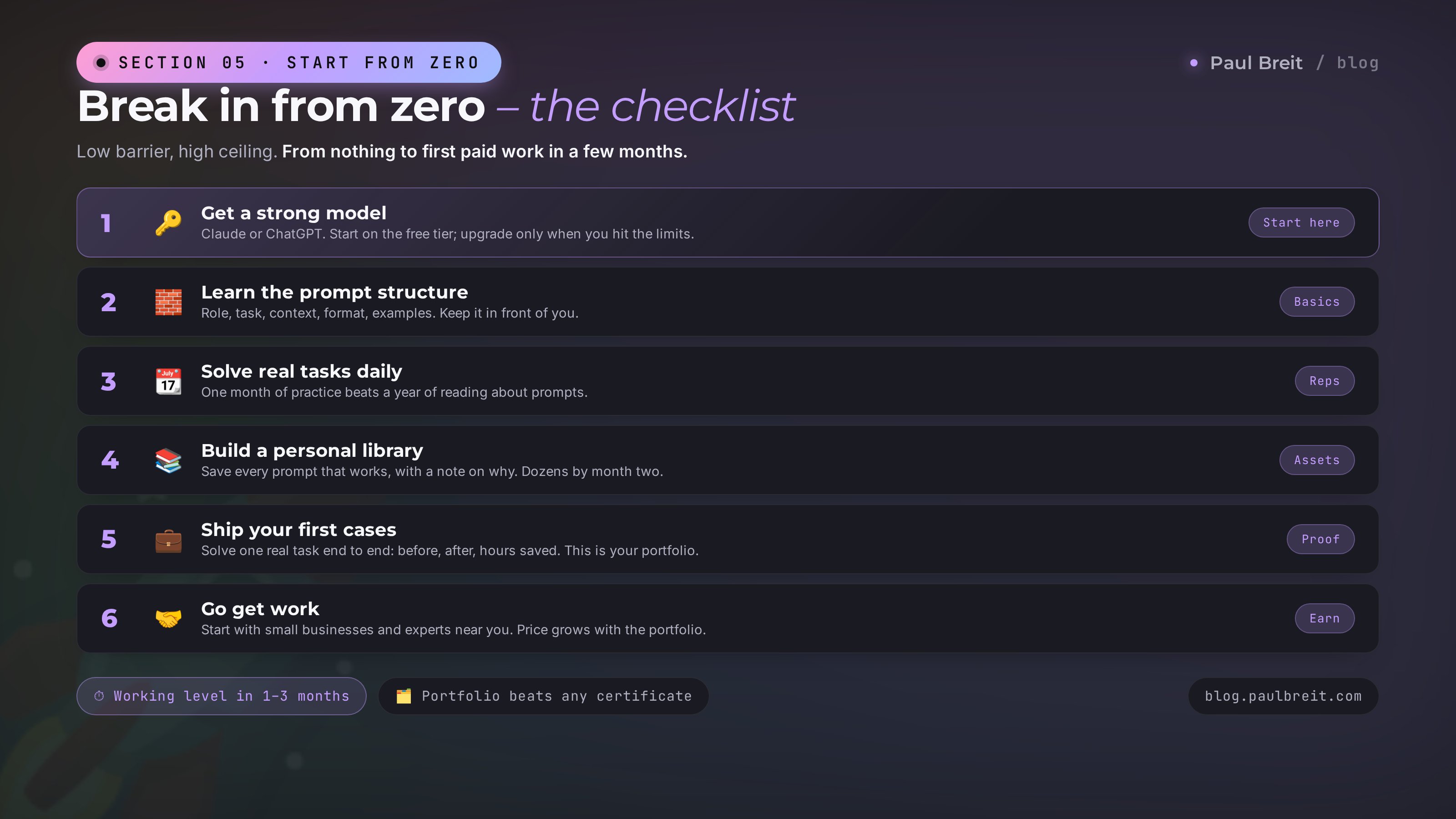
Get access to a strong AI. You need a good model to practice on. I work with Claude – it holds context carefully and writes well. Sign up at claude.ai; in the US it opens with no extra setup. Start on the free tier; the paid plan comes later, once you hit the limits.
Learn the structure of a prompt. A good request is made of clear parts: role ("you're an editor"), task ("rewrite this text"), context (for whom, why, constraints), output format (list, table, length), and examples of what you consider a good result. Build this structure once and keep it in front of you – a detailed breakdown with examples is in the piece on how to write prompts. After that you'll slot different tasks into it almost on autopilot.
Solve real tasks every day. Take what you actually need right now. Write a post with AI, work through a tricky email with it, build a plan for the week, put together a table. Every task is practice. A month of daily work teaches you more than a year of reading theory.
Build a personal prompt library. Save every request that works with a short note: which task, what worked, what didn't. In a couple of months you'll have your own working base of dozens of ready solutions. It's both your working tool and the seed of a portfolio.
Ship your first cases. Take a real task – yours or a business-owner friend's. Set up an AI that solves it end to end: answers reviews, prepares product descriptions, writes content. Package the result: it was like this, now it's like that, we saved this much time. One live case convinces an employer more than any certificate.
Go get work. With a couple of cases in hand, you can offer the service. Start with small businesses and experts around you – they need help with AI, and they're close. First projects are often taken cheap or free for a testimonial and a case. After that the price grows along with the portfolio.
How long it takes. A working level – when you handle routine tasks with confidence – takes 1-3 months of daily practice. A level with a portfolio and first paid clients is about six months. It's not a "job in a weekend," but it's not five years of university either. A real, foreseeable path.
Section 06Where to find work and first clients
Once you have the skill, the question is where to take it. There are more places than it seems, if you look past the exact search term "prompt engineer."
Staff openings. Check LinkedIn, Indeed, and Glassdoor, plus niche AI communities that post jobs. Search not only "prompt engineer," but also "AI specialist," "AI content specialist," and even marketing, analyst, and support roles that list working with AI in the requirements. The most active hirers are tech companies, banks, marketing agencies, and education and healthcare organizations.
Freelance and projects. Freelance platforms, entrepreneur chats, AI communities. Here the work is one-off and project-based: set up a bot, build a prompt library for a department, automate the messaging. This is the easiest place to start – the barrier is lower than a staff role, and you can land your first case within a couple of weeks.
Your own business and your own expertise. I'll repeat the point from the money section, because people keep missing it. If you already have a business or a profession, the fastest earnings come from applying the skill to yourself: pull the routine off your own project and free up time for what makes money. Many of my clients came to learn AI for exactly this reason – to unload their own work and start growing.
What to show instead of a degree. Employers and clients care about a portfolio; a certificate barely registers. Three or four worked cases of "here was the task, here's how I solved it with AI, here's the result" weigh more than any diploma. Collect cases from day one of practice, even if you do them for free.
Section 07Will AI itself kill the job
The beginner's biggest fear sounds like this: "I'll spend six months, and then AI gets smarter and prompts stop mattering." It's an understandable fear – let's take it apart honestly, with no comforting lies.
The truth is that AI really did get better at understanding. Five years ago you had to hunt for clever wordings just to get the model to grasp a request. Today it often understands a plain ask. Some primitive prompting tricks really are obsolete. If your value was in knowing a dozen "magic phrases," that value is indeed about to disappear.
But the tasks grew alongside the models. The ceiling used to be a single well-turned reply. Now people build agents that run on their own: chains of dozens of steps, integrations with databases and services, quality and safety control of answers. The smarter the model, the more complex the work it's given, and the more important the person who can design the whole process. The value shifted from one phrase to the ability to design an AI workflow end to end.
Look at it like any other tool. Convenient editors appeared – layout designers didn't vanish, what they do changed. Website builders appeared – web developers didn't disappear, they moved up in complexity. It's the same with AI. It takes the simple work, but it opens a new layer of tasks, reachable by whoever grew up alongside the tool.
So my honest conclusion: the job won't disappear, but it'll change fast. Bet on the very ability to figure out new tools as they show up, because memorized tricks age too quickly. That's a skill that won't go stale, because the tools will always keep changing. Whoever learned to pick up new things fast stays valuable no matter how the models develop.
Section 08Common beginner mistakes
Studying theory instead of practicing. The most common one. People read articles and watch videos about prompts for weeks but never solve a single real task. The skill doesn't come from reading. It comes from asking an AI for something every day and bringing the answer up to working quality.
Chasing "secret prompts." Course sellers promise hidden formulas. There are no hidden formulas. There's a clear request structure and practice. The money spent on a "collection of a thousand magic prompts" is almost always thrown away.
Taking the AI's first answer. A beginner writes a request, gets an answer, and decides that's how it's supposed to be. A pro knows the first answer is a draft. The real work starts with the edits. Skip that stage and you hand the client a raw result.
Not checking the facts. The AI invents things confidently. A beginner takes a number or a link on faith and carries it forward. One day that ends in a made-up fact inside an important document. Checking the result is a mandatory part of the job.
Waiting for the perfect moment. "Once I finish one more course, I'll start." You can take courses forever. Cases only come from doing. Take a real task today, even a small one, and solve it with AI. A portfolio grows out of what you did, not what you planned.
ChecklistThe start checklist
Get access to a strong AI (in the US, claude.ai opens with no extra setup). Learn the structure of a prompt: role, task, context, format, examples. Solve your first five real tasks from your own life or work with AI.
Solve tasks with AI every day and bring the answer up to working quality through iteration. File the good prompts into a personal library with notes. By the end of the month you should have a few dozen working templates.
Take two or three real tasks – your own or a friend's business. Build end-to-end solutions and package them as cases: before, after, how much was saved. This is your portfolio instead of a diploma.
With cases in hand, offer the service to small businesses and experts, or respond to openings. Take the first projects for a testimonial. After that, raise the price along with the portfolio and decide where to grow: employment, freelance, or your own business.
The prompt engineer job is a rare case where the barrier is low and the ceiling is high. You can start with what you already have: clear language, logic, and a willingness to try every day. After that, practice decides everything. And the most underrated use of the skill is to point it at your own work, so AI takes the routine off you and you spend your time on what makes money. If you want to go exactly that way, below is my free guide to make the first step easy.
FAQFrequently asked questions
What is a prompt engineer, in plain words?
Someone who can explain a task to an AI so it returns the result you need on the first or second try. They set the model up with words: context, role, output format, and examples. They don't program the model itself. In practice it's a translator between a person who knows what they want and an AI that can produce it.
Do you need to know how to code to become a prompt engineer?
Code isn't required to get in: the base level is working with an AI in a chat window, in plain text. Programming becomes a plus at higher grades, where prompts are wired into apps and services through an API. But most practical business tasks get solved with no code at all.
How much does a prompt engineer make in the US in 2026?
The average sits around $131K a year, with a typical range of roughly $104K to $168K. Entry-level roles start near $70K, and senior or specialized positions run $200K and up, reaching $377K a year. Freelance and project work is counted separately and depends on the niche.
How long does it take to learn the job from zero?
A working level takes 1-3 months of daily practice: understand the structure of a prompt, build a personal library of go-to templates, and learn to bring an answer to where it needs to be over a few iterations. A confident level with a portfolio and first clients is about six months of regular work.
Won't the job disappear as AI learns to understand without exact prompts?
Models did get better at understanding, and some simple prompts are no longer needed. But the tasks grew alongside them: agents, chains, integrations, quality and safety of answers. The value shifts from one clever phrase to the ability to design the whole workflow. Demand for that is only rising.
Where do you find first clients and job openings?
Openings show up on LinkedIn, Indeed, and Glassdoor, and in niche communities; project work lives on freelance platforms and in entrepreneur chats. The easiest start is small businesses and experts – they need AI set up for content, sales, and support. First cases are often done cheap or free for the portfolio.
How is a prompt engineer different from a regular ChatGPT user?
A regular user types a request and takes the first answer. A prompt engineer works systematically: sets the role and context up front, checks the result for errors, refines it over iterations, and turns the wins into repeatable templates the team reuses. The whole difference is predictability of the result – access to AI is something anyone has today.