How to Teach AI to Write in Your Voice: the 30-Post Method
By default AI writes smooth and lifeless: everyone's text looks the same, with the same clichés and the same flat, plastic rhythm. That's fixable. You feed it 30 of your own texts, pull out a passport of your voice, and from then on write with that as the anchor. The result sounds like you, not like a stock robot. Below is the whole method step by step, with ready-made prompts and what to do if you don't have many texts yet.
To make AI write in your voice, "write like me" won't cut it. You have to show it samples. Collect 30 of your own texts – posts, emails, transcripts of voice memos – hand them to the AI, and ask it to derive the rules of your style in a separate file: favorite words, sentence length, rhythm, topics, humor, taboo words. You attach that passport file to every writing task. Then you compare the draft with your own posts, catch the mismatches, and add to the passport. After 3-4 rounds the AI hits your voice so well the reader can't tell. Fewer than 30 texts? The voice gets built from voice memos and a live interview with yourself.
The first thing a beginner does is tell the AI "write in my style" and gets the same smooth text with exclamation marks and filler. Nothing worked, faith in the whole thing fades. The reason is simple: the words "my style" are empty noise to an AI. It hasn't read your blog and doesn't know how you joke or where you pause. Style isn't a setting you flip on. It's a set of concrete writing habits, and you have to pull them out, show them to the AI, and lock them in.
I run a channel of 20,000 subscribers and four client projects, each with its own voice. AI helps prepare the texts for them, and not one reader has complained about a robot. The whole secret is this method: a voice passport plus a few rounds of edits. More than 10,000 people have gone through our school, and the ones who built themselves a passport like this stopped rewriting every line behind the AI. Let's walk through how you build yours.
You'll read this in 21 minutes. You'll build your voice passport in one evening. And from the next day the AI will write texts you'd be glad to put your name on.
What's inside
- Why AI writes "not like you"
- What your voice is made of
- Why exactly 30 texts
- The method step by step: from 30 posts to a voice passport
- Ready-made prompts to copy
- What to do if you don't have many texts
- How to check the voice worked
- 5 mistakes when training the voice
- Voice-building checklist
- The whole path in a minute
The method works on any strong AI, but the best result for text is Claude – it holds style more finely and slips into clichés less. In some regions Claude doesn't open directly – you'll need a VPN set to the EU or the US. Working ones in 2026: AmneziaVPN, Proton VPN, Hiddify. Register through claude.ai and log in before you start.
Part 01Why AI writes "not like you"
Open any AI, ask it to write a post on your topic, and look at the result. Smooth, correct, with a peppy intro and a tidy conclusion. And utterly faceless. Anyone could have written that text. Six months in, the internet is packed with identical posts, and readers have learned to smell them from the first line. Let's unpack why this happens – without it the method won't click.
AI was trained on a giant volume of text: articles, books, forums, billions of pages. Out of all of it, it derived an averaged manner of writing – the one that shows up most often. When you ask for text with no samples, it hands you exactly that average: correct, safe, and nothing. It's like the average height in a country. It exists, but you'll never meet a specific person of exactly that height.
Your voice is the deviation from the average. You cut a sentence off where someone else would put a comma. You have three or four words you run from post to post. You joke a certain way and steer clear of certain topics. By default the AI knows none of this, so it smooths you down to the general norm. The job of the method is to put the deviations back.
Why "write in my style" doesn't help
The command "write like me" fails for one reason: the AI has nothing to use as a sample. The word "my" is an abstraction to it. It knows what "friendly," "expert," and "with humor" mean, but that's its idea of friendly, not yours. So you get someone else's version of you, assembled from clichés.
Compare it to a person. If you told a new copywriter "write like the founder," they'd ask to see a dozen of your posts, read closely, and catch the manner. The AI needs the same thing: samples. The difference is that a person catches style intuitively, while for the AI the rules have to be spoken out loud in words and locked into a file. That's exactly what you'll do in one evening.
AI writes facelessly not because it's dumb, but because you haven't given it yourself. It takes the internet's average manner. Your voice is a set of concrete habits that differ from the average. Show them and you get yourself back. The 30-post method is the way to show them.
Part 02What your voice is made of
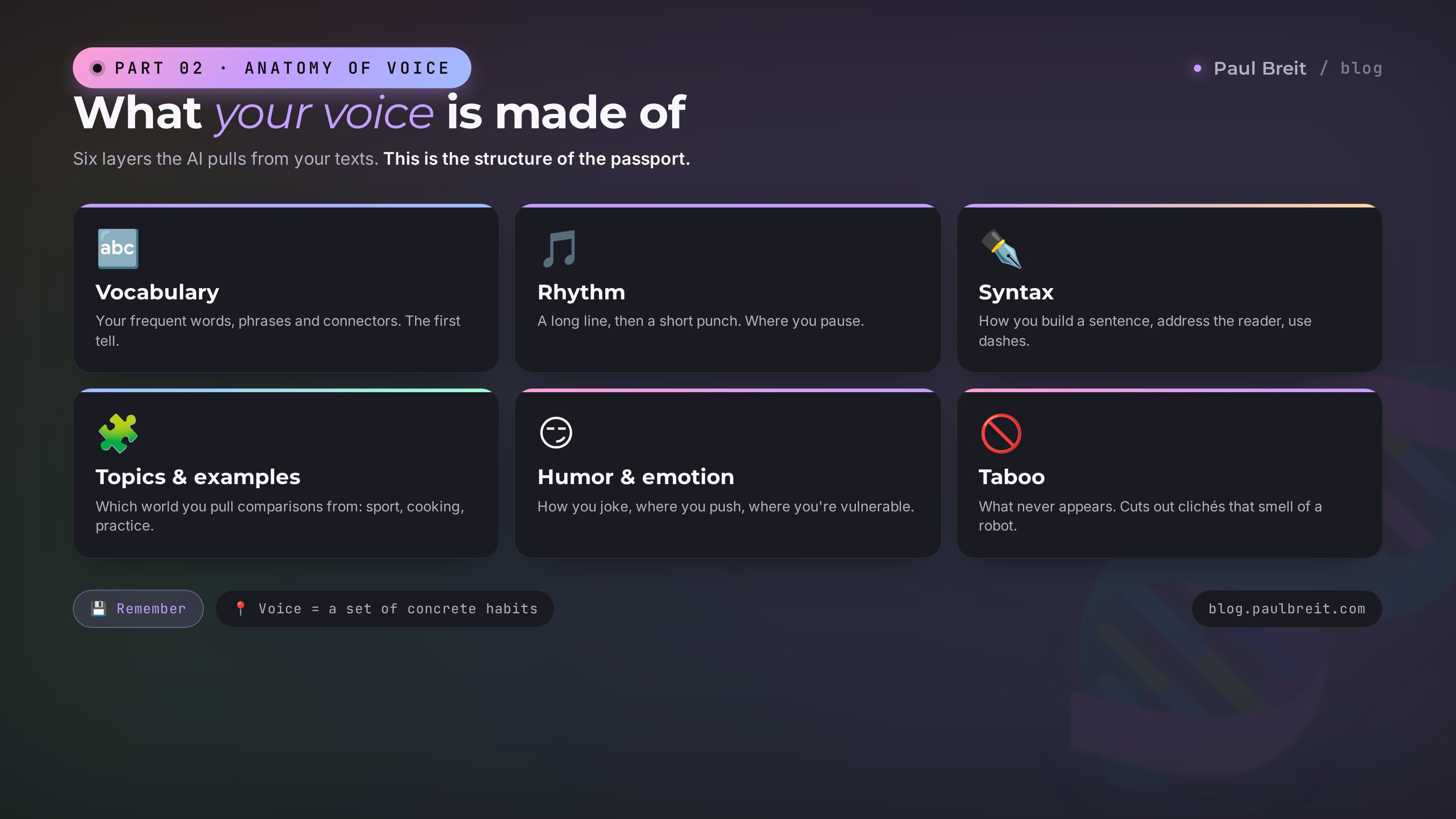
Before you train the AI, let's spell out what exactly it will be copying. "Voice" sounds like something elusive, but it breaks down into six clear layers. Once you understand the layers, you set the task more precisely and you can see where the AI missed.
Vocabulary – your words
Every author has a fingerprint dictionary. Some say "folks" and "thing," others "colleagues" and "tool." Some love "honestly" and "here's the deal," others never use them. It's the first thing that gives a person away. The AI has to collect a list of your frequent words and connectors and drop them in where they fit.
Sentence length and rhythm
Some write in long, unspooling sentences, some in short chops. Live text usually alternates: a long line, then a short punch. Seriously. Like that. By default the AI runs a flat, monotone rhythm of equal length. Your rhythm has to be described: where you spread out, and where you hit with a two-word pause.
Syntax and punctuation
How you build a sentence: do you start with "And" or "But," do you ask the reader questions, do you use dashes instead of commas. Whether you love parentheses, ellipses, one-line paragraphs. All of it is the recognizable machinery of your writing, and it's easy to capture in rules.
Topics and examples
You explain through something of your own: one pulls metaphors from sports, another from cooking, a third from childhood. You cite numbers from your practice, refer to your clients, recall your own cases. That's what can't be invented. The AI has to know which world to draw examples from and understand that you'll supply the raw facts yourself.
Humor and emotion
How you joke: with self-irony, light provocation, dry sarcasm. Where you allow yourself to be vulnerable, where you turn up the drive. Tone is the subtlest layer, and the AI catches it last. But it's exactly what makes text alive, so it has to be spoken out too.
Taboo – what you never do
Just as important is what never shows up in your text. Maybe you never write "dear subscribers," never stack three exclamation marks, never push with fear, never use corporate-speak. A list of bans is often more important than a list of permissions: it cuts out exactly the clichés that make text smell of a robot.
These six layers become the structure of your voice passport. You won't invent them by hand – the AI pulls them out of your 30 texts itself. Your job is to check and fix. And the sharper you set any writing task, the fewer edits later. How a strong task is built is covered in the piece on the five-part prompt formula – it sits nicely next to this method.
Part 03Why exactly 30 texts
The number isn't random, and here's the logic. On five texts the AI catches only a general direction and mistakes half of it for chance. On three hundred it drowns in the volume and starts averaging inside your own material. Thirty is the sweet spot where a steady handwriting is already visible and there's no mush yet.
On thirty texts the recurring separates from the one-off. If the word "listen" showed up in one post, that's chance. If it's in eight of thirty, that's your habit and it has to be locked in. At that volume the AI confidently sees what's a system for you and what's a one-time mood swing. Less material and it confuses the two.
It doesn't have to be channel posts. Anything you wrote or said yourself works: posts, long comments, emails to clients, transcripts of voice memos, chat replies, notes. The one condition: you wrote the text personally, with no AI and no editor. Otherwise you'll teach it someone else's voice. Thirty such chunks of 3-10 sentences are a sufficient base.
Spread matters too. Take texts of different moods: where you explain, where you're angry, where you're glad, where you sell. The voice shows up differently in each of these states, and the AI needs to see the full range. Thirty same-type posts give a flat cast, thirty varied ones give a three-dimensional one.
Part 04The method step by step: from 30 posts to a voice passport
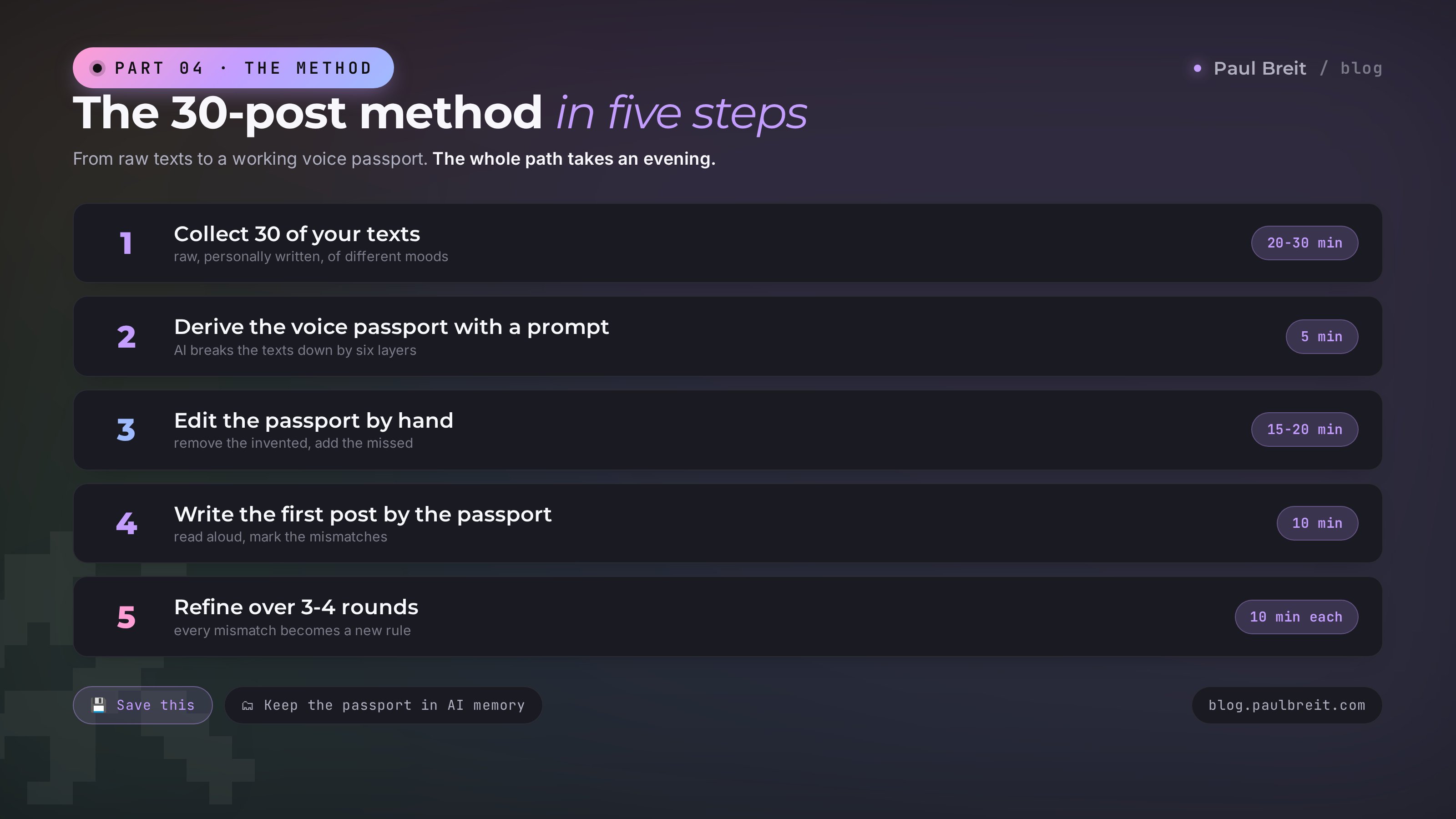
Now the method itself. Five steps, each spelled out so you can repeat it knowing nothing in advance. The whole path takes an evening, and the passport then serves for months and gets tuned along the way.
Collect 30 of your texts in one document
Open a blank document and drop 30 of your texts into it one after another, separating each with a line of three asterisks so the AI sees the boundaries. Pull from your channel, from chats, from notes. Short on posts? Add transcripts of voice memos: record one in a messenger, copy the transcript, paste. Don't clean or polish anything – on the contrary, you want raw live text, the way you actually write.
Ask the AI to derive the voice passport
Load the document into the AI and give it the task: break your texts down by the six layers above and assemble a voice passport. A ready-made prompt for this step is below, in the prompts section – copy and paste it. The AI reads all 30 texts and outputs a structured breakdown: your frequent words, sentence length, syntax habits, topics for examples, the character of your humor, and a list of what you avoid. That's the draft passport.
Read and edit the passport by hand
This is the most important step, and it's the one most often skipped. In places the AI nails it, in places it invents something you don't have or misses the obvious. Read the passport as a description of yourself and fix it: "no, that stiff word isn't me," "yes, two-word pauses are mine, lean into it," "add that I always address the reader as you." You know your voice better than the AI, and your edit here decides it. After it, the passport becomes yours instead of made up.
Write the first post against the passport
Attach the passport to the task and ask for a post on a new topic strictly by these rules. The AI outputs text that's already far closer to you than the faceless average. Read it out loud. Wherever you stumble and think "I wouldn't say it that way," mark it. The first result is rarely perfect, and that's normal: the passport is still breaking in.
Add to the passport from the mismatches
Every place you stumbled in step four becomes a new rule you add to the passport. "Intros too long – start with the point." "Cut the exclamations, I almost never use them." "Don't wrap up with a moral, end on an action." Run the next post with the updated passport. Three or four such rounds and hitting the voice becomes steady. After that the passport lives and gets tweaked in small ways whenever you spot a fresh miss.
What it looks like on an example
To make the difference tangible, here's the same post on the topic "why an expert should run a blog" – first as the AI writes it with no passport, then with a tuned voice.
In today's world, a personal brand plays a key role. Running a blog helps an expert raise visibility, attract a target audience, and build trust. Regular, high-quality content is the key to long-term success and a steady flow of clients!
A blog isn't about likes. It's about the client showing up already warmed up and not haggling. Write honestly and to the point for six months, and the people who read you and already decided they want you slide into your DMs. Without a blog you prove who you are from scratch every time. With a blog the texts you wrote once speak for you.
The first text could have been written by anyone about anything. The second sounds recognizable: short punches, specifics, direct "you," zero exclamations or clichés. The difference came from a voice passport plus a couple of rounds of edits. That's exactly the result you're walking toward with the five steps above.
Keep the passport in one place so you can attach it to any task. The most convenient spot is the AI's persistent memory or a dedicated project where it remembers the passport between conversations. Then you don't paste the file every time: you just write "a post on such-and-such topic" and the voice is already on. How such a persistent base is built is covered in the overview of 10 tasks with no code.
Part 05Ready-made prompts to copy
So you don't have to assemble the wording yourself, take them ready. Three prompts cover the whole method: pull the passport, write text by it, refine from mismatches. You only change the topic in brackets.
Prompt 1. Build the voice passport
Below are 30 of my texts, separated by asterisks. I wrote them myself.
Analyze them and assemble a passport of my author voice across six layers:

1. Vocabulary: my frequent words, connectors, phrases. Give specific examples from the texts.
2. Rhythm and sentence length: do I alternate short and long, where do I pause.
3. Syntax and punctuation: how I start sentences, how I address the reader, which marks I favor.
4. Topics and examples: which field I pull comparisons and stories from.
5. Humor and emotion: how I joke, where I turn up the drive, where I'm vulnerable.
6. Taboo: what never appears in my texts.

Write it as rules that can be applied to a new text.
Don't invent anything that isn't in the texts. Rely only on examples.

[paste your 30 texts here]
Prompt 2. Write text by the passport
Here is my voice passport:
[paste the finished passport]

Write a post on the topic: [your topic].
Stick strictly to the passport: my vocabulary, my rhythm, my habits, my taboos.
Don't add exclamations or clichés that aren't in the passport.
Give the text at the end with no explanations.
Prompt 3. Refine from mismatches
This text sounds not like me in places. Here's what's off:
[list them: intro too long / extra exclamations / a moral at the end]

Turn my notes into new rules and add them to the passport.
Then rewrite the text by the updated passport.If after three rounds the AI still misses on a specific topic, hand it one of your own posts on exactly that topic and ask it to hold that as the tone reference. A pinpoint sample under the task works stronger than any general rule. Your own example always beats an abstract instruction.
Part 06What to do if you don't have many texts
Common situation: the channel is new, there are five posts, and you still want to tune the voice. The method still works, you just gather the material differently. A voice lives not only in posts, it's in how you talk in general.
Voice memos
The richest source of a live voice. Record 15-20 voice memos on different topics – how you explain your work to a friend, what you think about your niche, how you answer a frequent client question. Transcribe them into text: AI can do it, or the built-in transcript in a messenger. In voice memos you speak naturally, with no eye to "how you're supposed to write," and that's your purest voice.
An interview with yourself
Ask the AI to put 20 questions to you about your topic, life, and views. Answer by voice or text, at length and in your own words. From the answers you get a rich body of material where the vocabulary, the line of thought, and the character all show. It doubles as unpacking: you put into words what you used to hold in your head vaguely.
Three authors close in spirit
Find two or three authors whose manner you like and that resonates with yours. Take a few of their texts and analyze with the AI what exactly feels close to you. This isn't about copying someone else's voice. It's a way to find your bearings while your own material accumulates. As the channel grows you'll swap these references for your own posts.
Having gathered material from these sources, you run the same method: passport, first text, rounds of edits. And from there you add every new live post to the pile, and in a couple of months you'll have an honest thirty of your own. Then you rebuild the passport from scratch on clean material, and the voice gets sharper.
While you gather the voice you inevitably put into words what you're about and how you differ from the neighbors in your niche. That's a foundation for both content and sales. The same gathered voice can later be sold as a service: tuning an author voice for a client is one of the in-demand income models, laid out in the piece on 7 income models with AI.
Part 07How to check the voice worked
How do you know the passport is ready and the AI hit you? There are four honest checks. Run a couple of fresh texts through them and it'll be clear whether you nailed it or not yet.
The read-aloud test
Read the text out loud as if it were your post. If you never stumbled and never thought "I wouldn't say it that way," the voice is there. Every stumble is a signal: mark the line and turn it into a rule. The ear catches falseness more precisely than the eye.
The swap test
Show the text to someone who's read you for a while, without saying an AI wrote it. Ask what they think. If they didn't suspect a machine and took it as your usual post – the method worked. If they said "doesn't quite sound like you," ask what exactly threw them, and that becomes a new rule.
The cliché test
Scan the text for machine markers: "in today's world," "it's important to note," "thus," even exclamations on flat ground. If they're gone, the passport screens clichés well. If they slip through, add them to the taboo list so the AI stops pulling them in.
The substance test
A live voice leans on specifics: your numbers, your cases, your examples. If the text is smooth but empty, with not a single detail from your life – the voice isn't yours yet. Add a rule to the passport that demands raw material from you and leaves gaps for you to fill.
Even a perfectly tuned AI won't replace your final read-through. It assembles the frame in your voice, but the live details – a fresh case from yesterday, an exact number from practice – you add. The AI's voice hits your manner, the substance stays with you. Handing text to a reader without your last pass is a bad idea.
Part 085 mistakes when training the voice
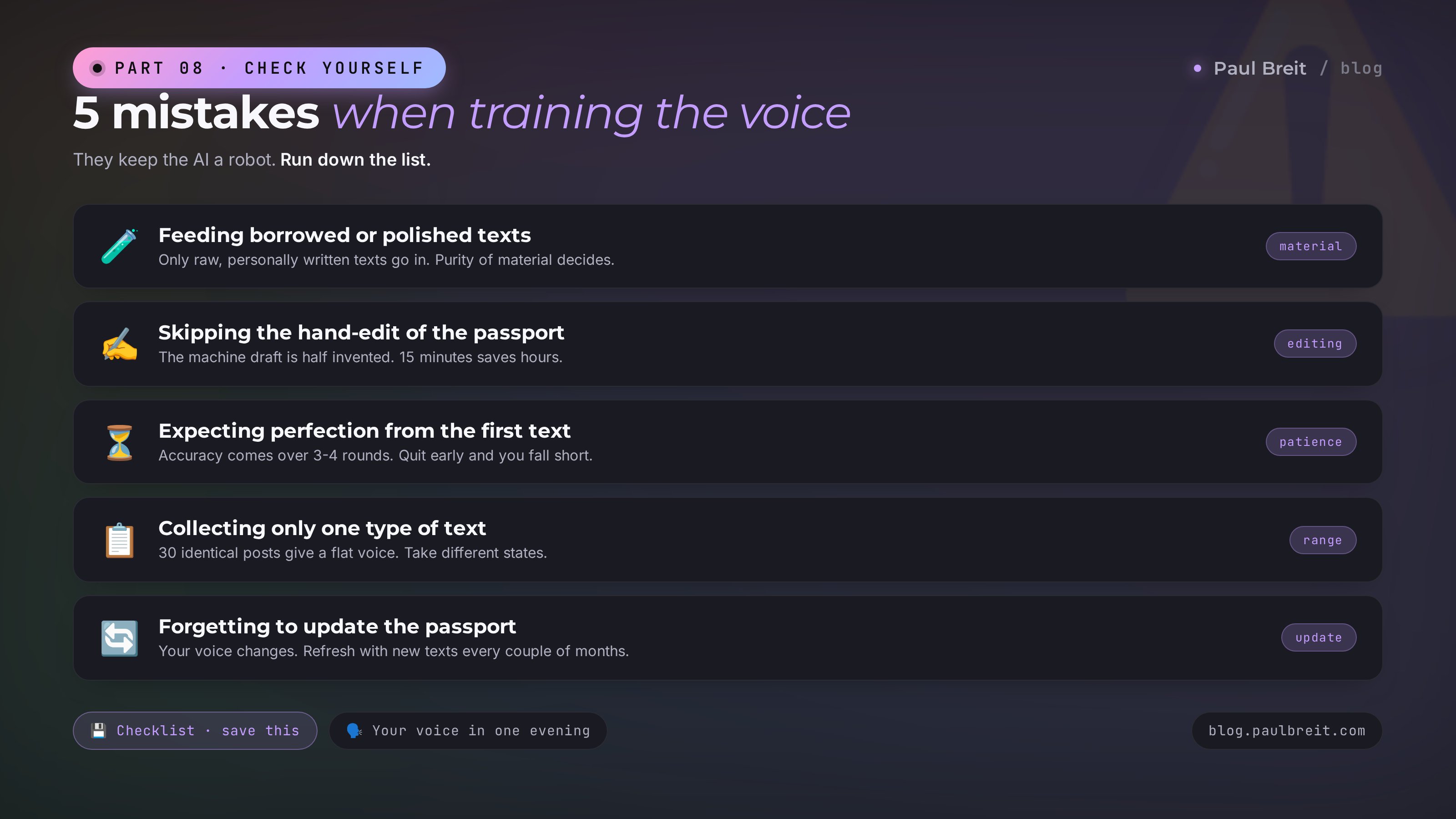
Feeding it borrowed or polished texts
Into the pile go posts you already wrote with AI or that an editor fixed. The AI learns the averaged voice and hands it back to you. Only raw texts written personally by you go into the base. Purity of material decides everything.
Skipping the hand-edit of the passport
You took the AI's first draft passport and ran off to write. And half of it is invented. A passport without your read-through is a version of you through the machine's eyes. Fifteen minutes of editing at step three saves hours of frustration later.
Expecting perfection from the first text
The first post came out so-so, and the person decides the method doesn't work. The method builds accuracy over three or four rounds of edits – that's baked in. Quitting after the first pass means falling a couple of steps short of a working voice.
Collecting only one type of text
Thirty identical sales posts give a flat voice that can only sell. Into the base take different states: where you explain, argue, celebrate, mourn. The wider the range, the more alive the AI comes out on any topic.
Forgetting to update the passport
You built the passport six months ago and use it as is. But the voice changes: you grow, the topic shifts, new words appear. Every couple of months add fresh texts and clear out stale rules. A living passport keeps you current, a frozen one lags behind the real you.
Part 09Voice-building checklist
Save it and go through the points. When all seven boxes are ticked, you have a working voice passport in hand.
- 30 of your texts collected – raw, written personally by you, no AI and no editor
- Texts of different moods – explanation, sales, argument, joy, not thirty of one type
- Passport derived across six layers – vocabulary, rhythm, syntax, topics, humor, taboo
- Passport edited by hand – the invented removed, the missed added
- First post written by the passport and read aloud
- 3-4 rounds of edits done – mismatches turned into new rules
- Passport stored in persistent memory of the AI or in a dedicated project at hand
AI writes facelessly until you give it yourself. The 30-post method brings your voice back: you collect raw texts, pull out a passport across six layers, edit by hand, and refine over a few rounds. From then on the AI writes the frame in your manner and you add the live substance and do the final pass. One evening of work – and the grind of writing stops eating your hours, while the texts stay yours.
RecapThe whole path in a minute
If you're short on time, here's the whole method compressed, in order of actions:
- Get the reason. AI writes averaged because it doesn't know your voice. Style is a set of concrete writing habits, and they have to be shown.
- Break the voice into layers. Vocabulary, rhythm, syntax, topics, humor, taboo – the six layers your manner is made of.
- Collect 30 of your texts. Raw, personally written, of different moods. Few posts? Add transcripts of voice memos and an interview with yourself.
- Derive the passport. With a prompt, ask the AI to break the texts down by six layers and assemble the voice rules.
- Edit the passport by hand. Remove the invented, add the missed. You know yourself better than the machine.
- Write and refine. First post by the passport, read aloud, mismatches into new rules. Three or four rounds to a steady hit.
- Store and update. Passport in persistent memory, refreshed with new texts every couple of months.
Start with the first step today. Collect thirty of your texts into one document – that's twenty minutes. The AI takes the rest, and you just steer. A voice that stops giving away the robot in you is worth one evening of work.
FAQFrequently asked questions
Why doesn't AI write in my voice if I just ask?
Because the words "my style" are empty noise to it. AI was trained on the internet's averaged texts and with no samples it outputs an average manner. Your voice is a set of concrete habits that differ from the average. You have to show them with samples and lock them into a separate passport file. Then the AI stops smoothing you down to the general norm.
How many texts do you really need to tune the voice?
Aim for 30 of your own texts. On five the AI catches only a direction and mistakes half for chance. On thirty the recurring separates from the one-off: if a word shows up in eight posts of thirty, that's your habit, not a fluke. Giving more than three hundred isn't worth it – the AI starts averaging inside your own material.
What if I don't have many posts yet?
Build the voice from other sources. The richest is voice memos: record 15-20 on different topics and transcribe them into text. The second is an interview with yourself: the AI puts 20 questions, you answer at length. The third is a study of two or three authors close in spirit as a temporary reference. As the channel grows, swap them for your own posts.
Which AI writes best in your voice?
For text the strongest result is Claude: it holds style more finely and slips into clichés less. The method works on any strong model, though. In some regions Claude opens through a VPN set to the EU or US; registration and login are covered in a separate note, and you sign up through the referral link at claude.ai.
Do I need to pay for an AI to build the voice?
The free tier is enough to start: you can build the passport and write a few posts without a subscription. The paid plan pays off when you write a lot and want to keep the passport in persistent memory or a dedicated project, so you don't paste the file every time. Claude Pro is about $20 a month.
Can I write for a client with a voice passport?
Yes, and it's a sought-after service in its own right. You build the client's voice passport by the same steps from their texts and voice memos, then prepare content that sounds like them. Tuning an author voice and running content done-for-you pays from roughly $300 a month per project. This and other income models are laid out in the piece on making money with AI.
Will AI replace me entirely if it writes like me?
No. AI assembles the frame of the text in your manner, but the live substance – a fresh case, an exact number, yesterday's detail – you add. And you do the final read-through too: a human answers to the reader for quality and facts. The method removes the grind of writing, the substance and the ownership stay with the author.
How do I know the voice is tuned and ready to use?
Run a text through four checks. Read aloud: do you stumble on any lines. The swap test: does a long-time reader take it as your usual post. The cliché test: no machine markers like "in today's world." The substance test: is there specifics from your life. Passed all four – the passport is ready, you can write at volume.