How to Make Money with AI: 7 Models, No Investment and No Code
Seven working ways to turn AI into income – from writing for clients to deploying AI workers inside someone else's business. Under each model: what you do by hand, who you sell it to, what the market pays, and which step to start from. No programming, no startup budget, no jargon. Just an AI subscription and a few hours a week.
You can make money with AI and no code in seven ways: writing and content for clients, visuals (banners, carousels, presentations), video and voice, done-for-you funnels, deploying AI workers into a business, teaching others, and your own micro-products. The barrier to entry is zero plus an AI subscription. First money on the simple models shows up in 30 days: 3-5 small clients bring $300-800. From there the check grows from services to deployment to your own products.
The ads promise a million a week on AI with no effort. That's a lie, and it poisons the market: people pay for "secret prompts", nothing works, and faith in the whole thing evaporates. The truth is duller and more reliable. AI doesn't earn money on its own. It speeds up, many times over, work people already pay for: writing, design, packaging, automation. You take a task that would take a person a week, close it in a day, and get paid for the result.
I run four client projects and a channel of 20,000 followers without a separate team. More than 10,000 people have gone through our school, and I see the same thing every time: the ones who earn aren't chasing a magic prompt, they picked one model and drove it to first money. Below are seven such models, ordered from the easiest entry point.
You'll read it in 22 minutes. You'll pick one model that fits you. You'll start this coming weekend and reach your first payments within a month.
What's inside
- How people actually make money with AI
- Model 1. Writing and content for clients
- Model 2. Visuals – banners, carousels, presentations
- Model 3. Video, voice, and translation
- Model 4. Done-for-you funnels
- Model 5. Deploying AI workers into a business
- Model 6. Teaching and mentoring
- Model 7. Your own micro-products and affiliates
- How much you can really make
- Where to start: a 7-day plan
- 5 beginner mistakes
- Starter checklist
In some regions Claude doesn't open directly – you'll need a VPN set to the EU or the US. Working ones in 2026: AmneziaVPN, Proton VPN, Hiddify. Turkey and the UAE won't do, they're on Anthropic's block list. Register through claude.ai and log in before you start.
Section 01How people actually make money with AI
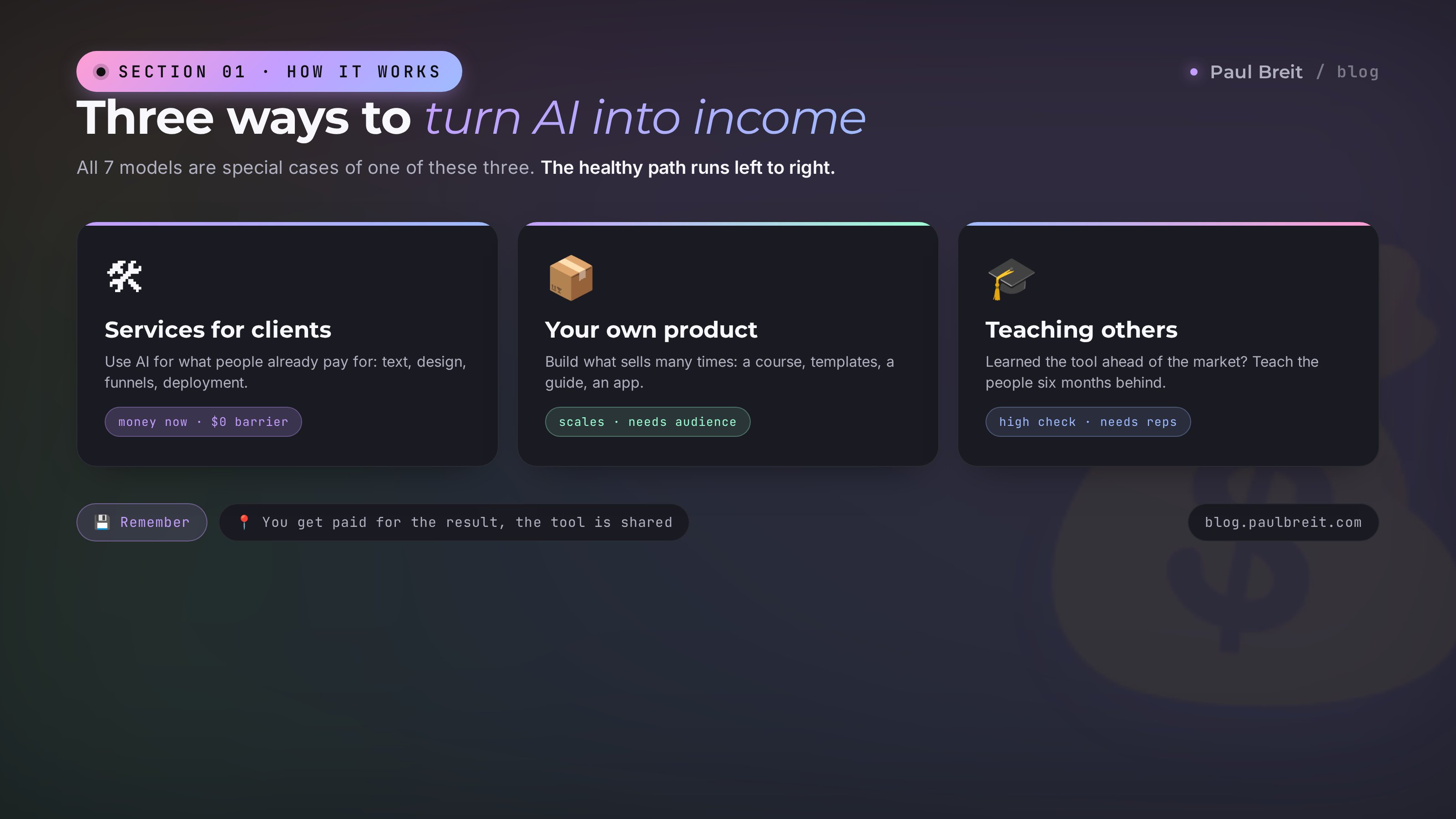
Before we get into the seven models, let's fix the main idea. Money on AI shows up three ways, and all seven models below are special cases of one of the three.
- Services for clients. You use AI to do what people already pay for – writing, design, funnels, automation. The client pays for a closed task. Money comes fast, the barrier is zero. Your ceiling is your own time.
- Your own product. You use AI to build something that sells many times: a mini-course, a set of templates, a guide, an app. Build once, sell to a hundred people. It scales, but it needs an audience and time to assemble.
- Teaching others. You learned the tool ahead of the market and teach the people who are six months behind. While the topic is hot, demand is huge. It's a model of its own and also a layer on top of the first two.
The healthy path for a beginner runs left to right. Services first: they feed you cash and teach you the market. On what you earn, and on that experience, you build your own product. And once you have dozens of closed tasks behind you, you start teaching others, because now you have something to show.
Who pays, and why
The beginner's main worry: "Who even needs my services if anyone can open an AI themselves?" The answer is simple. Anyone can open it; almost nobody gets the result they want. Small businesses and busy experts have no time to wrestle with prompts, test ten tools, and proofread the output. They have money and a task. You close the gap between "there's an AI" and "there's a finished result", and that gap is what gets paid.
Second, people pay for accountability. AI will make a mistake and not notice, invent a fact that doesn't exist, put a clumsy headline on your work. The client needs a human who checks, finishes the job, and owns the outcome. That's a role AI can't fill by definition.
This is a rare moment. The tools are already powerful, and the mass market still doesn't know how to use them. In two or three years, working with AI will be a basic skill, like knowing how to search. Whoever enters now and builds a portfolio and a reputation will be riding the wave ahead of everyone else. A year from now the entry will be harder.
One last thing before the models. Not one of the seven needs programming. Where "code" is required, the AI writes it for you and you just copy the ready output by the steps. We'll cover that in the AI-workers model. Everything else is plain work with text, images, and simple services.
Model 01Writing and content for clients
The lowest barrier of them all. Businesses and experts constantly need text: social posts, blog articles, newsletters, product descriptions, video scripts. That used to go to copywriters and take weeks. Now, with AI, you produce the same volume many times faster.
An important clarification: what you sell is a solved task, and "text from an AI" on its own is worthless. The client needs posts that get engagement and articles that pull people in from search. Your job is to set the task well, gather material for the specific niche, and proofread so that no trace of the machine is left.
What you do, step by step
Capture the client's voice
Take 20-30 of the client's posts, or samples of writing they like, and ask the AI to distill the rules of their style into a separate file. From then on every text is written against that file, and the result sounds like the author instead of a robot. The detailed how-to is in the piece on the five-part prompt formula.
Write in batches, not one at a time
A month's content plan comes together in one evening. You set the topics and rubrics, the AI drafts all the posts at once. What's left is proofreading and live edits. In the time a copywriter writes one post, you hand the client ten.
Remove the AI fingerprints
This is the part people pay for. Clichés, stiff phrasing, the same rhythm over and over, the machine's pet words – all of it gets scrubbed out. The client gets text they'd happily put their name on. A beginner who can clean text down to something human is worth more than one who ships raw output.
A pack of 8-12 posts a month for one client – $100 to $250. A blog SEO article – $40 to $100 each. Full content management (posts plus newsletters plus scripts) – $300 to $800 a month per client. Three or four clients on retainer is already a full workload and steady income.
Where to get your first clients. Message five experts or business owners you know whose social media has gone quiet, and offer to build them a week's content plan for free as a demo. Out of five demos, one or two usually turn into paid work. That's your way into the model. For more of what AI can close on content, see the roundup of 10 tasks with no code at all.
Model 02Visuals – banners, carousels, presentations
The second-easiest entry. Text always needs a picture: a post cover, a carousel, an ad banner, presentation slides. Designers charge a lot and take their time. With AI you close standard visuals fast and get paid for the speed.
There are two different skills here, and both sell. The first is generating images from a description: covers, illustrations, backgrounds. The second is building structured visuals – carousels, infographics, presentations, where what matters is a clear delivery of meaning. Clear delivery of meaning is the point; a pretty picture is secondary. That second skill is rarer and pays more.
Tools by task
- Covers and illustrations. Midjourney and Gemini give a quality image from a text description. The barrier is learning to describe the shot you want in words.
- Carousels and presentations. Built with a text AI plus a simple editor like Canva or ready templates. The AI invents the structure and the slide copy; you assemble and style it.
- Ads and thumbnails. Here a catchy delivery matters: a big headline, one idea per banner, readable on a phone. The AI helps with ideas and copy; you control the final build.
A month's set of channel covers – $70 to $200. A social carousel – $20 to $50 each. A 10-15 slide deck for a talk or a sales pitch – $100 to $350. Ongoing visuals for one project on a steady basis – from $300 a month.
The catch in this model: a client easily tells a template picture from a thoughtful one. Whoever just hits "generate" and ships the first thing out competes on price at the bottom of the market. Whoever builds visuals around the client's meaning and brand charges many times more. Learn to think in composition, not just prompts.
Model 03Video, voice, and translation
A harder entry, but demand is higher and there are fewer competitors. Short vertical videos are needed by everyone: experts, stores, creators. And there's a whole layer of tasks where AI does what used to cost studio money: voiceover in your own voice, video with a digital presenter, translating a clip into another language while keeping the voice.
What you can sell here
- Short-form editing. The AI cuts a long video into clips, adds subtitles, trims the pauses. You assemble a finished clip with a cover and a caption. Subtitles are a must: most people watch with the sound off.
- Voiceover and voice cloning. Tools like ElevenLabs read text in a lifelike voice across languages. Useful for clips, audio versions of articles, auto-replies.
- Video with a digital presenter. Tools like HeyGen produce a clip with a talking avatar from a single script. An expert who doesn't want to be on camera gets a video without filming.
- Video translation. A clip is translated into another language with the voice preserved and the lips synced. For anyone going after a foreign audience, that's a standalone service with a high check.
Editing a short clip with subtitles – $10 to $35 each, cheaper in packs. Voicing a minute of audio – from $7. A clip with a digital presenter – $30 to $80. Translating and re-voicing a clip – from $40. A "10 clips a month done for you" pack for one expert – $300 to $700.
Where to start. Take one long stream from an expert you know and cut three short clips with subtitles for free. Show the result. The expert sees finished content made from footage that was already gathering dust, and usually says yes to a pack. Video is the model where one good demo sells better than any words.
Model 04Done-for-you funnels
This is where the grown-up checks start. Experts don't need scattered posts and pictures, they need a system that brings clients: a lead magnet, a warm-up sequence, a sales message, a landing page. Building that by hand is weeks of a marketer's work. With AI you do the package in a few days and charge for it as a project, not as a post.
The value of the model is that you sell a result in the client's money. A post is "nice". A funnel is "leads come in". People pay far more readily for the second, because they see the direct line to revenue.
What goes into a funnel package
- Lead magnet. Free value that captures a contact: a mini-course, a checklist, a teardown. AI helps build the script and the copy in an evening.
- Warm-up sequence. 5 automated messages that carry a person from "interesting" to "I want to buy". Written to a ready structure, grounded in the audience's pains.
- Sales message and landing page. An offer with a deadline, tiers, and proof. The AI drafts it, you finish it for the niche.
I laid out the full anatomy of this system in a separate piece on the expert sales funnel with AI – five stages with prompts for each. Master it, and you package other people's funnels done-for-you.
A done-for-you lead magnet – $150 to $400. A warm-up sequence – $100 to $250. A full funnel (lead magnet plus warm-up plus landing plus offer) – $400 to $1,000 per project. With experience and case studies, funnel packaging goes for $1,300-2,000.
The catch: a client judges a funnel by the leads, and leads also depend on traffic, which you don't control. Agree up front on exactly what you're being paid for: building the system, or building plus running the ads. Otherwise you end up on the hook for something outside your reach.
Model 05Deploying AI workers into a business
The most lucrative and most underrated model. An AI worker is a setup that does one concrete job on its own: answers customers in the DMs, sorts incoming leads, prepares reports, watches for mentions of the company. A business pays for that like a hire, because it replaces hours of manual work.
The word "deployment" scares a beginner: it sounds like you need a programmer. You don't. Modern AI writes the needed code itself, and you copy it step by step and connect ready services. What an AI worker is and how it's built inside is in the piece on AI agents.
Which deployments sell
- DM auto-responder. Answers customers' standard questions, collects leads, books calls. Small businesses lose leads simply because they can't answer in time. This deployment brings that money back directly.
- Lead triage. The AI reads incoming messages, flags the hot ones, prepares a short summary for the manager.
- Morning reports. The setup pulls the data and sends the owner a daily digest of sales and content each morning. An example of an AI channel teardown is in the piece on analyzing Telegram with Claude.
A one-time deployment of a simple AI worker – $700 to $2,000 per project. Support and tweaks – from $200 a month. This is the lane where one or two clients bring the income that takes a dozen orders in other models. Demand from businesses is growing faster than the number of people who can deploy.
The barrier is higher than in writing and visuals: you have to work out how to connect the AI to a messenger and to spreadsheets. But it's learned from instructions in a couple of weeks, and the check pays back the time many times over. Start with a simple auto-responder for a business you know – and you'll have your first case study, which sells the next deployments.
Model 06Teaching and mentoring
Once you've closed 10-15 tasks in any of the models above, you have something most of the market doesn't: real experience. Which means you can teach the people six months behind you. Demand is huge: thousands of people want to learn AI and are looking for someone to walk them through it.
Teaching comes at different scales, and it's best to enter from the bottom up.
One-off consultations
An hour or ninety minutes of personal help: you get someone's AI set up for their task. The fastest way into the model, no audience required. You only need to know what the other person doesn't yet.
Mini-course or workshop
You pack your experience into a short program of 3-5 sessions on one narrow topic: "AI for reels", "AI content for a therapist". Record once, sell to many.
Mentoring
You guide a person to a result over several weeks and own their progress. The highest check, because the client buys support to the goal. They'll find the knowledge themselves; what they need is a hand that gets them to the result.
A consultation teardown – $30 to $100 an hour. A recorded mini-course – $40 to $200 for access. A month of mentoring – $400 to $1,300. Teaching is good because it compounds reputation: a happy client brings the next one.
An honest caveat. The right to teach belongs to someone who has actually done the work. The market is packed with people who took one course and are selling mentoring the next day. It shows, and their reputation is short. Get your hands dirty on real tasks first, then teach. Then people follow you instead of walking away disappointed.
Model 07Your own micro-products and affiliates
The last model plays for the long game and for passive income. Here you build once, with AI, something that sells many times without you being in every deal.
Micro-products
These are small digital products with concrete value: a niche prompt pack, a "how to do X with AI" guide, post templates, checklists, a mini-book. AI helps you assemble one over a weekend. How to build a full book-as-lead-magnet is in the teardown on writing a book with AI in a weekend.
A micro-product is cheap – $5 to $25 – but it sells in the hundreds if it solves a live pain and sits on the audience's path. Five or six of them add up to a small store that drips income in the background while you're busy with services.
Affiliates for AI services
Many services pay for the users you bring. You already recommend the tools you use: to clients, followers, readers. Set up an affiliate link and you earn a cut of everyone who signs up on your recommendation. It's not the main income, but it's a nice add-on to teaching and content: you talked about a tool, you earn from it.
A micro-product – $5 to $25 a copy, volume does the work through the number of sales. A niche prompt or template pack – $15 to $60. AI-service affiliates – usually 20-40% of the payment from a referred user across their subscription. Small on their own, meaningful together as a background stream.
The catch: your own product only sells to people who already have an audience or traffic. Building a guide is easy; selling it into a void is impossible. So this model comes third, not first. Services and teaching give you the audience and the name first, then your own products fire on top of them.
Section 02How much you can really make
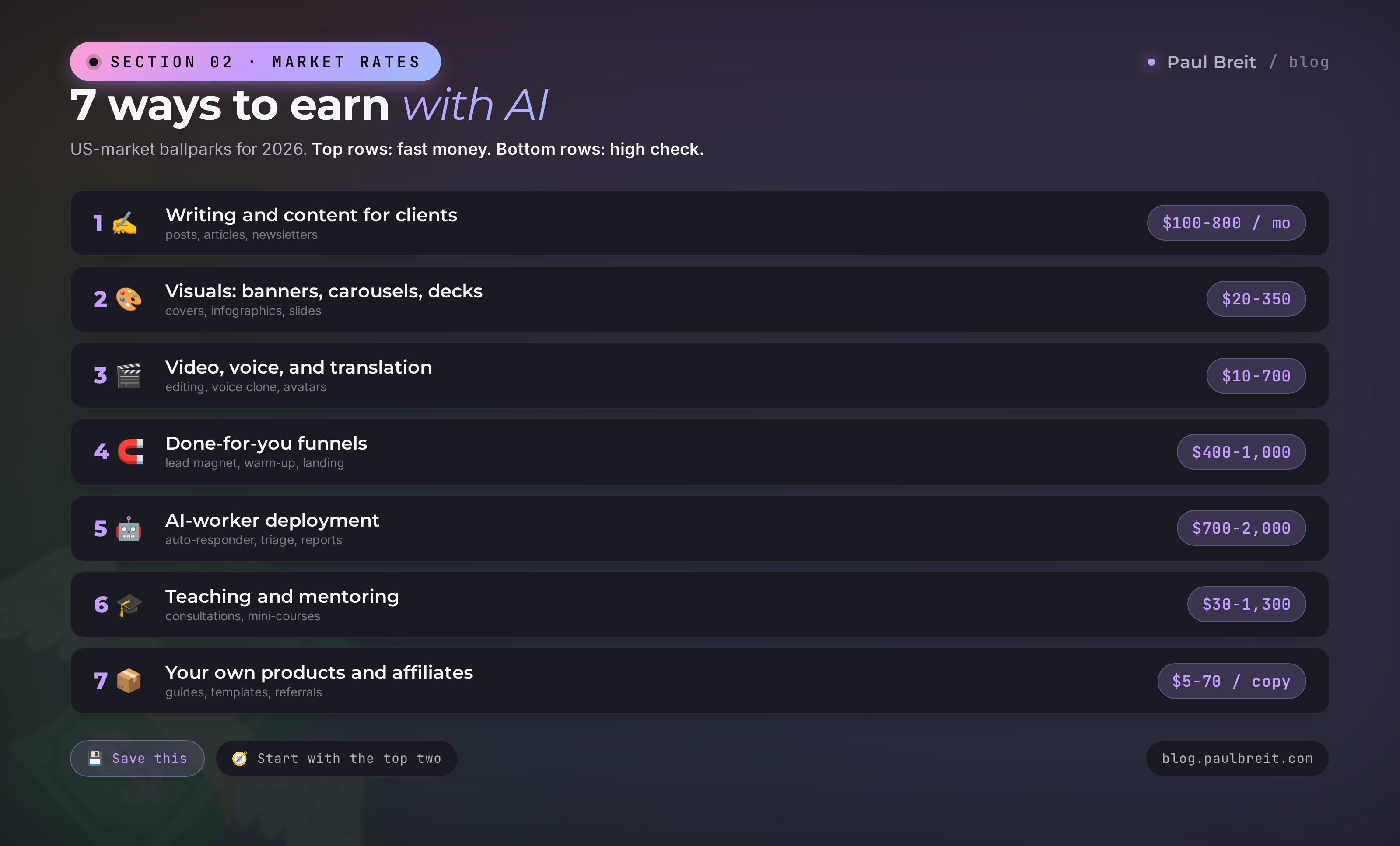
Let's gather the seven models into one table so you can pick an entry point. The numbers are US-market ballparks for 2026. Yours will depend on niche, quality, and persistence, but the order of magnitude is this.
| Model | Barrier | Market check | Speed to first money |
|---|---|---|---|
| Writing and content | minimal | $100-800 / mo per client | 1-2 weeks |
| Visuals | minimal | $20-350 per piece | 1-2 weeks |
| Video and voice | medium | $10-700 per project | 2-3 weeks |
| Done-for-you funnels | medium | $400-1,000 per project | 3-5 weeks |
| AI-worker deployment | above average | $700-2,000 per project | 1-2 months |
| Teaching | medium | $30-1,300 per format | 2-4 weeks |
| Your own products | needs an audience | $5-70 per copy | 1-3 months |
The top of the table is fast money and a low barrier; the bottom is a high check and a delayed result. It makes sense for a beginner to start with the top two rows: they pay in the first month and teach you to work with a client. Once you have a portfolio, you add a heavier model with a bigger check. You can and should stack models: writing plus visuals for one client is already two checks from one project.
A realistic picture of the first month at 1-2 hours a day on the top models: 3-5 small clients and $300-800. It's not the million from the ads, but it's real, and real is where growth starts. Six months in, the ones who didn't quit are running several projects and adding models with checks above $700.
Section 03Where to start: a 7-day plan
Theory without action earns nothing. Here's a concrete week to get from "read the article" to "made a first demo and sent a first offer".
Set up your working tool
Register for an AI. For writing and packaging, one is enough – Claude. Set up your account through claude.ai, and if it doesn't open in your country, turn on a VPN set to the US or EU first. What Claude can close for you is laid out in 10 tasks with no code.
Choose one model
Not seven, one. The one closest to what you already do. You write – take writing. You have an eye for visuals – take images. Past experience in sales – take funnels. One model driven to money beats seven started and dropped.
Do 3 practice pieces
Practice on made-up or your own tasks. Three posts, three banners, one funnel teardown. The goal is to get your hands in and gather the first samples for a portfolio. Learn to set the task for the AI with the prompt formula, or the result will be weak.
Package 3 samples
Put your best pieces into a simple collection: a document, a page, a folder. That's your storefront. Without samples the first client won't trust you; with them the conversation gets concrete.
Make a free demo for a real person
Pick an expert or business you know with a sagging task and do a slice of the work for free: a week's content plan, three clips from an old stream, a funnel teardown. A demo on a real task sells harder than any price sheet.
Send 5 concrete offers
Message five people directly: show the demo or the samples and offer to close their task for money. Be specific: what you'll do, by when, for how much. Out of five targeted offers, one or two usually turn into payment.
A working tool, a chosen model, three samples in a portfolio, one live demo, and five offers sent. It's not "a million a week", it's the foundation real income starts from. From here it's repeat and refine: more demos, more offers, a higher check.
Section 045 beginner mistakes
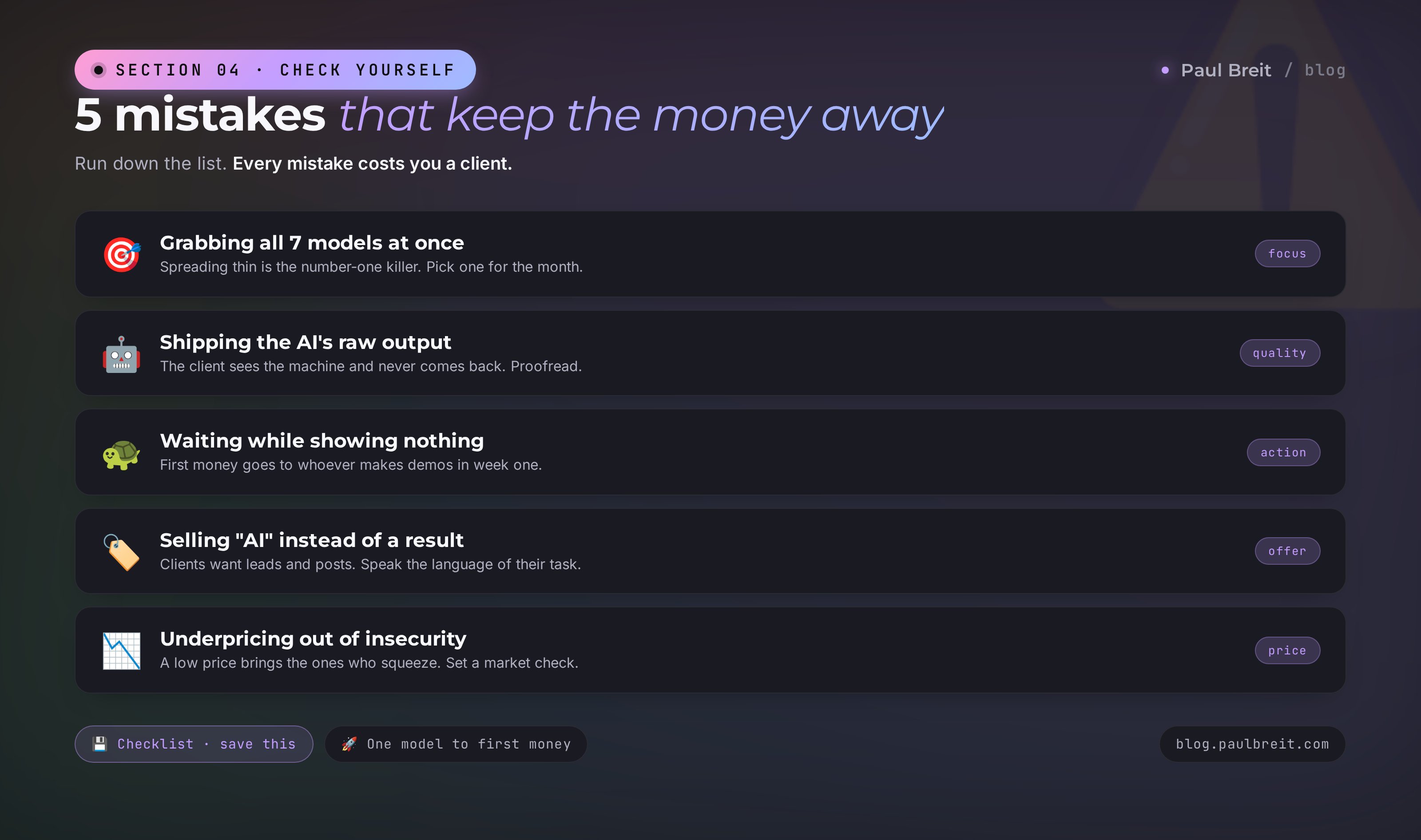
Grabbing all seven models at once
A beginner reads the list and wants all of it. In the end nothing gets to money. The fix is a hard choice: one model for the coming month, the rest wait. Spreading yourself thin is the number-one killer of first earnings.
Shipping the AI's raw output
Generate, copy, send. The client sees the machine's clichés and never comes back. Cleaning it down to something human is what gets paid. Always proofread and edit: no trace of the AI should be left in finished work.
Waiting for clients while showing nothing
"Once I finish learning, then I'll pitch." Months pass without a dollar. First money goes to whoever makes demos and sends offers in the first week, while the skill is still raw. Action gets ahead of readiness.
Selling "AI" instead of a result
"I work with AI" tells a client nothing. They want leads, posts, clips, answered messages. Speak in the language of their task and their money, and leave the tool offstage. People buy the result.
Underpricing out of insecurity
A beginner is afraid to name a price, works for pennies, burns out, and quits. Set a market check from the first client. A low price doesn't bring good clients, it brings the ones who squeeze and don't value the work. Confidence in your price grows from case studies, and case studies come from properly paid work.
Section 05Starter checklist
Print it or save it. Tick the boxes as you go. When all seven stand, you're in the game.
- Tool set up – you have AI access, VPN configured if needed
- One model chosen to fit your past experience, the rest parked
- 3 samples gathered for a portfolio storefront
- Task-setting learned for the AI with the prompt formula
- 1 live demo made for a real person, free
- 5 offers sent with specifics: what, for how much, by when
- Market check set, no underpricing out of insecurity
AI doesn't pay you on its own. It strips weeks of grind out of work people already pay for. Choose one model, drive it to a first client, and don't quit in week two. Whoever enters the topic now and stacks case studies will, a year from now, be among the people others come to for lessons and deployments. The window is open – step in.
How this connects to the other articles
Making money with AI stands on three legs. First, knowing how to set the task: the five-part prompt formula. Second, access to a strong tool: what you can do with AI. Third, understanding what you can close with AI in the first place: the same roundup of tasks with no code. Master these three, and any of the seven models above becomes a working income stream for you.
FAQFrequently asked questions
Can you really make money with AI without investment or code?
Yes. None of the seven models in this article require programming or startup money beyond an AI subscription of about $20-25 a month. You sell the result: text, a banner, a funnel, an automation. The client cares that the job is done, not which tool did it.
How much can a beginner make with AI in the first month?
A realistic first-month range at 1-2 hours a day is $300-800 on writing and visuals. That's 3-5 small clients. From there the check grows: a done-for-you funnel runs $400-1,000, deploying an AI worker starts at $700 per project.
Which AI is best for making money?
For text, strategy, and code without programming - Claude. For images - Midjourney or Gemini; for video and voice - ElevenLabs plus HeyGen. One Claude Pro subscription is enough to start: it covers most writing and packaging tasks.
Do I need to pay for Claude or ChatGPT to start?
The free tiers are enough to land your first client or two and earn the subscription. Once orders come in, the paid plan pays for itself with the first client: it lifts the limits and gives you stronger models. Claude Pro is about $20 a month.
Where do I find my first clients for AI services?
Start with your warm circle: experts you know, small businesses, founder chats. Then move to marketplaces (Upwork, Fiverr, niche communities) and direct messages to experts with a specific offer plus a free demo of their task. The first 2-3 clients almost always come from personal connections.
What's better - services for clients or your own product?
Services bring money fast and teach you the market, but your ceiling is your time. Your own product (a mini-course, templates, mentoring) scales, but it needs an audience and time to build. The working path is to start with services, then build your product on what you earn and learn.
Will AI replace me if everyone learns to use it?
The tool is shared, but the result depends on who sets the task. People pay for a packaged service, niche understanding, and ownership of the outcome, not for access to an AI. Whoever learns the tool a year ahead of the market is the one who earns by teaching everyone else.
Is it legal to earn from AI-written text and images?
Yes, for commercial use. Register as a sole proprietor or the local equivalent and pay tax on your income. For content, always keep a final human review: you answer to the client for quality and facts, not the AI.