Who owns AI-generated content: copyright in 2026
In plain English: who owns the text, image, and video an AI makes for you. What the law says in the US, the EU, and China, what the ChatGPT, Claude, and Midjourney terms actually promise, when AI content can land you a claim, and how to set the work up so it's truly yours and pays you without the stress. Inside: a ready checklist and a paragraph for your client contract.
Who owns text an AI wrote: under US law and most systems only a human can be an author, so the AI itself gets no rights. If you set the idea, wrote the prompt, and selected and reworked the result, the rights are yours as the author. Pure machine output with no creative input of yours usually isn't protected by copyright: you can use it, but you can't easily stop others copying it. ChatGPT, Claude, and Midjourney assign the rights in the output to the user in their terms, usually in full on a paid plan. There's no separate AI-content statute yet; existing copyright law and the human-authorship rule apply.
You wrote an article with Claude, built a cover in Midjourney, and put a guide up for sale. Then the little voice starts: is this even mine? Can I sell it? What if a client asks who the author is? What if a competitor copies my text word for word tomorrow – can I do anything about it? The topic is murky, lawyers hedge, and the work has to ship today.
I run four client projects and a personal channel of 20,000 followers, and almost all of our content passes through AI. The rights question comes up constantly: in contracts, in disputes with contractors, when launching courses. This article gathers what actually matters for anyone who sells services, courses, and consulting and wants to sleep at night.
Let's be clear up front: I'm not a lawyer, and this article doesn't replace advice on your specific case. But the ground rules for 2026 are simple and clear, and they're enough to keep you out of trouble and out of pocket. It reads in 19 minutes and closes a question most people carry for years.
What's inside
- What copyright is, in plain words
- Who owns text an AI wrote
- What the law says: US, EU, China
- What the ChatGPT, Claude, and Midjourney terms say
- Can you protect and register AI content
- When AI burns you: borrowed text, faces, brands
- 7 common situations and what to do
- Your client contract: what to put about AI
- How to protect yourself: step by step
- The AI-content owner's checklist
Some of the tools here can be region-locked depending on where you are. Anthropic, for one, restricts access from certain regions at sign-up. If a tool won't open, use a connection based in the US or EU and register with a mainstream email such as Gmail or iCloud, which pass more reliably. You can try Claude itself at claude.ai.
Section 01What copyright is, in plain words
Before arguing over whose text it is, you need to know what copyright actually protects. It protects a specific form: this exact text, this exact image, this exact melody. The idea itself isn't protected. Anyone can take the idea "a post on how AI helps a therapist," but your specific text, with your words and examples, is protected.
Take an everyday example. You invented a series format, "one client mistake broken down each week" – the idea itself isn't protected, and a competitor is free to run the same series. But the specific episodes you wrote, with your phrasing, your breakdowns, your conclusions, are protected as your works. Copying them verbatim isn't allowed. That gap between idea and form is the key to the whole AI question: the tool helps you crank out form fast, while value and rights are born where you put yourself into that form.
Second key point: copyright arises on its own, the moment a work is created. You don't have to register anything, add a copyright symbol, or file with anyone. Write something with your own effort and you're already the author, and the rights are already yours. The © symbol, a date, and a formal deposit help you prove in a dispute that it was you and when, but they don't create the protection itself.
Third: an author has two sets of rights. Moral rights – to be named as the author and to protect your name – stay with the person forever and can't be sold. And the economic (exclusive) right – to use the work, sell it, and allow or forbid others. That economic right is the one that earns money and the one you can hand to a client or a contractor.
Now the catch. This whole machine was written around the human: their creative labor, their name, their will. An AI doesn't fit that frame anywhere. It isn't a person, has no will and no creative intent, and has no name in the legal sense. That's why the simple-sounding question "whose text is it" turns into a whole topic that even courts in different countries stumble over.
Section 02Who owns text an AI wrote
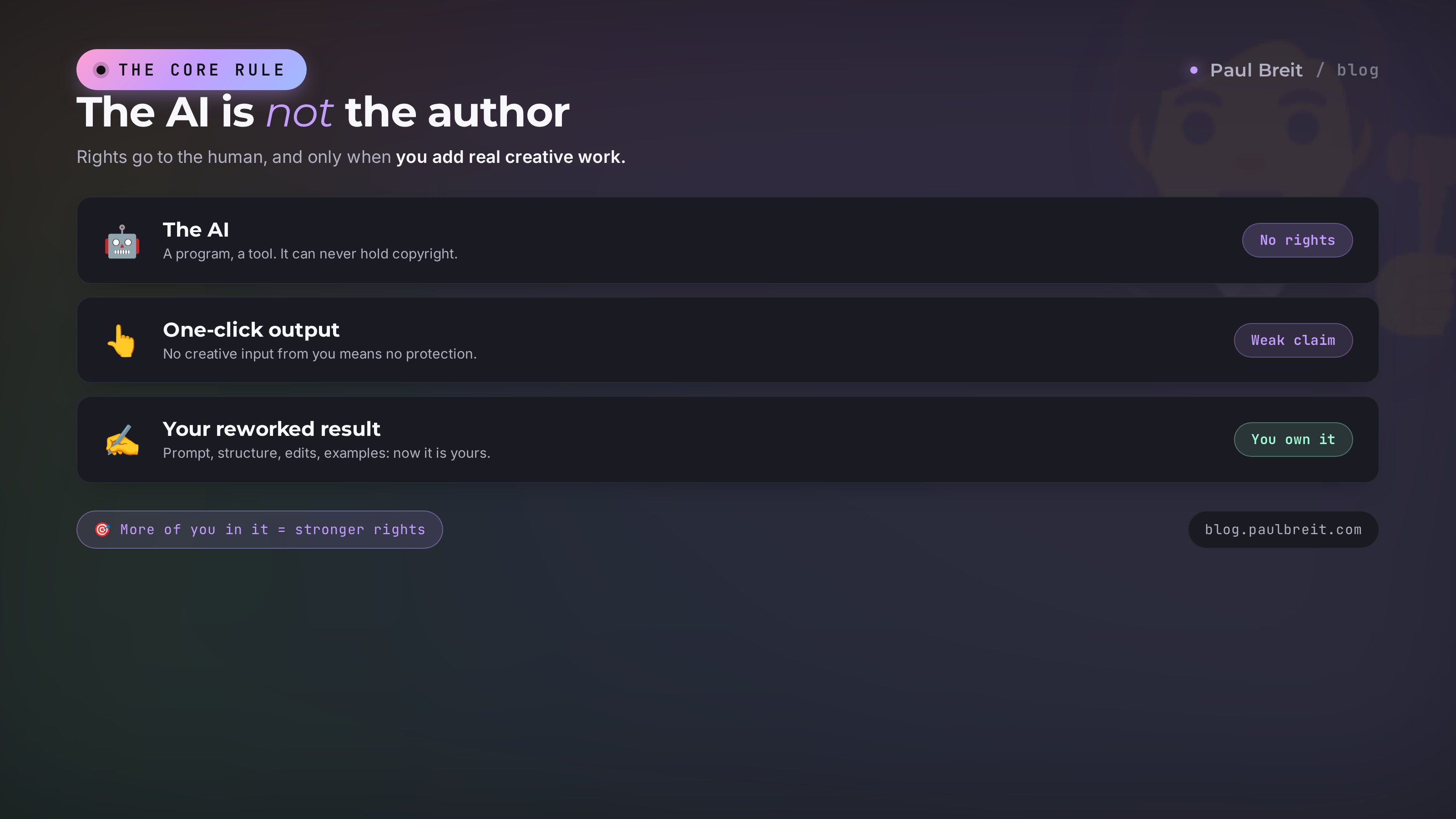
Start with what can't happen. An AI can't be an author and can't be a rights holder. It's a program, a tool, not a legal subject. Only a human can hold copyright – or, in some cases, a company the human transferred the rights to. That's the starting point in every country that has thought about this at all.
Since the AI is out, two real options remain for any result. First: the result has a human author, the one who put creative work into it. Then the rights belong to that person. Second: there's almost no human creative input and the machine did it all. Then the result has no author at all, and copyright doesn't protect it. You can use such text freely, but protecting it from copying is hard, because there's nothing to protect.
It all comes down to how much of you is in it. Look at two examples. You open a chat and type "write a post about coffee" – the result is nearly all machine, your creativity is worth pennies, and the rights are shaky. Now the other approach: you thought through the structure of a guide, wrote a page-long prompt, ran a dozen variations, picked the best pieces, rewrote them in your own words, added examples from your practice, and assembled it into one coherent piece. That's your creative labor, and the result is protected as your work.
Hence a simple daily rule: the more of you in the finished text, the stronger your rights. In this logic the AI is like a brush and paint in an artist's hand. The brush doesn't become the author of the painting; the author is the human who guided it. And the more purposefully they guided it, the more obvious the painting is theirs. The same principle works with text, which is exactly why the skill of writing strong prompts feeds not just quality but your rights.
What if a contractor or an AI agent made it
A common story for anyone who sells services: you don't make the text and images yourself. A freelancer, a copywriter, or an AI agent you set up does. The logic is the same, with an add-on about transferring rights. If a person worked under a contract, the rights first arise with them, and they pass to you by an assignment agreement or as part of their employment duties. Forget to spell out the transfer and, formally, the rights stay with the contractor – and that surfaces at the worst possible moment, once you've already put the material into your product.
With an AI agent it's simpler: an agent is a program and can't be an author, so the rights arise with the human who set it up, gave it tasks, and selected the output. Usually that's you. But if a contractor built and configured the agent for you, check the contract again: whoever's creative input went into the prompts, scenarios, and selection is the rights holder of the result. The takeaway is one: any chain where another person sits between you and the result should be closed with a written transfer of rights. Verbal deals don't hold up in a dispute.
Section 03What the law says: US, EU, China
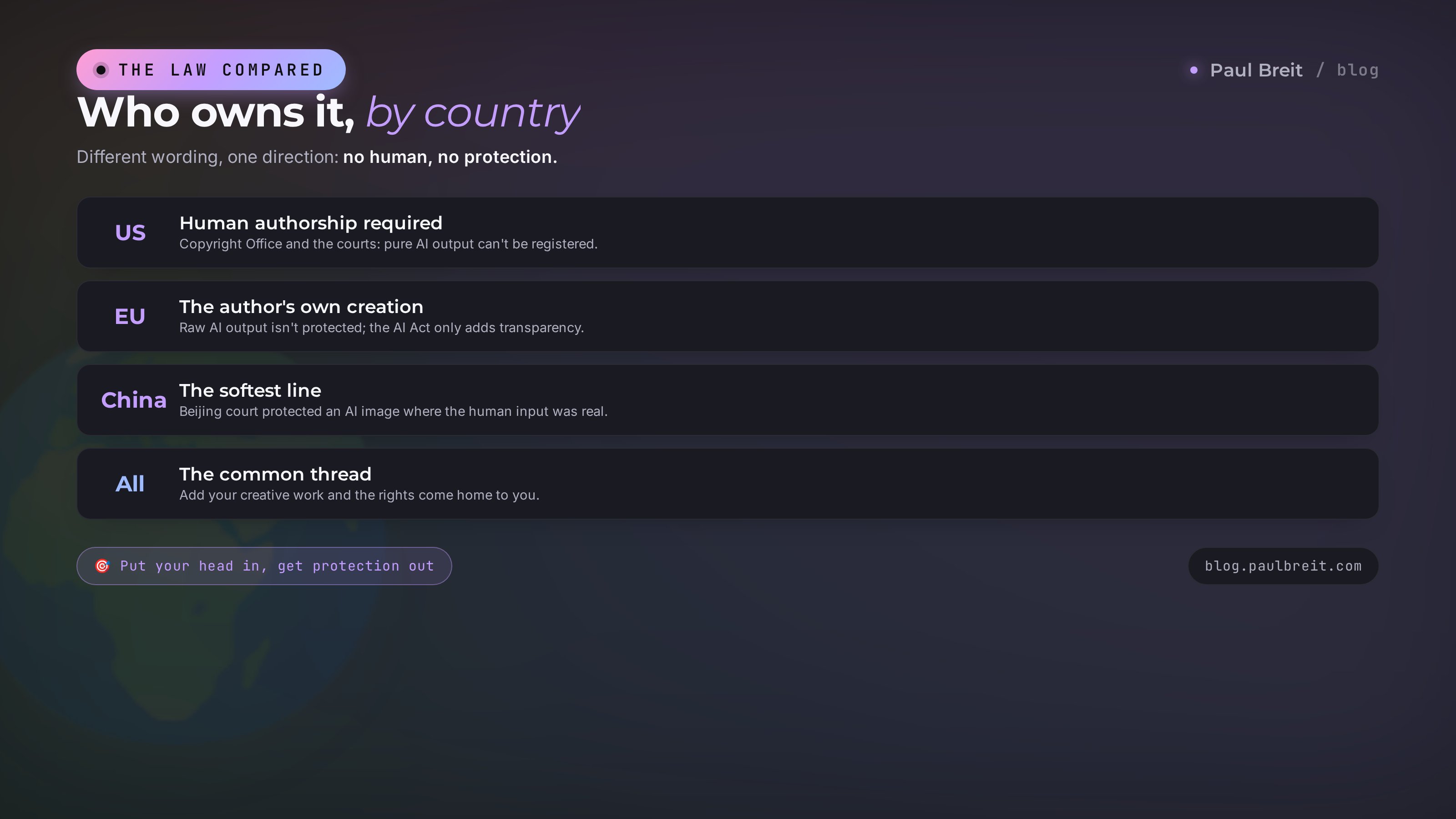
There's no single global AI law; each country handles it its own way. But look at the major jurisdictions and the direction is roughly the same everywhere: no human, no protection. The difference is in the details and in how leniently they view the user's creative input.
United States
Here the position is stated bluntly and clearly. The U.S. Copyright Office requires human authorship: anything made by a machine with no creative participation from a human can't be registered. The comic Zarya of the Dawn is the textbook case – the images drawn by Midjourney got no protection, while the text and the way the author arranged the pages were protected as human contribution. There was also the Thaler case, where a machine was named as the author and the court refused. The lesson: in the US, they protect exactly the human part of your work.
This matters if you sell to a US audience or license content there. Even with full rights under a service's terms, you can't register pure AI output with the Copyright Office. But you can register your rework and arrangement. So the same rule holds for export: put your head into it, and protection appears – and it's easier to sell with a clear conscience.
European Union
In the EU a work is protected if it's the author's own intellectual creation. Pure AI output doesn't meet that and gets no protection. The EU also passed a separate AI Act, but that's about something else: transparency, safety, and labeling. It requires generated content to be flagged and training data to be disclosed, but it doesn't decide who owns the result. Ownership is still determined through human creative input.
United Kingdom
The UK is a bit of an outlier: its law has a long-standing provision for "computer-generated works," which can be protected with the person who made the arrangements treated as the author. It's a narrow, much-debated rule, and it doesn't change the practical playbook – the more genuine human input you add, the safer your position. If you sell into the UK, still lean on your own creative contribution.
China
The softest of the major positions. In a well-known case the Beijing Internet Court recognized a generated image as a protected work, because the user had put in creative input: choosing prompts and settings and refining the result. So with meaningful human involvement, China is willing to protect even an AI image. It shows where global practice is slowly heading: look less at the tool and more at the human behind it.
Across all these countries the answer to "whose is it" converges on one thing: no human, no protection; with a human, the rights are the human's. Only the bar for creative input moves. So the universal strategy is the same for any country: put yourself into the result and keep the traces of that input.
Section 04What the ChatGPT, Claude, and Midjourney terms say
Here you have to separate two things people constantly blur. There's the right under the law – whether it arises at all, which we covered above. And there's the right under your contract with the service – what the terms of use say. A service can't gift you a copyright that doesn't exist under the law. But it can hand you all of its rights in the output and let you use it however you like, including commercially. That's what the terms cover.
Because of that fork, read the word "you own" in a service's terms soberly. It means the service won't come after you and lets you earn from the result. It doesn't mean you automatically gained a copyright you can use to forbid the whole world from copying your text. A monopoly still needs your creative input. In practice: the service's terms clear the problem with the service, and the strength of your rights against everyone else you build up with your own head and your own rework.
ChatGPT (OpenAI)
In its terms OpenAI assigns the user all of its rights in the generated output and allows commercial use. So the text ChatGPT produces you can sell, put in a course, and publish. Two caveats: another user with a similar prompt may get a similar result, and the service doesn't guarantee copyright will arise in the output at all. The right to use – yes. A guaranteed monopoly – no.
Claude (Anthropic)
Anthropic's logic is similar: under its terms the output belongs to you, and the company assigns its rights in the output to the user. Claude is a common pick for working text, contracts, and long documents, and on rights in the result it's user-friendly. As everywhere, the commercial details and limits depend on your plan, so before serious use it's worth opening the Commercial Terms.
Midjourney
With images the rules are stricter and tied to your plan. On a paid subscription you own the images you create and can use them commercially. On free or trial access the rights are heavily cut, and the company keeps a broad license over your generations. Plus, by default everything you generate lands in a public feed, which is worth noting if you need an image kept confidential.
Other services
Gemini and the rest each have their own terms, and they differ noticeably. Some put the rights in the result with the user; others reserve more for the service or limit commercial use on the free tier. One rule holds: before you build a business on a tool, open its terms of use, find the section on content and intellectual property, and read what it says about output, ownership, and commercial use. Five minutes of reading saves a lot of stress later.
The most common mistake is building a logo or a cover on the free tier and pushing it into commercial use. On free access you often have no rights, or cut-down ones. If the image goes into a product, a site, or an ad, make it on a paid plan, where commercial use is clearly allowed. The subscription pays for itself with a single dispute avoided.
Section 05Can you protect and register AI content
Short answer: you can protect what you put creative work into, and there are ways to strengthen your position up front. Here's what actually works, step by step.
First and most important – add your input so the result is eligible for protection at all. Rework the text in your own words, invent an original structure, drop in your examples, data, and conclusions, and edit it to your voice. The material turns from machine output into yours, and now the law is ready to protect it. As a bonus you strip out the AI flavor and the work reads as written by a person, not a model.
Second – fix authorship and the date. In the US copyright arises automatically, so registration isn't required. But registration with the U.S. Copyright Office gives you real teeth: it's a precondition for suing for infringement of a US work, and timely registration opens the door to statutory damages and attorney's fees. For anything you'll defend or license, registering the human-authored version is worth it.
Third – keep proof of the process. Drafts, versions, your prompts, the back-and-forth with the AI, file dates. All of it shows your labor and your decisions stood behind the result. If it comes to a dispute, that folder of work history is worth more than any words.
Fourth – labeling and metadata. Many AI tools embed a hidden marker that an image was generated, and some platforms require that marker shown openly. It's not about ownership but about honesty and about following platform rules. Keep the original files with their source metadata and, where required, add a visible note. In a dispute, an original with metadata is one more confirmation that you made the visual, and when.
And separately, the brand. A logo, a name, and a trademark go a different route: they're protected as a trademark through registration with the USPTO. It doesn't matter whether a human or an AI drew the mark: you file the mark itself. One nuance – the mark must be distinctive and not repeat someone else's brand, so an AI logo gets an especially careful check before filing, to make sure the machine didn't accidentally trace something recognizable.
Section 06When AI burns you: borrowed text, faces, brands
The "whose is my text" question is secondary here. Far more dangerous is the reverse: when the AI hands you someone else's work and you answer for it. Here are the main risks that really hit your wallet and reputation.
A protected fragment of someone else's. The model learned on millions of texts and images, some of them protected. Sometimes it returns a piece too close to the original: a paragraph from a book, a recognizable illustration, a musical phrase. Publish or sell it and the claim lands on you, not the model's maker. What saves you is an originality check and plain judgment: if a result looks suspiciously like something famous, don't use it.
Other people's brands and faces. An AI will happily drop a known company's logo, a recognizable character, or a real person's face into an image. Using someone else's trademark or the likeness of a specific person without permission isn't allowed. Before publishing, look for stray brands and real people in the frame.
Plagiarism and duplicates. Ask ten people to prompt an AI about the same thing with no rework and they'll get similar texts. On a blog or site that hurts SEO: search engines dislike duplicates. And a client who sees near-identical text at a competitor loses trust. The cure is your input and your rework.
Client data in the prompt. The temptation to paste a chat log, a contract, or a contact list into the AI is strong, but that's a leak. People's personal data is protected by law, and uploading it to a third-party service without a basis is a violation. In commercial work this is its own headache – be careful what you send. There's more on safe handling in the piece on protecting yourself against AI-driven attacks.
Made-up facts. An AI confidently invents: nonexistent studies, numbers, quotes, laws. In an ordinary post that's annoying; in an ad or an expert piece it becomes liability for false information. Check every fact, number, and reference from an AI text by hand before publishing.
How hard does this actually hit the wallet? In the US, a rights holder can pursue statutory damages of up to $150,000 per work for willful infringement, plus removal of the material and a reputational hit. For someone else's trademark in an ad, or for false advertising claims, the advertiser is on the hook. The law gives no discount for "but the AI drew it": you published and profited, so you answer. That's why checking others' work before you publish is far cheaper than any dispute.
Section 077 common situations and what to do
Theory is theory, but everyone's questions are the same and very concrete. Here are seven of the most common from client practice, each answered short and to the point.
I wrote a book or guide with AI and I'm selling it
You can and should. Add your input: structure, examples, editing, your voice. Then the reworked result is protected as your work, and you can sell it or give it away as a lead magnet with a clear conscience. Keep the drafts and prompts on hand as proof of authorship.
I made a logo in Midjourney for my brand
Use an image from a paid plan, where commercial use is allowed. For full brand protection, register the mark with the USPTO as a trademark. Before that, check the logo has no third-party elements and doesn't repeat an existing brand.
A client wants exclusive rights to AI-assisted text
You can assign your rights in the reworked result by an assignment agreement. State that you're the rights holder, that AI tools were used, and warrant there's no infringement of third-party rights. The client gets the exclusive; you're covered by the warranty.
A competitor copied my AI post word for word
If your input was minimal and the text is nearly pure machine output, protection is weak and stopping the copy is hard. The lesson for next time: put more of yourself in, and the post becomes your work, which gives you leverage. Weak protection is a direct result of weak input.
I voiced a video with a cloned voice
You're free to clone and use your own voice. Someone else's voice, even a very close match, needs the owner's consent: a person's voice is protected. For ads and commercial work, use either your own voice or a voice under a contract with a speaker.
I generated a photo of a nonexistent person for an ad
A fictional face is fine to use, as long as it doesn't accidentally match a specific real person. Where a platform or the law requires it, mark the image as generated. Don't pass an AI character off as a real client with a testimonial – that's deception.
I use AI images in a paid course
Check the plan's license for commercial use and generate on a paid plan. Make sure the images have no third-party brands or faces. Save the prompts: if a question comes up, you can show how and with what the visuals were made.
Section 08Your client contract: what to put about AI
If you make content to order, the rights question is closed in the contract once and for all. You don't need three pages of legalese – a few clear points are enough. Here's what to nail down.
- Who holds the rights in the result. State plainly that the contractor is the rights holder of the reworked result and transfers the rights to the client.
- How the rights transfer. An assignment if the client wants a full exclusive, or a license if the right to use is enough. Describe the term and territory.
- The fact that AI was used. Honestly note that AI tools were used in the work. That heads off later complaints like "I thought a live human wrote this."
- A clean-hands warranty. The contractor warrants the result doesn't infringe third-party rights, brands, or likenesses.
- Data and confidentiality. How the parties handle personal data and what may not be uploaded to third-party services.
The Contractor confirms that it is the rights holder of the delivered result, created using artificial-intelligence systems together with the Contractor's own creative work, and assigns to the Client the exclusive right to the result in full. The Contractor warrants that the result does not infringe the copyright, trademark rights, or likeness rights of third parties, and bears responsibility for any such infringement. The parties do not transfer personal data to third-party services without a lawful basis.
Separately, spell out revisions and edits. Clients often add their own ideas, and then the client's creative input goes into the result too. Agree in advance that the final work still belongs to the client after payment, while intermediate versions and your building blocks stay with you. That way you can reuse your groundwork on other projects and don't end up with one paid job tying your hands forever.
Adjust the wording to your case and, for serious sums, show it to a lawyer. But even the basic paragraph closes 90 percent of the questions that otherwise surface at the worst moment.
Section 09How to protect yourself: step by step
Let's put it all into a simple sequence you can run on autopilot before every commercial piece. Six steps, each takes minutes.
Decide what the result is and which rights you need
A blog post, a lead magnet, a logo, a paid course, work for a client – each has its own bar. For an internal post, being able to use it is enough. For a product you'll sell and for a client, you need strong rights and a contract.
Put in creative work
Your prompt, your selection of variants, rework, structure, examples, editing. The more of you in the finished work, the stronger the rights. This step decides the main thing: whether the result is eligible for protection at all.
Check the tier and the service terms
Open the tool's terms of use, find the section on content and commerce, and confirm your plan allows what you have in mind. For commercial work, use the paid plan.
Check the result for anything borrowed
Originality of the text, no third-party brands or real faces in the images, accuracy of facts and numbers. This is your defense against the main risk – a claim over someone else's work.
Keep your proof
Prompts, drafts, versions, dates. For important material, register the human-authored version with the U.S. Copyright Office to lock in authorship and date. A folder of work history is your trump card in any dispute.
Close it in the contract
If you're working to order, spell out the rights, the fact that AI was used, and the clean-hands warranty. One paragraph removes most future disputes with a client.
Section 10The AI-content owner's checklist
Before you publish or sell anything made with AI, run this short list. Every box a yes – ship it with a clear conscience.
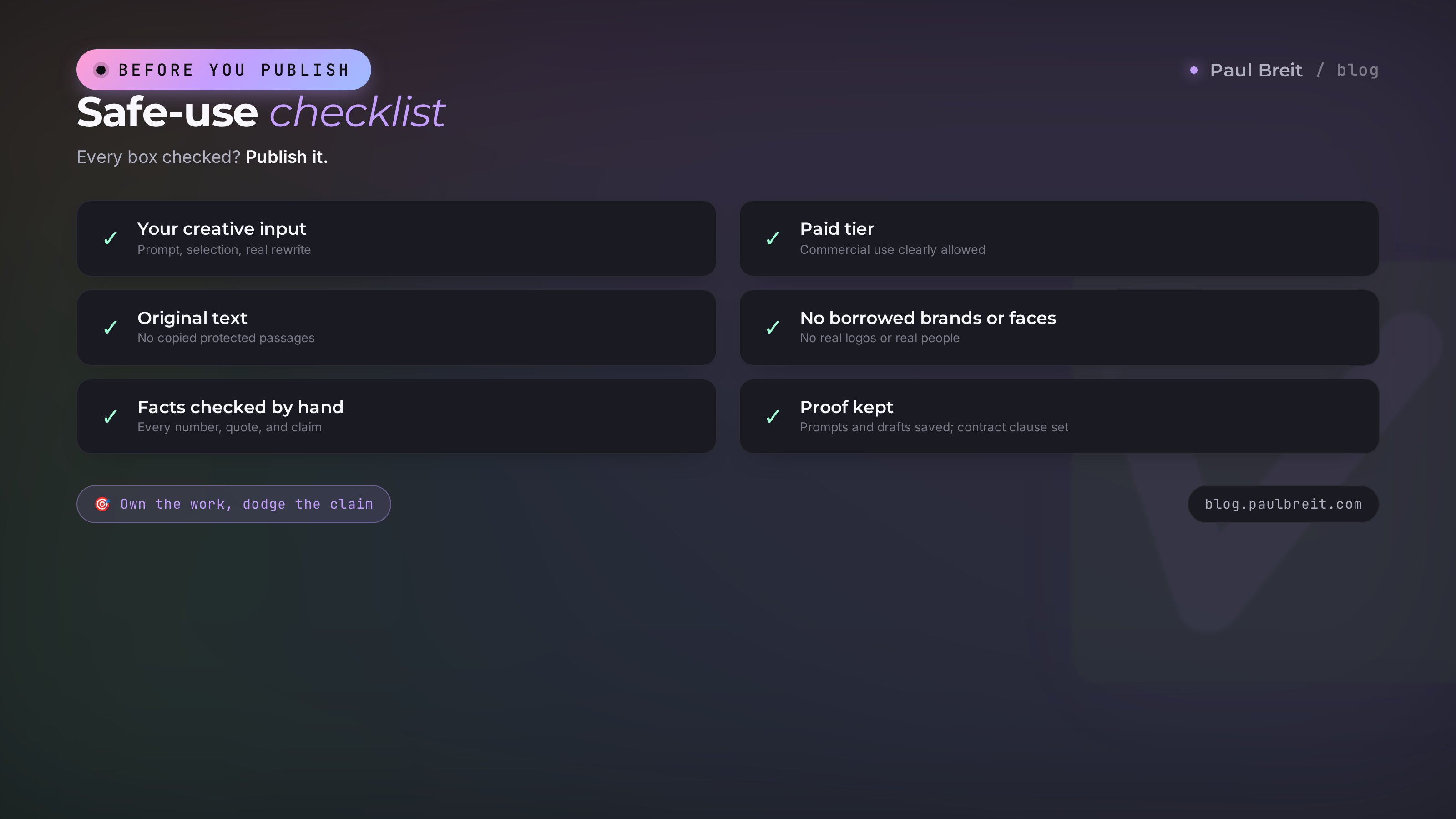
✅ The finished work has my creative input: prompt, selection, rework.
✅ The service tier allows commercial use.
✅ The text is original, with no protected fragments of others.
✅ No third-party brands or real faces in the images without permission.
✅ Every fact, number, and quote checked by hand.
✅ No client personal data was uploaded into the prompt.
✅ Prompts and drafts saved as proof of authorship.
✅ If it's work to order, the contract states the rights and warranties.
Let's pull it together in a minute. An AI can't be an author, so the rights in the result go to a human, and only if that human put in creative work. Pure machine output is barely protected anywhere: you can use it, but stopping the copy is hard. There's no special AI-content statute yet, so existing copyright law and the human-authorship rule apply, and in the US, the EU, and China the conclusion is the same – no human, no protection. The ChatGPT, Claude, and Midjourney terms assign the rights in the result to you, strongest on a paid plan. The main risk sits in the borrowed: protected fragments, brands, faces, and invented facts you answer for. Put yourself in, check the result, keep your proof, and close it in the contract. Then AI content becomes a safe asset of yours, not a mine under your business.
FAQFrequently asked questions
Who owns text that an AI wrote?
Under US law and most other systems, only a human can be an author, so the AI itself gets no rights. If you set the idea, wrote the prompt, and selected and reworked the result, the rights to the final work are yours. If you got the output with one click and no creative input of your own, that text usually isn't protected by copyright: you can use it, but stopping others from copying it is hard.
Can I sell text and images made by an AI?
Yes. ChatGPT, Claude, and Midjourney assign the rights in the output to the user in their terms and allow commercial use, usually in full on a paid plan. Before you sell, open the service terms, find the section on output and commercial use, check your tier, and make sure the result has no third-party brands, faces, or protected fragments.
Is there a US law about copyright in AI content?
There is no separate AI-content statute in 2026. Existing copyright law applies, and the U.S. Copyright Office requires human authorship: pure machine output can't be registered, while a result with your creative input is protected and the rights are yours. The Thaler and Zarya of the Dawn cases set the line.
Can I register copyright on AI-generated text?
You can register the parts a human created. Add your creative input first: rework the text, build the structure, edit it, add your own data and examples. Pure AI output can't be registered with the U.S. Copyright Office, but your reworked, arranged result can. A brand name or logo is protected separately as a trademark through the USPTO.
Who is liable if an AI outputs someone else's text or brand?
Whoever published or sold the material is liable, which means you. The model trained on other people's work and sometimes returns a passage close to the original, a real logo, or a real person's face. Before you publish, check the result for originality, for third-party brands and faces, and for invented facts.
Do I have to tell a client the material was made with AI?
There is no blanket legal duty to disclose it in the US right now, but your contract should state that AI tools were used and who is responsible for the result. Some platforms and ad systems require AI content to be labeled. An honest note heads off future disputes and builds client trust.
Can I transfer exclusive rights in AI content to a client?
Yes. You can assign your rights in the reworked result to the client or grant a license, just like any other work. State that you are the rights holder of the reworked result, that AI tools were used, and warrant that it doesn't infringe third-party rights. That closes the rights question for both sides in advance.
Will copyright protect my AI post if a competitor copies it?
If your input was minimal and the text is nearly pure machine output, protection is weak and stopping the copy is hard. Strengthen your authorship: your own structure, live examples, real rework, facts from your practice. The more of your creative work is in the result, the stronger your rights and the easier they are to prove.