AI for coaches: from a client's request to a program in an hour
AI for coaches isn't about "write me a post." It's about how, in a single evening, you can build a program for one specific client, come up with forty strong questions tailored to their request, break down a session recording, and pull out content that brings in new people. Inside: 12 real tasks from practice, ready-made prompts for each, and walkthroughs on live examples. Plus an honest talk about where AI helps a coach and where you can't trust it with a human being.
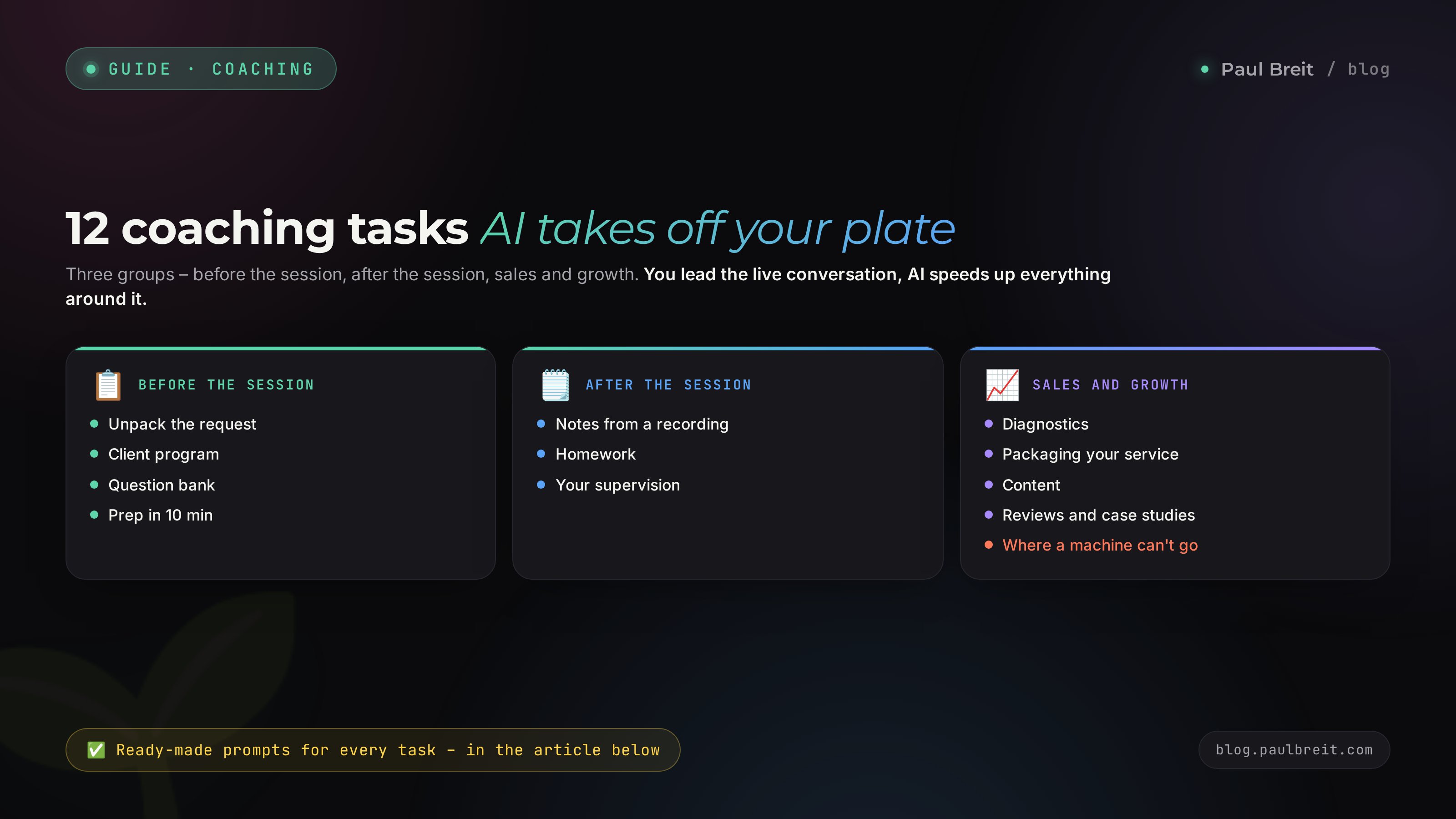
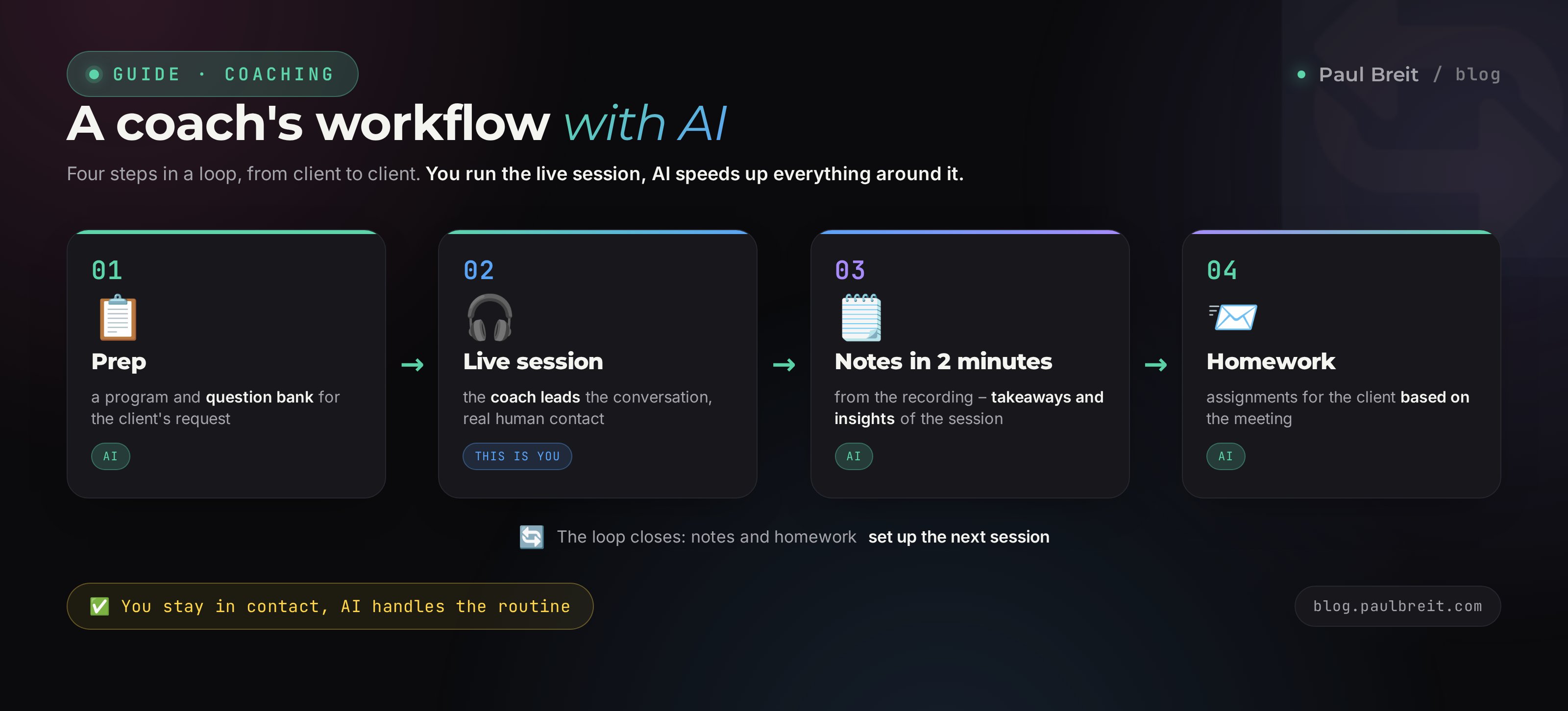
AI for a coach is a second brain that takes on the prep and the review. It builds a program for the client's request in an hour instead of an evening, generates a bank of strong questions for them, transcribes and structures the session recording, invents homework and writes content in your voice. In the session it doesn't replace the client: live presence, trust and working with feelings are done only by the coach. Everything auxiliary around the session, AI speeds up many times over.
You took on five clients. The joy lasts exactly until Sunday evening, when you sit down to prep for the week. For each client – recall where you left off, come up with questions, build the program, think through the homework. Plus content for the blog, plus sales calls with new people. By Wednesday you're wrung out, and you've held only eight sessions. Taking on more clients feels scary: you won't survive the prep.
I run four client projects and a channel of 20,000 followers without a team of assistants. Everything that doesn't require the live me is done by a set of prompts. This article is the same logic, carried over to a coach's work. Twelve tasks where AI takes hours off your plate, so you spend your energy on the client, not on the paperwork around them.
You'll read it in 22 minutes. You'll run the first prompt today. Within a week you'll find you're prepping for sessions twice as fast and taking on more people without fear of drowning.
What's inside
- What AI actually gives a coach
- Task 1. Unpacking the client's request before the session
- Task 2. A coaching program tailored to a client in an hour
- Task 3. A bank of strong questions for the request
- Task 4. Session prep in 10 minutes
- Task 5. Session notes and review from a recording
- Task 6. Homework between sessions
- Task 7. Diagnostics before the sale
- Task 8. Packaging the service and the offer
- Task 9. Content that brings in clients
- Task 10. Reviews and case studies from practice
- Task 11. Your supervision and growth
- Task 12. Where AI hurts a coach
- How to get Claude if you're outside the US/EU
- A coach's checklist with AI
In some regions Claude doesn't open directly – you'll need a VPN with an EU or US location. Some countries are on Anthropic's blocklist, so pick a supported one. A full walkthrough of sign-up and payment is below in the section on getting access.
Section 01What AI actually gives a coach
Let's clear up the main misunderstanding first. AI in coaching isn't about it leading the client instead of you. Presence, trust, silence at the right moment, reading what a person didn't say out loud – that's your work, and no one hands it to a machine. AI takes on everything around the session. And everything around the session adds up to more hours than the sessions themselves.
Count your week honestly. Prep for every meeting, recalling the client's context, coming up with questions and exercises, writing session notes afterward, inventing homework, replying to messages, plus the blog, sales calls, packaging. Live coaching takes maybe a third of your time. The rest is prep and paperwork. Those two thirds are exactly what AI compresses.
Three principles without which nothing works
- Context decides everything. An empty request like "come up with questions for a client" gives an empty answer. The more input you give – the client's request, their words, where they're stuck – the sharper the result. How to phrase requests properly is covered in the article on prompts.
- Your method stays yours. AI doesn't invent an approach for you. You give it your framework, your principles, your style – it assembles along those lines. Otherwise you get average coaching pulled from the internet.
- The final word is yours. Everything the machine produces, you read with a coach's eyes. It offers twenty questions – you keep the seven that sound alive and fit this particular person.
What follows is twelve tasks in the order they come up in the work: from prep for the first session to selling to new clients. Each comes with a ready-made prompt. Take it, drop in your own data, run it.
Task 01Unpacking the client's request before the session
A client messages you: "I want to earn more, but something's not moving." That's not a request. That's the tip. Underneath it there's fear, a belief, an old story, a real goal. An experienced coach digs this out over the first session. AI helps you prepare for the digging in advance.
You give it what the client wrote themselves: the intake form before you start, the messages, the voice note where they talked about themselves. AI hands back a map: which themes surface, where the words contradict, which questions to ask first to get to the core faster.
You are a supervisor with 20 years of experience in coaching. Below is a client's intake form and their message before we start. Break down the request: 1) formulate the real request behind what the person says out loud; 2) list the contradictions and marker words worth latching onto; 3) suggest 3 beliefs that may be keeping them stuck; 4) give 5 questions it makes sense to open the first session with, to reach depth quickly and gently. Client's text: [paste the form and message].
The result: you arrive at the first meeting prepared. You already see the possible forks and don't spend half the session just figuring out what the person came with. The client feels they've reached someone who gets it – and trust switches on from the first minute.
A real example. A client wrote: "I want to leave my job for my own business, but I keep putting it off." From her form, AI pulled out a contradiction: in one place she writes about freedom, in another that she's afraid of losing a stable salary and letting her family down. The real request was deeper: about giving herself permission to take the risk. The business turned out to be just a pretext. The first question in the session – "what would have to happen for you to let yourself try?" – went straight to the depth. Without prep, I'd have spent half the session circling the money topic.
An important caveat. AI's hypotheses are hypotheses, not a diagnosis. You test them in the live conversation. Sometimes the real request turns out completely different from what the machine guessed, and that's fine. It saves you the prep, it doesn't think for you.
Task 02A coaching program tailored to a client in an hour
Building an 8–10 session program for a specific person is an evening's work. You need to break the path from point A to point B into stages, and for each stage come up with a focus, exercises, metrics. With AI it's an hour, and mostly an hour of your own edits.
The secret is that you give it your methodology. If you work with the GROW model, spiral dynamics, or your own scheme, you describe the framework and AI arranges the client along it. It doesn't bring in someone else's approach, it structures by yours.
Help me build an 8-session coaching program. My approach: [describe your working model in 5–7 sentences]. The client: [point A – where they are now, point B – what they want, the main obstacles from the unpacking]. Break the path into 8 sessions: for each, give a theme, the goal of the meeting, 2–3 key questions, one exercise and a homework task. At the end, add the signs that tell me the client is ready to move to the next stage. Write in plain, living language, no bureaucratese.
Then you sit down and edit. Somewhere you'll change the order, somewhere swap an exercise for your favorite, somewhere realize the client needs two more blocks on the topic of confidence. But there's no blank page in front of you anymore. There's a skeleton to work from. An empty evening turns into an hour of meaningful fine-tuning.
A program for a new client used to eat a whole day off. Now it's an hour before the first session. Multiply that by the number of clients a month, and you'll see where the time comes from to take on two more.
Task 03A bank of strong questions for the request
A coach's power is in the questions that turn a person back toward themselves. Ready-made advice barely works here. And the most common trap is sliding into the same phrasings with every client. "What does this mean for you?", "What are you feeling?" – round and round.
In a minute AI produces forty questions for the client's specific situation. You read them, weed out the templated ones, keep the seven or eight sharp ones that fit this person. A living bank that doesn't repeat itself.
The client is stuck on the topic: [describe the situation and their words]. Give 40 open coaching questions that will help them see the situation in a new way. Split into groups: awareness questions, values questions, limiting-belief questions, action questions. Avoid banalities on the level of "what are you feeling." Keep the phrasing short and alive, like a real conversation.
After a month of this practice you'll notice you're asking more varied questions yourself. AI works like a trainer here: you see other phrasings, adopt some, and your own arsenal grows. There's a separate article on how to teach the machine to speak in your exact words – on your voice in text – and the same method works for questions.
Task 04Session prep in 10 minutes
A week passes between sessions. In that week you've held five more meetings, and remembering exactly where you left off with a particular person is hard. Usually you reread your notes, rebuild the context, figure out where to start. Twenty to thirty minutes per client.
If you keep your session notes in one place, AI prepares you for the meeting in a couple of minutes. It reminds you where you left off, what the client promised to do, what the dynamic was, and suggests an entry point for the new session.
Here are the notes from the last three sessions with a client: [paste]. We have a meeting in an hour. Prepare me: 1) briefly remind me where we left off and what the dynamic was; 2) what the client took on and what to ask about at the start; 3) which topics they avoided going into – there may be a growth point there; 4) suggest a gentle way to open the session. Three or four sentences per point.
For this to work, the notes need to sit in one place the AI can access. Claude Projects is the handiest fit – you put the client's materials there, and AI keeps the whole context in its head. How that's set up is covered in the article on Projects as a knowledge base.
The data question is especially important here. Real names, surnames, and client contacts must not be uploaded to AI. Anonymize: "client K.", "a mid-level manager, 34." More on the confidentiality line in the last section.
Task 05Session notes and review from a recording
The session is over. While it's fresh, you need to write it down: what you talked about, what you reached, what the client took on. Writing it by hand is another half hour after every meeting. By the end of the day you can't face it, and the notes pile up as debt.
With the client's permission, you record the session. AI transcribes the recording and turns it into structured notes: the main insights, what you decided, the homework, what to watch for next time. Half an hour of work turns into two minutes. How reviewing meeting recordings works is shown in detail in the article on analyzing calls.
Here is the transcript of a coaching session: [paste the text]. Assemble notes for me as a coach: 1) the main request and how it shifted over the session; 2) 3–5 key client insights; 3) what decisions we reached; 4) the homework the client took on; 5) my observations for the future – where the client came alive, where they closed up. Write to the point, no filler.
There's a pleasant side effect too. When notes accumulate in one place, you get the client's story in motion. Three months in, you ask AI to assemble the picture of the journey from all the notes: where the person started, what changed from session to session, what progress is visible from the outside. That's material for a final review with the client, a ready backbone for a case study, and a reason for the client themselves to see how far they've come from the starting point.
A separate value is reviewing the session itself for your own growth. AI will highlight where you slipped into advice instead of questions, where you interrupted the client, where you missed a strong theme. It's like supervision, only available right after the meeting. More on that in Task 11.
Task 06Homework between sessions
Coaching works between sessions, not inside them. Real change happens when the client does something in their life during the week. And coming up with the right task for each person is a job in itself. Too simple doesn't move anything, too hard scares them off and doesn't get done.
Based on the client's request and their type, AI offers several practices of different calibers. You pick the one that matches this particular person's capacity.
The client is working on the topic: [topic]. By temperament they are [cautious / tend to take on a lot and not finish / need a challenge]. Suggest 5 homework tasks of varying difficulty – from a small step to a serious challenge. For each, explain what it develops and how the client will know they've managed it. The tasks should be concrete and doable within a week, no abstractions like "reflect on life."
A good move is to ask AI to tie the task to what the client said in the session themselves. Then the homework doesn't look pulled from a textbook, it sounds like a continuation of your conversation. The client sees the connection and does it more willingly.
Task 07Diagnostics before the sale
Now, money. It's not enough for a coach to run sessions, you also have to find clients. And the first bottleneck is the sales consultation, the diagnostic, the discovery call. The person came, you talked, and they left to think it over and never came back.
AI prepares you for a sales call the same way it does for a session. From the person's application it assembles hypotheses: what they really came with, what objections are likely, where their pain is, what they're ready to pay for. You enter the conversation prepared and lead it toward a decision instead of improvising.
I have a sales diagnostic with a potential client. Their application: [paste]. Help me prepare: 1) what their real request and pain most likely is; 2) 5 questions that reveal the cost of inaction and show them the scale of the problem; 3) which 3 objections they'll likely raise and how to answer them honestly, without pressure; 4) how to connect their request to my program. My product: [describe briefly].
The key here is not to overdo it. A diagnostic helps a person see their situation, and the sale follows on its own if you were useful. AI prepares the structure, but pressure and manipulation are off-limits: a coach who sells through fear loses the very trust the whole work rests on. A breakdown of sales conversation technique is in the article on analyzing calls.
Task 08Packaging the service and the offer
"Coaching" is a word that sells nothing. People buy a result: calm, money, relationships, clarity. The word "coaching" itself means nothing to them. Packaging your service so a person recognizes their own problem and their desired future in it is a copywriting skill not every coach has.
AI helps rephrase your service into the client's language. You give it what you do and who you work with, and it hands back a description framed around the target person's pain and result.
I'm a coach, I work with [niche and type of clients]. My service: [describe what you do]. Repackage it into the client's language: 1) formulate what pain I solve, in the client's own words; 2) what result they get after 3 months of work; 3) give 5 headline options for the service description – through the result, not through the word "coaching"; 4) a short offer description of 4–5 sentences for the website. Tone: warm, confident, no grandstanding and no "transformations" from the info-business world.
A good offer brings in clients on its own, before you've even opened your mouth on the call. For a coach, the first step of the funnel is often a free format: a mini-review, a checklist, a short guide. How to build a lead magnet like that in an hour is shown in the article on lead magnets with AI.
Task 09Content that brings in clients
A coach without content is invisible. People find out about you through what you say publicly: posts, reels, live streams. And here coaches hit the same trouble as every expert: content takes time you don't have between clients.
AI takes this load off if you teach it your voice. You give it 20–30 of your own texts, it extracts your manner, and then writes drafts that sound like you. The method is broken down step by step in the article on how to teach AI to write in your voice.
A separate gold mine for content is the sessions themselves. Every client insight, every typical sticking point, every breakdown is the topic of a post that will resonate with dozens of people who share the same pain. Just without names or details that would give the person away.
Here is a typical situation clients come to me with: [describe it anonymized]. Come up with 7 post topics that will hook people with this pain and show me as a coach who gets it. For each topic, give a catchy opening paragraph. Write in my style – here are examples of my posts: [paste 3–5 of your texts]. No promises of magic results, honest and human.
That way one session turns into a week of content, and content brings new clients to a diagnostic. The loop closes: working with clients feeds the blog, the blog brings clients.
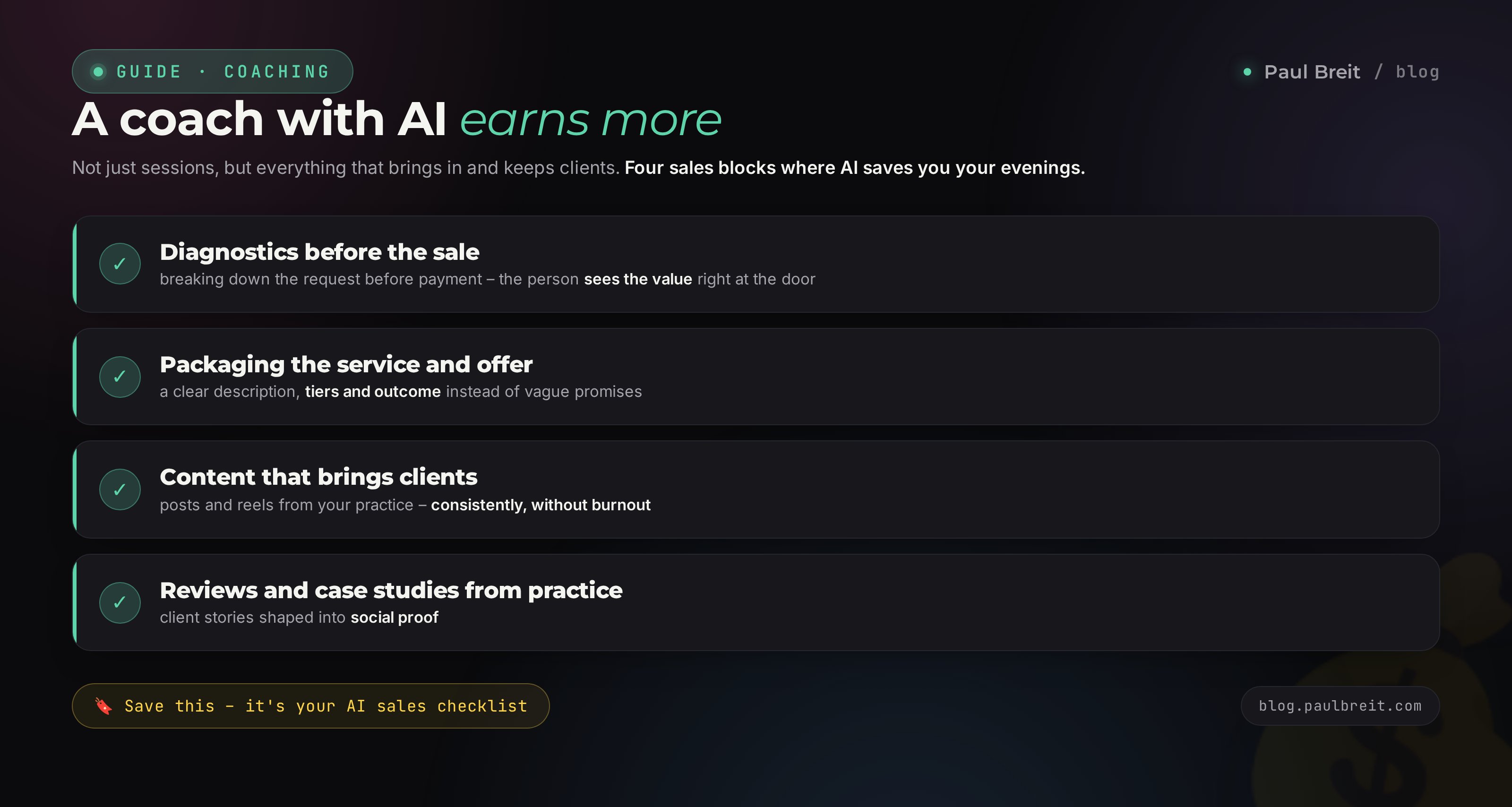
Task 10Reviews and case studies from practice
A review is the strongest proof for a coach. But clients write them short and generic: "Everything was great, thanks." A review like that doesn't sell. What sells is a story: what they came with, what got in the way, what changed, what result in numbers or concrete facts.
AI helps assemble a structured case study from what the client said. You take their words from the messages or the review, add your own view of the dynamic, and get a story you can show – with the client's consent, of course, and without personal details.
A client left a review: [paste]. Plus my observations from the work: [point A, what got in the way, what changed]. Assemble a mini case study from this along the scheme: before – what the difficulty was – what we did – after. 4 paragraphs, in living language, in the third person, without the client's name and without embellishment. At the end, one sentence that captures the essence of the change.
A few such case studies on your site and blog remove half of a new client's doubts before they even talk to you. The person sees others like themselves and their result, and comes in already warm.
Task 11Your supervision and growth
Supervision is when a more experienced colleague reviews your work and highlights your blind spots. It's irreplaceable, but not always available: a supervisor costs money and isn't there for every session. AI partly fills that gap.
You give it the transcript of your session and ask it to review your work as a supervisor would. Where you led and where you followed the client, where you slipped into advice, where you missed a strong line, where you interrupted. It doesn't replace a live supervisor with their experience and intuition, but between supervisions it keeps you sharp.
You are an experienced coaching supervisor, ICF approach. Here is the transcript of my session: [paste]. Review my work honestly and to the point: 1) where I asked strong questions and where I slipped into advice and judgment; 2) where I interrupted or steered the client toward my own answer; 3) which strong client themes I missed; 4) what specifically to improve for the next session. Don't soften it for politeness – I need an honest review to grow.
Separately, AI works as your study trainer. It reviews recordings, helps you prepare for certifications, explains the models you're learning. When it comes to building up your learning with AI as a mentor, the basic principle is the same one used across the board.
Task 12Where AI hurts a coach
Now an honest talk, without which this article would just be an ad. AI has hard limits in a coach's work, and crossing them is dangerous.
- It doesn't lead the client. Coaching is a relationship between two people. Trust, empathy, intuition, working with what a person didn't say out loud – the machine can't do this and won't. A client who's "led by a bot" feels it and leaves.
- It doesn't work with the psyche. If the client's request moves into trauma, depression, a serious state – that's the zone of a psychologist and psychotherapist, not a coach and certainly not AI. No prompt replaces a specialist.
- Client data stays locked. Real names, contacts, recognizable details must not be uploaded to AI. Anonymize everything. The client trusted you with something personal, and leaking it into a third-party service is a betrayal of trust and a violation of data privacy law.
- It hallucinates. AI can confidently produce a nonexistent method or mangle a model. Everything touching technique and theory, you check yourself. Especially if you're preparing for certification from its materials.
AI prepares you for the work and reviews the work afterward. The work with the person, you do yourself. It's your second brain for prep and routine, not a second coach. Hold that line, and it will free up hours for you without taking anything from the quality of your sessions.
Section 02How to get Claude if you're outside the US/EU
All the prompts above are built for Claude – it holds context better than the others and writes in a human way. If you're outside the countries where Anthropic operates, access takes a couple of steps, but it's set up in an evening.
Turn on a VPN with an EU or US location
Working options in 2026: Proton VPN, and other reputable providers. Some regions are on Anthropic's blocklist, so pick a supported country. The VPN should be on both when you register and every time you log in.
Create an account at claude.ai
Sign up by email. When choosing a country, use the same one as your VPN. For verification you sometimes need a virtual phone number – services like this hand one out for a few cents.
The Pro plan is $20 a month
You can pay with an international card or a virtual card. The free version is enough to start, to run your first prompts and feel the difference.
After that you put your client materials into Claude Projects – one project per client, all anonymized – and AI keeps the context at hand. Then you just paste in the prompts from this article.
Section 03A coach's checklist with AI
Print it out and keep it on your desk for the first month. Roll out one task a week, not all at once.
- Access is set up – VPN, a Claude account, payment, a Project for each client
- Your method is written down – your framework sits in a Project, and AI builds programs along it
- Unpacking the request – you run the client's form before the first session
- A tailored program – a skeleton in an hour, then your edits
- A question bank – fresh phrasing for every request, not the same template on repeat
- Session notes – a recording turned into structured notes in two minutes
- Homework – matched to the client's type and capacity, tied to their own words
- Content from practice – anonymized session insights turned into posts in your voice
- Data stays locked – not a single real name or contact in the AI
- The line holds – the machine prepares and reviews, you lead the live session
AI takes two thirds of a coach's time back – the part eaten by prep and paperwork around the client. Before the session it unpacks the request, builds the program and the question bank. After the session it transcribes the recording, writes the notes, invents the homework, reviews your work like a supervisor. For sales it prepares the diagnostic, packages the service, assembles case studies, writes content in your voice from real practice. It doesn't replace a live client and doesn't wade into serious states: the live work stays with you and with a psychologist. It's set up in an evening: VPN, Claude, a Project per client. Roll out one task a week, and within a month you're prepping for sessions twice as fast and taking on more people without fear of drowning in prep.
FAQFrequently asked questions
Can AI replace a coach?
No. The live session – trust, presence, working with feelings and with what the client didn't say out loud – is done only by a human. AI covers the prep and routine around the session: unpacking the request, the program, the notes, the homework. It doesn't lead the client.
Which AI is best for a coach?
Claude – it holds a client's long context more precisely and writes in a human way. Outside the US/EU you'll need a VPN with an EU or US location. The free version is enough for your first prompts, then Pro at $20 a month.
Is it safe to upload client data to AI?
Real names, contacts and recognizable details must not be uploaded – it's a breach of trust and of data privacy law. Anonymize everything: "client K.", "a manager, 34." That way you get the benefit without risk to the client.
Which task should you start with?
With session notes and the question bank – they give the fastest time savings and don't require rebuilding your work. Roll out one task a week, not all at once, or you'll give up.
How do I make AI work by my method, not someone else's?
Describe your framework in a separate document and keep it in Claude Projects. In every prompt, AI will lean on your approach instead of bringing average coaching from the internet.
Can I take blog content from client sessions?
Yes, but only anonymized. A typical sticking point, an insight, a breakdown of a situation is the topic of a post that will resonate with dozens of people who share the same pain. Names, details, and anything that gives away a specific person, you remove.
What if the client's request moves into trauma or depression?
That's the zone of a psychologist and psychotherapist, not a coach and certainly not AI. No prompt replaces a specialist. In that moment a coach honestly hands the client over to the right expert.