Buy Telegram channel ads without burning your budget
Seeding in Telegram means buying ad posts inside other people's channels – a direct line to a warm audience. We'll walk through it step by step: where to find channels, how to screen out fake followers, how to write the post, add a tracking link, and count your cost per subscriber. With ready-made AI prompts and a breakdown of the mistakes that cost beginners money.
Seeding in Telegram is when you pay the owner of another channel to post a link to your channel. It's a five-step play: pick channels that match your audience with TGStat, screen each one for fake followers by its growth chart and reach, write an ad post in the hook-value-call format, add a named invite link to count joins, and calculate your cost per subscriber. The norm for expert niches is $0.50-2 per subscriber. You can start with $70-130 across 2-3 channels.
Someone decides to buy an ad in Telegram. They find a channel with 40,000 followers, see a price of $110 per post, pay, and it goes live. A day later, 11 new subscribers show up. Eleven. The money is gone, and the takeaway is simple: ads in Telegram don't work. They do. The channel just had a dead audience, the post was written to be skipped, and there was no tracking link – so figuring out what actually broke became impossible.
I run four client projects and a personal channel with 20,000 subscribers. Part of that audience came straight from seeding. Over a few years of buying ads, I built a system that screens out empty channels before you pay and turns advertising from a lottery into a measurable tool. This article is that whole system.
You'll read it in 22 minutes. You can launch your first seed tonight. And you'll stop paying for thin air, because every dollar shows up in the numbers.
What's inside
- What seeding is and how it differs from Telegram Ads
- Who seeding is for, and who should wait
- Where to find channels: marketplaces and manual search
- How to screen a channel for fake followers in 5 minutes
- The ad post: structure and 10 versions with AI
- Tracking and counting: how many people came from a channel
- How to deal with an admin and not get scammed
- Budget, formats, and calculating your return
- 7 mistakes that burn your budget
- Your first seed in one evening: a step-by-step plan
- The pre-launch checklist
Section 01What seeding is and how it differs from Telegram Ads
A seed is buying an ad post directly from the owner of another Telegram channel. You pay the admin, they publish your text with an image and a link to your channel. To their followers it looks like a regular post: same author, same tone, only the subject is you. The word comes from farming – you scatter seeds across other people's plots and harvest subscribers who care about the topic.
Telegram has two different ways to buy ads, and people constantly mix them up. Let's sort them out so it's clear what this article is even about.
Telegram Ads – the official platform
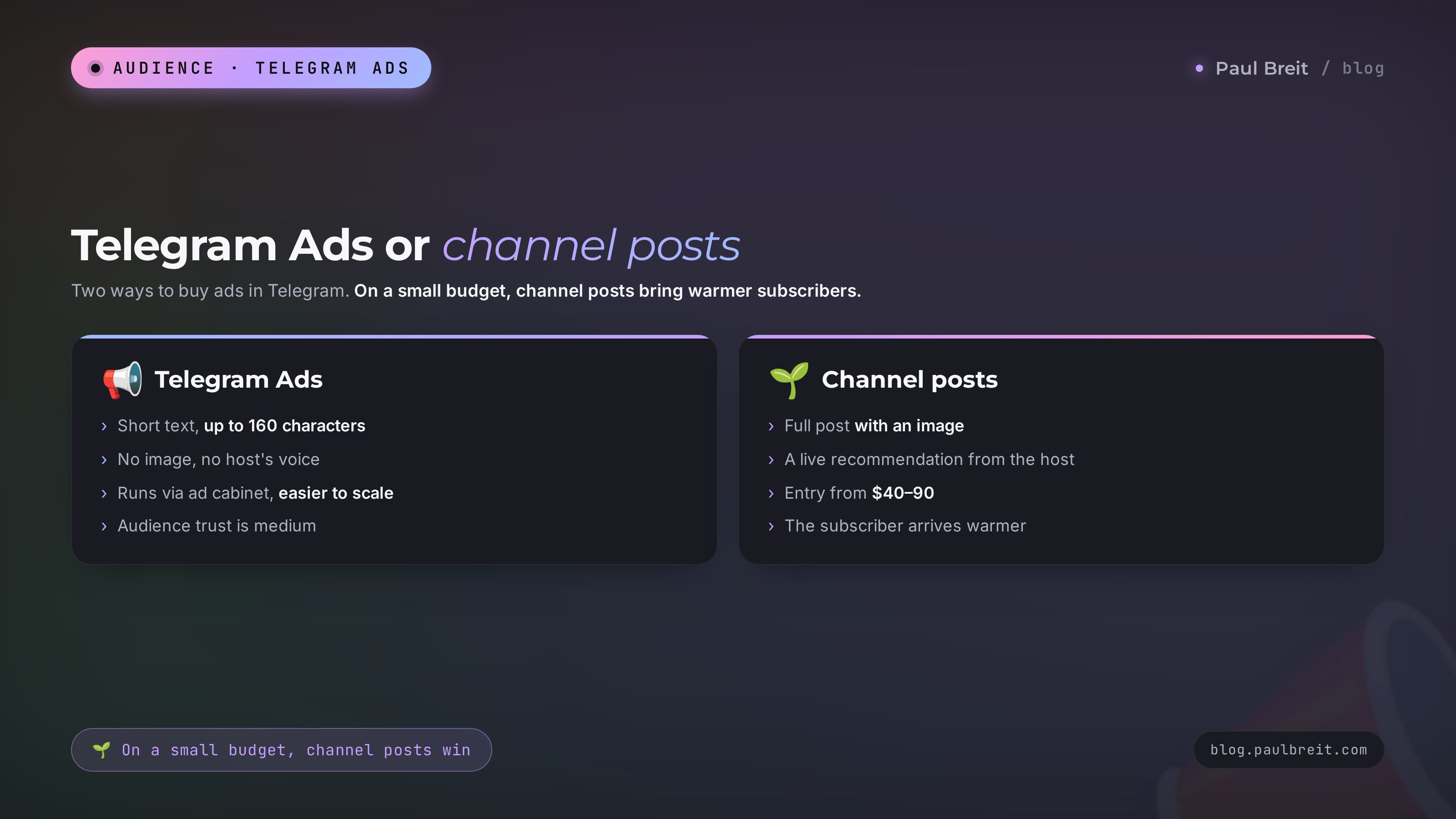
This is Telegram's own ad manager. You write a short ad up to 160 characters, and it shows under posts in channels you picked by topic. Payment runs through the official platform, and placements are automatic. The format is dry: text only and one link, no image and no live voice from an author. I broke this path down in detail in a separate article on Telegram Ads from scratch.
Seeding – a direct buy from the author
Here you deal with a specific person who runs a channel. They put up your full post: a headline, several paragraphs of text, an image, emoji, a link. And they often add a couple of their own words, like "folks, I'm subscribed myself, I recommend it." The subscriber arrives warmer, because they were brought in by an author they trust. That's the main advantage of seeding over official ads.
Let's compare the two in a table so the choice is obvious.
| Parameter | Telegram Ads | Seeding |
|---|---|---|
| Format | 160 characters of text | Full post with an image |
| Author's voice | None | Yes, a live recommendation |
| Audience trust | Medium | High |
| Barrier to entry | Higher, you need an ad account | From $40-70 |
| Scaling | Easier, all automatic | Manual, channel by channel |
| Fake-follower risk | Lower | Higher, needs screening |
The conclusion is simple. For a beginner with a small budget, seeding delivers more warmth per dollar spent. So that's what we'll dig into from here.
Section 02Who seeding is for, and who should wait
Seeding is a working tool, but not for everyone and not always. Here's the honest version of when to reach for it.
You already have your own Telegram channel with a clear topic and at least 5-10 live posts. You have somewhere to send people: the channel isn't empty, and it's obvious how you help. And you have a small test budget, from $70, that you won't regret spending to learn.
The channel is empty or has three posts that say "hi, this is my blog." A person clicks the ad, sees a void, and leaves. Fill the channel first so a new subscriber instantly gets the value. How to build a base with no budget is in the article on your first 1,000 followers.
One more honest point. A seed brings a subscriber, and after that they have to buy something from you, or the ad won't pay off. So the traffic needs a funnel behind it: a channel where the person warms up, and a product they move toward. Without a funnel, seeding turns into expensive subscriber collecting. The simplest first step of a funnel is a lead magnet, and you can build one in an hour: I covered it in the article on building a lead magnet with AI in an hour.
Below, we'll use the AI Claude to analyze channels and write posts. Anthropic limits access in some regions, so it may not open directly – you'll need a VPN set to an EU or US location. Ones that work in 2026: AmneziaVPN, Proton VPN, Hiddify. Turkey and the UAE don't work, they're on Anthropic's blocklist. Step-by-step sign-up and payment are in the article on getting started with Claude. AI here is a helper, not a requirement: you can do all of it by hand, just slower.
Section 03Where to find channels: marketplaces and manual search
You find channels to seed in two ways. Through a marketplace, where everything is collected in a catalog with prices, and by hand, when you find channels in your niche yourself. A marketplace is easier for a beginner, but manual search often turns up channels that are cheaper and cleaner. Use both.
Path 1. The Telega.in marketplace
Telega.in is one of the largest seeding marketplaces in Telegram. You go in, pick a topic, and see a list of channels with a price per post, reach, stats, and reviews. Payment runs through the marketplace, and that's its main upside: your money is held and only released to the admin after the post has gone live and stayed up for the agreed time. If the admin disappears or pulls the post early, you get your money back. For a first seed, it's the safest entry point.
The downside of a marketplace is slightly higher prices, because the platform takes a cut. And not every good channel is listed there. So in parallel, we go the second route.
Path 2. Manual search through TGStat and Telemetr
TGStat and Telemetr are analytics catalogs of Telegram channels. There you can search channels by topic, keyword, language, and size. You type in your niche, say "psychology" or "marketing," and get hundreds of channels with their stats. From there you pick the ones that fit by size and message the admins directly.
A direct deal is cheaper than a marketplace but riskier: there's no escrow, and you pay a person directly. How to protect yourself on a direct deal is covered in the section on negotiation.
The neighboring-channels method
Open the card of any channel in your niche in TGStat. Near the bottom you'll find a "Similar channels" block – the platform picks channels with overlapping audiences. This is a gold mine: people who read a neighboring channel on your topic are very likely to subscribe to you too. Collect 15-20 such channels into a list and move on to screening.
What channel size to buy
Beginners gravitate to big channels: 100,000 followers must mean a lot of people show up. In practice, small and mid-sized channels deliver a cheaper subscriber, because their audience is livelier and the admin is closer to their people. A good target for the start is channels with a post reach of 2,000 to 15,000 views. One big seed is easy to replace with three small ones: that spreads your risk and helps you find which audience is yours faster.
Section 04How to screen a channel for fake followers in 5 minutes
This is the most important section of the article. Fake followers are the number-one reason people burn their budget on seeding. A channel shows 50,000 followers, but only a couple thousand are real. The rest are bots, bought by the batch for a pretty number. A post in that channel is seen by the same couple thousand, and you pay as if for fifty.
The check takes five minutes and rests on three signals. We look at them in TGStat or Telemetr.
The subscriber growth chart
Open the tab with follower dynamics. On a healthy channel, the line grows smoothly, with small bumps after good posts or ads. On a padded one, you'll see vertical walls: plus 5, 10, 20 thousand in a single day, then a plateau or a drop. Spikes like that with no reason are bought bots. One or two bumps after obvious advertising are normal. A wall out of nowhere means pass.
Reach relative to followers
Divide the average post reach by the follower count. On a live small channel, reach is often 20-60% of the base: 10,000 followers, posts at 3,000-6,000 views. If a channel has 50,000 followers but posts pull 800-1,500 views, that's 2-3%, a dead audience. There's no point paying for subscribers who never see the posts.
Live reactions and comments
Scroll through the channel's last 10-15 posts by hand. On a live channel there are reactions under the posts, and if comments are open, people write real things. On a padded channel it's silent: thousands of views and three reactions, comments empty or made of identical bots saying "great, thanks." Your eye catches it in a minute.
How AI speeds up the check
Going through 20 channels by hand takes a while. Here Claude helps. You take a screenshot of a channel's stats from TGStat and hand it to the AI with a simple task.
You're a media buyer who buys ads in Telegram. The screenshot shows a channel's stats from TGStat. Assess whether it looks like fake followers. Calculate the ratio of average reach to follower count as a percentage. Watch for sharp growth spikes. Give a verdict on a scale: buy, doubtful, don't buy – and one sentence on why.
Claude will compute the percentages in seconds, flag the suspicious spikes, and give a short call. The decision is still yours, but the AI clears the routine and won't miss a number your eye might have smeared over. To phrase tasks like this more precisely, check the breakdown in the article on how to write prompts.
Section 05The ad post: structure and 10 versions with AI
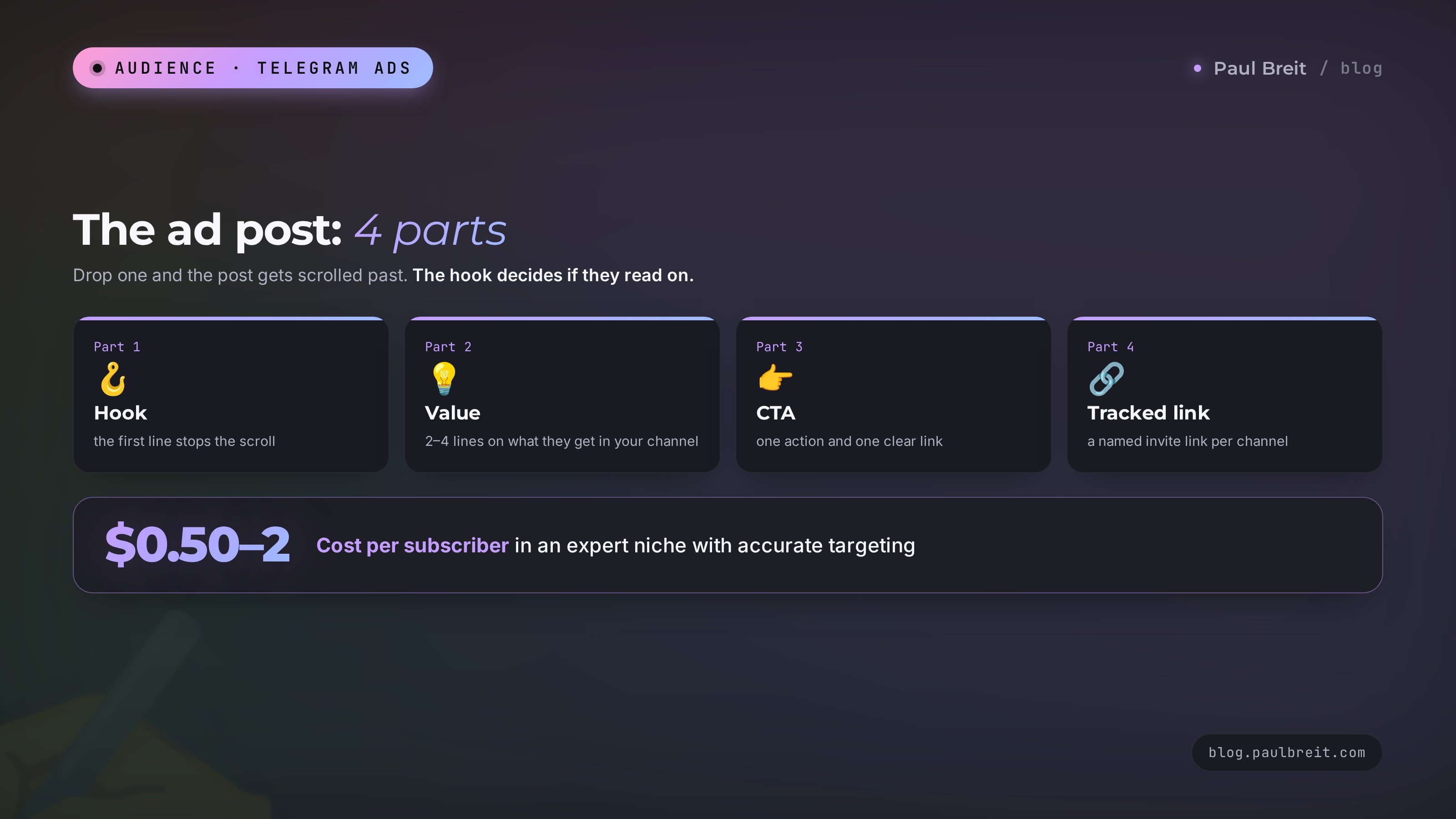
Even in a perfect channel, a boring post pulls three subscribers. The post is what a person reads before deciding to click or scroll past. It has a working structure of three parts.
The hook – the first line
The first sentence decides everything. People scroll fast, and you have one line to stop them. What works: a sharp question about a pain ("Why do you have 20,000 subscribers and zero clients?"), a promise of specifics ("In 3 posts I'll show you how to build a funnel with no designer"), a contrast with a number ("I spent $3,000 on ads so you don't have to repeat it"). Without a hook, no one reads the rest.
The value – the body of the post
Next, 2-4 short paragraphs on what a person gets in your channel. Concrete and to the point: which topics, which breakdowns, what makes you different. This is also the place for live proof – a number, a mini case study, a client result. Write like you're telling a friend, not defending a thesis.
The call – one clear link
At the end, one clear action: "Subscribe, next up is a step-by-step funnel breakdown," plus a link. One call, one link. Two calls split attention, and the person does neither. And always that tracking link we'll cover in the next section.
Writing 10 versions with AI
One version of a post is a blind bet. A good media buyer tests several hooks and keeps the one that worked. It used to take an evening to write 10 versions. Now Claude writes them in a minute, and you pick and edit to your voice. First, sign up for the AI – at claude.ai – then give it the task.
You write ad posts for Telegram. Here's my channel: [topic, who it's for, how it helps, a couple of sample posts]. Here's the channel where the ad will run: [topic and audience of the host channel]. Write 10 versions of an ad post using the hook-value-call structure. Keep each under 600 characters, in a lively conversational voice, addressed to "you," with no corporate stiffness and no em dashes. Make the hooks different: a question, a promise, a contrast, a story.
From there, pick the 2-3 versions that sound like you and fine-tune the details. The AI gives you a draft and kills the blank-page fear. The final text is always yours: your voice is exactly what separates a live post from an ad template people scroll past.
Section 06Tracking and counting: how many people came from a channel
Without a tracking link, seeding is guesswork. Forty subscribers came in a day, and you ran ads in three channels. How many from which? No idea. Which means you don't know which channel to scale and which to never touch again. A tracking link solves this completely, and it's built into Telegram itself.
Named invite links
In Telegram you can create several different invite links for a channel and see, for each one, how many people joined through it. You make a separate link for each seed, name it after the host channel, and after the ad you see the exact number.
How to create a tracking link
Open your channel, go to "Manage Channel," then "Invite Links." Tap "Create a New Link." Give it a name you'll recognize the channel by, for example "seed-psy-channel." Optionally set an expiration or a limit. Done: you have a unique link. That's exactly what you paste into the ad post for this channel. For a second channel, you create a second link with a different name.
After the seed, you go back to the same section and see the number of joins next to each link. Those are the subscribers from that specific channel, no guesswork. You don't need external UTM tags for this – the whole tracking lives inside Telegram.
Two channels can cost the same and deliver completely different results. One brings 60 subscribers, the other 12. Without a tracking link you never see that, and you keep paying both. With a link you switch off the weak one, double down on the strong one, and your cost per subscriber drops from seed to seed. That's the whole job of a media buyer. You lean on the join counts from each link and build the next step on them. Guessing goes away, and clean arithmetic stays: this much spent, this many people came, this much one subscriber cost.
Section 07How to deal with an admin and not get scammed
When you buy through a marketplace, the negotiation is simple: the price and terms are on the page, and payment is protected by escrow. A direct deal is cheaper but takes care. Let's break down how to run the conversation so you don't lose money.
What to write to the admin
Keep the first message short and to the point. Introduce yourself, say you'd like to place an ad, ask the price and open dates. While you're at it, ask for fresh stats – the reach of recent posts. A real admin answers calmly and shows numbers. If it turns into "no slots, but pay upfront and I'll squeeze you in right now," that's pressure and a reason to be careful.
Lock four things in writing
The placement format (for example, 1/24 – an hour at the top of the feed and a day in the feed without deletion). The exact date and time the post goes live. The final price. And that the post won't be removed before the agreed time. All of it in text, in the chat, so there's something to point to if there's a dispute. Verbal agreements don't count.
Placement formats
Seeding has standard notations worth knowing so you can read a price list.
| Format | What it means |
|---|---|
| 1/24 | An hour at the very top of the feed, then a day in the feed without deletion. The basic working format. |
| 2/48 | Two hours at the top, two days in the feed. Pricier, more reach. |
| No deletion | The post stays in the channel forever. Good for evergreen topics. |
| Native | The author adds their own words and a recommendation. Higher conversion, higher price. |
Three rules for a direct deal. First: check the channel in TGStat before you pay, so you're not paying for fake followers. Second: with an admin you don't know, arrange for payment on delivery or a partial payment, and run large sums through an escrow marketplace. Third: don't click links from the admin and don't install any "payment bots" – real payment goes by transfer or through the marketplace, not through sketchy apps.
Section 08Budget, formats, and calculating your return
Now the numbers. How much to pay, how to know a seed paid off, and when it's time to scale. Anyone can do the math – there are exactly two formulas here.
Cost per 1,000 views and cost per subscriber
Ad prices are often quoted per 1,000 views. Divide the post price by the reach and multiply by a thousand. A post costs $70 and reaches 10,000 views – that's about $7 per 1,000 views. It's a benchmark for comparing channels against each other.
But the main metric is cost per subscriber. Divide what you spent by the number who came in through the tracking link. You paid $70 and 50 people came – a subscriber cost about $1.40. That's the number you optimize from seed to seed.
Cost per 1,000 views in niche channels is usually $2-9. Cost per subscriber through seeding is $0.50-2, and with a precise audience match it can go even lower. If a subscriber comes out over $3, the problem isn't the budget. Change the post or the channel instead of pouring more money into the same spot.
When a seed pays off
A subscriber doesn't make you money on its own – it makes money when it buys something. Run a simple chain. Say a subscriber costs $1.30. Say out of a hundred subscribers, three buy your product over a couple of months, at an average ticket of $70. A hundred subscribers cost about $130 and brought in about $210. The seed paid off and turned a profit. If the chain doesn't add up, the funnel behind the ad is usually what's sagging: the subscriber arrives, but no one warms them up or walks them to a product. The seed itself is usually not to blame.
Don't scale on your first seed
Start with 2-3 channels at $70-130 each, a tracking link on each. Collect the numbers: where a subscriber is cheaper, where the audience is more active. And only then put more money into the winners. One blind $650 seed is a bet. Three $90 seeds with tracking links are data you build your next step on.
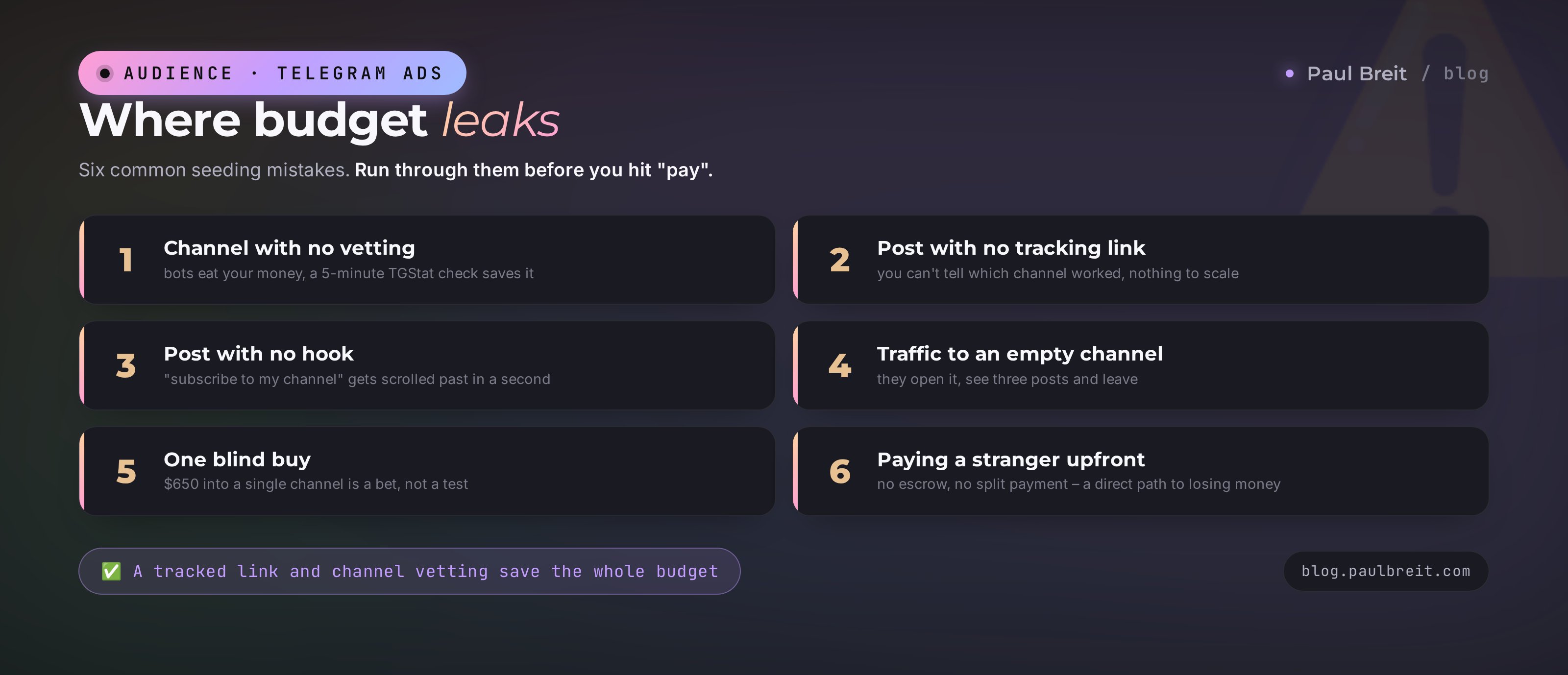
Section 097 mistakes that burn your budget
I gathered the main rakes almost everyone steps on early. Run through the list before your first buy.
Buying a channel without screening for fake followers
A big follower number hypnotizes you. Five minutes in TGStat saves you $70. Checking reach and the growth chart always comes before payment.
Seeding without a tracking link
Without a named link you won't know which channel worked. Which means you can't scale. A tracking link takes a minute and saves your entire next budget.
A boring "subscribe to my channel" post
With no hook in the first line, the post gets scrolled past. Spend 15 minutes on 2-3 headline versions and test different ones.
Sending traffic to an empty channel
A person clicks over, sees three posts, and leaves. The ad is paid for, the subscription isn't. Fill the channel first, then buy traffic.
One big seed instead of several small ones
$650 into one channel blind is a bet. Split it into tests, find the channels that work, then scale.
Paying the full amount upfront to a stranger
A direct deal with no escrow and no screening is a straight road to losing money. Use a marketplace with escrow or pay on delivery.
Quitting after the first bad seed
Your first seed is a lesson, not a verdict on advertising. Collect the takeaways, fix the post or the channel, and repeat. The system comes together over 3-5 buys.
Section 10Your first seed in one evening: a step-by-step plan
Let's pull it all into a single evening. Below is a step-by-step plan that actually gets your first ad live today.
Prep the channel
Make sure you have 5-10 strong posts and a clear description. A new subscriber should get who you are and why to stay within 10 seconds.
Build a channel list
Using TGStat and the "similar channels" method, collect 15-20 channels in your niche with a reach of 2,000 to 15,000. Note the names and links.
Screen by the three signals
Run each channel through the growth chart, reach, and live reactions. Hand screenshots of the doubtful ones to the AI for a second opinion. Keep 3-4 clean channels.
Write the post
Generate 10 versions with the AI using the prompt above, pick 2, and shape them to your voice. Check for a hook, value, and one call.
Make the tracking links
A named invite link for each channel. Name it after the channel. Paste the right link into the post for each channel.
Agree and pay
Through Telega.in or directly, with screening. Lock the format, date, and price in the chat. Your first budget is $70-130 across 2-3 channels.
Pull the numbers
A day after each post, check the joins by the tracking link. Calculate the cost per subscriber. Repeat the winners, switch off the weak ones.
Section 11The pre-launch checklist
The final check. Run through it before you hit "pay."
The channel is filled and the description is clear. A list of 3-4 channels is screened for fake followers by the three signals. The ad post is written in the hook-value-call structure, and the hook grabs from the first line. Each channel has its own named invite link pasted into the post. The format, date, and price are locked in the chat or covered by the marketplace escrow. The test budget is split across 2-3 channels, not dumped into one. After it goes live, you know where to check the number of joins.
If every point is checked, launch. A first seed is rarely perfect, and that's fine. The value comes from a system that makes each subscriber cheaper over time. One lucky buy doesn't work that way: today you got lucky with a channel, tomorrow you didn't, and with no takeaways you're back in the lottery. After a few seeds you'll have a list of channels that work and a clear sense of your price per subscriber. From that point, ads in Telegram become a controllable stream of people you switch on whenever you need it.
FAQFrequently asked questions
How is seeding different from Telegram Ads?
Telegram Ads is the official platform, where a short ad shows up at the bottom of a channel through Telegram's own ad manager. Seeding is when you buy a full post directly from the owner of another channel, and it appears in their feed like a normal publication. Seeding gives you more text, an image, and a live recommendation from the author, so the subscriber arrives warmer. Telegram Ads is easier to scale; seeding borrows the trust of the host channel's audience.
How much money do you need for your first seed?
You can start with $70-130. That covers 2-3 small channels with 3,000-7,000 views each. This shows you real numbers: what a view costs and what a subscriber costs in your niche. After the first tests you scale the channels that delivered cheap subscribers.
How do you tell if a channel has fake followers?
Check three things in TGStat or Telemetr: the growth chart (sharp vertical jumps of thousands in a day for no reason means bought bots), reach relative to followers (if a channel has 50,000 followers but posts get 800 views, the audience is dead), and reactions and comments (a live channel collects them, a padded one stays silent).
How much does one subscriber cost through seeding?
In expert niches, usually $0.50-2 per subscriber. It depends on how well you match the audience and the quality of the ad post. If it comes out over $3, change the post or the channel instead of pouring more money into the same spot.
How do you track how many people came from a specific channel?
Telegram has named invite links built in. In your channel settings you create a separate link for each seed, name it after the host channel, and see the exact number of people who joined through each one. No external UTM tags needed – the tracking lives inside Telegram.
How do you avoid getting scammed by a channel admin?
Work through a marketplace with an escrow, like Telega.in, which holds the money until the post goes live and refunds you if something is off. On a direct deal, check the channel in an analytics tool, ask for a screenshot of recent stats, don't pay the full amount upfront to a stranger, and lock the format and posting time in writing.
What time of day is best to run a seed?
For an expert audience, weekdays usually work, mornings 9-11 and evenings 7-10 p.m. But that's a starting point. Ask the admin when their channel is read most actively, and choose the 1/24 format: the post stays at the top for an hour and lives in the feed for a day.
Do you need AI for seeding?
Not required, but it saves hours. Claude helps you read a channel's stats and judge fake followers in minutes, write 10 versions of the ad post in your voice for a specific audience, and calculate your return. Then you pick the best version and edit it to sound like you.