How to Collect Client Reviews: a system and AI working together
Reviews sell for you while you sleep. But for most people they sit as dead weight in DMs and stories instead of working on conversion. In this article: a 6-step system, ready questions, request templates for every channel, and AI prompts that turn a client's raw answer into a finished case study in a couple of minutes.
To collect reviews consistently, turn it into a 6-step system: catch the client at peak joy, ask through the channel that's easy for them, ask three specific questions (what it was like, what changed, who you'd recommend it to), remove the blank-page barrier, get permission to publish, and store everything in one base. AI speeds up the hardest part - it turns a raw answer or a chat into a structured before-and-after case in a couple of minutes. A noticeable effect on sales starts at 10-15 different stories covering different objections.
The client is happy, the work delivered a result, and you got a warm "thanks, you're amazing" in your DMs. And that's it. A week later the chat is buried, the screenshot is lost, and your landing page still has three reviews from two years ago. Six months pass, you sit down to launch a promo, and you realize you've barely got any proof. Even though dozens of people with real results have come through you in that time.
I run four client projects and a personal channel of 20,000 subscribers. And I know for sure: reviews are the strongest element of any sale, stronger than a pretty landing page and a polished offer. But they only work when they're collected on a system, not when you remember them once every six months. This article is the whole system, with ready questions, templates, and prompts.
You'll read it in 22 minutes. Set it up in an evening. And from then on, every closed project turns automatically into proof that sells to the next client.
What's inside
- Why reviews sell harder than you do
- Which reviews work and which just hang there
- The collection system: 6 steps
- Questions that pull a selling review
- Request templates for every channel
- AI inside the system: 4 roles
- How to turn a review into a case by formula
- Video reviews without the client's shyness
- Where to place them so the review sells
- 7 mistakes when collecting reviews
- The whole path in a minute + checklist
Section 01Why reviews sell harder than you do
When you tell people how great a specialist you are, their defenses go up. It's advertising, and people believe it about a third of the way. When a client who paid and got a result says the exact same thing, the defenses drop. The reader sees a person just like themselves, who had the same problem and solved it. That's social proof - the strongest argument in a sale.
Simple psychology is at work. Before buying, a person is always afraid: what if it doesn't work, what if the money and time go to waste, what if I'm not like your ideal clients. A good review hits that exact fear. It shows a living person who feared the same thing, went for it, and didn't regret it. The reader tries someone else's story on for size and draws the conclusion themselves.
Here's another thing people underrate. A review takes part of the value-explaining work off your shoulders. You can write "I help you reach a stable income" ten times, and those are your words. Or you can show a review where a client writes "in two months I raised my consultation fee from $40 to $110 and stopped being afraid to name my price for the first time." The second is worth ten paragraphs of your copy and triggers no resistance.
From what I've seen on client landing pages, adding a live block of reviews next to the offer lifts the lead conversion noticeably - sometimes by 1.5 to 2 times. And the block itself is built once and keeps working for years. It's one of the cheapest ways to lift sales without extra traffic.
And one last thing. Reviews are an asset that compounds. Advertising ends when the budget runs out. Reach drops when the algorithm changes its mood. But a folder with a hundred different client stories stays with you forever and works in every sale, every warm-up, on every page. The sooner you start collecting them systematically, the more you'll have a year from now.
Section 02Which reviews work and which just hang there
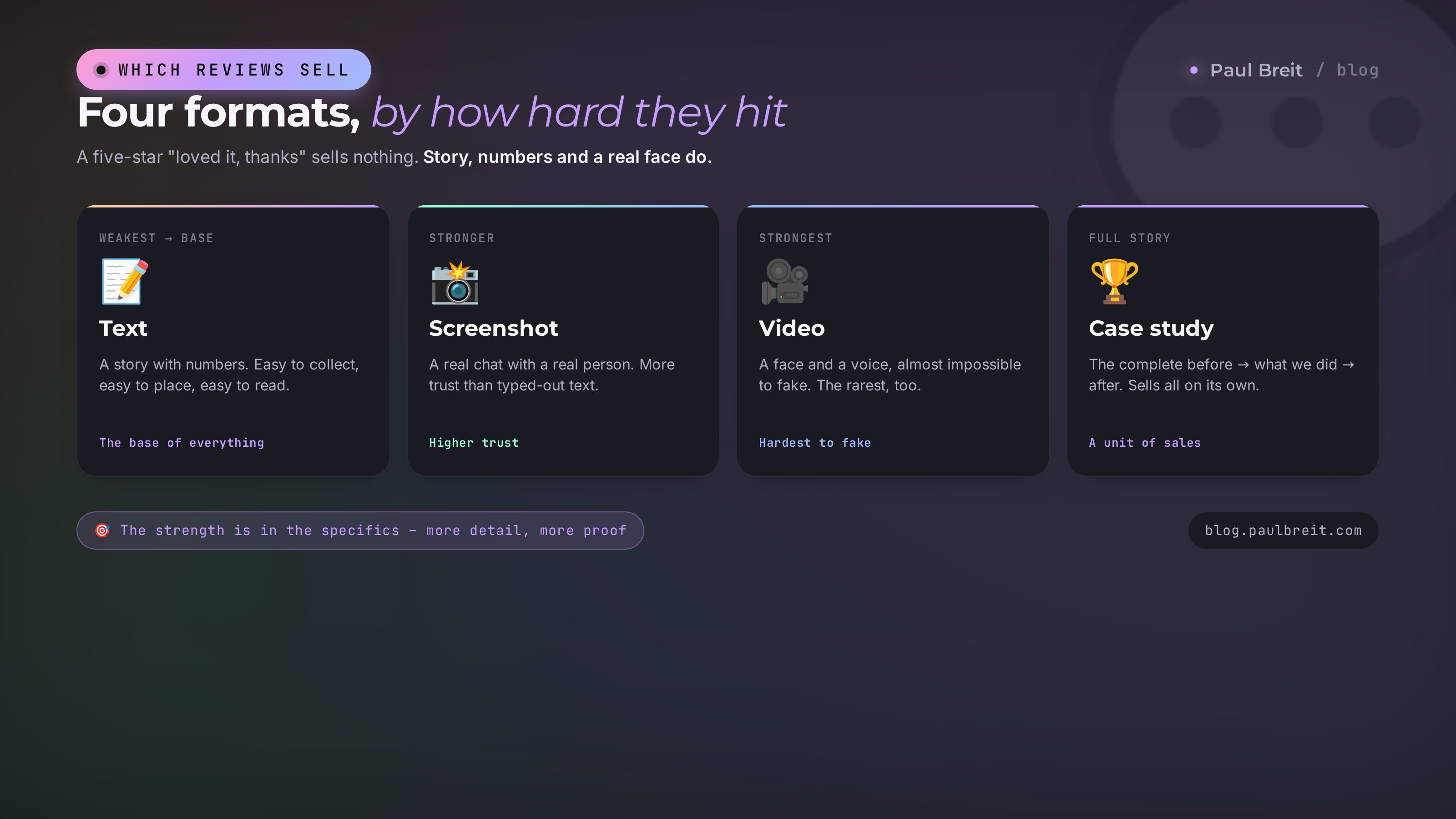
Not all reviews are equally useful. "Thanks, loved it, recommend" with five stars sells nothing. There's no story, no numbers, no recognition. The reader skims it and forgets it. Let's break down which formats actually move the sale.
By impact
- A text review with a story and numbers. The base of everything. Easy to collect, easy to place, easy to read. Its power depends on the specifics: the more detail and numbers, the more convincing.
- A screenshot from a chat. It earns more trust than typed-out text, because you can see it's a real person in a real messenger. It works when the client said thanks in their own words and with emotion.
- A video review. The strongest format. You see the face, you hear the intonation, and it's almost impossible to fake. The one downside: it's harder for people to give, so it shows up less often. Below, I'll break down how to get video without putting the client through pain.
- A full case study. The complete client story by the formula "before - what we did - after." That's already a separate content format that works as a standalone unit of sales. More on it in the section on case studies.
What makes a review sell
The difference between a dead review and a live one comes down to three things.
- A starting point. You could see where the person began and what tormented them. "I couldn't get clients with 8,000 followers" is a starting point. "Everything was bad" is nothing.
- A concrete result. A number, a timeframe, a fact. "In three weeks I got to 5 leads a week" beats "it got a lot better" by a mile.
- A closed objection. The best review closes a specific fear of a new client. "I was afraid I wouldn't figure out the tech, but it turned out easier" is gold, because half of your future buyers have that exact fear.
Keep these three pillars in mind. The whole collection system is built around getting the client to hand you exactly these, rather than brushing you off with a polite "all great." And then AI helps you assemble a clean text from it.
Section 03The collection system: 6 steps
The main reason you have few reviews is simple - collecting them isn't built into the process. You remember them when you need to sell something, and you panic-message everyone at once. It should be the opposite: set it up so the review collects itself, at the moment the client is ready to give it. Here are the six steps that turn it into a system.
Catch the moment the client is happy
You have to ask for a review at the peak of the emotion. That's the moment the client got their first noticeable result, when a strong call just wrapped, when they thanked you on their own. At that moment they're ready to speak well of you, and they do it sincerely.
A month later the emotion fades. The person gets used to the result, treats it as normal, and answers a review request with three limp sentences. So don't wait for the end of the work. Set request points right in the process: after the first result, in the middle, at the finish. That way you catch three waves of joy instead of one.
Pick the channel that's easy for the client
Ask where it's easiest for the person to answer. If you talk in Telegram, ask right there - don't push them to a separate form or an outside site. Every extra click loses half your people. Someone who'll happily dictate a voice note in a messenger will never go fill out a form on Google Maps.
The voice note is your friend. For many people, talking is easier than writing. Let them answer by voice, and you'll assemble the text yourself with AI. More on that in the prompts section.
Ask the right questions
This is the heart of the system. Don't ask "did you like it?" Ask specific questions that pull out a story with numbers and a closed objection. I'll break down the full question formula in the next section - it's the most important part of the article.
Remove the blank-page barrier
The main enemy of a review is an empty field and the question "so what do I write?" The person wants to help but doesn't know where to start, puts it off, and forgets. Your job is to remove that barrier. Give 3-4 specific questions that are easy to answer one by one. Allow a voice note. Offer: "Answer as is, I'll clean up the text myself and send it back for you to approve." After that line, almost everyone agrees.
Get permission to publish
A review is valuable when it has an author: a name, a city, a niche, and ideally a photo. An anonymous "review from J." adds almost no trust. So right away, while the person is still in touch, ask directly: can I publish your words, show a screenshot, list your name and profile. Check what to hide if the client doesn't want their last name out there. Permission taken on the spot saves you weeks of chasing later.
Store everything in one base
The last step everyone skips. A review sitting in a chat doesn't exist for you - you won't find it when you need it. Set up one place: a spreadsheet or a folder where every review lands. The columns are simple: client name, niche, format (text, screenshot, video), which objection it closes, a link to the source, permission to publish. In six months you'll have a library you can pull the right story from in a minute for any sale.
You're not chasing reviews before a launch. You've built the request into the work so that every happy client leaves a trace in your base automatically. All it takes from you is setting up the request points and templates once, and then the system runs itself.
Section 04Questions that pull a selling review
If you remember one thing from this article, let it be this. The quality of a review is 80% determined by the question you asked. Ask badly and you get "loved it, thanks." Ask well and you get a ready-made selling story.
Three core questions
The whole formula rests on three questions that walk the client through the plot from problem to result.
- What was it like before we started working together? What was the problem, and what was holding you back before buying? This question pulls out the starting point and the objection. The client recalls what tormented them and why they hesitated - and that's exactly what the future buyer recognizes in themselves.
- What changed afterward? What concrete result did you get, and in what numbers or facts is it visible? Here comes the main thing - a measurable result. Ask for the number directly: how many leads, what fee, over what timeframe.
- Who would you recommend this work to, and why? This question does two things. It makes the client state the value in their own words once more, and at the same time it paints a portrait of your ideal client for the reader.
Booster questions
You can add targeted questions to the three core ones when you want to strengthen a specific review.
- What stopped you from buying at first and turned out to be a needless fear? A direct hit on the objection. The answer to this closes the doubt for half of your new clients.
- Which moment of the work did you enjoy most? It gives a live detail that makes the review feel real.
- What would you say to someone who's hesitating right now the way you hesitated? The client writes you a selling call to action themselves, and it sounds a hundred times more convincing than yours.
Don't dump all the questions at once as a wall of text - the person gets scared by the volume. Ask one at a time, like in a real conversation. They answer the first, you send the second. That way the review comes together easily and turns out deeper, because the client answers thoughtfully instead of brushing off the whole list with generic words at once.
By the way, these same questions work great for diagnosis before a sale. If you want to dig deeper into how AI prepares a client breakdown before the deal, check out the article on client research before a sales call - it's the same question logic, just at the entrance to the funnel.
Section 05Request templates for every channel
Ready-made wording so you don't have to compose it every time. Take them, adjust for your own voice, and put them to work. They're all built to remove the barrier and make it easy for the client to answer.
After a strong call or result (Telegram, DMs)
[Name], it was great working together, and we got you
a real result. I want to ask you one thing - a few words
for the people who are hesitating right now the way you
hesitated at the start.

Please answer these 3 questions by voice or text,
whichever is easier for you:
1. What was it like before - the problem and what held you back?
2. What changed - the result in numbers or facts?
3. Who would you recommend it to, and why?

Answer as is, no prep. I'll carefully assemble the text
myself and send it back for you to just check and approve.
Is that okay?
An email after the work wraps (email)
Subject: Thank you for the work + a small favor

[Name], thank you for trusting me. It mattered to me to
get you to a result, and we did it.

I have a small favor to ask. Your story can help someone
who's right now at the same point where you were at the
start. In two or three paragraphs, tell me:
- what you came in with and what was holding you back;
- what changed after the work, ideally with numbers;
- who you would recommend it to.

If it's easier to answer by voice, record audio and send
it in reply to this email. I'll assemble the text myself
and clear it with you before publishing.
An automatic request in the funnel (bot)
If you have a chatbot, build the review request into the flow - a few days after the result is delivered, the bot sends the same three questions on its own. That way collection runs on autopilot. How to build an auto-series like this I've covered in detail in the context of warm-ups and sequences - the mechanics are the same, only the text changes.
You don't need to pay for a review - bought ones read as fake. But light gratitude works: a small bonus, access to a private resource, a public "thank you" with a tag of the client. The honest driver is the strongest - show the person that their story will genuinely help people just like them. That motivates more than a gift.
Section 06AI inside the system: 4 roles
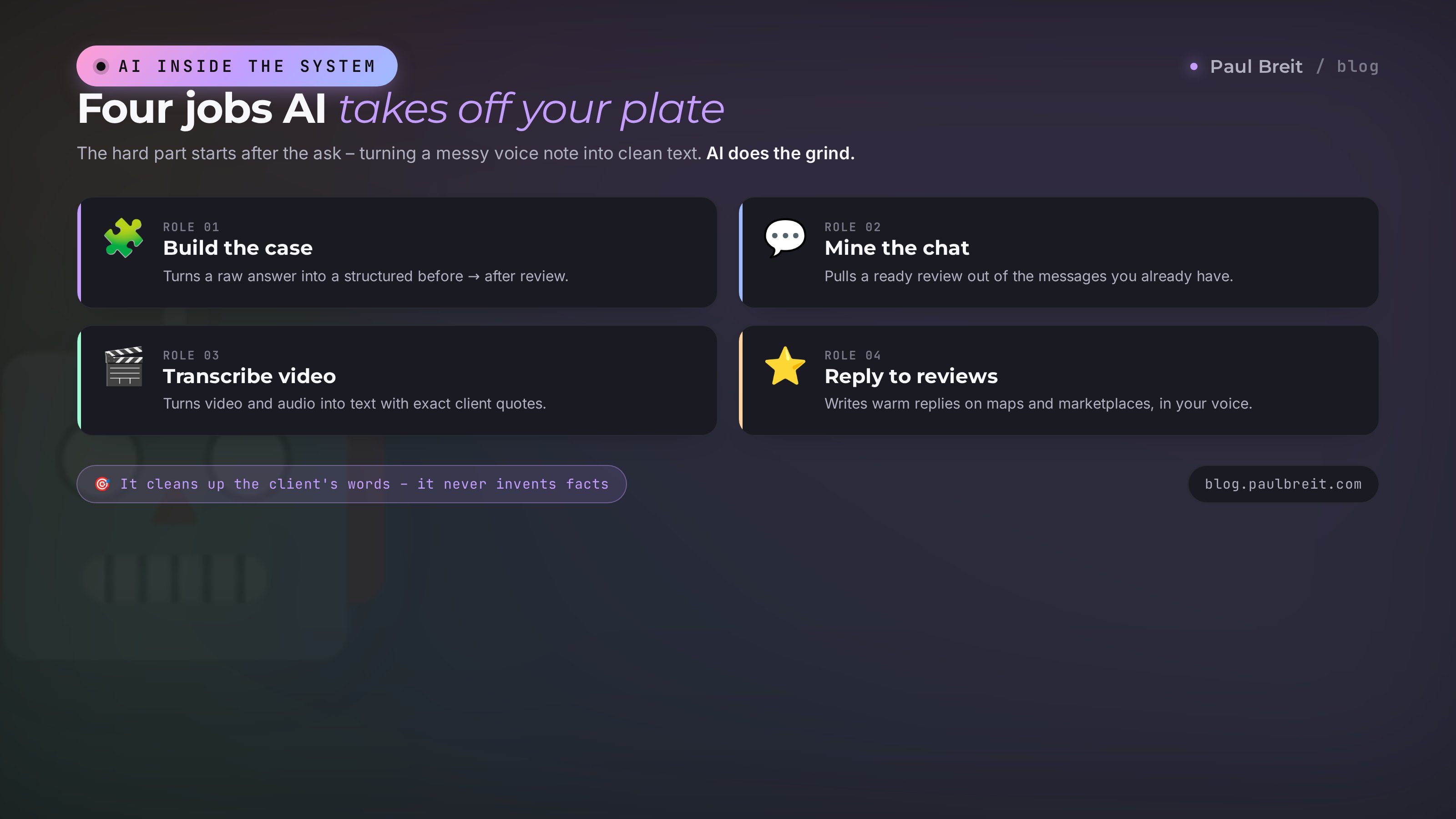
The hardest part of collecting reviews starts after the ask - processing what the client sent. The client sent a rambling three-minute voice note or five disconnected messages, and you have to assemble a clean text out of it. By hand it's slow and tedious, which is exactly why reviews pile up unprocessed. This is where AI covers four jobs and takes all the grind off your plate.
I work with Claude - it holds natural language better than the others and doesn't dress up the facts if you ask it to leave them alone. The prompts below are written for it, but they'll work in other AIs too.
Claude isn't available in every country. If it doesn't open directly for you, use a VPN with a US or EU location - Proton VPN and similar work well. Note that a few regions are on Anthropic's blocklist, so pick a US or EU exit rather than just any server. Register with an email that isn't tied to a blocked region, and if you don't have one, create a fresh account with the VPN already on so it doesn't get linked to the wrong place. Login link: claude.ai. New to AI? Start with what you can actually do with it.
Role 1. Build a case from a raw answer
The client answered the three questions by voice or text. You hand it to AI, and it assembles a clean, structured review. The important rule in the prompt is the ban on inventing. AI only tidies up what the client said and adds nothing of its own.
You are a review editor. Here is a client's raw answer to
three questions (what it was like before, what changed,
who they recommend it to).

[paste the voice-note transcript or the client's text]

Assemble a natural, first-person review from this. Requirements:
- keep the client's voice and words, just remove the junk,
  repetition, and filler words;
- structure: problem before -> what we did -> result
  with numbers -> recommendation;
- INVENT NOTHING, don't add facts or numbers that aren't
  in the answer. If there's no number, don't make one up;
- length 4-6 sentences, plain human language,
  no corporate speak and no hype;
- at the end, pull out one strong quote for a banner.

Give two lengths: short (for a card) and
expanded (for a landing page).
Role 2. Mine a review out of a chat
Your DMs already hold dozens of reviews - they're just scattered across messages. The client wrote in passing, "hey, it actually worked, two leads came in yesterday." That's a ready review; you only have to assemble it and ask for permission. Copy a chunk of the chat and hand it to AI.
Here's a chunk of a chat with a client. Find the fragments
in it that could be used as a review: where the client talks
about the problem, the result, emotions, gratitude.

[paste the chat]

Do the following:
1. Write out the client's quotes verbatim (for a screenshot review).
2. Assemble them into a coherent first-person review,
   adding nothing of your own.
3. Note which objection of a new client this review touches.
4. Draft a short, polite message to the client
   asking permission to publish these words.
A similar move - reading through conversations for sales insights - I showed in the article on analyzing sales calls with AI. There, AI looks for where money leaks; here, for where ready reviews are hidden.
Role 3. Turn video and audio into text with quotes
The client recorded a video review or a long voice note. Transcribe it and ask AI to pull the strongest quotes - for the caption under the video, for the text version, for clips. That way one video review turns into several units of content at once.
Here is the transcript of a client's video review.

[paste the transcript text]

Do the following:
- a short text review based on it (5 sentences),
  strictly in the client's words, no invention;
- 3 short quote lines for a video caption and
  for cutting into stories;
- a case-study headline in a result format
  (for example: how she got to 5 leads a week in 6 weeks).
Role 4. Reply to reviews on maps and marketplaces
If you have a listing on Google or Yelp, on a marketplace, you should reply to every review - the good ones and the bad ones. New clients see the replies, and a polite response to negativity sells better than a perfect rating with not a single reply. AI writes the drafts; all you have to do is check them.
You write replies, in the voice of an expert, to client reviews.
Tone: warm, alive, no corporate speak and no template phrases
like "thank you for your feedback."

Write replies to these reviews:
[paste the reviews, both good and negative]

Rules:
- for a good review: a short, sincere thank-you
  with a specific detail from the review, not copy-paste;
- for negativity: no excuses and no arguing, acknowledge what
  matters, offer a fix, move the conversation to DMs;
- length 2-3 sentences, a polite tone.
Replying in your own voice instead of dry stock phrases is helped by the approach in the article on how to teach AI to write in your voice. Upload samples of your own messages, and the replies will sound like you.
Section 07How to turn a review into a case by formula
A short review closes one objection. A full case study sells on its own - it's a complete story you can run as a post, a webinar slide, a landing-page section. The difference is depth and structure. A case is built on a three-part formula.
The case formula: before - what we did - after
- Before. The client's entry point. What they came in with, what hurt, what they'd tried before and why it didn't work. Here the reader recognizes themselves.
- What we did. Exactly what you did together. The key steps and decisions, without a blow-by-blow retelling of the whole process. Here the reader sees your method in action.
- After. The result in numbers and facts plus the client's emotion. Here the reader realizes this can work for them too.
AI assembles a case like this from your notes and the client's review. Give it the facts, and it builds the structure.
Assemble a client case by the formula before - what we did - after.

Here are the facts:
Client: [niche, who they are]
Entry point: [the problem they came in with]
What we did: [the key steps of the work]
Result: [numbers, timeframes, facts]
Client's words: [a quote from the review]

Requirements:
- three parts with the subheads before, what we did, after;
- natural language, simple words, no corporate speak;
- the "after" block must have numbers and a client quote;
- invent nothing beyond the facts;
- at the end, one takeaway line: who this case shows
  that the solution will work for.

Give two versions: a channel post and a landing-page block.A screenshot of the result beats any wording of yours. A dashboard with leads climbing, a screenshot of a chat with a new client, a before-and-after photo. Ask the client not just for words but for proof - a single image makes a case far more convincing. Get permission to publish the screenshot separately.
A case fits perfectly into an offer. When you frame a proposal and back it with a specific client story, it stops being a promise and becomes a proven fact. On how to build a strong offer, there's a separate article on how to write an offer with AI.
Section 08Video reviews without the client's shyness
The video review is the strongest format and the rarest, because people get self-conscious. "I don't know what to say," "I look bad," "my mic is bad" - the typical excuses. Your job is to remove the fear and give structure. Then even introverts give video.
How to remove the fear
- Give the questions ahead of time. Send the same three core questions. The person isn't afraid of the camera. What scares them is the unknown of "what do I say." When there are questions, the fear goes away.
- Let them re-record. Say it plainly: shoot as many takes as you want, send the best one, no big deal. That defuses the perfectionism.
- Let them go vertical from a phone. No lighting or mic needed. A live vertical video from a phone earns more trust than a studio picture. It looks real.
- Offer a call format. For some, it's easier if you get on a call and ask the questions live, and the person just answers. The recording of the call is a ready video review.
What to do with the finished video
One video is several units of content at once. Transcribe it (with the prompt from role 3), pull the quotes, cut it into short clips for stories and reels, assemble the text version for the landing page. A three-minute video review yields a post, three stories, and a page block. That's how you squeeze the most out of the client's effort.
Even one video review on a landing page sharply raises trust in the whole block of reviews. The reader thinks: if there's a live video, then the text reviews are real too. So if you can get even one or two videos, get them - they work for the entire block.
Section 09Where to place them so the review sells
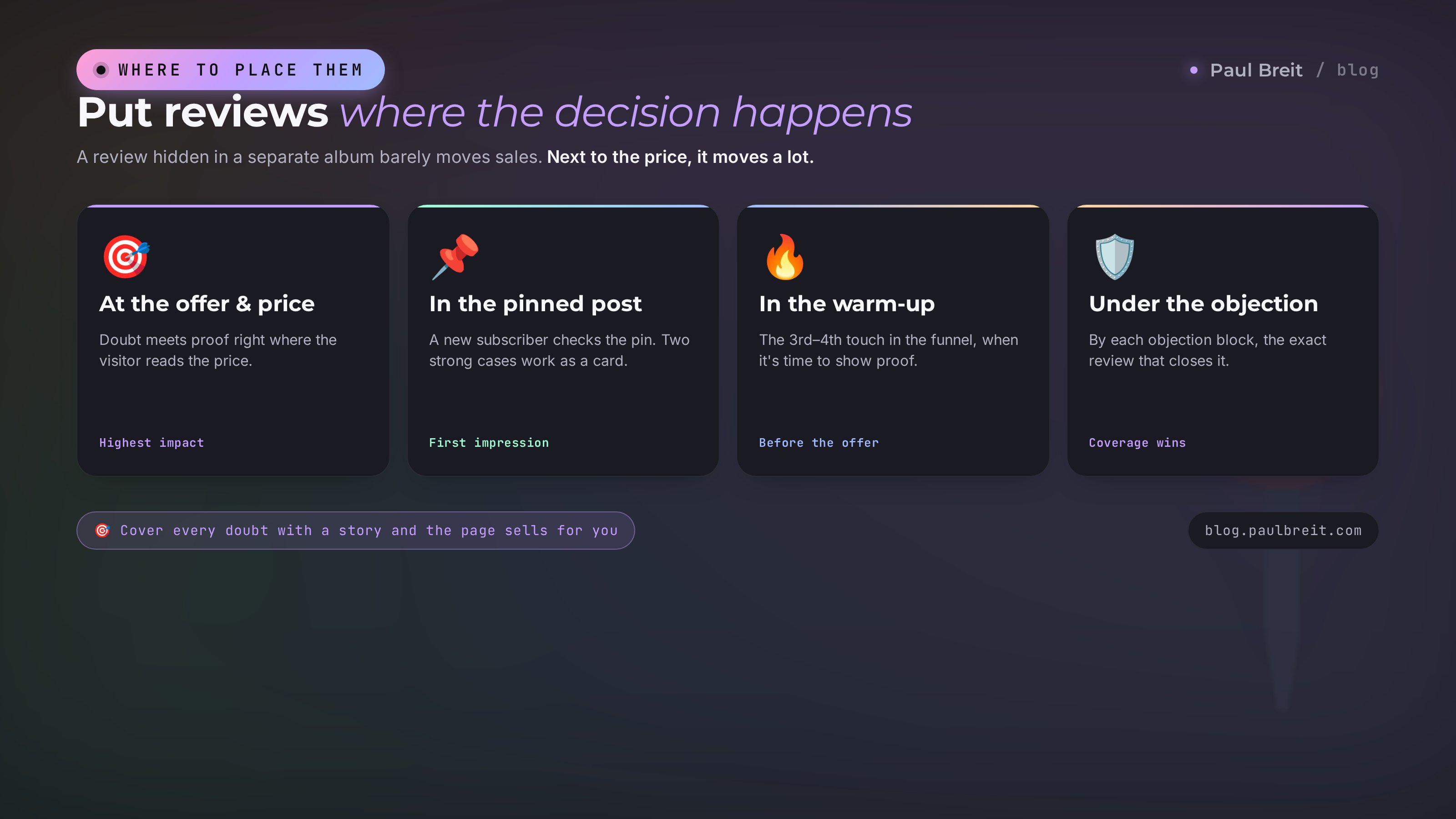
Collecting reviews is half the job. The other half is putting them where the person makes the decision. The most common mistake: dumping all the reviews into one album or a separate "reviews" tab nobody visits. A review like that barely affects sales. The one that works stands right next to the decision point.
The spots where a review works
- Next to the offer and the price. The person reads the proposal, sees the price, hesitates - and right here meets a review that closes their fear. This is the main spot.
- In the channel's pinned post. A new subscriber comes in and checks the pin. A couple of strong cases there work as a business card.
- In the warm-up before the offer. In the funnel, the review comes as the third or fourth touch, when it's time to show proof. How to build it into the sequence of touches - that's warm-up logic.
- On the service card and on maps. Where a person chooses a provider, reviews decide directly.
- Under the objection. On the landing page, next to each objection block, place the review that closes it. "I was afraid I wouldn't figure it out" goes next to the block about difficulty.
The objection-coverage principle
Don't chase the number of reviews for its own sake. Chase coverage. Write out 7-10 typical objections from your clients: too expensive, I won't figure it out, my case is special, no time, afraid it won't work. And for each one, find or build a review that closes it. When every doubt has a live story behind it, your page sells almost without you.
Old reviews from two years ago with outdated numbers work weaker than fresh ones. Every couple of months, refresh the shelf: put new stories up front, remove the ones that have lost relevance. The collection system is exactly what gives you a stream of fresh reviews to update with.
Section 107 mistakes when collecting reviews
Let's break down the typical failures that leave people with few reviews or reviews that don't work. Check yourself against the list.
- Asking for "a couple of words." An open request with no questions gives an empty "loved it." Always give three specific questions.
- Asking too late. A month after the work the emotion is gone. Catch the peak of joy, put request points into the process.
- Pushing the client to an inconvenient channel. A separate form or an outside site loses half your people. Ask where you already talk.
- Not getting permission right away. Later you'll spend weeks chasing the person for the right to publish their words with their name.
- Not saving reviews in one base. A review in a chat doesn't exist for you. Set up one place and put everything there at once.
- Publishing anonymously. "A review from a client" with no name, niche, or photo adds almost no trust. Always ask permission for authorship.
- Inventing reviews or editing them beyond recognition. Fakery is read instantly and kills trust in the whole page. AI tidies the client's words but doesn't make them up for them. Facts and numbers - only real ones.
Not collecting reviews at all until you need them. That's the most expensive miss. Every project closed without an ask is a lost piece of proof that could have sold to the next client for years. Set up the system once, and it will work for you on every sale.
SummaryThe whole path in a minute + checklist
Let's pull it all together. Collecting reviews is a system built into the work, not a panic blast before a launch. Here it is in full.
- Moment. Ask at the client's peak of joy, put request points into the process, not only at the end.
- Channel. Ask where it's convenient for the person, allow answers by voice.
- Questions. Three pillars: what it was like before, what changed in numbers, who you'd recommend it to. One question at a time.
- Barrier. Remove the blank page with the line "answer as is, I'll assemble the text and clear it with you."
- Permission. Get the right to publish with a name right away, while the client is still in touch.
- Base. Store every review in one place with a note on which objection it closes.
- AI. Builds a case from a raw answer, mines a review from a chat, transcribes video, writes replies on maps.
- Placement. Put reviews at the offer, in the pinned post, in the funnel, under every objection.
Reviews are the cheapest and strongest way to lift sales without new traffic. A system set up once turns every happy client into proof that sells to the next. And AI takes off all the processing grind that usually leaves reviews piling up unprocessed. Start collecting today, and a year from now you'll have a library of stories no competitor will have.
How this connects to other articles
Reviews are the proof that slots into every point of the sale. The offer from the article on how to write an offer gets stronger when a client case stands next to it. The diagnosis from the article on client research before a sales call uses the same questions, just at the entrance. And analyzing sales calls helps you find both money leaks and ready reviews in your conversations. Put together, they form one sales system with no marketing department.
FAQFrequently asked questions
When is the best time to ask a client for a review?
At the moment of peak joy: right after the first noticeable result, after a strong call, when the client just thanked you. A month later the emotion fades and the answer comes out flat. Build the ask into the work itself so you don't have to chase the mood by hand.
What questions make a review sell?
Three pillars: what it was like before (the problem and the doubt before buying), what changed (a concrete result in numbers or facts), and who you would recommend it to and why. A vague 'did you like it?' gives the useless 'all great'. Specific questions give a story the reader tries on for size.
How does AI help with reviews?
Four roles: it turns a raw client answer into a structured before-and-after case, pulls a ready review out of your chat history, turns video and audio into text with exact quotes, and writes polite replies to reviews on maps and marketplaces. Every edit is approved by the client, and facts are never invented.
The client is shy about writing a review. What do I do?
Remove the blank page. Ask 3-4 specific questions by voice or in chat, record the answer, and let AI assemble a clean text from it. The client only has to read and confirm. That's how even people who hate writing end up leaving a review.
Can I publish a chat with a client as a review?
Only with permission. Ask directly whether you can use their words and a screenshot, and check whether to hide their last name or photo. The strongest review comes from the client with their name, city, and niche, so get permission right away, while the person is still in touch.
How many reviews do I need for it to affect sales?
A noticeable effect starts at 10-15 different stories covering different questions and objections. After that, coverage matters more: for every typical client doubt there should be a review that closes it.
Where should I place reviews so they work for sales?
Next to the decision point: on the landing page near the offer and the button, in the channel's pinned post, in the funnel before the offer, on the service card. A review buried in a separate album barely moves conversion. The same review next to the price moves it a lot.
Do I need to pay or give a gift for a review?
Not necessarily, and bought reviews read as fake. Soft gratitude works: a small bonus, access to a resource, a public thank-you. The honest driver is the strongest: show the client that their story will help people just like them decide.