How to Write an Offer People Pay For: Formula and Breakdown
An offer is a promise of a specific result, for a specific price, on clear terms. I break down the six-element formula, show five before-and-after rewrites, hand you ready templates by niche, and share the prompts Claude uses to draft your offer in one evening. With a way to price it and a way to test it before the first dollar goes to ads.
To write an offer people pay for, assemble six elements: the client's desired result in numbers, proof you deliver it (cases, a guarantee), the timeframe, what you take off their plate to make it easy, a stack of bonuses, and a reason to act now (a deadline or limited spots). Set the price at roughly one tenth of the value the person will get in money. Claude will draft a version for your niche from the five prompts in this article in one evening, and you can test the wording on ten people from your target audience before you ever run an ad.
I open channel after channel and see the same thing. "Come to a consultation." "I'll help you grow your income." "Let's look at your situation." Warm, polite, and nowhere near the checkout. A person reads a line like that and misses the one thing that matters: what they get, for how much, by when, and why buy right now. The sale never happens, because there's nothing to buy – only an invitation to talk.
I run four client projects and a personal channel of 20,000 followers. Hundreds of offers have passed through my hands and my clients' hands. The gap between what hangs unsold for months and what sells out in an evening is almost always in the wording. This article is about how to build the wording people pay for, and how to hand the grunt work to AI.
You'll read it in 22 minutes. You'll build your offer in an evening. You'll test it on real people in a day, before you spend the first dollar on traffic. Let's go step by step, so it works even from scratch.
What's inside
- What an offer is, and why a service alone doesn't sell
- The strong-offer formula: six elements
- How to calculate value and name the price
- Draft the offer with Claude: five prompts, step by step
- Five offers before and after: a breakdown
- Ready templates by niche
- Seven mistakes that keep offers from selling
- How to test an offer before launch
- The whole path in a minute, plus a checklist
In some regions Claude won't open directly – you'll need a VPN set to the EU or US. Anthropic blocks a handful of countries (Turkey and the UAE among them), so pick a different location. The full walkthrough on signing up and paying is in how to pay for Claude.
Section 01What an offer is, and why a service alone doesn't sell
An offer is a promise. You promise to take a person to a specific result, for a specific price, on clear terms, and you give them a reason to say "yes" right now. That's it. If your proposal is missing even one of those pieces, selling gets hard and your ad budget drains into sand.
Here's the swap that trips people up. Most experts describe what they do. "I run nutrition consultations." "I'm a goals coach." "I set up paid ads." That's a description of a process. And a person doesn't pay for a process. They pay for the state they'll be in after working with you. Fifteen pounds down by summer. Their first five clients from cold traffic in a month. A clear plan for the year instead of mush in their head. That's what gets the card out.
A service and an offer are different things
A service answers "what I do." An offer answers "what the person gets, and why they should buy from me and today." The same service can be wrapped in a dead offer or a live one. A massage is a service. "I'll clear your back pain in five sessions or your money back" is an offer. See the difference? In the second version, a picture of the result, the timeframe, and the guarantee forms in the person's head.
Ask your proposal four questions. What result does the person get, and in what numbers? In what timeframe? Why will they believe it will work? Why buy now and not "someday later"? If all four have a clear answer in a sentence or two, you have an offer. If even one hangs unanswered, what you have so far is an invitation to chat.
The value equation
There's a simple model Alex Hormozi laid out well in his book "$100M Offers." The value of an offer in a person's mind comes from four variables. On top – the desired result and the odds of reaching it. On the bottom – the time to the result and the effort and risk they'll have to put in. The bigger the top and the smaller the bottom, the more they want to buy.
The recipe falls right out of the model. Want a stronger offer? Raise the promised result and its believability, shorten the timeframe, and take the effort and fear off the person. The rest of this article is about turning those four dials by hand and with AI.
Why a weak offer kills even a good product
Here's the painful part. A person can have a strong service, real results, happy clients. And still few sales. Because at the entrance stands wording you can't make a decision from. People don't buy what they don't understand. They scroll past. A good product with a dead offer loses to an average product with a live offer almost every time – simply because the second one is easy to buy.
That's why the offer is the first thing I fix in any project. Before traffic, before the funnel, before content. A funnel without a strong offer just shows people faster what they don't want to buy. First the proposal people pay for. Then everything else.
Section 02The strong-offer formula: six elements
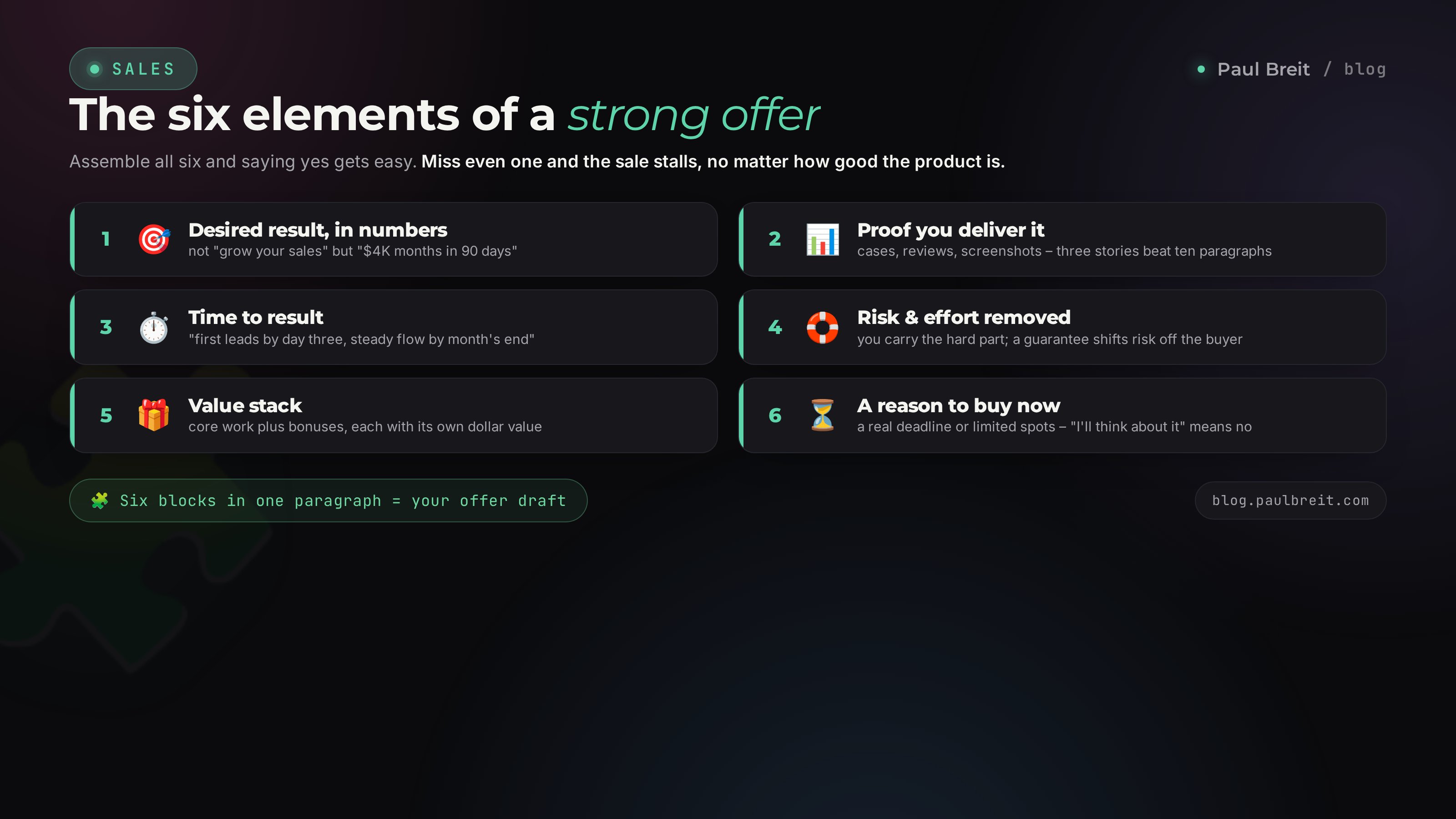
I break an offer into six pieces. Assemble all six and you get a proposal that's easy to say "yes" to. Let's walk through each with examples.
The desired result, in numbers
First and most important. Name the concrete result the person wants and turn it into something measurable. Not "I'll improve your sales" but "I'll get you to $4K in monthly revenue." Not "I'll help you lose weight" but "fifteen pounds down in ten weeks." A number and a timeframe make the promise tangible. If the result is hard to quantify, tie it to a clear point: "a clear 30-day content plan you don't have to reinvent every morning."
Proof that you deliver it
A promise without proof is just words. Prop it up with cases, reviews, numbers, screenshots of results. Three concrete client stories beat ten paragraphs about your experience. "Marina came in with 200 followers; two months later she ran her first launch and made $5K" carries more weight than "extensive launch experience." If you don't have cases yet, your own path and the clear logic of your method work as proof.
Time to result
A person wants to know when. "Over a weekend," "in 30 days," "by the end of the first month." A timeframe lowers anxiety and brings the result closer. If the process is long, split it into the first quick win and the final result: "first leads on day three, a steady flow by the end of the month." A fast first win keeps the person in the work.
Removing effort and risk
Show that you take the heavy lifting and leave the person the simple part. "I handle the scripts, the copy, and the setup; all I need from you is three phone-shot videos." Same bucket: the guarantee – a refund, work continued until the result, a free extension. A guarantee works as a lever: it moves the risk from the buyer to you, and that sharply lifts response. Only give the guarantee you're truly ready to honor.
The value stack
Gather everything the person gets into one pile and show it whole. The core work plus bonuses: templates, checklists, chat access, a review, the recording. When a list of seven items sits next to the price, the price looks small against everything it buys. It helps to assign each bonus its own dollar value, so the total of the stack is visible.
A reason to buy now
Without this element the decision is postponed forever. "Let me think about it" is a polite no. Give an honest limit: enrollment closes Friday, the price goes up after ten spots, the fast-decision bonus expires in 48 hours. The deadline has to be real. Fake "last spots" once and you lose trust, and the next deadline won't work.
Assemble these six elements into one paragraph and you have an offer draft. Next you polish it and work out the price. We'll come back to niche-specific wording below; first, let's deal with the money.
Section 03How to calculate value and name the price
The most common sticking point for experts is the price. They set it at random, out of "it feels awkward to ask for more," or by peeking at a neighbor. There's only one right way: count from the client's money and benefit, not from your own feelings.
Count in the client's money
Ask yourself: how much will the person earn or save thanks to your work? If you take an expert to an extra $2,600 in monthly revenue, that's about $31K a year. If a nutritionist saves a client years of health and money wasted on useless supplements, that too converts into clear sums. Once you see the value you create in numbers, naming a price gets easy.
A working benchmark: the price of the product is roughly one tenth of the value the person gets. Create $6,500 of value for a client over a year and a $650 product looks like a fair deal – the person feels they're taking home ten times what they hand over. It's not a hard law, but it's a good starting point for getting over the fear of higher prices.
Three tiers as an anchor
One tier robs the person of choice and forces a "yes or no." Three tiers turn the question into "which one." The middle usually gets picked most, the expensive one makes the middle look like a bargain by contrast, and the cheap one catches those who aren't ready for more yet. The classic: basic access, a main package with support, and a VIP with personal work. The expensive tier is almost always needed as an anchor, even if it rarely sells.
Payment plans remove the price barrier
An $800 price tag scares people; "six payments of $135" goes down easy. A payment plan widens the circle of who can buy right now, at the same total price. You set it up through a payment provider – how to accept payments and offer installments is covered in a separate article on accepting online payments. For the offer, what matters is that a payment plan is part of the terms, and it's worth stating right in the proposal.
Why a low price hurts
A cheap product sells worse than an expensive one more often than you'd think. A low price reads as low value. The person thinks: if this costs $40, there's probably not much to it. Plus cheap clients are fussier and more demanding than expensive ones – tested across many projects. Raising the price and strengthening the offer usually beats a race to the bottom. Money spent on the offer's appeal goes into wording and proof, not into a discount.
How to justify the price in words
Naming a price isn't enough; you have to justify it so it looks obviously worth it. Comparison works. Put an alternative the person already knows next to the price. "One missed client costs you $650. The program costs the same, but brings ten clients a month." "A year of DIY attempts and burned budget versus three months on a system, for the price of one botched test." When a clear reference point sits beside the price, the person does the math themselves and sees the win.
A second move is the per-day breakdown. A $400 course over three months of work sounds heavier than "$4 a day, cheaper than a cup of coffee, for a result that stays with you for good." Same number, different feeling. Both moves are honest – they don't change the price, they help the person see it at the right scale. AI is great at generating these comparisons: give Claude the price and the result and ask for ten ways to justify the cost through comparisons a person understands.
Section 04Draft the offer with Claude: five prompts, step by step
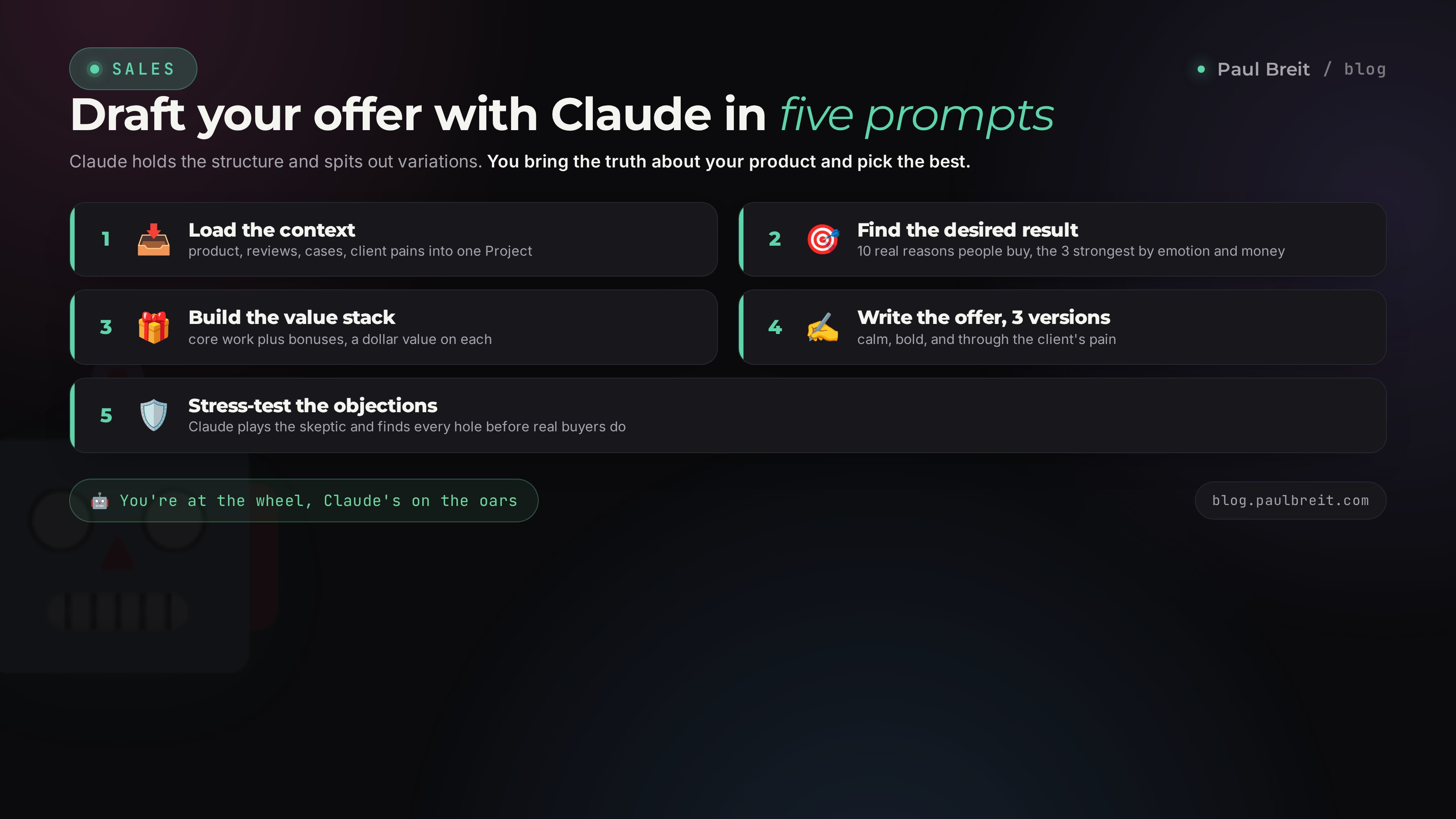
Now the convenient part. You can hand the rough draft of the offer to AI. Claude holds the structure, generates wording options, and finds objections and weak spots. Your job is to give it the truth about your product and your clients, then choose and polish the best. Sign up for Claude here: claude.ai.
Load the context into a project
AI will write junk if it doesn't know your product and your audience. Gather into one chat or a Project everything you have: the service description, reviews, cases, client pains and objections, your past sales copy. If you haven't unpacked your expertise yet, do that first, as in the guide on unpacking your expertise with AI. The more truth on the way in, the sharper the offer on the way out.
A starter prompt: "You're a marketer who packages offers for experts. Here's my niche, product, reviews, and client profile: [paste it all]. Study the material and ask me 7 clarifying questions whose answers you need to build a strong offer." Answer the questions – that's how you hand the AI the missing pieces.
Find the desired result
Prompt: "From the material, write out 10 of my client's desired results – what they're really buying. State each result concretely and, where possible, in numbers and with a rough timeframe. Mark the three strongest by emotion and by money." From that list you'll pick the main result for the offer, and the rest go into bonuses and the warm-up.
Build the value stack
Prompt: "Build a value stack for the product. Split it into the core work and bonuses. For each item, note which client pain it closes and suggest a separate dollar value for the bonus. Finish by showing the total value of the stack, so the price looks like a bargain next to it." Check it by hand – the AI sometimes inflates the numbers; keep only the ones that are honest.
Write the offer in three versions
Prompt: "Build the offer by the formula: desired result in numbers, proof, timeframe, what we take on plus the guarantee, the value stack, a reason to buy now. Give three versions of the wording – calm, bold, and through the client's pain. Each in one paragraph with a short headline. Write in a natural, direct voice, no corporate speak and no long dashes." Three versions let you feel the different tones and build the final from the best pieces.
Stress-test the offer against objections
Prompt: "You're a skeptical client in my niche with money but with doubts. Read the offer and write out every reason you wouldn't buy. Then suggest how to strengthen the offer and what guarantee to add to remove those objections." It's the best way to find the holes before real people do. Turn the objections into separate lines in the offer and into a Q&A block.
An important thought, so you don't get disappointed. AI won't invent your meaning for you and won't replace knowing your own clients. It's great at holding structure, tossing out options, and catching weak spots – that saves you hours. But the truth about the result, honest numbers, and a real guarantee come from you. An offer where the AI fantasized the promises sells once and comes back as refunds. You're at the wheel; Claude's on the oars.
Section 05Five offers before and after: a breakdown
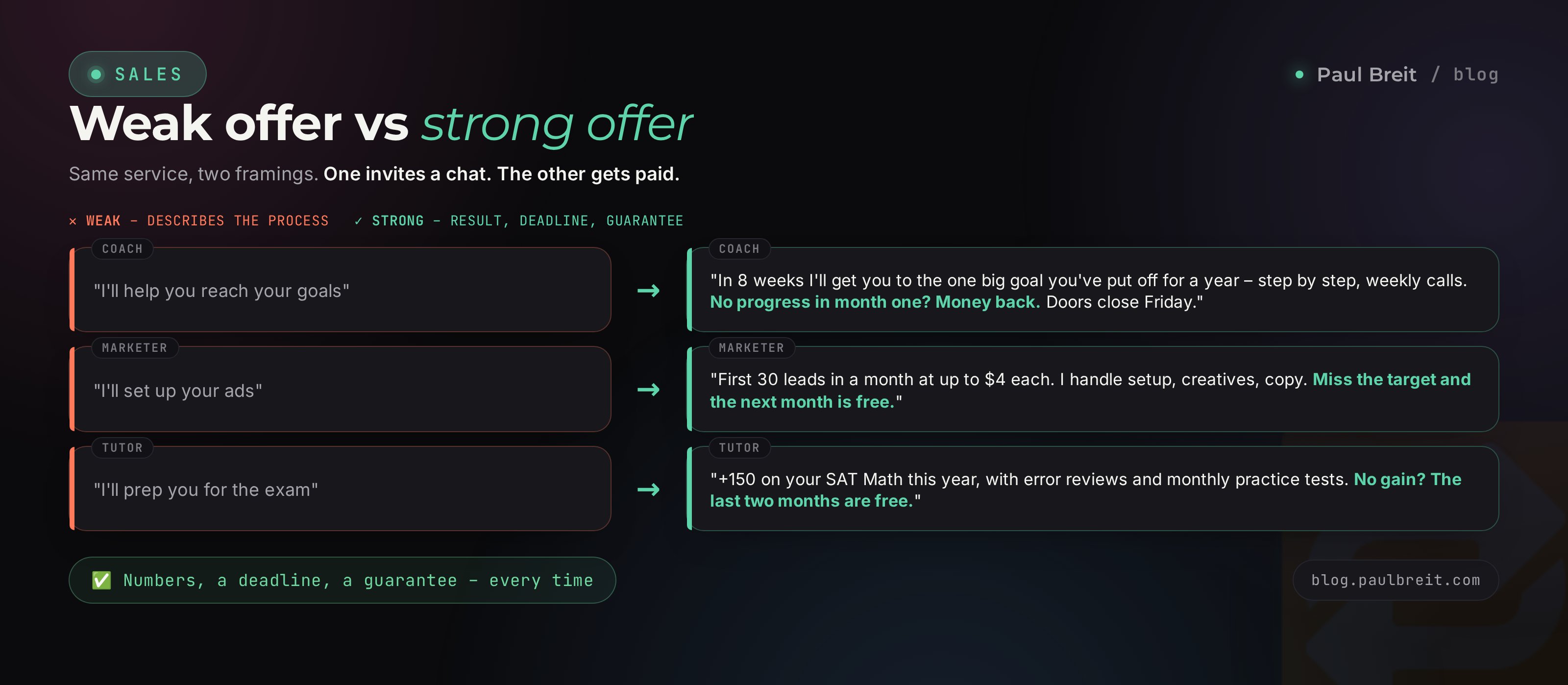
Theory comes alive on examples. I took five typical weak offers from different niches and rewrote them by the formula. Watch what changes.
Goals coach
Before: "I'll help you reach your goals and unlock your potential." After: "In 8 weeks I'll get you to one big goal you've been putting off for a year – step by step, with weekly calls and a plan for each day. No movement in the first month? Money back. Enrollment closes Friday; after that the price goes up." Now there's a timeframe, a mechanism, a guarantee, and a deadline. The abstract "potential" turned into clear movement.
Psychologist
Before: "One-on-one sessions, work with anxiety and self-esteem." After: "A program of 6 sessions, after which you stop waking up with anxiety and learn to bring yourself back to calm in a couple of minutes. I'll give you the first technique in the first session, so it gets easier right away. If you feel no shift after three sessions, we keep going for free until you do." The promise became concrete on the result and on the first quick relief.
Marketer
Before: "I'll set up your paid ads, done for you." After: "I'll bring your first 30 leads from ads in a month at up to $4 per lead. I handle the setup, the creatives, and the copy; from you I need access and a budget from $400. If we don't hit the target cost per lead, I work the next month for free." The result in numbers, a split of the work, a guarantee on the metric.
Nutritionist
Before: "I'll build you a custom meal plan." After: "In 10 weeks I'll get you to 12–15 pounds down, with no crash diets and no counting calories by hand – a plan, swaps for your usual meals, and daily support in a chat. I'll send the first week's menu and shopping list right after payment. Spots for this month are limited: I take 8 people." A timeframe, a result range, routine removed, limited spots.
Tutor
Before: "I'll prep you for the math exam." After: "I'll raise your SAT Math score by at least 150 points over the school year – on a custom plan, with a review of your mistakes and a practice test every month. If we don't gain 150, the last two months are free. Enrolling for September: 4 spots left." A concrete score gain, a mechanism, a guarantee, an enrollment deadline.
Notice the common thread? Every rewritten version gained numbers, a timeframe, a split of effort, a guarantee, and a reason to decide now. Exactly the six elements of the formula. And the tone stayed human, no hype.
Section 06Ready templates by niche
A table for a fast start. Find your niche or a close one, take the frame of the strong wording, and drop in your own numbers and guarantee. These are starting points; shape them to your own truth.
| Niche | Weak offer | Strong offer (frame) |
|---|---|---|
| Coach | Help you reach your goals | In 8 weeks I'll get you to [goal] step by step, with calls and a plan. No movement in a month – money back |
| Psychologist | Work with anxiety | In 6 sessions we'll clear [state], first technique right away. No shift in 3 sessions – we continue free |
| Nutritionist | A meal plan | [X] pounds off in [N] weeks, no crash diets, menu and chat support. Taking [number] people this month |
| Marketer | I'll set up ads | First [N] leads in a month at up to $[X] each. Miss the plan – I work a month free |
| Tutor | I'll prep you for the exam | +[N] points in a year in [subject], with mistake reviews and practice tests. No gain – two months free |
| Sales mentor | I'll boost your sales | I'll get you to $[amount] in revenue in [N] months on a call system. First result by week 2 |
| Designer | I'll make it look good | I'll build a landing that sells in 7 days, with copy and structure built for leads. 3 revisions included |
| Lawyer | Legal services | I'll review and fix your contracts in 3 days, with a guarantee on corrections. First document the day you reach out |
The frame is the same everywhere: result, timeframe, what you take on, a guarantee or a limit. From there, the AI will fill in your details using the prompts from the previous section. A good offer then becomes the core of a sales webinar and the whole sequence of touches.
Section 07Seven mistakes that keep offers from selling
I've gathered the rakes people step on most. Run down the list and check it against your own proposal.
- Promising the process instead of the result. "10 consultations" instead of "calm sleep in a month." A person pays for the destination; describe the road afterward.
- No numbers, no timeframe. "You'll grow your income" with no sum and no time sounds like a promise of everything and nothing. Put numbers on it.
- Everything for everyone. An offer that fits anyone grabs no one. Narrow it to a specific person with a specific pain.
- No proof. A strong promise with no cases and no guarantee reads as bragging. Back it up.
- No reason to buy now. With no deadline or limit, the decision drifts into "later," and "later" never comes.
- Price too low. Cheap reads as unserious. A low price drags down both the perceived value and the quality of your clients.
- The offer is hidden. Even a strong proposal won't work if it's not front and center – in the bio, the pinned post, the first screen of a landing. The offer should meet a person right away.
Show the offer to someone outside your niche and ask them to retell, in their own words, what you're offering, for how much, and why buy now. Retold it accurately – the offer is clear. Stumbled or asked again – go back to the formula and fix the element they tripped on.
Section 08How to test an offer before launch
Don't burn your ad budget on an untested offer. You can check the wording in a day, on real people, for almost nothing. Here are three ways, from simple to serious.
A survey of ten people
Take ten people from your target audience – followers, peers in your niche, past clients. Show them the offer and ask three things: is it clear what you're offering; did it make them want to learn more; what's holding them back from buying. Their answers hand you a list of objections and the words people use to describe their own pain. Put those words into the offer.
Pre-sales
The most honest test is money. Offer the deal to a small warm audience before everything is ready, at an early-decision discount. If people buy on your word and a deposit, the offer is alive. If they nod politely and don't pay, something in the formula isn't tightened. Pre-sales also give you your first money and first clients for cases.
The consultation test
Run five sales calls and name the offer at the end of each. Watch the reaction: where the eyes light up, where objections surface, which words hook the person. A live conversation reveals an offer's weak spots faster than any analytics. How to run a call so it sells is covered in the article on the sales call script.
What's signal and what's noise
Be careful with advice from people who aren't your client. If someone isn't going to buy in your niche, their "too expensive" or "I don't get it" means little. Listen to those who are in the target audience and could actually pay. Signal is when several real people from your niche trip over the same spot, or reach for the same promise. One random comment is noise; a repeating reaction is a signal worth changing the offer for.
One more thing. The best signal is money, not words. A person can say "interesting" out of politeness and not buy. A person who pulls out a card at pre-sale is voting for real. That's why pre-sales rank above every survey: they test the offer by the very thing it exists for. Collect three to five deposits on the first version and you can confidently turn on traffic and scale.
And don't worry if your first offer isn't perfect. Nobody's is. An offer gets tightened by real reactions over two or three passes. Build the first version by the formula, show it to ten people, fix it in their words, test it with pre-sales. A week later you'll have a proposal people actually pay for. Easy does it – it's simpler than it looks.
Section 09The whole path in a minute, plus a checklist
Let's put it all into a short track to keep in front of you.
- Got the difference: an offer is result, price, terms, and a reason to buy now – not a description of a service.
- Assembled the six elements: result in numbers, proof, timeframe, risk removal, value stack, deadline.
- Priced from the client's money – roughly one tenth of the value created, three tiers, a payment plan.
- Ran the build through Claude with five prompts: context, result, stack, wording, objections.
- Tested the offer on ten people, with pre-sales, and on calls.
A pre-launch checklist. While all seven boxes are ticked, the offer is ready to work.
- The result is named concretely and in numbers, with a timeframe
- Proof is in place: at least three cases or reviews
- The guarantee is stated and deliverable
- The value stack is assembled, and the bonuses have their own value
- The price is calculated from the client's benefit, with a payment plan
- A reason to buy now that's honest: a deadline or limited spots
- The offer is front and center: bio, pinned post, first screen
The offer is the first thing you fix when sales are low. Not the traffic, not the funnel, not the number of posts. A strong statement of the result, the price, and the terms makes everything behind it work. It's built in an evening from a six-element formula, and AI takes the grunt work off you and holds the structure. Your job is to bring the truth about your product and your clients.
How this connects to the other articles
The offer is the core everything else revolves around. It's the foundation of a funnel, it gives meaning to a sales webinar, and it decides what you promise in a lead magnet. First the proposal people pay for, then the machine that carries it to them. Build the offer, and everything else finds its purpose.
FAQFrequently asked questions
How is an offer different from a USP?
A USP answers how you're different from others. An offer is broader: it's about the result, the price, the terms, and the reason to buy now. A USP can be part of an offer, but on its own it sells nothing until there's a promise of a result, a timeframe, and a guarantee beside it.
What if I don't have any case studies for proof yet?
Your own path, the logic of your method, and the first results of your first clients all work as proof. Build the offer, sell it to two or three people at an early-bird discount, get them to a result, and you'll have your first cases. Then you add them to the offer and raise the price.
What kind of guarantee can I give without going broke?
Only give the one you're truly ready to honor: a refund when the client holds up their end, work continued until the result, a free extension. A conditional guarantee (the client does their part) protects you and removes the buyer's fear.
How many versions of the offer should I test?
Start with three framings for one product: calm, bold, and through the client's pain. Show them to ten people and on your calls, and keep the one that gets the strongest reaction. More than three at the start scatters your attention and hides what actually worked.
Can I raise the price on an offer that's already working?
You can, and often should. Add a new bonus to the stack or strengthen the guarantee, show fresh cases, and raise the price for the next cohort. Warn your audience ahead of time – a price increase becomes its own reason to buy at the old rate.
Is a deadline required if I don't want to pressure people?
A deadline isn't about pressure – it's an honest limit. If you can only take eight people a month, say so. If the price goes up next cohort, warn people. A real limit helps a person decide instead of postponing forever.
Can AI come up with the whole offer for me?
AI will draft it, throw out framings, and find weak spots. But the truth about the result, honest numbers, and a guarantee you can keep come from you. An offer where Claude invented the promises sells once and comes back as refunds. The meaning is yours; the grunt work is the machine's.
Where should I place the offer?
At every entry point: your profile bio, a pinned channel post, the first screen of a landing page, the service description. The offer should meet a person right away, not hide in the third paragraph. A hidden offer doesn't sell, even a strong one.