Unpack Your Expertise With AI: Deeper Than a Marketer
Unpacking your expertise means pulling everything sellable out of your head: your meanings, positioning, offer, cases, and content topics. Normally a marketer does this over a call or two. AI does it in more detail and more honestly: it asks a hundred and fifty questions in a row, doesn't fade at the forty-minute mark, follows up five times, and never worries about looking too nosy. Below is the whole method – with prompts, a real slice of dialogue, and a finished expert passport at the end.
Unpacking your expertise with AI is a structured interview where you answer 150–200 questions while the AI pulls your meanings, positioning, offer, cases, and content topics out of your answers. You prep the context, launch a prompt that puts the AI in the interviewer role, answer honestly for an hour or so, then ask it to assemble everything into one document – an expert passport. From there, that document becomes the base for your content, lead magnet, and sales copy.
You know the story. Someone pays a marketer for an unpacking session, they hop on a call for an hour and a half. The first twenty minutes are lively, then the marketer gets a little tired, the questions slide into a template, and half of your answers get filtered through their past experience. What comes out is a document that describes you roughly the same way it would describe any other coach or psychologist. The second scenario is sadder still: you decide to unpack yourself, open a blank file, type "my mission," and stare at the cursor for forty minutes.
Unpacking yourself from the inside is nearly impossible. Your eye is blurred, the obvious feels boring, and the most valuable thing you don't even notice, because to you it's just Tuesday. You need someone on the outside who will keep asking "but why?" until they hit bottom. And that's the role AI plays better than a live person.
I've unpacked both myself and my school's clients this way. Below is the whole process, step by step, so you can repeat it in one evening and walk away with a document that your entire content and sales output grows out of.
What's inside
- What unpacking your expertise actually is
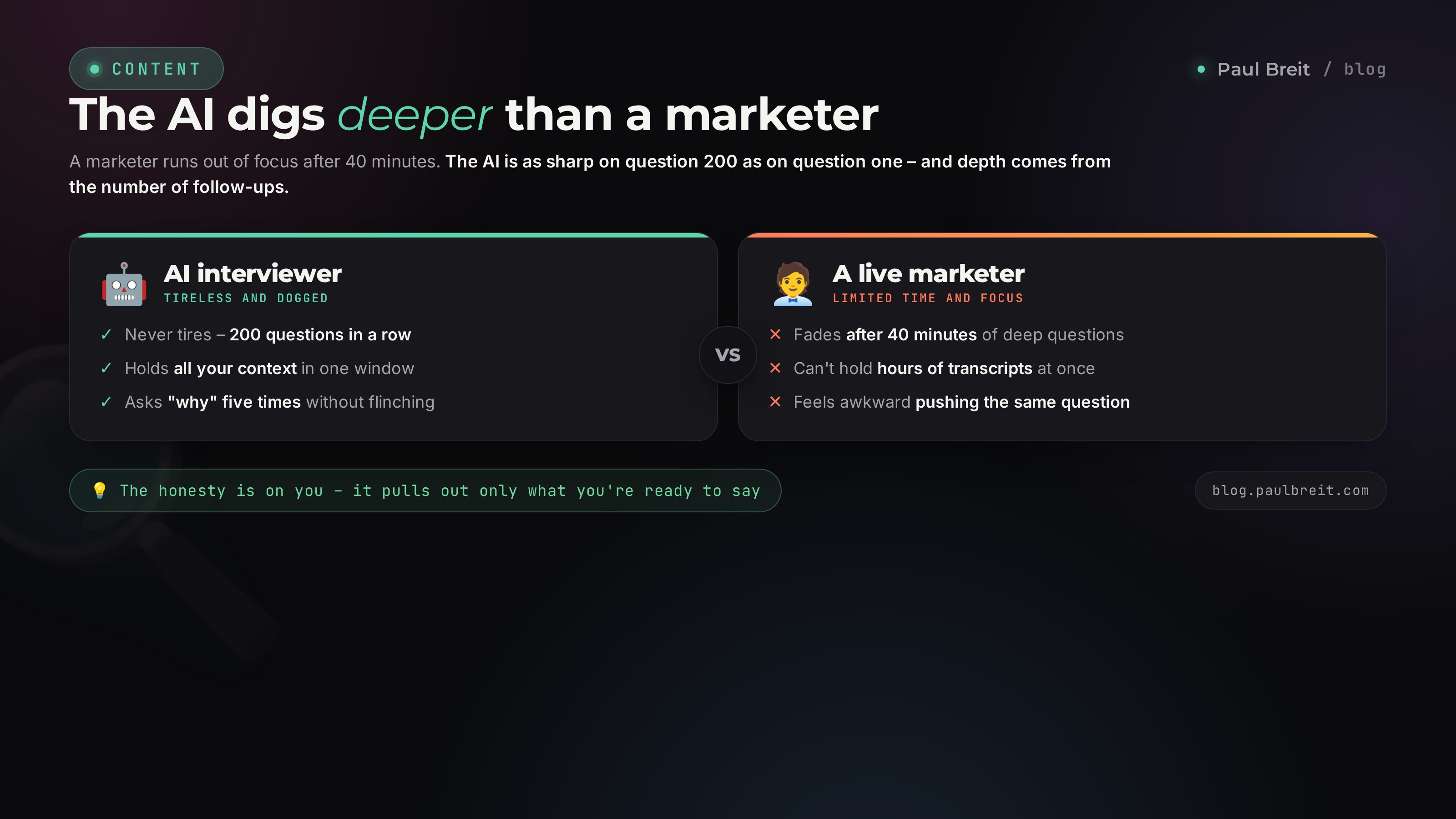
- Why AI digs deeper than a marketer
- Prep: what to feed the AI
- The interviewer prompt: starting the unpacking
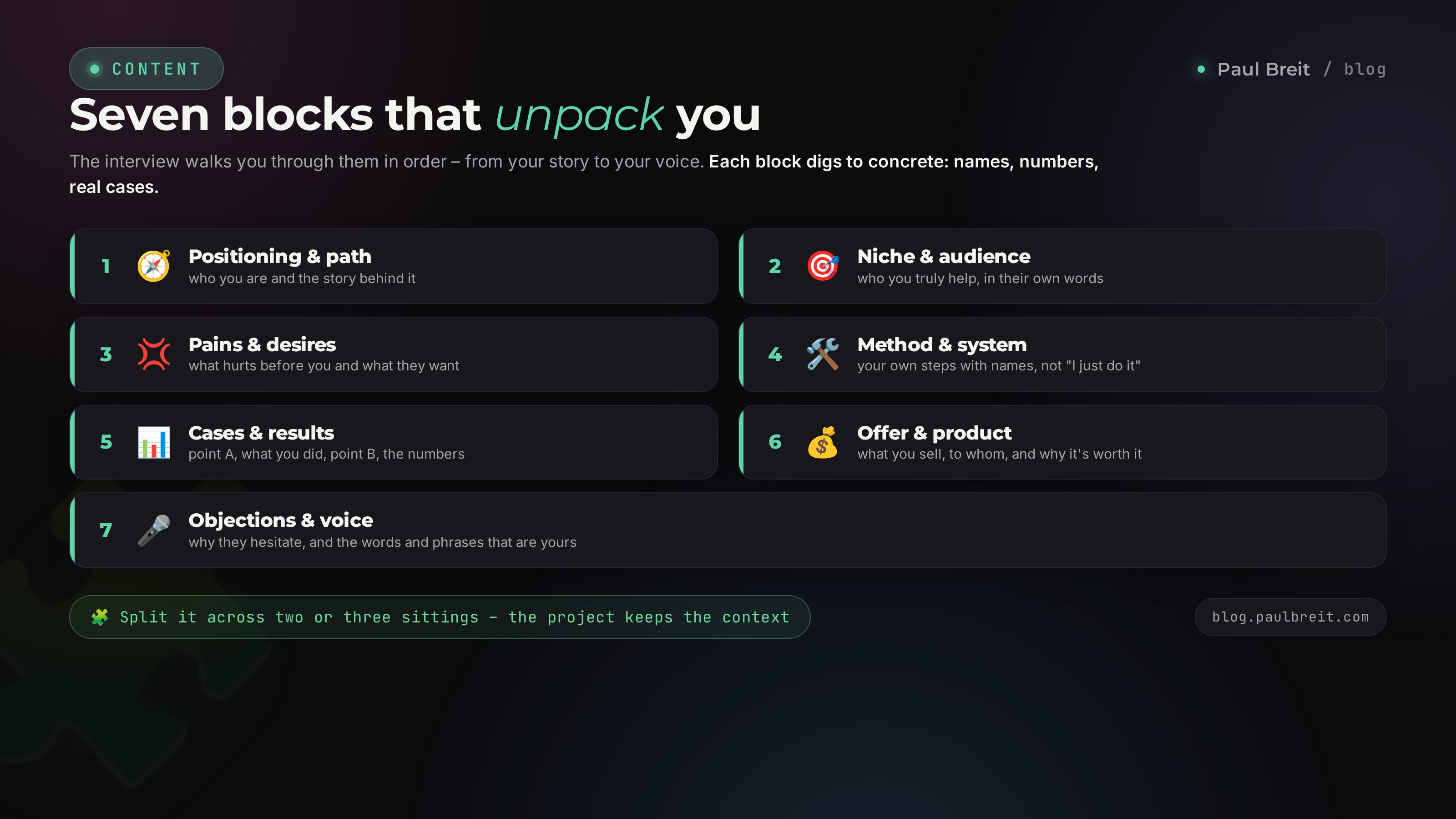
- The seven interview blocks
- How to run the dialogue for depth
- The expert passport: what to assemble
- Where to put your unpacking to work
- Five unpacking mistakes
- Checklist
Claude doesn't open in every region – from some countries you'll need a VPN set to an EU or US location. Turkey and the UAE won't work; they're on Anthropic's blocklist. The step-by-step of signing up and paying is covered in the getting-started-with-Claude guide.
Section 01What unpacking your expertise actually is
Unpacking your expertise is meaning-mining. It's everything sitting in your head about your work that can be turned into money: what clients value you for, how exactly you get results, what sets you apart from the person next to you in the niche, what stories stand behind you. As long as it lives inside your head, it doesn't work. The moment you pull it out and write it down, it becomes content, an offer, sales messages, and a landing page.
Here's the crux of it. Every specialist already has everything they need for strong marketing. They have clients they've helped. They have their own way of working, arrived at over years. They have the phrases, examples, and beliefs people love them for. It's all just scattered across their head and old message threads. Unpacking gathers it in one place and lays it out on shelves.
What exactly we're pulling out
- Positioning. Who you are, who you're for, and what result you deliver – in one sentence a person can grasp in three seconds.
- Niche and audience. Who you genuinely help, who you don't, and the language those people use to describe their problem.
- Pains and desires. What hurts for a client before they work with you, and what they want to walk away with.
- Method. Your own system, broken into named steps, instead of "well, I kind of just do it."
- Cases. Client stories with a point A, a point B, and numbers.
- Offer. What you sell, to whom, for how much, and why it's worth the money.
- Objections. Why people hesitate, why they put it off, and the honest answer to each.
- Voice. Your turns of phrase, your intonation, your favorite metaphors and examples.
Why this is a foundation, not a one-off exercise
Every post, reel, sales message, and landing page you make stands on these meanings. Without unpacking, AI writes a generic text "for a specialist in general," and it reads like a borrowed jacket off someone else's shoulders. With unpacking, it writes about you, in your words, about your clients. That's the difference between "scrolled past another post" and "wait, it's like I wrote this myself."
If you've already worked through the meaning pyramid or picked your niche, unpacking pulls those pieces together and surfaces what wasn't said yet. It doesn't replace those exercises; it's the next level of depth on the same meanings.
Section 02Why AI digs deeper than a marketer
Fair question: why AI, when live marketers and producers have been unpacking people for decades. Here's the point-by-point on where the AI pulls out more.
It doesn't get tired
A live person holds real focus on deep questions for about forty minutes. After that attention drifts, and the questions run on autopilot. AI is as sharp on question one hundred as on question one. And depth in unpacking comes precisely from the number of follow-ups. Two hundred questions in a row is more than a human interviewer can physically carry; for AI it's nothing.
It holds all your context at once
You've loaded call transcripts, old posts, client reviews. AI keeps all of it in one window and connects the dots: "In Marina's review you talk about saving time, but in the interview you named money as the main result. Which of these do clients actually value?" A live marketer can't hold that much material in their head at the same time.
It isn't shy about being dogged
A good interviewer knows: you reach the core when you ask "but why?" five times in a row. But a live person feels awkward hammering the same question – they're afraid of looking slow or annoying. AI doesn't care. It calmly asks a fifth time, and on that fifth answer you suddenly say the thing the whole unpacking was for.
It has no frame of its own
A marketer can't help dragging you into their last successful project: "I had a nutritionist client, let's do it the same way." AI works from you, not from someone else's case. It doesn't force your meanings into a template that happened to work last time.
You can run it as much as you want
Didn't finish the offer block? Come back the next day and wrap it up. Want your positioning rephrased ten ways? You get ten in a minute. With a live specialist, every session costs money and time; here you run as many passes as you need.
It won't sense that you lied to yourself, and it won't catch, by your tone, where it actually hurts versus where you're bluffing. A good producer sees that and pushes right there. So the honesty is on you: AI will pull out exactly what you're ready to say. Smooth over your answers and you'll get a smooth, empty document. The tool is powerful, but the thinking and the remembering are still yours to do.
Step 01Prep: what to feed the AI
The more live material you bring in up front, the less the AI has to guess and the more precisely it pulls your own phrasing. Bare unpacking "from a blank page" works too, but with loaded context the result is far denser.
Input material for unpacking
- Your profile or site. Copy the text from your bio, your landing page, your pinned post.
- 5–10 transcripts. Your client calls, live streams, webinars, voice notes. This is gold: your live voice and your real phrasing are in there. Transcribing a recording takes minutes – the AI turns audio and video into text on its own.
- Client results. A list: who came in, with what, what they got, over what time frame, ideally with numbers.
- Reviews. Screenshots and text. In reviews, clients say in their own words what they value you for – ready-made meanings.
- Old posts that landed. The ones that got a response. Your working topics and your intonation are already hidden in them.
Next you need Claude itself. It holds long context and carries a live dialogue across a hundred turns without losing the thread. If you don't have an account yet, sign up at claude.ai (with a VPN on if your region needs one). Create a separate project, name it "Unpacking," and load all your gathered material into the files section. That way the AI can see it for the entire interview.
No problem. Record one voice note right now, 10–15 minutes: walk through how you work with a client from first contact to result. Turn it into text and upload it. Even a single monologue like that gives the AI plenty of hooks to pull on during the interview.
Step 02The interviewer prompt: starting the unpacking
Now we give the AI a role. The key point: it doesn't write text for you, it interviews you. One question per turn, not a wall of twenty questions at once. Otherwise you'll drown and answer everything on the surface.
Copy this prompt into the project, in the instructions section. That way the role holds for the whole dialogue.
You are an experienced producer and interviewer who unpacks
specialists. Your job is to unpack me deeply as an expert,
so that at the end we can assemble a document for my marketing.

How you run the interview:
- You ask ONE question at a time and wait for my answer.
- After each answer you follow up with "but why?", "how exactly?",
  "give me an example" - until you reach the core.
  On average 3-5 follow-ups per topic.
- If I answer in generalities or slogans, you don't let it slide -
  you ask for specifics: numbers, names, real situations.
- You keep all the loaded material in mind (transcripts, reviews,
  posts) and catch contradictions between what I say now and what
  was in there.
- You lead me through the blocks in order; at the end of each block
  you give a short summary in my own words and ask if it's all right.

Interview blocks:
1. Positioning and path
2. Niche and audience
3. Client pains and desires
4. Method and personal system
5. Cases and results
6. Offer and product
7. Objections and voice

Hard rules:
- Don't invent facts, numbers, or cases for me. Work only with what
  I said or what's in the loaded files.
- Don't flatter or praise out of politeness. If an answer is weak,
  say so and dig further.
- Don't dump ten questions on me at once.

Start with the first block, the first question. Go.
After that the AI asks the first question, you answer, it follows up. Your job from here is to answer honestly and in detail. It feels like talking to a sharp producer, except this producer never gets tired.
Step 03The seven interview blocks
Let's go through what each block pulls out and what's worth digging to inside it. The order isn't random: first you, then your path, then your client, then your method and product. That way you reach the money conversation already warmed up.
Positioning and path
Who you are, how you came to your topic, what you went through yourself. This is where we pull out your story and your footing. Why people should listen to you specifically. It's worth digging to the personal: what failure you lived through, what road you walked to get to a result. A specialist's story sells harder than a list of credentials.
Niche and audience
Who you help and who you don't. Here the AI pushes you toward specifics: not "women 30–45," but "a mom of two who runs her blog at night and is burning out because she has reach but no money." The sharper the portrait, the sharper all your content later.
Client pains and desires
What hurts before you, what the person wants to get, what they're afraid of along the way. Take the phrasing in the client's words, not your terminology. "I don't understand what I'd even charge for" is a pain. "Lack of expertise monetization" is your professional jargon, and it doesn't work in content.
Method and personal system
How you get a result, step by step. The AI helps turn "well, I just feel it out" into a clear system with named steps. This is the most valuable block: your own method sets you apart from everyone in the niche. This is also where we catch your quirks – the things you do differently from everyone else.
Cases and results
We break down client stories by the formula: point A, what you did, point B, over what time frame, the numbers. The AI pulls out details you wouldn't remember on your own: what request the person came in with, what the turning point was, what line they said at the end.
Offer and product
What you sell, to whom, for how much, what's included, why it costs that. Here the AI helps you build the offer so a person sees their own result in it. Along the way we pull out your product ladder: where a person comes in and where they grow from there.
Objections and voice
Why people hesitate, why they put it off, what you answer. And separately – how you talk: your phrases, turns of speech, favorite examples. This piece later becomes the base for getting AI to write in your voice, instead of smooth text from nowhere.
What it looks like in a live dialogue
To make it concrete, here's a slice of a real interview from the method block. Watch how the AI doesn't let go after the first answer.
AI: Where does your work with a new client start?
You: With a diagnostic – I look at what's off for the person.
AI: "Look at what's off" – but how exactly do you look? What signs tell you where the problem is?
You: Well, I ask about their product, audience, sales. I see where it sags.
AI: And where does it sag most often? Give me an example from your last client.
You: My last one had a good product and followers, but in his posts he sold straight to the face, no warm-up. People weren't buying.
AI: Now that's concrete. So your first step isn't a general diagnostic, it's a check on one thing: whether you bring a person to the purchase gradually or crash straight in. What should we call this step?
See the difference. The first answer was empty – "I look at what's off." Three follow-ups later, a concrete method step surfaced, with an example and an almost-ready name. A live interviewer would be starting to fade by this point. The AI pushes every topic this hard across all seven blocks.
Seed questions, if the AI stalls
Sometimes the AI asks questions that are too broad and the conversation drags. When that happens, hand it a seed for each block – copy the relevant question and ask it to dig from there. Usually one seed per block is enough to send the dialogue back into the deep end.
- Path. What failure or dead end did you go through before you figured your topic out?
- Niche. Describe the last client it was a joy to work with. And the one you shouldn't have taken on.
- Pains. What phrase do people most often come to your inbox with? Word for word.
- Method. What do you do differently from the norm in your niche, and what did you get criticized for at first?
- Cases. Which client result surprised even you? What did they say at the end?
- Offer. What do clients pay you for most readily, and what do they haggle over?
- Voice. Which three words or phrases do you repeat most often? What in competitors' writing drives you up the wall?
What to do if you don't have cases yet
A common beginner fear: "I have nothing to unpack, I don't have big cases yet." You have plenty. Unpacking just shifts the weight from other people's results onto your own path. The AI pulls meanings out of how you walked the road you now show others.
In the path block, dig deeper than usual: where you were at point A, what you went through, what skill you carried over from your old profession into the new one. In the method block, instead of ten client cases, you break down your own result as the first case. You take the client's pain from your own recent pain – you went through it and remember it word for word. Your clients' first small wins, even without big numbers, count too: "a person wrote their first post in six months and didn't delete it" is a result. You'll wrap up the cases in a couple of months and update the passport, but you can start right now.
Step 04How to run the dialogue for depth
The prompt sets the frame, but the result depends on how you answer. Here's what actually moves the needle.
- Answer long and in your own words. Don't write "I help experts grow." Tell it the way you'd tell a friend across the table. The AI will tidy it up afterward; your job is to dump the raw, living version.
- Don't polish on the fly. The first thought, even if it's clumsy, is usually more honest than a smooth phrasing. Smoothness kills unpacking: you hand over edited emptiness.
- Let yourself hear "why" five times. When the AI follows up for the third round and you want to wave it off with "I already told you" – that's exactly where depth begins. Push through.
- Give specifics. Client names, numbers, dates, situations. "One client grew" – a miss. "Marina, a psychologist, from zero to $2,400 a month in two months" – on target.
- If a question feels dumb, say so. "Weird question, but I'll answer it like this." The AI will note it and come at it from another angle. The dialogue is alive; you get to steer it.
- Split it into sittings. Seven blocks in one go is heavy. Do three today, four tomorrow. The project keeps the context, and the AI picks up where you left off.
- Ask for a summary at the end of each block. "Pull together what we uncovered in this block, in my own words." You check that it's all accurate, fix it, and move on with a clean chunk.
The temptation to answer prettily and briefly so it "looks professional." That kills the whole thing. The AI pulls out exactly as much as you put in. Put in raw, honest stories and you get gold. Put in smooth slogans and you get a smooth, empty document you can't tell apart from a thousand others.
Step 05The expert passport: what to assemble
Once you've been through all seven blocks, the most valuable thing is to not lose it inside a long thread. Ask the AI to gather everything into one structured document. I call it an expert passport.
We've been through all the unpacking blocks. From our dialogue
and the loaded materials, assemble one document - my expert
passport. Structure:

1. Positioning (one sentence + an expanded version)
2. My path and my footing (a short story)
3. Client portrait (who, pains, desires, fears -
   in the client's own phrasing)
4. My method (named steps + quirks)
5. Cases (3-5: point A, actions, point B, numbers)
6. Offer and product ladder
7. Common objections and answers to them
8. My voice (turns of phrase, pet words, examples, banned words)
9. 30 content topics that follow from everything above

Write in my words and phrasing from the interview; don't smooth it
down to the market average. Invent nothing: if data is missing for
a point, mark it "needs filling in."
What you get is a document a few pages long. Read it through: where the AI nudged a phrase off course, fix it; where it marked "needs filling in," wrap it up with a separate question. Then save the file and drop it back into the project, in the permanent-context section.
Now any text you ask the AI for inside this project, it writes already knowing you: your method, your cases, your voice. A post, a sales message, a reel script – all of it comes out in your meanings on the first try. That's the main payoff of unpacking: you build the foundation once, and it works on every text afterward.
Step 06Where to put your unpacking to work
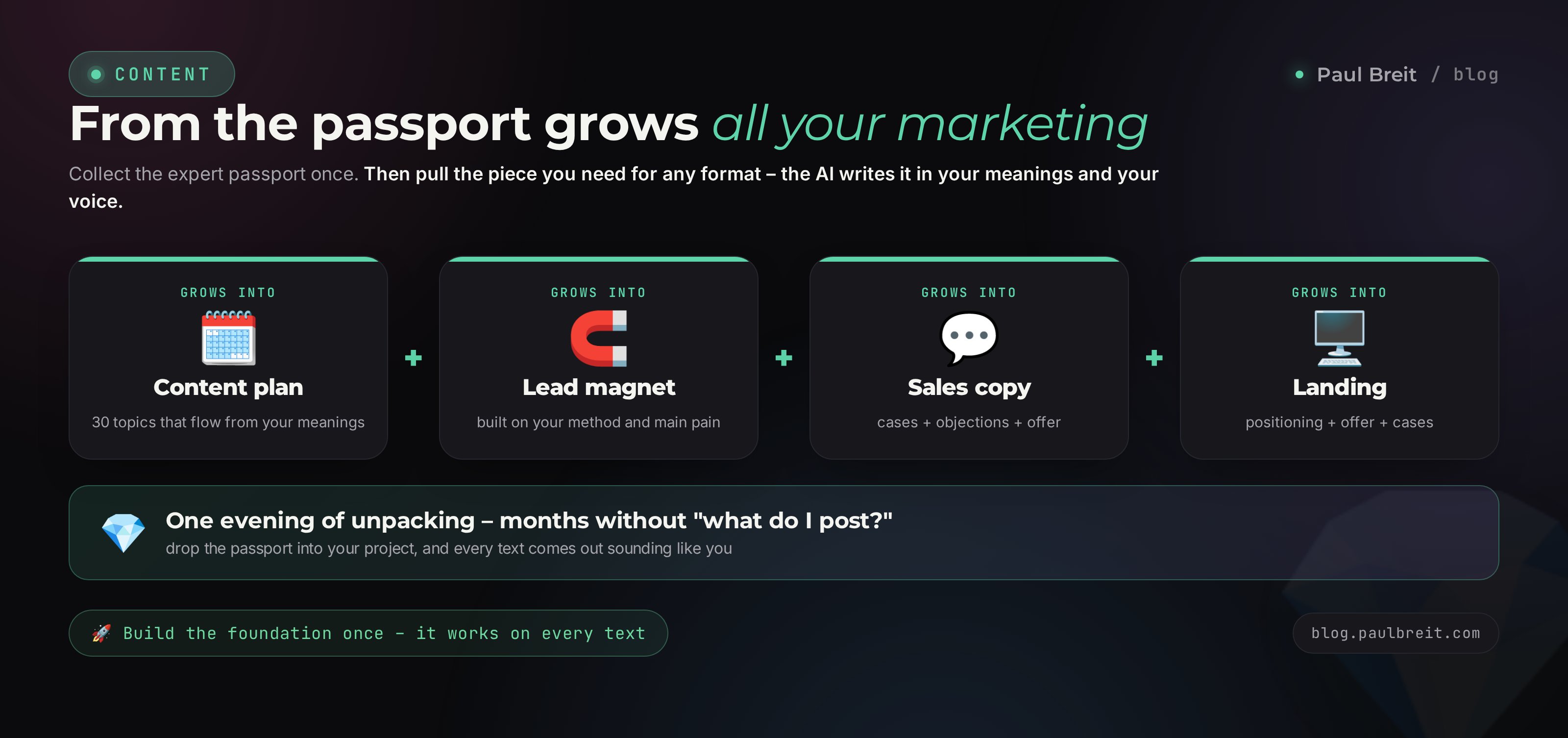
An expert passport isn't a document for the drawer. Almost your entire marketing grows out of it. Here's what comes from which block.
| What you're making | What you pull from the passport |
|---|---|
| A month of content | 30 topics + client pains + method. Built with this guide |
| Lead magnet | Method + the main pain. A quick lead magnet in an hour is built on exactly this |
| Sales and warm-ups | Cases + objections + offer |
| Landing page and profile bio | Positioning + offer + cases |
| Reel scripts | Topics + voice + stories from the path block |
| Funnel | The whole chain from lead magnet to offer – see the funnel breakdown |
Example: from passport to post in one prompt
Let me show how this works live. Say the passport has a method step called "the sell-to-the-face check" and a case about Marina the psychologist. You ask the AI right there in the project: "Write a post about why a specialist has followers but no sales. Lean on my method and Marina's case, write in my voice."
Without unpacking, the AI would produce a generic text about "the importance of warming up your audience" – smooth and off the mark. With the passport in the project, it takes your own phrasing about selling to the face, drops in Marina's real story with her numbers, and picks up your pet words from the voice block. What comes out is a post that reads like you dictated it yourself, not like it was assembled in a minute. Proofing takes five minutes instead of an hour of writing from scratch.
Every format works this way. A passport assembled once turns the AI from "writes text in general" into "writes text about you." From there all that's left is pulling the right chunk for the task.
One evening of unpacking closes out months of agonizing over "what do I even post about" and "how do I explain what makes me better." Topics stop being conjured out of thin air – they flow from your own meanings. And every text sounds like you, because the AI holds your voice inside the project.
If you've already built prompts for experts before, unpacking strengthens every one of them: any prompt now gets dense context about you on the way in and hands you text on the way out that you can publish without a rewrite.
Section 07Five unpacking mistakes
Here are the most common failures that leave unpacking empty. Check yourself against the list.
- Answering short and polished. The big one. You hand over an edited version of yourself and the AI works with emptiness. Answer raw and in detail.
- Letting the AI invent. Without an explicit ban, it will make up pretty phrasings and slip you the market average. In the prompt you flatly forbid inventing facts, and you check every number by hand afterward.
- Stopping at the first answer. Depth lives on the third and fifth "why." If the AI stops following up too early, push it yourself: "dig deeper, that's still surface level."
- Making it and forgetting it in a folder. A passport with no use is just a file. Drop it into the project right away and write through it from your very first post.
- Chasing pretty words instead of specifics. "I help you unlock your potential" sounds smooth and means nothing. "I help psychologists hit $2K a month with a personal brand and no round-the-clock stories" – that works. Specifics always beat abstraction.
You gathered the context: profile, transcripts, cases, reviews – all into the project. You gave the AI the interviewer role with a prompt. You went through the seven blocks, answering honestly and in detail, pressing every "why." At the end you asked it to assemble the expert passport, read it through, and filled the gaps. You put the passport back into the project. Now your content plan, lead magnet, sales copy, and landing page grow out of it – and every text sounds in your voice.
Section 08Unpacking checklist
- Input material gathered: profile, 5–10 transcripts, client results, reviews, strong posts.
- A separate project created, all material loaded into the files.
- The interviewer prompt pasted into the project instructions; the role holds.
- All seven blocks completed, answers raw and detailed rather than polished.
- On every topic the AI pushed at least three follow-ups.
- A summary taken at the end of each block and checked for accuracy.
- The expert passport assembled across all nine structure points.
- The document proofread, "needs filling in" gaps closed, numbers verified.
- The passport placed in the project as permanent context.
- The first post already written through the passport – and it sounds like you.
Unpacking is one of those cases where a single evening of work pays off for months. After it, you stop conjuring what to write and how to explain yourself. You just pull the right chunk from the passport and the AI assembles the text in your meanings. Sit down and unpack yourself today – tomorrow your content flows completely differently.
FAQFrequently asked questions
How is unpacking with AI different from working with a marketer?
A marketer is limited by the length of the call and by their own attention: after an hour or so they tire, and part of your answers gets heard through the lens of their experience. AI asks 150–200 questions in a row without fatigue, follows up five times, holds your whole context at once, and isn't shy about being dogged. The depth comes precisely from the volume of follow-ups, which a live person doesn't have the resource for.
How long does unpacking your expertise with AI take?
Prepping the context – 30–40 minutes. The interview itself – anywhere from an hour and a half to three hours, and you can split it across two or three sittings. Assembling the expert passport from the answers – about 20 minutes of the AI's work plus your proofread. In one evening you can realistically go from the start to a finished document.
Which AI is best for unpacking?
Claude – it holds long context, asks live follow-up questions, and doesn't lose the thread after a hundred turns. In some regions you'll need a VPN set to an EU or US location. Signing up and paying are covered in the getting-started article. ChatGPT can handle it too, but over a long run it more often loses the thread.
What do I need to prepare before unpacking?
Your profile or site, 5–10 transcripts of your calls or streams, a list of client results with numbers, and a couple of reviews. The more live material there is, the less the AI guesses and the more precisely it pulls your own phrasing rather than the market average.
Can I unpack myself if I'm just starting and barely have cases?
Yes. Then the interview's weight shifts onto your path, your experience before this niche, personal stories, and first small results. The AI pulls meanings from your biography and your transferred skills. You'll add cases later and update the expert passport.
Won't the AI make up facts and numbers for me?
It will, if you let it. In the prompt you flatly forbid inventing facts and ask it to flag anything that wasn't in your answers. You verify every number in the final document by hand. The AI pulls out and packages what you said; it doesn't compose a biography.
What do I do with the finished expert passport next?
Almost your whole marketing gets built from it: content plan, lead magnet, sales copy, landing structure, video scripts. The passport goes into the AI project as permanent context, and from there any text is generated already in your meanings and your voice.
How often do I need to redo the unpacking?
Once every six months to a year, or when your product, niche, or positioning changes. The base of meanings lives a long time; what updates is the cases and the offer phrasing. It's easier to keep the expert passport as a separate file and add to it than to unpack yourself from scratch again.