A content plan for a month in one evening: prompts and a live example
You sit down in the evening with a cup of tea, open an AI chat – and by midnight you have 30 topics for the month, laid out by day, with hooks and formats for each platform. I'll show the whole system: which five inputs to gather ahead of time, which prompt gives a working plan instead of an empty list, and how to unfold one topic into a post, a reel, and a carousel. With a live dialog with Claude, from the first request to a finished calendar.
To build a month's content plan in one evening, give the AI five inputs: your niche, an audience profile, your product, two or three of your own posts as a voice sample, and a list of formats. Then one prompt builder: "generate 30 topics for 30 days, split them across content pillars 40/30/20/10, give each topic a hook and a format." You get a table of topics, lay it out on a calendar, and with a second prompt you turn each topic into a finished post. One evening – and a month's plan is done.
Sunday evening. You have to post tomorrow and the editor is empty. You open the channel, stare at the blinking cursor, and spend ten minutes figuring out what to even write about. You come up with one topic, publish it – and tomorrow you start from scratch again. Two weeks in, the drive runs out and the channel goes quiet for a month. Then it feels awkward to come back, so you come back even later.
The problem isn't laziness or a shortage of ideas. You have plenty of ideas. The problem is that you make the "what to write about" decision fresh every single day, at the worst possible moment – when you're tired and out of time. A content plan takes that decision off your plate. You sit down once, build a month, and after that you just grab what's ready and post it.
This kind of plan used to eat a whole day: write out topics, check they don't repeat, arrange them by logic, come up with headlines. Now it's one evening and an AI. I run four client projects and a personal channel of 20,000 followers, and I build the content plans for all of them on the same scheme. That's the one I'll show – with every prompt you can copy and paste right now.
What's inside
- Why bother with a plan if you can just go "on inspiration"
- Five inputs to gather before the AI
- The prompt builder: setting the task for 30 topics
- A live example: the dialog with Claude from start to plan
- Splitting topics across content pillars
- A 30-day calendar: laying it out by day
- From topic to finished post: the second prompt
- One topic – five formats
- 5 mistakes that leave a plan in a drawer
- If the plan came out weak: quick fixes
- A content plan for different niches
- The whole path in a minute
I build plans in Claude – it holds voice and long context better than anything else. If you're outside the US or EU, you may need a VPN set to a supported region, and Anthropic blocks a handful of countries by IP. Sign up at claude.ai; a step-by-step guide to access and payment is in the piece on getting started with Claude. Everything here works the same in ChatGPT – the prompts below are universal.
Section 01Why bother with a plan if you can just go "on inspiration"
There's a pretty myth: a real expert writes from the heart when the mood strikes, and that's exactly what lands. Sometimes it does strike, and a strong post really comes out. But a channel runs on rhythm, and bursts of inspiration don't replace it. Your audience gets used to you when you show up regularly. Disappear for two weeks – they forget you, reach drops, and only half of them see the next post.
Working "on inspiration" breaks for three reasons. First: inspiration comes irregularly, but posts are needed on a schedule. Second: when you come up with a topic in the moment, you grab the first thing that pops into your head, and that's usually the most obvious one. Third: without a plan you don't see the whole picture, and the content comes out jagged – three posts in a row about the same thing, then an abrupt selling post that looks like a shout in the silence.
A plan solves all of this at once. You sit down once, calm, look at the month from above, and lay out topics so they lead the reader by the hand. Value, story, more value, engagement, a soft sell. The reader doesn't get tired and doesn't feel sold to head-on. And in the morning you don't agonize over the choice – you open the plan, take the day's topic, and put a post together in 15 minutes.
A channel that posts 4-5 times a week steadily for six months grows 3-4 times faster than one that pumps out 10 posts in a lucky week and stays silent the rest. Algorithms and real people love predictability equally. A plan is exactly that predictability machine, and the AI simply strips all the drudgery out of it.
Section 02Five inputs to gather before the AI
The classic beginner mistake is to open a chat and type "come up with a content plan for a psychologist." The AI will hand you twenty topics on the level of "5 signs of burnout" and "what personal boundaries are." Technically those are topics. They won't sell, because every psychologist on earth writes them and your audience has read them a hundred times.
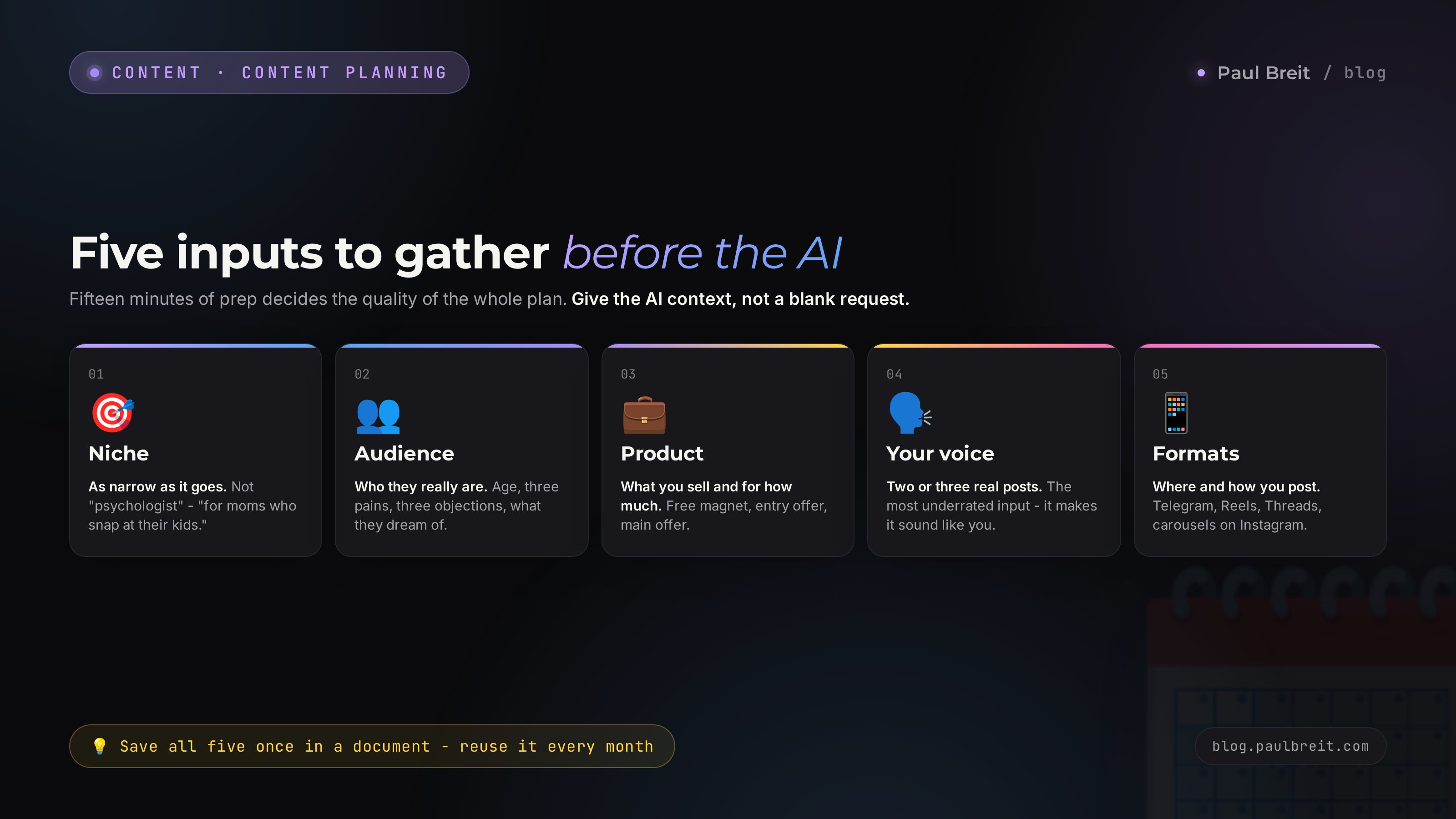
For the plan to come out as yours, not average-of-the-ward, the AI needs context. Gather five things ahead of time – it takes 15 minutes and decides the quality of the whole plan.
Niche – as narrow as it goes
"Psychologist" is too broad. "A psychologist for moms on leave who snap at their kids and blame themselves" – now that's a precise picture. "Marketer" says nothing. "I help nail techs land clients through Instagram" – it's instantly clear who needs you. The narrower it is, the more precisely the AI hits the pains of specific people. If your niche is fuzzy, first look at the piece on choosing your niche – without that foundation any plan will be blurry.
Audience profile – who these people really are
Age, situation, three main pains, three objections, what they dream about. Example: "women 30-45, back from parental leave, want to lose weight but have no energy for diets or the gym; afraid of slipping up, don't believe it'll work for them, ashamed of their bodies." The AI later uses these exact phrasings in hooks, and they land, because a person recognizes herself.
Product and the offer ladder
What you sell and for how much. A free lead magnet, a low-priced entry product, the main product. The AI needs this to place selling posts correctly and lead to the purchase gently. If you have one expensive product, say so – the plan will warm people up longer before selling.
Your voice – two or three real posts
This is the most underrated input. Copy two or three of your own posts in full and paste them into the prompt with "write in this tone." Without a sample, the AI hands you smooth, faceless text you can spot from the first line. With a sample, it picks up your manner: sentence length, favorite words, how much you joke. How to teach it to sound like you is covered in detail in the piece on voice through 30 posts.
Formats and platforms
Where you post and in what formats. Telegram only? Telegram plus reels? Do you run Threads and Instagram carousels? This decides how the AI lays out the topics – for text, for video, for visuals. While you're at it, ask it to alternate formats so the channel doesn't turn into a wall of identical text slabs.
It's handy to collect all five inputs once into a separate document and keep it on hand. Claude has Projects for exactly this – you load in the description of your niche, audience, and post samples, and the AI remembers them in every new chat. No re-pasting the audience profile every month. How that's set up is in the piece on Claude skills for writing.
Section 03The prompt builder: setting the task for 30 topics
Now the main thing – the prompt that turns five inputs into a working plan. It has five blocks: context, voice, task, structure, response format. Each block plugs one leak where quality usually drains out. Here's the ready template; paste your data into the square brackets.
You are my content strategist with experience in info-marketing.
Help me build a 30-day content plan for a Telegram channel.

1. CONTEXT
I am [niche: a nutritionist for moms on parental leave].
Audience: [women 30-45, back from leave, want to lose weight
without harsh diets; afraid of slipping up, don't believe
in results, ashamed of their bodies].
I sell: [a nutrition program for $200 and a review for $40].

2. VOICE
I write like this (hold this tone across every topic):
[paste 2-3 of your own posts in full].

3. TASK
Come up with 30 topics for 30 days. Each topic is one idea
that hooks my audience and gently leads to the product.
Topics must be specific and non-generic: my own observations,
breakdowns of real situations, stories, numbers. No general advice.

4. STRUCTURE
Split the topics across content pillars:
40% - value (how-tos, breakdowns, instructions),
30% - engagement (stories, takes, questions),
20% - values (views, inspiration, behind the scenes),
10% - selling (offer, cases, reviews).
Alternate the pillars; don't place selling posts back to back.

5. RESPONSE FORMAT
A table: Day | Topic | Pillar | Hook (first line of the post) |
Format (post / reel / carousel / poll).
Write hooks that grab, in plain living language, no corporate-speak.
Let me walk through why each block sits where it does.
Context sets the boundaries. Without it the AI writes for an abstract person and the topics come out about everything at once. With an audience profile it strikes specific pains.
Voice is what sets your plan apart from anyone else's. Two sample posts change the result more than any adjectives like "write in a friendly, expert tone." The AI copies what it sees, not what you describe in words.
Task with the "specific and non-generic" qualifier cuts the filler. Without saying it, half the topics will be along the lines of "the importance of a sleep schedule." A direct request for personal observations and numbers turns the AI toward your experience.
Structure with pillar percentages is the reason the plan will sell, not just entertain. More on the pillars themselves below.
Response format as a table saves you an hour. You see the whole month at once: where the value is, where the sell is, which post fills which day. And a hook in the first line is already half of the future post.
If you skip the "Voice" block, the AI hands you topics that look decent but reek of a template. The hooks will be even and faceless, every one starting with "Want to learn how to…". A living person doesn't write that way. So keep samples of your posts in the prompt always – without them the plan comes out smooth and dead. How to scrub machine traces from finished texts if some slip through is in the piece on AI markers and cleanup.
Section 04A live example: the dialog with Claude from start to plan
Let me show it end to end. I'll take a real niche – a nutritionist for moms on parental leave – and walk through the whole dialog. You'll see what the AI answers, where it stumbles, and how to fix it with a single line.
I send the prompt builder with the inputs filled in. Claude thinks for a couple of seconds and returns a table. The first rows look like this:
Day 1 · Pillar: engagement · Topic: "Why I gained 26 lbs on leave and couldn't lose it for two years" · Hook: "I'm a nutritionist. And for two years I couldn't lose the baby weight. Let me tell you what was going wrong." · Format: post
Day 2 · Pillar: value · Topic: "Three 5-minute breakfasts that kill the sugar craving by noon" · Hook: "If by 11 a.m. you're already digging through the cupboard for cookies, look at your breakfast – that's usually where it starts." · Format: carousel
Day 3 · Pillar: value · Topic: "How to eat at the same table as your kids and not finish their plates" · Hook: "Motherhood is when you're not hungry but you finish three spoons of porridge after your child. Every day." · Format: post
Already not bad. The hooks are alive, the topics hit recognizable situations. But I see a problem: by day three there are two value posts in a row about food and hacks, and the personal-voice stories run out. I fix it in one line.
Claude: Got it, reshuffled. Now after two value posts comes a personal story or a question to the audience. Here's the updated plan...
The AI rebuilds the table. Now the rhythm is even: value, value, story, engagement, value, values, soft sell. I read on and notice the selling posts sit too early – on days 6 and 9, when the audience isn't warmed up yet. One more correction.
Claude: Moved it. First sell is day 12, through the story of a client, Olga, who lost 18 lbs with no bans. I left the direct offer for day 27, closer to the end of the month.
Three short replies – and the plan went from "fine" to working. The whole dialog took about ten minutes. That's the essence of working with an AI: it produces the rough volume in seconds, you fix the meaning and rhythm with short commands. To phrase requests more precisely, see the piece on the five-part prompt structure.
Don't expect a perfect plan from the first answer. The first answer is clay. You shape it with three or four tweaks: mix the pillars, add personal, push the sells later, sharpen the hooks. Each edit is one line. Ten minutes later the plan is done, and it sounds like yours, because you led the AI instead of accepting its first version in silence.
Section 05Splitting topics across content pillars
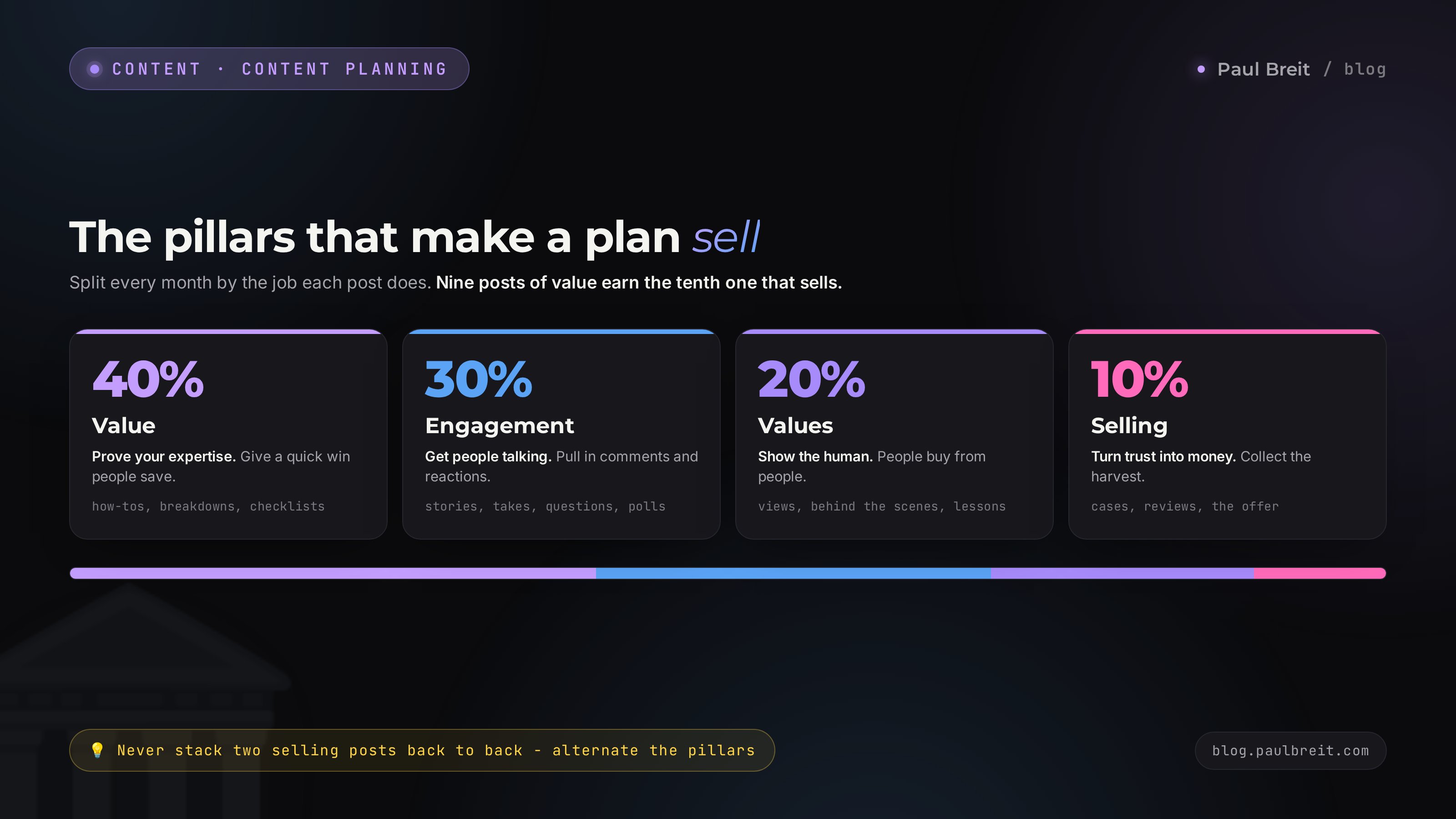
Content pillars are types of posts by their job. Without them the plan skews: either wall-to-wall value that gets boring, or wall-to-wall stories after which no one can tell what you even sell. Here's the proportion tested on my channels.
| Pillar | Share | Job | Example topics |
|---|---|---|---|
| Value | 40% | Show expertise, give a quick win | instructions, breakdowns, checklists, "how to do X" |
| Engagement | 30% | Get people talking, pull reactions and comments | stories, takes, questions, polls, debates |
| Values | 20% | Get closer, show the human behind the expert | views, behind the scenes, mistakes, inspiration |
| Selling | 10% | Turn trust into money | cases, reviews, the offer, an invite to a call |
Here's why it works this way. Value is the foundation: it proves you know your stuff, and people save it. Engagement lifts reach, because comments and reactions tell the algorithm the post is alive. Values make you a person worth trusting – people buy from people. Selling harvests what the first three built.
Ten percent for selling scares beginners: it feels like you should sell more often or no one will buy. In reality it's the opposite. When nine of ten posts give value and warmth, the tenth selling post reads calmly, as a natural continuation. When every third post pushes something, people get tired of the channel and unsubscribe.
The AI holds this proportion on its own if you set it in the prompt. But check with your eyes: ask it to print a summary of "how many posts of each pillar came out." Sometimes it gets carried away and gives 50% value. One line, "bring it back to the 40/30/20/10 proportion," and everything falls into place.
Section 06A 30-day calendar: laying it out by day
You have the table of topics. Now turn it into a calendar you can actually live by. Three things matter here: frequency, selling days, and slack for the spontaneous.
Frequency. For Telegram a healthy rhythm is 4-5 posts a week. Every day isn't needed – it wears out both you and the reader. Thirty topics for the month land nicely on "every other day plus weekdays." Ask the AI: "lay out the 30 topics across weekdays, keep weekends lighter – Saturday a lifestyle post or a poll, Sunday a break or a repost of the best."
Selling days. Place selling posts when the audience is more active and in the mood to spend. In my experience that's Tuesday to Thursday, first half of the day. Monday people are digging out of their tasks; by Friday evening their minds are already on the weekend. Tell the AI to shift all the selling posts to Tuesday and Wednesday.
Slack. Don't nail down all 30 slots. Leave two or three days empty for the live stuff: a strong review comes in, something happens, news breaks in your topic. A spontaneous post on something hot often outperforms a planned one. A plan is a frame, not a straitjacket.
Lay out the 30 topics across a month's calendar:
- 4-5 posts a week, on weekdays;
- Saturday - a light post (lifestyle, poll),
  Sunday - a break;
- shift all selling posts to Tuesday and Wednesday,
  the first half of the day;
- leave 3 days empty for spontaneous content,
  mark them as "reserve."
Print the final table with dates starting from [start date].Move the table from the AI into wherever it's easy for you to check things off: Notion, Google Sheets, or a plain note. I keep plans in Notion – I stash the finished post texts under each topic there too, so the whole month's editorial lives in one place. The main rule: the plan has to be in front of your eyes every morning, or it doesn't work.
Section 07From topic to finished post: the second prompt
The plan is a map. But you still have to walk it: turn each topic into text. That's the second prompt, which makes a finished post out of a table row in 15 seconds. And again the key is voice, so keep the post samples in the same chat or in a Project.
Take the day 7 topic from the plan:
"[topic + hook from the table]".

Write a Telegram post in my voice (samples above).
Structure:
- a grabbing hook in the first line (you can take it from the plan);
- short paragraphs of 2-3 sentences, the text breathes;
- one specific example, story, or number;
- end with a soft question or a light call to action.

No markdown, no long dashes, address the reader directly.
Length 1,200-1,800 characters.
The AI hands you a finished post. From there, two paths. If it hit – you copy it, tweak it a bit, publish. If it missed – you fix it in one line: "too long, cut it in half," "the first line is weak, give me five hook options," "add a specific story from practice." In two or three iterations the post is ready.
An important note on editing. Even a good AI post is worth passing your eyes over and dropping in something only yours: a client's name, a detail from yesterday, your favorite phrase. It takes a minute and turns "AI text" into "your post, built with AI." The reader feels the difference even without noticing it.
Don't write posts one at a time, once a day. Sit down that same evening and run 7-10 topics for the week ahead through the second prompt at once. The AI is already in context, the voice is picked up, it goes like clockwork. An hour of work and a week of posts is ready and queued. After that you don't think about content at all, you just answer comments.
Section 08One topic – five formats
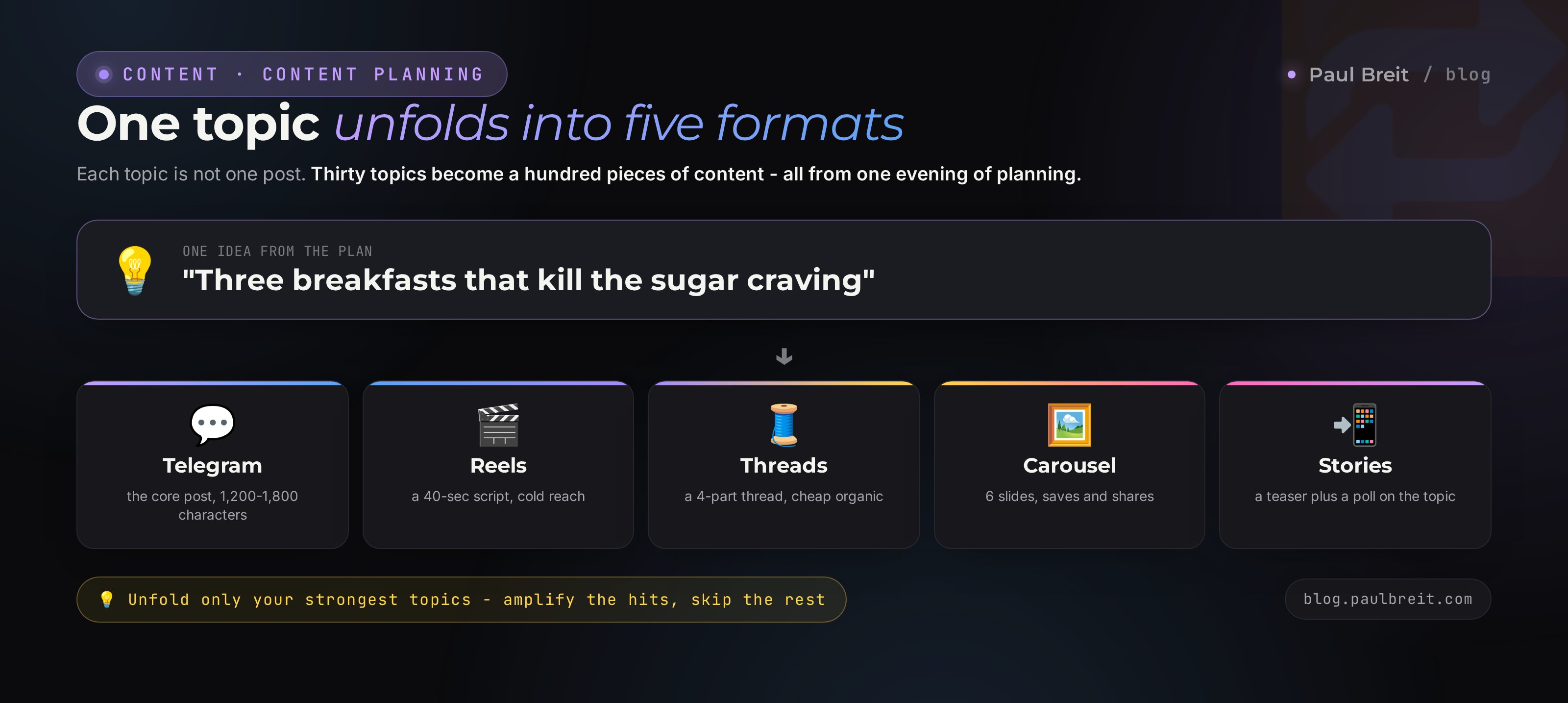
This is where the plan starts to pay off big. Each topic is not one post. It's a post, a reel, a Threads thread, a carousel, and stories. One idea, five touchpoints across different platforms. Thirty topics turn into a hundred pieces of content, all from one evening of planning.
A third prompt unfolds the finished post into other formats:
Take this post and repurpose it, keeping the meaning and my tone:

1. REEL (a 40-second script): a hook in the first 3 seconds,
   3 short points, an ending with a call to action. Written for
   voiceover, the way people talk, not the way they write.

2. THREADS (a 4-part thread): the first part a grabbing
   statement, then one idea unpacked per part.

3. CAROUSEL (6 slides): one idea per slide, slide 1 the
   cover with the hook, the last one a CTA. Give the text of each slide.
The logic is simple. The post lives in Telegram. The reel catches new cold audience on Instagram and Meta. The thread works on Threads, where organic reach is cheap right now. The carousel gets saved and forwarded – it has a long tail. One idea, served in different ways, catches a person wherever they spend their time.
You don't have to drag every topic into all formats. Take a rule: unfold the strongest topics of the month (wow-effect value and gripping stories) into a reel and a carousel, and leave the rest as posts. That way you amplify the hits and don't drown in production. On building carousels on autopilot there's a separate piece on Instagram carousels, and on running Threads with AI – the one on Threads automation.
Section 095 mistakes that leave a plan in a drawer
Asking for a plan with no inputs
"Come up with a content plan for a coach" gives you twenty clichés that every coach writes. The AI doesn't know your niche, audience, or voice, so it takes the average. Cured by the five inputs from section 02. Fifteen minutes of prep changes the quality of the whole plan.
Taking the first answer in silence
The first plan is a draft. Publish it as is and it comes out smooth and faceless. A strong plan is born in dialog: mix the pillars, add personal, push the sells later, sharpen the hooks. Three or four edits and the plan is yours.
Overloading on selling
The fear of "what if they don't buy" pushes people to run selling posts every other day. The audience gets tired and unsubscribes. Hold 10% for selling; the rest is value and warmth. What sells is the trust built by nine posts, not the tenth shout of "buy."
Building a plan and never writing the posts
A pretty table in Notion is not content yet. Many stop at the plan and go back to inventing text from scratch every morning. Run the topics through the second prompt in a batch right after planning – a week of queued posts in an hour.
Forgetting your voice and live details
A post without a single detail of yours reads like a robot's text, even if it's smooth. Drop in client names, moments from yesterday, your own turns of phrase. A minute of work turns a generation into your post. The audience senses the fake faster than you'd think.
Section 10If the plan came out weak: quick fixes
Sometimes after the first prompt the plan disappoints: boring topics, limp hooks, all like everyone else's. This is fixable – no need to rewrite the inputs from scratch. Here are five commands that pull a plan out of the swamp.
- Topics are generic. "These topics are too general; everyone in my niche writes them. Give me topics from my own experience, contrarian takes, breakdowns of specific situations, non-obvious observations."
- Hooks don't grab. "Rewrite all the hooks. Each must stop the scroll: a question tied to a pain, an unexpected statement, a number, the start of a story. No 'want to learn.'"
- Everything's about one thing. "The topics are too narrow, it'll get monotonous. Widen it: add topics about money, relationships with the people around them, inner fears, not just [the main topic]."
- Doesn't lead to the product. "Tie the topics to my product. Let the value naturally point to the full solution being in [product]. Without being pushy."
- Doesn't sound like me. "You write too smooth and formal. Here are three more of my posts – pick up the choppy rhythm, the humor, and the plain words. Rewrite the hooks in that tone."
Before you queue the posts, read five hooks out loud. If even one sounds like a radio ad or a school essay, fix it. Living text reads easily and feels like it's talking to you. Wooden text trips on the very first phrase. Your ears are a better fake-detector than any checklist.
Section 11A content plan for different niches
The scheme works for anyone who sells services, courses, or consulting. Only the inputs and the emphasis change. Here's what a starting flagship topic and the main pillar look like across different niches.
| Niche | Strong pillar | Example flagship topic |
|---|---|---|
| Psychologist | Stories + value | "A client endured it for a year, then left after one conversation. Here's what was said" |
| Nutritionist | Value + before/after | "Three breakfasts that kill the sugar craving by noon" |
| Tutor | Value + results | "How to raise a grade in a month when your kid hates the subject" |
| Coach | Values + engagement | "Why goals don't work and what to set instead" |
| Service pro | Before/after + value | "Clients left after the first visit. One detail changed everything" |
| Marketer | Value + cases | "I audited a client's funnel and found where the leads were leaking" |
| Expert mentor | Cases + values | "My client earned more than me. I couldn't be happier about it" |
The principle is the same for everyone. Find the audience's main pain, come in through it with a story or value, show the result, lead to the product. The AI tunes topics to the niche if you gave it a precise audience profile. The more specific the inputs, the fewer edits on the way out.
Section 12The whole path in a minute
Here's everything in a short route to keep on hand.
- Gather the five inputs before the AI: niche (narrow), audience profile (pains and dreams), product, two or three of your own posts, formats. 15 minutes.
- Send the prompt builder of five blocks: context, voice, task, structure, response format. Get a table of 30 topics.
- Refine the plan in dialog: mix the pillars, add personal, push the sells to the end, sharpen the hooks. Three or four edits.
- Check the 40/30/20/10 proportion of pillars and lay the topics out on a calendar: 4-5 posts a week, sells on Tuesday-Wednesday, three days in reserve.
- Run the topics through the second prompt in a batch – a week of posts in an hour, all queued.
- Unfold the strong topics with the third prompt into a reel, a thread, and a carousel. Thirty ideas – a hundred pieces of content.
One evening instead of daily agony with an empty editor. The AI takes on the volume and the grunt work; you make the decisions and add the live parts. The channel fills up evenly, the audience gets used to the rhythm, and sales come in soft and steady. And best of all – your head is free for clients and life, not stuck on the eternal "what should I write about tomorrow."
Don't put it off until "whenever I'm in the mood to build the whole month." Tonight, take only the first step: gather the five inputs into a note. Twenty minutes. Tomorrow you paste them into the prompt builder and get the plan. The system starts with one note, not with a perfect free day that will never come.
FAQFrequently asked questions
Which AI is better for a content plan – Claude or ChatGPT?
Both handle it. Claude holds long context and voice a little better, so I build plans in it. ChatGPT is faster on short tasks and handier if you already live in its ecosystem. The prompts from the article work in either one with no changes. If you're choosing your first AI, start with the one that's easier for you to access.
How long does it actually take to build a month's plan?
Prepping the inputs is 15 minutes if you're doing it the first time. The plan itself, with edits in dialog, is 20-30 minutes. Running the topics into finished posts in a batch is another hour. So, one evening. From the second month the inputs are already made and stored in a Project, so the whole cycle drops to an hour or two.
Won't AI posts all look the same and faceless?
They will, if you skip the block with samples of your voice and take the first answer in silence. With two or three of your own posts in the prompt and a light edit, the texts sound like you. Add live details: client names, moments from practice, your own turns of phrase. A minute of work on a post removes the robot effect.
How many posts a week is optimal for Telegram?
A healthy rhythm is 4-5 posts a week, steady, for months. Every day isn't needed: it wears out both you and the reader, and quality drops. Consistency beats volume – a channel with a steady five posts grows faster than one that pumps out ten in a lucky week and stays silent the rest.
How often should I run selling posts without wearing people out?
Hold the 10% ratio – about one selling post for every nine that give value and warmth. What sells is the trust built by value and stories; frequent head-on selling scares people off and leads to unsubscribes. Place the first selling post of the month only after the audience has warmed up – usually past day 10-12.
What do I do if the AI hands me generic topics?
Ask for specifics: "give me topics from my own experience, contrarian takes, breakdowns of real situations, non-obvious observations, not general advice." Generic output shows up when the AI doesn't know your niche and audience. Sharpen the audience profile with its pains and add samples of your posts – the topics get sharper right away.
Do I need to pay for an AI for this task?
A basic plan comes together even on the free tier. But a paid subscription (Claude Pro or ChatGPT Plus, about $20 a month) holds long context, remembers your inputs, and works without limits on the number of requests – for regular content work it pays for itself in the very first month of time saved.
Can I plan for several platforms at once?
Yes, and that's the main payoff. You build the plan once, then with a third prompt you unfold the strong topics into a reel, a thread for Threads, and a carousel. One idea works across four platforms. Thirty topics for the month turn into a hundred pieces of content with no extra planning.