How to Remove AI Traces From Your Writing: 5 Markers and a Cleanup
AI writing gives itself away with the same filler phrases, flat rhythm, and dead punctuation. Here are the 5 markers that readers and algorithms spot instantly, plus a four-pass cleanup. You also get a ready prompt so Claude writes like a human from the start, and one paragraph rewritten before and after.
AI traces are the repeating filler phrases (it's important to note, in today's world, furthermore), the "not just X, but Y" flip, lists of exactly three items, sentences of identical length, and flawless punctuation with em dashes. You remove them in four passes: strip the filler, break the templated constructions, restore a ragged living rhythm with real words, fix the typography, and read the text out loud. The fastest route is to hand the AI a prompt that bans those phrases up front. Manual cleanup runs 5–10 minutes per post; with a prompt it is close to zero.
You ask an AI to write a post. Ten seconds later it hands back a smooth, polite, perfectly correct block of text. You paste it into your channel. And under the post: silence. No reads to the end, no reactions, no replies. Within two paragraphs the reader felt that no human wrote this, and scrolled on. The topic was fine. The grammar was flawless. What killed the post was the texture – that AI accent everyone can hear.
I run four client projects and a personal channel of 20,000 subscribers, and almost all of the rough draft starts in Claude. The gap between "you can see the robot" and "this sounds like me" is 5–10 minutes of cleanup against a clear list. That list is below, in full, with before-and-after examples.
You'll read this in 22 minutes. You'll clean your very next post in ten. And once you drop the ready prompt into your AI, cleanup almost disappears – it starts writing clean from the first line.
What's inside
Section 01Why AI writing is obvious from a mile away
Open any feed. Under every third post you get that feeling: a human didn't write this. It isn't the topic and it isn't mistakes – there are no mistakes. It's the texture. By default an AI assembles a sentence from the averaged mush of the whole internet and returns the most likely, safest option. What comes out is smooth, even, and completely faceless. People spot it within two paragraphs, even the ones who have never opened ChatGPT.
Where does the accent come from. The model was trained to be maximally safe and to please everyone, so it reaches for the most average, most neutral version of a phrase. It would rather write something smooth and empty than sharp and on the edge. Hence the polish without a face, the even phrasing, the vague generalities. Until you set a frame and a voice, the AI writes as the average author of the internet, not as you.
This isn't a cosmetic problem. Your voice on the page is an asset, and when it sounds like an answering machine, you lose money at every step. Here's exactly where.
Trust drops first
A human never phrases things perfectly evenly. They stumble, repeat themselves, drop in a live detail, land a short punch. When text is polished to a mirror shine, the reader feels it before they can name it. And then a simple logic kicks in: if the author didn't write this themselves, the product is probably slapped together the same way. Trust in the expert and trust in the offer sag at the same time.
Read-through and shares
Monotone text doesn't hold attention. On a channel your reach may not track quality directly, but reads-to-the-end, reactions, and shares do. And a share is growth: new people see it. Flat text with no living hook doesn't get shared. On Medium, LinkedIn, or any algorithmic feed, monotony kills retention, and retention there is a direct ranking signal.
Search and AI answers
Search engines and AI assistants keep getting better at filtering stamped-out content. Thousands of sites now crank out identical reviews with the identical phrases. That text doesn't stand out and doesn't make it into answers from ChatGPT, Perplexity, or Google. Living material with specifics, numbers, and a point of view gets cited more often – there's a whole breakdown of that mechanic in the article on getting found in AI search.
Sales
Sales copy works through voice. The reader needs to hear a real person behind the letters, someone they can ask a question and pay. A sterile offer reads like a bank email, and the reaction is the same: scroll. The exact same offer, written in a living voice, outsells the robot version many times over.
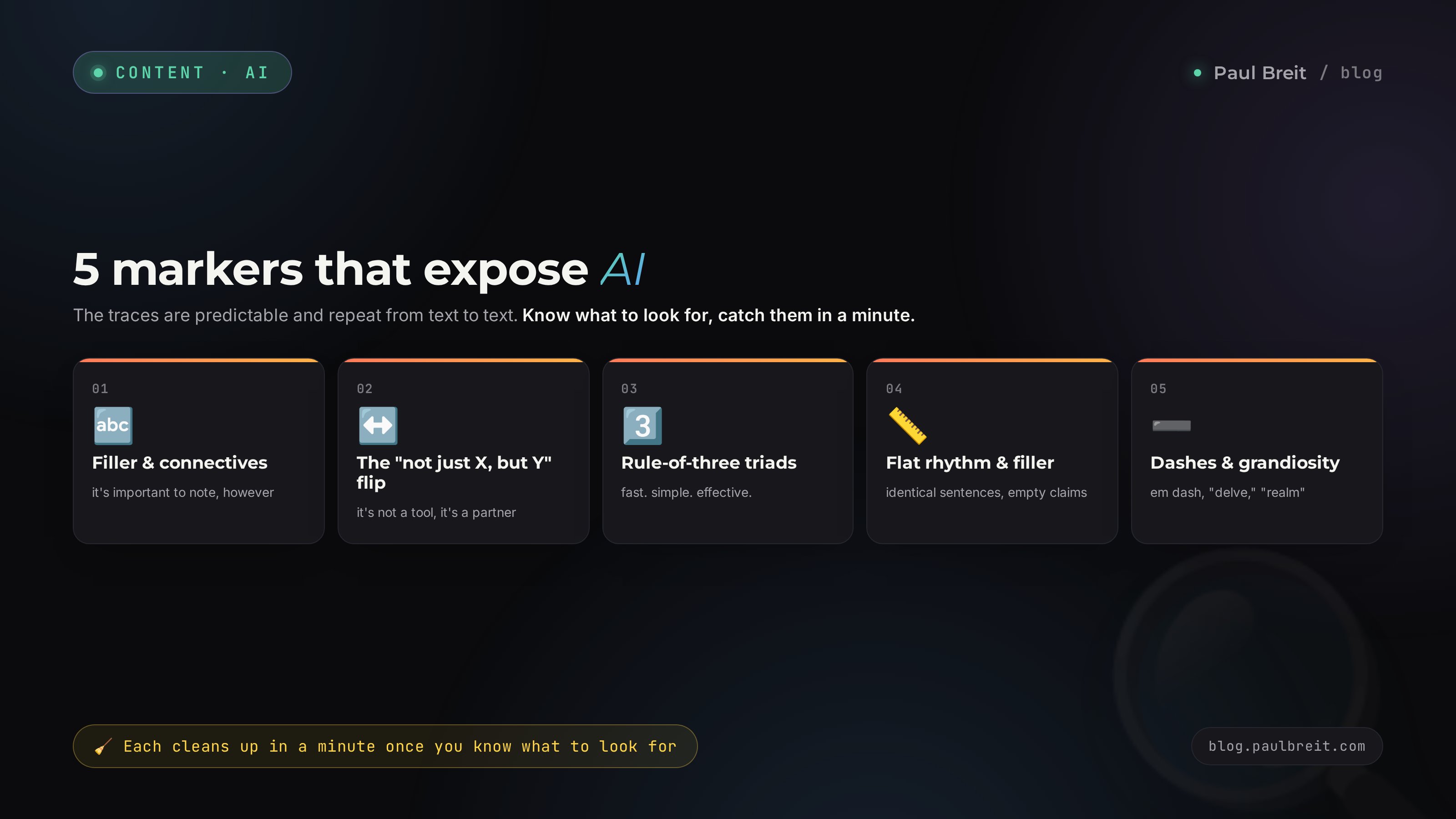
The good news: the traces are predictable. There aren't many, they repeat from text to text, and each one cleans up in a minute once you know what to look for. Below are the five markers an AI gives itself away with most often.
Section 025 markers of AI text – with examples
Below, for each marker: how it looks, why the AI loves it, and how a living version reads. Red marks the bits that expose the robot, green shows how a human would say the same thing.
Marker 1. Filler phrases and connective tissue
The first and most common trace. AI loves service connectives that mean nothing but fake a sense of flow. Here's the standard set worth stripping almost every time:
it's important to note, it's worth noting, in today's world, in the modern era, furthermore, moreover, however, additionally, first and foremost, when it comes to, needless to say, let's dive in, at the end of the day, that being said, in conclusion.
The trick is that almost every one of them just gets deleted with no replacement. The sentence doesn't break; it gets straighter and stronger.
It's important to note that in today's world, content plays a crucial role. Furthermore, it's worth noting that high-quality writing, needless to say, helps attract clients.
Content brings in clients. Full stop. One strong post a week does more than ten polished ones that say nothing.
Marker 2. The "not just X, but Y" flip
Every AI's favorite rhetorical move. It sounds clever, so the model glues it into every other paragraph: "it's not just a tool, it's a full-on partner," "it's not about the quantity, it's about the quality," "this isn't about money, it's about freedom." Once in a long piece is forgivable. But when the construction comes back-to-back, it exposes the generation instantly – a real person doesn't build sentences that way so often.
AI isn't just a passing trend, it's a powerful tool. This isn't about replacing the human, it's about amplifying them. It's not about technology, it's about results.
AI saves me about ten hours a week. I used to write posts by hand in the evenings; now the draft is ready in a minute and I just fix the voice. The freed-up time goes to clients.
The cleanup is simple: split the flip into two plain statements, or drop the negation and keep only the second half.
Marker 3. Rule-of-three triads
AI thinks in threes. Three bullets, three adjectives, three short choppy sentences in a row: "Fast. Simple. Effective." Or even parallel constructions: "No budget. No team. No experience." Rhythmically neat, but so predictable the eye trips over it. A human rarely lays a thought out in a perfect triad – they've got two points, or five, or one long developed one.
This method works. It saves time. It makes money. It changes how you approach content. No complex setup. No expensive subscriptions. No technical skills.
The method saves time and genuinely makes money – every post I've run for the last six months goes through it. No complex setup: open the chat, drop in the topic, grab the draft.
To break it: count the items. If there are exactly three and they're the same length, merge two and develop the third. It comes alive right away.
Marker 4. Flat rhythm and filler
Living text breathes: a long sentence, then a short punch, then a long one again. By default an AI outputs sentences of the same middling length, one after another, like a fence of identical planks. Plus it pours in filler: generalities with no specifics, "plays a vital role," "represents an effective solution," "unlocks new possibilities." Lots of words, zero meaning.
Leveraging AI unlocks a wide range of possibilities for businesses. This approach represents an effective solution for many tasks. It allows you to significantly optimize workflows and boost team productivity.
A landing page used to take me a full day. Now it takes an hour. Claude drafts the first version in a couple of minutes, and I rewrite the headlines and the offer for the client. A day turned into an hour. That's the whole optimization.
Filler is cured with numbers and personal detail. Replace every vague claim with a concrete fact: how much, when, for whom, with what result. A generality reads like an ad; specifics read like the truth.
Marker 5. Sterile punctuation and inflated vocabulary
The fifth trace is subtler, but a trained eye catches it fast. AI drops em dashes "—" where a person on their phone would use a comma or a short dash. It loves colons and semicolons, lays out every bullet with an emoji at the front, and reaches for grand words: "delve," "realm," "tapestry," "seamless," "a testament to." One long dash on its own proves nothing. But paired with a flat rhythm and the filler, it finishes the picture.
Let's delve into the realm of AI — a truly seamless and indispensable tool of the modern age. 🚀 It unlocks boundless horizons; it empowers creation; it inspires the new.
AI is a working tool, not a miracle. It writes drafts, I finish them. After six months I'm so used to it I barely write anything from scratch by hand anymore.
On typography specifically: my rule is a short dash "–," never a long em dash. More on that in pass 4.
Section 03The cleanup in 4 passes
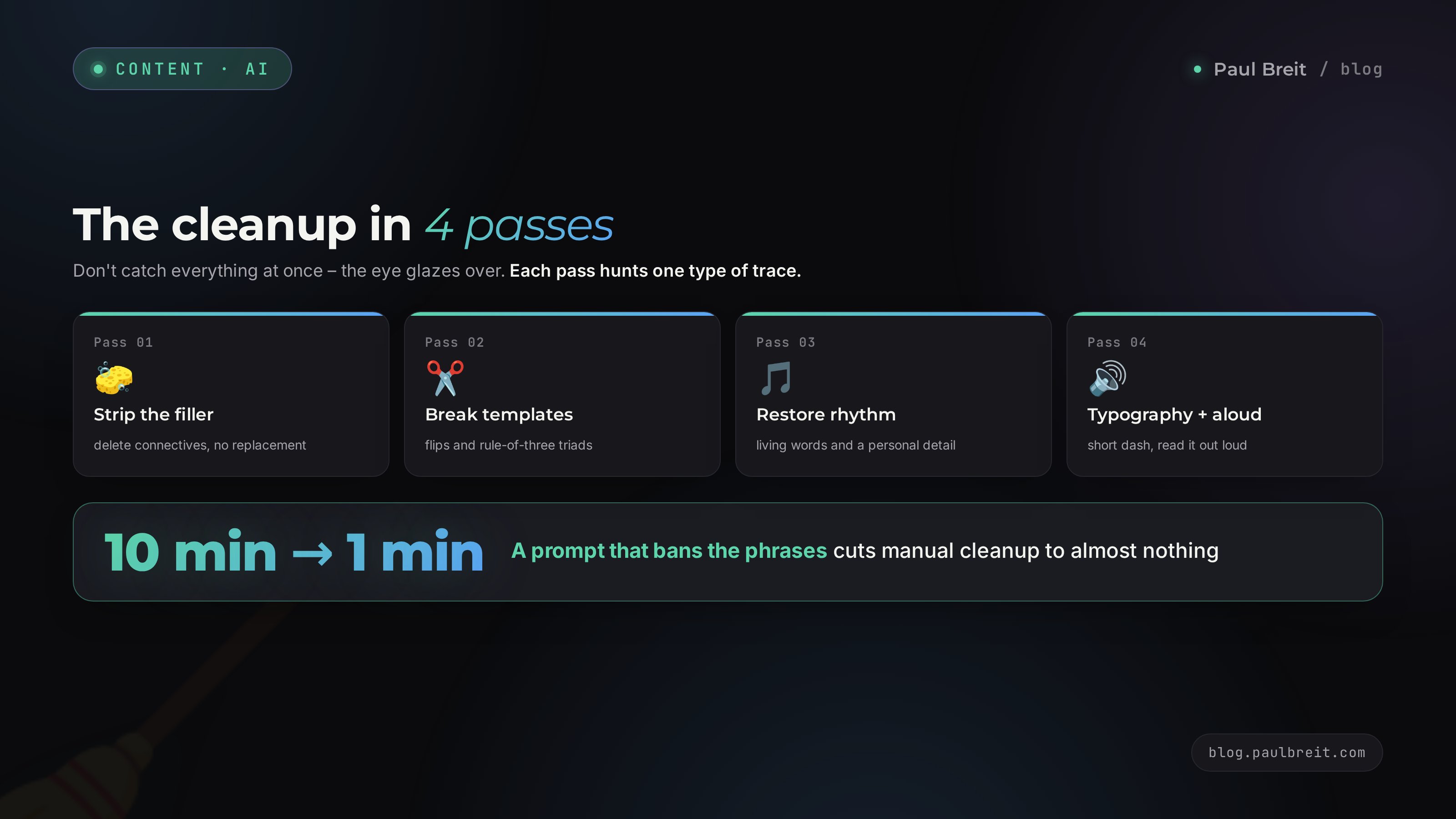
You know the markers, now the method. Don't try to catch everything at once – the eye glazes over. Clean the text in four passes, each time hunting only one type of trace. It's more reliable and faster. On a medium-length post all four passes take 5–10 minutes.
Pass 1. Strip the filler and connectives
Go through the text and delete every service connective from marker one. Don't replace them – delete them. "It's important to note that the method works" becomes "The method works." "However, there's a catch" becomes "There's a catch." Nine out of ten fillers come out with no loss of meaning, and the sentence only wins. While you're at it, catch the crutch words – "just," "really," "basically" – and cut them too if they carry no weight.
Quick trick: open find (Ctrl+F) and type the most common phrases one by one. Found one, delete it. After a couple of posts the set lives in your head and you catch them on the fly.
Pass 2. Break the templated constructions
The second pass hunts flips and triads. Every "not just X, but Y" either splits into two plain sentences or keeps only the strong half. Every list of exactly three parallel items gets broken: merge two, develop the third with a living detail, or add an uneven fourth. The goal is to knock out the perfect symmetry the eye snags on.
Same pass, dump the empty flourishes: "unlocks possibilities," "plays a crucial role," "represents." If deleting the phrase doesn't change the meaning, the phrase was trash.
Pass 3. Restore rhythm and emotion
This is the main pass, the one that turns cleaned text into living text. Three things:
- Ragged rhythm. Find three or four sentences of the same length in a row and break them. Keep the long one, cut the next to three words. "Seriously." "That's it." "Tested on myself." A short punch after a long thought is the text breathing.
- Living words. Swap the formal register for the one you say out loud. Keep a short list of common swaps handy: "utilize" → "use," "in order to" → "to," "commence" → "start," "purchase" → "buy," "at this point in time" → "now," "is beneficial" → "helps," "a multitude of" → "many," "assist" → "help." The bureaucratic tone leaves and the text warms up.
- A personal detail and a number. Drop in one specific from your own life: a client's name, a dollar figure, a deadline, a city, what you felt. One real detail makes the whole paragraph alive, because the AI couldn't have invented it. Details are what readers remember and forward to friends.
Pass 4. Typography and reading out loud
The final pass. Typography first: replace every long em dash "—" with a short dash "–" or a comma. Cut the extra colons and semicolons – in living text they're rare. Strip the emoji if there are more than one or two in the whole post. Check that headings and lists don't read like a robot's slide deck.
Then the important part. Read the whole text out loud. Anywhere you stumble, run out of breath, or get bored – fix it. The ear catches the fakeness the eye skips. Better yet, open the text on your phone and read it like an ordinary reader: on a small screen the dead spots jump out. I never skip this step, not on posts and not on blog articles.
Section 04A prompt that makes AI write clean from the start
Cleaning finished text takes longer than framing the AI from the start. Explain once which phrases to avoid and how your voice sounds, and it starts handing back an almost-clean draft. Below is the prompt I keep in Claude's system instruction. Copy it and paste it at the top of the chat or into your project settings.
You write in my voice, for a blog and a social channel.
Write the way a real person talks, not the way an AI writes.

Banned phrases (never use):
it's important to note, it's worth noting, in today's world,
in the modern era, furthermore, moreover, however, additionally,
first and foremost, when it comes to, needless to say, let's dive in,
at the end of the day, in conclusion, plays a crucial role,
unlock, leverage, seamless, delve, realm, tapestry, a testament to.

Banned constructions:
- the "not just X, but Y" and "it's not about X, it's about Y" flip;
- lists of exactly three parallel items;
- three short choppy sentences in a row.

Rhythm rules:
- alternate long and short sentences, the text should breathe;
- after a long thought, land a short punch of two or three words;
- add specifics: numbers, names, deadlines, dollar figures.

Typography:
- short dash "–" only, never a long em dash "—";
- minimal colons and semicolons;
- no more than one or two emoji in the whole text.

Address the reader as "you." Write with confidence and warmth,
no bureaucratic tone and no grandiosity. Read the finished text
out loud in your head: wherever it stumbles, rewrite it.
The prompt closes four of the five markers right at the input. The fifth – a living personal detail – the AI won't invent for you; you add that in pass three. But the manual work drops from ten minutes to one.
To avoid pasting the prompt into every new chat, store it in permanent memory. In Claude that's Projects; in ChatGPT it's custom instructions: set the voice rules once and the model keeps them in every reply. From then on you just drop in a topic and grab a draft already shaped to your requirements. The saving isn't a one-off – it lands on every text, and an active creator writes dozens a month.
Teach the AI your voice
The prompt sets the "what not to do" frame. To make the model write like you specifically, and not like an average living author, feed it your own texts. Simple method: take 20–30 of your posts, hand them to the AI, and ask it to extract the rules of your voice – your typical openers, sentence length, favorite words, what you'd never write. Then keep that breakdown in the project and reference it in every task. The full method is in the article on teaching AI to write in your voice.
If prompts aren't your thing yet, start with the basics. The article on how to write prompts breaks down a five-part formula, and the AI prompts for experts collection has ready templates for content. And so you don't rebuild the instruction every time, it's handy to wrap these rules into a reusable skill – that's the article on Claude skills for writing.
For clean writing I use Claude. You can sign up at claude.ai – the base tier is free, and for daily work Pro at $20 is more comfortable. If Claude isn't available in your region, you may need a VPN set to a US or EU location; Anthropic blocks a handful of countries by IP. A step-by-step setup is in the article on learning Claude from scratch.
Section 05The truth about AI detectors
Once a week someone asks: shouldn't I run the text through an AI detector, just to be sure? Straight answer: don't waste your time. Tools like GPTZero, Turnitin, and dozens of clones work unreliably, and leaning on them is dangerous in both directions.
How they work
A detector looks at two things: how predictable the words are and how varied the sentence lengths are. AI text is on average more predictable and more even; a human's is ragged and full of surprising words. Reasonable idea, but it falls apart in practice. A living human who writes smoothly and by the template gets a verdict of "AI-generated." And AI text, lightly cleaned, passes as human.
Why you can't trust them
False positives are everywhere. Detectors regularly flag genuinely human text as AI – student essays, passages of classic literature, even chunks of the US Constitution in well-known tests got tagged as machine. OpenAI itself shut down its own detector back in 2023 over low accuracy and publicly admitted that no tool can reliably tell generated text apart. Nothing fundamental has changed since: the arms race between generators and detectors runs forever, and the detectors are losing it.
People start editing text for the detector: deliberately mangling phrases, adding mistakes, breaking up the smooth parts just to score a pretty "0% AI." What you get is ugly, unreadable text that the robot happens to approve of. It's cargo-cult work. Your reader isn't running your posts through GPTZero – they just feel whether the text is alive or dead.
What to do instead
Aim at the human, not the detector. The only reliable check is to read the text out loud and hand it to a real person. If it sounds like you, if a living author with real experience comes through, it passes the test that matters: people read it to the end and they believe it. The five markers and four passes in this article do the job completely, with no detector at all.
Section 06Breakdown: before and after
Let's put it all together on one paragraph. Here's a typical AI answer to the prompt "write an intro to a post about AI for experts." Raw, exactly as it leaves the chat:
In today's world, AI plays a crucial role in an expert's work. It's important to note that this isn't just a passing trend, it's a powerful tool for growth. It helps save time, create content, and attract clients. Furthermore, leveraging AI unlocks a wide range of possibilities. However, it's important to approach this matter wisely.
Let's walk the markers. "In today's world," "it's important to note," "furthermore," "however" – filler from marker one. "It isn't just a trend, it's a tool" – the flip. "Save time, create content, attract clients" – a triad of exactly three. "Plays a crucial role," "unlocks a wide range of possibilities" – filler. The rhythm is flat, every sentence the same length. Zero living detail. Five of five markers in one paragraph.
Now the four passes. I strip the filler, break the flip and the triad, add ragged rhythm and a personal number, fix the dashes. After:
A year and a half ago I wrote posts by hand, in the evenings, and hated it. Now the draft is ready in a minute – the AI writes it and I bring it to my voice. The saving is about ten hours a week. That time goes to clients instead of staring at a blank page. But there's a catch: you can't drop a raw draft straight into a channel, it's visible from a mile away. What to do about it is the whole post below.
Same meaning, same length. But the first text is dead and the second sounds like a real person with real experience. The difference is four passes and one honest detail about ten hours a week. The whole thing took about three minutes.
AI text is exposed by five markers: filler connectives, the "not just X, but Y" flip, lists of three, flat rhythm with filler, and sterile punctuation. It cleans up in four passes: delete the filler, break the templated constructions, restore a ragged rhythm with living words and a personal detail, fix the typography, and read it out loud. So you don't clean every single time, hand the AI a prompt that bans those phrases and teach it your voice with the 30-posts method. Forget the detectors – the only judge is a living reader.
Section 07Cleanup checklist
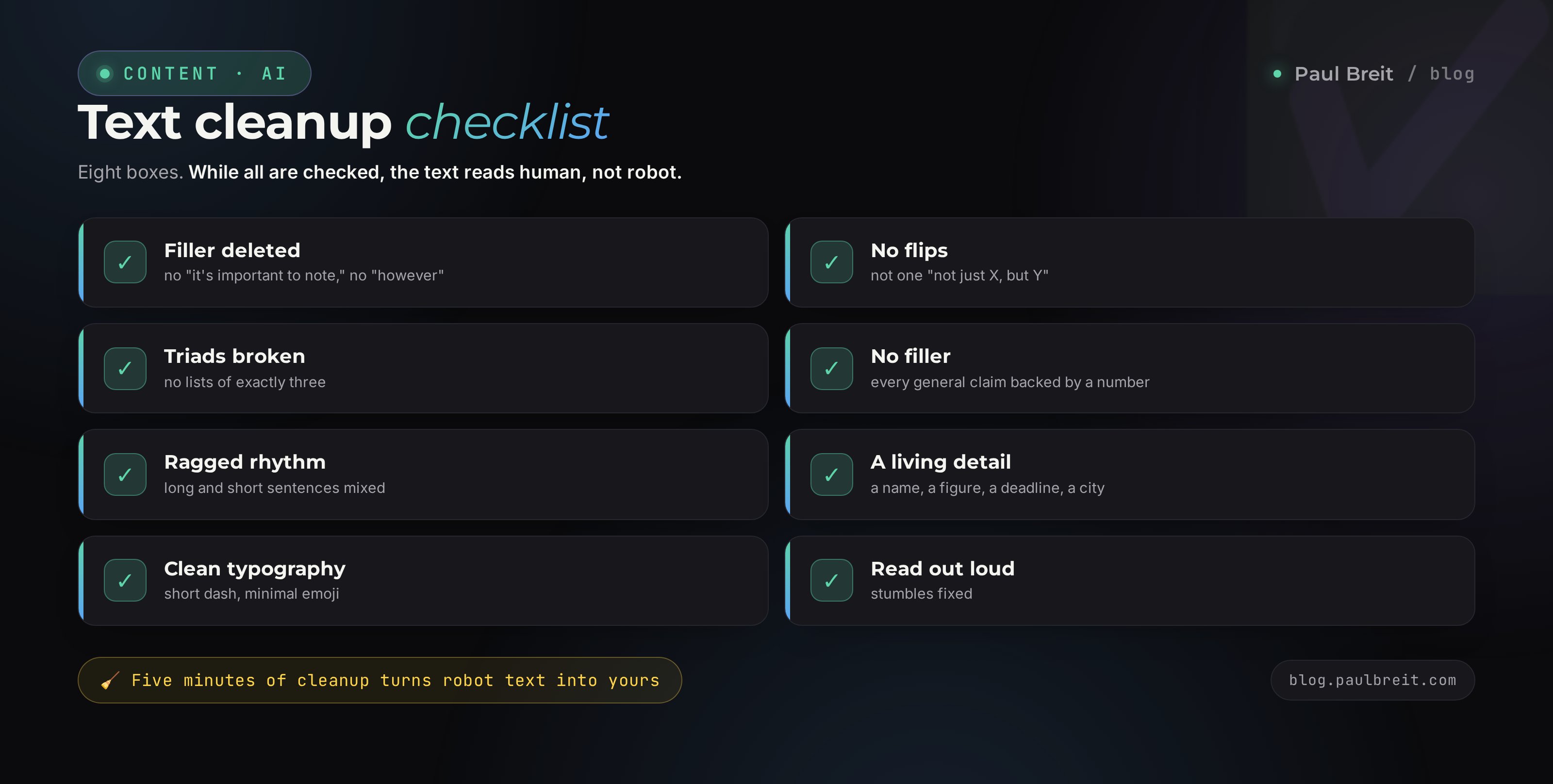
Keep it handy and run every text through it until the list settles in your head. While all eight boxes are checked, the text is clean.
- Filler deleted. Not a single "it's important to note," "furthermore," "however," "at the end of the day," or their kin.
- No flips. Not one "not just X, but Y" or "it's not about X, it's about Y."
- Triads broken. No lists of exactly three parallel items and no three choppy sentences in a row.
- No filler. Every general claim is either backed by a number or deleted.
- Ragged rhythm. Long and short sentences alternate, with a short punch after a long thought.
- A living detail. At least one specific from your life: a name, a dollar figure, a deadline, a city.
- Clean typography. Short dash "–" only, minimal colons, no more than a couple of emoji.
- Read out loud. The whole text spoken through, stumbles fixed, ideally on your phone.
AI is a draft, not a final. It takes the clean mechanics off your hands: building structure, the first version, the busywork. But the voice, the living detail, and the final read-through you keep for yourself. Five minutes of cleanup against this list turns robot text into your text, and it's your text the reader pays for.
How this connects to the other articles
This article is about removing the traces. Making the AI write in your voice from the start is a separate breakdown of the 30-posts method. For prompting basics, there's the five-part formula. And if you're choosing between models, an honest comparison is in Claude vs ChatGPT. Four articles, one system for working with text.
FAQFrequently asked questions
Can you write with AI so the traces don't show?
Yes. The AI gives you a draft; the voice and the final read-through are yours. Set a prompt that bans the typical phrases, clean the text in four passes, and it is indistinguishable from human writing. The AI handles speed, you handle voice.
What's the most common AI trace?
Filler connectives and bureaucratic phrasing - service words that mean nothing and only fake a sense of flow. Second place goes to the flip that pits one thing against another with a comma. Those two markers expose the generation in the first paragraph. The full list with examples is in the body.
Do I need to run text through an AI detector?
No. Tools like GPTZero and Turnitin are unreliable: they flag human text as machine and pass cleaned AI. OpenAI shut down its own detector in 2023 over low accuracy. The only check that works is reading out loud and handing the text to a real person.
How long does cleaning one text take?
5 to 10 minutes on a medium post if you work the markers. With a ready prompt that bans the phrases, cleanup is almost unnecessary; you only add the living detail.
Does a long dash really expose AI?
One dash by itself proves nothing. But paired with a flat rhythm and filler phrases, it finishes the picture. It is easier to use a short dash, so the text looks like a real person typed it on a phone.
How do I teach the AI my voice?
Feed it 20 to 30 of your posts and ask it to extract your voice rules: openers, sentence length, favorite words, what you never write. Keep that breakdown in the project. The full method is in the article on teaching AI to write in your voice.
Should I clean old texts on my site and channel?
Yes, by priority. Start with sales pages and your most-read articles, where the AI trace hits trust and sales directly. Archive posts can wait or be cleaned gradually.
Claude or ChatGPT for cleaner English writing?
Both give clean output with the right prompt. The result depends on your frame and final edit more than on the model. For writing I often reach for Claude. A detailed comparison is in a separate article on the blog.