How to Write a Case Study: the formula that makes the result sell itself
A case study is your story of a result, told so the next client recognizes themselves in it and wants the same. Below is a seven-block formula for assembling a strong case, plus ready AI prompts: the AI pulls the facts out of you, puts them in order, and shapes them into text, a carousel, and a video script. One evening of work, and you have proof that keeps selling for months.
To write a client case study, gather the facts by a seven-block formula: who the client is, what they came in with, what was holding them back, what you did step by step, the result in numbers and time, what the client said, and the takeaway for the reader. Collect the material in a 15-minute interview, then hand the transcript to an AI with a ready prompt - it puts the story in order and shapes it into a post, carousel, or video script.
A familiar picture: the client has a result, but there's nothing to tell about it. A screenshot of a "thanks, all great" chat flashes by in stories, and that's it. A testimonial with no numbers, no story, no name. The reader scrolls past and doesn't believe it. Yet a case study is exactly what closes every buyer's main objection: it worked for others, but will it work for me?
I run four client projects and a channel of 20,000 followers. My cases are built by a pairing of a short interview and AI - by one and the same formula. This article is that whole formula, with the prompts that turn a client's raw story into proof that sells.
You'll read it in 22 minutes. You'll build your first case in one evening. After that it runs on rails: every new client result turns into content in an hour and stops getting put off forever.
What's inside
- What a case study is and why it sells harder than ads
- The formula for a strong case: 7 blocks
- Where to get the material: a client interview
- Build the case with AI: prompts for every block
- Four formats of one case
- A case for your niche
- How not to mess it up: consent, facts, ethics
- 5 mistakes in case studies and how AI fixes them
- A case in one evening: a step-by-step plan
- The finished-case checklist
Claude works out of the box in the US and most of Europe. If you're in a region where it's restricted, you'll need a VPN with a US or EU location and an email on a non-restricted domain - Anthropic blocks a few countries, so pick a clean location. A step-by-step walkthrough of accounts and first prompts is in the piece on what you can do with AI. Direct link: claude.ai.
Section 01What a case study is and why it sells harder than ads
A case study is the breakdown of one client story from the start to the result. There was a person with a problem, they came to you, together you did something, and things got noticeably better. The case shows the whole road: where they started, what happened along the way, and where they arrived. With a name, with numbers, with the client's own words.
People often confuse a case with a testimonial, and it's an expensive mix-up. A testimonial answers the question "is it pleasant to work with you." A case study answers "will I get a result." The first is about emotion, the second about proof. A buyer looks for proof before they pay. They've already seen ten pretty promises, and one more "thanks, loved it" no longer moves them.
Why a case works when ads no longer do
In the head of the person reading your case, one thought keeps turning: "it worked for him, but I'm a special case, it won't work for me." You don't break that objection with a promise. You break it with recognition. When the reader sees a client in a similar situation - same niche, same fear, same stuck point - they stop arguing. They start trying the story on themselves.
It works on three levels at once:
- Social proof. If it worked for a real, living person, the risk in the buyer's head drops. They're not the pioneer.
- Recognition. The client's point A matches the reader's point A. From there the reader wants a match at point B too.
- Method on display. A case shows what you do and how. The person understands what they're paying for before they even talk to you.
One strong case closes more deals than a month of "value" posts. Because value convinces the head, while a story of a result convinces both the head and the place people actually make buying decisions from.
Where a case study lives
A case works in every spot where a person decides whether to pay you or not:
- a pinned post and stories in your Telegram channel;
- a dedicated "client results" block on your landing page;
- a reply to a lead in DMs when they're on the fence;
- a slide in a webinar at the moment of the offer;
- a carousel on Instagram, Threads, and other socials;
- a short video script built around the client's story.
That's why a case is built in several formats at once from a single interview. More on that in the formats section. First, let's break down what a case is made of.
Section 02The formula for a strong case: 7 blocks
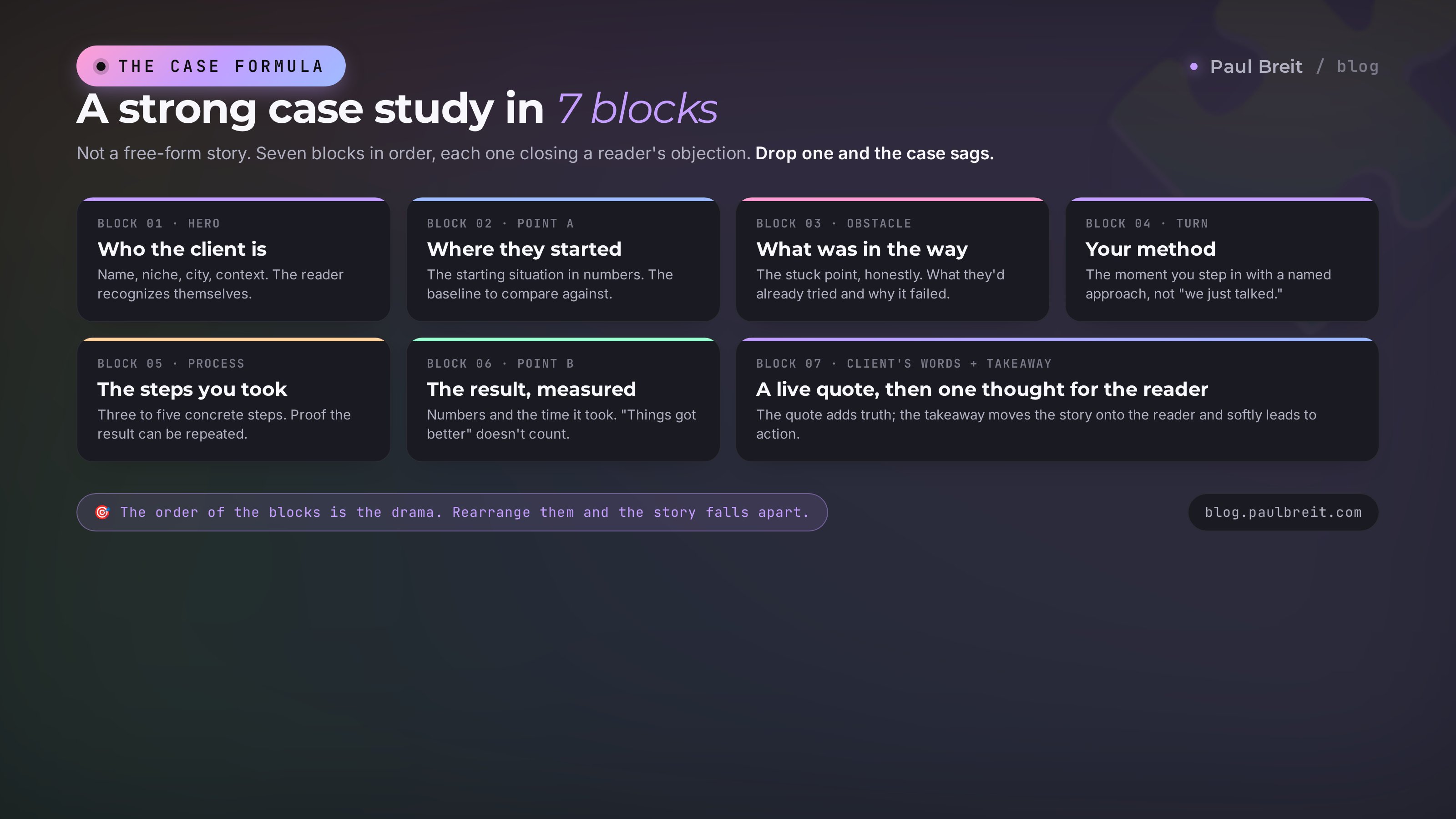
A strong case isn't a free-form "here's how it all went." It's seven blocks in a strict order. Each block closes a specific reader objection. Drop one and the case sags. Below is each block with an example, so you see the difference between a weak and a strong version right away.
Who the client is
Name, niche, city, a short bit of context. The reader should recognize themselves in the hero. The more specific, the stronger the recognition.
Weak: "one of my clients." Strong: "Marina, a psychologist specializing in family systems in Portland, ran a blog of 3,000 followers."
What they came in with, in numbers
The starting situation with measurable figures. This is the baseline for comparison. Without point A, any result hangs in the air.
Weak: "sales were low." Strong: "two or three inquiries a month, average check $60, took on consultations only now and then because she was afraid to name a price."
What was in the way and what they'd already tried
This is where the reader recognizes their own pain. Describe the stuck point honestly: what the client already tried and why it didn't work. This block makes the story feel alive and answers the objection "I've already tried everything."
Example: "Marina had taken three marketing courses, started reels, burned out within a month. The problem wasn't the content. Marina flat out couldn't see what people would pay her, specifically, for."
What you decided to do (your method)
The moment you step onto the stage with your approach. Name the method so it sounds like a system, not "well, we talked." The method is always your authorship - the client is the one who applied it.
Example: "We started with unpacking her expertise by my model: we dug out the strengths Marina thought were ordinary and assembled them into one clear offer."
What you did, step by step
Three to five concrete steps. This is the proof that the result can be repeated, not caught by luck. It also lets the person see what they're paying for.
Example: "Step 1 - we built a one-sentence offer. Step 2 - we rewrote the pinned post around that offer. Step 3 - we launched a simple funnel to a free consultation. Step 4 - we scripted the call so Marina wouldn't lose leads on price."
The result in numbers and time
The main block. The result must be measurable and have a timeframe. "Things got better" doesn't count. You need numbers and the time it took to reach them.
Example: "In 10 days Marina sold $3,300 worth. Her average check went from $60 to $550. Inquiries come in steadily now, not once a month."
A direct quote and one thought for the reader
Close the case with a live client quote and one takeaway for the reader. The quote adds credibility; the takeaway moves the story onto the reader and gently leads to action.
Example quote: "Turns out people were ready to pay several times more. I was just too shy to name a price." Takeaway: "Often it isn't even about new knowledge. Sometimes it's enough to see your own value from the outside and package it into a clear offer."
The order of the blocks is the drama itself. First we show the hero the reader recognizes. Then we deepen the pain. Then we give the turn and the result. And only at the end - the takeaway. Rearrange the blocks and the story falls apart and stops selling.
Section 03Where to get the material: a client interview
The raw material for a case is facts from the client themselves. Not your memories - their words, their numbers, their emotions. Most experts get stuck exactly here: there's a result, but they never sit down and pull the story out. One short interview solves it.
How to ask the client
Don't write "leave me a review" - you'll get a routine "loved it." Ask differently: "I want to write up your story as a case study, so people just like you six months ago realize they can be helped too. It'll take 15 minutes by voice, and I'll send the questions ahead of time." In that frame the client feels like the hero, not a debtor, and talks freely.
How to record it
Three workable options, in order of convenience:
- Voice notes in a messenger. The client answers the questions by audio whenever it suits them. Zero calls.
- A short call. 15 minutes on video, screen recording. Livelier, but you have to coordinate a time.
- In text. The weakest option: the client writes briefly and without emotion. Only use it if they really won't talk.
Audio and video are turned into text automatically afterward - the same AI or a separate service does the transcription. That transcript is what you'll hand over next to assemble the case.
Prompt: the AI prepares the interview questions
So the interview lands squarely in the seven blocks of the formula, let the AI build the questions. Give it the context of the client and the product:
You're a marketer interviewing a client for a case study.
Here's the context: [the client's niche, what product they
bought from me, roughly what result I remember].

Draft 12 questions for a 15-minute interview so the answers
cover the 7 blocks of a case:
1. Who the client is (name, niche, context)
2. Point A - what they came in with, the numbers before
3. What was in the way, what they'd already tried
4. Why they decided to work with me
5. What we did step by step
6. Point B - the result in numbers and time
7. What changed inside, one summing-up line

Keep the questions plain and human, no corporate jargon.
One or two questions per block. Add 2 emotion questions
("what did you feel when you saw the first result").
You get the list, send it to the client, collect the answers. That's where the manual work ends.
Section 04Build the case with AI: prompts for every block
Now for the good part. You've got the interview transcript: alive, rambling, full of filler and repeats. The AI's job is to pull the facts out of it, lay them into the formula, and write coherent text in your voice. Without AI this eats half a day. With ready prompts - half an hour.
Step 0. Set up the context once
Create a separate project in the AI and drop a permanent context into it: who you are, how your voice sounds, what you call your method, which words you avoid. Then every case gets written in one style and you don't have to explain from scratch. How to build that kind of expertise unpacking is in the piece on 10 prompts for experts.
Step 1. Lay the transcript into the formula
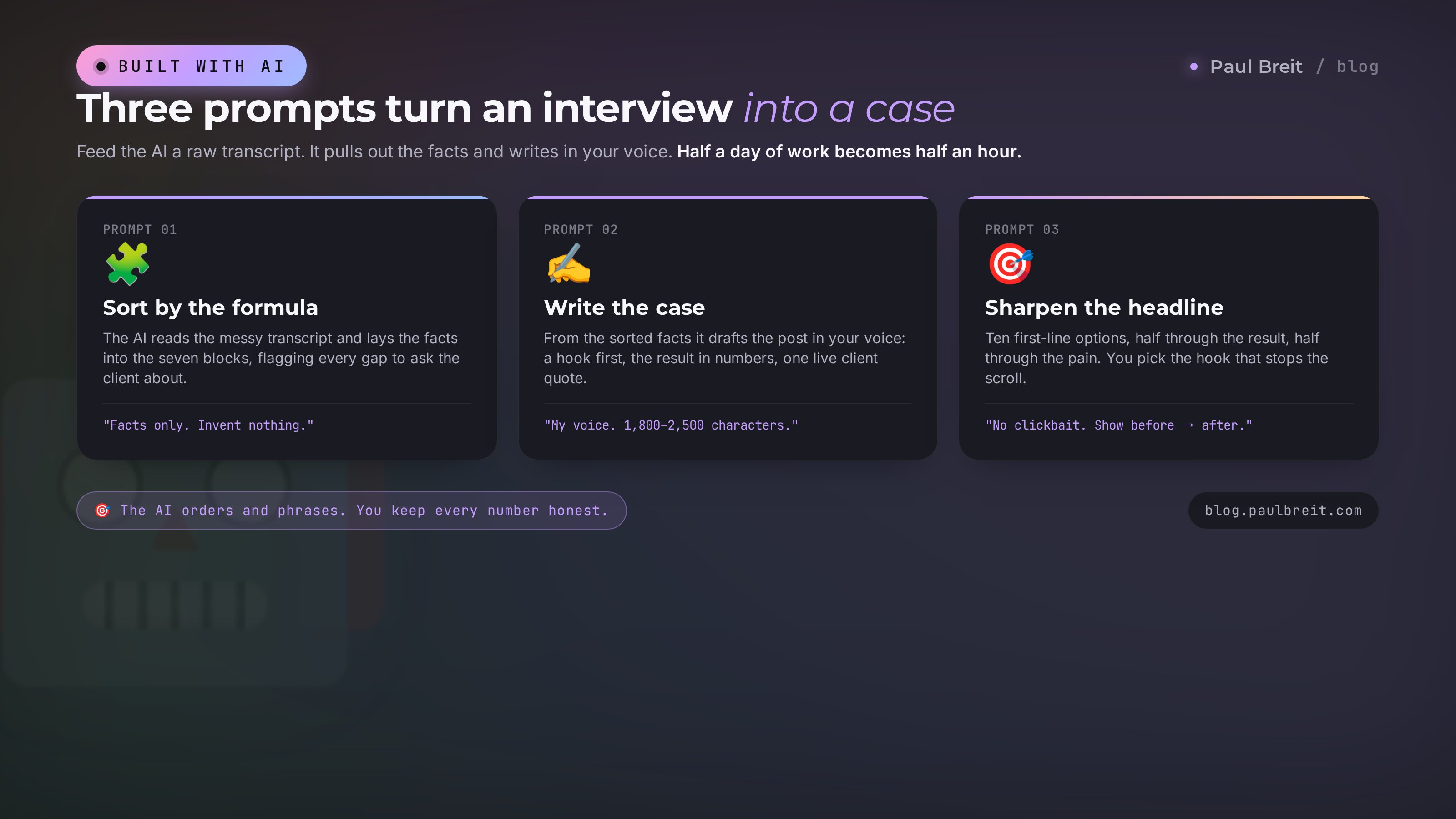
The first prompt doesn't write text. It creates order: it pulls the facts out of the raw interview and sorts them into the seven blocks. That way you immediately see where the holes are and what to re-ask the client.
Here's the transcript of an interview with my client: [paste text].

Sort it into the case study formula of 7 blocks:
1. Hero - who the client is, niche, context
2. Point A - the situation and numbers before
3. Obstacle - what was in the way, what they tried
4. Turn - why they came to me, what we decided to do
5. Process - what we did step by step
6. Point B - the result in numbers and time
7. The client's words - 1-2 strong quotes verbatim + takeaway

For each block, write out only the facts from the transcript,
no making things up. If a block is missing data, write
"need to check with the client" and phrase the question.
Keep numbers exact, invent nothing.The line "invent nothing" is mandatory in the prompt. AI loves to "fill in" a pretty number that was never there. In a case study, a fabricated number is a collapse of trust and a legal risk. Anything not in the transcript should come back flagged as "to check," not as a guess.
Step 2. Write the case text
Once the facts are sorted and the holes are closed, the second prompt assembles them into finished text. Here it matters to set the voice and the length.
Using the facts sorted into the formula, write a case study
for my Telegram channel.

Requirements:
- length 1,800-2,500 characters;
- my voice: alive, warm, addressing "you," no corporate
  jargon, no pathos (samples of my posts are in the project);
- open with a hook: the hero's recognizable pain in line one;
- move through all 7 blocks of the formula in order;
- point B result - as its own punchy paragraph with numbers;
- drop in 1 direct client quote without quotation marks,
  after a colon;
- close with a takeaway for the reader and a soft invitation
  to message me if they recognized themselves;
- short dashes, never long ones;
- avoid corporate jargon and the cliches of AI-written text.
Step 3. Sharpen the headline and the result
The first line of a case decides whether it gets read or scrolled past. The third prompt makes hook variants and checks that the numbers land with weight.
Give me 10 options for the first line of this case.
Half through the result in numbers, half through the
hero's recognizable pain. No clickbait, no promises
that aren't in the text. Short, under 90 characters.

Separately, suggest how to strengthen the result:
show not just the outcome but the trajectory (before → after),
and add the timeframe it took to get there.
Pick the best option by hand - that's your call, not the AI's. What's left is the read-through: read it aloud, cut anything that sounds like an ad, put the client's live words back in. All of it - half an hour instead of half a day.
Section 05Four formats of one case
One interview is raw material for a whole week of content. From the same facts the AI builds four formats, and each one lives in its own touchpoint. That's the density that makes it worth building cases regularly.
| Format | Where it works | What to emphasize |
|---|---|---|
| Story post | channel, pinned post, newsletter | the drama: pain → turn → result |
| Carousel | Instagram, Threads, socials | one block per slide, the number on the cover |
| Video script | reels, YouTube Shorts | a hook in the first 3 seconds, the result at the end |
| Landing block | website, offer page | dry and numeric: before → what you did → after |
The prompt for spreading it across formats is a single one:
Take the finished case text and repackage it into three
formats, keeping the facts and numbers unchanged:

1. A 7-slide carousel: slide 1 - a cover with the result
   in numbers and a hook, slides 2-6 - one formula block each,
   slide 7 - the takeaway and an invitation to message me.
   Each slide - a short headline and 1-2 sentences.

2. A 40-60 second vertical video script:
   a hook in the first line (pain or a number), then the story
   by the formula in conversational language, the result at
   the end, a CTA. Write it the way people talk, short lines.

3. A landing block: dry, three columns - Before / What We Did /
   After. Numbers big. One client quote line at the bottom.
How to design the carousel visually is a separate breakdown; the "one slide, one idea" principle here is the same as in posts. The video script can then be voiced and edited, but that's already beyond the case itself.
Section 06A case for your niche
The formula is the same for everyone, but "result" looks different in every niche. Money is the most obvious one, but far from the only measurable outcome. Here's what to lean on if the client has no direct growth in money yet.
| Niche | What to show as the result | Where to get the number |
|---|---|---|
| Coach, psychologist | higher rates, steady inquiries, confidence to name a price | rate before/after, sessions per month |
| Tutor, teacher | the student's result: score, admission, timeline | scores before/after, prep time |
| Nutritionist, trainer | a measurable change in the client and their retention | body metrics, length of engagement |
| Designer, copywriter | the effect for the client: conversion, leads, sales | project metrics before/after |
| Consultant, lawyer | money saved, time saved, risk removed | amount saved, hours, issue resolved |
| Online school, expert | launch revenue, number of clients, speed | launch total, build time |
The logic is simple: take any measurable change from point A to point B and state the timeframe. Time (freed up 10 hours a week), volume (300 leads in a month), speed (a launch over a weekend), quality (conversion from 2% to 7%) - all of it works as proof just as well as a dollar figure.
No loud number? Show the trajectory. "It was 2 inquiries a month, now it's 2 a week" sounds more convincing than a vague "more clients." The reader's brain latches onto a concrete before-and-after.
Section 07How not to mess it up: consent, facts, ethics
A case runs on trust, and one mistake here costs more than anywhere else in your content. Three things to check before publishing.
The client's consent
Always get written permission, even for an anonymous case. A short message from the client is enough: "I allow you to use my result in case studies and ads, name can / can't be used." It protects you legally and keeps the relationship intact. While you're at it, clarify which numbers can be stated openly and which to round.
Only real facts
Not a single fabricated number. If the client gave a range - put a range. If the result is modest - show it modest but honest. An embellished case always surfaces: in the comments, in DMs, in a conversation with that very client. Trust doesn't come back after that.
Anonymity without losing power
The client doesn't want the spotlight - that's fine. Swap the name for a role and niche ("a relationship coach from Denver"), exact amounts for growth percentages, a chat screenshot for a paraphrase. The power of a case is in the structure and the trajectory, not in ID data. An anonymous case built by the formula sells almost as well as a named one.
AI is a helper, not the author of the facts. It puts what the client told you in order and writes the text in your voice. But checking the numbers, names, and wording is your job. Read the finished case with a skeptic's eyes: would I believe this if I were seeing it for the first time? Re-verify anything that raises doubt against the transcript.
Section 085 mistakes in case studies and how AI fixes them
A case with no point A
They show only the result: "the client made $3,300." Without a starting point the number means nothing. The sorting prompt always asks for point A and flags its absence as a hole to close.
No numbers at all
"The client got a lot better" is not a case. The prompt demands a measurable result and a timeframe. If there's no money, it suggests which other metric to show: time, volume, speed, quality.
A dull, dry retelling
The case is written like a report: dates, stages, zero emotion. Impossible to read. The AI rewrites the story in your live voice, adds a hook at the start and the client's direct speech, keeping every fact.
The method dissolved
From the case it's unclear what exactly you did - as if the client managed on their own. Then there's nothing to pay for. The "Process" block in the formula forces you to show concrete steps, and the prompt names your method like a system.
No takeaway for the reader
The story ends - and that's it, the reader is happy for the client and leaves. The seventh block of the formula moves the meaning onto the reader and gently calls them to act. Without it, a case entertains but doesn't sell.
Section 09A case in one evening: a step-by-step plan
Let's put it all into one route. Below is the real sequence of actions by which the first case comes together in a single evening.
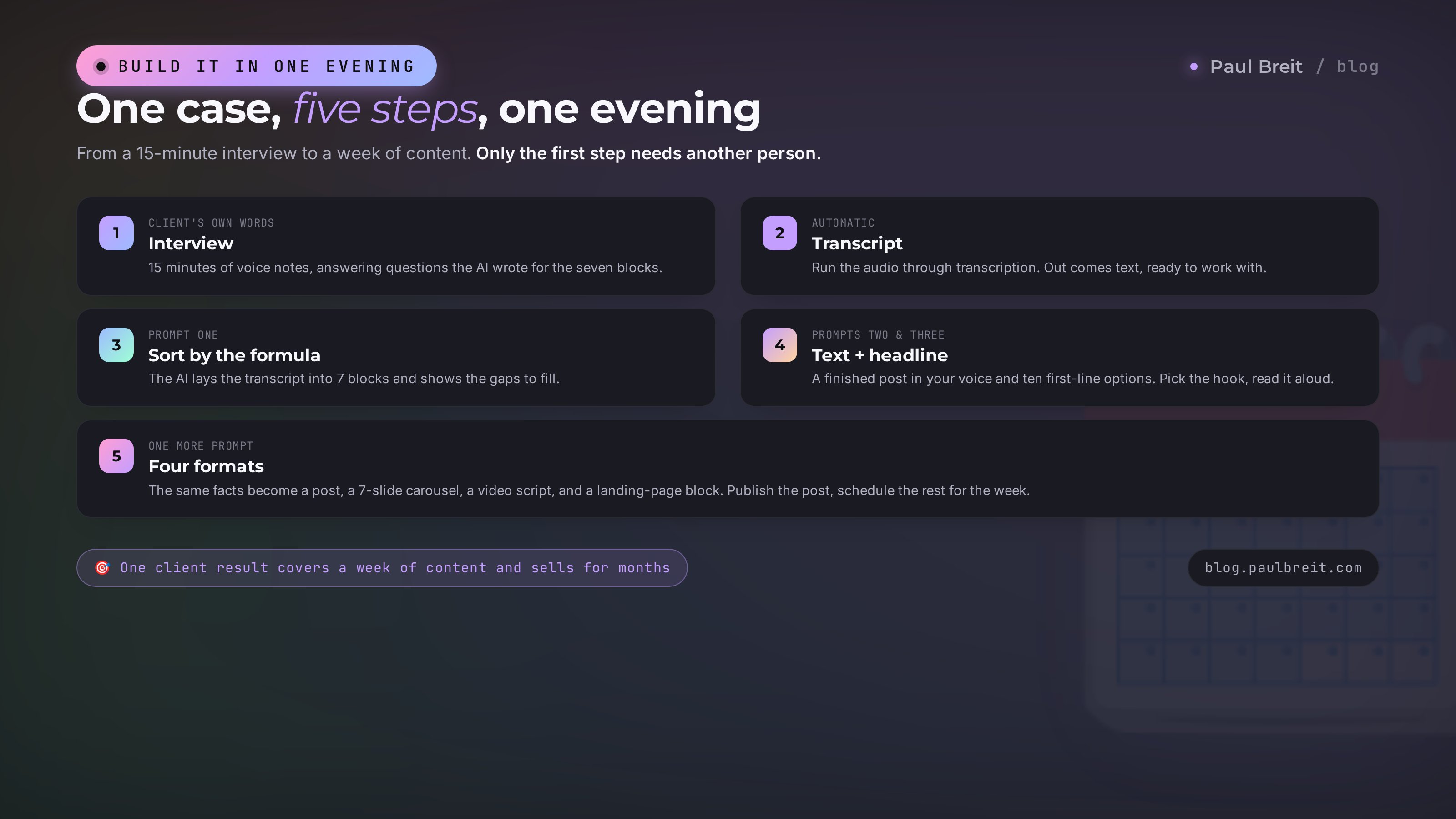
Pick a client and ask for the interview
Choose a client with a vivid result and a good relationship. Send them the frame "let's write up your story as a case" and the 12 questions the AI built.
Collect the interview by voice
The client answers with voice notes whenever it suits them. While you wait - set up the AI project with your voice and method.
Transcribe
Run the audio through transcription. Out comes the interview text, ready to break down.
Sort by the formula
The prompt from step 1 sorts the transcript into 7 blocks and shows the holes. You close the holes with a single follow-up message to the client.
Write the text and the headline
The prompts from steps 2 and 3 give you a finished post and ten first-line options. Pick the hook, read it aloud.
Spread it across formats
One prompt turns the post into a carousel, a video script, and a landing block. You publish the post and schedule the rest for the week.
What you walk away with: a story post for the channel, a 7-slide carousel, a video script, and a ready landing block - all from one 15-minute interview. One client result covers a week of content and keeps selling for months.
Section 10The finished-case checklist
Before publishing, run through eight points. All the boxes ticked - the case sells at full power.
- There's a hero with a name (or role and niche) and recognizable context
- There's a point A in numbers - what the client came in with
- The obstacle is shown - what was in the way and what they'd already tried
- Your method is visible along with concrete steps, not "the client managed on their own"
- Point B is measurable - numbers and the time it took to reach them
- There's direct speech from the client and a takeaway for the reader
- Consent is obtained from the client, all numbers are real
- It's built into formats - post, carousel, video, landing block
A case study isn't a one-off text made on a whim. It's a system: a short interview of seven questions, a breakdown by the AI along the formula, spreading it across four formats. Built once, it turns every client result into proof in an hour. And proof sells better than any ad - because in it the reader sees themselves.
How this connects to the other articles
A case is "what" you prove a result with. The reviews from the piece on collecting client reviews are the raw material cases are born from. The script from the breakdown of the sales call is "where" a case fires in a conversation with a lead. And the expert sales funnel is "where to" build finished cases in so they warm your audience on autopilot. Four articles - one sales system.
FAQFrequently asked questions
How is a case study different from a testimonial?
A testimonial is emotion: "thanks, loved it." A case study is a story with facts: who the client is, what they came in with, what you did, and the result in numbers and time. A testimonial confirms you're pleasant to work with. A case study proves people get results with you. The second one is what sells.
What if the client won't show numbers or their name?
Build an anonymous case. Swap the name for a role and niche ("a relationship coach from Denver") and exact dollar figures for ranges or growth percentages ("revenue grew 2.5x"). Readers believe a percentage and a trend as much as an exact number. The key is to round real data with the client's consent and invent nothing.
How long does it take to build one case study?
A client interview is 15-20 minutes by voice. Transcription is automatic. Assembling the text with AI from a ready prompt is 20-30 minutes including a read-through. In one evening you can comfortably build one full case in several formats at once: a post, a carousel, and a video script.
What numbers do I show if the client has no growth in money?
Money isn't the only result. Show time (freed up 10 hours a week), volume (collected 300 leads in a month), speed (launched over a weekend instead of three months), quality (conversion up from 2% to 7%). Any measurable change from point A to point B works as proof.
Do I need the client's consent to publish a case study?
Yes. Even for an anonymous case, get written consent: a short message like "I allow you to use my result in case studies and ads, name can / can't be used." It protects you legally and keeps the client's trust. While you're at it, clarify which numbers you can state openly.
Can I build a case if the client just started and there's no result yet?
Too early - a case needs a point B. But start gathering the material now: lock in point A, the request, and the numbers at the start. When a result appears you'll have something to compare against, and the case will come together in minutes. A middle option is a process case: show the first steps and early signals, honestly noting the outcome is still ahead.
Which AI works best for building case studies?
For long transcripts and coherent text, Claude is handy: it holds the context of the whole interview and writes with life. Any other strong model works too. Claude is available in the US and most of Europe out of the box; where it's restricted, a VPN with a US or EU location plus a non-restricted email gets you in. A full walkthrough is in the getting-started guide.
Where do I post the finished case study?
Everywhere people see you before buying: a pinned post and stories on your channel, a dedicated block on the landing page, a reply to a lead in DMs, a slide in a webinar, a carousel on Instagram and Threads. One case from an interview spreads across 5-6 touchpoints - which is exactly why you build it in several formats at once.