Make money with AI from scratch: first income in 30 days
A step-by-step plan for a beginner with no investment, no code, and no audience. In a month you'll learn one tool, build a small portfolio, and close your first paid orders. Broken down week by week: which service to sell, where to find clients, what to charge, and where to grow next.
To make money with AI from scratch, pick one service with a low barrier to entry – usually copywriting – learn one tool (Claude or ChatGPT), and in week one make 2–3 free samples for your portfolio. In week two, package the service and send pitches on marketplaces and in community job channels. First paid orders land in week 2–3. A realistic first-month income at 1–2 hours a day is $200 to $700. No investment needed: the starter kit is free, and the only possible cost is Claude Pro at $20.
Sound familiar: you read that people earn thousands with AI, you open ChatGPT, type a couple of prompts, and close the tab. Impressive, but it's not clear where your money is. The reason is almost always the same – a beginner hunts for a magic button that doesn't exist and walks right past a simple service people already pay for today.
I teach this to people with no experience and I see the same pattern every time. Those who pick one service and take it to a first client in a month get paid. Those who bounce between twenty options end up a month later right where they started. This article walks through the first path week by week, with concrete actions for each day.
You'll read it in 20 minutes. You can start today. In 30 days you'll have your first income and a clear system for repeating and growing it.
What's inside
- What "from scratch" means and why 30 days is realistic
- Which service to sell first
- Week 1. The tool and your first result
- Week 2. Packaging and first outreach
- Week 3. Your first paid orders
- Week 4. Repeatability and raising your rate
- How much you can really earn: the math
- 7 beginner mistakes that steal your first money
- The "first income in 30 days" checklist
Section 01What "from scratch" means and why 30 days is realistic
"From scratch" is an honest starting point. You have no audience, no portfolio, not a dollar for ads, and no technical background. You have a computer or even just a phone, a couple of free hours a day, and the will to earn your first money. That's enough, and here's why.
AI broke the main barrier to entry into digital work – years of learning a craft. To get paid for writing, you used to need to learn to write. To build sites, to learn to code. To design banners, to master a graphics editor. Now one skill stands between you and the result: the ability to explain a task clearly to the AI and pick the good output from what it produced. That's learnable in a week of focused practice.
Money on this market shows up the moment you solve someone's pain. Small businesses need social copy but can't afford a full-time copywriter. Online schools need hundreds of lesson descriptions. Marketplace sellers need product listings. A therapist needs a chatbot that answers routine client questions. All of it takes minutes through AI and costs the buyer real money. You keep the gap between "expensive to hire a person" and "fast to do with AI."
Why exactly 30 days
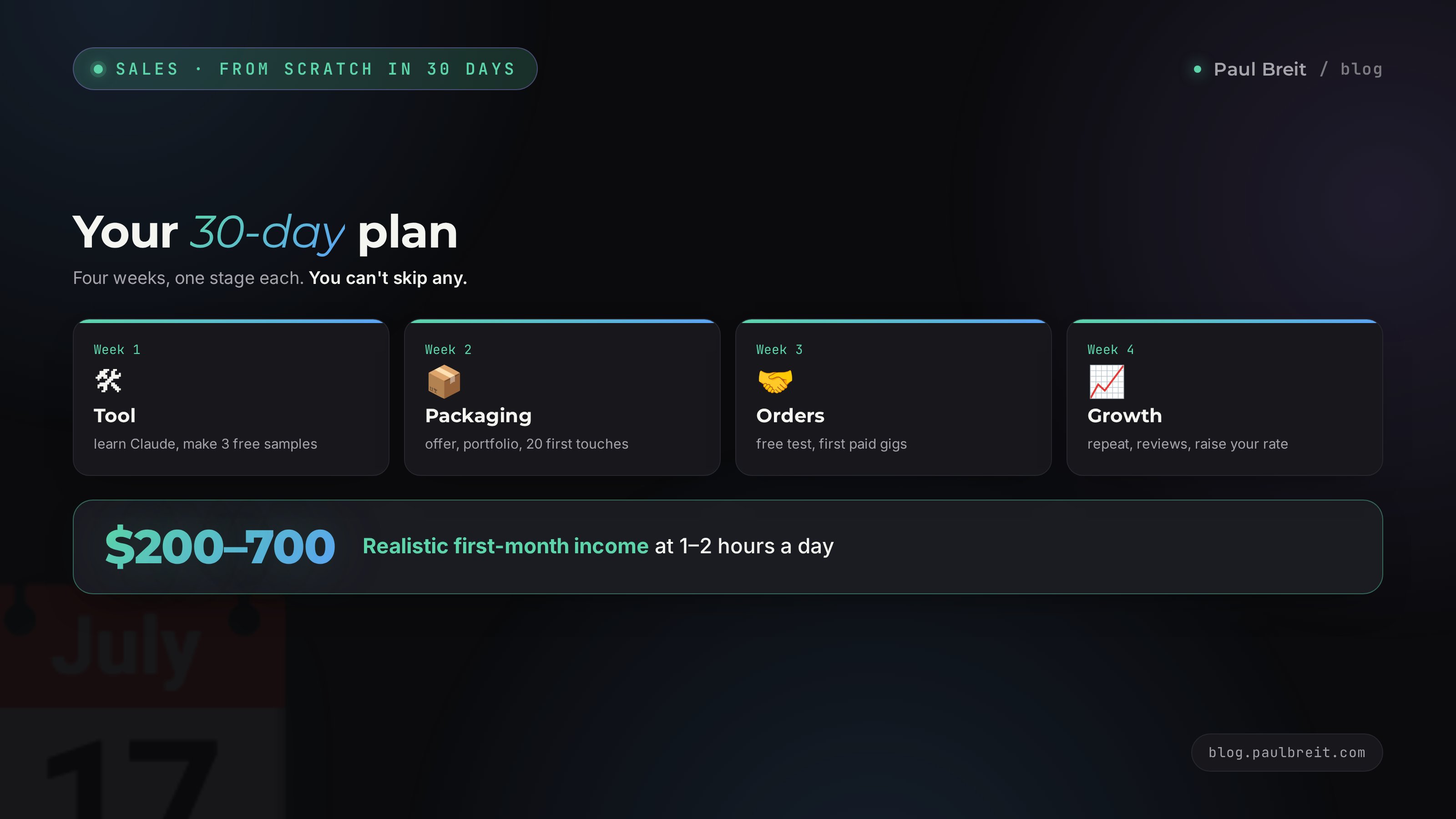
A month isn't a marketing number for looks. It's the time it takes to pass four required stages, and each one takes about a week.
- Week 1 – skill. You learn one tool to the point of "I get a predictable result" and make 2–3 samples for free so you have something to show.
- Week 2 – packaging. You define exactly what you sell and for how much, and lay out your first samples so you can send them to a buyer.
- Week 3 – first deals. You reach out to people, handle objections, and close your first paid orders.
- Week 4 – repeat. You confirm the first deal wasn't a fluke, repeat it a few more times, and raise your rate.
You can't skip a stage. People who try to find clients in week one with no samples in hand hit the "show me examples" wall and burn out. People who polish the skill for a month and never reach a live buyer stay broke. The order of the stages is the whole secret.
If you already have an audience, case studies, or expertise in a topic, a faster and more lucrative path through a funnel and a launch fits you better. I put a breakdown of seven earning models, including selling your own products, in a separate article on making money with AI. This article is about starting from absolute zero, when there's nothing behind you yet.
Section 02Which service to sell first
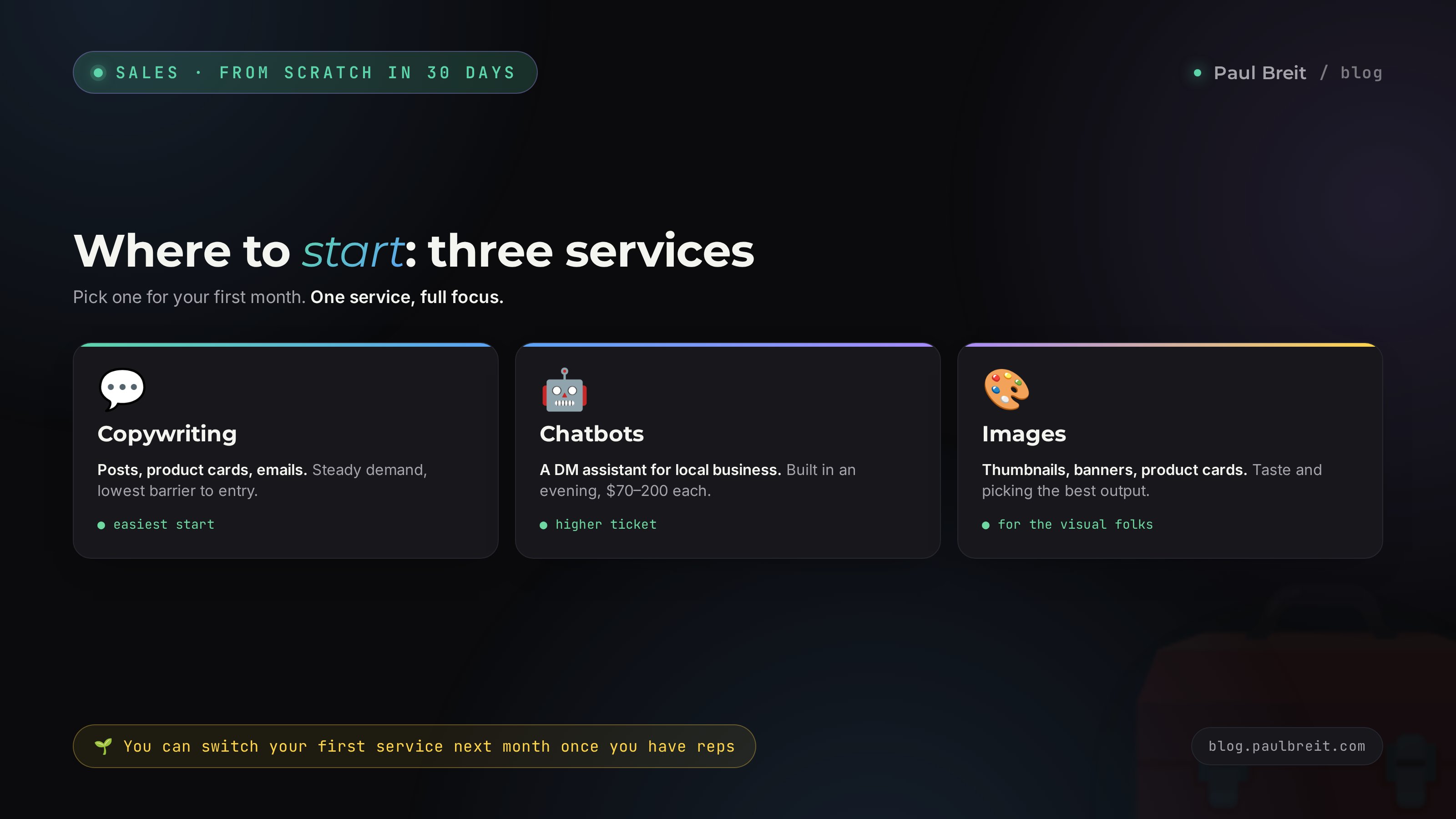
The main beginner mistake is trying to do everything at once. Copy, images, chatbots, video, and sites all together. In the end there's no depth anywhere, and when someone asks "what do you do," the answer is "a bit of everything," which to a buyer sounds like "nothing in particular." Pick one service for your first month. Below are three directions that are easiest to take to first money.
Copywriting – the lowest barrier
Demand is steady and huge. Social posts, product listings for marketplaces, email newsletters, blog articles, reel scripts, sales copy for landing pages. The result is visible right away, and you don't have to explain anything to the buyer – they read it and know whether it's good.
The barrier is minimal: you need one text tool and the ability to frame a task for it. Claude writes more cleanly and invents fewer facts, so for copy I suggest starting there. How to frame a task so you get what you want on the first try is broken down in the article on how to write prompts.
Chatbots and automation – a higher ticket
Small businesses need an assistant that answers routine client questions in DMs: price, address, hours, booking. This used to cost thousands and required a developer. Now a simple bot on a no-code builder with AI plugged in gets built in an evening, and you charge $70–200 for it. The barrier is a bit higher than copy, and so is the ticket. Where to start building such an assistant is shown in the article on building an AI agent with no code.
Images and visuals – if aesthetics is more your thing
Thumbnails, product cards, banners, avatars, article illustrations. Taste matters here: the AI gives ten options, and your job is to pick one strong one and take it to the right look. Tools – Midjourney for quality, free options to start with no spend. A pack of 10 images sells for $30–50, a thumbnail for $15–30.
How to choose in 5 minutes
Answer one question: what comes easiest to you right now. Love and can write – take copy. Enjoy tinkering with settings and assembling builders – go for bots. Have an eye and a sense of style – try visuals. At the start, speed to a first result matters more than "where the money is." You can and should switch your first service in month two, once you have reps.
If you're unsure – take copy. It's the direction where a first paid order shows up fastest, which means belief in yourself shows up fastest too. From here I'll run the example on copy, but every step transfers easily to bots and images.
Week 01The tool and your first result
The job of week one is to turn "I've heard of AI somewhere" into "I can get the result I want and I have something to show." I'll split it by day so it's clear this is doable.
Days 1–2. Access to the tool
Set up an account at claude.ai. If AI is blocked in your region, the site opens only with a VPN set to an EU or US location. The free tier is enough to start; add Pro at $20 later, once orders come in and you hit the limits. Where to look for the right tools with no spend is covered in the article on free AI tools.
Don't upload a client's personal data, passwords, or trade secrets into the AI. For copy and images you don't need to. When you get to bots and working with client databases, study the rules separately – they're simple but important.
Days 3–4. The first skill – framing the task
The whole secret to a good result is how you set the task. A bad request sounds like "write a post about a coffee shop." The AI gives back faceless text you'd be embarrassed to show. A good request gives the AI a role, context, an audience, and a format. Compare what happens in practice.
You: You're a social media copywriter. Write a post for a family coffee shop in a residential neighborhood. Audience – parents with strollers and remote workers. The goal is to announce the new morning menu and invite people in before 11 a.m., when there's a 20% discount. Tone warm and lively, no hype. Length up to 100 words. Add one question to the reader at the end.
Claude: returns a finished post with a hook, concrete menu details, a call to action, and a question – text you can publish with almost no edits.
The formula worth memorizing from day one: role + context + audience + task + format + tone. The more of these details you give, the less you'll rewrite. Practice on five different tasks until the result feels predictable.
Days 5–7. Three samples for your portfolio
Now make 2–3 full samples as if they were ordered. Not abstract ones, but for real businesses you see around you. The bakery down the street, a nail tech you know, a local clothing shop online. Find their pages, see what they post, and do it better.
A series of 3 posts for a real business
Take a coffee shop, barbershop, or florist in your area. Write three posts: an announcement, a useful tip on the topic, and a promo with an offer. Lay it out cleanly in a document.
10 product descriptions for a marketplace
Pick a category on Amazon or Etsy where the descriptions are weak. Rewrite ten listings: a catchy title, benefits, specs. This is a common, paid order.
Copy for an email or a landing page
A sales email or a short block for one section of a site. Shows the buyer you can move a person toward an action, not just stack words.
By the end of week one you have three finished samples in hand. That's your capital. Without them it's too early to reach out to buyers; with them, you can close deals.
Week 02Packaging and first outreach
You have the samples; now turn them into an offer people pay for. Packaging is the answer to three buyer questions: what you do, how much it costs, and why they can trust you with the task.
Days 8–9. Your offer in one line
State what you sell, short and clear. Bad: "I do various texts and honestly a lot of things." Good: "I write posts and product listings for small businesses with AI, fast and affordable." A buyer should understand in five seconds whether you fit.
Ask the AI to help here too. Feed it your three samples and the task.
You're a marketer. Here are three of my samples: [paste texts].
I'm a beginner and want to sell a copywriting service
for small businesses using AI. Write 5 versions of a
short one-line offer and suggest a starting price range
for the 2026 US market. Audience – small businesses with
no budget for a staff copywriter.
Days 10–11. A simple portfolio
You don't need a site. To start, one of three formats is enough: a clean Google Doc shared by link, a folder in the cloud, or a simple page where you post your work. The point is that one link shows the buyer what you can do. Put your three samples there, add the offer and a line about yourself.
Don't write "beginner specialist with no experience." Write it straight: "I write copy for social media and marketplaces. I use AI, so I'm fast. First clients get a below-market rate in exchange for an honest review." Honest and disarming.
Days 12–14. First outreach
Time to reach people. Three sources that work with no audience of your own.
Send at least 20 touches over these three days. Not one or two – twenty. Earning at the start is a numbers game: the more people know what you do, the higher the odds someone says yes. Keep your first message short and human.
You – to someone you know with a business: Hey! I've started writing social copy with AI – comes out fast and lively. Here are a couple of examples [link]. If you need posts for your account, I'll do the first few for a token price so you can see the style. Want me to send a test post for your topic?
Week 03Your first paid orders
Week three is the one this was all for. The first replies come in, and now the key is not to freeze and to walk the person to payment.
Days 15–17. How to answer an inquiry
When someone writes "how much" or "tell me more," don't dump a price list on them. First ask a couple of questions about the task – it shows you're paying attention and helps you name an exact price.
Buyer: Hi, how much are the posts?
You: Hi! Depends on volume and topic. Tell me: what business is it for, how many posts a week do you need, and do you have examples of what you like? I'll pick a format and name a price. I can do one test post for free first so you can judge the style.
A free test post at the start is a strong move. It removes the buyer's fear and almost always converts to payment if the work is good. It costs you half an hour and earns you a client.
Days 18–19. What to charge
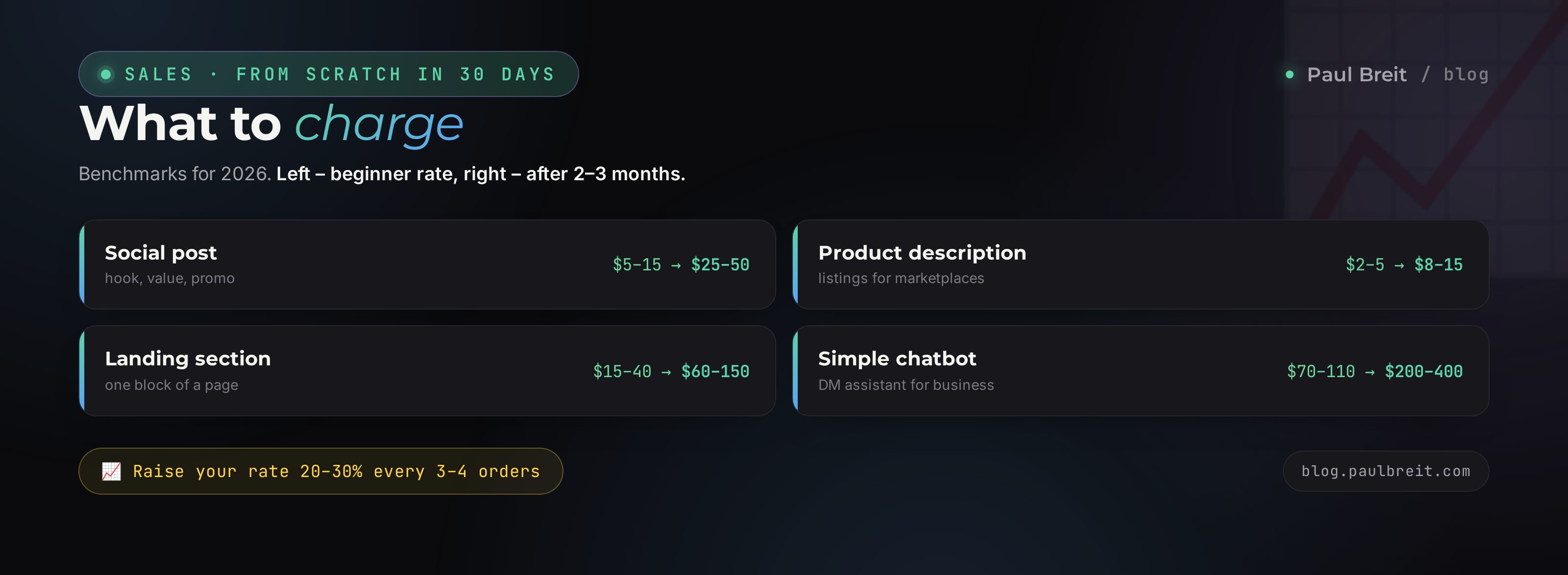
Beginner pricing is its own pain. Too high scares people off, too low cheapens you. Hold these benchmarks for the 2026 US market.
| Service | Beginner rate | After 2–3 months |
|---|---|---|
| Social post | $5–15 | $25–50 |
| Product description | $2–5 | $8–15 |
| Landing section | $15–40 | $60–150 |
| Simple chatbot | $70–110 | $200–400 |
| Pack of 10 images | $30–50 | $80–140 |
On your first 2–3 orders, go for the lower end or work free in exchange for a detailed review. Your goal at this stage is to collect proof that you're pleasant to work with, not to earn a lot. Reviews and case studies let you raise your rate by the end of the month.
Days 20–21. Closing and delivery
Once you agree, lock the terms: what you'll do, by when, for how much, and how many revisions are included. One message with all of it spelled out kills 90% of future disputes. Deliver a little early and a little better than expected. A first client you pleasantly surprised brings you a second and a third with no advertising.
By the end of week three, most people who sent 20 touches get their first 1–3 paid orders. Even if it's $50, it's a turning point. You're no longer "trying out AI," you're a person who gets paid for results. From here it's only a question of volume.
Week 04Repeatability and raising your rate
One deal is luck. Three similar deals are a system. The job of week four is to confirm the first order wasn't a fluke and to lay the ground for growth.
Repeat what worked
Look at where the first client came from and which message worked. Came from a job channel – send another 20 replies there. The free-test template worked – keep using it. Don't invent new things until you've squeezed what already brings money.
Collect reviews and case studies
After every delivery, ask for a short review. Ideal – a screenshot of the buyer thanking you, plus a line or two about the result. Three or four such reviews in your portfolio completely change the pricing conversation. The case formula is simple: before – did – after. It works every time.
Raise your rate
Simple rule: raise your price 20–30% every 3–4 closed orders. New clients hear the new number; existing ones keep the old one for an order or two. In a month or so you'll be surprised to find you charge twice what you did at the start, and it doesn't scare clients off, because there are reviews behind you now.
Speed up with AI where you used to burn hours
Once you're doing several orders a week, the bottleneck is your time. AI helps again: build a separate Project in Claude for each task type, holding your best examples and style rules. How to teach AI to write in the right voice from samples is shown in detail in the article on writing in your voice. Then a post takes about ten minutes instead of an hour, quality holds thanks to your samples, and you calmly run more clients at once.
Section 03How much you can really earn: the math
Honest numbers beat pretty promises. Let me break down a realistic first month on one service – copy, at 1–2 hours a day.
Say across weeks three and four you close 8 small orders at an average of $40. That's $320 for the month, given the first half you were still learning and building a portfolio. Some will make $200, some $700 – the range depends on outreach activity and the service you chose.
From there the numbers grow in steps, not linearly, because three levers work at once.
- More orders. Established channels and reviews bring clients on their own. Month two is almost always stronger than month one with no extra effort.
- Higher rate. The same work costs twice as much two months in, thanks to reviews and confidence.
- Pricier service. From $10 posts you grow into $200 chatbots and monthly retainers to run social accounts at $300–600 per client.
Track your economics every week by three numbers: how many touches you sent, how many replied, how many reached payment. If touches are high but replies are low – weak offer or portfolio. If people reply but don't pay – the pricing conversation is sagging. The numbers show you exactly what to fix.
Section 047 beginner mistakes that steal your first money
Learning forever without reaching clients
The most common one. A person "prepares" for a second month, watching lessons. The first order teaches faster than ten courses. Reach out with three samples; you'll pick up the rest in the field.
Taking on everything at once
Copy, bots, images, video, and sites all together. The buyer can't tell what you're strong at. One service for the first month, full stop.
Delivering the AI's first draft with no edits
The AI gives you a draft, not a final. The buyer instantly feels faceless machine text. Your value is in selecting and polishing. How to clear the machine markers is broken down in the article on removing AI traces from text.
Being shy about a low starting rate
A beginner thinks cheap means embarrassing. A low rate on your first orders is payment for the reviews that later multiply your ticket. It's a deliberate move.
Sending 2 touches instead of 20
Messaged two friends, got no reply, gave up. Earning at the start is statistics. 20 touches a week bring orders; 2 bring disappointment.
Not locking terms before the work
Started with no clear deal on deadline, price, and revision count – ended up in a dispute and free redos. One message with the terms up front saves nerves and money.
Quitting after the first "no"
Rejections are part of the game. Of 20 touches, half go silent, some say "too expensive" or "not now." That's normal. You need one yes to get the whole thing rolling.
Section 05The "first income in 30 days" checklist
Print it and check boxes as you go. While all eight are checked, you're on the right track.
- One service chosen for the first month: copy, bots, or images
- Access to a tool: a Claude or ChatGPT account, VPN set up if AI is blocked in your region
- The request formula learned: role + context + audience + task + format + tone
- 3 samples ready in a portfolio for real businesses
- An offer stated in one line, plus a starting price range
- A simple portfolio assembled: a doc, folder, or page behind one link
- 20+ touches sent a week: marketplaces, job channels, personal contacts
- 3 numbers tracked weekly: touches, replies, payments
Pick one service with a low barrier. Spend week one learning the tool and making 2–3 free samples. Week two, package the service into an offer and portfolio and send 20 touches. Week three, answer inquiries, give a free test, close your first payments at the lower rate. Week four, repeat what worked, collect reviews, and raise your rate. Track touches, replies, and payments every week. In 30 days you have your first income and a system to repeat it.
Where to grow next
First money from services is a foundation for a much bigger income. Once a stream of orders shows up, two growth paths open. First – hire other doers like you and turn freelancing into a small agency: you find clients and control quality while helpers cover the routine. Second – package your experience into your own product, course, or mentorship, and sell it through a funnel. Then income stops depending on hours worked and starts growing with your audience. Both paths are real within the first six months if you did the first 30 days honestly. To choose a direction and take the first steps, book a free consultation below.
FAQFrequently asked questions
Can you really make money with AI from scratch with no investment?
Yes. The starter kit is free: the browser version of ChatGPT or Claude, a freelance-marketplace account, a channel to show your work. The only possible cost is Claude Pro at $20 a month, but your first orders can be closed on the free tier. You get paid for the service you sell – copy, chatbots, images – not for the subscription.
How much can you earn in the first month?
A realistic range for a beginner working 1–2 hours a day is $200 to $700 in the first month. That is 5–10 small orders at $40–70 each. First money usually lands in week 2–3, once you have a portfolio of free samples and have sent your first pitches.
Do I need to know how to code?
No. Every service in the plan is done through a chat with the AI in plain English. You describe the task in words, the AI produces the result, you edit and deliver it. Code only matters if you later want to build complex autonomous agents, and that is a next level, not your first income.
Which AI should a beginner choose?
For text and logic, Claude – it writes more cleanly and invents fewer facts. For images, Midjourney or a free tool. For quick general tasks, ChatGPT. To start, one text tool is enough; add the rest as orders come in.
Where do I find first clients if I have no audience?
Three sources without an audience: freelance marketplaces (Upwork, Fiverr, Contra), Slack and Discord communities with job channels, and direct messages to people you know and small local businesses. Your first 2–3 clients almost always come from personal contacts and communities, rarely from the cold market.
What should I charge at the start?
On your first 2–3 orders, price below market or work for free in exchange for a review – that builds your portfolio fast. After that hold a range: a page of copy $15–40, a simple chatbot $70–200, a pack of 10 images $30–50. Raise your rate 20–30% every 3–4 closed orders.
What if Claude or ChatGPT is blocked in my region?
Anthropic and OpenAI limit access in some regions. Use a VPN with an EU or US location. For sign-up you may also need a phone number from a supported country via a virtual-number service. On paid tiers your data is not used to train models.
Which service is easiest to sell first?
Copywriting. Demand is steady, the barrier is low, and results are visible immediately. Social posts, product descriptions, email newsletters, blog articles. From the second month you add higher-ticket services: chatbots for business and image packs.