Your Personal AI Tutor: How to Learn a New Skill Faster
The same chat with Claude or ChatGPT can become your private tutor, your examiner, and your coach for working through mistakes. It explains hard things at your level, drills you on the material, catches your gaps, and holds your study plan. Inside: seven tutor roles, copy-paste prompts, a real learning dialogue you can watch unfold, and a 30-day plan to build a new skill without paying for a course.
Learning with AI means turning a chat into a private tutor: it explains a topic at your level, asks leading questions, runs mini-exams, and breaks down your mistakes. It beats an online course because it adapts to you and answers in seconds, not once a week on a webinar. You need one strong prompt that hands the AI the tutor role, and a dialogue mode instead of finished answers. On this plan a new working skill is realistic in 30 days at 30-40 minutes a day, and it costs nothing on the free tier.
You buy a $400 course, finish three lessons, get stuck on the fourth, and it slides into the "someday I'll finish it" folder. You Google a question, open ten tabs, drown in articles written for engineers, and close everything without ever getting it. You sit through a webinar where the speaker skims the surface and your specific question never gets answered. The problem isn't you and it isn't your memory. The problem is that every one of those formats talks to the average person, not to you.
I run four client projects and a channel with 20,000+ followers. I pick up new tools almost every week – in the AI space you fall a month behind if you don't. And I do it through a dialogue with an AI that plays my private teacher. I barely need courses for it. This article is the whole system, with prompts you can copy and run today.
Read it in 22 minutes. Launch your first tutor in 10. A month from now you'll have a skill, not a folder of half-watched lessons.
What's inside
- What a personal AI tutor is
- Why people learn faster with AI than with courses
- Getting started: access and first run
- 7 tutor roles with copy-paste prompts
- The 30-day method: build a skill step by step
- A library of tutor prompts
- A real tutoring dialogue, unpacked
- Mistakes that make AI teach badly
- For your niche and your goal
- The whole path in a minute + checklist
Section 01What a personal AI tutor is
A personal AI tutor isn't a separate app or a paid service. It's a plain chat with Claude or ChatGPT that you've handed, in a single message, the role of your private teacher and a set of working rules. After that, the reference book turns into a tutor: it sits next to you, asks questions, and walks you toward understanding instead of dumping a finished answer on the table.
The difference shows in a simple example. You ask a normal AI, "What is unit economics?" It hands you a paragraph of definition. You nod, close the chat, and an hour later you remember nothing. A tutor answers the same question differently: "Before I explain, tell me – have you ever worked out how much you earn from one client over their whole time with you? And where are you starting from, from zero or have you tried some of this already?" From there it builds the explanation around your answer, checks as it goes that you're following, and at the end asks you to run your own numbers on a real example.
Three things a tutor does
- Diagnoses your level. It won't bury you in jargon if you're new, and won't spell out the basics if you already know them. It asks what you know and starts from there.
- Leads with dialogue. Real understanding comes when you answer questions, not when you read. A tutor keeps passing the ball back to you: "So why do you think that is?"
- Tests and locks it in. It runs mini-exams, catches the spots where you're shaky, and makes you recall the material from memory. That's the mechanism that makes knowledge stick for the long haul.
A normal AI answers your question. A tutor teaches you so the question doesn't come up next time. The first saves a minute. The second saves months.
You can learn almost anything that fits into text and logic with AI: marketing, sales, finance, psychology, languages, copywriting, working in specific software, the legal basics for your niche, even music theory. Its weak spot is where you need physical practice with feedback from your body (sport, singing, a craft), or where absolute factual precision matters – there the AI sometimes invents things, and we'll cover that separately in the mistakes section.
Section 02Why people learn faster with AI than with courses
I've got nothing against courses – I sell training myself. But every recorded course has a built-in speed limit, and AI removes it. Here are four reasons a personal AI tutor outruns most online programs.
Personalized to your level
A course is recorded once for a thousand people. It moves at the pace of the average student: too fast for a beginner, too slow for someone experienced. A tutor adjusts to you every second. Didn't get it? It explains again in different words, through an analogy from your own field. Got it in half a sentence? It doesn't waste your time and moves on. Your learning speed is always your own, never the group average.
Feedback in seconds
On a course you ask a question in the support chat and wait a day for a reply. On a webinar you hope the speaker reaches your topic. With a tutor the loop of "question – answer – follow-up" takes seconds, and you run a hundred of those loops in a single evening. It's the frequency of feedback, not the number of lecture hours, that decides how fast you grow.
Active recall instead of passive reading
The brain remembers what it retrieves with effort, not what it rereads. That's a long-proven principle – flashcards and quizzes are built on it. A passive course keeps you in consumption mode: you watch, you nod, you forget. A tutor flips you into active mode – it asks, it makes you explain in your own words, it runs checks. Every answer you drag out of memory locks the knowledge in harder than one more watched lesson ever could.
Endless patience and zero shame
Plenty of people are afraid of looking dumb, so they don't ask again in a live class. AI does not care how many times you ask the same question. You can say, "Explain it like I'm five," "I completely lost you, come at it from another angle," "Say it simpler" – and it will calmly explain a tenth time. For an adult who's embarrassed about what they don't know, that removes the single biggest brake on learning.
AI won't replace a human mentor where you need lived experience, a breakdown of your specific project with someone accountable for the outcome, and the push to not quit. It gives you speed and explanations. The discipline and the doing you bring yourself. The best setup is to learn at a fast clip with AI and check the hard forks and the strategy with a live expert.
Section 03Getting started: access and first run
Both Claude and ChatGPT can play the tutor. For learning I lean toward Claude – it holds a long dialogue more calmly, is less likely to cut in with a finished solution, and stays in the assigned teacher role better. If you're weighing the two for your own tasks, there's a full breakdown here: Claude vs ChatGPT in 2026. To start, the free tier of either one is plenty.
Get access in a couple of minutes
Open a chat at claude.ai, sign up with any email, and you're in. Everything runs right in the browser window – nothing to install. A few regions still need a VPN to reach Claude, since Anthropic gates access by location, but most people just sign up directly. If you'd rather start with the mechanics first, there's a step-by-step guide for non-techies here: Claude from scratch.
Your first run in 10 minutes
To turn an ordinary chat into a tutor, send it a setup message – it assigns the role, your level, and the rules of the game. Here's a base prompt you can start with right now. Copy it, drop in your own topic and level:
Assign the tutor
"You are my personal teacher for [marketing for a psychologist]. My level is [beginner, I only know the basic terms]. Teach me like this: first ask me a couple of questions to see what I already know. Then explain in small chunks, in plain language, with examples from my field. After each chunk, ask me one question to check understanding and wait for my answer – don't run ahead. If I get something wrong, correct me gently and show me where the logic slipped. Every few topics, give me a short quiz. Start by diagnosing my level."
Send it, and the AI opens with questions instead of a lecture. From that moment you become a participant and stop being a passive reader. If you want the rules to hold automatically in every future chat, you can write them once into your profile settings (in Claude that's the personal-instructions section; in ChatGPT it's "Customize ChatGPT"). Then you won't have to assign the tutor role from scratch each time.
Section 047 tutor roles with copy-paste prompts
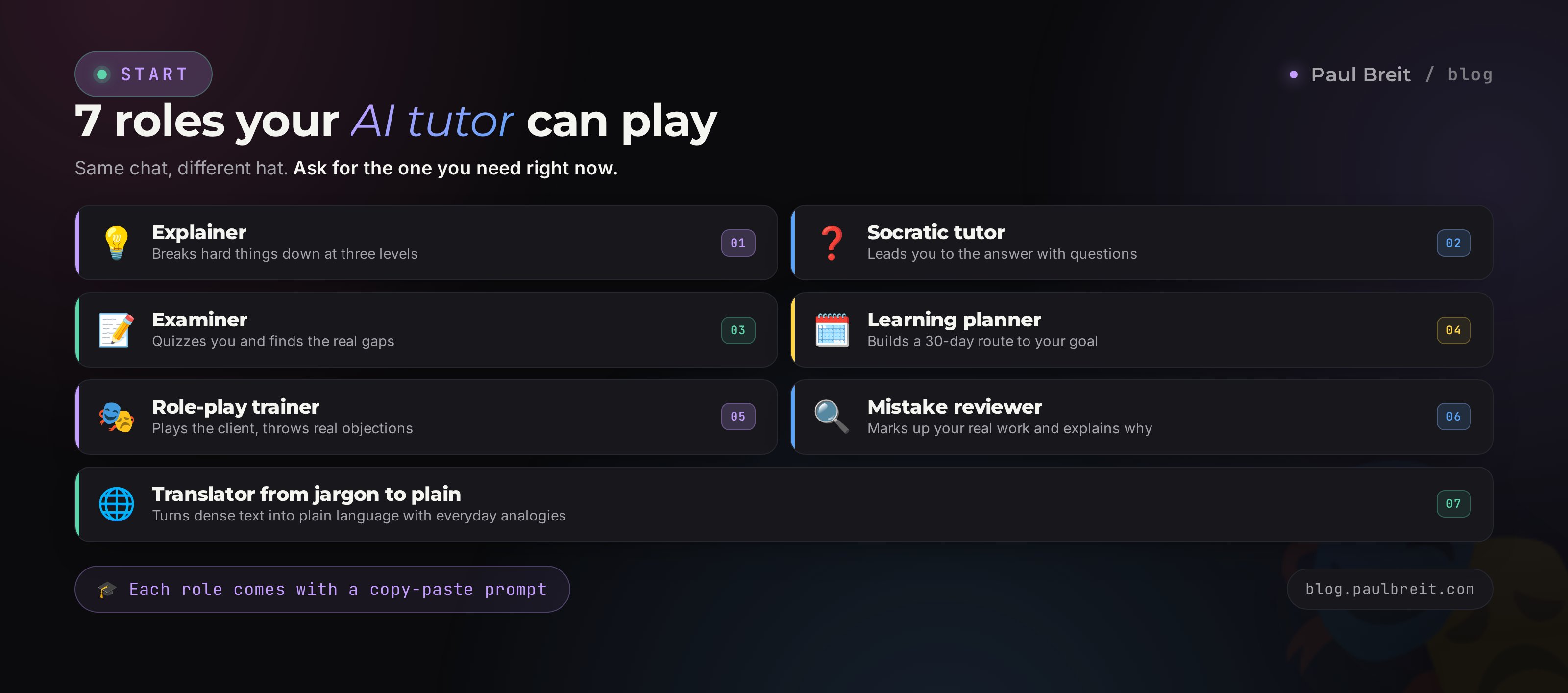
One tutor can wear a lot of hats. Depending on what you need right now – to understand, to practice, or to test yourself – you ask it to play a specific role. Here are the seven most useful ones, each with its own prompt.
The explainer
When a topic feels impassable, the tutor breaks it into digestible pieces and explains through familiar images. The key move is to ask for the explanation at several levels of difficulty in a row.
Prompt: "Explain [what a sales funnel is] three ways in a row: like I'm a five-year-old, like I'm a teenager, and like I'm an adult beginner in my niche. After each version, ask me which level makes the most sense to keep going with."
The Socratic tutor
The deepest understanding comes when you reach the answer yourself. The tutor leads you with questions and keeps the finished solution to itself. Harder than reading, which is exactly why it works.
Prompt: "Teach me [pricing my services] using the Socratic method. Don't give me finished answers. Ask leading questions one at a time, wait for my answer, and use the next question to move me closer to the point. If I'm stuck for 30 seconds, give me a small hint but not the whole answer."
The examiner
Testing is the step everyone skips, and it's the one that cements the material. The tutor runs you through a mini-exam and shows you where the real holes are.
Prompt: "Quiz me on [the basics of Meta ads]. Ask 7 questions of rising difficulty, one at a time. After each answer, tell me if it's right or wrong and briefly explain why. At the end, score me 1 to 10 and name the two topics I should shore up."
The learning planner
A chaotic "I ask whenever I remember to" becomes a system once you have a route. The tutor builds you a program around your goal and timeframe.
Prompt: "Build me a 30-day plan to learn [copywriting for sales posts]. I can give it 40 minutes a day. Break it into weeks and days – each day one small topic plus a practical task. At the end of each week, add a review day. Give it to me as a table."
The role-play trainer
Skills that hinge on live reaction – sales, negotiation, interviews, hard client conversations – get trained by acting them out. The tutor takes the other side and plays it honestly, objections and all.
Prompt: "Play a skeptical client on a sales call. You're unsure about the price and not convinced you need this. I'll be selling [AI mentoring at $1,200]. Act like a real person, throw real objections. After the call, drop the role and break down where I sold weakly and what to say differently."
The mistake reviewer
We grow fastest on our own missteps – if someone shows us exactly what went wrong. The tutor reviews your real work – a text, a calculation, a script – and explains the fix.
Prompt: "Here's my post selling a service: [paste your text]. Review it like a teacher: what works, what's weak, and why. Don't rewrite the whole thing for me. Point to 3-4 specific spots and explain the principle, so next time I fix this kind of thing myself."
The jargon translator
When you're reading an article, a contract, or a guide stuffed with terms, the tutor translates it into plain language and ties it to what you already know.
Prompt: "I'll paste a dense text. Translate it into plain language for me, and explain each term in parentheses with an everyday analogy. Then ask me 2 questions to check I got the main point. Here's the text: [paste]."
Section 05The 30-day method: build a skill step by step
Separate questions to the AI give you separate answers. A skill grows out of a system. Here's the method I use to pick up a new topic in a month at 30-40 minutes a day. It turns scattered chats with the AI into actual learning with testing. If you want the wider view on teaching yourself without paid programs, this pairs well with how to learn AI without courses.
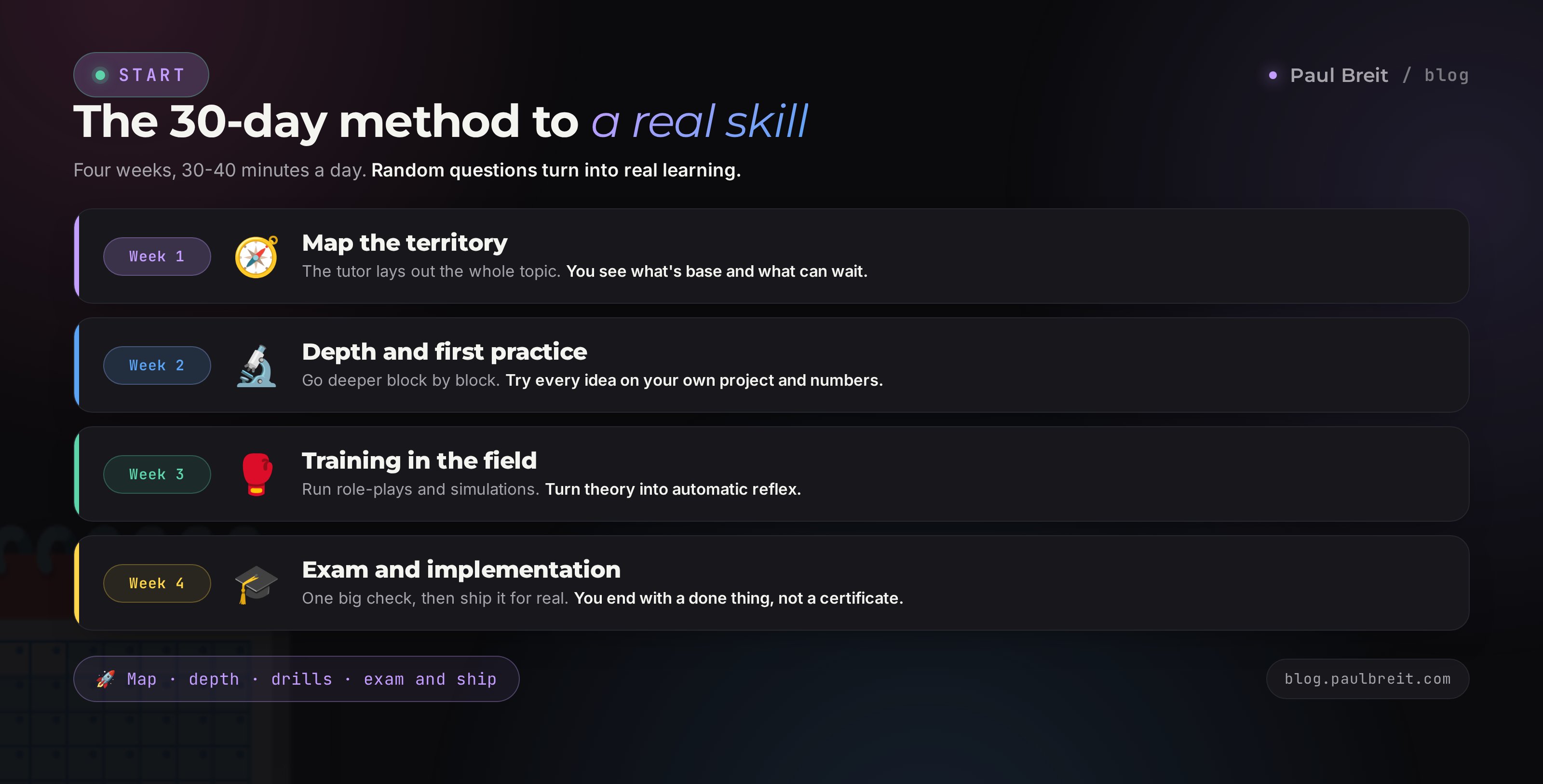
Week 1. Map the territory
The first job is to see what the topic is even made of, and not drown. Ask the tutor to build you a map: the main sections, what comes before what, what's foundational and what can wait. Each day you take one section, the tutor explains it in chunks and asks comprehension questions. At the end of the week, a first review across the whole map, so you can see the big picture.
Prompt for the week: "Break the topic [cold outreach in DMs] into 8-10 main blocks, from simple to advanced. Mark which are beginner foundations and which are advanced. From here we'll go block by block, one at a time."
Week 2. Depth and first practice
Now you go deeper on each block and try it on your own material right away. Not in the abstract, but on a real task: your product, your client, your numbers. The tutor reviews what you made using role 6. Practice on your own material from day one is what separates learning from collecting notes.
Daily rhythm: 10 minutes the tutor explains a topic → 20 minutes you do a task on your own project → 10 minutes it reviews your work and suggests fixes.
Week 3. Training in the field
You bring in role-plays and simulations (role 5). Learning to sell? Run ten practice calls with the tutor as different types of client. Writing copy? Run it through review and rewrite until the principle settles in. The goal of the week is to make automatic what was theory in week one.
Week 4. Exam and implementation
The finale is a big check across the whole topic (role 3) plus real implementation. You apply the skill to a live task: you launch, you publish, you sell, you count. The tutor helps you break down the result and assigns what to shore up next. By the end of the month you have a finished thing in hand and a skill that stays with you. That beats a line that says "completed a course."
The plan copies how good human teachers work: first the big picture, then depth with practice, then drilling to automatic, then testing and application. AI simply makes each of those steps available any minute, for free.
Section 06A library of tutor prompts
Here are the prompts I reach for most. Copy them, swap the topic in the square brackets. The more precisely you describe your level and goal, the more useful the answer – and there's a separate breakdown of what a strong prompt is built on, with a four-part formula: the AI prompt library.
Get into a new topic from zero
"I want to understand [topic] from scratch. Imagine you're a patient tutor. First, in one paragraph, paint the big picture – why this matters and where it's used. Then ask what I already know about it, and from there walk me through it in small steps, checking understanding with questions. Don't dump it all at once."
Close one specific gap fast
"I'm tangled up on [a specific question]. Explain it through an everyday analogy, then show it on a concrete example from [my niche], then hand me a similar task to solve myself so I can check that I got it."
Make flashcards for retention
"From the topic we just covered, build me 15 question-and-answer flashcards for review. Phrase the questions so I have to recall the answer from memory, not just recognize it. Then run me through the cards one at a time, showing the answer only after my attempt."
Check what you actually understood
"Let's flip it: I'll explain the topic [in my own words], as if I'm teaching it to you, and you play the strict examiner who finds the inaccuracies, holes, and errors in my explanation. That way I'll see what I actually know versus what I only think I know."
Learn from someone else's strong example
"Here's a professional's work: [paste a good text, script, or case]. Break it down like a teacher: which techniques are used here and why they work. Pull out 5 principles I can apply in my own work, and give me a mini-task to practice each one."
Add this line at the end: "If you don't have enough information to explain this well, ask me clarifying questions first, then answer." The AI stops guessing your context and starts working from it. The answers get noticeably sharper.
Section 07A real tutoring dialogue, unpacked
To keep this from staying theory, here's a slice of a real learning dialogue. I'm learning to calculate the unit economics of a service, at beginner level. Watch how the tutor pulls understanding out of me with questions instead of handing over a finished answer.
You
I don't get why I need unit economics. I'm a psychologist, my sessions are $80. What is there to calculate?
Tutor
Good start. Let's begin with one question. When a new client comes to you – do they buy a single session and disappear, or usually take several? Ballpark it: how many sessions does one person have with you on average?
You
On average eight, I suppose. Some come once, some stick around for half a year.
Tutor
Great, you just named your first important number. Eight sessions at $80 is $640 from one client over their whole time with you. In economics that's called the lifetime value of a client. Now tell me: how much does it cost you to get that one client to your door? Ads, time on a free intro call, anything. Even roughly.
You
I run ads, and a lead comes in at about $15. But not everyone buys – maybe one in four.
Tutor
So to get one buyer you pay for four leads at $15 – that's $60 per client. Now you've got your two key numbers side by side: you pay $60 and you earn $640. Do you think that's good economics or bad? And roughly how much could you push your ad budget while the deal still makes money?
In six lines a person who a minute earlier didn't see the point worked out lifetime value, cost of acquisition, and saw they can scale their ads with confidence. Nobody lectured them. They were led. A dialogue like that sticks hard, because the numbers were their own and they reached the conclusion themselves.
Section 08Mistakes that make AI teach badly
A personal AI tutor works powerfully when you set the rules. Without them it slides back into a reference book, and the learning stalls. Here are the common slip-ups and how to close them.
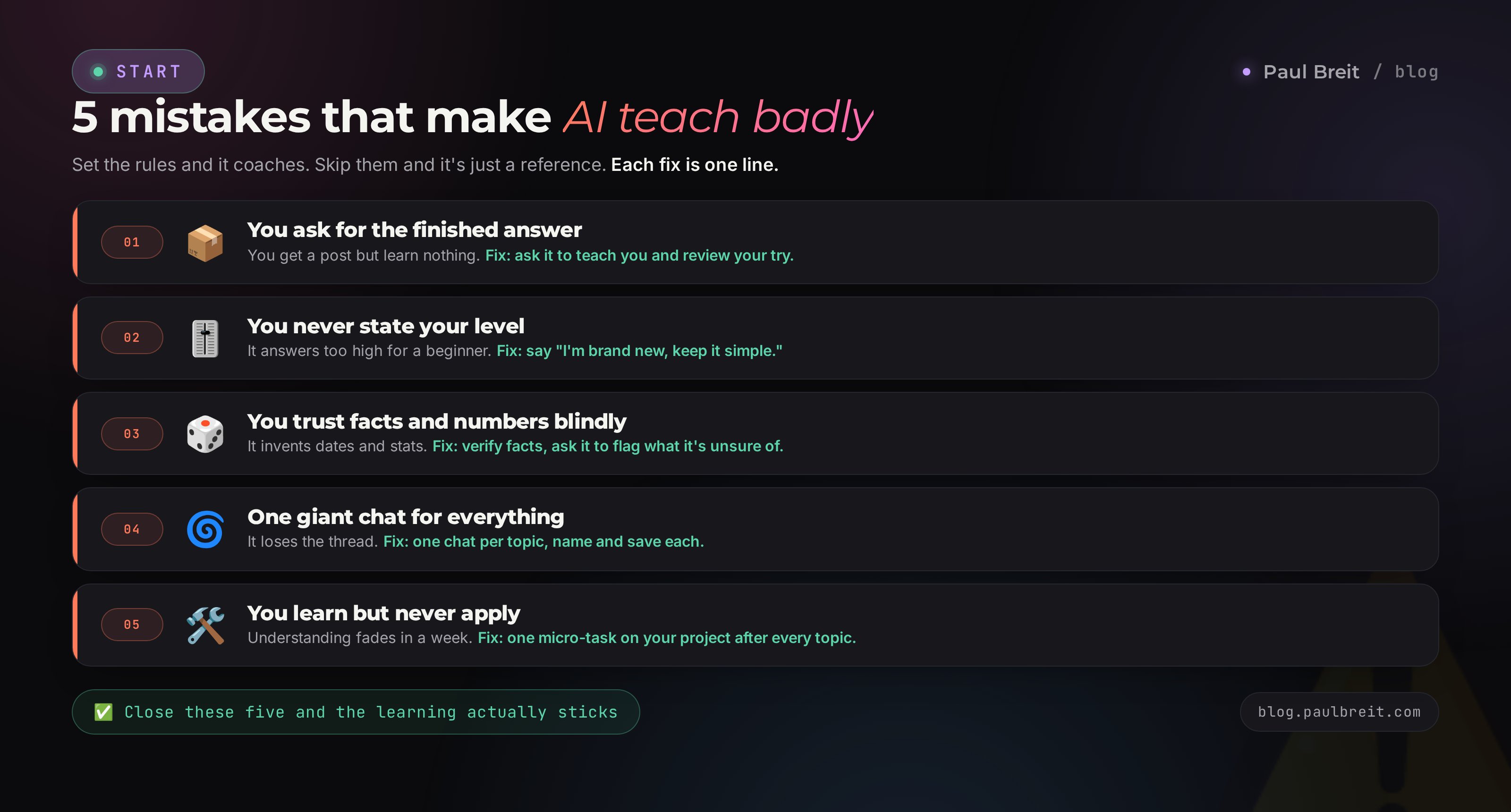
Asking for the finished answer instead of learning
"Write me a sales post" – and you got a post but learned nothing. Next time you'll go back to the AI again. The phrasing that teaches is "teach me to write a post like this and review my attempt." Fix: in every request, ask for explanation and participation, not a finished result.
Not stating your level
By default the AI answers at a middling level – often too hard for a beginner. It doesn't know you're hearing a term for the first time. Fix: always state your level and ask it to go simpler if you didn't get it. Phrases like "I'm a total beginner" or "explain it like I'm not a pro" change the answer completely.
Taking facts and numbers on faith
The AI sometimes invents things with total confidence – dates, statistics, book titles, quotes. For logic and explanations that doesn't matter; for hard facts it's critical. Fix: anything that looks like a specific fact, date, or number, verify it in search. Ask the tutor to flag where it isn't sure. A good habit sounds like this: "if you're not sure of a fact, say so honestly, don't make it up."
One giant chat for everything
When one dialogue has three topics jumbled together, the AI gets confused and loses the thread. Fix: give each major topic its own chat. In Claude and ChatGPT you can name and save them – it becomes your personal folder of courses.
Learning but never applying
You can spend a hundred hours with a tutor and not move an inch if you never do anything with your hands. Understanding without application evaporates in a week. Fix: turn every topic into an action on your own project right away. Simple rule – one micro-task on a real problem after every explanation.
Section 09For your niche and your goal
The method is one thing; everyone's topics are different. I put together a table of what makes sense to learn with a tutor for people in different fields. It's just an entry point – from here you'll easily come up with your own.
| Who you are | What to learn with a tutor | Which role leads |
|---|---|---|
| Psychologist, coach | Packaging your service, a strong intro call, handling objections | Role-play trainer + examiner |
| Tutor, teacher | Explanation methods, prompts to grade student work, your own sales webinar | Explainer + planner |
| Nutritionist, health pro | Marketing in your niche, compliant content, case breakdowns | Jargon translator + mistake reviewer |
| Marketer, ad buyer | New platforms, reading the numbers, breaking down strong campaigns | Examiner + example breakdown |
| Entrepreneur, services | Unit economics, hiring, negotiating with contractors | Socratic tutor + role-play |
| Coach, expert | Launches, funnels, sales calls, unpacking your own experience | Planner + role-play trainer |
If you're deciding where to head in AI at all, and whether to buy a paid program, I broke that down separately in how to choose an AI course and not overpay. A tutor in the chat and a course don't fight each other – the pairing works best: the course gives structure and a live guide, the AI tutor closes gaps any minute and speeds up the pace.
A little every day beats a lot once a week. Thirty minutes of dialogue with a tutor daily gives you more over a month than a weekend marathon you'll forget by Wednesday. The AI is always there – all that's left is to show up.
Section 10The whole path in a minute + checklist
The short version, to hold the whole system in your head:
- A tutor is a plain chat you've handed the teacher role, your level, and the rules.
- It outruns courses through personalization, instant feedback, active recall, and endless patience.
- Seven roles: explainer, Socratic tutor, examiner, planner, role-play trainer, mistake reviewer, jargon translator.
- The 30-day method: map the topic → depth with practice → training in the field → exam and implementation.
- Verify facts and numbers, and turn every study session into action on your own project right away.
First-day checklist
7 steps to launch your tutor
- Pick an AI: Claude or ChatGPT, the free tier is enough.
- Choose one topic you want to learn in the next month.
- Send the setup prompt from section 3, stating your level honestly.
- Ask the tutor to build a map of the topic and a 30-day plan.
- Work through the first topic in dialogue and do a micro-task on your own project right away.
- Give the topic its own chat and name it – that's your personal course.
- Come back tomorrow. Thirty minutes a day beats a weekend binge.
Learning with AI doesn't take money, perfect English, or a technical mind. It takes one strong prompt, a dialogue mode instead of finished answers, and the habit of showing up every day. A tutor that explains exactly at your level and never gets tired now fits in a single browser tab. All that's left is to open it and ask your first question.
FAQFrequently asked questions
How is learning with AI different from a regular course?
A course is recorded once for everyone and moves at an average pace. A personal AI tutor adapts to your level, answers in seconds, and checks your understanding in dialogue. So your speed is your own, not the group average.
Which AI is best for learning – Claude or ChatGPT?
Both work. Claude holds a long dialogue more calmly and stays in the teacher role better; ChatGPT is a touch faster on short answers. To start, the free tier of either one is plenty.
How much does it cost to learn with AI?
On the free tier of Claude or ChatGPT, nothing. A paid plan around $20/month lifts the limits on dialogue length, but you don't need it to begin.
Can an AI tutor really replace a course?
For speed and explanations, largely yes. A course still gives structure and a human guide; an AI tutor closes gaps any minute and sets the pace. The best setup is both: a course for the map, the tutor for the daily reps.
How fast can I actually pick up a new skill?
At 30-40 minutes a day, a working skill takes about a month: map the topic, go deep with practice, drill it, then a final exam with real implementation.
Can AI be wrong about what it teaches?
Yes. On specific facts, dates, and numbers it sometimes makes things up. Trust its logic and explanations, verify facts in search, and ask it to flag where it isn't sure.
Will AI replace a human teacher?
Not fully. It gives you speed, explanations, and practice any minute. A human mentor is for your specific project, your strategy, and staying motivated. Best combo: learn fast with AI and check the big forks with a person.
Where do I start today?
Pick an AI, give it the tutor role with a setup prompt that states your level, ask for a 30-day plan, and work through the first topic in dialogue while doing a task on your own project right away.