AI for Online Schools: 12 Places Where AI Saves Money
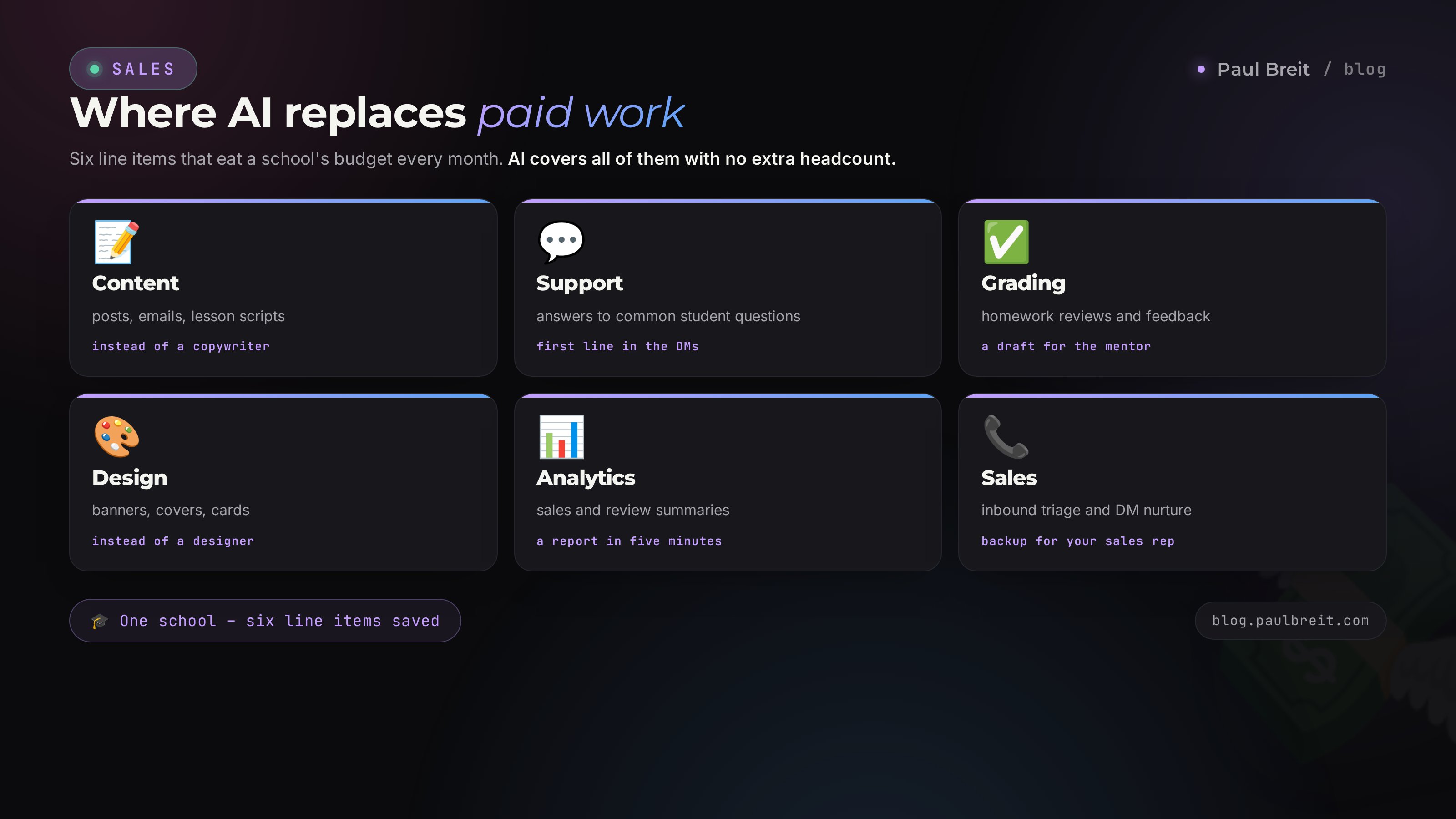
An online school leaks money where you don't see it right away: a copywriter, a mentor, support, an editor, a media buyer, a designer. AI covers these line items and holds the quality. Here are 12 places where AI takes the cost out – with a ready prompt for each and a dollar estimate of what you save.
AI saves an online school money in 12 places: content for your blog and launch nurture, sales copy and landing pages, first-line replies in your DMs, sales scripts, homework grading, student support, turning livestreams into content, reels scripts, banners and slide decks, sales and call analytics, email sequences, onboarding. A school with one active cohort takes $1,200–3,000 a month off contractors and team hours this way. The whole stack runs on Claude plus two or three services.
A familiar picture. A school with three or four products, traffic from your blog and ads, a small team. A copywriter for posts and emails, a mentor for grading, an assistant in support, an editor for cutdowns, a media buyer for ad copy, a designer for covers. These line items repeat every month, and the margin melts. The bigger the cohort, the more the manual mode costs.
I run four client projects and a school with a steady flow of clients on a stack of AI plus a small team. Below are 12 places where AI took the cost out for me and my clients, with numbers and prompts so you can copy them.
Let's walk all twelve. Each place is its own line item that AI closes fully or halfway. At the end we'll put it in a table and count what it means in dollars for a school your size.
What's inside
- Where an online school's budget leaks
- Place 1. Content for your blog and launch nurture
- Place 2. Sales copy, landing pages, emails
- Place 3. First-line replies in your DMs
- Place 4. Sales scripts and objection handling
- Place 5. Homework grading and feedback
- Place 6. Student support and FAQ
- Place 7. Livestreams into ten pieces of content
- Place 8. Reels and short video
- Place 9. Banners, covers, slide decks
- Place 10. Sales and call analytics
- Place 11. Email and reactivating your list
- Place 12. Onboarding and retention
- What it means in dollars: counting the savings
- Where to start: three places in week one
- Five mistakes that make AI burn money
- Rollout checklist
Section 01Where an online school's budget leaks
Before we save, let's see where the money goes. A school's costs split in two. First is traffic: ads, sponsorships, paid reach. AI trims that partly, through ad copy and fast creative tests. Second is production and service: content, sales, grading, support, design, editing, analytics. This is where AI takes out the most visible sums, because it's repetitive manual work by clear rules.
The logic is simple. Wherever a person does the same thing every day by a template – writes a post to a structure, answers the same question, grades homework against criteria, cuts a livestream into quotes – AI drafts it in minutes. The human stays to check and approve. One specialist starts carrying the volume you used to hire two or three people for.
Next come twelve concrete places. For each I show what AI does, give a ready prompt to copy, and add a market dollar range for the savings. Start with the places that hurt you most right now.
One thing to keep in mind. Savings show up where the school already has a system: a clear program, grading criteria, tested scripts. AI speeds up and cheapens a process that already works, and it scales chaos just as fast as order. So before you roll it out, describe once how the task is done by hand – that description becomes your prompt.
The main tool in this article is Claude. In a few regions Anthropic restricts access – if that's you, a VPN set to a US or EU location fixes it. Sign up at claude.ai; the step-by-step on signing up and paying is in the guide on paying for Claude.
Section 02Place 1. Content for your blog and launch nurture
The most expensive routine in a school is content. Channel posts, nurture sequences before a launch, blog articles on your site. A copywriter on retainer runs $500–900 a month and still misses your voice half the time.
AI solves this with a voice passport. You give Claude 30 of your best posts, it maps your manner: sentence length, favorite turns, rhythm, topics. Then it writes in that manner on any topic. You edit a finished draft instead of a blank page.
Here are 30 posts from my school's channel. Study my
style: sentence length, signature words, how I open and
close a post, my tone. Write a short voice passport.
Then, in that voice, write a post on: [topic]. Hook in
the first line, one idea, a lively conversational tone.
In practice: in the morning you dictate three topics for the week, Claude expands each into a post in your voice, you edit for ten minutes and queue it. That used to be a copywriter's day plus a round of edits; now it's a coffee and half an hour.
How to build your school's voice in detail is in the 30-post method, and how to lay out a month of content in one evening is in the content-plan breakdown.
A retained copywriter at $500–900/mo is replaced by a Claude subscription around $20/mo. Net savings – $480–880 a month, and the content comes out in the school's voice.
Section 03Place 2. Sales copy, landing pages, emails
A product landing page, launch emails, offers, checkout copy. A sales copywriter charges $200–500 for a landing page and about the same for an email series. A school launches several products a year, and the sums add up.
Claude writes the full sales structure: a headline aimed at the audience's pain, a problem block, the offer, objection handling, the call to action. It keeps your audience and product in view, if you've described them, and returns copy for a specific segment.
You're a sales copywriter. Product: [name, what's
inside, price]. Audience: [who they are, their pain,
fears, desires]. Write a landing page structure:
headline and subhead, a pain block, the offer with its
contents, 5 common objections with answers, a call to
action. Lively language, no corporate filler.
Another win is speed of hypotheses. Want to test a new headline or a different angle on the offer? Ask for three variants and run the test tonight instead of waiting a week for copy from a contractor. Fast checks over time beat one perfect landing page a quarter.
How to build a full funnel around this is in the expert sales funnel breakdown.
Sales copy for a launch runs $200–500 a piece. Across several launches a year that's $800–2,000 that stays in the school.
Section 04Place 3. First-line replies in your DMs
After an ad, questions land in your DMs: what's the price, is there a payment plan, when does it start, is this right for me. An assistant on those replies costs $300–500 a month and still answers late, and a warm lead cools within the hour.
An AI manager covers the first line. A bot answers common questions instantly, qualifies the person with a couple of questions, and passes only the ready ones to a live salesperson. It's built in a no-code chatbot builder like ManyChat.
AI manager: The course is [price], with a 6-month plan at no extra cost. Are you already working in this field or just starting out? I'll match the format to you and send the program.
The bot doesn't sell for you. It clears the first wave of same-y questions and brings the person to the point where a live salesperson steps in with full context: what they were interested in, what they already asked, where they stopped. The salesperson enters prepared and spends time on the people actually close to buying.
How to stand up an agent like this in your DMs, step by step, is in the DM agent guide.
A first-line assistant at $300–500/mo is replaced by a bot plus a service around $30–40. Savings – $280–460, plus a reply speed that lifts conversion to payment directly.
Section 05Place 4. Sales scripts and objection handling
Sales calls and discovery sessions are the heart of a school. A weak script costs money on every call. A sales trainer who builds a script and maps objections charges hundreds of dollars a project.
Give Claude transcripts of five of your real calls – wins and losses. It finds where the deal breaks, builds a script for your product, and writes objection answers in your own words that already worked.
Here are transcripts of 5 of my sales calls. Three
closed, two didn't. Find the step where the deal most
often falls apart. Build a call script for [product]:
opening, discovery, pitch, handling price. Separately,
list 7 common objections with answers in my words from
the winning calls.A one-time script setup with a trainer runs $400–800. With AI it's an evening's work and a subscription, and the script updates for every new product for free.
Section 06Place 5. Homework grading and feedback
Grading homework is a hidden hole in the budget. A mentor spends hours on same-y submissions, and on a cohort of a hundred that's a full role. Feedback often lands late, and the student loses momentum.
AI grades a submission against your criteria and drafts a structured review: what worked, what to fix, concrete steps. The mentor reads the draft, edits, and sends – minutes instead of half an hour. The student is told upfront that the first pass is done by AI and the grade is set by a human.
You're the mentor for a course on [topic]. Grading
criteria: [list]. Here's a student's submission: [text].
Give a review against the criteria: what's done well,
what to improve and exactly how. Supportive tone, to the
point. End with three concrete next steps.
A separate plus is even quality. A live mentor tires by end of day, and the hundredth submission gets less attention than the first. AI reviews the hundredth as carefully as the first, by the same criteria. Students stop complaining that one person got a detailed reply and another got a brush-off.
Don't upload personal or sensitive data into the AI. Work with anonymized submission text. Keep the final grade and the live support with the mentor – that's what students value the school for.
On a cohort of a hundred, AI takes $130–320 a month of manual work off the mentor and speeds feedback from days to hours.
Section 07Place 6. Student support and FAQ
Where's the lesson link, how do I extend access, where do I submit homework. The same questions on a loop. A support assistant on a cohort is another role.
A support bot built on the school's knowledge base answers 80 percent of these itself. You load in the common answers, course rules, links. A live person steps in only for the unusual.
Here's our course FAQ and answers: [text]. Reply to
students as the school's support: short, friendly, to
the point. If a question falls outside the base, politely
say you'll pass it to the mentor and ask for details.First-line support at $200–400/mo is closed by a bot for almost nothing. The freed-up person works on retention and upsells instead of pasting lesson links.
Section 08Place 7. Livestreams into ten pieces of content
An hour-long livestream is a pile of content that usually goes to waste. Hiring an editor to break the recording into posts and quotes is expensive, so the recording just sits in the archive.
Transcribing a livestream takes minutes, and then AI pulls a dozen pieces of content out of it: talking points for posts, quotes for cards, questions for reels, a chunk for your newsletter, a draft blog article. One livestream feeds a week of your content plan.
Here's a transcript of my hour-long livestream: [text].
Pull out: 5 post topics with ready hooks, 7 short quotes
for cards, 3 reel ideas, 1 newsletter email draft, and a
blog article outline. Keep my voice.
The full breakdown of this move is in the article on analyzing sales calls with AI (the same method works on livestreams).
This move changes how you treat livestreams. When every recording becomes a week of content, running them pays off. One live session feeds your channel, your newsletter and your reels, and the school stops inventing topics from scratch.
A repurposing editor runs $260–520/mo. AI does the same in minutes, and no recording goes to waste.
Section 09Place 8. Reels and short video
Short video pulls new traffic to a school, but a reels writer costs money, and without a script the clips come out flat and don't hold attention.
Claude writes reels scripts in batches: a hook in the first seconds, a short turn of thought, a call to action. You set the topic and format, get 10 scripts in one pass, and shoot them in an evening.
Write 10 reels scripts for an online school on [topic].
Each: a gripping hook in the first line, one useful point
in the middle, a short call to action. Conversational,
30–40 seconds. Vary the hooks: question, pattern break,
promise, rookie mistake.A short-video writer runs $260–520/mo. With AI you're left with just the shoot and the edit, and the flow of ideas never runs out.
Section 10Place 9. Banners, covers, slide decks
Lesson covers, ad banners, webinar slides. A designer on retainer is $200–400 a month, and every small fix waits in line.
AI draws covers and banners from a text description, and builds slide decks from your lesson outline in minutes. You make the small fixes yourself, without waiting on a contractor.
Build a webinar deck outline on [topic] for [N] slides:
title, agenda, 3 value blocks, a case study, the offer,
a call to action. Per slide – a heading and 3–4 big-idea
points, no fine print.Cover and slide design on retainer – $160–360 a month that stays in the school. Turnaround on fixes speeds up several times over.
Section 11Place 10. Sales and call analytics
Where deals fall apart, which objection repeats, why the cohort sags in the middle. The answers sit in call transcripts and chats, but there's no one to comb through them by hand.
Load Claude a week of sales-call transcripts. It sums up where people drop off most, which objections repeat, and what the reps who close actually say. A ready list of what to fix in the script.
Here are 10 sales-call transcripts from this week. Sum
up the analytics: which stage deals most often break at,
the top 5 recurring objections, how the closed calls
differ from the lost ones. Give 3 takeaways for fixing
the script to lift conversion.
A review like this once a week turns sales from a feeling into numbers. Instead of guessing "clients got stingier," you get a fact: deals break at the price question because the product's value never landed before it. That's fixed with one script edit, and next week shows whether it worked.
An analyst combing calls by hand is a separate cost. AI finds the leaks in an evening and pays for itself with one saved deal.
Section 12Place 11. Email and reactivating your list
A school builds up a list of people who were interested but didn't buy. That's warm money you never get around to. Writing a reactivation series is a copywriter's job.
AI writes an email sequence per segment: one angle for people who attended a webinar and didn't buy, another for people who finished a free course. Each email carries one idea and a clear action at the end.
Write a 4-email reactivation series for an online
school's list. Segment: attended the free webinar, didn't
buy. Product: [name, price, deadline]. Each email: a
gripping subject, one idea, lively language, one clear
call to action. No pressure, no fake urgency.An email series from a copywriter runs $200–400. With AI, reactivating the list becomes an evening task, and warm leads bring sales with almost no traffic cost.
Section 13Place 12. Onboarding and retention
Bought, vanished, refunded. Refunds and churn eat revenue you already counted. Often the reason is simple: the person didn't get where to start and cooled off in the first week.
AI builds an onboarding sequence that walks a new student by the hand: a welcome, a first easy step, reminders, answers to a beginner's fears. The person gets through the first week active and doesn't ask for a refund.
Build a 5-message onboarding sequence for a new student
on [topic]. Goal: get them to a first result in week one
and ease beginner anxiety. Each message: a warm greeting,
one small step, encouragement. Lively language.Every refund that doesn't happen is the full product price saved. Cutting churn by a few points on a cohort of a hundred is a few thousand dollars in retained revenue.
Section 14What it means in dollars: counting the savings
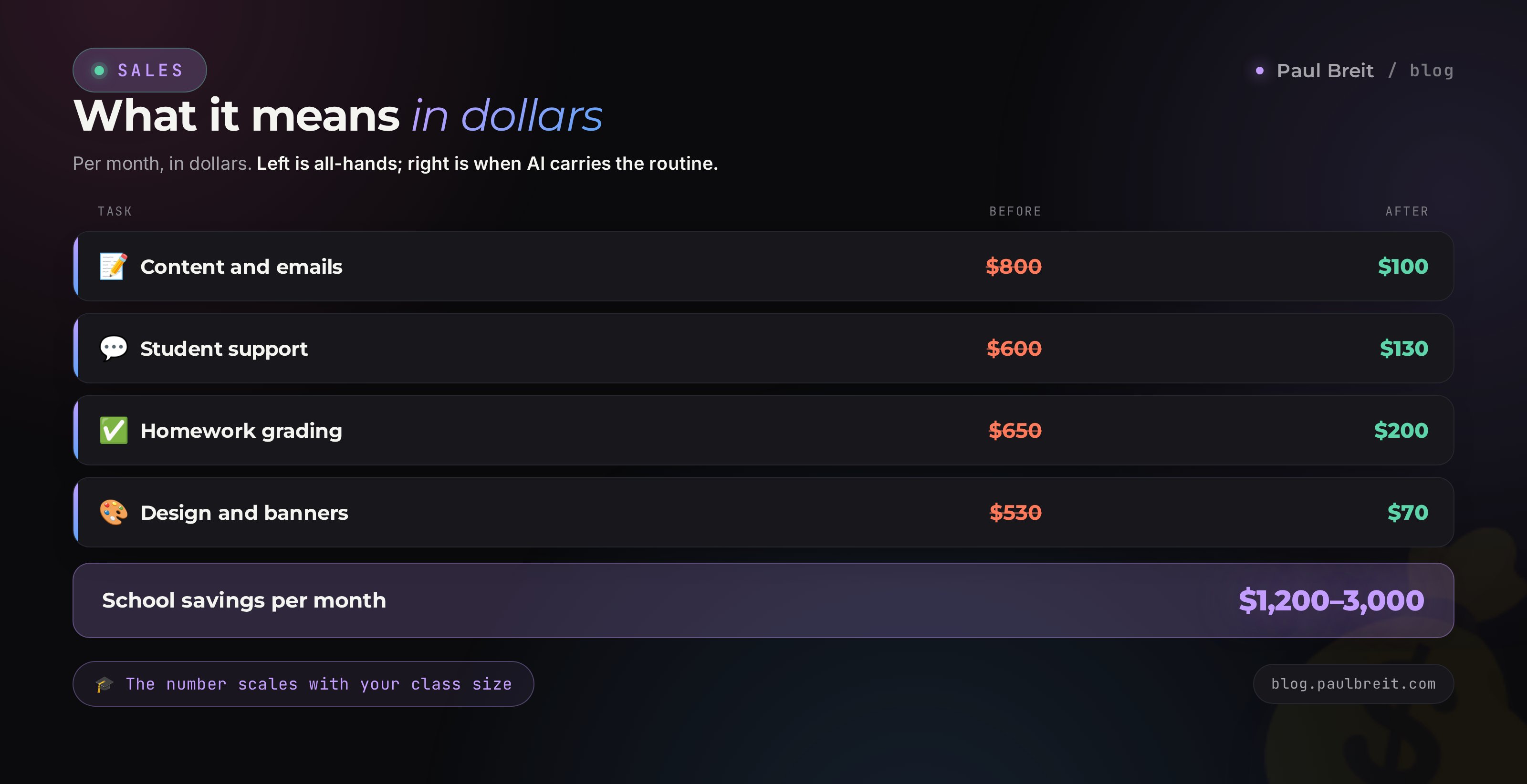
Let's put the places in a table. The numbers are market ranges for a school with one active cohort and a small team. Yours will differ, but the order of magnitude is clear right away.
| Task | Used to pay | Savings per month |
|---|---|---|
| Blog and nurture content | copywriter $500–900 | $480–880 |
| First line in the DMs | assistant $300–500 | $280–460 |
| Homework grading | mentor hours | $130–320 |
| Support and FAQ | assistant $200–400 | $180–380 |
| Reels and livestream cutdowns | writer and editor $260–520 | $160–400 |
| Cover and slide design | designer $200–400 | $160–360 |
| Ad and email copy | copywriter $200–400 | $130–320 |
All in, the range is $1,200–3,000 a month. Against that stand the tool costs: a Claude subscription around $20, an email service and a bot – another $20–40. The difference stays in the school as margin or goes into traffic that brings new clients.
Let's run it on a real school. A cohort of a hundred, three launches a year, a team of three contractors and a mentor. Before AI, production and service ran about $2,000 a month. After moving seven places to AI, about $550 stays on people where a live touch is needed, plus $50 on tools. Roughly $1,400 a month the school either keeps as profit or reinvests in traffic and grows faster.
AI doesn't zero out the team. The mentor, the salesperson, the editor stay – they do the work that needs a live human and a final call. What changes is the volume: one specialist carries the flow you used to hire two or three for. The savings come from there, not from layoffs.
Section 15Where to start: three places in week one
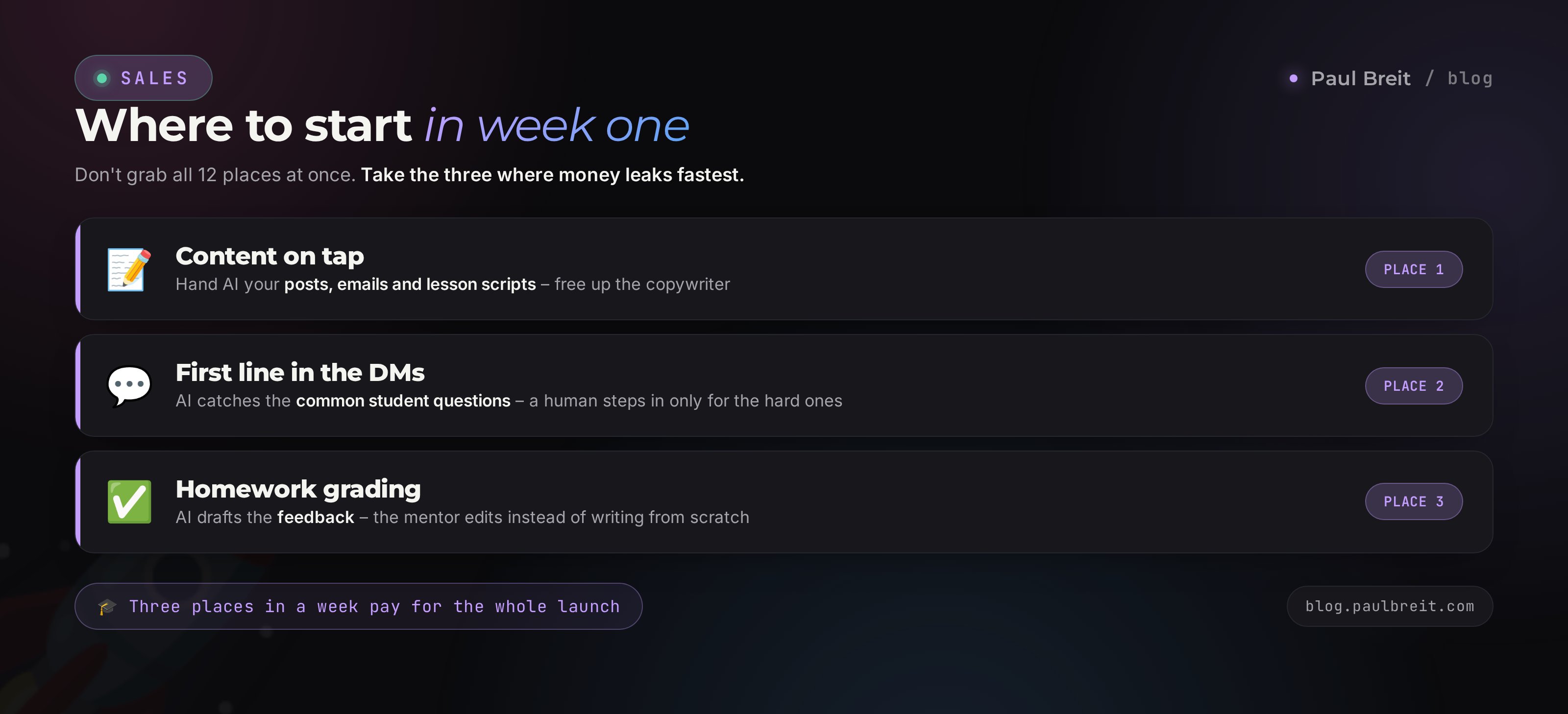
You don't need to roll out all twelve places at once. Take the three that eat the most money and time for you personally, and stand them up in one week.
Content in the school's voice
Build a voice passport from 30 posts and set up generation. The very first evening takes the copywriter off your plate and brings the content flow back.
First line in the DMs
Set up a bot for the common questions after an ad. Warm leads stop cooling in the queue, and conversion to payment rises.
Support on a knowledge base
Load the common questions into a support bot. The freed-up person works on retention instead of pasting lesson links.
After a week, count how much time and money went into these three places versus before. The number usually surprises, and it's what motivates you to stand up the fourth and fifth. From there, expand one place a week until you've closed all twelve.
For all of this you need one paid tool – Claude. Sign up at claude.ai (with a VPN if it's blocked where you are), take the Pro plan, and start with the voice passport. How to sell this kind of rollout to other schools as a service is in the guide on selling AI implementation.
Section 16Five mistakes that make AI burn money
AI saves money when it's driven right. Here are five slips that make a school waste time and get disappointed.
An empty prompt with no context
"Write a post about our course" gives you bland filler. Give it the product, the audience, the pain, the voice – and the quality jumps.
Sending without a human check
AI gets facts and numbers wrong. Anything that goes to a student or into an ad gets read by a live person. The machine drafts, the specialist approves.
Loading personal data into the AI
Client personal data, IDs, payment details don't go into the chat. Work with anonymized text.
Rolling out everything at once
Twelve places in a day turn into chaos. One place a week: lock it in, take the next.
Expecting AI to supply the substance
AI amplifies your expertise and voice. Over emptiness it will dress up emptiness nicely. The substance and method are yours; the polish and volume are its.
Section 17Rollout checklist
✅ Built the school's voice passport from 30 posts
✅ Set up content generation for the blog and nurture
✅ Stood up a first-line bot in the DMs
✅ Loaded the knowledge base into a support bot
✅ Built the sales script from real call transcripts
✅ Connected homework grading with mentor review
✅ Break every livestream into a dozen pieces of content
✅ Write reels and emails in batches from prompts
✅ Sum up call analytics once a week
✅ Walk new students through an onboarding sequence
✅ A live human checks every AI output before it ships
Twelve places is a map, not a to-do list for one day. Start with the three that hurt most, count what you saved after a month, and keep going. The school gets lighter, and the margin gets easier to see.
FAQFrequently asked questions
Which AI should an online school start with?
The base tool is Claude: it writes well, holds a long context, and reads big files. Add an email service and a bot (ManyChat) for the first line in your DMs. If Claude is blocked where you are, open it through a VPN set to a US or EU location.
Will AI fully replace the mentor and support?
AI takes the rough part: grading against criteria, the first answer to a common question, sorting incoming messages. The final word and the live contact with the student stay with a human. That's how one mentor carries a cohort that used to need three.
How much does a school really save?
A rough guide for a school with one cohort and a small team is $1,200 to $3,000 a month on contractors and team hours. The exact figure depends on your content volume, cohort size, and how many line items you move to AI.
Will the quality of the teaching suffer?
Quality holds when a human checks what AI produced before it reaches the student. The AI drafts, the mentor edits and approves. The student gets a review faster and in more detail than with hand-grading at the end of the week.
Is it legal and ethical to grade homework with AI?
Yes, on two conditions: students are told the first pass is done by AI, and the final grade is set by the mentor. Personal and sensitive data doesn't go into the AI, so you work with anonymized submission text.
How long does it take to roll out the first place?
One place goes up over a weekend. Building the school's voice passport from 30 posts and setting up content is a Saturday. Standing up a first-line bot in the DMs is a Sunday. After that you add one place a week.
Do I need a programmer?
No. Content, copy, reviews, and analytics all happen in a plain chat with Claude. The first-line bot is built in a visual no-code chatbot builder. All the work with AI is text and voice.
What if the school is small and the cohort is tiny?
Start with the two places that eat your own time: content for the blog and nurture, plus first-line replies in your DMs. That frees your evenings and needs no budget beyond a Claude subscription.