How to sell AI implementation: package your service from scratch
A step-by-step breakdown of how to build and sell an AI-implementation service to other businesses: who to sell to, what people actually pay for, how to package the offer, how to build a ladder from audit to retainer, how much to charge, and where to find your first clients. With ready-made prompts and a sales-call script. No code, no team of your own.
To sell AI implementation, package the service around one business pain and sell the result in money – not "setting up a bot." Build a ladder of four products: an express audit for $200–500, a pilot on one process for $500–1,500, a full implementation for $2,000–8,000, and a retainer for $300–900 a month. Land your first client from your warm circle with a pilot priced on the result, turn it into a case study with numbers, and scale through referrals and content. A solid specialist gets to $8,000–15,000 in monthly revenue with two or three clients on retainer.
Here's the usual picture. Someone learns to build bots and automations, makes a couple for friends for free, and gets stuck. Selling feels scary, naming a price feels scary, and when a client asks "so how much is this?" they mumble something about "a few hundred bucks, I guess." They end up skilled at a lot and paid like it's a side hustle. The problem is almost never the skill. The problem is the packaging – and the fact that they're selling their hands instead of a result for the business.
I run four client projects and a school of my own. Implementing AI inside other people's businesses is one of the most lucrative niches of 2026, precisely because supply still lags far behind demand. This article is the whole system for selling that service: from who to take it to, all the way to the meeting script where you name a price and hear "let's do it."
You'll read it in 22 minutes. You'll build your package over a weekend. Within two weeks you'll run your first sales diagnostic and close your first client.
What's inside
- What selling AI implementation actually means
- Who to sell to: 5 types of client
- What clients actually pay for
- Packaging the service: 6 elements of the offer
- The ladder: audit, pilot, implementation, retainer
- How much to charge: 3 pricing models and market rates
- Where to find your first clients: 5 channels
- The sales diagnostic: a meeting script
- How AI packages and sells for you
- 6 beginner mistakes
- A week-by-week launch plan
- The launch checklist
For building implementations, Claude is the most comfortable choice – it holds long instructions and a client's large knowledge base better than anything else. You can start on the free tier and move up as your projects grow; a paid plan pays for itself with a single client. Grab access at claude.ai, and if you're weighing options, here's how Claude compares to ChatGPT and how to pick the right AI tool for the job.
Section 01What selling AI implementation actually means
First, let's separate two different things that beginners confuse – and lose money over. There's setup, and there's implementation.
Setup is when you build a business a bot or an automation, hand it over, get paid once, and walk away. The client got a tool. What they do with it next, whether it even works in practice – none of that is your problem anymore; your responsibility ended the day you delivered. It's a one-off service with a ceiling on the price and no recurring revenue.
Implementation is when you embed the AI into the client's live workflow so it produces a measurable result: saved hours, a lower cost per lead, higher revenue. You dig into how the business runs, find the bottleneck, build a solution around it, train the team to use it, and track the metrics. The work doesn't end on delivery day – it turns into a retainer with monthly payments.
The difference in money is enormous. Setting up a bot is a one-time $300–800. Implementing that same bot as part of the sales process is $3,000 for the project plus $600 a month for support. Same tool. Different packaging and different accountability. The client pays more because they're buying a result and peace of mind that you're on the hook for. A file with settings they could have ordered for pocket change.
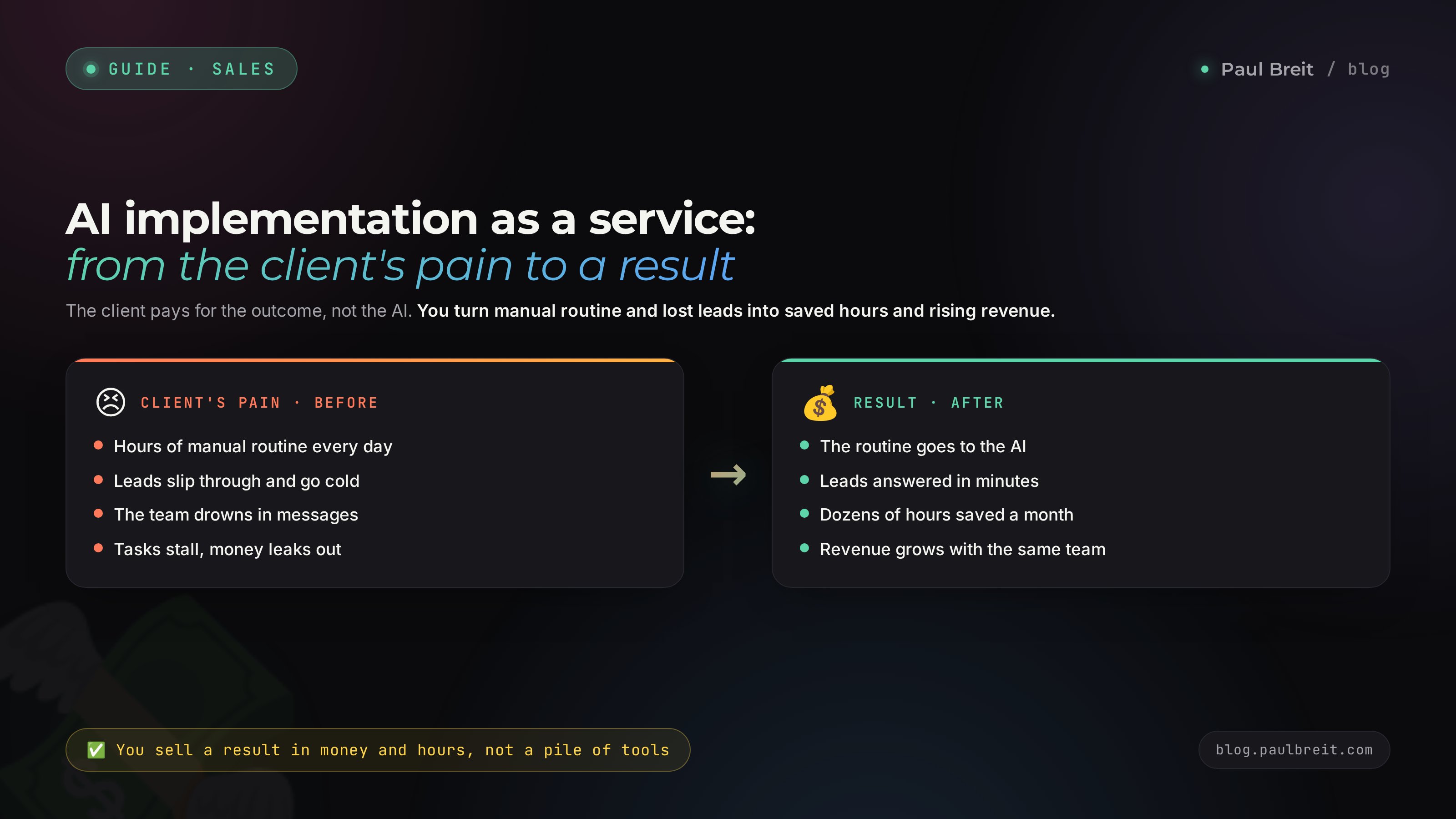
You're not selling the business a technology. You're selling a pain that goes away: leads stop slipping through the cracks, the team stops drowning in messages, the owner stops checking reports by hand. The AI under the hood is your tool – the client only cares about the outcome. Build everything downstream from the client's pain to their result, and keep the technology under the hood.
Section 02Who to sell to: 5 types of client
The first mistake is trying to sell to "anyone with a business." That way you sell to no one. Pick a niche by three signals at once: the client has money, has repetitive manual routine, and has a clear pain they already feel themselves. Below are five segments where those three signals line up most often.
Online schools, experts, coaches
The warmest market, because they already sell through content and already believe in AI. The routine: content calendars, posts, DM replies, lead handling, breaking down sales calls. The pain: the expert burns out and can't keep up with selling by hand. What you implement: a content pipeline, a DM auto-responder, an assistant that reviews sales calls. The easiest way in is through the tasks AI takes off an expert's plate – here's how AI works for coaches and experts.
Small service businesses: clinics, salons, auto shops, studios
The routine: a front-desk person answering the same questions, booking, sending reminders, calling back missed inquiries. The pain: leads get lost in the evenings and on weekends, and the front-desk hire is expensive and keeps quitting. What you implement: an AI receptionist in DMs and on the site that answers around the clock, qualifies, and books appointments. A ready-made example is an AI assistant that finds and books clients for you.
Agencies, production shops, studios
The routine: producing the same kind of content over and over, briefs, client reports, handling revisions. The pain: scaling hits a wall at hiring, and margins get eaten by manual work. What you implement: text and visual production pipelines, automated reporting, a project knowledge base. The ticket is high here because you directly raise the agency's margin.
E-commerce and product businesses
The routine: product descriptions, replies to reviews and questions, support, email campaigns. The pain: thousands of listings and messages that there's physically no one to handle. What you implement: description generation from a feed, automated review replies, first-line support. The result is measured in listing conversion and in load taken off the support team.
Local offline businesses
The routine: working a call list, taking inquiries from the site, answering messages, paperwork. The pain: the owner is wearing five hats and holding it all together personally. What you implement: intake and routing of inquiries, a document assistant, inbox triage. Here you're often the first person to even offer something like this – there's almost no competition.
Pick one segment to start with. The one where you already have contacts or firsthand experience. Knowing the client's inner workings sells harder than any portfolio: you speak the language of their pain instead of the language of technology.
Section 03What clients actually pay for
A business parts with money for three reasons: to earn more, to spend less, or to take a headache off their plate. All of AI implementation fits inside those three motives. Your job on the sale is to translate any technical solution into the language of one of them.
Compare two ways of describing the exact same service.
| How a beginner says it | How a sale sounds |
|---|---|
| I'll set up an AI chatbot for you | Leads stop slipping away at night and on weekends – you'll reply in 5 seconds instead of an hour |
| I'll do content generation | Your three-person content team gets done what one person can, saving $6,000 a month in salary |
| I'll connect AI to review handling | Every review gets a reply within a minute, your listing rating climbs, and support load drops by half |
| I'll build a knowledge base in Claude | A new hire ramps to full speed in 3 days instead of a month, and you stop answering the same questions |
The right column sells because it has a number and an outcome the client understands. The left column scares them: the client doesn't know what an AI chatbot is or why they'd want one. They know they're losing leads. Talk about the leads.
Before every sale, fill in three lines about the client: how many hours a week go into the routine you'll close; what those hours cost in money; how much money leaks away through errors and lost leads. The quarterly total is the value of your implementation. Your price should be noticeably lower than that total – then the deal looks obvious.
A word on the results that are hard to quantify. Sometimes a client is buying peace of mind: not having to fear the business grinds to a halt if a key employee leaves. That sells too, just through a different framing: "the system runs without you and doesn't depend on the receptionist's mood." An owner's peace of mind is worth a lot – don't be shy about naming it as value.
Section 04Packaging the service: 6 elements of the offer
The offer is your answer to the client's question: "why should I give my money to you, and why now?" A strong offer is built from six elements. Miss even one and the sale sags.
A concrete result with a number
Not "we'll improve how you work with clients," but "we'll cut response time on a lead from an hour to a minute and recover 15 lost leads a week." The number comes from diagnosing the client's business, so you can't invent it in advance for everyone. Keep one typical result per segment and refine it in the meeting.
A clear scope of work
The client needs to see exactly what they're buying: how many processes you'll automate, what's included, what isn't, how long the project runs. A vague "I'll implement AI in your business" triggers fear of an endless construction site. A crisp "in 3 weeks we'll build and launch lead handling, train two of your reps, and support it for two weeks" – that sells.
A guarantee or risk reversal
The client is risking money and time. Take that risk off them: a pilot on one process priced on the result, a partial refund if you don't hit the agreed numbers, free tweaks for a month. A guarantee is the strongest argument for a beginner with no name. It says: I'm so sure of the outcome I'll put my own money on the line.
Social proof
One case study with numbers beats ten promises. At the start, when you have no cases, a live demo on the client's own data plus a testimonial from your first project does the job. The moment you have a first result, package it by formula: the situation before, what you did, the result in numbers, the timeframe. Three cases like that answer most objections before the meeting even starts.
Justifying the price
A price with no justification looks pulled from thin air. Tie it to the value from the last section: "the implementation is $3,000, and it returns $8,000 over six months in saved hours and recovered leads." When the price sits next to the payoff, it stops being the main question of the conversation.
A reason to decide now
With no deadline, a decision gets put off forever. The reason has to be honest: a slot in your schedule this month, a price increase next quarter, a competitor of theirs already implementing and pulling ahead. Fake urgency reads as fake and hurts you. A real reason moves the deal.
Collect these six elements into a single two-page document – that's your proposal. Below, in the section on AI, I'll give you a prompt that assembles it in ten minutes for a specific client.
Section 05The ladder: audit, pilot, implementation, retainer
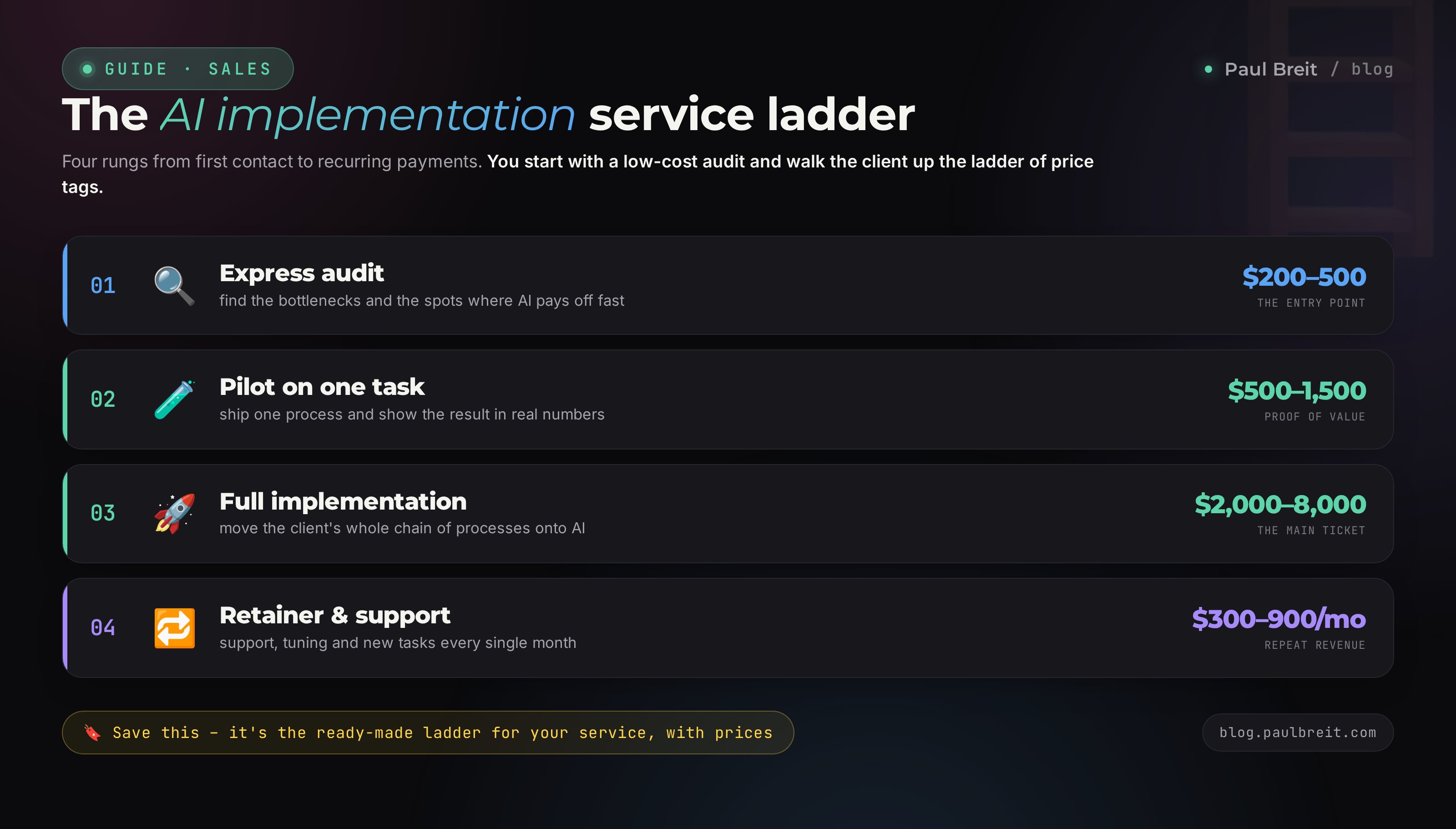
Selling an expensive implementation to a cold client straight away is hard. They don't know you and aren't ready to hand over $5,000 on trust. So you build a ladder of four products: each rung is pricier than the last, and each warms the client up for the next. People step on at the bottom and climb as trust grows.
Express audit
You go through the client's business and find 3–5 spots where AI can remove routine or recover money. The deliverable is a document with a map of opportunities, priorities, and the potential savings on each item. It's a cheap way in that introduces the client to you and shows your competence. The audit is often sold cheap or free – it pays for itself on the next rung.
Pilot on one process
You take one bottleneck from the audit and close it completely in 1–2 weeks. Just inbound lead handling, say. The client sees a live result on their own data for a small investment. The pilot removes the beginner-buyer's biggest fear and doubles as your case study. This is exactly where you should start with first clients.
Full implementation
After a successful pilot, you offer to close the rest of the processes from the audit. This is the main ticket. Here you embed several automations, train the team, write the playbooks, track the metrics. The project runs from 3 weeks to 2 months depending on scope. Selling it after the pilot is easy: trust is already there, and the client has seen a result with their own eyes.
Retainer
AI and processes change, automations need tuning, and the client comes up with new tasks. The retainer is a monthly fee for support, updates, and small tweaks. This is your stable income – the kind that doesn't depend on new sales. Three clients on retainer at $600 a month is $1,800 in baseline revenue before you land a single new project.
Each rung sells the next. The audit reveals the scale of the problems, the pilot proves you solve them, the implementation closes everything, and the retainer keeps the client for years. One client who came in through a $400 audit brings $8,000–15,000 over a year. That's why the bottom rung can be nearly free: it pays for itself across the whole ladder.
Section 06How much to charge: 3 pricing models and market rates
Pricing is where beginners lose the most money. They lowball, they're afraid to name a figure, they agree to work for free. Let's go through three working models and the market rates for 2026.
Model 1. A fixed project fee
The clearest model for the start and for the client. You name a sum for a specific scope: "a pilot on lead handling – $1,000." The client knows the final number up front and doesn't fear the bill will balloon. The downside: if you underestimate the complexity, you work at a loss. So build in a 20–30% buffer for surprises. This model is your choice for the first six months.
Model 2. Payment on results
You take a percentage of what the client earned or saved thanks to the implementation. Say, 20% of the value of recovered leads over the first quarter. The model sells itself: the client risks nothing and pays out of profit. The downside: you need to measure the result honestly and agree on the method up front. Best used once you already have cases and you're sure of the numbers.
Model 3. A retainer for support
A fixed monthly fee for support and development. This is the model for the fourth rung of the ladder. It gives you predictable income and turns one-off deals into a stream. The bedrock of a steady income in this niche is retainers – one-off implementations just fill up your base of clients on support.
| Product | Market rate, 2026 | Pricing model |
|---|---|---|
| Express audit | $200–500 (or free as a way in) | Fixed |
| Pilot on one process | $500–1,500 | Fixed or on results |
| Full implementation | $2,000–8,000 | Fixed or on results |
| Retainer | $300–900 / month | Retainer |
A cheap price scares off good clients. The owner reasons like this: if the implementation costs $200, it's either not serious or the person isn't sure of themselves. A low price attracts the people who'll grind you into the dirt for pennies. Set your price from the middle of the market and back it with a guarantee. A confident price with a guarantee sells better than a timid one without.
Section 07Where to find your first clients: 5 channels
Without clients, the packaging is useless. The good news: at the start you don't need ads or a big budget. Your first three to five clients come from channels that cost nothing but time.
Your warm circle
Make a list of 30–50 people who either run a business or know people who do. Message each one personally – no copy-paste blast: tell them what you do, ask if they have routine they'd love to offload. Out of 50 messages you usually get 3–5 conversations and 1–2 first projects. It's the fastest way to start today.
Content on your own platforms
Show the process and the results where people can see you: a channel, your personal profiles, niche communities. A case like "built a client lead-handling flow, recovered 15 leads a week" works like a magnet. People show up asking "can you do that for me too?" How to build a steady stream of that content is in the guide on your first 1,000 followers, and here are the ways to actually make money with AI.
Direct outreach off a list
Pick 20 companies in your segment, study each one, and find a specific hole: slow to answer DMs, no replies to reviews, losing leads in the evening. Message the owner with a pointed note about their pain and a ready mini-solution. A personal touch with something concrete gets answered far more often than a template blast.
Partnerships
Marketers, outsourced accountants, web studios, social media managers already work with your future clients and don't cover the automation piece. Agree on a referral cut. One partner with a base of fifty clients brings you more than a month of cold outreach.
Niche communities and marketplaces
In founder groups and on freelance marketplaces, people regularly ask "who can set up AI for this task?" Answer with value, not a pitch: unpack the question, offer a line of thinking. Expertise in the comments pulls inquiries into your DMs. It's slower than the warm circle, but it compounds over time.
Don't spread yourself across all five channels at once. Week one – just the warm circle and direct outreach; they get you a client fastest. The moment you have a first case, turn on content: now you have something to show. Partnerships and communities come later, when you're on your feet and want a steady stream.
Section 08The sales diagnostic: a meeting script
The sales diagnostic is a 30–40 minute meeting where you break down the client's business and name a price at the end. Its core principle: what sells is the questions that help the client see the scale of the problem for themselves. Showing off your skills is secondary. Here's a six-step script.
Rapport and the frame
Set out how the meeting will go: "I'll ask a few questions about your processes, then show you where AI would deliver a result, and if we're a fit – we'll talk about how to work together." The client understands the structure and relaxes. Agree on the timing.
Questions about routine and pain
Dig into the repetitive tasks: what eats the most time for you and the team, where leads or money most often get lost, what you keep putting off because you never get to it. Listen more. Every complaint the client makes is a future line item in your offer.
Putting a number on the losses
Turn the pain into money together with the client: "how many leads a week never get answered? What's each one worth? So you're losing roughly this much a month." Once the client has done the math with their own hands, they sell it to themselves from there. Your price looks modest against those figures.
A mini-demo on their data
Show live how the solution works on the client's own material. Take 10–20 of their real leads or reviews and run them through the flow right there in the meeting. Fifteen minutes of a demo on live data convinces harder than an hour of slides. This is the moment the client says "wow."
The offer and the price
Propose starting with a pilot, name the price calmly, and go quiet. The pause after the price is your best tool. Whoever speaks first loses: don't fill the silence with excuses and discounts. Let the client think and answer.
Handling objections and locking it in
"Too expensive" goes back to the losses you counted. "I need to think" – pin down what exactly is giving them pause. "Not now" – close with the reason-to-decide-now from your offer. End the meeting with a concrete agreement: when you start, what you need from the client, how payment is handled. A deeper look at closing technique is in the guide on the expert sales funnel.
One extra source of growth is reviewing your own recorded meetings. Run them through AI and see where you lost the client: talked over them, didn't hold the price, caved on the pause. Here's how to set that up – a walkthrough on analyzing sales calls with AI.
Section 09How AI packages and sells for you
The irony is that you package an AI-implementation service with AI itself. Below are four prompts that take the prep work off your plate. Drop a description of your niche and your services into a Claude Project, and the prompts will run in your context. How to build a Project like that step by step is in the guide on building an AI agent with no code, and if you want the prompting fundamentals first, start with how to write prompts.
Prompt 1. Package the offer for a segment
You're a marketer who packages services.
My service: implementing AI into a business.
My client segment: [e.g., dental clinics].

Build an offer around 6 elements:
1. A concrete result with a number
2. Scope of work (what's included, timeline)
3. Guarantee / risk reversal
4. Social proof (what to use at the start
   with no cases yet)
5. Price justification through value
6. A reason to decide now

Write in the language of the client's pain,
no technical jargon. The result in money and hours.
Prompt 2. Calculate the client's savings
Help me calculate the value of an implementation
for a client. Here's their process:
[describe the routine and volumes].
Employee rate: [amount] per hour.
Leads/inquiries per week: [number].
Client's average order value: [amount].

Calculate:
- how many hours a month the implementation frees up
- that saving in money over a quarter
- how much money we recover on lost leads
Give a short calculation I can show
the client in the meeting.
Prompt 3. The proposal
Based on the offer and the savings calculation,
assemble a 2-page proposal.
Structure: the client's pain - what we propose -
what's included and the timeline - the result in
numbers - price and justification - guarantee -
the next step.

Tone is businesslike, no filler, no corporate-speak.
The client is an owner with little time -
write short and to the point.
Prompt 4. Prep for the diagnostic
I'm going into a sales diagnostic with a client.
Client's niche: [niche]. What I know: [facts].

Give me:
- 10 questions to surface their routine and pain
- the 3 processes most likely to hurt in this niche
- how to quantify the losses together with them
- 3 objections they'll raise, and the answersThe AI drafts; you decide. Check the numbers in the calculations – AI sometimes produces plausible but invented figures. Only calculate savings from the client's real data, the data you got in the diagnostic. One wrong number in the meeting destroys trust entirely.
Section 106 beginner mistakes
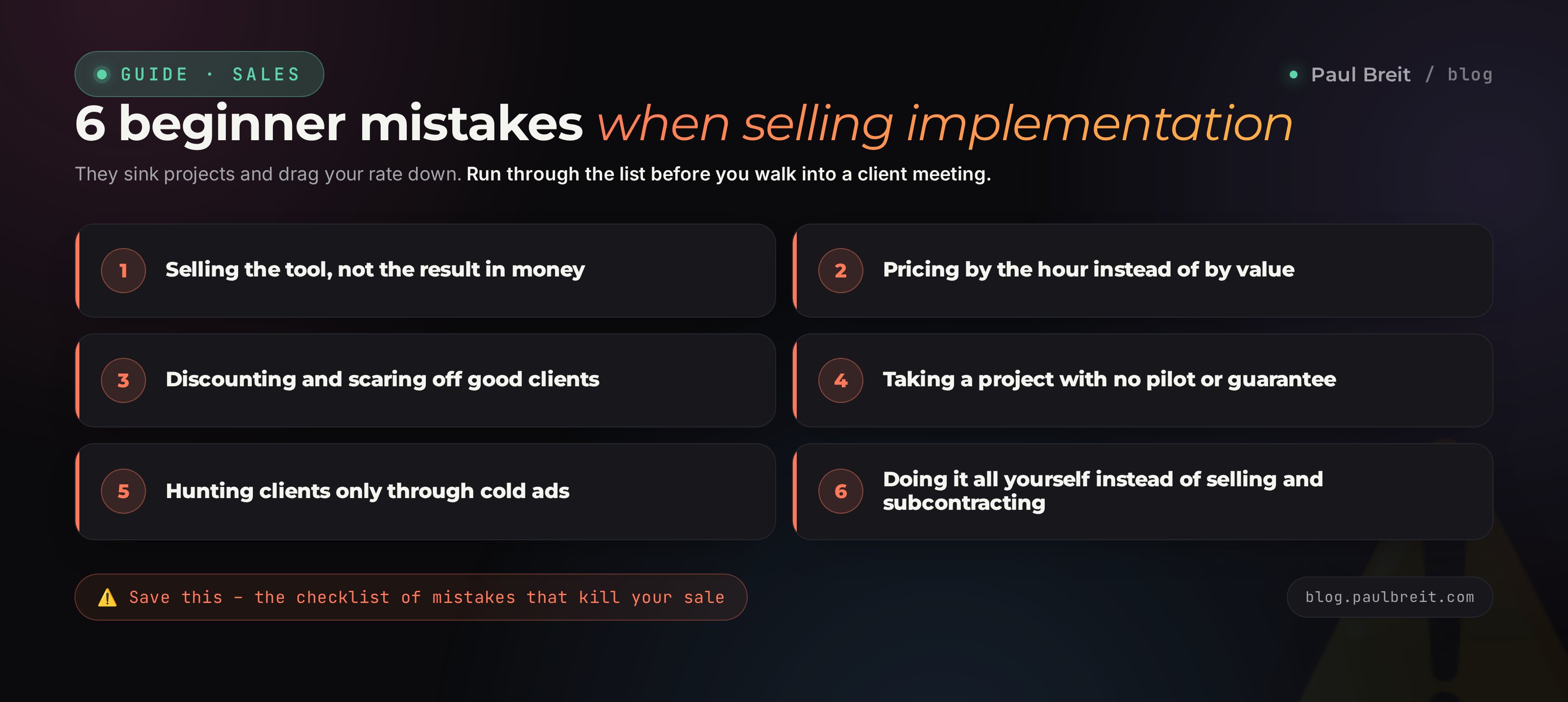
- Selling the technology instead of the result. "I'll set up a GPT bot" means nothing to an owner. "I'll recover your lost leads" means everything. Always translate into the language of money and hours.
- Working for free forever. One free pilot in exchange for a testimonial is fine. A fifth free project "for the portfolio" is burnout with no income. After the first case, charge.
- Naming the price timidly. If you don't believe your own price, the client hears it. Calculate the value in advance, name the figure calmly, and hold the pause.
- Taking every client in sight. Different niches mean different processes, different pains, different builds. Spreading yourself thin kills your speed. Focus on one segment until you have three cases in it.
- Promising more than you can deliver. One blown result buries your reputation in a small market. Under-promise, over-deliver. Only guarantee what you're sure of.
- Skipping the retainer. One-off implementations are a rollercoaster – feast, then famine. Only a monthly retainer gives you stability. Build support into every project from the very start.
Section 11A week-by-week launch plan
To turn this article into money, let's lay it all out as a two-week plan. It assumes someone who can already build basic automations and wants to start selling.
Packaging and first outreach
Days 1–2: pick one segment, build the offer around the six elements with prompt 1, prepare a proposal template. Day 3: put together a list of 50 warm contacts and 20 companies for direct outreach. Days 4–7: message everyone personally, book your first diagnostics. The goal for the week: 3–5 meetings booked.
Diagnostics and the first pilot
Days 8–11: run the diagnostics on the six-step script, do a mini-demo on the client's data in each one, name the price. Days 12–14: close your first client on a pilot and kick off the work. The goal for the week: one paid pilot and an agreement with one more client for later.
From there the cycle repeats, and each time it's easier: a case study appears, content kicks in, referrals start working. In two or three months you've got several clients on retainer and a predictable income. Adjacent steps for starting from zero are in the guide on making money with AI.
Section 12The launch checklist
Print it out. Tick the boxes as you go. When all nine are checked, you're ready to sell and close deals.
- Segment chosen – one where there's money, routine, and a pain the client feels
- Offer built across the six elements with prompt 1, the result framed in money
- Ladder ready – audit, pilot, implementation, retainer, with prices
- Prices set from the middle of the market, with a guarantee on the pilot
- Proposal – a 2-page template tailored to the segment
- Diagnostic script – the six steps rehearsed
- Mini-demo built and working on test data
- Client list – 50 warm contacts and 20 companies for outreach
- Payments sorted – invoicing set up and ready to receive money
Pick one segment with money and pain. Package the service as a result in money that you're accountable for. Build a four-rung ladder: the audit warms them up, the pilot proves it, the implementation is the main ticket, the retainer is steady income. Set your price from the middle of the market and back it with a guarantee. Land your first clients from your warm circle and direct outreach, and close them in the sales diagnostic through quantifying losses and a live demo. All the prep – the offer, the math, the proposal, the meeting questions – you assemble with AI using four prompts. One client who came in through an audit brings $8,000–15,000 over a year. Your job for two weeks: build the package and run the first meeting.
How this connects to the other guides
Implementation is the "what" you sell a business. Building the agent itself with no code is the "how" you close the client's task. The expert sales funnel is how you take a meeting all the way to payment. And the models for making money with AI put implementation in context – it's one of several. Four guides, one system for earning with AI.
FAQFrequently asked questions
Do you need to know how to code to sell AI implementation?
No. Most tasks are handled with ready-made tools and good prompts: chatbots, lead handling, content generation, document parsing. Code is rarely needed, and when it is, it's cheaper to hire a contractor once than to learn it yourself. You sell a result in money and hours. The client doesn't care about the code.
How much can you charge for AI implementation?
Market ranges for 2026: an express audit runs $200–500, a pilot on one task $500–1,500, a full implementation $2,000–8,000, and a monthly retainer $300–900. The exact number is set by the value to the client: how much money or time you bring them. Your hours are secondary.
Where do you find first clients without spending on ads?
Five channels that work: your warm circle and former colleagues, other agencies as a subcontractor, local businesses near you, expert content on social and this blog, and partnerships with people already selling adjacent services. The first two or three clients almost always come from the warm circle.
How do you price it so you don't undersell?
Don't price by the hour. Tie the price to the result: if the implementation saves the client 40 hours a month or brings an extra $5,000 in revenue, your $3,000 is an obviously good deal. The article covers three models: a fixed project fee, a percentage of the result, and a monthly retainer.
What do you do when a client says it's too expensive?
"Too expensive" almost always means "I don't see the value." Go back to the numbers: how much the client loses now and how much they'll save after. Offer to start with a cheap audit or a pilot on one task, so the person tests you on a small amount and wants to continue on their own.
Do you need your own team to implement AI for clients?
Not at the start. You can close your first projects solo with the help of the AI itself: it writes the prompts, the documentation, and the client instructions. When the orders pile up, you hand the routine to hourly contractors and keep sales and strategy for yourself.
How fast can you make your first money?
On the plan in this article, a first paying client is realistic in two to three weeks: a week to package the offer and pricing, a week of outreach to your warm circle, then the sales diagnostic and launching a pilot. You can and should sell a pilot on one task right away, without waiting for a perfect package.
Which niches pay best for AI implementation?
The ones with lots of manual routine and a clear cost of error: online schools and experts, agencies, e-commerce stores, clinics and salons, and legal or accounting outsourcing. The more an employee's hour costs the client, the easier it is to justify your price for automation.