Medium for business: free traffic from search
Medium is a platform where your articles bring in readers from the feed and from search for months, while you're busy with clients. We'll walk through it step by step: how to set up your profile, how the read-through algorithm works, how to write articles with AI in batches, how to reach the top of Google, and how to turn a random reader into a client. With a plan for your first 30 days and a launch checklist.
Getting traffic on Medium comes down to read-through: the algorithm shows an article to new people when the first readers finish it to the end and spend 40-60 seconds or more on the page. Build a profile around one topic, publish 3-5 articles a week of 700-1,000 words each with a strong headline and cover image, write drafts with AI, and edit them into your own voice. After 20-30 articles, the profile starts steadily bringing readers from the feed and from search, and the warm-up inside the article turns them into leads for your services.
You started a Medium profile, posted five articles, got about 30 views each, and quit. A week later you decided the platform was dead and there's no traffic here. Nine out of ten people do exactly that. Meanwhile, someone in your niche has one article from two years ago that brings 200 readers a day from Google search, and half of them are hearing his name for the first time.
The difference isn't luck. He understood how the platform works and built that into every article. This guide is the whole mechanism, with a plan and prompts, so you can build the same flow in a month with no ad budget.
You'll read this in 22 minutes. You'll launch your first profile in an evening. In 30 days you'll see your first leads from people who found you in search and read the article to the end.
What's inside
- What Medium is in 2026 and where the traffic comes from
- Who Medium works for in business
- Step 1. Set up your profile the right way
- Step 2. The algorithm: read-through is everything
- Step 3. The structure of an article people finish
- Step 4. An AI content pipeline
- Step 5. Headlines and cover images
- Step 6. How to rank in Google search
- How to turn a reader into a client
- Metrics: what to check every week
- 7 mistakes that keep Medium from growing
- A plan for your first 30 days
- Launch checklist
Medium itself opens freely almost everywhere, no VPN needed. But Claude, which we'll use to write the articles, may not be available in your region directly - you'll need a VPN with an EU or US location. Working ones in 2026: Proton VPN and other reputable providers. A handful of regions are on Anthropic's blocked list, so pick an EU or US endpoint. A detailed guide to signing up and paying is in the article on getting started with AI.
Section 01What Medium is in 2026 and where the traffic comes from
Medium is a platform for articles and long-form writing. It has its own recommendation feed and a huge base of readers who come to learn something and stay. For you as a business owner, one thing matters: it still hands out free reach, and hands it out generously if you play by the platform's rules.
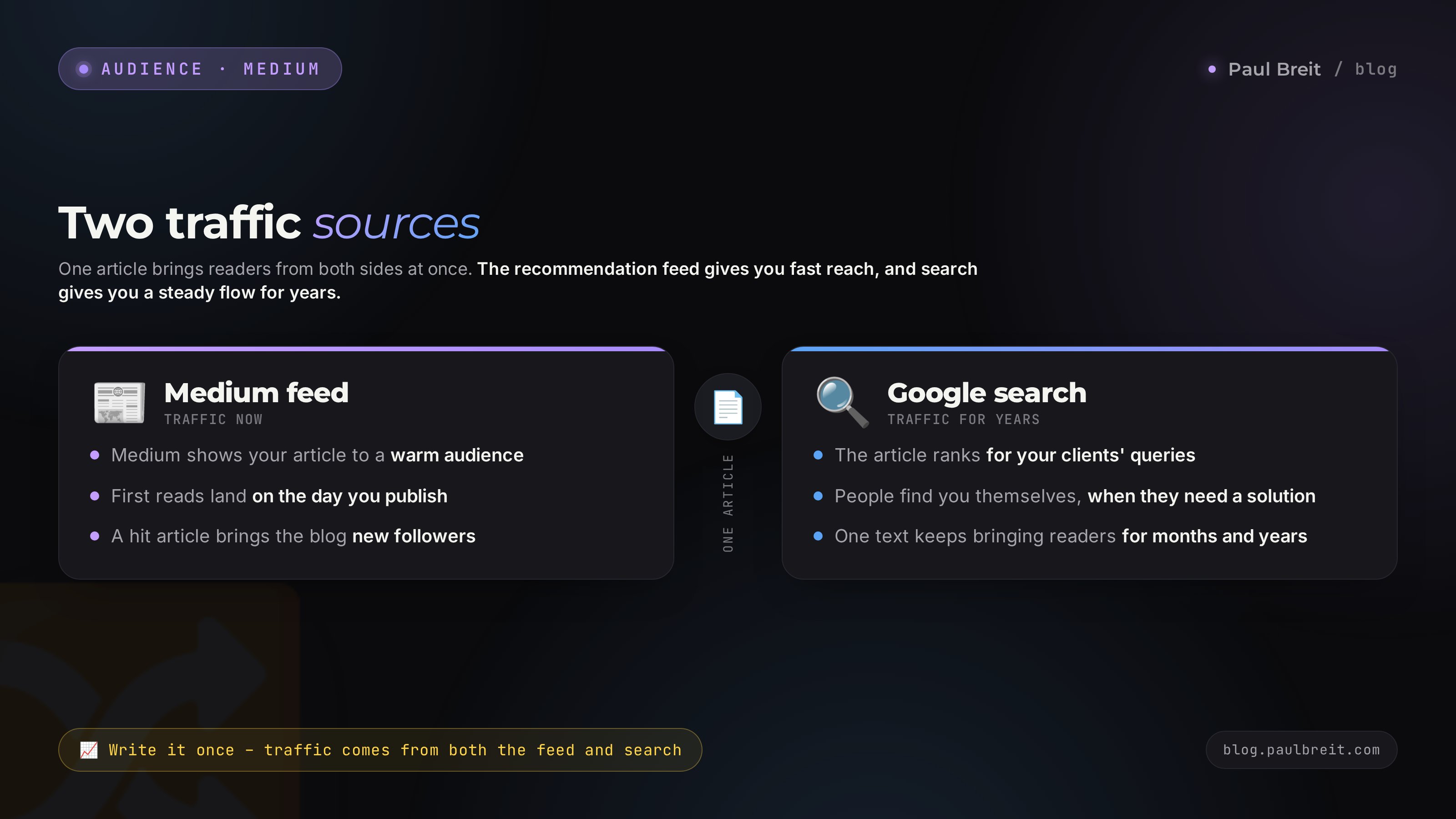
Traffic to your articles comes from two sources, and they work at the same time.
Source 1. The Medium recommendation feed
This is what a person sees when they open the app or the site. The algorithm matches articles to each reader's interests. Your new article gets a small test impression in its first hours - a hundred or two hundred people. Medium watches how they behave. Do they finish it? Do they spend a minute on the page? Do they open your next article? If yes, the impression expands several times over. If they behave poorly, the article fades. This check runs on every publication, which is why there's no such thing as a "dead" account on Medium: even a profile with three followers can land an article with 50,000 reads.
Source 2. Search
This is where the headline of this article lives. Every publication becomes a regular web page that Google indexes. Medium is one of the most authoritative domains on the web, with enormous weight in search. An article on your own site would claw its way to the top over months, while the same article on Medium slides into the rankings far more easily, simply because it sits on a strong domain.
And this is traffic that doesn't run out. Ads work while you pay. A Telegram post lives a day. But a Medium article that lands in search for a good query brings readers every day for years. You wrote it once, and it keeps paying off again and again. I covered the search mechanics for the new AI-answer era in detail in the article on getting found in AI search - Medium fits into the same logic.
Section 02Who Medium works for in business
Medium loves text. That means it fits perfectly for anyone with something to explain. If you sell services, consulting, or training and you can break the complex down into the simple, the platform becomes your main free channel.
Check yourself against this list. Medium will bring you clients if you're:
- An expert, coach, psychologist, nutritionist, or tutor. You have a deep topic, client questions repeat, and you can write a breakdown for each one. That's a ready-made content plan for a year.
- A service business owner. Home repair, legal services, accounting, real estate, dentistry. People google their problem before they buy, and your article catches them in that moment.
- A mentor or online-course creator. An article warms up a cold reader and points them to a lead magnet or a consultation without spending a dollar on ads.
- A local business with expertise. A salon, a studio, an auto shop. Useful articles about your city collect a warm audience right next to you.
It'll be tough if your product is a pure impulse buy that needs no explanation, or if you physically can't give the platform a couple of hours a week even with AI as your helper. Medium is a marathon. It rewards those who publish regularly and forgets those who vanish for a month.
The Medium audience is broader and "colder" than your Telegram. There are plenty of random people here who came from the feed to read and leave. The conversion into a lead from a single read is lower than from a warmed-up subscriber. You make up for it with traffic volume: when thousands read the article, even one percent is dozens of new people in your funnel every week.
Step 01Set up your profile the right way
Registration takes ten minutes, and at this stage it's easy to bake in mistakes that slow your growth later. Let's do it right from the start.
Build a profile around one topic
Go to Medium, sign up, and set up your profile. The main rule is one topic per profile. Medium studies what you write about and matches you with the right reader. If you jump from psychology to recipes to travel, the algorithm can't figure out who to show you to, and reach drops. A psychologist writes about relationships and anxiety. A lawyer writes about deals and disputes. Keep the focus.
Name and bio built around a query
Name your profile so a person understands the value at a glance. "Marina Strong" is weak. "Psychologist on anxiety and relationships" is strong, because it has both the name-brand and the topic right there. In your bio, use 2-3 sentences to say who you are, who you help, and what a person gets if they follow you. Work in the keywords of your niche - both the algorithm and search see them.
Avatar and header image
Your avatar is your real face up close, not a logo. People go to people; a real photo lifts both follows and trust. Style your profile header to match your site and social accounts, so a person recognizes you across every platform.
Link your profile to your site
In the settings, add a link to your site and verify it. This gives you two things: a verified-author badge next to your name and the ability to place working links inside your articles. Without verification, links in the text may not function as links, and you lose the clicks into your funnel.
A beginner's first instinct is to go collect followers. On Medium that's secondary. A follow barely affects a new article's reach - it's still shown by read-through. Followers are for something else: they're a warm base you'll later offer a consultation or a lead magnet. Build the flow of articles first, and the followers come on their own.
Step 02The algorithm: read-through is everything
If you understand this one chapter, you're already ahead of most people. Medium rates an article by reader behavior, and the two main metrics are read-through and reading time.
A read-through counts when a person scrolls the article to the end. Reading time is how many seconds they spent on the page. The algorithm reasons simply: if people finish your article and linger on it for a minute, it's useful, so show it to thousands. If they bail on the second paragraph, it's useless, so throttle it.
From this follow conclusions that break a beginner's habits.
- The first screen decides the article's fate. In the first 15 seconds a person decides whether to read on or close it. If you've got a three-paragraph windup - "today I want to talk about something important" - they're gone, and the article is dead.
- Length works for you if the text holds. A 700-1,000-word article that people finish gives more reading time than an 800-character note. But only if every paragraph pulls toward the next.
- A clickbait headline kills the profile. If the headline promises one thing and the inside is empty, the person opens and closes it instantly. Zero read-throughs, and the algorithm remembers that and cuts reach across your whole profile.
- Claps and comments are a nice bonus. They barely affect reach. There's no point chasing them - put all your effort into read-through.
There's also a profile-level signal. If a person finishes your article and immediately opens a second one, Medium sees you as an author who holds attention and lifts the whole profile. So at the end of every article, always link to your next article on the topic. That's both retention and internal linking, which search loves.
Step 03The structure of an article people finish
Since it all rides on read-through, you have to build the article for holding attention. Here's the structure that works for me and for clients from the school.
Headline and first paragraph - the hook
The headline promises a specific benefit or pokes at a pain. The first paragraph confirms it right away: yes, you're in the right place, the answer is here. No "hello, dear readers." Straight into the problem: "A client read your proposal and vanished. Let's break down the three reasons why, and how to rewrite the text so people reply."
A promise in the lead paragraph
In two or three sentences, say what the person will get by the end of the article. This keeps them: they see the goal and scroll toward it. "By the end you'll have a selling-copy structure you can apply today."
The body - in short blocks
Break the text into subheads, lists, and short paragraphs of 2-4 lines. A wall of text scares people and drops read-through. The eye needs footholds. Every subhead is a mini-promise that leads onward.
Examples and numbers
Readers skim abstractions and read specifics. "Lots of clients" - skipped. "12 leads in a week from one article" - stops the eye. Bring in real cases, dialog, dollar figures, timelines. That's what holds people to the end.
The close and a soft call to action
At the end, a short takeaway and one target action. A link to your next article for retention, and one invitation: grab a checklist, book a consultation, follow. One, not five. Five actions equal zero actions.
The sweet spot is 700-1,000 words. Enough to open up the topic and rack up reading time, and not so much that a person tires out. Take the topic for each article from real client questions: what people ask on consultations, what they write to you in DMs. Those articles always match a query, because live people created the query.
Step 04An AI content pipeline
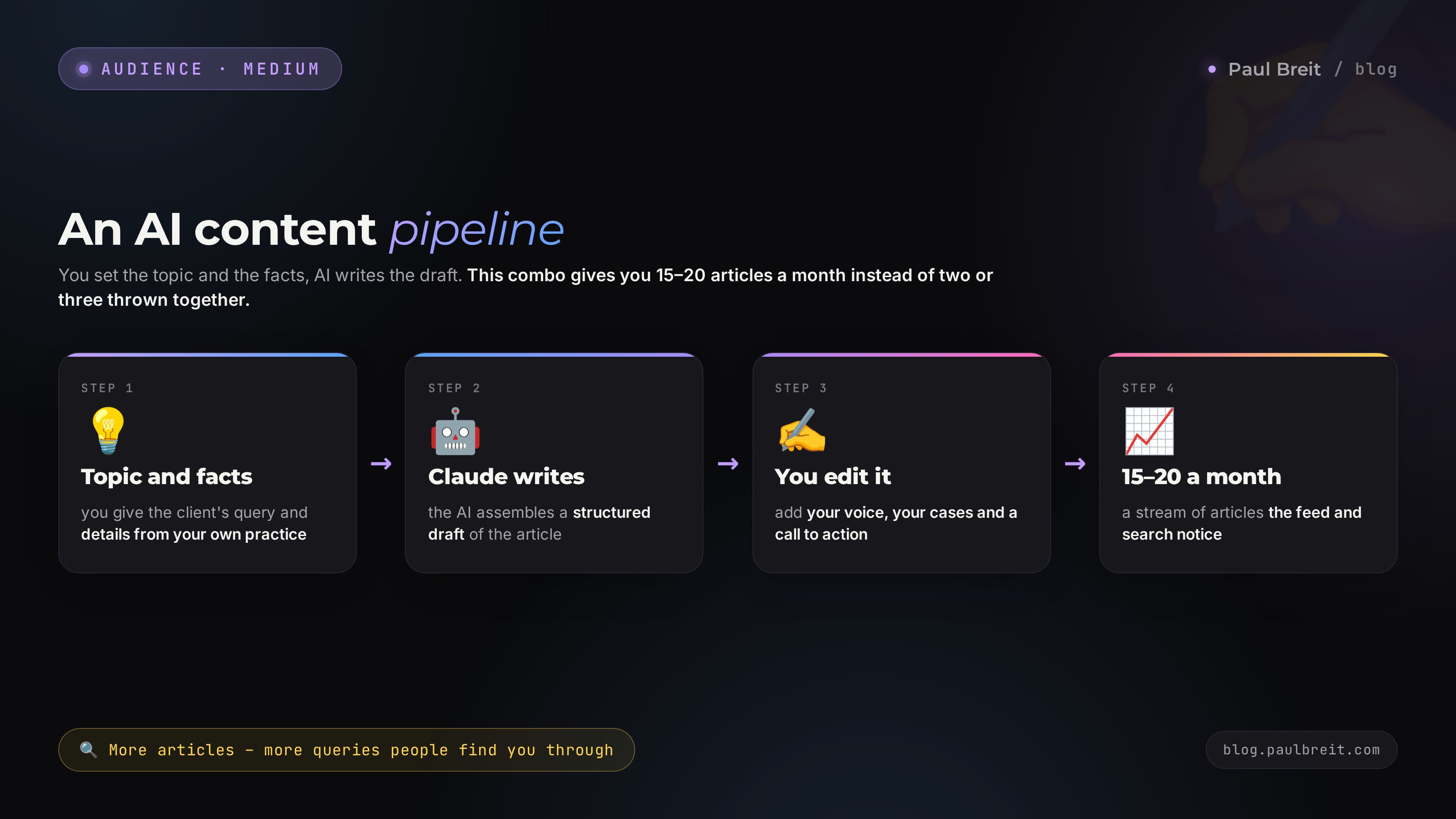
This is where most people break. Writing 15-20 articles a month by hand is a second job. Few people hold that pace longer than a month. So we hand the drafts to AI and keep the ideas, the facts, and the final edit into our own voice for ourselves.
A heads-up right away: you can't publish raw AI text. It's visible a mile off from the wooden turns of phrase, and the reader bails on the second paragraph - and remember, read-through is everything. For how to scrub out the machine traces, I have a separate breakdown on AI traces in text. The scheme below gives you living text, not stamped-out copy.
Step 1. Teach the AI your voice
Take Claude - it holds long, coherent text better than the others. Sign up through claude.ai (with a VPN on, if it isn't available in your region). Then build a dossier of your style: send the AI 10-15 of your posts or transcripts and ask it to describe your voice - which words, what sentence length, which turns of phrase you like. Save that breakdown; it becomes the foundation of every prompt. I laid out the full method in the article on teaching AI to write in your voice.
Step 2. The article prompt
Here's a working prompt - fill in your data in the square brackets:
"You're writing a Medium article as [niche, e.g. a psychologist who helps with anxiety]. My voice: [paste the style description from step 1]. Article topic: [topic]. Target reader: [who they are, what their pain is]. Requirements: a headline with a specific benefit; a first paragraph that hooks through the reader's pain, no windup; length 700-900 words; short paragraphs of 2-4 lines; subheads; at least one real example with numbers; a soft call to book a consultation at the end. Write in plain, conversational English, no corporate-speak or cliches."
Step 3. Edit it into your own
The AI gives you the frame. You go through it and add what makes the text yours: a real case from practice, your own tone, a phrase you say to clients. It's usually 15-20 minutes per article versus two hours from scratch. In one evening that's a week of content. It's handy to prep ideas and topics a month ahead in one sitting - I covered that mechanism in the article on building a content plan with AI.
An honest Medium article by hand is an hour and a half to two hours. 20 articles a month is 30-40 hours, almost a full workweek gone. With an AI pipeline, that same twenty takes 6-8 hours over the month. The freed-up time you spend selling and serving clients.
Step 05Headlines and cover images
First, the article has to get opened. In the feed a person sees only the cover image and the headline, and in a split second decides whether to click or scroll on. A weak "cover plus headline" pair buries even a strong text.
The headline
A good Medium headline does one of three things: promises a benefit, pokes at a pain, or sets up intrigue. Formulas that work:
- Number plus result. "7 phrases that stop a client from haggling."
- Pain plus solution. "Clients disappearing after the first call? It's one question you're not asking."
- Mistake. "3 profile-bio mistakes that keep people from buying from you."
- Concrete case. "How I landed 40 leads in a week without a dollar on ads."
Stick to the truth. The headline promises exactly what's inside. Deceive people and they close the article, and the algorithm cuts reach. The same AI helps you come up with 15 headline options for one topic in a minute: give it the topic and ask for headlines under each formula above, then pick the strongest.
The cover image
The cover is the image that catches the eye in the feed. The rules are simple:
- A real face with emotion works better than abstract backgrounds. People react to people.
- A large, high-contrast caption on the cover doubles the point. Many people scroll on mute and read with their eyes.
- One recognizable style across the whole profile. The reader starts to recognize you in the feed and clicks more often.
Cover images come together in a couple of minutes in any simple editor or with an image AI. Don't go down the perfectionism rabbit hole: test, see what gets opened, and repeat the winning moves.
Step 06How to rank in Google search
The feed gives you a spike in the first days, and search gives you a steady flow for years. To get articles into the rankings, add a few search moves to your structure. This is light SEO - no coding needed.
Write for a real query
Take the phrase a person types into search: "how to choose a nutritionist," "how much does a full home remodel cost." Put it in the headline and in the first paragraph word for word. That's how search understands your article answers exactly this query. You can gather your niche's queries easily with a keyword tool - it shows what people search for and how often.
Answer the query right away
Search engines love pages that give the answer up front. The first paragraph after the headline is a short, direct answer to the question in the headline. After that you go into detail. It's the same short-answer logic you see at the start of my articles.
Subheads for related queries
Each subhead in the article is one more query you'll be found for. An article "how to choose a psychologist" with subheads like "how much a session costs," "online or in person," "how to tell if the specialist is right for you" catches traffic across several phrases at once.
Link your articles together
Put links to your other articles on the topic in the text. This keeps the reader inside your profile and shows search you have a deep, worked-out topic, not one random note. Three to five linked articles on one query lift each other up.
Search traffic builds slowly - the first meaningful clicks come 2-4 months after publishing. But then the article works without you. After six months of regular publishing you'll have 30-50 articles, and some of them will bring people from search every day. That's the free traffic this was all for.
Section 03How to turn a reader into a client
Traffic by itself brings no money. Thousands of reads are useless if the reader left without leaving a contact. The task is to move them further down the funnel.
Medium has its own paid program: the platform pays writers based on member reading time. For a blogger that's income, but for an expert it's pennies compared with what one client brings. Your goal is different - leads for your services. One client pays for months of those reads, so we subordinate every article to one target action.
Three reader paths
- To a free consultation. The most direct path for an expert. At the end of the article, you invite them to book a free consultation, where you break down their situation and gently offer to work together. Point the link to a simple page with a form.
- To a lead magnet. You promise a useful checklist, guide, or mini-course in exchange for a contact. The person leaves an email or opens a bot, lands in your base, and from there you warm them up with a series of messages. The lead magnet itself can be built with AI in an hour.
- To a Telegram subscription. You move a warm reader into your channel, where you already control the touchpoints directly and don't depend on Medium's algorithm.
A hard sell to a cold reader almost never works. Value and trust first, then an invitation to take one next step. How to build the whole chain from subscription to payment, I broke down in a separate big guide on the expert sales funnel - Medium sits right at its start, filling the top with cold traffic.
Don't try to call people to a consultation, get them to follow the channel, and shove in a lead magnet all in one article. The reader's attention is a single thing; spread it and they do nothing. Pick one target action for the topic and lead them to it.
Section 04Metrics: what to check every week
Without numbers you're working blind. Medium shows stats for each article and for your profile. Once a week, open them and look at four figures.
- Read ratio. The main metric. The norm is 30 to 50 percent. Below 25 means the article is finished poorly - dig in: a weak headline broke expectations or the text sags in the middle.
- Average reading time. Good is from 40-60 seconds and up. A short time says people are skimming and leaving.
- Views and opens (cover CTR). If there are many views but few opens, your "cover plus headline" pair is weak - rework it.
- Clicks on your target link. How many people went from the article to the consultation or lead magnet. That's what all of this is for.
Look at patterns, not a single article. Which topics steadily give high read-through? Write more of those. Which headlines get opened more often? Use those formulas. Medium is a platform where in a couple of months, on live numbers, you understand what lands with your audience, and after that you only aim at the target.
Section 057 mistakes that keep Medium from growing
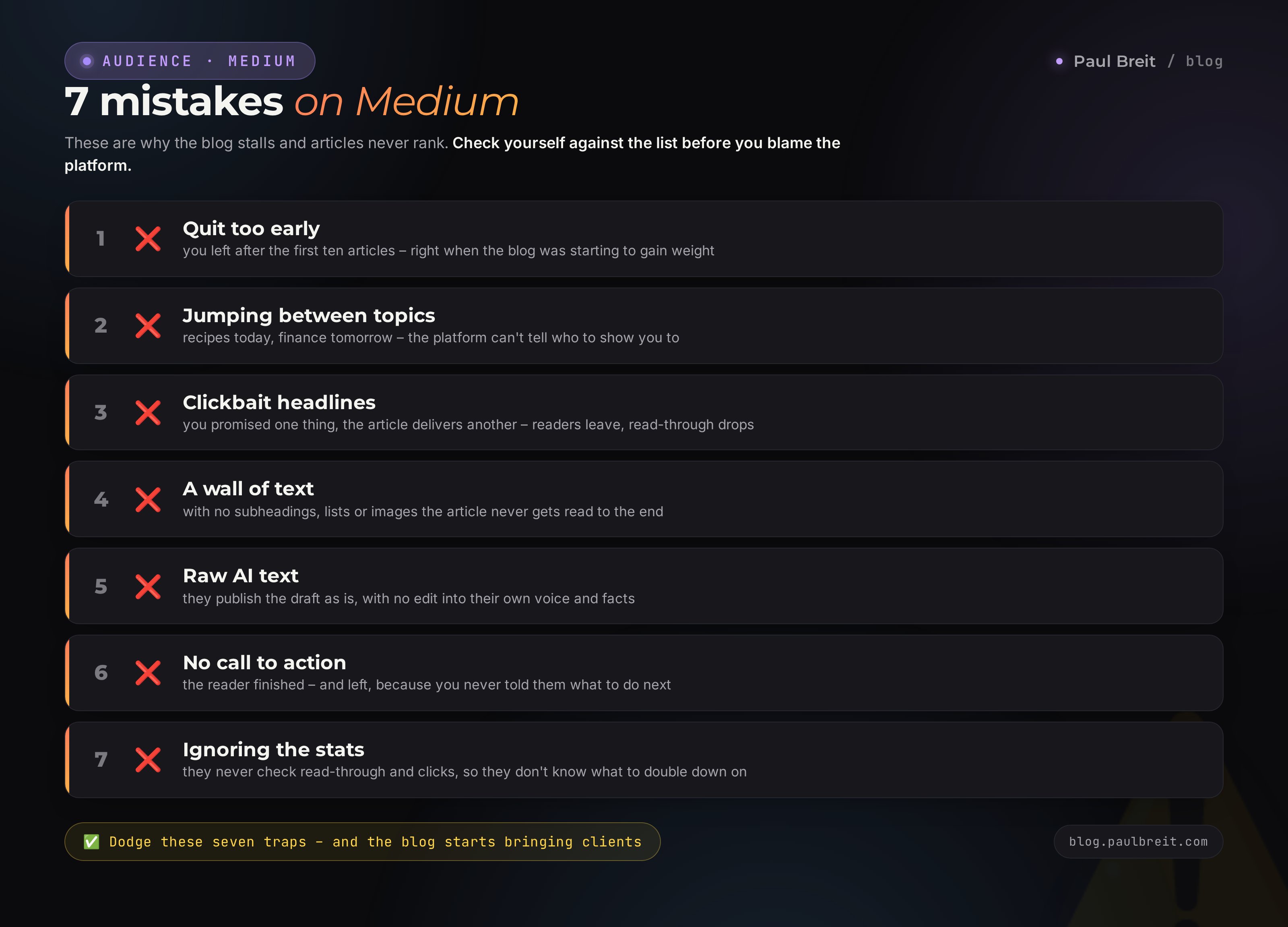
Almost everyone steps on these rakes. Walk the list ahead of time and save yourself months.
- Quit after a week. Five articles and the verdict "it doesn't work." Medium needs volume and time to understand your topic. First results come after 15-20 articles, not after five.
- Jumping across topics. Today about business, tomorrow about your cat, the day after about politics. The algorithm loses track of who to show you to and cuts reach. One profile, one topic.
- Clickbait with no substance. A screaming headline and emptiness inside. People open, get disappointed, close. Zero read-throughs, and the whole profile suffers.
- A wall of text. A canvas with no subheads or paragraphs. The reader is scared off by the volume and leaves on the first screen.
- Raw AI text. Published as is, with no edit and no voice. It reads dead, read-through drops. Always take the draft to a living finish.
- No call to action. The article gets read, people are impressed and leave forever, because you never said what to do next. The traffic drained away.
- Ignoring stats. Writing blindly for months, never looking at the numbers. And they've long shown which topics and headlines land. Watch the stats and double down on what works.
Section 06A plan for your first 30 days
Let's put it all into a concrete route. Stick to it, and in a month you'll have a live profile with its first leads.
Week 1. Foundation
- Build a profile around one topic; set up the name, bio, avatar, and header image.
- Verify your site so working links function.
- Collect 20 topics from real client questions. Check them in a keyword tool.
- Tune the AI to your voice: build a style dossier per the step from Step 4.
- Publish your first 3 articles. Don't expect miracles - this is the warm-up.
Week 2. Ramp-up
- Get to a pace of 4-5 articles a week through the AI pipeline.
- Test different headline and cover-image formats.
- Put a soft call to one target action in every article.
- Start pointing readers to a simple page with a consultation form or a lead magnet.
Week 3. Tuning
- Open your stats. Find articles with high read-through - those are your topics, write more of them.
- Rework weak headlines; on Medium you can change a headline after publishing.
- Link articles on one topic with internal links, for search and retention.
Week 4. System
- Hold a steady publishing pace; by now it's a habit worth 6-8 hours a month.
- Gather warm readers into Telegram or a lead-magnet base.
- Count your first leads. From here you only strengthen what already brings results.
Section 07Launch checklist
Print it and check items off as you go. While all eight boxes are ticked, the profile runs at full strength.
- Profile built around one topic, name and bio contain the niche's keywords
- Site verified, working links in articles function
- 20 topics collected from real client questions and checked in a keyword tool
- AI tuned to your voice, the article prompt ready to copy
- Article structure dialed in: hook, promise, short blocks, examples, close
- Headline and cover image tested against working formulas, no deceiving the reader
- A target action in every article: consultation, lead magnet, or follow
- Stats opened once a week: read-through, reading time, clicks
Medium hands out free traffic from the feed and from search. Build a profile around one topic. You write 15-20 articles a month with an AI pipeline, taking drafts to a living voice. You build the article for read-through: a hook up front, short blocks, examples with numbers, one target action at the close. You test the headline and cover, and for search you put a real query in the headline and subheads. Once a week you check the stats and strengthen what lands. In 30 days - a live profile; in a couple of months - a steady flow of readers and leads that works without you and without an ad budget.
How this connects to other articles
Medium is the top of your funnel, where cold traffic comes in. Where it flows next is laid out in the guide on the expert sales funnel. What to fill your articles with every day without burning out is in the breakdown on building a content plan with AI. And if you want to strengthen the flow with one more free channel, look at the article on buying Telegram channel ads. Three channels, one client-acquisition system.
FAQFrequently asked questions
Is Medium still worth it for a business in 2026?
Yes. Medium is one of the few platforms left that hands out free traffic: articles surface in the recommendation feed and rank in Google search. For anyone who sells services or courses, it's a steady source of new readers with no ad budget.
How many articles a month do I need to publish?
To grow from zero, 3-5 articles a week, so 15-20 a month. The algorithm needs volume to understand your topic and find your audience. With AI you can actually hold that pace solo without burning out.
What matters more to the Medium algorithm: claps or read-through?
Read-through and reading time. Claps and follows barely move reach. The algorithm shows an article to a new audience when the first readers finish it to the end and spend 40-60 seconds or more on the page.
Can I write Medium articles with AI?
Yes, but you can't publish raw AI text - it's visible in the boilerplate turns of phrase, and readers bail on the second paragraph. The working setup: you give Claude the topic, the facts, and your voice, get a draft, and edit it to sound like you. That's how one person ships 20 articles a month.
How long until the traffic kicks in?
First feed impressions come within days. A steady flow from the feed comes after 15-20 articles, once the algorithm has your topic figured out. Search traffic builds over 2-4 months: old articles slowly climb the rankings and bring readers for years.
Do I need a VPN to write with Claude from outside the US or EU?
If Claude isn't available in your country, you'll need a VPN with an EU or US location. Working ones in 2026: Proton VPN and other reputable providers. A handful of regions are on Anthropic's blocked list, so pick an EU or US endpoint. Medium itself works everywhere.
How do I turn Medium readers into clients?
Inside the article and at the end, point readers to one target action: a free consultation, a lead magnet, or a subscription to your Telegram channel. A hard sell to a cold reader almost never works. Value and trust first, then a soft invitation to take the next step.