AI for Nutritionists: Meal Plans and Reviews in Minutes
AI for nutritionists takes the heaviest part of the job off your plate – the part that eats your evenings. In a few minutes it assembles a draft meal plan for one specific person, reviews their food diary, finds swaps for intolerances and budget, builds a shopping list and a session summary. Inside: 12 real tasks from practice, a ready prompt for each, and worked examples. Plus an honest talk about where AI helps and where a physician's and a live specialist's territory begins.
AI for a nutritionist is an assistant that takes over the rough assembly and review. It builds a menu for a client's goal and preferences in minutes instead of a whole evening, reads their food diary, finds swaps for intolerances and budget, pulls together a shopping list and a session summary. Diagnoses, labs, and responsibility for health stay with the specialist – AI doesn't touch them. Everything supporting the consultation, it speeds up several times over.
You've signed ten clients for ongoing support. The joy holds right up until Sunday evening, when you sit down to plan the week. For each one: build a menu for their goal and limits, review the food diary they sent, invent swaps for the foods they hate, boil it all down to a shopping list. Plus replies in DMs, plus blog content, plus discovery calls for new people. By Wednesday you're wrung out, and you've run only a handful of sessions. Taking on more clients feels scary: you won't survive the routine.
I run four client projects and a 20,000-subscriber channel with no team of assistants. Everything that doesn't need the live me runs on a stack of prompts. This article is that same logic applied to a nutritionist's work. Twelve tasks where AI lifts hours off you, so you spend your energy on the client, not the paperwork around them.
You'll read it in 21 minutes. You'll run the first prompt today. In a week you'll notice you build client support twice as fast and take on more people without the fear of drowning in routine.
What's inside
- What AI actually gives a nutritionist
- Task 1. Unpacking the client before the call
- Task 2. A client meal plan in minutes
- Task 3. Reviewing the food diary
- Task 4. Food swaps and working with limits
- Task 5. Shopping list and weekly prep
- Task 6. Session notes and review
- Task 7. Handouts and client materials
- Task 8. Pre-sale diagnosis
- Task 9. Packaging the service and offer
- Task 10. Content that brings clients
- Task 11. Testimonials and case studies
- Task 12. Where AI hurts a nutritionist
- How to set up Claude
- A nutritionist's AI checklist
All the prompts below run on Claude – it holds a long client context best and writes like a human. Getting started is a plain email signup at claude.ai, and the free tier is enough to run your first prompts. Full setup and payment are in the setup section below and in the guide on paying for Claude.
Section 01What AI actually gives a nutritionist
Let's clear up the main misunderstanding first. AI in a nutritionist's work does not diagnose and does not prescribe treatment – that's a physician's territory, and nobody hands it to a machine. AI takes everything around the consultation. And around the consultation, the hours add up to more than the consultations themselves.
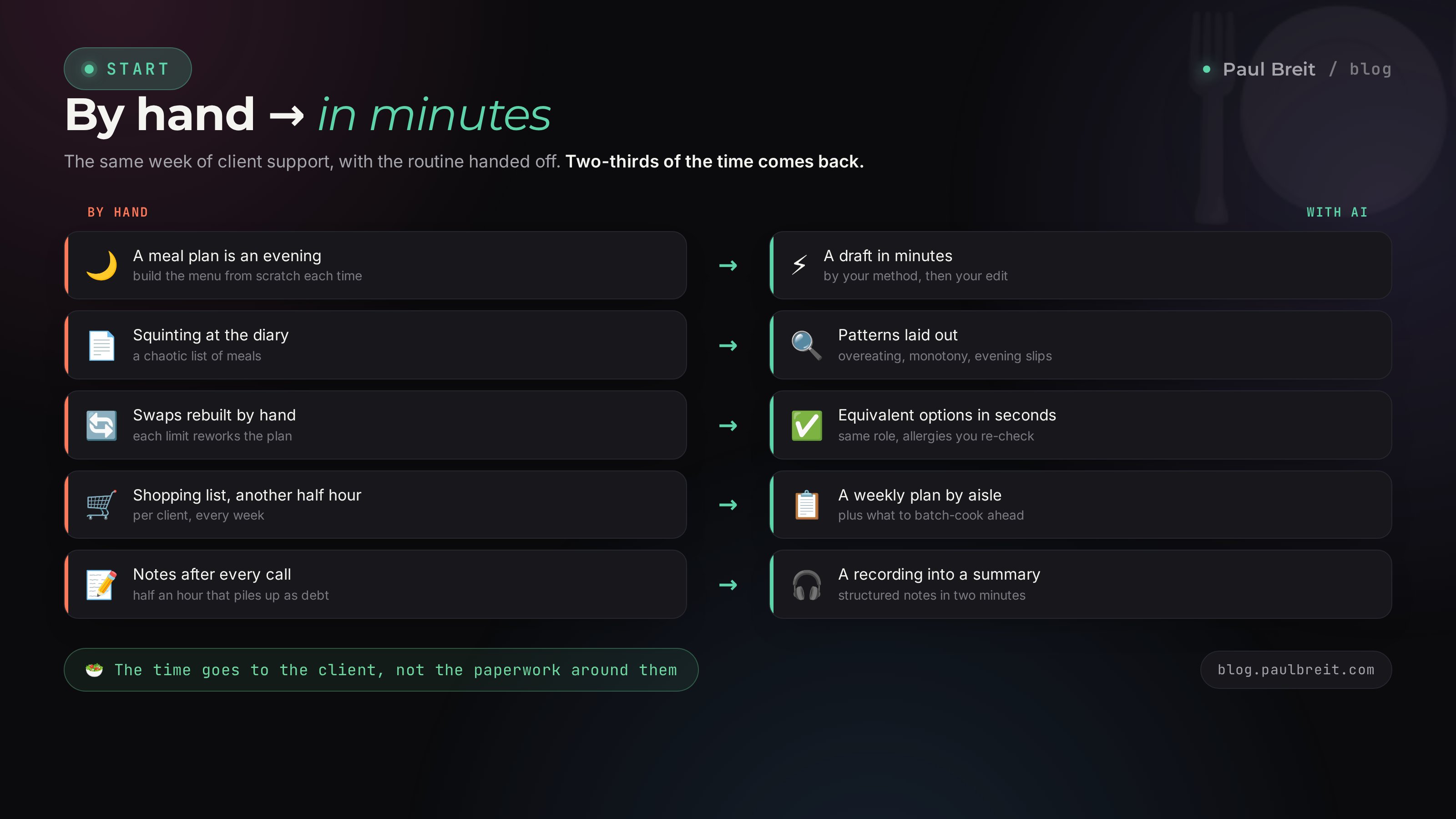
Count your week honestly. Build a meal plan for each client, review the food diary they sent, find swaps, boil it down to a shopping list, write a summary and a handout after the session, answer DMs, and then there's the blog, discovery calls for new people, packaging. Live work with the client takes maybe a third of the time. The rest is assembly and paperwork. Those two-thirds are exactly what AI compresses.
Three principles, without which none of it works
- Context decides everything. An empty "build a meal plan" gives an empty answer. The more you feed it – goal, weight, daily schedule, what the person won't eat, intolerances, budget – the sharper the draft. How to phrase requests properly is covered in the piece on writing prompts.
- Your approach stays yours. AI doesn't invent a nutrition method for you. You give it your frame, your principles, your style – it assembles by them. Otherwise you get an averaged menu off the internet.
- The final word is yours. Everything the machine produces, you read with a specialist's eye. Calorie and macro numbers especially: AI estimates them rather than counting exactly, and checking them is your job.
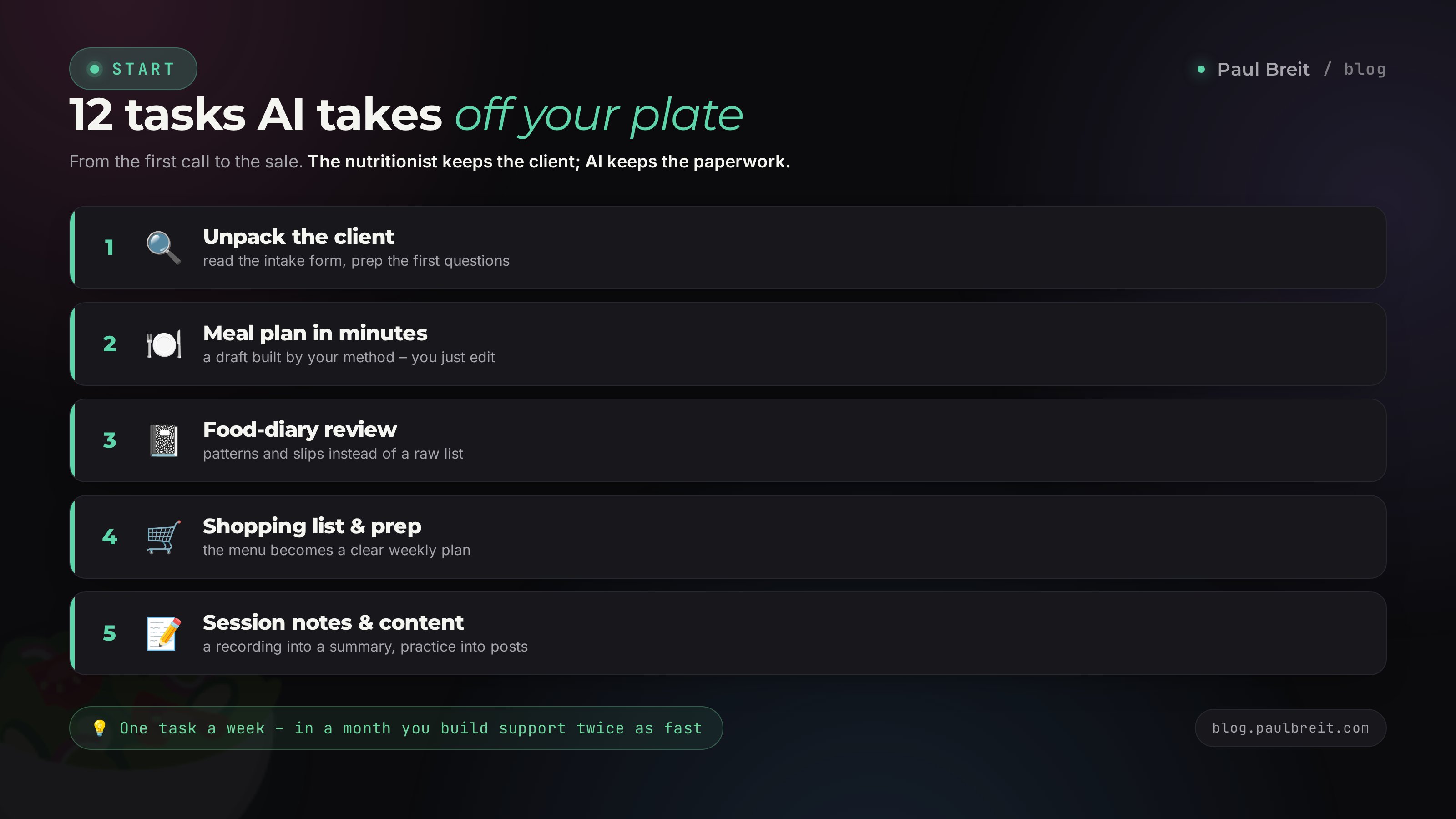
Next – twelve tasks in order, the way they come up in the work: from prepping for the first call to selling to new clients. Each with a ready prompt. Take it, drop in your data, run it.
Task 01Unpacking the client before the call
The client fills out an intake form before you start: goal, habits, what they eat on a normal day, what bothers them, how their day runs. Reading it carefully and catching what matters is a job of its own, especially when you have a lot of clients. AI reads the form in a minute and hands back a map: where the contradictions are, what to watch for, which questions to ask first on the call.
You give it what the client wrote themselves: an anonymized form, a two-day diary, a voice memo where they talked about themselves and their goal. AI hands back a hint on where to look, so you don't spend half the session collecting the obvious.
You are an experienced nutritionist-supervisor. Below is an anonymized client intake form before ongoing support begins. Break it down: 1) name the real request behind what the person wrote; 2) list the contradictions and weak spots in their food and routine; 3) which habits are most likely working against their goal; 4) give me 7 questions worth asking on the first call to get to the heart of it fast. Form: [paste].
You walk into the first meeting prepared. You already see the likely forks and don't burn half the session just figuring out the picture. The client feels they've landed with someone who knows the terrain – and trust switches on from the first minute.
A real example. A client wrote: I want to lose weight, I think I eat fairly well, but the scale won't budge. From her diary, AI pulled the thing that's easy to miss by eye: breakfasts and lunches were fine, but every evening there were three cups of tea with cookies she didn't count as food. The real cause was hiding in evening slips from exhaustion. Her actual meals were decent. The first question on the call – what happens around nine in the evening – took us straight to it. Without the review I'd have spent half the session rewriting an already-working breakfast.
An important caveat. AI's hypotheses are hypotheses, and you test them in a live conversation with the client. Sometimes the real cause turns out to be nothing like what the machine guessed, and that's fine. It saves you the prep; it won't do the thinking for you.
Task 02A client meal plan in minutes
Building a week's menu for one specific person is an evening's work. Factor in the goal, weight, schedule, tastes, what they won't eat, how much they'll spend on food and on cooking. With AI the draft comes together in minutes, and your evening goes only to editing.
The trick is that you give it your frame. If you build plans by your own principles – by food-group balance, by meal timing, by your signature scheme – you describe the approach, and AI lays the client out along it. It doesn't bring someone else's diet; it assembles by your method.
Help me draft a 7-day menu. My approach to meal plans: [describe your principles in 5-7 sentences]. Client: [sex, age, weight, height, goal, activity level, what they won't eat, intolerances, budget, how much time they'll spend cooking]. Give me a week's menu – breakfast, lunch, dinner, 1-2 snacks per day with rough portions. Repeat foods across the week so the shopping list is realistic. Write in plain language, no complex restaurant dishes.
Then you sit down and edit. Somewhere you'll swap a dish for your own tested one, somewhere you'll see the client can't cook that often, somewhere you'll simplify. But there's no blank page in front of you anymore. There's a skeleton to work from.
Check the numbers separately. If you gave AI a target calorie level, recompute the result: it makes counting errors and can pull the menu off course. A ready calculator or your own experience is more reliable here than the machine. AI saves time on assembly; nutrient accuracy stays on you.
A menu for a new client used to eat an evening. Now it's a few minutes for the draft and half an hour of editing. Multiply that by your clients per month, and you'll see where the time comes from to take on two more.
Task 03Reviewing the food diary
Clients send food diaries – as lists, as photos of plates, as app exports. Reading each one carefully, spotting the patterns, seeing where the person is sagging – that's time you don't have between sessions.
AI reads the diary and lays it out: where the overeating is, where the monotony is, which usual food groups are clearly missing, what time the slips are tied to. You get structure where you used to squint at a chaotic list.
Here's a client's food diary for a week: [paste]. Client's goal: [goal]. Review it as a nutritionist: 1) what patterns show up – overeating, skipped meals, monotony, slips and what time they're tied to; 2) what's clearly missing by food group; 3) 3-4 gentle points to start changes from; 4) what to praise – what the person already does well. No harsh judgments, keep the tone supportive.
Then you read the review with a specialist's eye and keep what actually matters for this person. A good move is to ask AI to call out separately what the client already does right. People come to a nutritionist carrying guilt about food, and starting with praise is what keeps them in the work.
An important boundary. Everything AI produces from the diary is observations on the text, not a conclusion about health. Deficiencies, labs, symptoms are a physician's territory, and there's a separate talk about it in the final section. And the data rule right here: names, contacts, diagnoses never go into AI – anonymize everything.
Task 04Food swaps and working with limits
A finished menu rarely fits a client as is. One is allergic to nuts, another won't eat fish, a third is vegetarian, a fourth has no time to cook, a fifth is on a tight budget. Each limit means rebuilding the plan, and that's tedious by-hand work.
AI finds equivalent swaps in seconds. You say what doesn't fit and why – it offers options in the same role in the plan, so the client's goal doesn't suffer.
Some dishes in the plan don't fit the client: [list – allergy, intolerance, dislike, no time to cook, budget limit]. Find equivalent swaps by composition and role in the plan, so the client's goal doesn't suffer. For each swap, briefly explain how it matches the original dish. Foods should be available in an ordinary grocery store.
AI also bails you out on seasonality and availability: a client writes that some food isn't sold in their town, and in a minute you assemble an alternative. That reshuffle used to eat time between sessions; now it's a couple of lines in a chat.
Swaps for a real food allergy are a no-room-for-error zone. AI may not know about a hidden ingredient or a cross-reaction. You re-check the composition of any swap for an allergic client yourself, and with a serious allergy the final word stays with a physician. Here a machine error costs someone's health.
Task 05Shopping list and weekly prep
A menu alone isn't enough for the client. They need to know what to buy and what to prep ahead, so weekdays don't turn into daily cooking. Boiling a menu down to a shopping list by hand is another half hour per person.
AI turns the menu into a ready list by store aisle and suggests what to batch-cook ahead. The client gets a clear weekly plan instead of an abstract menu.
Here's the client's menu for the week: [paste]. Assemble: 1) a shopping list grouped by store aisle (produce, meat and fish, dairy, dry goods, frozen); 2) what of this can be cooked ahead in one go for 2-3 days; 3) a short weekend cook plan to unload the weekdays. Quantities – for one person for a week.
This is the detail clients hold onto most. The biggest barrier in eating well is not knowing what to buy and when to cook. When you remove it with a ready list, the person stays in the work longer and reaches a result. A list like that, by the way, doubles nicely as a free lead magnet for new subscribers – how to build one in an hour is shown in the piece on lead magnets with AI.
Task 06Session notes and review
The session's over. While it's fresh, you need to write down what you talked about, what you decided on food, what recommendations you gave, what the client is taking into the work. By hand that's another half hour after every meeting. By the end of the day your hand won't move, and the notes pile up as debt.
With the client's permission, you record the session. AI transcribes it and turns it into a structured summary. Half an hour of work becomes two minutes. How reviewing call recordings works is shown in detail in the piece on analyzing calls.
Here's a transcript of a session with a client: [paste text]. Build a summary for me as a nutritionist: 1) what request the client came with and how it sharpened over the meeting; 2) what we decided on food and routine; 3) what recommendations I gave; 4) what the client is taking into the work before the next meeting; 5) my notes for the future – what to track. Write to the point, no filler.
There's a pleasant side effect too. When notes pile up in one place, you get the client's history over time. Two months in, you ask AI to build the arc across all the notes: where the person started, what changed meeting to meeting, what progress shows from the outside. That's material for a review with the client, a ready backbone for a case study, and a reason for the client to see how far they've come. To keep the notes handy for AI, it's convenient to hold them in Claude Projects – one project per client, everything anonymized.
Task 07Handouts and client materials
Clients constantly need short handouts: how to read a label, what to snack on at work with no cooking, what to order at a cafe, what to pack for a trip. Writing each one from scratch every time is time that leaks away unnoticed.
AI builds a handout for the client's specific situation and in your voice. You collect a library of these materials once, then reuse and tweak them per person.
Make a handout for a client on: [e.g. no-cook snacks at work]. Client: [goal, limits]. Format: a 2-sentence intro + a list of 10 concrete options with rough portions + one reminder line at the end. Plain, warm language, no lecturing or scare tactics. My tone of voice – here are samples: [paste 2-3 of your own texts].
The more of your own texts you give AI, the more the handouts sound like you and not like a faceless brochure. How to teach the machine to write in exactly your voice is walked through step by step in the piece on writing in your voice. That same library of handouts later becomes the base for content and lead magnets.
Task 08Diagnosis before the sale
Now, money. It's not enough for a nutritionist to run clients well; you also have to find them. And the first bottleneck is the sales call – the discovery, the diagnosis. The person shows up, you talk, and they leave to "think about it" and never come back.
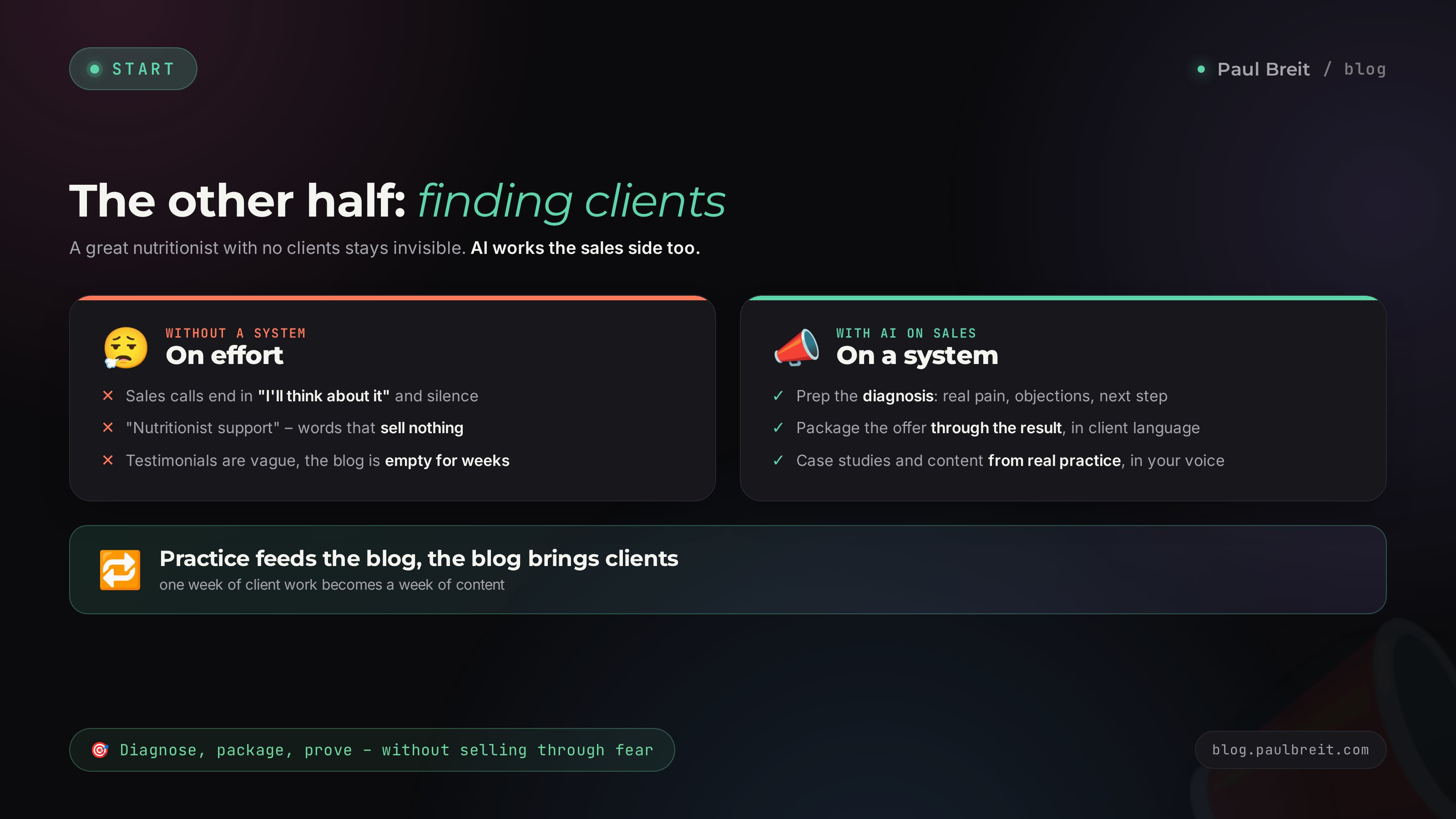
AI preps you for a sales call the same way it preps you for a consultation. From the person's request it gathers hypotheses: what they really came with, which objections are likely, where their pain around food sits, what they're willing to pay for. You walk into the conversation prepared and steer it toward a decision instead of improvising.
I have a sales diagnosis call with a potential client. Their request: [paste]. Help me prep: 1) their likely real request and pain around food and wellbeing; 2) 5 questions that will show them the cost of doing nothing; 3) the 3 objections they'll probably raise and how to answer honestly, with no pressure; 4) how to connect their request to my support program. My product: [describe briefly].
The key here is not to overdo it. A diagnosis is helping the person see their situation, and the sale follows on its own if you were useful. AI builds the structure, but pressuring and scaring people with diseases is off-limits: a specialist who sells through fear loses the trust their whole work rests on. A breakdown of sales-conversation technique is in the piece on analyzing calls.
Task 09Packaging the service and offer
"Nutritionist support" are words that sell nothing. People buy a result: energy, lightness, a normal weight, calm around food, the end of endless diets. Packaging your service so the person recognizes their own problem and their desired state in it is a copywriting skill not every specialist has.
AI helps you rephrase your service into the client's language. You give it what you do and who you work with – it hands back a description through the target person's pain and result.
I'm a nutritionist working with [niche and client type]. My service: [describe what you do]. Repackage it into the client's language: 1) name the pain I close, in the client's own words; 2) the result they get after 2-3 months of work; 3) give me 5 headline options built on the result, not the word "support"; 4) a short 4-5 sentence offer description for a website. Tone warm, confident, no promises of magic diets or "lose 10 pounds in a week."
A good offer brings clients in on its own, before you've opened your mouth on a call. For a nutritionist the first step of the funnel is often a free format: a one-day food review, a checklist, a short guide. How to build a lead magnet like that in an hour is shown in the piece on lead magnets with AI.
Task 10Content that brings clients
A nutritionist with no content is invisible. People learn about you through what you say publicly: posts, reels, live streams. And here comes the same trouble that hits everyone who sells services: content takes time you don't have between clients.
AI lifts that load, if you teach it your voice. You give it 20-30 of your texts, it extracts your manner and from then on writes drafts that sound like you. The method is walked through step by step in the piece on teaching AI to write in your voice.
A separate goldmine for content is the practice itself. Every frequent question, every typical nutrition mistake, every case is the topic of a post that will resonate with dozens of people who share the same pain. Just without names and details that would identify the person.
Here's a typical question clients come to me with: [describe anonymized]. Come up with 7 post topics that will hook people with this pain and show me as a nutritionist who knows the terrain. For each topic, give a gripping first paragraph. Write in my style – here are samples of my posts: [paste 3-5 of your own texts]. No promises of magic results and no scaring with diseases, honest and human.
So one week of client work turns into a week of content, and the content brings new people to a diagnosis call. The loop closes: practice feeds the blog, the blog brings clients.
Task 11Testimonials and case studies
A testimonial is the strongest proof for a nutritionist. But clients write them short and vague: "Everything was great, thanks." A testimonial like that doesn't sell. A story sells: what they came with, what was in the way, what changed, what result in wellbeing, habits, or numbers.
AI helps you build a structured case out of what the client said. You take their words from a chat or a review, add your own view of the change – and you get a story you can show, with the client's consent and no personal details, of course.
A client left a review: [paste]. Plus my notes on the work: [starting point, what was in the way, what changed – wellbeing, habits, numbers if any]. Build this into a mini case study: before – what the difficulty was – what we did – after. 4 paragraphs, living language, third person, no client name and no embellishment. End with one line that captures the essence of the change.
A few cases like that on your site and in your blog take half the doubt out of new clients before they even talk to you. The person sees others like themselves and their result – and comes in already warm.
Task 12Where AI hurts a nutritionist
Now the honest talk, without which this article would be an ad. AI has hard boundaries in a nutritionist's work, and crossing them is dangerous – we're talking about people's health.
- It's not a physician and doesn't diagnose. Anything touching illness, labs, deficiencies, and prescriptions is a physician's territory. AI can confidently suggest a supplement or a restriction that's contraindicated for the person. Medical decisions are made by a trained specialist, not a machine. On adjacent helping-practitioner work, see the piece on AI for coaches.
- It fumbles the numbers. Calories, protein, fat, carbs, composition – AI estimates rather than counts. A counting error is critical for a nutritionist. You verify the final figures yourself or with a dedicated calculator.
- Client data stays locked up. Real names, contacts, diagnoses, lab results must never go into AI. Anonymize everything. The client trusted you with something personal, and leaking it into an outside service is a betrayal of trust and a breach of privacy law.
- Allergies leave no room for error. With a real food allergy, a human re-checks the composition of any swap, and the final word stays with a physician. No prompt takes on responsibility for a client's health.
AI drafts and clears the routine. Decisions about food and health are yours, and where a physician is needed – a physician. It's your assistant for assembly and paperwork, not a second specialist. Hold that line, and it frees you hours without taking anything from the quality of your work with the client.
Section 02How to set up Claude
All the prompts above are built for Claude – it holds context best and writes like a human. Getting started takes a few minutes.
Create an account at claude.ai
Registration is by email, no card required to start. Open the chat, and you're ready to run the first prompt from this article on a real task.
The free tier is enough to begin
Run your first prompts on the free tier and feel the difference. Pro is $20 a month – it lifts the message limits and unlocks Projects. A full breakdown of payment is in the piece on paying for Claude.
Put each client in their own Project
You drop client materials into Claude Projects – one project per person, everything anonymized – and AI keeps the context on hand. After that you just paste the prompts from this article.
Section 03A nutritionist's AI checklist
Print it and keep it on your desk for the first month. Roll out one task a week, not everything at once.
- Access set up – Claude account, payment, a Project per client
- Your approach described – your working frame lives in the Project, AI builds plans by it
- Client unpacking – you run the intake form before the first call
- Meal plan per client – a draft menu in minutes, then your editing and number-checking
- Diary review – patterns and growth points instead of squinting at a list
- Food swaps – equivalent options for limits, allergies you re-check yourself
- Shopping list – the menu becomes a clear weekly plan
- Session notes – a recording transcribed into a structured summary in two minutes
- Content from practice – anonymized client questions become posts in your voice
- Boundaries hold – diagnoses and labs to the physician, data locked up, numbers verified
AI takes off a nutritionist the two-thirds of time eaten by the assembly and paperwork around the client. Before the call it unpacks the form and preps your questions. For the work – it drafts the meal plan, reviews the food diary, finds swaps for limits, boils it into a shopping list, writes handouts and session notes. For sales – it preps the diagnosis, packages the service, builds case studies, writes content in your voice from real practice. Diagnoses, labs, and responsibility for health it doesn't take: that stays with you and with a physician. Setup takes a few minutes: Claude, a Project per client. Roll out one task a week – in a month you build client support twice as fast and take on more people without the fear of drowning in routine.
FAQFrequently asked questions
Can AI replace a nutritionist?
No. A live specialist – responsible for the client's health, attentive to labs, able to see the whole person – is not something the machine replaces. AI handles the routine around the work: a draft meal plan, food-diary reviews, food swaps, shopping lists, session notes. The final call stays with you.
Can I trust AI to build a meal plan from lab results?
Building nutrition strictly from lab work and drawing conclusions from it is not a job for AI. That is a physician's territory. AI prepares a draft plan around a general goal and the client's preferences; anything touching diagnoses, deficiencies, and medical restrictions is checked and decided by a qualified specialist.
Which AI is best for a nutritionist?
Claude – it holds a long client context more accurately and writes like a human. The free tier covers your first prompts; after that Pro is $20 a month. Setup is just an email signup at claude.ai.
Is it safe to upload client data into AI?
Real names, contacts, diagnoses, and lab results should never go in – that breaks trust and privacy law. Anonymize everything: "Client K., 35, goal – lose weight." That way you get the benefit with no risk to the client.
Which task should I start with?
Food-diary reviews and shopping lists – they give the fastest time savings and don't require rebuilding your workflow. Roll out one task a week, not everything at once, or you'll drop it.
Won't the plan from AI be made up on calories and macros?
AI can be wrong on calorie and macro numbers – it estimates them by eye, without exact counting. So you verify the final figures yourself or with a dedicated calculator. AI saves time on assembling the menu; nutrient accuracy stays on you.
Can I turn my client work into blog content?
Yes, but only anonymized. A common nutrition mistake, a frequent question, a case breakdown – that's the topic of a post that will resonate with dozens of people who share the same pain. Names, details, and anything that identifies a specific person get stripped out.