Email newsletters that get read to the end
A newsletter works when the email gets opened, read to the last line, and acted on. This article gives you the anatomy of that kind of email, a 5-email series, ready AI prompts, an evening build plan, and a look at the mistakes that get you closed on the second paragraph. It's for everyone who sells services, courses, and consulting.
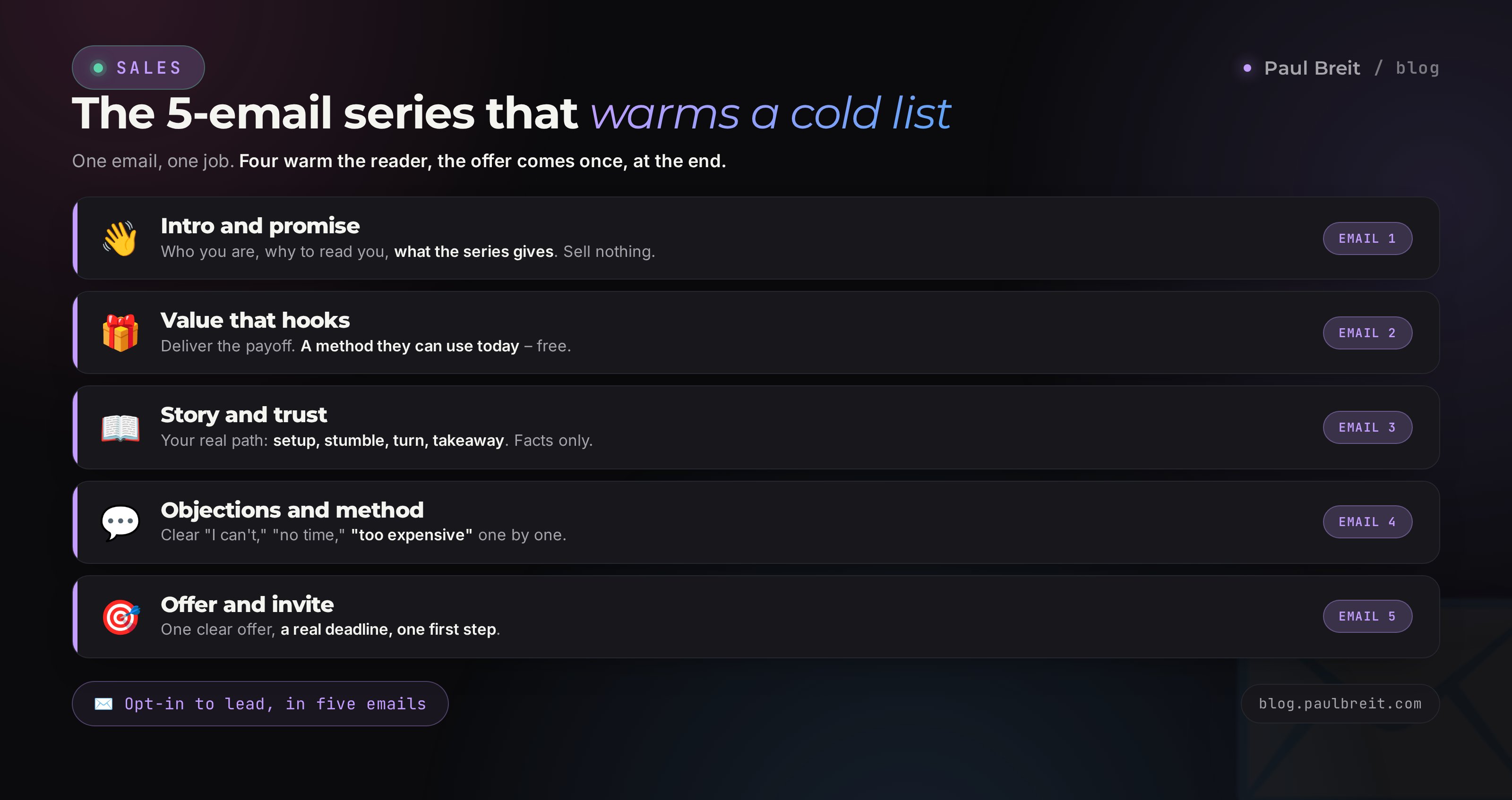
An AI newsletter gets built in an evening on one blueprint. First you hand the model your voice, your audience's pains, and one real case. Then you write each email by the anatomy: the subject earns the open, the preheader adds pull, the first line kills the urge to close, the body opens one idea, the ending points to one action. A five-email series carries a subscriber from intro to offer: email 1 introduces you and promises value, email 2 delivers that value, email 3 builds trust with a story, email 4 clears objections, email 5 makes an offer with a deadline. AI writes each email from a prompt in a couple of minutes, and you read it over and shape it to fit you.
You built a subscriber list, sent an invitation email, and watched 12 percent open it and a handful read it through. It feels like nobody reads email anymore and newsletters are dead. What's really happening is that specific emails go unread: the ones with a subject about nothing, a first paragraph about the weather, and an author who wanders to the point somewhere around the middle. Emails that get read to the end are built differently from the first line.
I run four client projects and a personal channel of 20,000 followers. A newsletter brings leads in every one of them, but only when the emails are built on structure. A series used to take me two or three days. Now AI hands over drafts in an evening, and I bring the meaning and do the edits. This article is the whole blueprint, with a prompt for every email.
You'll read it in 21 minutes. You'll build it in an evening. A week from now the first subscribers finish your series and write to you first.
What's inside
- What a newsletter is and why emails go unread
- The anatomy of an email that gets read to the end
- What to prep before you start
- Email 1. Intro and promise
- Email 2. Value that hooks
- Email 3. Story and trust
- Email 4. Objections and method
- Email 5. Offer and invite
- Subject lines: 15 headlines in a minute
- How to make AI write in your voice
- Build the series in an evening: hour by hour
- 5 newsletter mistakes and how AI fixes them
- Launch checklist
Claude may not open directly from your country – you may need a VPN set to an EU or US location. Working ones in 2026: Proton VPN, AmneziaVPN, Hiddify. Some regions are on Anthropic's blocklist, so pick a supported one. Sign up through the referral link. Every prompt in this article works on the free plan and in ChatGPT too, though Claude gives the best copy for emails.
Section 01What a newsletter is and why emails go unread
A newsletter is a series of emails you send to your list: subscribers in the inbox, readers of your Telegram channel, clients in a messenger. One email does one job and moves the reader a step forward. A good newsletter warms your list, wins back clients who drifted, and brings leads without a single call. A weak one piles up in the "read later" folder and quietly erodes trust in you.
The reason a newsletter falls flat is almost always the same: the emails go unread. Someone opens the email, skims the first few lines, finds no reason to stay, and closes it. They never reach your offer at all. So the first thing we fix is read-through. As long as the email gets dropped on the second paragraph, any offer inside it lies there as dead weight.
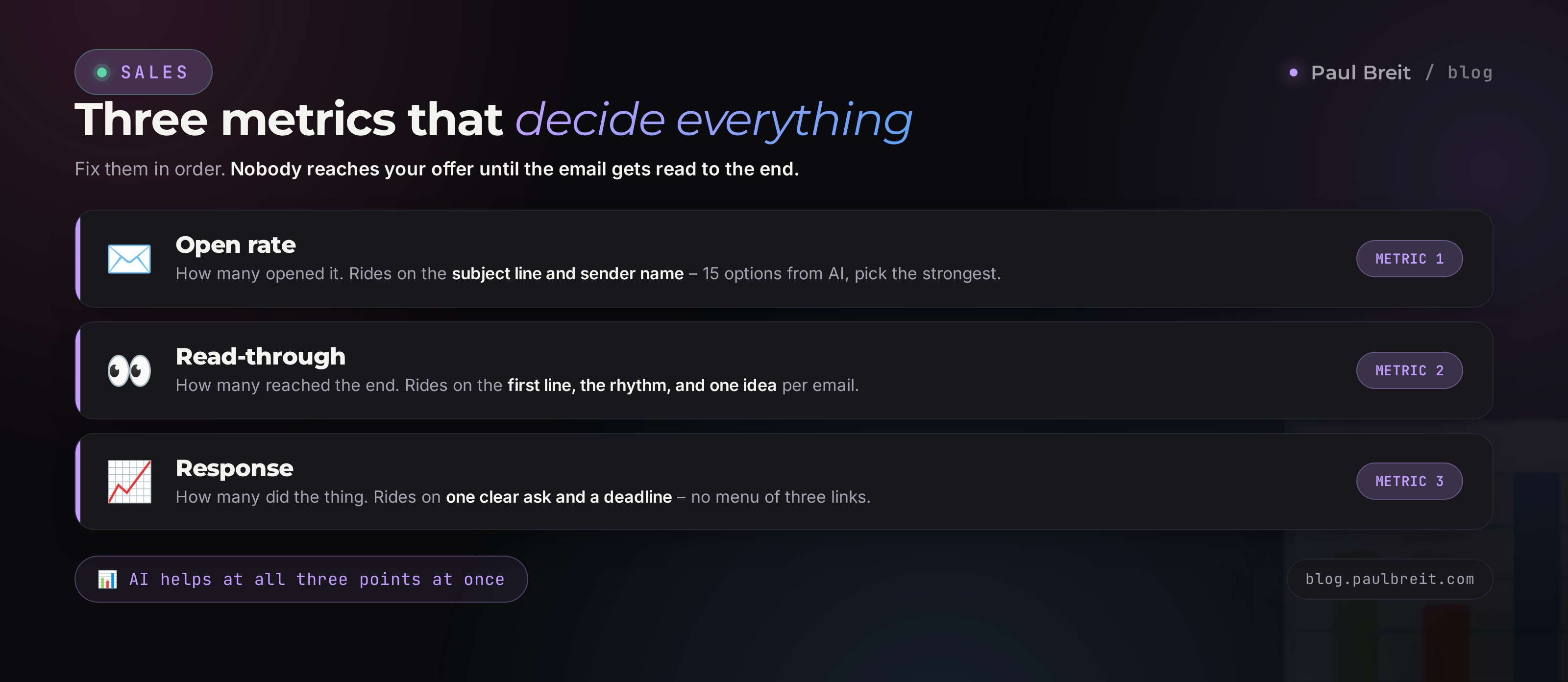
Three metrics that decide everything
- Open rate. How many people opened the email. This is on the subject line and the sender name.
- Read-through. How many reached the end. This is on the first paragraph, the rhythm of the text, and one idea per email.
- Response. How many did what you asked. This is on a clear call to action and a deadline.
AI helps at all three points at once: it spins up subject lines by the dozen, holds the rhythm of the text, trims the filler, and offers call-to-action options. Later in the article we take each point on its own and hand you a prompt for it.
Where a newsletter lives
The logic of an email is the same on every platform; the packaging changes. In email it's a full message with a subject and a preheader. In Telegram it's a series of posts or bot messages, where the subject becomes a first-line hook. In messengers it's short messages with one action. The prompts in this article build the core, then you ask AI to repackage the text for the format you need. From here I show everything on email, the most demanding format: if the text holds attention in the inbox, it holds even better in a messenger.
One email, one idea
The classic rookie mistake is to cram everything into one email: the value, the story, and three offers. The reader gets lost in the flood and closes it. A working email carries one idea and leads to one action. When you have several ideas, break them into a series. Five short emails warm a list better than one five-screen email that only your mom will finish.
A newsletter gets read not because of the moment you sent it, but because every past email was worth the time. Read-through compounds: someone opens the fifth email because the first four never wasted a minute. Value at the start of the series matters more than the offer at the end.
Section 02The anatomy of an email that gets read to the end
Let's take one email and break it into parts. These five pieces work in any email in the series; only the content changes. Get them right and the text carries the reader from the subject to the call to action without a single stop.
The subject line
The subject decides whether the email gets opened. You have 5 to 7 words to catch someone in a crowded inbox. What works: specifics, a number, curiosity, and plain value. Weak subjects like "This week's news" and "Important update" get scrolled past unopened. AI hands you 15 subject options in a minute, and you pick the strongest. Full breakdown in the section below.
The preheader
This is the preview line after the subject in the inbox list. People forget it, so the boilerplate "If this email doesn't display, click here" lands there. The preheader continues the subject and adds intrigue. Two short lines that finish the case for opening the email.
The first paragraph – the hook
The email is open; now you have to hold it. The first paragraph kills the urge to close. Start with a concrete scene, a question, or a number. Lines like "Hello dear subscribers" and "Today I want to tell you" kill read-through at the start: the reader has seen them a hundred times and knows boredom is coming.
The body – one idea
One idea, laid out in short paragraphs of 2 to 4 lines with air between them. Long walls of text get abandoned mid-email. Move the idea like a small story: setup, turn, takeaway. Each paragraph pulls into the next and never lets the reader stop.
The ending – one call to action
One action. Reply to the email, click the link, send a code word. Three links to choose from guarantee the reader picks none. Give one clear step and a reason to take it right now.
A prompt for one email
Write in my voice (the style file above). Build one newsletter
email on the topic: [enter the email topic].
The audience and its pains are in the map above.
Structure: 3 subject options (5-7 words, catchy),
a one-line preheader, a hook first paragraph with no greetings,
a body of 1500-2500 characters with one idea and short paragraphs,
an ending with one clear call to action.
No corporate filler, no throat-clearing intros, address the reader
directly. Short dashes only.AI writes smoothly but generically. Your edit is to drop in a detail the model can't have: a real line from a client, something from your week, a dollar figure, a name, a place. One living detail turns a template into your email.
Section 03What to prep before you start
The main reason an AI newsletter comes out empty and faceless is that the model writes from thin air. It doesn't know your clients, your numbers, or your voice. Give it material and the drafts come alive. Prep takes 40 to 45 minutes, and it's the most important part of the evening.
The voice of your newsletter
Gather 20 to 30 of your own texts that you actually like: emails, posts, transcripts of livestreams. Upload the file to the chat and ask AI to break down how you write: sentence length, favorite turns of phrase, where you joke, where you get serious. From there the model holds that voice across every email. Full method in the article on how to teach AI to write in your voice.
A map of your audience's pains
An email hits home when it speaks in the reader's words. Ask AI to pull those words out of live sources.
You're a marketing analyst. Here are 30 comments, questions,
and client chats from my channel (pasted below).
List the recurring pains, fears, and objections of the audience.
Phrase them verbatim, in the words people actually use, no polishing.
Group them by theme and flag the top 3 most frequent.
The top 3 pains grow into email topics and hooks for your first paragraphs.
One real case
The proof email needs one client with a result. It doesn't have to be a star – honest is enough. Record it by voice or text: who they are, what they came with, what you did, what they got, and how long it took. Numbers and details. This is the piece AI can't invent for you, and you must not invent it either. One real case beats ten pretty promises.
The goal of the series and the offer
Decide up front where the series leads: a free consultation, a low-priced product, the main course, or one-on-one work. Write down the price, what's included, the deadline, and the first step the reader takes. Without that, the final email dissolves into generalities.
A read on your list
Look at who's on your list. Someone who subscribed yesterday and a client who's been with you a year read differently. When the list is large, split it into segments and write the series for the most common one. Once the main series is done, AI rewrites the same emails for another segment in minutes, swapping the examples and the tone.
Before you write a single email, you have five things in hand: the voice file, the pain map, one case with numbers, the gist of the offer, and a read on your list. Have all of it and the series comes together in a couple of hours. Missing something? Spend the time on prep now, or you'll rewrite drafts in circles.
Email 01Intro and promise
The first email sets the tone for the whole series. This is where someone decides whether the next ones are worth opening. You introduce yourself, explain why you're worth reading, and promise concrete value in the emails ahead. You sell nothing and link to no checkout.
Email structure
- A warm intro. Who you are and why you're worth trusting, in two or three lines, no page-long resume.
- The promise. What the reader gets from the series and why it's worth reading to the end.
- A first micro-win. One tip or idea they can apply today.
- A bridge. A hint that the next email is even more useful.
Prompt
Write in my voice. This is email 1 of a welcome newsletter series.
Job: introduce myself, build trust, promise value, sell nothing.
About me, briefly: [enter 1-2 facts].
What the reader gets from the series: [enter].
Make it 1200-1800 characters: 3 subject options, a preheader,
a warm intro with no long resume, the promise of value,
one idea they can use today, a bridge to email 2.
No corporate filler, no stock greetings, address the reader directly.The first email often lands in Promotions or spam. Ask subscribers at opt-in to move the email to Primary and reply with any word. A reply lifts you in the mail provider's eyes and clears the path for the emails that follow. In Telegram and messengers this problem doesn't exist.
Email 02Value that hooks
The second email delivers on the promise from the first. You give the value that keeps the reader around. It's the best email in the series for read-through: when someone gets a result for free, they believe the paid thing is even stronger.
Email structure
- A hook from a pain. Start with a problem the email solves right now.
- A step-by-step breakdown. A concrete method, checklist, or teardown of a mistake. Usable the moment they finish reading.
- A micro-win. Something they can now do differently.
- A soft bridge. A hint at the topic of the next email.
Prompt
Write in my voice. This is email 2 of the series – pure value,
no selling. Value topic: [enter, e.g. 3 mistakes in the first
message to a client]. Top pain from the map: [enter].
Make it 1500-2500 characters: 3 subject options, a preheader,
a hook from a pain, a step-by-step breakdown with specifics,
a micro-win at the end, a bridge to email 3. Short paragraphs, air,
no corporate filler, address the reader directly.
If after this email the value sounds like everyone else's, go back to positioning. Generic advice won't be saved by even perfect writing. How to find your angle and narrow your niche is in the article on choosing your niche.
Email 03Story and trust
The third email builds trust through a story. People connect with stories more than with dry bullet points. Tell your path or a client's: where you started, where you stumbled, what changed. A story makes you a real person someone wants to reply to.
Email structure
- The setup. The point where it all began. Honest, with details.
- The failure or doubt. The moment it wasn't working. Vulnerability brings people closer.
- The turn. What changed the situation.
- The takeaway for the reader. Which idea from the story applies to them.
Prompt
Write in my voice. This is email 3 of the series – a trust story.
Here's my real story (don't invent, use only this):
[enter: where you started, where you stumbled, what changed,
where you ended up].
Make it 1800-2600 characters: 3 subject options, a preheader,
a vivid setup with details, an honest moment of failure or doubt,
the turn, a takeaway for the reader. Warm tone, no bragging,
short paragraphs, address the reader directly. Add no facts that
aren't in the story.AI loves to paint in pretty details to a story. Check the text line by line: every event, name, and number has to come from your life. An invented story unravels on the very first call and kills trust in the whole newsletter.
Email 04Objections and method
The fourth email clears what's stopping the reader from taking a step. By now they've gotten value and warmed up to you, but "I won't be able to do it," "no time," and "too expensive" are spinning in their head. You name those objections out loud and close each one. Along the way you show how your method works.
Email structure
- The method in broad strokes. What the right path looks like, without handing over every detail.
- The "I can't do it" objection. An example of someone who started from the same place as the reader.
- The "no time" objection. How much time it actually takes and why it's doable.
- The "too expensive" objection. Through the cost of doing nothing: what staying put actually costs.
Prompt
Write in my voice. This is email 4 of the series – method and
objections. The gist of the method: [enter in 2-3 sentences].
A real case for the example (use only this): [enter briefly –
who, point A, what you did, point B, timeframe].
Make it 1600-2400 characters: 3 subject options, a preheader,
the method in broad strokes, then clear the objections one by one:
"I can't do it," "no time," "too expensive."
Close "too expensive" through the cost of doing nothing. No pressure,
human, short paragraphs, address the reader directly.
Email 05Offer and invite
The fifth email formalizes a decision that's nearly ripe. By now the reader has been through the whole series: gotten value, believed you, cleared their objections. The offer has to be concrete, with a deadline and one clear step. A vague "message me if you're interested" zeroes out the whole series, because it doesn't say what to do right now.
Email structure
- Back to the promise. One line about what this was all for.
- The offer. What you're offering, what's included, who it's for.
- The deadline. A limit by time or spots. Without it the decision gets put off forever.
- The first step. One action: reply to the email with a word, click the link, send a DM.
Prompt
Write in my voice. This is email 5 of the series – the offer.
The gist: I'm offering [what], includes [what], for [who],
price [how much], deadline [by what date or how many spots].
First step: [e.g. reply to the email with the word REVIEW].
Make it 1200-1800 characters: 3 subject options, a preheader,
a short reminder of the result, a clear offer,
an honest deadline, one call to action at the end. Confident and calm,
no aggressive pressure, address the reader directly.
Give 2 versions of the final call to action.
If the series leads to a sales webinar or a consultation, the fifth email becomes an invitation to the event. How to build that event with AI is in the article on the sales webinar.
Section 04Subject lines: 15 headlines in a minute
The subject line decides everything at the door. Even brilliant writing goes unread if the email never gets opened. Open rates ride on the subject and the sender name. AI is priceless here: it hands you dozens of subject options in a minute, and you pick and refine the best.
What works in a subject
- Specifics and numbers: "3 mistakes in the first message to a client."
- Curiosity: "Why your best email went unopened."
- Plain value: "A ready invitation-email template inside."
- A personal address and a little intrigue with no bait.
What kills open rates
- Generic words: "News," "Digest," "Important." Subjects like these get scrolled past unseen.
- Bait in the subject that the body doesn't back up. Bait once and people stop opening you.
- All caps and three exclamation points. The mail provider sends that straight to spam.
The 15-subjects prompt
Give 15 subject options for an email on the topic [enter].
Each subject 5-7 words, catchy on open, no caps and no bait.
Mix approaches: specific with a number, curiosity, plain value.
Flag the 3 strongest and explain briefly why.
For each strong subject add a one-line preheader option.
Out of 15 options, one or two always land. Run this prompt for every email in the series and subject lines stop being your weak spot. How strong headlines work in general is in the article on how to write an offer.
If your platform allows it, send two small slices of your list different subjects for the same email and see which got opened more. Send the winner to the whole list. AI gives you the material for that test in a minute: two different takes on the same idea.
Section 05How to make AI write in your voice
The most common complaint about AI emails is that they smell like AI. Smooth, correct, and lifeless. Those emails get read to the end the least. The fix happens on the way in and on the way out.
On the way in: hand over your voice
Upload a file with 20 to 30 of your own texts and add one line to every prompt: "write in my voice, per the style I uploaded." The model picks up your sentence length, your rhythm, and your favorite words. The more living material on the way in, the fewer edits on the way out.
The banned list
Add a direct ban on AI markers to your prompt. That clears half the problem at once:
Ban corporate filler, bookish intro phrases, and copywriting cliches.
Cut the smooth connective tissue between paragraphs and the throwaway
lines that add nothing. Write in short, living sentences,
alternate long and short, a light conversational tone is allowed.
Short dashes only, address the reader directly.
No stock greetings like "Hello dear subscribers."
On the way out: read it aloud
Read the finished email out loud. Wherever you trip or get bored, fix it. A live human hears the fakeness the eye skips. A full breakdown of the tells and the cleanup is in the article on removing AI traces from text. A human does the final pass, always – that part isn't up for debate.
Match the length to the platform
The same email lives differently in email and in Telegram. For email, ask for 1500 to 2500 characters with paragraphs of 2 to 4 lines, a subject, and a preheader. For Telegram, a post of 800 to 1500 characters, where the subject becomes the first-line hook. For a messenger, a short message with one action. The voice and the meaning stay the same; the packaging changes. That's how one evening's series becomes a newsletter across several platforms at once, with nothing to rewrite from scratch.
Put at least one detail in every email that AI couldn't have known: a real line from a client, something from your week, a specific place, time, or dollar figure. Details are fingerprints. By them the reader knows a live person is behind the email, not a generator over their shoulder.
Section 06Build the series in an evening: hour by hour
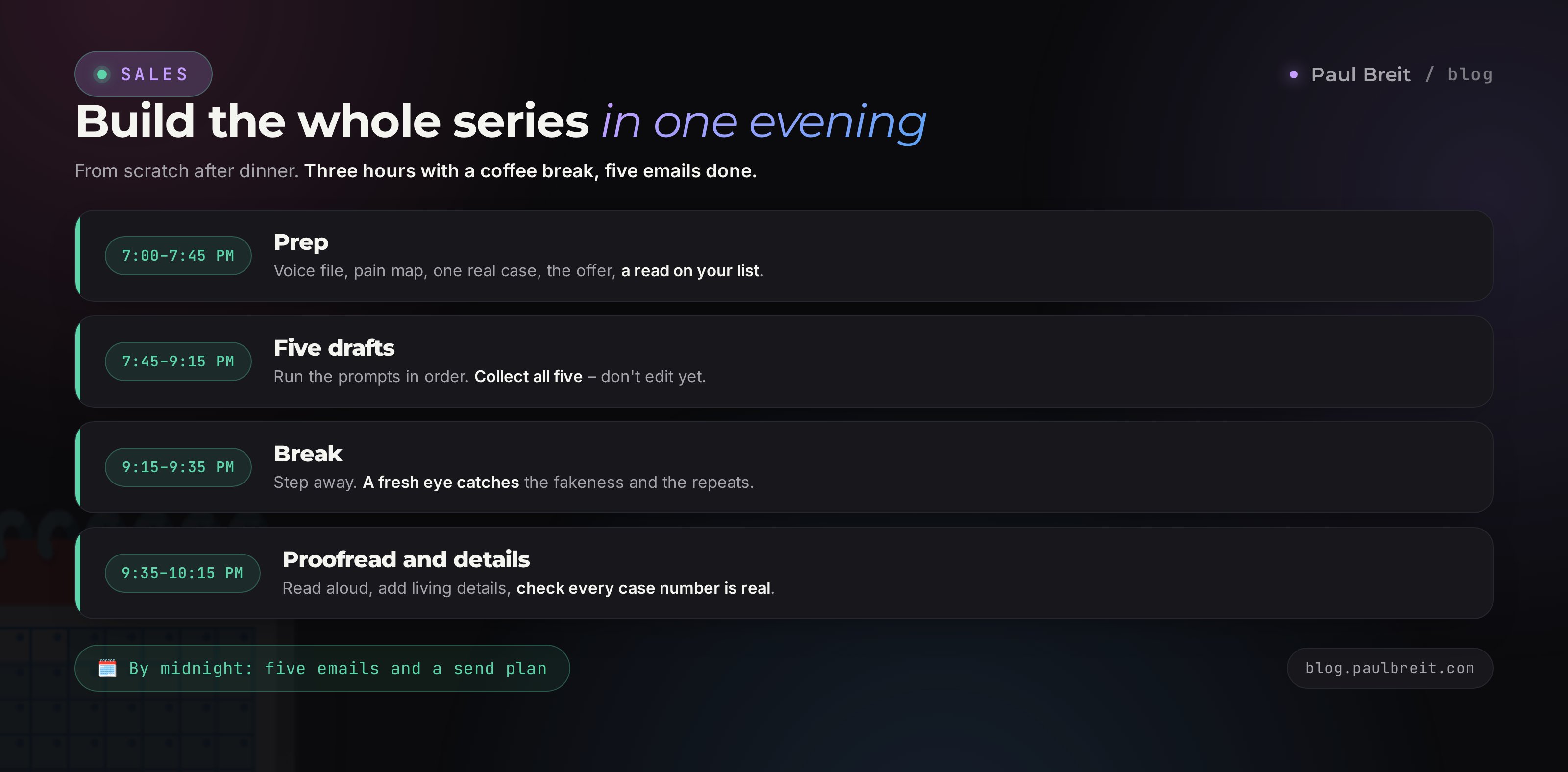
Real timing if you sit down from scratch in the evening. It all fits in three hours with a coffee break.
Prep
You gather the file of 20 to 30 texts, upload it, and ask for the voice breakdown. You run the pain-map prompt. You record one case. You pin down the goal of the series and the offer. You look at who's on your list. Five prep pieces done.
Five drafts
You run the prompts for emails 1 through 5 in order. AI hands over each email in a couple of minutes. Don't edit at this stage; just collect all five drafts in one file. About 15 to 18 minutes per email, subject options included.
Break
Step away from the screen. A fresh eye after a pause catches the fakeness and the repetition you miss in the flow.
Proofread and details
You read all five emails aloud in a row, as one story. You fix the rhythm, add living details, cut the repetition between emails. You check that each email leads to the next, the subjects are chosen, and the numbers in the case are real.
By midnight you have five finished emails and a send plan. From there you set one email a day with the offer at the end. A week later the first people write to you first. The whole series is built in one evening instead of three days of writing by hand.
Section 075 newsletter mistakes and how AI fixes them
A weak subject
The subject is about nothing, and the email goes unopened. All the work on the text is wasted. The fix is the 15-subjects prompt: pick the strongest one with a specific, a number, or curiosity, and add a preheader. Open rates climb from the first email.
A slow warm-up
A first paragraph about the weather, greetings, and "today I want to tell you." The reader closes the email before the point. The fix is a hook with no greetings. AI gives three versions of the first line, and you take the grabbiest.
Everything in one email
Three ideas and three offers in one text. The reader gets lost and does nothing. The fix is one idea per email and a series of five. AI builds the series in an evening, so "no time to write" no longer holds.
Selling only
The list only hears from you when you're selling something. People unsubscribe because all they get is offers. The fix is a series where four emails warm with value and story, and the offer comes once, at the end. A warm list answers better than a cold one.
The email smells like AI
Smooth, correct, lifeless – and trust melts away. The fix is voice on the way in, a banned-markers list, and reading aloud on the way out. Plus one living detail in every email. The cleanup breakdown is in a separate article.
Section 08Launch checklist
Print it and check the boxes. As long as all seven are ticked, the newsletter runs at full strength.
- Voice captured – a file of 20 to 30 texts uploaded, the model writes in your style
- Pain map ready – the top 3 pains written out in the audience's words
- Case and story – one real client and your path, with details and numbers
- Series goal and offer – what, for whom, price, deadline, first step
- Five emails – intro, value, story, objections, offer written and proofread
- Subjects chosen – the 15-subjects prompt run for each email, a strong subject and preheader taken
- Send plan – one email a day, offer at the end, the first step works
A newsletter is a system you build once and run on every launch. You bring the meaning, the cases, and the voice; AI turns them into emails in an evening; you finish by hand. One person with no team warms a list the way a marketing department does, once five emails stand in the right order and AI takes the grind of writing.
How this connects to the other articles
A newsletter sits in the middle of the expert sales funnel: the emails stand between the lead magnet and the offer. The same logic of a touch series works in posts – the breakdown is in the article on a fast launch to your audience. The material for your emails comes from a month-long content plan, and the voice for the newsletter is set by the method in teach AI to write in your voice. Together it adds up to a sales system built on AI.
FAQFrequently asked questions
What is an email newsletter, in plain terms?
A newsletter is a series of emails you send to your list of subscribers – to their inbox, to Telegram, or through a messenger. One email does one job and moves the reader a step forward: it introduces you, gives value, builds trust, then invites them to an offer. A good newsletter warms your list and brings leads without you selling to each person by hand.
Does email still work in 2026?
Yes. Email is alive and still brings leads. What died is the habit of blasting dull text with no subject line and no structure. Emails where the subject hooks, the first line holds, and the body carries one idea and one ask get opened and read to the end. In Telegram and messengers a newsletter works even harder thanks to high open rates.
How many emails should a series have?
The working minimum for warming a list is five: intro, value, story, objections, offer. One email rarely sells, and past seven the audience tires. Five emails cover the whole path from opt-in to lead and get built in one evening with ready prompts.
Can I hand the whole newsletter to AI?
AI pulls subject lines, drafts, and call-to-action options in minutes, but the facts, cases, and living details come from you. The model doesn't know your clients or your numbers, so without your material it writes in generalities. The working setup: you bring the meaning, the story, and the voice; AI turns them into emails; you read them over and fix them.
How often should I send?
For a welcome series, one email a day with the offer at the end. That pace holds attention and keeps you top of mind. For a regular newsletter, one or two emails a week is plenty. Always leave a gap between a value email and an offer email: people need time to warm up.
How do I raise open rates?
Open rates ride on the subject line and the sender name. Run every email through the 15-subjects prompt and pick the strongest: specific, with a number or curiosity, no bait. Send from your own name and never bait in the subject – one bait and people stop opening you.
My emails go to spam – what do I do?
Check three things: are you sending from a proper domain, is the text stuffed with caps and exclamation points, are subscribers moving your email to Primary. Ask new subscribers to reply to the first email with any word – a reply lifts you in the mail provider's eyes. In Telegram and messengers the spam problem doesn't exist at all.
How do I keep emails from reading like AI?
Feed the model 20–30 of your own texts and ask it to write in your voice, ban corporate filler and stock phrases, drop in real details from your life, and read the draft aloud. There's a full cleanup breakdown in the article on removing AI traces from text. A human does the final pass, always.