The Warm-Up Series: 5 Nurture Posts in One Evening With AI
A warm-up is what stands between your follower and the sale. Five posts that carry a person from "I'm fine as I am" to "I want this." Inside: the structure of every post, ready-to-paste AI prompts, a plan to build the whole series in one evening, and the mistakes that keep a warm-up from selling. Written for everyone who sells services, courses, and consulting.
A warm-up built with AI comes together in one evening on a single blueprint. First you hand the model your voice, your audience's pains, and one real case study. Then you write five posts to a formula: post 1 shows the result (point B), post 2 names the pain (point A), post 3 explains why it never worked before, post 4 proves it with a case and clears objections, and post 5 makes the offer with a deadline. AI drafts each post in a couple of minutes from a prompt; you read it back and tune it to sound like you. You publish one post a day.
You run a channel, you post value, your audience grows. Then you write "sign up, I have a product" – and silence. A couple of likes, zero leads. It feels like people just don't need it. In reality you never let them ripen. Between "I read your content" and "I pay you money" there's a gap, and it needs a bridge across. That bridge is the warm-up.
I run four client projects and a personal channel with 20,000 followers. Not one sale gets closed by a genius offer in a single post; every sale is closed by a series of touches placed in the right order. That series used to eat a full day of writing. Now AI drafts it in an evening while I bring the meaning and do the edits. This article is the whole system, with a prompt for every post.
You'll read it in 22 minutes. You'll build it in one evening. Within a week you'll get your first warm leads from people who write to you first.
What's inside
- What a warm-up is and why exactly 5 posts
- What to prep before you start
- Post 1. Point B – show the result
- Post 2. Point A – name the pain
- Post 3. The insight – why it never worked
- Post 4. Proof and objections
- Post 5. The offer and the invite
- How to make AI write in your voice
- Build the series in one evening – an hour-by-hour plan
- 5 warm-up mistakes and how AI closes them
- Launch checklist
Inside the US and EU, Claude opens directly – no extra steps. A handful of regions outside them are on Anthropic's block list and need a VPN with a US or EU location to sign up; if that's you, avoid Turkey and the UAE as exit points, since they're blocked too. Registration is through the referral link, and the full setup and billing walkthrough lives in the piece on paying for Claude. Every prompt in this article works in the free tier and in ChatGPT, but Claude gives the best written text.
Part 01What a warm-up is and why exactly 5 posts
A warm-up is a follower's path from first touch to purchase, broken into clear steps. Someone followed your channel because one post or one reel caught them. In that moment they're cold: to them you're one of a hundred names in the feed, they don't need the product, and they're not planning to spend money. The job of a warm-up is to move them through a few states until, at the finish, they want to buy on their own.
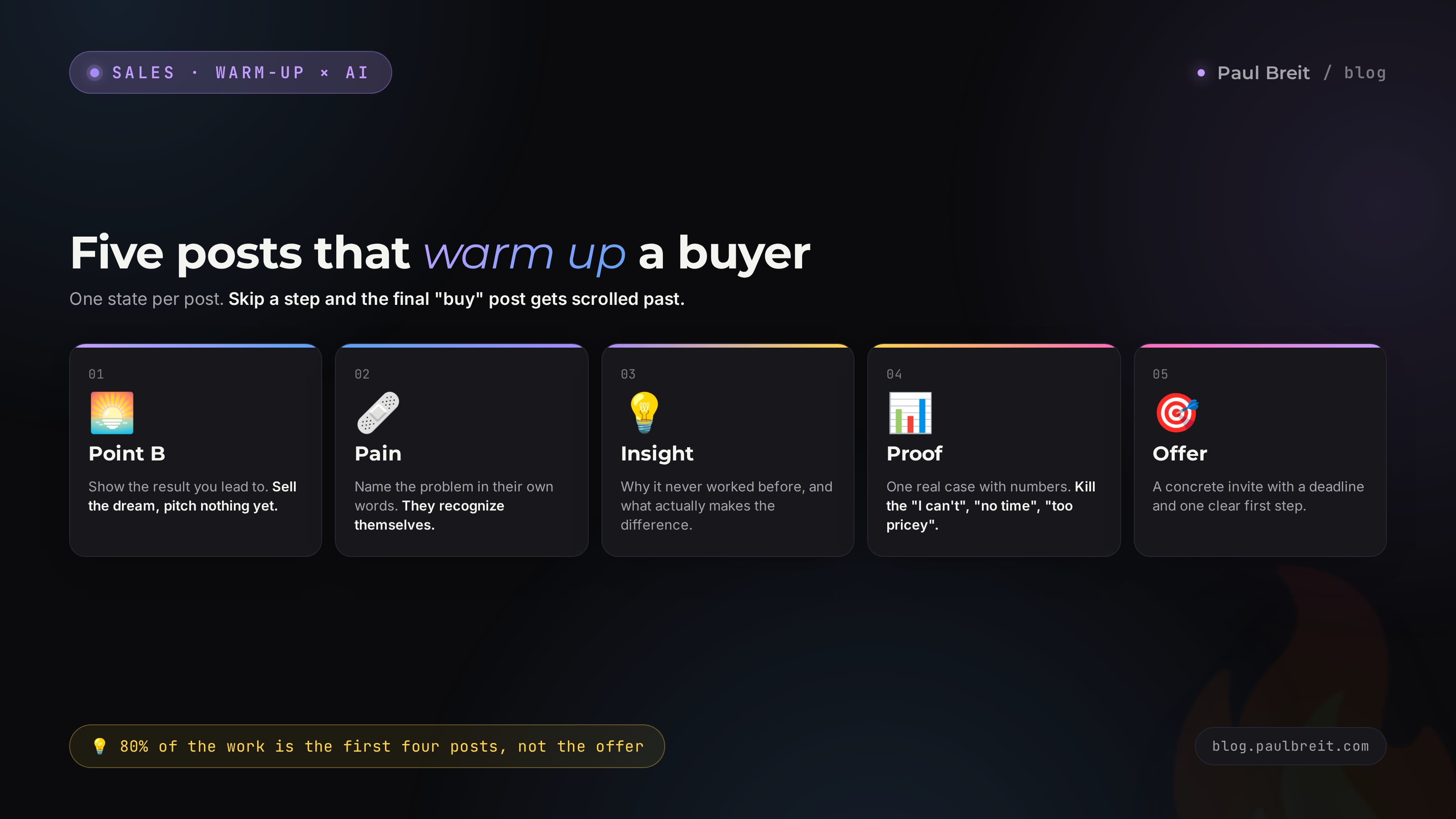
Those states are always the same. First the person has to want the result. Then honestly see where they're stuck right now. Then understand why past attempts failed and what actually makes the difference. Then believe the method works, through someone else's example. And only then accept the offer. Skip even one step and, at the finish, you get that same "buy this" post people skim and scroll past.
Why five, not three and not ten
Three posts is the bare minimum that leads to a sale at all, but it compresses the path and loses part of the audience. Ten posts stretch the warm-up over two weeks; people get tired and tune out of the topic before the offer ever lands. Five posts are the working sweet spot: they cover all five states, one per post, they fit inside a week, and they come together in a single evening. I've tested that number across dozens of launches in client projects.
The five posts and their jobs
- Point B. You show the result you lead to. You sell the dream, you paint the "here's how it could be" picture. You offer nothing.
- Point A. You name the problem in the reader's own words. The person recognizes themselves and sees that standing still is costing them.
- The insight. You explain why it never worked before and show what actually does. You sell the idea of the approach.
- The proof. You give a real case study with numbers and clear the main objections: "it won't work for me," "no time," "too expensive."
- The offer. You make a specific invitation with a deadline and one clear first step.
A warm-up sells across the whole distance, not in the last post. By the time the offer lands, the person has already traveled from "interesting" to "I want it." The offer only formalizes a decision that's almost ripe. That's why 80% of the work is the first four posts, not the final one.
Where to publish it
The logic of a warm-up is the same on every platform; only the form changes. In Telegram it's five separate posts of roughly 1,000 to 2,500 characters, read like little stories. In stories on Instagram or Threads, each post splits into 4 to 6 short frames with text and polls. In email it's one message a day. The prompts here build the core, and then you ask AI to slice the finished post into the format you need. From here on I'll show everything on Telegram posts, since that's the format most people who sell to their audience reach for first.
Warm, cold, and hot audiences
A warm-up matters because people arrive at different temperatures. The cold ones are seeing you for the first time and trust no one yet. The warm ones have read you for a while but never found a reason to buy. The hot ones are ready and only waiting for the offer. One post can't close all three: the hot crowd finds it dragging, the cold crowd finds it premature. A series of five posts walks each person through the heat at their own pace. The cold reader gets time to ripen, the warm reader remembers why they followed, and the hot reader gets the offer at the finish. That's why a warm-up runs as a series and is stretched over time, so everyone heats up to the buying point at the moment that suits them.
Part 02What to prep before you start
The main reason an AI warm-up comes out hollow and faceless is that the model is writing from thin air. It doesn't know your clients, your numbers, or your voice. Give it material and the drafts come alive. The prep takes 30 to 40 minutes, and it's the most important part of the evening.
Your channel's voice
Collect 20 to 30 of your own posts that you actually like into one file. Upload it to the chat and ask AI to break down how you write: sentence length, favorite turns of phrase, where you joke, where you get serious. From then on the model holds that voice across every draft. The full method is in the piece on how to teach AI to write in your voice.
A map of your audience's pains
A warm-up hits home when it speaks in the reader's own words. Ask AI to pull those words out of real sources.
You are a marketing analyst. Here are 30 comments and questions
from my channel and two competitor channels (pasted below).
Write out the recurring pains, fears, and objections of my audience.
Phrase them verbatim, in the exact words people use, no polishing.
Group them by theme and mark the top 3 most frequent.
What you get back is a list of real pains. The top 3 will grow into posts 2 and 3.
One real case study
The proof post needs one client with a result. It doesn't have to be a superstar – an honest one is enough. Record it by voice or type it out: who the person is, what they came with, what you did, what they got, and over what timeframe. Numbers and details. This is the piece AI can't invent for you, and inventing it is off the table. One real case study beats ten pretty promises.
The core of the offer
Decide in advance where you're leading: a free consultation, a low-cost product, the main course, or one-on-one work. Write down the price, what's included, the deadline, and the first step the person has to take. Without this, post five drifts into vague generalities.
Before you write a single post, you have four things in hand: the voice file, the pain map, one case study with numbers, and the core of the offer. If all four are there, the five posts come together in a couple of hours. If something is missing, spend the time on prep now, or you'll be rewriting drafts in circles.
Post 01Point B – show the result
The first post opens the series and sets the desire. You show the result you lead to in a way that makes the person think, "I'd love that too." You sell nothing, you invite nothing, you give no links. There's one job: light up a picture of the future.
Post structure
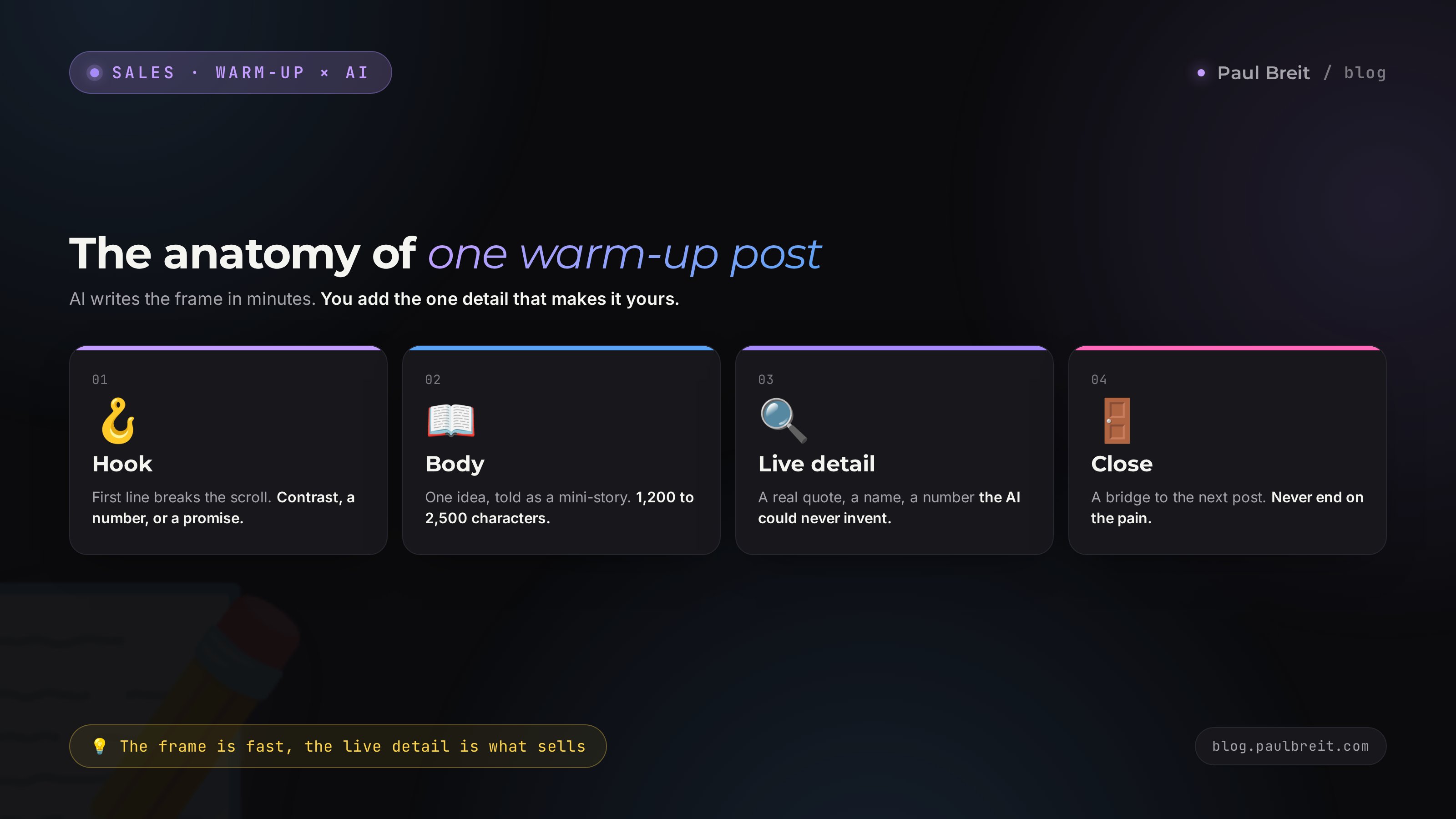
- The hook. The first line stops the scroll. A contrast, a number, or a promise.
- The result picture. A concrete scene from the life of someone whose problem is already solved. What they do in the morning, what their work looks like, what they feel.
- Attainability. The thought that this is real and closer than it seems.
- A light hook forward. A hint that you'll tell them how to get there next.
The prompt
Write in my voice (the style file above). The topic is the first post
of a warm-up. The job of this post: show point B, spark desire,
sell nothing. The audience and its pains are in the map above.
The result I lead to: [fill in, e.g. a solo owner gets 5-7 leads
a day on autopilot, no burnout].
Write a post of 1,200-1,800 characters: a gripping hook in the first
line, a living scene of "what life looks like when the result is
already here," the thought that it's attainable, a light teaser at
the end. No corporate speak, no throat-clearing intros, address the
reader as "you." Give me 3 options for the first line.AI will write it smoothly, but generically. Your edit is to add the concrete detail the model doesn't have: a client's name, a city, a dollar figure, a time of day, a real quote. One living detail turns a template into your post.
How it looks in practice
Take the niche "AI for coaches." A draft of post 1 after editing might sound like this:
"Yesterday a client texted me at seven in the morning: 'Paul, while I was drinking my coffee, AI put together a month of my content plan and three finished posts. I wasn't even fully awake yet. And the day's work is already done.' Six months ago she sat up until midnight agonizing over what to write about. Now she spends an hour a week on content and calmly runs two channels at once. That's what the day of a coach looks like once AI takes the busywork off her plate. And it's closer than it seems: the whole path is a few evenings of setup. Where to start, I'll tell you in the next posts."
Notice: there's a real quote, a time, a concrete task, and a measurable result. AI gave the frame, and the details that the model could never have known made the post alive.
Post 02Point A – name the pain
The second post brings the person back to reality. You name the problem they're stuck in, in their own words from the pain map. They read it and recognize themselves. What matters here is showing honestly that staying where they are is expensive. Without scare tactics.
Post structure
- Recognition. Describe the typical day of a person with the problem so precisely that they think "this is about me."
- The cost of inaction. What they lose while everything stays the same: time, money, nerves, opportunities.
- Honesty instead of pressure. No "you're a failure." With warmth: "I got stuck the same way."
- The bridge. A hint that there's a way out and you'll walk them to it.
The prompt
Write in my voice. This is post 2 of the warm-up. The job: name the
audience's pain in their own words, create recognition, show the cost
of inaction, without scaring anyone. The main pain from the map:
[fill in the top pain].
Write a post of 1,200-2,000 characters: a scene of recognition, "a
typical day with this problem," what the person loses while nothing
changes, a warm honest tone with no blame, a bridge to the solution
at the end. Add 2-3 self-diagnosis questions, "Have you ever had it
where...". No corporate speak, no throat-clearing, address as "you."Don't turn the post into fear-mongering. Lines like "you'll lose everything if you don't start now" push people away. What works is honest recognition and a light sadness about being stuck, not fear. Sell through the pull toward the result, and leave the pressure to people who have no arguments.
Post 03The insight – why it never worked
The third post is the heart of the warm-up. Here the person understands why past attempts failed and what makes the difference. Here you sell the idea of the approach itself. Stay quiet about the product for now. After this post the reader should think, "So that's what it was."
Post structure
- The false cause. What people are used to blaming the failure on ("didn't try hard enough," "not enough talent").
- The real cause. What was actually in the way. An unexpected turn that flips the picture.
- Your method. What the right path looks like. The general logic, without handing over every detail.
- The catch. Why it's easy to go off course alone. The thought: you need a guide.
The prompt
Write in my voice. This is post 3 of the warm-up. The job: deliver the
insight - why the audience never got results before and what actually
solves the problem. We sell the idea of the approach, not the product.
The false cause people blame the failure on: [fill in].
The real cause: [fill in]. The core of my method: [fill in
in 2-3 sentences].
Write a post of 1,500-2,200 characters: first debunk the false cause,
then turn to the real one, show the logic of the method without every
detail, note the catch of doing it solo. No corporate speak, address
as "you," a living rhythm with short punchy lines.
If after this post you feel the method sounds like everyone else's, go back to your positioning. A generic method won't be saved even by perfect writing. How to narrow your niche and find your angle is in the piece on choosing your niche.
Post 04Proof and objections
The fourth post turns interest into trust. The person already wants the result and understands the method; now they need to believe it will work for them too. The proof is a real case study. And right away you clear the three objections spinning in their head before a purchase.
Post structure
- A case with numbers. Who the client is, point A, what you did, point B, the timeframe. Honestly, with details.
- The "it won't work for me" objection. Show that the client in the case started from the same place the reader is in.
- The "no time" objection. How much time it actually takes and why that's manageable.
- The "too expensive" objection. Through the cost of inaction from post 2: what it costs to stay put.
The prompt
Write in my voice. This is post 4 of the warm-up. The job: prove it
with a case and clear 3 objections. Here is my real case (invent
nothing, use only this): [paste the case - who, point A, what you did,
point B, timeframe, numbers].
Write a post of 1,500-2,300 characters: unfold the case as a short
story with details, then clear the objections one by one - "it won't
work for me," "no time," "too expensive." Close "too expensive"
through the cost of inaction. No corporate speak, address as "you,"
no bragging - keep it human. Don't add numbers that aren't in my case.AI loves to paint in pretty numbers. Check the post line by line: every number, name, and fact has to come from your case. A made-up result in a warm-up is a lie that surfaces on the very first call and kills trust in the whole series.
Post 05The offer and the invite
The fifth post formalizes a decision that's almost ripe. By now the person has traveled the whole path. The offer has to be specific, with a deadline and a clear first step. A vague "message me if you're interested" kills the whole series, because it doesn't tell anyone what to do right now.
Post structure
- Back to the result. One line reminding them of point B from post 1.
- The offer. What you're offering, what's included, who it's for.
- The deadline. A limit on time or spots. Without it, the decision gets put off forever.
- The first step. One clear action: "message me the word AUDIT in DMs" or a link to a form.
The prompt
Write in my voice. This is post 5 of the warm-up - the offer. Here's
the core: I'm offering [what], it includes [what], it's for [who],
the price is [how much], the deadline is [by what date or how many
spots].
The first step for the person: [e.g. message the word AUDIT in DMs].
Write a post of 1,200-1,800 characters: a short reminder of the result
from the first post, a clear offer, an honest deadline, one clear
call to action at the end. No corporate speak, address as "you,"
no aggressive pressure - confident and calm.
Give me 2 options for the final call to action.
If the offer leads to a sales webinar or a consultation, post five becomes an invitation to an event rather than a direct sale. How to build that event with AI is in the piece on the sales webinar.
Part 03How to make AI write in your voice
The most common complaint about AI text is that it smells like AI. Smooth, correct, and dead. You fix that on the way in and on the way out.
On the way in: hand over your voice
Upload a file with 20 to 30 of your own posts and add one line to every prompt: "write in my voice, per the uploaded style." The model picks up your phrase length, your rhythm, and your favorite words. The more living material on the way in, the fewer edits on the way out.
The banned list
Add a direct ban on AI markers to the prompt. That clears half the problem right away:
Ban corporate speak, bookish intro phrases, and copywriting cliches.
Cut the smooth connective glue between paragraphs and the filler
lines that add nothing. Write in short living sentences, alternate
long and short, a light conversational tone is allowed.
Address the reader as "you."
On the way out: read it aloud
Read the finished post out loud. Wherever you stumble or get bored, fix it. A live human hears the fakeness the eye skips over. A full breakdown of every tell and how to clean it is in the piece on removing AI traces from text. The final edit is always done by a human, no debate.
Keep the length matched to the platform
The same idea lives differently in Telegram and in stories. For Telegram, ask for a post of 1,200 to 2,500 characters with paragraphs of 2 to 4 lines. For stories, add "slice this post into 5 one-screen frames, and add a poll question to two of them." For email, ask for a subject line and a preview line. The voice and the meaning stay the same; only the packaging changes. That's how one series in one evening turns into a warm-up for three platforms at once, with nothing to rewrite from scratch.
Put at least one detail into every post that AI couldn't have known: a real client quote, an incident from your week, a specific place, time, or dollar figure. Details are fingerprints. They're how the reader knows there's a live human behind the text, not a generator.
Part 04Build the series in one evening – an hour-by-hour plan
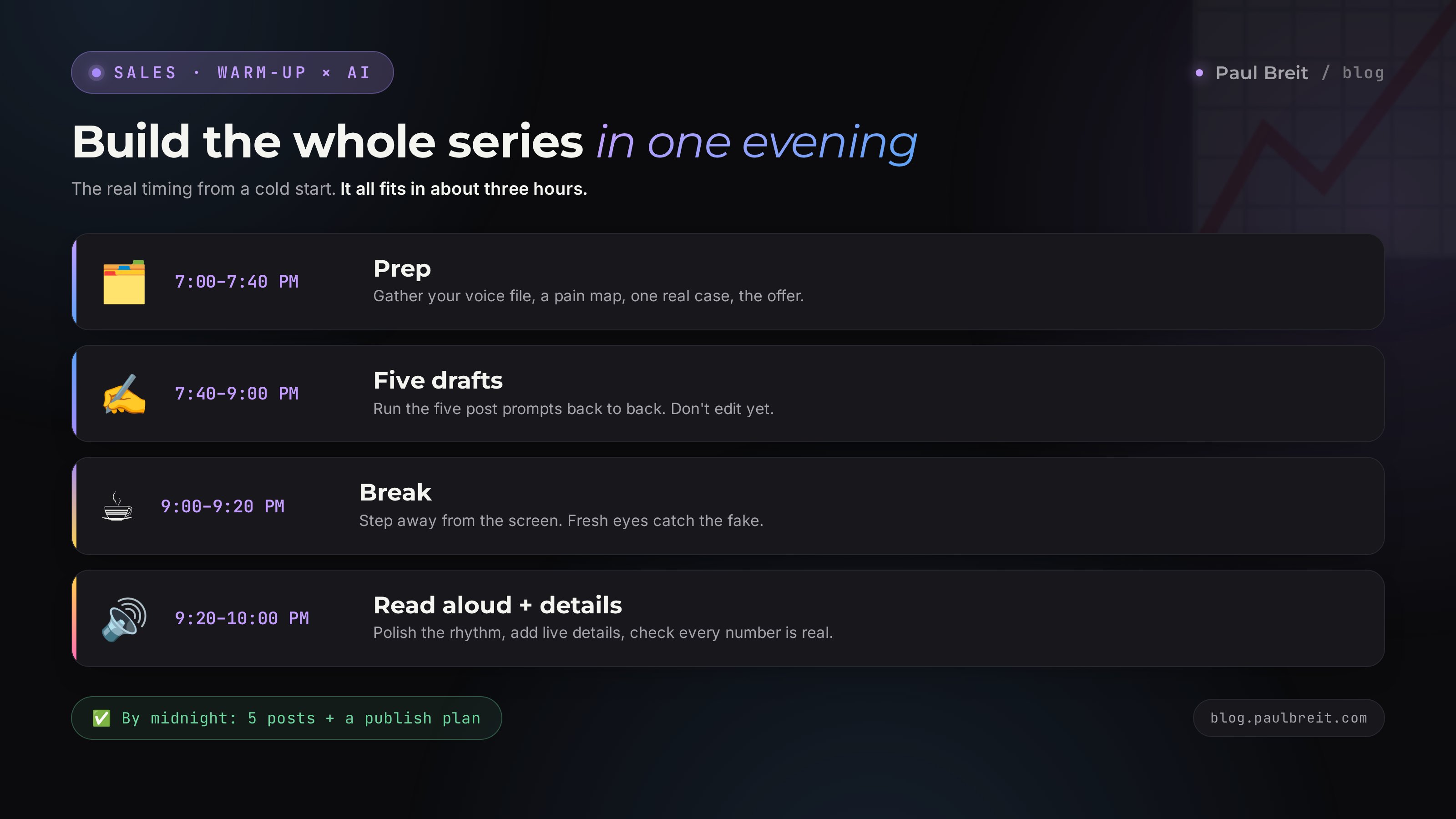
A real timeline if you sit down from scratch in the evening. It all fits into three hours with a tea break.
Prep
You assemble the file of 20 to 30 posts, upload it, and ask AI to break down the voice. You run the prompt for the pain map. You talk out one case study. You state the core of the offer. Four prep pieces done.
Five drafts
You run the prompts for posts 1 through 5 one after another. AI hands back each post in a couple of minutes. Don't edit at this stage; just collect all five drafts in one file. About 12 to 15 minutes per post, options included.
Break
Step away from the screen. A fresh eye after a pause catches the fakeness and the repeats you can't see in the flow.
Read-through and details
Read all five aloud in a row, as one story. Fix the rhythm, add living details, cut repeats between posts. Check that each post leads to the next and that the numbers in the case are real.
By midnight you have five finished posts and a publishing plan. From there you post one a day, offer on day six. Within a week the first people write to you on their own. The whole series is built in one evening instead of a week of writing by hand.
Part 055 warm-up mistakes and how AI closes them
Straight to the offer, no path
The person followed you, and the next day got "buy the course." Conversion in the basement. The fix is a series of five posts between the follow and the offer. AI builds it in an evening from the prompts in this article, so the excuse "no time to write a warm-up" is gone.
Pain in vague words
The problem post is written abstractly: "a lot of people don't have enough clients." A miss. The reader doesn't recognize themselves. The fix is a pain map from real comments. The prompt pulls the audience's exact words, and post 2 hits home.
No proof
A warm-up built on promises alone, not a single case. People don't believe it. The fix is one real client with numbers in post 4. AI unfolds them into a short story, but you take the facts from life, not from the model's head.
An offer with no deadline
"Message me if you're interested" – and everyone puts it off to a later that never comes. The fix is a deadline and one clear first step in post 5. A limit on time or spots gets the decision off dead center.
The text smells like AI
Smooth, correct, dead – and trust melts. The fix is voice on the way in, a banned list of markers, and reading aloud on the way out. Plus a living detail in every post. The full cleanup breakdown is in a separate article.
Part 06Launch checklist
Print it and check the boxes. As long as all seven are ticked, the warm-up works at full strength.
- Voice collected – a file of 20-30 posts uploaded, the model writes in your style
- Pain map ready – the top 3 pains written out in the audience's words
- Case with numbers – one real client, point A, point B, timeframe
- Core of the offer – what, for whom, price, deadline, first step
- Five posts – point B, pain, insight, proof, offer written and read through
- Details in place – a living detail in every post, all numbers real
- Publishing plan – one post a day, offer on day six, the first step works
A warm-up is a system you build once and run on every launch. You bring the meaning, the case studies, and the voice; AI turns them into drafts in an evening; you finish them by hand. One solo owner with no team can warm up an audience the way a marketing department does, if the five posts line up in the right order and AI takes the busywork of writing off your plate.
How this connects to the other articles
The warm-up is the middle of the sales funnel: it sits between the lead magnet and the offer. The material for the posts comes from your content plan for the month, and the prompts for tighter work with the text are in the piece on how to write prompts. Three articles fold into one AI-powered sales system.
FAQFrequently asked questions
What is a warm-up in plain terms?
A warm-up is a series of posts or stories that carries a follower from "I'm fine as I am" to a decision to buy. Between the first touch and the offer, the person moves through desire, awareness of the problem, understanding of the method, and trust in you. The warm-up puts those touches in order so that by the moment of sale the person is ready.
How many posts should a warm-up have?
The working minimum is five posts: point B, point A with the pain, the insight about the method, a case that clears objections, and the offer. Fewer than three touches almost never sells; longer than seven and the audience tires out. Five posts cover the whole path and come together easily in one evening.
Can I hand the whole warm-up to AI?
AI builds the structure, the drafts, and the headline options in minutes, but the facts, cases, and living details come from you. The model doesn't know your clients or your numbers, so without your material it hands back generic words. The working setup: you bring the meaning and the story, AI turns them into text in your voice, and you read it back and edit.
How often should I publish warm-up posts?
One post a day, the series over five days, the offer on day six. That pace holds attention and keeps the topic from being forgotten. If the audience is active, you can speed up to two posts a day, but always leave at least a full day between the insight and the offer – people need time to ripen.
How is a warm-up in Telegram different from one in stories?
The logic is the same, the form is different. In Telegram it's separate posts of 1,000 to 2,500 characters, read like little stories. In stories it's short frames with text and polls, where each warm-up post splits into 4 to 6 frames. The prompts in this article work for both formats; you just ask AI to slice the finished post into stories.
The warm-up didn't work – what do I check first?
The offer first: does it have a deadline, a specific price, and a clear "what to do right now." Second, the pain post: did you name the problem in the reader's words or in vague phrases. Third, the proof: is there a real case with numbers. Most often what kills sales is an offer with no time limit.
Do I need a warm-up if my audience is small?
Yes, and on a small audience it matters even more. When you have few followers, every one counts, and a single warm nurture lifts conversion more than a hundred new cold followers. A warm-up to 200 people in your own audience often brings more leads than ads to a thousand strangers.
How do I keep the posts from reading like AI?
Upload 20 to 30 of your posts and ask the model to write in your voice, set a ban on corporate speak and intro filler, drop in real details from your life, and always read it aloud. There's a separate breakdown of the cleanup in the article on removing AI traces from text. The final edit is done by a human, always.