The AI assistant career: where it pays in 2026 and how to start
An AI assistant is a person who gets a business's work done with AI: content, call breakdowns, funnels, bots, routine on autopilot. This article lays the profession out end to end – what you do, who needs you, what the market pays in 2026, and how to break in within 30 days with no degree and no code.
An AI assistant is someone who closes working tasks with AI: writes content in the client's voice, builds funnels and bots, prepares call breakdowns, automates the routine, and runs a company's knowledge base. In 2026 this specialist earns roughly $400 to $2,700 depending on the format: part-time with an expert, a one-off project done for you, or an in-house role. You can enter the profession in 30 days: learn one strong tool (Claude, for example), build 2–3 cases on free tasks, and reach your first paying clients. No degree and no programming required.
Every week someone messages me with the same question: "AI is about to replace everyone, so where do I even go to work?" Here's my honest answer. AI on its own doesn't make money. It produces raw material. What turns that raw material into a result is a person who knows what to ask for, how to check it, and how to wire the finished thing into a business. That person is the AI assistant. The profession exists precisely because the tool landed in everyone's hands, while only a few can build a paid working process out of it.
I run an online school and four client projects, a personal channel with 20,000 followers, and more than 10,000 people have come through my courses. Every month I see the same thing: ordinary people with no degree and no code take these tasks off businesses and get paid for them. Below is the whole profession end to end: what to do, who needs it, what it pays, and how to start tomorrow morning.
You'll read this in 22 minutes. You can build your first case over a weekend. Reaching your first paid tasks in a month is realistic if you do a little every day instead of waiting for the "perfect course."
What's inside
- Who an AI assistant is and where the profession came from
- What an AI assistant actually does: 10 tasks
- Who needs AI assistants and why demand is growing
- What it pays in 2026: five formats and ranges
- What you need to know: skills, tools, and what you can skip
- The 30-day plan to enter the profession
- Portfolio and first clients with no experience
- Where to find gigs and jobs in 2026
- 6 beginner mistakes
- The starter checklist
The profession's main tool is a strong AI, and most often that's Claude. If it doesn't open directly where you are, use a VPN set to a US or EU location. One detail worth knowing: some regions sit on Anthropic's blocklist, so pick a mainstream US or EU exit rather than an unusual one, and switch it on before you sign up so the account isn't tied to a blocked region. Register with a mainstream email like Gmail or iCloud. Open it here: claude.ai. A full walkthrough of signup and payment is in Claude from scratch.
Section 01Who an AI assistant is and where the profession came from
An AI assistant is a specialist who solves business tasks with AI. Not a developer, not a programmer, not someone who "trains models" in a lab. A regular practitioner who can brief the AI, get a result of the right quality, and hand it to the client in the exact form people pay for.
The easiest way to get it is by analogy. Twenty years ago the internet arrived, and with it the job of "the person who can build a site and set up ads." Everyone had a computer, but few could turn it into a working sales channel. Those few earned well in the early years. The same thing is happening now with AI. Everyone has access; the button is the same for all of us. The only difference is who can squeeze money out of that button.
One point that trips up beginners. The label "AI assistant" is sometimes used for a chatbot or a voice helper. This article is about the profession – about a living person. To keep it straight, hold three neighboring roles side by side:
- Prompt engineer – specializes in the requests themselves: writing, testing, building prompt libraries. That's a narrow slice of the work. More on it in the prompt engineer career.
- AI assistant – broader. Takes a whole business task ("run my content and bring in inquiries") and carries it through AI from start to a finished result.
- AI implementer – works at the level of company processes: where AI saves time and money, what to automate, who to train. That's the next rung up in rate. How to package that service is covered in selling AI implementation.
It's really one ladder. People start with prompts and simple tasks, grow into running whole projects, then into full done-for-you implementation. The rate climbs with the level. The good news: you can enter from the very bottom, with no experience, and it already pays there.
Why this isn't "just another hype cycle"
Fair question: won't the profession fizzle out in a year. Here's my answer with numbers and logic, no promises of gold. AI has locked itself into how companies work for the long haul, because it saves real money: one person with AI produces the output that used to take three. Business has already felt that and won't roll it back. And as long as the tool stays, so does the need for people who can use it for results. The profession will change (tools update every couple of months), but the need itself isn't going anywhere. You'll have to change too – that's part of the job, and I'll come back to it in the skills section.
Section 02What an AI assistant actually does: 10 tasks
Nobody buys a vague "I work with AI." They buy a concrete result. Here are ten tasks businesses are willing to pay for in 2026, from the most common to the more advanced.
- Content in the client's voice. Posts, articles, newsletters, reels scripts, product descriptions. The key phrase is "in the client's voice," not faceless AI text. How to teach the AI that is covered in the 30-posts method.
- Breaking down calls and chats. Upload a sales call transcript and get a breakdown: where the rep lost the client, which objections went unanswered, what to say next time. For a sales team that's pure money.
- Building a funnel. Lead magnet, warm-up sequence, selling offer. The AI drafts every message; you refine them and wire it all together.
- AI agents and bots. A DM bot that takes inquiries, answers common questions, and books calls. Built with no code, in an evening.
- Company knowledge base. Load your playbooks, scripts, and cases into the AI, and it answers staff and clients like someone who knows the business from the inside.
- Analytics and reports. Pulling metrics together, spreadsheet reports, finding bottlenecks in the numbers. No formulas, just plain words.
- Visuals. Banners, covers, decks, simple text-to-video. It won't replace a designer on hard jobs, but it covers 80% of the routine visual work.
- Research. Competitor analysis, niche breakdowns, digging through market reviews. What used to eat days now fits into an evening.
- Documents. Drafts of contracts, proposals, instructions, replies to complaints. With a lawyer's review wherever it matters.
- Training the team. You come into a company and teach the staff to work with AI on their own tasks. That's implementation-level work and the top rate.
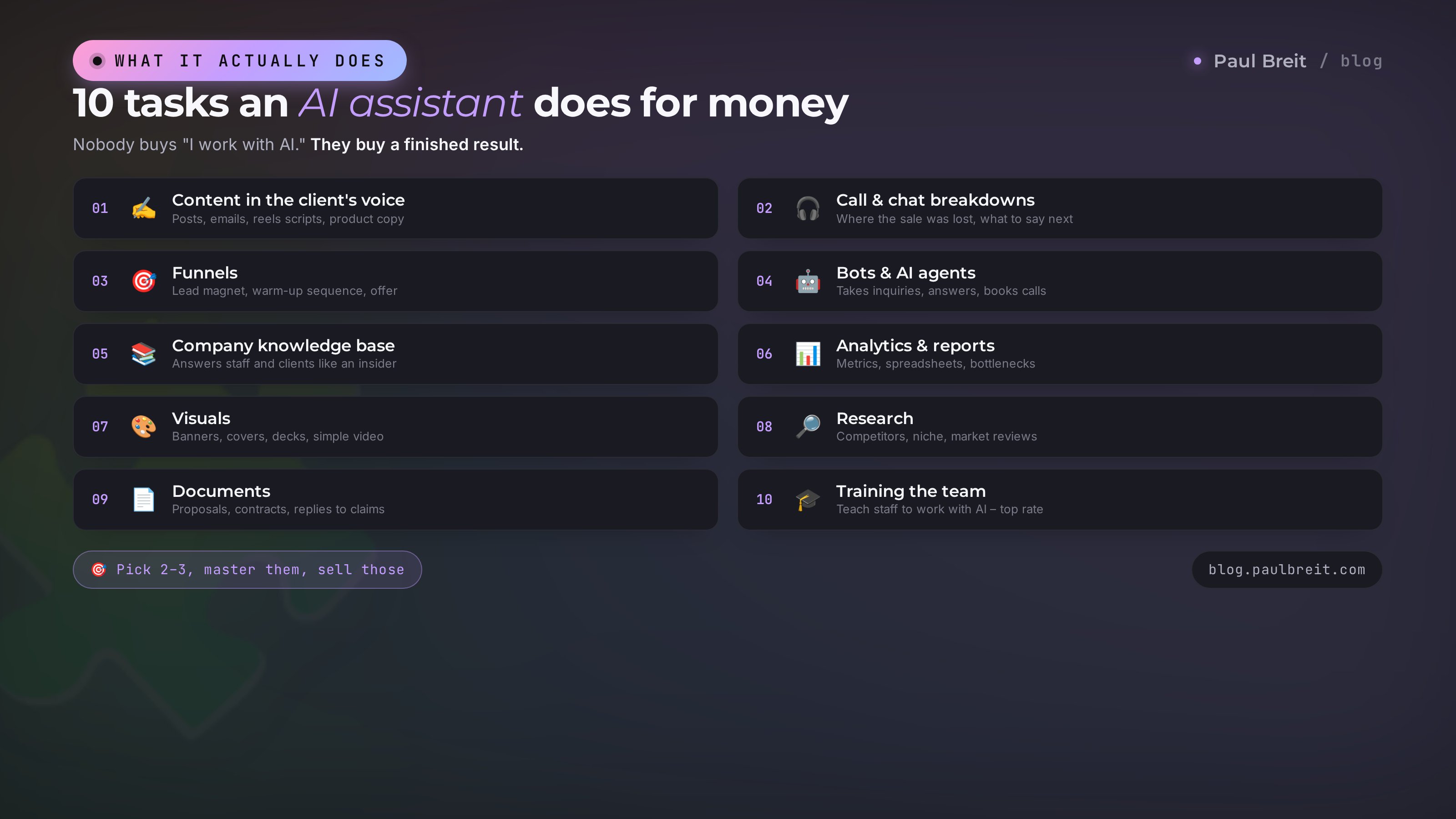
Don't try to do everything at once. A beginner's edge is picking 2–3 tasks from this list, taking them to excellent quality, and selling exactly those. "AI assistant for content" sells more easily than "AI specialist in general." A tight specialization gives a clear result and a clear price.
Section 03Who needs AI assistants and why demand is growing
An AI assistant's client is anyone with money, tasks, and no time to figure out AI themselves. There are more of them than you'd think. Here's who pays most often:
- Experts and creators. Therapists, coaches, nutritionists, tutors, mentors. The expertise is in their head and they're always short of hands for content and sales. The most accessible entry point for a beginner.
- Online schools and course creators. An ocean of tasks here: warm-ups, funnels, webinar breakdowns, student support, launch analytics. And bigger budgets than a solo expert.
- Small business. Salons, studios, local services, cafes. They need posts, DM replies, simple bots. They pay modestly, but there are many of them and they're right next door.
- Online store sellers. Product listings, descriptions, review responses, photo cleanup. A huge, repetitive volume that fits AI perfectly.
- Agencies and other freelancers. Marketers, ad buyers, social media managers who want AI to speed up their own work. You become their "AI hand" on contract.
Why demand is actually growing rather than standing still. Three reasons, and all three match what I see in the market every month. First: AI got noticeably stronger over the past year, and what was a toy yesterday now does sellable work today. Second: business has already done the math on the savings and wants them, but can't build the process on its own – it needs someone to execute. Third: people who can take AI all the way to a result are still scarce, because most "played with it and quit." That's a window, and it's open right now.
Look around you. The therapist you know who never gets around to posting. The friend with a small shop who can't find time for product listings. The expert in your own circle drowning in DMs. Your first client is almost always two steps away, not on a freelance marketplace. Start there.
Section 04What it pays in 2026: five formats and ranges
Let me be upfront: exact numbers depend on niche, region, and your level. Below are market benchmarks for 2026 – ranges, not guarantees. But they give an honest picture of what to anchor to in a negotiation.
| Work format | What you do | 2026 range |
|---|---|---|
| Part-time with an expert | Run one client's content, breakdowns, bots, and routine on an ongoing basis | $400–800/mo |
| One-off project, done for you | Build a funnel, an agent, or a knowledge base and hand it over | $700–2,700 per project |
| In-house role | AI assistant on the marketing, support, or sales team | $1,100–2,000/mo |
| One-off freelance tasks | A post, an email series, a call breakdown, a prompt set on request | $30–70 per task |
| Your own product or training | Guides, templates, mentoring, training teams | from $0, no ceiling |
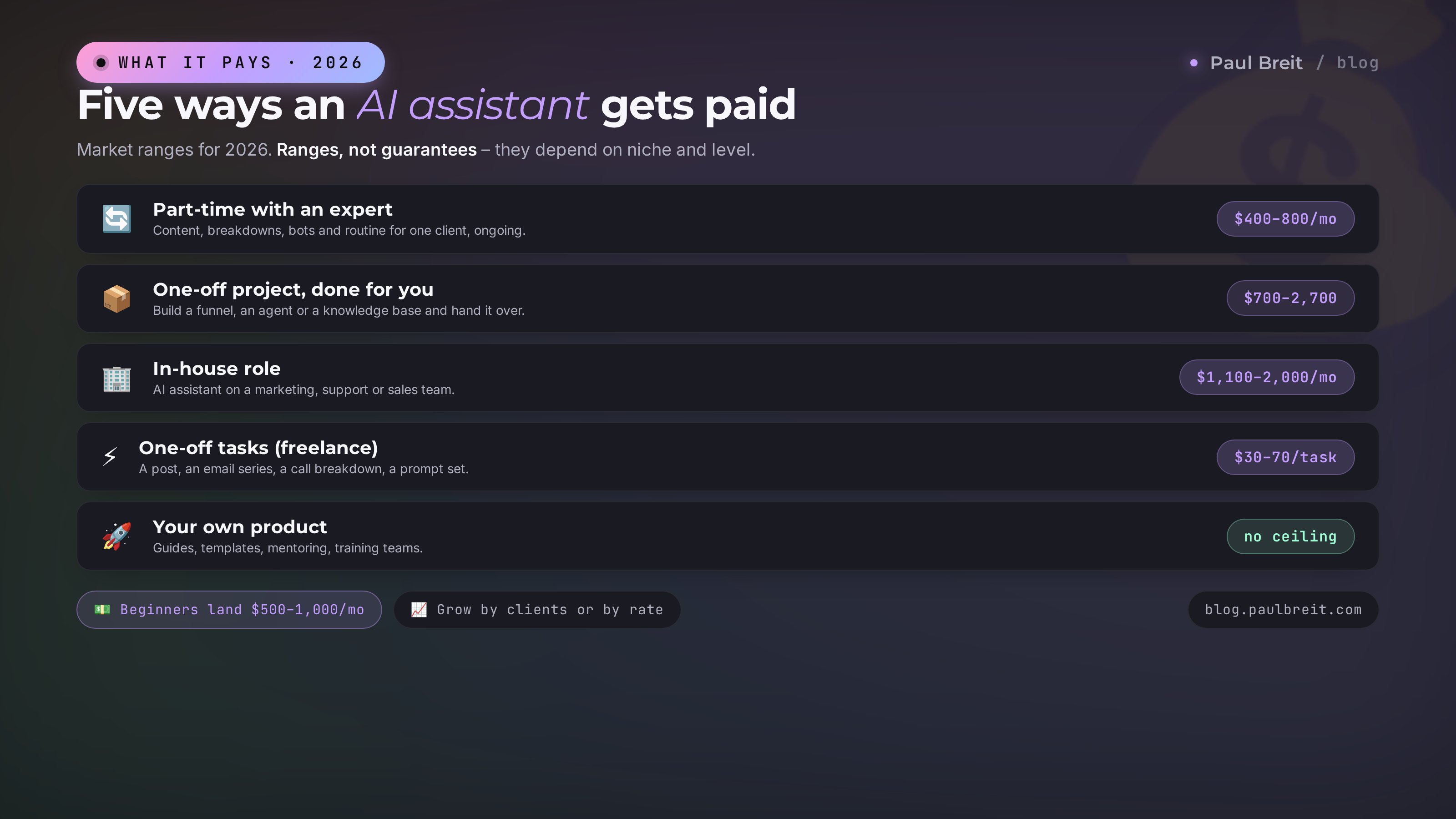
Here's how it looks in practice. A beginner usually starts with one-off tasks and one part-time client. That alone brings $500–1,000 a month at a few hours a day. From there, two growth paths. Either you take on 3–4 retainer clients and reach a steady $2,000+, or you raise your rate through done-for-you projects, where a single project earns more than a month of small tasks.
What your rate depends on
- Result, not process. "I'll write 20 posts" is cheap. "I'll bring in inquiries from your blog" is expensive. The closer your work sits to the client's money, the higher the price.
- Niche. The same skill pays noticeably more in the online-school niche than at a local salon. Choose a niche where the budgets move.
- Cases. Three packaged results lift your rate more than any certificate. How to build them with no experience is below.
- Packages, not hourly. Sell the result as a fixed-price package. Hourly pins you to a ceiling: there are only 24 hours in a day.
A common beginner mistake is charging $7 to "get the reps in." It's a trap. The $7 client is the most demanding one, and raising the price later is nearly impossible. Better to do the first 2–3 jobs free in exchange for a testimonial and permission to show the result, then set a real market price right away. For the bigger picture of earning with AI, there's a separate breakdown – 7 income models.
Section 05What you need to know: skills, tools, and what you can skip
Good news for anyone afraid of "getting into tech": you don't need to code. You don't need a degree. You don't need math or the theory of neural networks. The profession rests on four practical skills.
Four skills that actually decide it
Briefing the AI
This is the base. Being able to explain what you need, give context, a role, examples, and a response format. A bad request yields garbage; a good one yields a finished result. The full five-part formula with before-and-after examples is in how to write prompts.
Checking the result
AI confidently produces both the truth and pure invention. An AI assistant tells them apart and never hands a client anything unverified. Facts get checked, numbers get re-checked, tone gets tuned to the client's voice. It's the checking and finishing you get paid for, not the button press.
Building a process
One task is freelance for one-off money. A process is a system that runs every day: where the material comes from, how it goes through the AI, where the output lands, how you measure the value. Being able to build a repeatable process turns you from a hired hand into a specialist on retainer.
Selling the result
The most underrated skill. You can be a virtuoso with AI and sit with no orders because you can't explain the value or name a price. Learn to talk to a client in the language of their money and their time. This skill is often more important than the technical one.
An AI assistant's toolkit in 2026
Start with one strong tool, don't spread yourself across twenty. My pick to start is Claude: it holds a long context better, writes more cleanly, and is handy for working with documents. Then add tools as your tasks demand:
- Text flagship: Claude or ChatGPT. Learn one deeply, try the other for comparison. A breakdown of the differences is in Claude vs ChatGPT.
- Images: a tool for banners and covers. A review of the working options is in AI for images.
- Bots and automation: no-code builders like ManyChat or similar.
- Voice and video: voiceover, simple text-to-video, subtitles.
Don't burn your first weeks on programming, machine-learning theory, pricey "new career in 12 months" programs, or chasing every fresh tool from the news. All of it is either unnecessary or can wait. At the start you learn one tool and 2–3 tasks. You pick up the rest along the way, when a specific client request calls for it.
Section 06The 30-day plan to enter the profession
This isn't theory. It's a plan that genuinely gets you to first money in a month at an hour or two a day. Four weeks, each with its own result at the end.
Learn one tool on real tasks
Sign up for Claude (outside the US/EU – with a VPN and a mainstream email, see the box above). Then the main rule: enough endless tutorials, time to do. Take five real tasks from your own life or a business you know and run them through the AI: write a post, break down a client conversation, plan your week, write a product description, come up with 10 blog ideas. By the end of the week you'll have a feel for the tool and your first saved winning prompts.
Pick a specialization and do one job for each
From the ten tasks in section two, pick 2–3 that fit you and are easier to sell in your circle. Content plus chat breakdowns, for example. Do one full piece of work for each, for yourself or free for someone you know. The week's goal is to see what a finished result of the right quality looks like. Money is secondary for now.
Build a portfolio of 2–3 cases
Package what you did as before-and-after cases. What the client had before you, what you did, what came out of it. Screenshots, numbers, a short write-up. Three cases like that on a simple page or even a Telegram channel is already your showcase. More on the format in the next section.
Reach your first clients
Now the selling. Every day you make 10 touches: message experts you know, reply to requests in chats, offer a free mini-audit in exchange for a chance to show what you can do. The formula for a first approach is simple: a free small result they can see immediately, then a paid offer. By the end of the month, most people who actually did the work – not just read – have their first paying client.
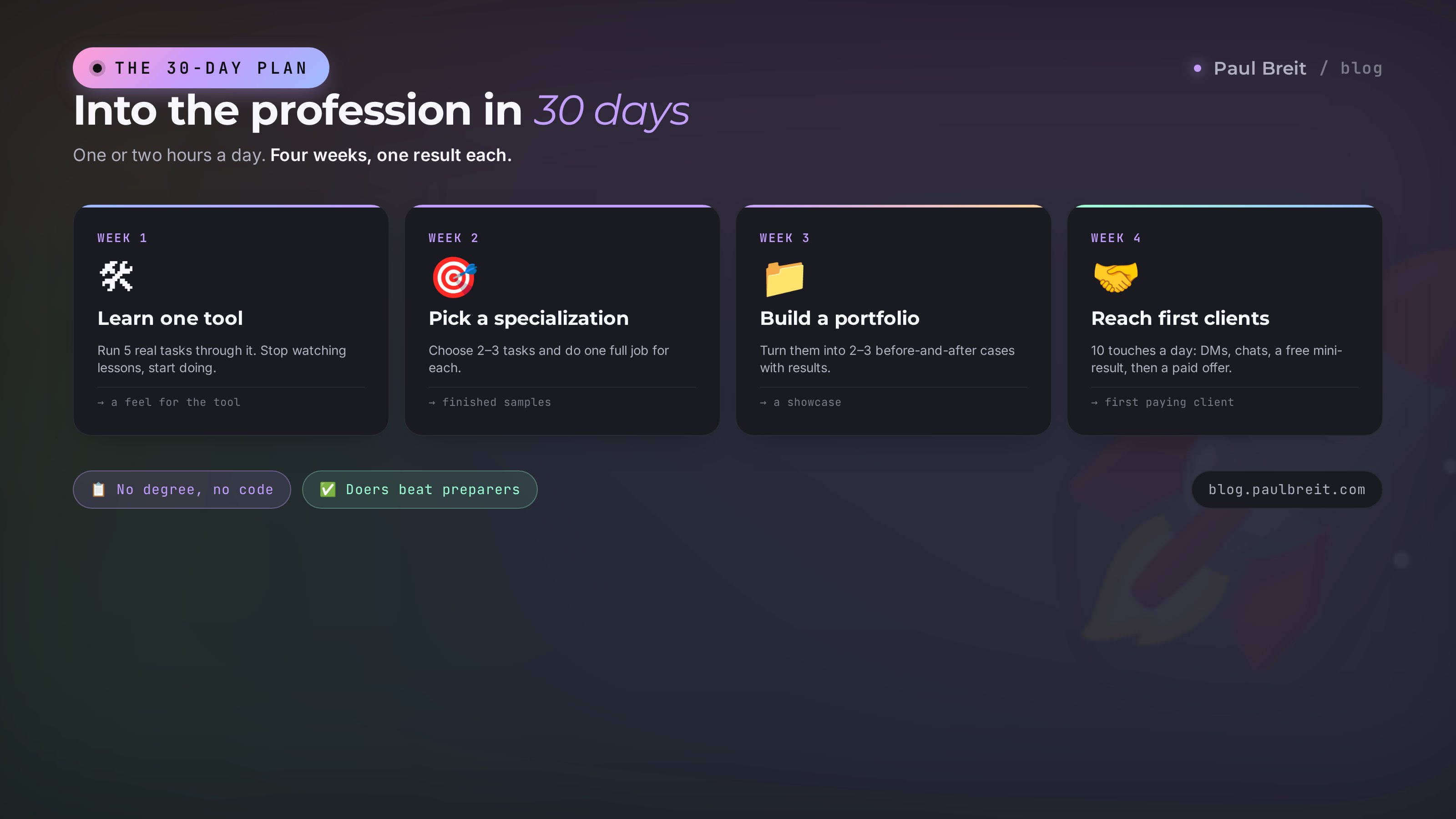
If you want the same path but with a ready plan and less chaos, look at the breakdown of how to learn AI in 30 days. Same principle: less theory, more real tasks from day one.
Section 07Portfolio and first clients with no experience
A beginner's biggest fear: "I have no experience, who's going to trust me with a task?" It's solved in a week, and here's how.
How to build cases when you don't have clients yet
Experience is created, not waited for. Take three businesses from your circle and do one task free for each. A week of content for an expert you know. Ten product listings for a friend with a shop. A booking bot for a local salon. In return, ask for one thing: a short testimonial and permission to show the result. A week later you have three real cases, and three people have gotten tangible value from you.
The formula for a case that sells
- Context. Who the client is, what they do, what the problem was. One or two sentences.
- What you did. Specifically and step by step, no vague "improved and optimized."
- Result. A number or a clear before-and-after. Even "a post used to take two hours, now 15 minutes" is a result.
- Client testimonial. A couple of real lines from the person you did it for. That's proof stronger than anything you say yourself.
You don't need a complex website. A Telegram channel with pinned cases works as a showcase, or a page on a simple builder, or even a tidy PDF. What matters is that a person sees it in a minute: here's what you can do, here's the result, here's the testimonial. That mini-site, by the way, can also be built with AI – that becomes your case number zero.
Section 08Where to find gigs and jobs in 2026
Clients don't come on their own while nobody knows you. At the start, you go to them. Here are the working channels, from fastest to slower.
- Your own circle. The fastest source of first money. Message everyone you know personally who has a business or an expert blog. A direct message beats a post in the feed.
- Niche chats. Chats for experts, online schools, entrepreneurs, marketers. People there regularly ask "who can help with content / a bot / a breakdown." Your job is to be there at the right moment with a ready answer and a case.
- DMs of experts with messy content. Find creators with strong expertise and a weak channel. Message them with a concrete offer and a mini-breakdown of their own content. Value shown up front sells better than a resume.
- Freelance marketplaces and platforms. Slower and competitive, but a steady stream of requests. Good for landing your first one-off tasks.
- Job openings. In 2026 companies post roles titled "AI specialist," "AI assistant," "AI marketer." Search those terms on job sites. A staff role gives stability and fast skill growth on a stream of tasks.
- Your own content. The slowest but strongest channel over time. Run a blog or reels about what you do, show results, and clients come to you. Within six months it becomes your main source.
Start with the first two – they bring money the fastest. Add content in parallel so that within a few months clients come to you and you get to choose.
Section 096 beginner mistakes
Learning everything at once
Someone opens twenty tools, watches a hundred tutorials, and quits in a month without earning a cent. The cure is blunt: one tool, 2–3 tasks, real practice from day one.
Selling "AI" instead of a result
"I work with AI" tells a client nothing about their benefit. "I'll bring you inquiries from your blog" or "I'll free you from 10 hours of routine a week" – that's what people buy. Speak in the language of the client's result.
Working with no cases
Without a portfolio you're a mystery box to a client. Three packaged cases remove that barrier and let you charge real money. They take a week to build on free tasks, so there's no point stalling.
Handing the client raw AI output
Copied the AI's answer, sent it to the client unchecked, got a complaint over an invented fact or the wrong voice. Your value is precisely in the finishing. Check everything that goes out the door.
Undercutting
A $7 price attracts the most difficult clients and devalues your work. Do the first jobs free for a testimonial, then set a market price as a package right away.
Waiting for the perfect moment
"I'll just take one more course and then start." That's how a year goes by. The market is open now, the tools are available today. You can do your first task this weekend. The one who does always beats the one who prepares.
Section 10The starter checklist
Print it or save it. Tick the boxes as you go. When all seven are checked, you're in the profession with a first client.
- Tool learned: Claude or ChatGPT, at least 5 real tasks run through it, a folder of winning prompts
- Specialization chosen: 2–3 specific tasks you sell, not "AI in general"
- Cases built: 2–3 before-and-after pieces with testimonials
- Showcase ready: a channel, page, or PDF where your work is clear in a minute
- Price set: a fixed-price package for each task, no hourly and no undercutting
- Outreach running: DMs to people you know, niche chats, replies to requests – 10 touches a day
- First client: a free small result done, a paid offer sent
Being an AI assistant isn't about knowing every AI tool by heart. It's about taking a business task and carrying it through AI to a result people pay for. The tool is available to everyone, the window is open, and the barrier to entry is lower than ever: 30 days of practice instead of years of study. The winner is the one who started doing while everyone else reads articles like this one and puts it off till Monday.
How this ties into the earlier articles
This article is about the whole profession. I've covered its individual bricks in detail: how to write prompts is the base skill, Claude from scratch is your main tool, 7 income models with AI is the wide map of earning, and selling AI implementation is the next rung an AI assistant grows into by rate. Together they add up to one path: from your first prompt to a profession on retainer.
FAQFrequently asked questions
Do I need to know how to code to become an AI assistant?
No. The profession is built on working with ready-made AI through a plain text chat. Programming, math, and machine-learning theory are not required. You need four practical skills: brief the AI, check the result, build a process, and sell the result to a client.
How much does an AI assistant really earn in 2026?
Market ranges: part-time with an expert $400-800/mo, a one-off project done for you $700-2,700, an in-house role $1,100-2,000/mo, and one-off freelance tasks $30-70 each. A beginner usually lands around $500-1,000 a month at the start, then grows by adding clients or raising the rate.
How fast can I enter the profession from zero?
At an hour or two a day, first paid tasks in 30 days are realistic: a week to learn the tool, a week on trial tasks, a week to build a portfolio, and a week to reach clients. It's not instant money, but a month of steady practice gets a first client for most people who actually do the work.
How is an AI assistant different from a prompt engineer?
A prompt engineer specializes in the requests themselves: writing, testing, and building prompt libraries. An AI assistant is broader: they take a whole business task and carry it from start to a finished result. Prompts are part of an AI assistant's work, not a separate profession for most people.
Which tool should I learn first?
One strong text flagship. I recommend Claude: it writes cleanly, holds a long context well, and is handy for working with documents. Learn it deeply on real tasks, then try a second tool later for comparison. Spreading yourself across twenty services at once is the classic starting mistake.
Where do I find first clients with no experience and no name?
The fastest source is your own circle: experts you know, friends with a business, local services nearby. After that come niche chats where people ask "who can help with content or a bot," the DMs of creators with a weak channel, and freelance marketplaces. Your own blog brings clients over the long run, so run it in parallel.
Won't AI replace this profession itself?
AI without a human doesn't deliver a business result: it produces raw material that has to be checked, finished, and wired into the work. The profession will change along with the tools, which update every couple of months, but the need for people who can turn AI into money only grows. You'll have to keep changing too - that's part of the job.