Why AI Makes Things Up: and how to protect yourself in 2026
AI invents numbers, quotes, links, laws, and even books that never existed, and it says all of it in the same confident tone it uses for the truth. These are called hallucinations. In this guide: why ChatGPT, Claude, Gemini, and DeepSeek make things up, where they slip most often, what famous fabrications cost lawyers and corporations, which models hallucinate less in 2026, ten ways to protect yourself, twelve ready prompts, and a five-minute check for any answer.
AI makes up facts because it predicts the next word by probability and is trained to always answer, even when it has no precise knowledge. These errors are called hallucinations. To protect yourself, give the AI your own documents and ask it to answer only from them, explicitly allow it to say “I don't know,” ask for a source for every fact, turn on web search, double-check anything important with a second AI, and verify numbers, links, quotes, and laws by hand.
Everyone who sells services, courses, and coaching or consulting and uses AI to write posts, articles, lessons, and client replies. The therapist who doesn't want to cite a study that doesn't exist. The nutritionist whose calorie number is about to go live in front of a thousand people. The lawyer and the accountant, for whom a made-up statute is a direct risk. The coach and the mentor preparing lessons. And anyone who has ever caught ChatGPT lying and couldn't figure out how that's even possible.
What's inside
- What AI hallucinations are
- Why AI makes things up: 5 reasons
- Where AI lies most: 7 risk zones
- Famous cases: what fabrications cost
- Which AI models make up less in 2026
- 10 ways to protect yourself from hallucinations
- 12 ready prompts against fabrications
- How to check an AI answer in 5 minutes
- Examples by niche: where to check extra hard
- When AI's imagination works for you
- If something goes wrong
- The whole path in a minute
Let me tell you how I got caught myself. I was writing a post about sales and asked AI to find me a couple of numbers to make it more convincing. It gave me a beautiful stat: “According to a 2021 Harvard Business School study, 68% of customers leave because of seller indifference.” Sounds solid, right? Harvard, a year, a percentage.
I went to check. There is no such Harvard study. The 68% figure has been floating around the internet for about twenty years with no proper original source. The AI simply assembled the most plausible thing it had seen and glued a big name onto it. Without blinking.
Good thing I checked. How many people don't? They drop it into a post, a lesson, a client deck. Then one reader googles it, and trust in you drops in a second. So here's the honest breakdown: why AI makes things up, where it does it most, and how to work with it so the lies shrink several times over. If you're just getting started, also look at 10 beginner mistakes with AI – blind faith in answers is on that list too.
Section 01What AI hallucinations are
An AI hallucination is an answer that sounds confident and plausible but doesn't match reality. AI can invent a fact, a number, a quote, a book title, a website link, a section of a law, or even a whole person with a biography. And present it as if it had read it in an encyclopedia.
The word “hallucination” is a little misleading here. The model doesn't “see” anything and nothing “seems” real to it. It just writes text that statistically looks like a correct answer. If it knows the correct answer, the lookalike text matches the truth. If it doesn't, the lookalike text still comes out, only now it's made up. From the outside, the two cases look identical. That's the whole catch.
Hallucinations come in different kinds, and it helps to tell them apart at least roughly:
| Type of fabrication | What it looks like | Example |
|---|---|---|
| Made-up fact | An event or claim that never happened | “Instagram banned links in Stories in 2025” |
| Made-up number | A percentage, amount, or date that doesn't exist | “72% of therapists find clients through Telegram” |
| Made-up source | A study, book, article, or author that doesn't exist | “As Philip Kotler writes in his book Marketing Trust…” |
| Broken or fake link | A URL that looks plausible and leads nowhere | A link to a “study” on a university site that returns a 404 |
| Swapped details | A real fact with the wrong year, name, or number | A real quote attributed to the wrong person |
| False confidence in math | Arithmetic with an error in the middle | A total in a table that doesn't add up from the rows |
| Made-up claims about itself | The AI claims abilities it doesn't have | “I opened your link and read the article” with search turned off |
That last one is especially sneaky. You drop a link to your website and ask for feedback on the copy. An AI with no internet access cheerfully replies: “Great page, strong headline, but I'd move the testimonials block higher.” It opened nothing. It guessed what a typical website review looks like. And it landed on a “typical” answer that may have nothing to do with your page at all.
A confident tone tells you nothing about whether the answer is true. AI writes a verified fact and pure fiction with the same calm. So build your trust in an answer on checking and on sources – the tone of voice won't help you here.
Section 02Why AI makes things up: 5 reasons
To protect yourself, you need to understand the mechanics. No formulas, just the plain version.
Reason 1. AI guesses words and has no database of facts
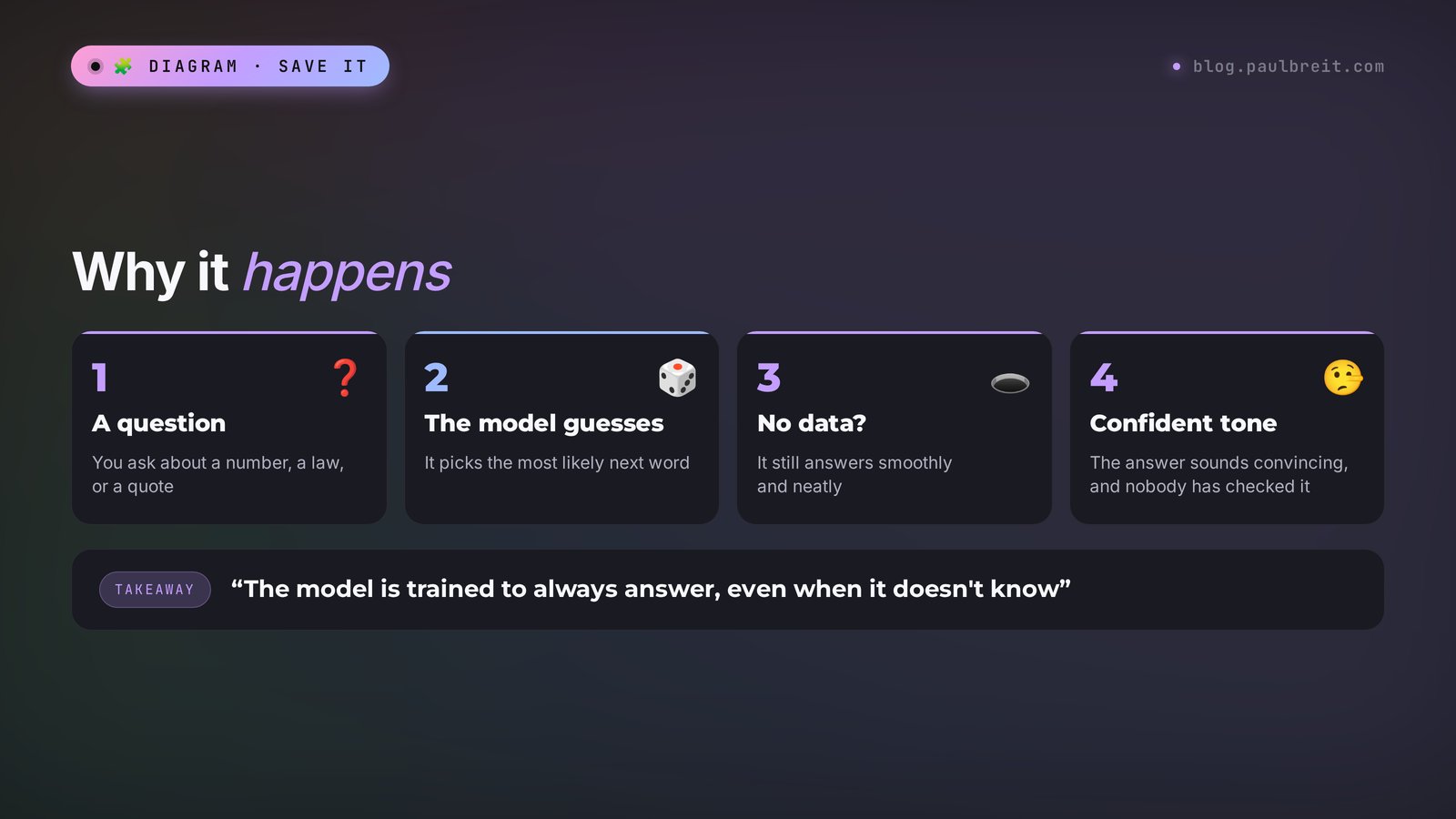
A language model like ChatGPT or Claude learned from an enormous amount of text and learned one thing: to predict which word logically comes next. You write a question, it estimates the most likely first word of the answer, then the second, then the third. That's how the text gets built.
There's no “verified facts” shelf inside it to look things up on. Knowledge is smeared across billions of settings, like memories in a human head. Common things like “the capital of France is Paris” the model has seen millions of times, and it almost never gets those wrong. Some rare figure from a 2019 report it has seen a couple of times, or never. So it fills in the answer by pattern: what such a figure, such a report, such a title usually looks like.
Reason 2. It was trained to answer, and “I don't know” earned no points
In September 2025, OpenAI published research on why language models hallucinate. The conclusion is very down to earth. Models are graded on tests where a correct answer earns a point and “I don't know” earns zero. Remember multiple-choice tests at school? If you don't know the answer, guessing pays off: there's a chance you'll hit it. A blank box is a guaranteed zero.
AI models “took” tests like that for years and learned the same strategy. Guessing pays better than honest silence. That's why a model would rather give you a plausible guess than say “I'm not sure.” Developers are fixing this now, and newer models admit ignorance more often, but the habit runs deep.
Reason 3. It was trained to be a pleasant conversation partner
After the main training, models are fine-tuned on human ratings: which answer people liked more. And people prefer answers that are complete, confident, and agree with them. The side effect: the model tends to tell you what you want to hear. Ask “isn't it true that organic reach on Telegram is growing fastest right now?” and there's a good chance it will find arguments in favor, even if reality is more complicated.
This is called sycophancy. In practice it means a question with the answer already built in almost always gets confirmed. If you want an honest picture, phrase your question neutrally.
Reason 4. Its knowledge stops at the training date
Every model has a date when its training texts ended. Anything that happened later, it doesn't know. Service prices, new laws, fresh social media features, exchange rates, today's news. If web search is off and you ask about something recent, the model will either honestly say it doesn't know or (more often) present the state of things at its training date as current. Or fill in the gaps.
Reason 5. A long conversation and a vague question
The longer the chat, the more the AI gets confused: it remembers the beginning of the conversation worse, and details blend together. A vague question gives it room to fantasize. “Tell me about marketing for a therapist” is an invitation to write anything plausible. “Which three marketing methods from the list below will bring a therapist inquiries fastest, and why” is already a frame where making things up is harder.
AI doesn't lie on purpose. It has no intent to deceive and no way to “feel” that it's fantasizing right now. So scolding it with “don't lie” is useless. What works: give it the right data, the right frame, and permission to say “I don't know.” Below I'll show exactly how.
Section 03Where AI lies most: 7 risk zones
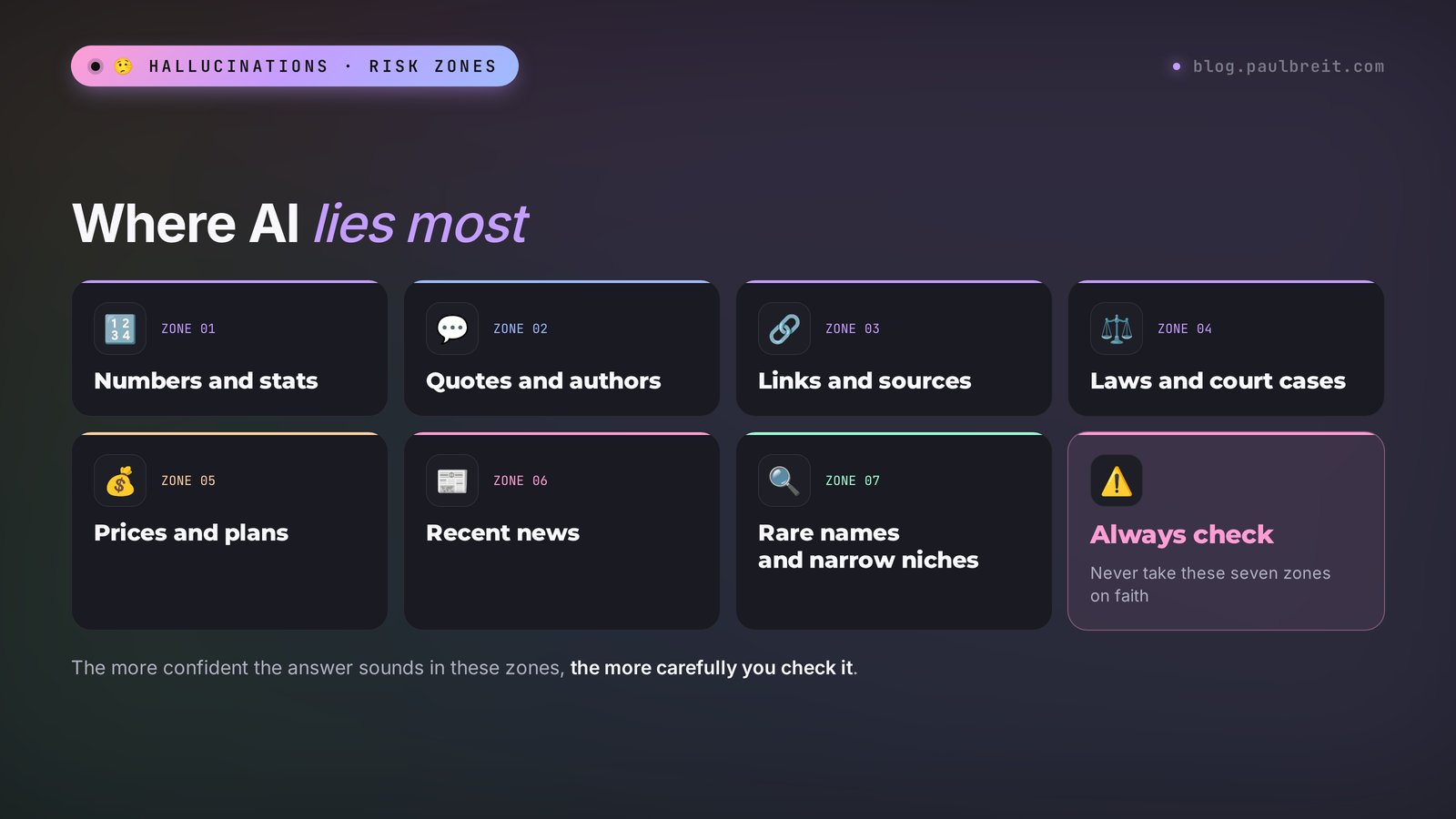
Good news: hallucinations aren't spread evenly. There are zones where AI almost never slips and zones where it lies regularly. Know the risk zones, and you know what to check.
1. Numbers and statistics
The most common fabrication. Percentages, amounts, market sizes, “according to research.” A number makes text convincing, and AI happily drops one in, because similar texts usually contain numbers. If an answer suddenly says “statistically, 73%…” without you asking and without a link, you're almost certainly looking at a fabrication or a very loose retelling of something.
2. Quotes and authors
“As Steve Jobs used to say…” Half the quotes from famous people on the internet are fake to begin with, and AI learned from the internet. On top of that, it can glue a real idea to the wrong name or compose a quote “in the style” of a famous author. For a post this is dangerous: you've put words in someone's mouth they never said.
3. Links and sources
A classic. You ask for a reading list and get a neat one: authors, titles, years, journals. Half of those works don't exist. Website links look right, the domain is real, and the page leads to a 404. The model knows what a link to a study looks like and writes a similar one.
4. Laws, sections, regulations
A section number, a clause, the wording of a law, the date it took effect. AI can mix up the number, cite a repealed version, or invent a clause entirely. For lawyers, accountants, and anyone writing about taxes, ad disclosure rules, and personal data, this is the main risk zone.
5. Prices, plans, limits
How much a subscription costs, what limits the free plan has, what fee a payment service charges. All of this changes constantly, and the model remembers the state of things at its training date. It sounds confident, and the number is a year out of date.
6. Recent news and events
What came out last week, who launched what, which features appeared on a social network. Without web search the model either doesn't know or fills in the blanks. With search there are fewer errors, but it can still misread the article it found.
7. Rare names and narrow niches
Ask AI about a famous marketer and it will answer decently. Ask about your colleague with a thousand followers or a narrow method in nutrition, and the fantasy begins. The model has seen too little text about it, so it builds a biography and a method “by analogy.” Try asking it about yourself. That's how many people see a hallucination with their own eyes for the first time: turns out you graduated from a university you never attended and wrote a book you never wrote.
| Task | Risk of fabrication | What to do |
|---|---|---|
| Rewrite your text, shorten it, change the tone | Low | Make sure the meaning didn't change |
| Come up with topics, headlines, ideas | Doesn't matter | Imagination is useful here |
| Summarize your document | Low to medium | Ask for answers with a quote from the document |
| Explain a well-known topic | Medium | Check the key claims |
| Give numbers and statistics | High | Only with a source and a manual check |
| Find literature and links | Very high | Open every link yourself |
| Answer about law, taxes, medicine | Very high | Check against the original source and a specialist |
| Describe a specific person or company | High | Turn on search, check against their website |
Section 04Famous cases: what fabrications cost
If this sounds like a small thing for bloggers, here are four real stories. All of them were widely covered in the press.
Lawyers and six court cases that never existed
2023, New York, Mata v. Avianca. A lawyer was preparing a court filing and asked ChatGPT to find similar court decisions. ChatGPT produced six cases with names, docket numbers, and quotes from the rulings. The lawyer even asked whether they were real. The AI confidently confirmed they were. Not one of those cases existed. The judge fined the lawyers $5,000, and the story went around the world and became the textbook example of hallucinations.
Notice the detail: the man did check. He just checked by asking the same AI. That's no check at all. Below I'll show how to check properly.
An airline chatbot that invented a policy
2024, Canada. A passenger asked the Air Canada chatbot about a bereavement fare discount. The bot confidently described a refund rule the airline didn't have. The passenger bought the ticket and was later refused. The case went to a tribunal, and the airline was ordered to pay: the tribunal ruled the company is responsible for what its bot says. The amount was small, about 800 Canadian dollars, and the reputational hit was big.
This is a direct lesson for anyone putting AI in charge of answering clients. A bot that invents terms on its own will make promises to your clients in your name.
A $100 billion mistake in a Google ad
February 2023. Google shows off its AI, Bard, in a promo video. In the video, it says the James Webb Space Telescope took the first pictures of a planet outside our solar system. Astronomers quickly noticed: the first such pictures were taken by other telescopes, long before Webb. The news spread, and Alphabet shares lost about $100 billion in market value that day.
A consulting report with links to nowhere
2025, Australia. The major consulting firm Deloitte delivered a report to the government worth about 440,000 Australian dollars. A university researcher noticed it contained references to nonexistent academic papers and a made-up quote from a court ruling. It turned out AI had been used to prepare it. The firm had to issue a corrected version and refund part of the money.
In every case the AI did the same thing: confidently filled a gap in its knowledge with plausible text. And in every case the problem happened at the same junction: “AI wrote it – a human didn't check – the text went out.” AI makes a great first draft. The final word on facts always belongs to a human.
Section 05Which AI models make up less in 2026
The honest answer: they all make things up. There is no model with zero hallucinations, and the developers admit it themselves. But the difference between models, and between modes of work, is big.
An interesting fact from an OpenAI report in spring 2025. Their new “reasoning” models o3 and o4-mini made things up more often than the older model on a test of questions about people: o3 was wrong in about a third of answers, o4-mini in almost half. The model got smarter at logic and code, and bolder at fantasizing about people. So “newer and smarter” doesn't equal “more accurate.”
There's a flip side. When summarizing a document you gave the model yourself, the best AI models rarely slip: according to Vectara's public leaderboard, strong models get it wrong in roughly a few cases out of a hundred. So when the AI has the correct text right in front of it, it holds on to it well. When it answers “from memory,” the risk grows several times over.
| AI | Strength against fabrication | Where to be careful |
|---|---|---|
| Claude | More often than others honestly says “I'm not sure,” sticks closely to documents uploaded to Projects | Recent facts without web search turned on |
| ChatGPT | Built-in search with sources, deep research on a topic | Tendency to agree with you, confident numbers without links |
| Gemini | Strong Google search and answer double-check against search | Details in narrow niches |
| Perplexity | Every claim comes with a link to a source | Can misread the article it found |
| NotebookLM | Answers only from your files and shows the source quote | Knows nothing outside what you uploaded |
| DeepSeek | Free, has search, shows its reasoning | Facts without search, quotes, and links |
Here's my working setup. Writing, document reviews, contracts, and long materials I do in Claude: you can sign in at claude.ai. For facts with links I use search mode in ChatGPT or Perplexity. A detailed comparison of the main models is in Claude vs ChatGPT in 2026, and if you want a free option, here's how to use DeepSeek.
The same AI makes things up very differently depending on the mode. “From memory” with no search is the riskiest option. With web search it's better, especially for anything recent. With your own documents and a request to answer only from them, it's best of all. Picking the mode gives you more than picking between ChatGPT and Claude.
Section 0610 ways to protect yourself from hallucinations
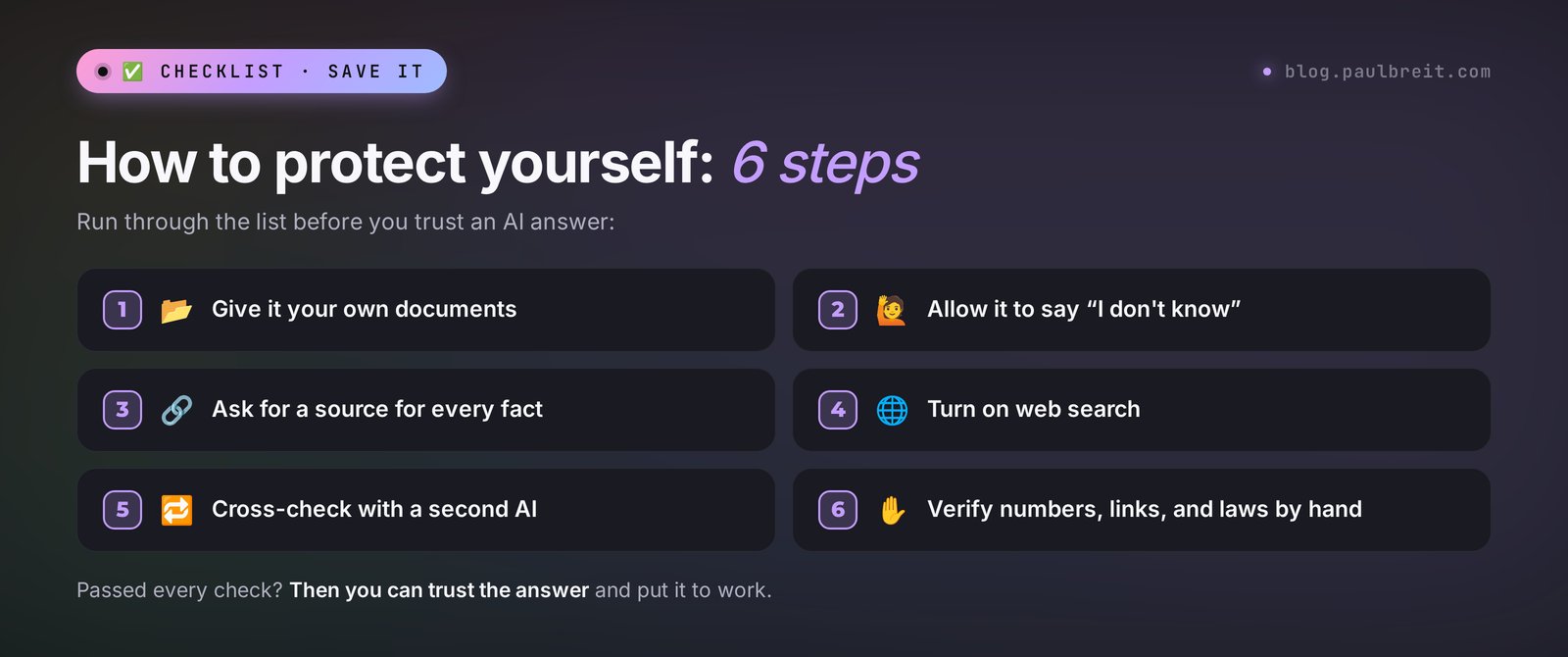
Now the main part. No single technique is a guarantee on its own. Together they cut fabrications several times over. For an ordinary post the first three or four are enough; for a contract, a health lesson, or an article full of numbers, turn on all of them.
Give the AI your own materials
The strongest technique. Upload a document, paste in text, attach a spreadsheet, and say: “Answer only from this material.” When the correct answer is right in front of the model, it has no reason to guess. Claude has Projects for this: upload your service descriptions, prices, testimonials, and FAQ, and every new chat in the project relies on them. In ChatGPT, projects and custom GPTs do the same.
Allow it to say “I don't know”
Remember the school test? Take the “must answer” pressure off the model. Write it out directly: “If you're not sure or there's no data, say so. An honest ‘I don't know’ is better for me than a pretty guess.” It's a simple sentence, and it works surprisingly well: the model starts flagging doubtful spots instead of papering over them with confident text.
Ask for a source for every fact
“For every number and every fact, tell me where it comes from.” If the AI is working with your document, have it give a verbatim quote from it. If it's working with the web, have it give a link. A fact the model couldn't tie to a source is immediately suspect. One important caveat: sources can be made up too. So this technique only works together with checking the links.
Turn on web search for anything recent and factual
Anything about prices, news, laws, people, and companies – ask with search turned on. In ChatGPT, Claude, Gemini, and DeepSeek it's a separate button or toggle. With search, the model relies on the pages it found and shows them to you. And about the link you drop into the chat: with search off, the model doesn't open it. If you want a page reviewed, paste its text right into the message.
Ask a narrow question with a frame
A vague question leaves room for fantasy. Narrow it down: who you are, who the text is for, what data you have, what format you need. “List 5 reasons” is worse than “from these 8 reasons, pick 3 that fit an online school with a $400 price point, and explain your choice.” The less the model has to fill in, the less it makes up.
Ask neutrally, without the answer built in
The question “isn't it true that X?” gets confirmed. Ask “what are the arguments for and against X?” or “how well does X match reality, and where doesn't it?” This treats the sycophancy I wrote about above.
Ask the model to check itself
After the answer, write: “List every specific fact, number, name, and link from your answer and rate your confidence in each: high, medium, low.” The model often finds its own weak spots and flags them. It won't replace a real check, and it makes a great filter: you see right away what to verify first.
Double-check with a second AI
Paste one model's answer into another: “Check this text for factual errors, made-up numbers, and nonexistent sources.” Models make different mistakes, and the second one often catches what the first missed. It also works within the same AI, just in a new chat: in the old one, it will defend its answer.
Start a new chat for a new task
A long conversation piles up confusion: details blend, early agreements get lost. If a chat has grown to a hundred messages, ask the model for a short summary of what matters, open a new chat, and paste the summary there. Fresh context means fewer fabrications.
Check numbers, links, quotes, and laws by hand
An iron rule, no exceptions. Every number that goes public, find it in the original source. Every link, open it. Every quote, search it in quotation marks. Every section of a law, compare it with the official text. It's five minutes of work, and it saves your reputation.
Section 0712 ready prompts against fabrications
Copy and paste. Replace the square brackets with your own details.
Prompt 1. Basic insurance at the start of any chat
Rules for working with me:
1. If you're not sure about a fact or there's no data, say "I don't know" or "I'm not sure" directly. An honest answer is worth more to me than a pretty guess.
2. Don't make up numbers, studies, quotes, names, or links.
3. When you state a fact, note where it comes from: my material, search (with a link), or your general knowledge.
4. Mark anything you're less than highly confident about with ⚠️.
Prompt 2. Answer strictly from the document
Below is my document. Answer questions ONLY from it.
If the answer isn't in the document, write: "This isn't in the document."
For every claim, give a verbatim quote from the document in quotation marks.

Document:
[paste the text or attach the file]

Question: [your question]
Prompt 3. Self-check of the answer
List every specific fact, number, date, name, title, and link from your previous answer.
For each one, state:
– confidence: high / medium / low;
– where it comes from: my material, search, or general knowledge;
– how I can check it myself.
Don't defend anything, look for the weak spots.
Prompt 4. Checking someone else's text for fabrications
You are a strict fact-checker. Check the text below.
Find: made-up or doubtful numbers, nonexistent studies and books, misattributed quotes, outdated data, logical contradictions.
For each finding: excerpt → what's wrong → how to check.
If everything is clean, say so, don't invent errors just to fill a list.

Text:
[paste the text]
Prompt 5. Facts only with search
Use web search. Find current data as of [month and year] on the topic: [topic].
For every fact, give a direct link to the page where it's stated.
If a source is more than two years old, flag it.
If you can't find a reliable source, write "no confirmation found," don't fill the gap.
Prompt 6. A neutral question against people-pleasing
I think that [your statement].
Don't agree with me automatically. Give arguments for and against, point out where my statement may be wrong or too general, and what you're missing to answer precisely.
Prompt 7. A post with numbers and no fabrications
Write a Telegram post on [topic] for [who your audience is].
Use ONLY the numbers and facts from the list below. Don't add new numbers, percentages, or studies.
If you feel a number would make it more convincing and it isn't on the list, insert [NUMBER NEEDED] instead.

My facts:
[your numbers, case studies, client results]
Prompt 8. A reading list you can verify
Find 5 books or studies on [topic].
Include only ones you're sure exist. For each: author, exact title, year, and how to find it (search by title, publisher's website).
If you can't confidently name 5, name fewer. A made-up source is worse than a short list.
Prompt 9. A legal or tax question
Explain [question] in plain words, as it applies to [country/state].
Give the section numbers and names of the laws you rely on, and the date of the version, if you know it.
Separately, write what may have changed after your training date and where to check the current version.
This is for general understanding; I'll make the final decision after checking with a professional.
Prompt 10. A summary without filling in
Summarize the text below in 7 bullet points.
Don't add anything that isn't in the source: no conclusions, no examples, no numbers.
If an idea in the text is worded unclearly, flag it: "unclear in the source."

Text:
[paste the text]
Prompt 11. Checking that the AI actually read the link
Before you analyze the page at this link, quote its first heading and first sentence verbatim.
If you can't open the link, say so directly, and I'll paste the text myself.

Link: [link]
Prompt 12. Final check before publishing
This is a text I'm about to publish. Make me a checklist for a manual check:
all numbers, all names and titles, all quotes, all links, all claims about laws, prices, and deadlines.
In a separate list, write out the places that sound like facts but have no source.
Format: a table "excerpt – what to check – where to check."

Text:
[paste the text]
A hundred more working prompts for content, sales, and analytics are collected in the AI prompt library. And if you also want AI to write in a live voice without corporate filler, look at how to make AI write like a human.
Section 08How to check an AI answer in 5 minutes
Here's my working routine for any text that goes out to people: a post, a lesson, an article, a reply to a client.
Minute 1. Write out everything checkable
Run prompt 12, or just skim the text and mark: numbers, dates, names, titles, quotes, links, claims about laws and prices. A post usually has three to five of these, an article fifteen to twenty.
Minute 2. Open every link
Every one. Does the page exist? Does it really say what the AI claims? This is where most problems get caught: the link is live, and it's about something else.
Minute 3. Search the numbers and quotes
Put the quote into Google in quotation marks. If it only shows up on “inspirational quotes” sites with no original source, better drop it. Search the number together with the name of its source. Can't find the original? Remove the number or replace it with your own, from your practice.
Minute 4. Give the text to a second AI
Prompt 4 in another model or a new chat. See what it flags. If two models independently doubt the same spot, there's almost certainly a problem there.
Minute 5. Decide the fate of every doubtful spot
Confirmed – it stays. Not confirmed – remove it or rewrite it without the specifics. Important – go to the original source or a specialist. Done, the text can go out.
Here's what it looks like in a real chat. A nutritionist is preparing a post and asks for a number:
You: How much water should an adult drink a day? Give me a number for a post.
AI: According to WHO recommendations, an adult needs to drink 8 glasses of water a day, which is about 2 liters.
You: Give me a direct link to the WHO document that says this, and quote the sentence from it.
AI: I need to clarify: I can't point to a specific WHO document with the wording “8 glasses a day.” The eight-glasses rule is a widespread popular tip, and it has no reliable original source. Fluid needs depend on weight, activity, and climate, and people get part of their fluid from food.
See? The first answer sounded like a fact backed by an authority. One follow-up question, and the “WHO recommendation” turned into a popular myth. Without that question, the post would have gone out with a made-up WHO reference.
Don't check an answer by asking “are you sure?” in the same chat. That's exactly what the lawyer in the Avianca story did. The model often either confirms its answer or, the other way around, rushes to apologize and swaps a correct answer for a wrong one. A real check is the original source, a link you opened yourself, or an independent look from another model.
Section 09Examples by niche: where to check extra hard
Every niche has its own landmines. Here's where they lie for people who sell services and knowledge.
| Niche | Where AI makes things up most | How to stay safe |
|---|---|---|
| Therapist | Links to studies, names of methods, author names, percentages “according to scientists” | Prompt 8 for literature, look up studies by title, replace made-up percentages with your own observations from practice |
| Nutritionist | Daily norms, calorie counts, “WHO recommendations,” supplement dosages | Check against official guidelines, never take dosages from an AI answer |
| Lawyer | Section numbers, case law, versions of laws | Prompt 9, check against the official legal database, court decisions only from court databases |
| Accountant | Rates, thresholds, filing deadlines, recent changes | Web search plus your tax authority's website, always check dates and rates |
| Coach and mentor | Quotes from famous people, “studies on motivation,” success stories | Search quotes in quotation marks, take stories from your own practice |
| Marketer | Market stats, reach, “industry average” conversion rates, social media features | Only numbers with a source, your own data from your ad dashboard, check features in the platform itself |
| Tutor | Dates, formulas, rules, facts in learning materials | Check against the textbook, solve problems with answers yourself |
| Online school | Facts in lessons, prices and features of tools in tutorials | Run every lesson through prompt 12, take screenshots yourself in the current version of the tool |
And one more scenario people forget about: a bot that answers clients. If you've set up AI to answer questions on Telegram or on your website, give it a strict knowledge base: prices, terms, what's included in your services, frequent questions. And write in the rule: “If the question isn't in the knowledge base, don't answer yourself, offer to connect with a manager.” Otherwise you'll get your own little Air Canada story, only with your price list and your promises.
If bots and agents interest you, start with what an AI agent is. It covers exactly how to give AI rules and boundaries so it works for you on its own.
Section 10When AI's imagination works for you
After all this, it may seem that AI's fabrications are pure evil. They aren't. The very same ability to “fill in the plausible” is its creative power.
When you ask for 30 post ideas, 15 headline options, a metaphor for a complex idea, a reel script, or a story for a warm-up series, imagination is exactly what you need. There's no right answer there, only good and bad ones. And an AI that combines boldly gives you more interesting material.
The rule is simple. Split tasks into two kinds:
- Creative: ideas, headlines, hooks, metaphors, structure, a draft, offer variations. Imagination helps. You only need to check facts if any slipped in by accident.
- Factual: numbers, studies, laws, prices, medicine, money, biographies, tool instructions. Imagination hurts. Turn on every protection.
The main mistake happens where the two meet: you ask for a creative post, and the AI drops in statistics “to make it convincing.” The text is creative, and the number in it is factual and made up. So in creative tasks I add one line: “don't add numbers or studies; if they're needed, put [NUMBER NEEDED].” Then I fill in my own: client results, my own measurements, my experience. Your own numbers, by the way, hit harder than other people's: “my therapist client got 14 inquiries in a month” grabs more attention than an abstract “68% of therapists.”
Section 11If something goes wrong
The AI still makes things up, even though I allowed “I don't know”
Put the rule at the very start of the chat or in the project instructions. In the middle of a long message the model can easily skip it. Repeat it right in the question: “if you don't know, say so.” And check whether you're asking about something the model can't know in principle: recent events without search, or your colleagues with small audiences.
I gave it a document, and it answers off-script
The model may not read a long document in full or may mix it with general knowledge. Ask for verbatim quotes (prompt 2). If the document is very large, split it into parts and ask questions about each. For working with a pile of files, try NotebookLM: it answers only from the uploaded sources and shows where every phrase came from.
The links lead to a 404
Almost certainly made up. Turn on web search and ask again. If search doesn't help, find the source yourself by title and author. Can't find it? Remove the link and the fact it was supporting.
The AI “read” my link and is telling me about it
Use prompt 11: ask it to quote the page's first heading. If it doesn't match the real one, the model opened nothing and was guessing. Paste the page text right into the chat.
When I ask it to check, it swaps a correct answer for a wrong one
That's the same sycophancy: the model hears “are you sure?” as a hint that it made a mistake and rushes to correct itself. Check by asking for a source, with a new chat, or with another model. Asking “are you sure” only does harm here.
The numbers in a calculation don't add up
AI models calculate decently with built-in tools, and in plain text they can slip on arithmetic. Ask: “calculate this with code and show the calculation” (it works in ChatGPT and Claude), or redo it in a regular spreadsheet.
The AI makes up facts about my company or about me
The model knows little about you, so it fantasizes. When you write texts about yourself, always provide your own background: who you are, how many years in the profession, what results, what products. In Claude it's convenient to put this into a Project once. And for AI search to know the truth about you, you need public content: articles, case studies, an “about me” page. More on that in how to show up in ChatGPT and AI search.
Section 12The whole path in a minute
- AI guesses likely text and has no database of facts. That's why it makes things up confidently and smoothly.
- Risk zones: numbers, quotes, links, laws, prices, recent news, narrow niches, and rare names.
- Every model in 2026 makes things up. The mode of work matters more than the model: your documents are more reliable than search, and search is more reliable than an answer “from memory.”
- Put insurance at the start of the chat: “I don't know” is allowed, no made-up numbers, a source for every fact (prompt 1).
- For facts, turn on web search and ask for direct links.
- Ask neutrally, without the answer built into the question.
- Before publishing: the model's self-check, a second AI, a manual check of numbers, links, quotes, and laws.
- In creative tasks imagination helps, and the numbers you put in should be your own.
- A client-facing bot answers only from your knowledge base and hands everything else to a human.
Copy prompt 1 right now and paste it into your project instructions in Claude or ChatGPT. It takes a minute, and half the fabrications disappear on their own. The five-minute check catches the other half. And that's the beauty of it: the AI writes, you answer for the truth, and you never have to be embarrassed in front of your readers 🔍
FAQFrequently asked questions
Why does AI make up facts?
Because it predicts the most likely continuation of a text and has no verified database of facts inside. When precise knowledge is missing, the model still writes a plausible answer. On top of that, it was trained on tests where guessing pays better than saying “I don't know,” so it would rather give you a confident guess.
What are AI hallucinations in plain words?
Confident, plausible answers that don't match reality: made-up numbers, quotes, studies, links, sections of laws, facts about people. AI doesn't lie on purpose. It simply can't tell knowledge from a lucky guess and writes both in the same tone.
Which AI makes things up the least in 2026?
None is free of hallucinations. Claude admits it doesn't know more often than others and sticks closely to uploaded documents. Perplexity and ChatGPT with search give links to sources. NotebookLM answers only from your files. The mode matters more than the model: an answer from your document is more reliable than one with search, and an answer with search is more reliable than one “from memory.”
How do I stop ChatGPT from making things up?
You can't remove fabrications completely, and you can cut them down several times over. Allow it to say “I don't know,” give it your materials and ask it to answer only from them, ask for a source for every fact, turn on search for recent data, ask neutrally, and check numbers, links, and quotes by hand.
Can I trust the links an AI gives me?
Only after you've opened them. Without search turned on, AI often writes links that look right and lead to a 404 or to a page about something else. With search, links are usually real, and even then it's worth checking that the page says exactly what the model claims.
Does asking “are you sure?” help?
Hardly. In the same chat the model either confirms its answer or, eager to please, swaps a correct answer for a wrong one. A reliable check is the original source, a link you opened yourself, a new chat, or another AI.
Why does AI say it opened my link when it didn't?
If web search is off, the model can't open the page, and it can guess what a typical answer to such a request looks like. Ask it to quote the page's first heading: if the quote doesn't match, paste the page text right into the chat.
Can I use AI for medicine, law, and finance?
As an assistant for general understanding and a first draft, yes. As the source of final decisions, no. Always check section numbers, dosages, rates, and deadlines against official sources, and make important decisions after consulting a professional.