Black Friday 2026: How to Sell a Course or Service Without Deep Discounts
Black Friday 2026 lands on November 27, and everyone who sells courses, services, and consulting is already getting ready for it. Most people will do what they always do: cut the price in half, work through December at half pay, and start January with clients who are waiting for the next sale. Below is a breakdown of how to run Black Friday so it actually makes you money, with no price slashing: 7 mechanics to use instead of a bare discount, the math worth running ahead of time, a 5-week plan, and copy-paste AI prompts for every step.
To sell a course or service on Black Friday, November 27, 2026, without deep discounts, replace the bare markdown with a mechanic that adds value: a bonus, a tier upgrade, a pre-order for the next cohort at today's price, a gift certificate, or installment payments. Start preparing 4-5 weeks ahead: build the offer in late October, warm up your audience and collect a waitlist in November, message your past clients personally, and run a launch, follow-up, and close series from November 27 to 30. If you do give a discount, keep it in the 10-25% range and only for a limited time.
Everyone who sells services, courses, and consulting. The therapist with one-on-one sessions who has nowhere to fit twenty more clients at half price. The coach or mentor running a group program. The nutritionist, the trainer, and the tutor whose December is already packed. The freelancer who wants to close out the year with January projects booked. And anyone launching a first product who wants to ride the November buying mood to those first sales.
What's inside
- Black Friday 2026: the dates and what they mean for you
- Discount math: what you really lose
- 7 Black Friday mechanics without price slashing
- Which mechanic fits your niche
- Which AI to use and how to set it up
- Step 1. Build the offer with AI
- Step 2. A 5-week sale calendar
- Step 3. The November warm-up
- Step 4. The waitlist and past clients
- Step 5. Launch, follow-up, and close
- Step 6. Answers to buyer questions
- A worked example: a therapist's sale
- What to do after November 30
- If something goes wrong
- 8 Black Friday mistakes
- The whole plan in a minute
Here's how it usually goes. By mid-November your feed fills up with "50% off everything," "last chance," "this price will never come back." You look at your peers, think "well, if everyone's doing it, so should I," write a discount post on Thursday night, and publish it Friday morning. Five people show up. Three of them are your regular clients, who would have bought in December at full price anyway. The other two are new, but they came for the discount and they'll be gone in a month.
Plenty of people know the outcome of a sale like that all too well: the same money as a normal month, more work, and then January sales sag, because everyone who planned to buy already did, at half price. There's one more unpleasant side effect. You've just trained your audience to wait for the sale. Next year, some of them won't buy anything before November 27.
The good news is that Black Friday can go a different way. In November your audience really is ready to buy. People are in the mood to wrap up the year, treat themselves, and start January with something new. You can use that mood and keep your price. It takes three things: a mechanic that gives a person a reason to buy now, an honest deadline, and preparation that starts a month ahead. All of it is below, with the math and the AI prompts that will do most of the work for you.
Why this article is coming out in October. If you start thinking about Black Friday on November 20, you'll only have time to write a discount post. Every mechanic below needs a warm-up and a list of people who are waiting for your offer, and that takes four to five weeks. Today is right on time.
Section 01Black Friday 2026: the dates and what they mean for you
Black Friday is the Friday after Thanksgiving, which the US celebrates on the fourth Thursday of November. In 2026 Thanksgiving falls on November 26, so Black Friday is November 27, 2026. After it come the weekend of November 28-29 (Saturday is also Small Business Saturday) and Cyber Monday on November 30, the day of online deals. Plenty of stores stretch the sale across the whole week, or across the whole month.
The season starts earlier every year. Big retailers roll out "early Black Friday" deals from the first days of November, so buyers are used to the idea that the entire month is shopping time. For you that means one simple thing: in November people are more willing to spend, but there are ten times more offers competing for their attention than usual.
| Dates | What's happening | What you do |
|---|---|---|
| October 27 – November 2 | Quiet, the sales haven't started yet | Pick a mechanic, build the offer, run the numbers |
| November 3-19 | Big retailers roll out "early Black Friday" deals | Warm up your audience with useful content and case studies |
| November 10-26 | People start waiting for Black Friday | Collect a waitlist, message your past clients |
| November 27 | Black Friday | Open sales, the waitlist goes first |
| November 28-29 | The weekend, people are scrolling | Follow-up: reviews, answers to questions, who it's for |
| November 30 | Cyber Monday | Close: the final hours, then the offer really goes away |
| December 1-7 | The sales are over | Review the results, onboard buyers, handle the late arrivals |
How Black Friday differs for courses and services
A store sells goods that are already sitting in a warehouse. A discount helps it clear the shelves and get cash before the year ends. You have no warehouse. What you sell is your time, your attention, and your knowledge. If you sell twenty consultations at half price, you have to show up for twenty calls, and nobody makes up the other half of your hourly rate.
With recorded courses it's a bit easier: selling one more seat costs you almost nothing. There's still a catch. Every buyer needs support, answers in the chat, feedback on assignments. And a discount devalues a course fastest in the eyes of the people who paid full price a month ago. They hear about the sale and message you asking why they paid more.
That's why, for anyone who sells knowledge, the Black Friday goal sounds different. You need to give people a strong reason to buy right now and keep the price of your work intact. There are mechanics built for exactly that, and there are more of them than you'd think.
Section 02Discount math: what you really lose
Before you put up "50% off," figure out how many sales you need just to break even. It's five minutes with a calculator, and for a lot of people the urge to cut the price in half disappears on its own afterwards.
A recorded course
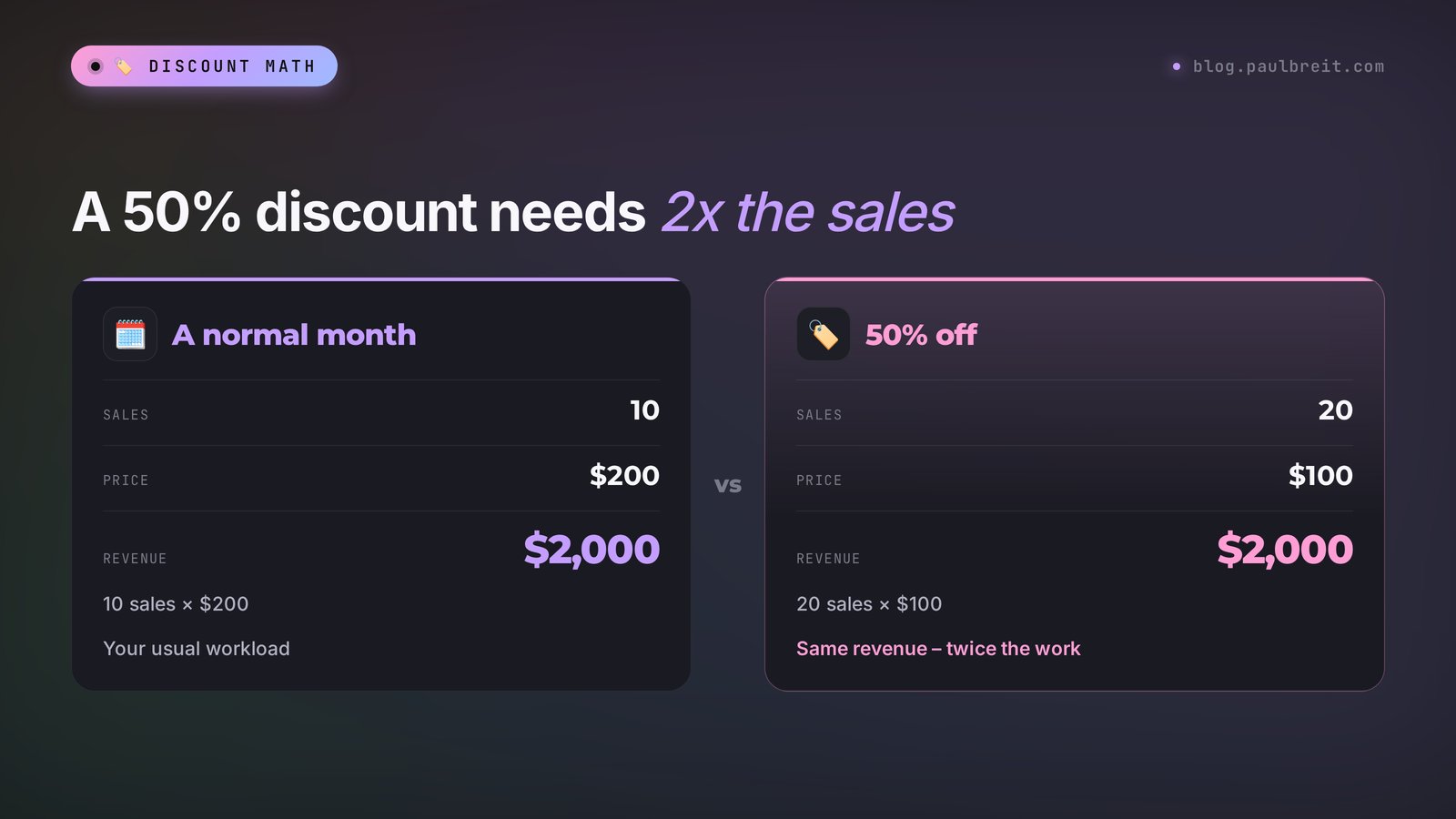
Take a $200 course as an example. In a normal month it sells 10 times, which is $2,000. You run a 50% discount and the price drops to $100. To earn the same $2,000, you need to sell the course 20 times. Twice the sales just to avoid losing ground against a normal month. And if you also pay for ads, payment processing fees, and a chat assistant, those costs take a bigger share of every sale, so you need even more sales.
| Discount | Course price | Sales needed instead of 10 to earn $2,000 |
|---|---|---|
| 0% | $200 | 10 |
| 10% | $180 | 12 |
| 20% | $160 | 13 |
| 30% | $140 | 15 |
| 50% | $100 | 20 |
| 70% | $60 | 34 |
The formula is simple: for a discount to pay off, your sales have to grow by a factor of 1 / (1 − discount). At 30% off that's 1.43 times, at 50% it's 2 times, at 70% it's more than 3 times. The numbers in the table are rounded up to a whole sale.
One-on-one services and consulting
With services it's even harsher. A therapist charges $100 a session and runs 40 sessions a month, which is $4,000. Put a 50% discount on a 5-session package, and to earn the same money you need 80 sessions a month. Physically that's close to impossible, and where it is possible, the price is burnout by New Year's. In effect, you're selling your December at half price.
There's one more hidden loss. Some of the people who bought at a discount would have bought anyway, at full price. Those are your regular clients and the people who have been eyeing your offer for a while. On them, you simply lose half the money. The bigger your warm audience, the harder a bare discount hits you.
How to run your own numbers in five minutes
You don't need to do this by hand, AI will do it. Open Claude, ChatGPT, or Gemini and paste this prompt with your numbers filled in:
I sell [product, for example: a 6-week group nutrition program]
for $[price]. In a normal month I make [number] sales.
Costs per sale: ads about $[amount], payment processing
fee [percent]%, my time per client [hours].

Calculate for Black Friday:
1. How many sales I need at 10%, 20%, 30%, and 50% off to
   earn the same as a normal month, including costs.
2. How many extra hours of my work this adds in December.
3. Which pays more: a 20% discount, or a bonus that costs me
   [hours] hours of work, assuming the same number of sales.
Show it as a table plus one paragraph of conclusions in plain words.
A minute later you'll have a table with your real numbers. The conclusion almost always comes out the same: a discount over 25-30% pays off only if your sales multiply, and that happens for people with a huge cold audience. Most of us don't have one, and a warm audience will buy without price slashing if you give it the right reason.
Section 037 Black Friday mechanics without price slashing
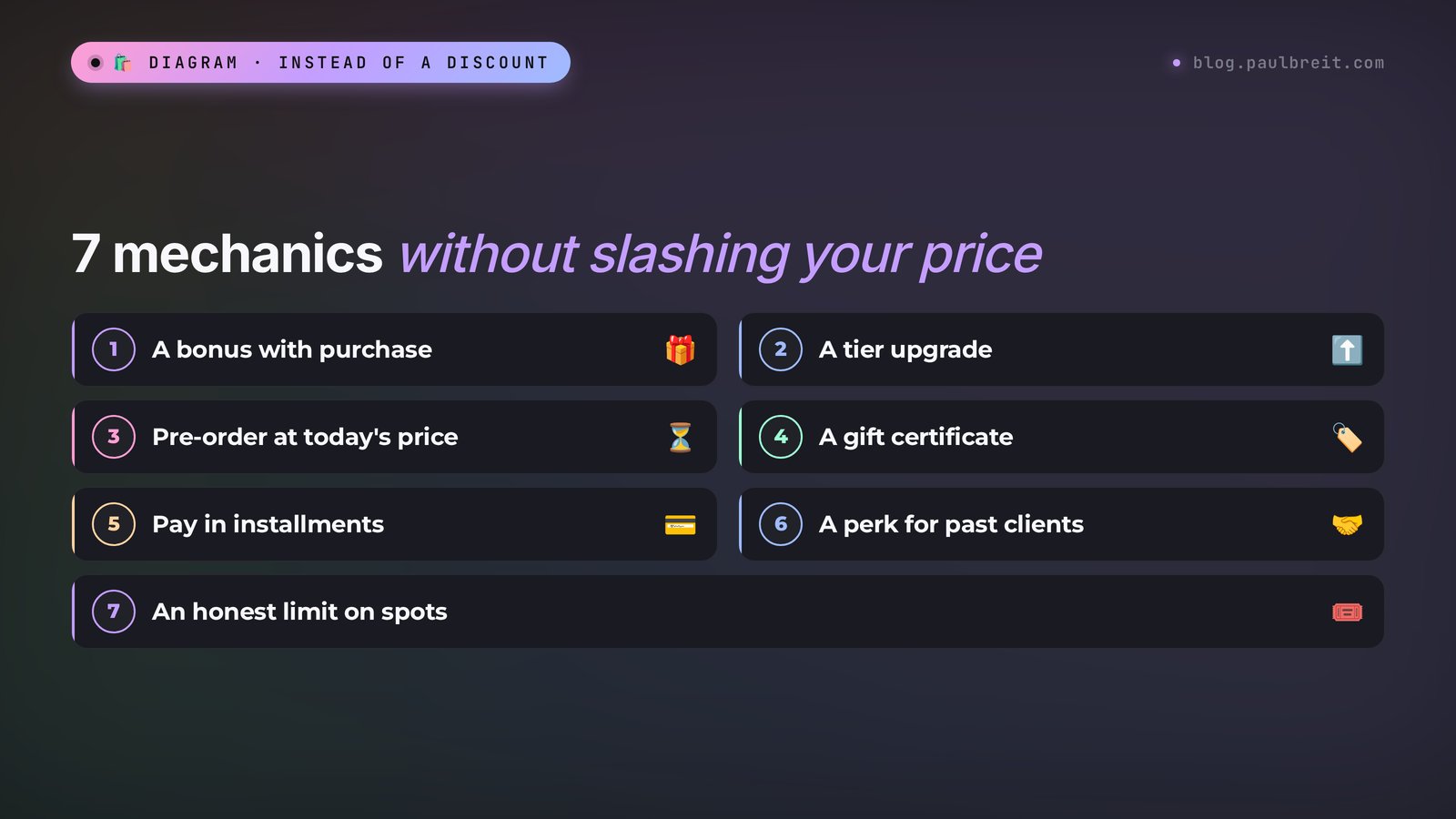
Every mechanic has one job: give a person a reason to buy between November 27 and 30 without devaluing your work. The price stays the same, and the buyer gets more than they would on a normal day. Here are seven options that work for courses, services, and consulting.
1. A bonus with purchase
The simplest mechanic and the most underrated one. The price stays the same, and for these four days the purchase comes with something valuable: an extra session, a review of homework, a recorded mini-course, templates, checklists, access to the recording of a past cohort. The key condition: the bonus has to solve a real problem for the buyer and look valuable on its own. "A one-page checklist" doesn't register as a bonus. "A personal review of your weekly meal plan" does.
Why it pays better than a discount: a bonus costs you an hour or two of work, or nothing at all if it's material you already have, while for the buyer its value can feel comparable to 20-30% off. The best bonuses are ones you've already made for clients and can hand over without doing new work.
2. A tier upgrade
If you have pricing tiers, on Black Friday the buyer pays for the basic tier and gets the next one up: with feedback, with a call, with longer access. It works great, because the person can see the difference between tiers and understands the upgrade's value in dollars. If you don't have tiers, create one "extended" option just for the sale.
3. A pre-order at today's price
This mechanic is for people whose price is about to go up or who are launching a new cohort in January. You announce it honestly: starting January 1 the program costs more, and until November 30 you can reserve a spot in the January cohort at the current price. The buyer locks in the price, and you get the money in November and a full cohort before the new year.
There's one hard rule here: the price increase has to be real. If the price doesn't go up on January 1, you've misled people, and next time they won't believe you. If you weren't planning to raise your price, pick a different mechanic.
4. A gift certificate
Black Friday is right at the start of the holiday season, and people are thinking about gifts. A certificate for your service or course is a ready-made gift for someone close: sessions with a therapist for Mom, a training program for a husband, tutoring for a kid. You can add a bonus to the certificate or sell a "two certificates" bundle to people who want one for themselves and one for a friend.
This mechanic widens your audience: one person buys, and someone else walks through your door, someone your ads would never have reached. And the holidays give you a natural deadline.
5. Pay in installments
What stops a lot of people from buying is the lump sum, and a discount doesn't touch that problem. Interest-free installments, available only during the sale, remove that barrier and keep your full price. Many payment processors offer buy-now-pay-later or payment plans (Stripe, PayPal, Klarna, Afterpay, and others); check the terms and fees with yours. If there's a fee, work out what it costs you: it's often less than a 10% discount.
6. A perk for past clients
Past clients are your warmest audience, they've already seen your results. For them you can create a separate private Black Friday offer: an extension of your support, the next level of the program, a package of sessions, a priority spot in January. The offer goes out to them in a personal message or an email a day before everyone else. People enjoy getting something first, and they buy more readily than they would from a public post.
A "bring a friend" mechanic fits here too: a past client brings someone they know, and both get a bonus. For services that live on word of mouth, this often brings in more than any November ad.
7. An honest limit on spots
If you work one-on-one, your time really is limited. On Black Friday you can open, say, 10 spots for coaching with a bonus and close enrollment when the spots run out. The limit has to be real: if you post "only 2 spots left" three days in a row, people notice. A real limit works harder than any discount, because there's a clear reason behind it.
And if a discount is unavoidable
Sometimes your audience expects a number with a minus sign in front of it, and you don't want to disappoint them. In that case keep the discount in the 10-25% range, put it on one specific product for 3-4 days, and ideally pair it with one of the mechanics above: a small discount plus a bonus for people who buy in the first 24 hours. And never inflate your price before the sale so you can "cut" it afterwards. That's deceiving your buyers, and people catch on fast. In the US, the FTC's guidance on deceptive pricing treats a made-up "former price" as deceptive: the reference price you advertise a discount from should be one you actually charged in good faith.
| Mechanic | What hooks the buyer | What it costs you | Best for |
|---|---|---|---|
| A bonus with purchase | More value for the same price | 1-3 hours or ready-made materials | Courses, programs, service packages |
| A tier upgrade | The difference is visible in dollars | Time for feedback | Products with 2-3 tiers |
| A pre-order at today's price | Locks in the price before an increase | Nothing, if the increase is real | Cohorts starting in January |
| A gift certificate | A ready-made holiday gift | Nothing, the client comes later | Consultations, sessions, lessons |
| Pay in installments | Removes the big-number barrier | The processor's fee, if any | Higher-priced programs and mentoring |
| A perk for past clients | First access, separate from everyone | Time for personal messages | Anyone with a client list |
| An honest limit on spots | A real reason not to wait | Nothing | One-on-one work, small groups |
Section 04Which mechanic fits your niche
You can combine mechanics, but for one sale it's better to pick one main mechanic and at most one supporting one. If a single post offers a bonus, installments, a certificate, and "bring a friend" all at once, the reader gets confused and puts off the decision. And on Black Friday, a decision put off almost always means "didn't buy." Here's what usually fits different niches well:
| Niche | Main mechanic | Supporting | Sample wording |
|---|---|---|---|
| Therapist | Gift certificate | Perk for past clients | "A certificate for 3 sessions – a gift someone close to you will actually need" |
| Coach, mentor | Pre-order for the January cohort | Installments | "A spot in the January cohort at the November price; from January 1 the program costs more" |
| Nutritionist | Bonus with purchase | Certificate | "Buy the program by November 30 and I'll personally review your holiday menu" |
| Fitness trainer | Honest limit on spots | Bring a friend | "10 coaching spots to get you ready for summer; sign up with a friend and you both get a bonus week" |
| Tutor | A lesson package with a bonus | Certificate | "An 8-lesson package plus a free practice exam in December" |
| Online course creator | Tier upgrade | A small discount for the first 24 hours | "Buy the basic tier, get the tier with assignment feedback" |
| Freelancer, designer | Prepaid January projects | Bonus | "I'm booking 4 January projects at current rates, each with a free round of revisions" |
Not sure what to pick? Ask the AI. Describe your product, your price, how many clients you have, and how much free time you'll have in December, and ask it to suggest three mechanics with the pros and risks for your situation. It will quickly rule out what doesn't fit you, for example a limit on spots if you sell a recorded course with no support.
Section 05Which AI to use and how to set it up
For Black Friday prep, AI comes in handy in five places: running the numbers, building the offer, writing the warm-up, writing the emails and posts for the sale days, and preparing answers to buyer questions. Any strong AI can handle it. Here's what to pick in 2026:
| AI | What it does best | Free plan |
|---|---|---|
| Claude | Natural-sounding copy: posts, emails, objection replies. Holds the author's voice well | Yes, with message limits |
| ChatGPT | The all-rounder: calculations, tables, bonus ideas, images for posts | Yes, with limits |
| Gemini | Number-crunching and day-by-day plans, works right inside Google Docs and Sheets | Yes, with limits |
My pick for sale copy is Claude: its posts and emails sound the least machine-made, and for sales copy in November that's decisive, because people's eyes are already glazing over from identical "50% off" posts. You can hand the math to any of the three. A head-to-head breakdown is in Claude vs ChatGPT in 2026, and a task-by-task comparison is in the best AI tools of 2026.
Getting started with Claude
Go to claude.ai and sign up with your email or a Google account. It takes a couple of minutes, no card required. The free plan is enough to prepare one sale if you split the work across several days. If you want to get it all done in one or two evenings, the paid plan is more convenient: you'll stop hitting message limits in the middle of a series.
One tip that saves a lot of time: do all your sale prep in one chat, or in one Claude Project. That way the AI remembers your offer, your numbers, and your style, and you don't have to explain everything from scratch each time.
How to make the AI write in your voice
Every piece of sale copy will sound like you if you give the AI samples at the start. Paste 5-7 of your posts that performed well into the first chat and ask: "Remember my style: sentence length, my favorite words, how I address the reader. Write every text in this chat this way." Keep the whole sale prep in that one chat, and the AI will hold on to your style, your offer, and your numbers. More on getting natural-sounding copy is in how to teach AI to write in your voice and in the article about the warm-up series with AI.
Section 06Step 1. Build the offer with AI
A Black Friday offer is one sentence that makes three things clear: what the person gets, why this offer beats a normal day, and when it ends. If your offer is just "30% off," what you've got is a price tag, and people will compare it with a hundred other price tags in their feed. A strong offer sounds like this: "Through November 30 – the 'Calm Sleep in 6 Weeks' program plus a personal review of your daily routine as a gift. From December 1, the review is no longer included."
Open a new chat and paste this prompt:
You're a marketer who helps people sell services and courses
without price slashing. I need a Black Friday offer for
November 27-30, 2026.

About me: [who you are and what you sell, for example:
a nutritionist running a 6-week group program].
Product: [name, what's inside, length].
Price: $[price]. I don't want to discount more than [percent]%.
My audience: [who they are, what hurts, what they want].
Materials I already have: [recordings, templates, checklists,
past live sessions].
My free time in December: [hours per week].

Tasks:
1. Suggest 3 offer options based on these mechanics: a bonus,
   a tier upgrade, a pre-order at today's price, a gift
   certificate, installments, a perk for past clients,
   an honest limit on spots.
2. For each option: a one-sentence wording, what the buyer
   gets, what it costs me in hours, and the deadline.
3. Tell me which option is strongest for my audience and why.
Ask clarifying questions if anything is missing.
What it looks like in a conversation
Here's a slice of a conversation using this prompt. The answers are illustrative.
AI: Let me clarify a couple of things. How many people bought the program in the past year, and how many of them could buy a next level? And do you have recordings of past live sessions you could give away as a bonus?
You: About 60 clients over the year, and there's no next level. I have recordings of four live sessions on eating through the holidays and a weekly menu template.
AI: Then here are three options. First: "Through November 30 – the program plus a bonus mini-course, 'The Holidays Without Falling Off Track,' built from your session recordings." It costs you nothing, the materials are ready, and the topic hits December head-on. Second: a gift certificate for the program with a card, for people who want to give it to someone close. Third: a pre-order for the January cohort, if you're ready to raise the price on January 1. For your audience, the first is strongest: at the end of November the holidays are on everyone's mind, and the bonus solves that problem right now.
You: I'll take the first. Help me name the bonus so people want it.
AI: Five options: "The Holidays Without the Extra 7 Pounds," "A Holiday Table Without the Guilt," "How to Get Through 10 Days of Feasting Without Falling Off Track"…
Test the offer with three questions
- Is it clear from the first sentence what the person gets? If you have to read a paragraph to understand it, rewrite it.
- Why is buying on November 27 better than buying on December 5? If the answer is "it isn't," the mechanic doesn't work.
- Is the deadline real? What happens on December 1: the bonus disappears, the price goes up, the spots run out. There has to be a concrete event.
If you want to dig deeper into the offer formula, take a look at how to write an offer people pay for. It explains in detail why people only reach out when they understand exactly what they'll get.
Section 07Step 2. A 5-week sale calendar
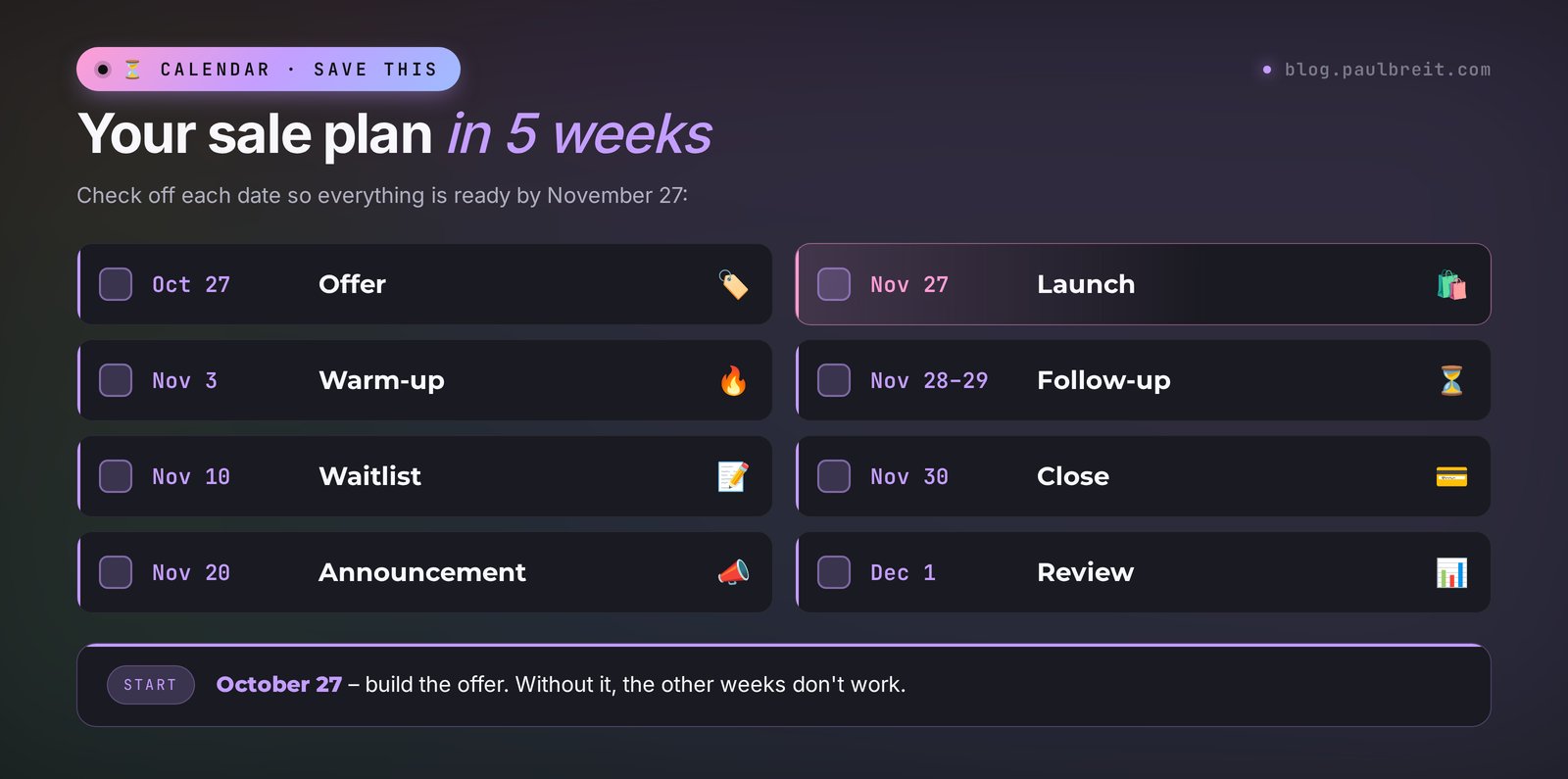
Black Friday sales are made by what you do before Black Friday. The post on Friday morning gets read by people who already know you and are already waiting. So all of November goes into preparing those people. Here's a working calendar from October 27 to December 1.
October 27 – November 2: the offer and the numbers. Pick a mechanic, run the numbers, prepare the bonuses or certificates, set up payments and, if needed, installments. By the end of the week you have a one-sentence offer and a page or post where the buyer will land.
November 3-16: the warm-up. Two weeks of useful content on your product's topic: breakdowns, client case studies, answers to common questions. Every post shows what problem your product solves and what changes for people after it. Not a word about the sale yet.
November 10-26: the waitlist. Announce that there will be a special offer on November 27 and invite anyone interested to send you a code word in a direct message or tap a button in your bot. People on the list get the offer first.
November 20-26: the announcement and your past clients. Message past clients personally, tell them what's coming on November 27, and give them a separate offer. On your channel, two or three teaser posts hinting at what's ahead.
November 27: the launch. In the morning, a message to the waitlist; a couple of hours later, a post on your channel with the offer, the price, the deadline, and how to buy.
November 28-29: the follow-up. Reviews and case studies, answers to questions, a "who it's for and who it isn't for" post. A reminder to people who asked but didn't buy.
November 30: the close. A "last day" post in the morning, "only a few hours left" in the evening. At midnight the offer really does close.
December 1: the review. Count your sales, where the buyers came from, what worked. Welcome the people who bought, and handle the ones who missed it.
You don't need to map all of it out by hand. Ask the AI to build the calendar for you:
Here's my Black Friday offer: [the offer in one sentence].
I run [an Instagram account / a blog / an email newsletter],
and I publish [how many] posts a week. I have [number]
followers and [number] past clients.

Build a day-by-day prep calendar from October 27 to
December 1, 2026: what to publish, whom to message personally,
when to open sales, and when to close them. The sale runs
November 27-30.
Keep in mind I can spend no more than [hours] a day on this.
Make a table: date, action, post or email topic, goal.
The AI will give you a 36-day table. Go through it and cut whatever you know you won't do: five posts you actually publish beat fifteen that stay in the plan.
Section 08Step 3. The November warm-up
The pre-Black Friday warm-up has one job: by November 27 the person should already want your product, and the sale simply gives them a reason to buy now. If someone hears about your product for the first time in a discount announcement, all they see is the number, and they compare it with a hundred other numbers in their feed.
For a two-week warm-up, 6-8 posts are enough. Here are the topics to build them from:
- The pain and what it costs. What a person loses while the problem stays unsolved: money, time, energy, relationships. With a concrete scene from real life.
- A breakdown of a common mistake. Why people fail to solve the problem on their own and what to do instead.
- A client case study. The situation the person came in with, what they put into practice with your method, what result they got, and how long it took.
- The mechanism. How your method works and why. Without giving away the whole product, but so the reader gets the logic.
- Answers to common questions. How much time it takes, whether it works for beginners, what happens if it doesn't work out.
- A personal story. Why you do this work, a mistake of yours, or a turning point.
A prompt for the warm-up series:
Write a series of 6 warm-up posts for the run-up to Black Friday.
Product: [what I sell and to whom]. The offer that opens on
November 27: [offer]. I publish 3 posts a week, November 3-19.

Post topics in order: the cost of the problem, a common mistake,
a client case study, how my method works, answers to common
questions, my personal story.
Facts for the case study: [client without a name, niche, what
they came in with, what they did, result, timeframe].
My story: [a couple of sentences].

Rules:
– don't mention discounts or the sale; only the last post gets
  a hint: "something is coming on November 27 for those of you
  who've been thinking about it for a while";
– each post 150 to 250 words, addressing the reader as "you";
– open each post with a vivid scene or an unexpected thought;
– write in my style from the posts I gave you earlier in this chat;
– don't invent numbers or facts I didn't give you.
The key detail in this prompt is the last line. AI loves to decorate a case study with "300% growth" that never happened. If an invented number shows up in a post, delete it or replace it with your own. A detailed walkthrough of building a warm-up in one evening is in the warm-up series: 5 nurture posts with AI.
Case studies carry the most weight
If you have even two or three client results, November is the time to show them. People buy cautiously on Black Friday: they're afraid of grabbing something they don't need just because it was "on sale." A case study takes that fear away better than any promise. How to turn a client's result into a story that sells on its own is covered in how to write a case study.
Section 09Step 4. The waitlist and past clients
The hottest Black Friday sales come from two groups: people who said "I'm interested" ahead of time, and your past clients. Work with both starts 2-3 weeks before the sale.
How to build a waitlist
In mid-November you publish a post: on November 27 an offer opens for people who've long wanted [result], the terms last only four days, and people on the list get it first, a few hours before everyone else. To get on the list, they send you a code word in a direct message or tap a button in your bot.
Why it works: the person takes a small step in advance and has already half-decided. When the message arrives on November 27, they're expecting it and open it first. And you see ahead of time how many people are interested, so you can tweak the offer or strengthen the warm-up if the list is small.
Once the list grows past 20-30 people, replying to each one by hand gets hard. That's where a simple Telegram bot helps: it signs people up on its own and sends them the offer on the right day. You can build one without a programmer in an evening; the step-by-step is in how to build a Telegram bot without a programmer. If your audience lives in email, a signup form for your newsletter does the same job.
Write a post inviting people to join my Black Friday waitlist.
Product: [what I sell]. The offer opens on November 27 and runs
through November 30. I'm not revealing the offer yet, only a hint:
[hint, for example: "something that isn't in the program
on normal days"].
People on the list get the offer 3 hours before everyone else.
To join the list, they DM me the word [code word].
Length – up to 170 words, address the reader as "you", no
exclamation point in every sentence, no loud ad language.
How to message past clients
Message past clients personally, one at a time. A mass blast that opens with "Dear friends, it's Black Friday!" performs poorly. A personal message where you recall what the person came to you with and suggest a next step performs many times better. AI will help you write those messages fast if you give it a short note on each client.
Help me write personal messages to my past clients before
Black Friday. For each client I'll give you: what they came in
with, what result they got, and when they finished working with me.

The offer for past clients: [what you're offering them, for example:
a one-month extension of support with a bonus session], valid
November 26-30, one day earlier than for everyone else.

Rules:
– each message up to 90 words, warm, like it came from a real person;
– open by asking how they're doing with [their goal];
– one sentence about the offer, no pressure;
– end with a question that's easy to answer.

Clients:
1. Client A: [what she came in with, result, when she finished]
2. Client B: [...]
Don't upload names, phone numbers, or conversation details into the AI. Label clients with letters and fill in the name yourself when you send the message.
It's better to send them gradually, 10-15 messages a day from November 20 to 26, so you have time to reply to everyone who writes back. Don't message everyone in one evening: if twenty people reply at once, you'll lose some of those conversations.
Section 10Step 5. Launch, follow-up, and close
The four days of the sale are a series of 6-8 posts and 2-3 emails. Each one does its own job and doesn't repeat the one before it. The most common mistake here is posting the same "30% off, hurry" post four days in a row. By day two, people stop seeing it.
| When | What you publish | The job |
|---|---|---|
| Nov 27, morning | An email or message to the waitlist | Give the offer first to the people who waited |
| Nov 27, midday | The launch post on your channel | The offer, what's inside, the price, the deadline, how to buy |
| Nov 27, evening | A short "first buyers" post | Show that people are already taking the offer |
| Nov 28 | A client case study or review | Remove the "what if it doesn't help me" fear |
| Nov 29 | A "who it's for and who it isn't" post | Help the reader decide whether it fits them |
| Nov 29 | Answers to questions from your DMs | Clear up doubts that many people share |
| Nov 30, morning | A "last day" post and an email | Remind people about the deadline |
| Nov 30, evening | An "only a few hours left" post | A last chance for people who kept putting it off |
A prompt for the whole series at once:
Write a series of Black Friday posts for November 27-30, 2026.
Offer: [offer]. Price: [price]. Deadline: November 30,
11:59 p.m. [your time zone].
What happens on December 1: [the bonus disappears / the price
goes up / enrollment closes].
How to buy: [link, or a code word sent by DM].
Reviews and case studies: [2-3 short real reviews].
Common buyer questions: [3-5 questions].

I need, in order:
1. A message to the waitlist (up to 110 words).
2. The launch post (up to 270 words): the pain, what the product
   gives, the offer, what's included, the price, the deadline,
   how to buy.
3. A short post for the evening of day one (up to 90 words).
4. A case study post (up to 220 words).
5. A "who it's for and who it isn't" post (up to 180 words).
6. A post answering questions (up to 270 words).
7. A "last day" post (up to 150 words).
8. An "only a few hours left" post (up to 70 words).

Rules: each post takes a fresh angle, don't repeat phrases or
images from the earlier ones; don't invent numbers, reviews, or
the number of spots; address the reader as "you"; write in my
style from this chat.
What the launch post must include
In the first two lines: what the offer is and when it ends. Many people only read the opening, and if the first lines are an intro about how "this year has been a tough one," they scroll on. After that, briefly: who the product is for, what the person will get, what's included in the sale offer and how it differs from a normal day, the price, the deadline, and how to buy. On its own line: what happens after the deadline.
The deadline has to be real
If on December 1 you extend the sale "by popular demand," you teach your audience that your deadlines aren't real. Next time, people will calmly wait for the extension. So decide ahead of time what you'll do with the people who write on December 1. You can sell them the product at the regular price without the bonus, or offer them a spot on the waitlist for the next cohort. Just don't bring back the sale terms after the deadline.
Email during the sale
If you have an email list or a bot that sends broadcasts, use it at three points: the launch, the middle of the sale, and the last day. Fewer people open an email than see a post, but the ones who open it read more carefully and buy more readily. How to write emails people read to the end is covered in email newsletters with AI.
Section 11Step 6. Answers to buyer questions
During the sale, people will message you. A lot. "What's included?", "Will it work for me if I'm a beginner?", "Can I pay in December?", "How is this different from your free course?" If you reply half a day later, half of them will have bought something else or simply cooled off. Prepare your answers in advance.
Here's my product: [description, what's inside, price, format, timing].
Here's my Black Friday offer: [offer].

Put together 15 questions people usually ask before buying a
product like this, and answer each one in my name. Each answer
is 2-4 sentences, warm, honest, no pressure. If my description
doesn't have the information for an answer, write "check with
the author" instead of making one up.

Separately, write 5 answers to these doubts:
– "it's too expensive";
– "I'll think about it";
– "what if it doesn't work for me";
– "I don't have time right now";
– "but you have free materials."
Save the answers in your notes and reply by copying them with a small tweak for the person. That way you answer in a minute and don't have to agonize over the wording every time.
How to answer "I'll think about it"
"I'll think about it" almost always means the person has one question left unspoken. Your reply's job is to find it. Skip the persuasion and ask directly and gently: "Of course, take your time. Can I ask what's holding you back the most: time, money, or not being sure it's right for you? If I can, I'll give you an honest answer, and if the product isn't a fit, I'll tell you that too." A reply like this respects the person and often leads to a purchase, because the question that was in the way finally gets said out loud.
If your sales happen on calls, figure out ahead of time how you'll run them. A structure for a sales call that turns most calls into purchases is in the sales call script.
Section 12A worked example: a therapist's sale
The example is illustrative and the numbers are there for clarity, but the scheme works. Anna, a therapist, runs one-on-one sessions at $100 each and sells a 5-session package for $500. She has an Instagram account with 1,800 followers and about 70 past clients. In December she has roughly 15 free hours.
Anna's first thought was 50% off the package. The AI ran the numbers: to earn what she usually does, she'd have to run twice as many sessions, and she has only 15 free hours in December. The discount was off the table immediately.
The mechanic. Anna chose a gift certificate as the main mechanic and a perk for past clients as the supporting one. The offer: "Through November 30 – a certificate for a 3-session package as a gift for someone close to you. Every certificate comes with a beautiful card with your own message and a bonus 30-minute intro meeting." For past clients: a package of monthly maintenance sessions for six months, with today's price locked in for the whole term.
The warm-up. From November 3 to 19, six posts: how the pre-holiday rush feeds anxiety, why we fight with family more often during the holidays, a case study of a client who stopped dreading family dinners, how working with a therapist actually goes, answers to "what if I don't really need this," and Anna's personal story of how she came to the profession.
The waitlist. On November 12, a post: "On November 27 I'm opening an offer for anyone who wants to give someone close to them care instead of one more thing. DM me the word GIFT and I'll send you the terms first." Over two weeks, a few dozen people sent the word.
Past clients. From November 20 to 26, Anna messaged 10 past clients a day. The AI prepared drafts from short notes, and Anna filled in names and adjusted a few words.
The sale. On November 27 at 9 a.m. the terms went to the waitlist, and at noon the post went up on her account. On the 28th, the story of a client who had been given sessions as a gift; on the 29th, a post on "who this gift is right for and who'd be better off with something else"; on the 30th, the last day. Anna didn't touch the package's full price, and her December didn't turn into an assembly line: the certificates get redeemed in January and February.
Here's the point of the whole story. Anna got money in November, new clients her ads would never have reached, and a calm December. And her January is already partly booked with people coming in on certificates.
What the AI did in this story
- Calculated what the discount would cost and showed that the hours wouldn't add up.
- Suggested three mechanics and helped pick the certificate.
- Came up with a name and the text for the certificate card.
- Drafted six warm-up posts in Anna's style.
- Prepared 70 drafts of personal messages to past clients.
- Wrote a seven-post series for the sale days and the answers to common questions.
The only things Anna did by hand were the things AI can't do: choosing, editing, sending, and talking to people.
Section 13What to do after November 30
The sale is over, but the work isn't. The first week of December decides whether new buyers become regular clients and what you take away for next year.
Take care of the people who bought
People who buy on Black Friday often have second thoughts: "did I do the right thing?" Message each of them within 24 hours of the purchase: thank them, tell them what happens next and when it starts, and give them a first simple task or piece of material. A person who gets value right away doesn't ask for a refund and tells friends about you.
Handle the people who missed it
On December 1-2 you'll hear from people who "didn't make it in time." Don't bring back the sale terms for them, but don't let them go either: offer the product at the regular price, a spot on the waitlist for the next cohort, or a free resource on the topic. Some of them will buy in December or January.
Review the results with AI
Here are the results of my Black Friday sale:
– offer: [offer];
– [number] people on the waitlist, [number] of them bought;
– I messaged [number] past clients, [number] bought;
– [number] bought from my channel;
– total: [number] sales for $[amount];
– what didn't work: [your notes].

Compare this with my normal month: [sales and revenue].
Tell me which channels brought the most sales, what's worth
repeating next year, and what to drop. Suggest 3 ideas for
January sales based on this data.
Save this review. A year from now you'll open it and prepare your sale twice as fast, because you'll already know what works for you specifically.
Section 14If something goes wrong
Almost nobody joined the waitlist. That means the warm-up missed the pain, or the hint about the offer was too vague. Publish one more post with specifics: what the person gets and why this offer beats a normal day. Ask the AI for five headline options and take the sharpest one.
Few sales on day one. That's normal, for many people purchases come on the last day. Don't panic and don't add a discount on the fly. Check that the post makes it clear how to buy: does the link work, is the code word visible? Reply to everyone who sent questions.
The AI writes too smoothly and too uniformly. Give it more of your posts as samples and ask: "Rewrite this the way I'd say it to a friend over dinner. Cut the fancy phrasing." If the texts still come out the same, start a new chat and paste the samples again.
The AI made up numbers in a case study. Delete them and write in the chat: "Don't use numbers I didn't give you. If there's no number, write without one." Check every number in your posts before publishing.
Past clients aren't replying. Your message probably reads like a mass email. Rewrite the first line: a question about that person's specific goal, with no "sale" or "discount" in the opening.
The checkout page couldn't handle it or broke. Test payments in advance: make a test purchase on November 25-26. Keep a backup payment option, for example an invoice link you can send by hand.
People ask, "Will there be a discount in December?" Answer honestly: the sale terms are valid only through November 30. If you really aren't planning anything, say so. It builds trust and nudges people to decide now.
More people bought than you can serve. That's exactly what an honest limit on spots is for. When the spots run out, close enrollment and announce it on your channel, and offer everyone else the next cohort.
Section 158 Black Friday mistakes
- Starting to prepare three days out. With no warm-up and no waitlist, only your most loyal followers see the offer post, and they would have bought anyway.
- Cutting the price by 50-70% "like everyone else." To break even you'll have to sell 2-3 times more and work all of December at half pay.
- Inflating the price before the discount. People notice, trust collapses, and in the US a fake "former price" can count as deceptive pricing.
- A fake deadline and an extension "by popular demand." Next time nobody will believe the offer really ends.
- Five mechanics in one post. A discount, a bonus, installments, and a certificate all at once confuse people, and they put off the decision.
- The same post four days in a row. By day two nobody sees it anymore. Every post has to do a new job.
- Forgetting your past clients. They're your warmest audience, and a personal message to them often brings more sales than your whole channel.
- Disappearing after November 30. Without taking care of buyers and handling the people who missed it, you lose half the value of the sale.
Section 16The whole plan in a minute
- Black Friday 2026 is November 27, and the sale runs through Cyber Monday, November 30.
- Run the numbers: at 50% off you need twice the sales, at 30% off, 1.43 times.
- Pick one main mechanic: a bonus, an upgrade, a pre-order, a certificate, installments, a perk for past clients, or a limit on spots.
- October 27 – November 2: a one-sentence offer, the numbers, payments set up.
- November 3-19: a warm-up of 6-8 posts and client case studies, with no mention of the sale.
- November 10-26: a waitlist via a code word or a bot.
- November 20-26: personal messages to past clients, 10-15 a day.
- November 27-30: launch, follow-up, close, with a fresh angle in every post.
- December 1-7: take care of buyers, handle the late arrivals, review the results with AI.
FAQFrequently asked questions
When is Black Friday in 2026?
Black Friday 2026 is November 27. It's the Friday after Thanksgiving, which the US celebrates on the fourth Thursday of November – in 2026, November 26. Cyber Monday is November 30. Many sellers run their sale across all four days, November 27 to 30.
How do I sell a course on Black Friday without a big discount?
Replace the discount with a mechanic that adds value: a bonus with purchase, a tier upgrade, a pre-order for the next cohort at today's price, a gift certificate, or installment payments. Start preparing 4-5 weeks ahead: warm up your audience with useful content, build a waitlist, and message your past clients before sales open.
What discount should I offer on services for Black Friday?
If you do give a discount, keep it in the 10-25% range and only for 3-4 days. At 50% off you have to sell twice as much to earn the same, and for one-on-one services that means twice as many of your working hours. For services, a gift certificate, a bonus session, or a package with extra value usually pays better.
When should I start preparing for Black Friday?
4-5 weeks ahead, meaning from late October. Week one is the offer and the numbers, then two weeks of warm-up, from November 10 you collect a waitlist, and from November 20 you send personal messages to past clients. The sale itself runs November 27 to 30.
How does AI help you prepare for Black Friday?
AI runs the discount math on your numbers, suggests mechanics and words the offer, and writes the warm-up series, the waitlist invitation, personal messages to past clients, the posts for the sale days, and answers to common buyer questions. Claude, ChatGPT, and Gemini all handle it; for sales copy, Claude holds your voice best.
How many posts should I publish during Black Friday?
For a four-day sale, 6-8 posts and 2-3 emails are usually enough: a message to the waitlist, a launch post, a short post on the evening of day one, a case study, a "who it's for and who it isn't" post, answers to questions, a "last day" post, and an "only a few hours left" post. Each one does its own job and doesn't repeat the one before.
Can I extend the sale after Black Friday?
Better not to. If the deadline moves "by popular demand," your audience remembers that your deadlines aren't real and next time waits for the extension. Offer the people who missed it the product at the regular price or a spot on the waitlist for the next cohort.
Can I raise my price before Black Friday and then discount it?
No, that's deceiving your buyers. People spot an inflated price quickly, and trust in you drops. In the US, the FTC's guidance on deceptive pricing treats a made-up "former price" as deceptive. If you want to give people a reason to buy now, pick an honest mechanic: a bonus, a pre-order before a real price increase, or a certificate.