Year in Review with AI: Plan Your 2027 Goals in One Evening
You can do your whole year in review in a single evening if you bring AI in as your thinking partner. It asks the questions, turns your answers into numbers, shows you what actually brought in money and energy, and helps you set 2027 goals that make it at least to March. Below is the step-by-step process with copy-paste prompts for ChatGPT, Claude, Gemini, and DeepSeek, a list of 25 year-in-review questions, and a real-looking example of a first-quarter plan.
To do a year in review with AI, open Claude, ChatGPT, Gemini, or DeepSeek and ask it to interview you about 2026: one question at a time, across ten areas of work and life. Then ask it to turn your answers into a table of numbers, name the three things that produced 80% of your results and the three that wasted your time. Based on that, set up to three goals for 2027, break them into quarters, and map out the first week of January. The whole thing takes one evening, about 3 hours, and you don't have to pay for a subscription.
Everyone who sells services, courses, and consulting and wants to walk into 2027 with a clear plan. The coach whose year flew by in client work, with no idea where the money actually came from. The therapist who wants to raise their rate. The tutor wondering whether it's time to launch small groups. The freelancer who's tired of taking every project that comes along. The review works for personal goals too: health, time off, relationships, family money. You don't need to code or know anything about AI in advance.
What's inside
- Why do a year in review, and why AI makes it faster
- Which AI to use and how to set it up
- Prep: what to gather in 30 minutes
- Step 1. The year interview: the AI asks, you answer
- 25 year-in-review questions
- Step 2. Your year in one table of numbers
- Step 3. What worked and what ate your time
- Step 4. Goals for 2027: three at most
- Step 5. A plan for Q1 and the first week of January
- Step 6. Stress-test the plan
- A worked example: a nutritionist's year in review
- Ready-made intros for different niches
- Step 7. How to keep the plan alive past February
- If something goes wrong
- 7 year-in-review mistakes
- The whole evening in one minute
You know the late-December scene. You open your notes app, type "2026 in review," stare at the empty screen for ten minutes, remember two big events, beat yourself up about everything you didn't do, and close the file. Your goals for the new year end up looking a lot like last year's: more clients, more money, finally start that blog. By the end of January, all that's left of them is a vague sense of guilt.
The problem is the format. Reviewing a year alone is hard, because memory serves up the last two months and the most painful failures. Whatever happened in March might as well never have happened. It's also hard to count honestly: how much you really earned, which channel brought your clients, where hundreds of hours went.
AI closes both gaps. It asks questions in order, keeps you from skipping ahead, pulls your answers into a table on its own, and notices what you missed. It's like sitting down with an attentive friend who never gets tired of asking "how much exactly?" and "what happened in April?" Below is the whole process, step by step, with prompts you can copy as is.
Why read this in October: searches for "year in review" spike in December, when everyone is busy, holiday sales are in full swing, and finding a quiet evening is almost impossible. Save this article now and block an evening in early December. Or do the review in November, which gives you a full month to prepare your January launch.
Section 01Why do a year in review, and why AI makes it faster
A year in review exists for one reason: so next year doesn't repeat this one. If you don't know what brought in most of your money in 2026, you'll very likely keep spending energy on things that bring in nothing. And goals set without a review come straight out of your head. They sound great and have nothing to do with how you actually work.
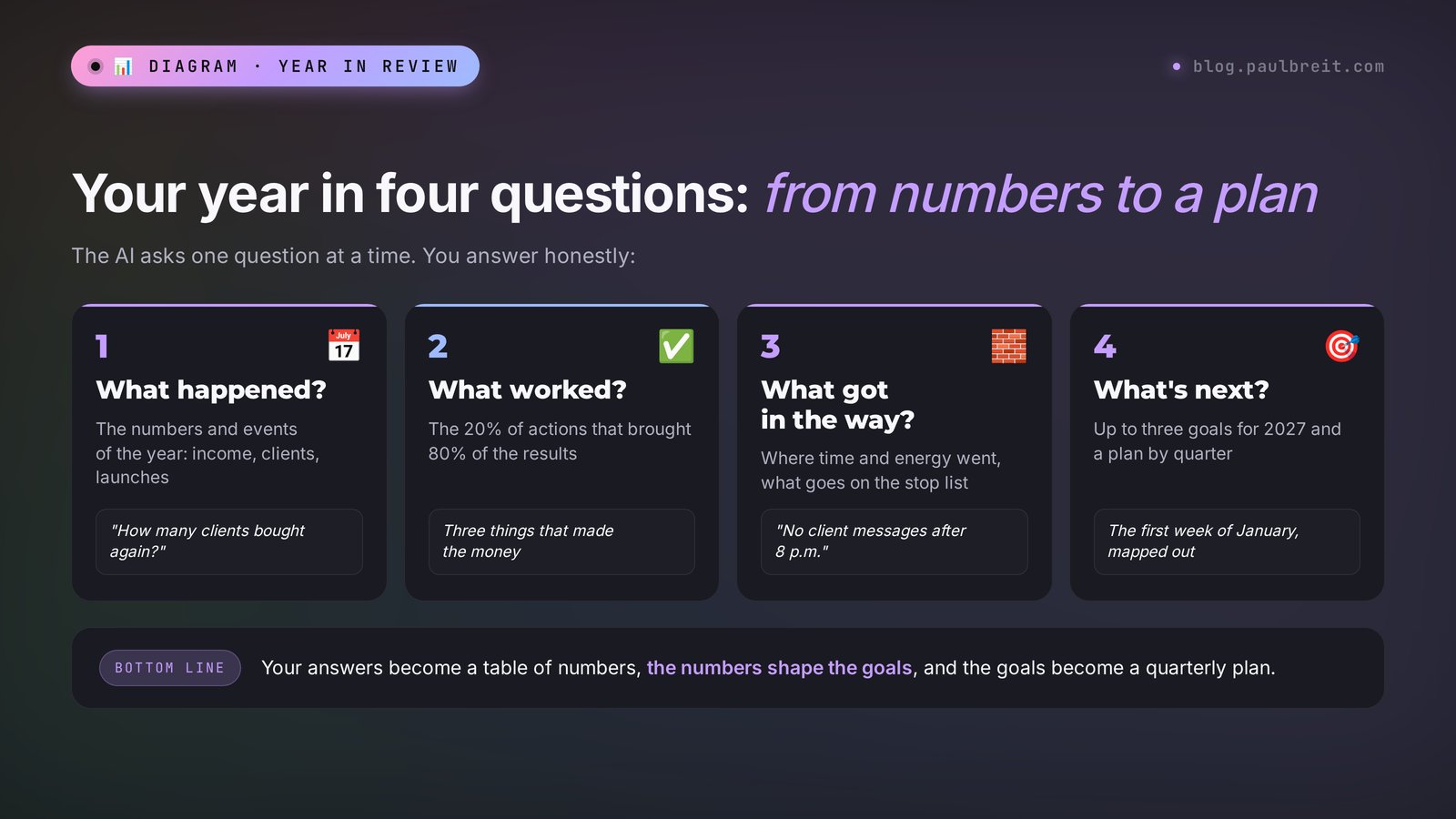
A good review answers four questions:
- What happened? Numbers, events, projects, clients, money. No judgment.
- What worked? Which actions produced the main results, which channels brought clients, which products sold best.
- What got in the way? Where time and energy leaked out, what you put off all year, what wore you down.
- What's next? Two or three goals for next year, broken down to specific actions for the first week.
What AI changes
Of course, the AI only knows about your year what you tell it. What it does well: it runs the conversation by a structure, keeps everything you said during the evening in memory, and turns a pile of scattered answers into a neat table in seconds. Here's what that looks like in practice:
- You remember more. A question like "which project from the first half of the year would you repeat?" pulls out things you'd never recall on your own.
- The numbers add themselves up. You throw out amounts in random order; the AI calculates the total, the average, and each source's share.
- You get an outside view. Ask it to find contradictions in your answers and it will notice that you complain about having no time while taking on five clients at your lowest rate.
- The plan gets specific. The AI turns "more clients" into "two live sessions a month, one case study a week, personal messages to ten past clients by January 15."
- Everything stays in one chat. A month later you come back to the same conversation and check the plan against reality.
One important caveat: deciding what you want stays with you. The AI helps you see the picture and asks uncomfortable questions, and the final call on your goals is yours, which is exactly how it should be.
Section 02Which AI to use and how to set it up
Any strong AI with a free tier will work for a year in review. There's only one real requirement: it has to hold a long conversation without losing the thread after twenty messages. Here's what to pick in 2026:
| AI | Why it's good for a year in review | Free tier | Paid plan |
|---|---|---|---|
| Claude | The most careful, thoughtful tone; holds a long dialogue well; builds clean tables from messy answers | A limited number of messages that resets every few hours | Pro, $20/month |
| ChatGPT | The all-rounder: tables, files, bank exports, and a voice mode that's great for the interview | A limited number of messages on the top model, then a lighter one | Plus, $20/month |
| Gemini | Works next to Google Sheets, Docs, and Calendar, so it's easy to pull in what you already track there | Generous daily use | Google AI Pro, about $20/month |
| DeepSeek | Strong logic; good at math and at breaking goals into steps | Generous limits | Not needed for this task |
My pick for this task is Claude or ChatGPT. A year in review is a conversation of 40 to 60 messages, and memory matters: when you get to goals, the AI needs to remember what you said about money at the very start. If you'd rather not deal with limits at all, DeepSeek is free with generous usage. You'll find a detailed comparison in the roundup of free AI tools that actually work, and if you want to pick one assistant for everything, see the review of the best AI tools of 2026.
How to get started with Claude
Go to claude.ai and sign up with your Google account or any email address. It takes about a minute, and you can start the interview right away in a new chat. The free plan is enough for a year in review if you split the work across two evenings. If you want to get through it all in one sitting, the Pro plan at $20 a month removes almost all the limits, and you can cancel after December if you don't need it.
One small setup tip that helps with any AI: start a fresh chat just for the review and give it a clear name, like "Year in review 2026." You'll be coming back to this exact conversation every Friday, so it should be easy to find.
What never to paste into an AI
A year in review is a conversation about money and clients, so one safety rule. Don't paste passwords, card numbers, Social Security numbers, or clients' personal data: names, phone numbers, detailed message threads. Refer to clients generically: "client A, relationship therapy, 4 sessions." A bank statement is fine, but strip out account numbers and last names first. For the review you need amounts and dates; everything else is noise.
Section 03Prep: what to gather in 30 minutes
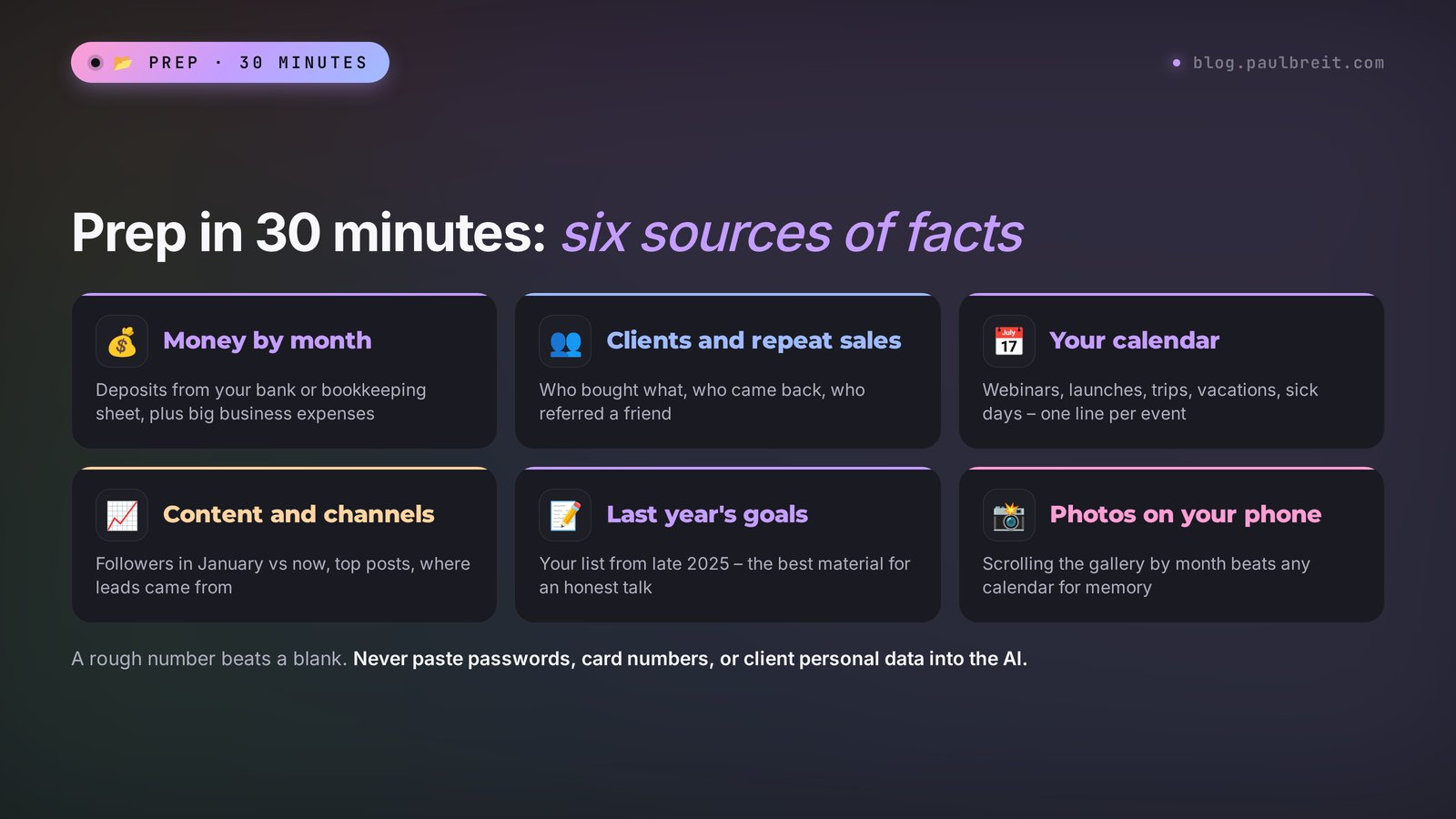
The more facts you bring to the review, the sharper the conclusions. You don't need a week of prep; half an hour is enough. Go through the sources below one at a time and dump everything related to 2026 into a single note. Rough chunks, no polish.
Money. Total income by month from your bank, your payment processor (Stripe, PayPal, Square), or your bookkeeping spreadsheet. If you didn't track anything, list the big sales from memory with approximate amounts. Separately, write down major business expenses: ads, software, courses, assistants.
Clients. How many clients you had, which products they bought, who came back, who referred friends. You can piece the list together from your DMs, email, and payment records.
Calendar. Scroll through the year in your calendar: webinars, launches, conferences, trips, courses you took, vacations, sick days. Write down the month and one line per event.
Content and channels. How many followers or subscribers you had in January and how many now. Which three posts or reels performed best. Where your leads came from: social media, referrals, ads, your website, your email list.
Last year's goals. If you wrote anything down at the end of 2025, find that list. It's the best material there is for an honest conversation.
Photos on your phone. Scroll through your gallery month by month. Photos jog your memory better than any calendar: there you are on stage, there's your first group, there's the screenshot of the first payment at your new price.
Don't worry if something is missing. The AI will help you rebuild the picture from indirect clues: "6 clients at $200 in May" is already a number. A rough number beats a blank.
If you don't feel like typing, dictate your raw notes. ChatGPT and Gemini both have a voice mode, and any phone can record a voice memo that you then transcribe. The AI handles rambling speech with repeats and "umm" just fine. All that matters is that the facts are in there.
Section 04Step 1. The year interview: the AI asks, you answer
This is the most important step of the evening. Your only job here is to answer questions. The AI walks you through the areas of your work and life and won't move on until your answer gets specific. Open a new chat and paste the whole prompt:
You are an attentive business coach. Help me review my year 2026.
I am [who you are and what you do, for example: a therapist, I run
online sessions and a group program].

Interview me. Rules:
1. Ask exactly one question at a time and wait for my answer.
2. Cover these areas: money, clients and products, marketing and
   channels, team and helpers, learning, health and energy, time off,
   family and friends, the main events of the year, what I'm proud of.
3. If my answer is vague ("fine", "a lot"), dig deeper: how much,
   when, what exactly.
4. Give no advice and no conclusions until I say "done".
5. Every 10 questions, briefly sum up what you've learned so far.

Below are my notes for the year. Use them as a reference:
[paste your raw notes from the prep]
Why one question at a time: if the AI dumps a list of twenty questions on you, you'll answer each in one line and skip half of them. With a single question, you actually think about it, and the next question builds on your answer. You get a real conversation.
What it looks like in a chat
Here's a slice of a conversation with the real structure. The answers are made up for the example.
AI: First question, about money. Roughly how much did you earn in 2026 from your sessions and the program? Quarter by quarter is fine.
You: About $96,000. Summer was a slump.
AI: Thanks. Let me ask about the summer: which months were slow, and what do you connect it with – fewer inquiries, your vacation, or something else?
You: July and August. I was away for a month and didn't post anything. When I came back, there were no inquiries until the end of September.
AI: Got it. So a one-month pause in content led to roughly two months of fewer inquiries. How much did you earn from July through September combined?
You: Around $13,500.
AI: That means the other 9 months brought about $82,500, roughly $9,200 a month. The summer averaged about $4,500 a month, less than half. I'll keep that in mind. Next question: which product brought in the most money?
Notice what happened: you said one sentence about the summer, and the AI worked out on its own that the content pause cost you roughly $14,000. Conclusions like that are what make the review worth doing.
How long the interview takes
Usually 40 to 60 questions and about an hour. Don't rush. If an area doesn't interest you, type "skip this one." If a question hits home and you want to tell the whole story, tell it; the AI will adjust. When you feel you've said everything, type "done."
If you're on a free plan and hit the limit, don't start a new chat. Wait for the limit to reset and continue in the same conversation: that way the AI keeps everything you've told it. A new chat starts from zero.
Section 0525 year-in-review questions
If you want to prepare in advance or do the review without AI, here are the year-in-review questions that pay off the most. You can also paste them into the prompt and ask the AI to go through the list.
Money and products
- How much did I earn in 2026, and how much was left after business expenses?
- Which product or service brought in the most money?
- What was my average sale, and how did it change since the start of the year?
- How many clients bought from me again?
- What did I spend money on and regret?
Clients and marketing
- Where did my highest-paying clients come from?
- Which post, webinar, or reel brought the most inquiries?
- Which marketing channel took a lot of effort and gave almost nothing back?
- Which clients were easy and fun to work with, and which weren't? What sets them apart?
- What did clients thank me or praise me for most often?
Time and energy
- Where did most of my work week go?
- Which task did I put off all year?
- What parts of my work could I hand off to an assistant or to AI?
- When did I feel my best, and what was going on at the time?
- How many days did I truly rest, without my phone?
Growth and decisions
- What new skill did I learn and actually use in my work?
- What was my best decision of the year?
- Which decision would I undo if I could?
- Which of last year's goals did I hit, which didn't I, and why?
- What did I stop doing and don't miss at all?
Life as a whole
- What am I proudest of?
- Who am I grateful to for this year?
- How were my health and sleep?
- How much time did I spend with the people I love, the way I wanted to?
- If I had to describe 2026 in one word, what would it be?
The last question sounds naive, yet it often puts everything in its place. If your year comes out as "sprint," it's obvious what one of your 2027 goals will be about.
Section 06Step 2. Your year in one table of numbers
After the interview, you have an hour of conversation sitting in the chat. Now we turn it into numbers. Type into the same conversation:
Done. From our whole conversation, build a table called "2026 by the numbers".
Rows:
- income for the year and by quarter
- business expenses for the year
- what was left after expenses
- number of clients, average sale, repeat purchases
- income from each product and its share in percent
- where clients came from and each source's share
- followers at the start and end of the year
- approximate work hours per week
- days off

Where I didn't give an exact number, put your estimate and mark it
with the word "estimate". Don't invent anything I didn't say – write
"no data" instead.
After the table, list 3 conclusions that only the numbers reveal.
The line "don't invent anything I didn't say" is mandatory. Without it, the AI may fill a gap with a nice-looking number that never existed, and your whole plan will rest on something untrue. With it, the table carries honest "estimate" and "no data" labels.
What the table tends to show
This step usually surfaces one or two discoveries. For example:
- 60% of your money came from one product you barely promoted.
- Referral clients buy at twice the price of clients who came from ads.
- The channel you spend 8 hours a week on brought you two clients all year.
- The summer months collapse every year, and this is the second year in a row it shows.
Check the table with your own eyes. If a number is wrong, fix it right in the chat: "Q2 income was $28,000, recalculate." The AI will rebuild the table and the conclusions.
AI is great at breaking things down and comparing them, but it sometimes slips on arithmetic with long sums. Ask it: "Double-check the totals and percentages and show your math." For precise bookkeeping, export the table to Google Sheets or Excel and check it with formulas. For a year in review, "roughly right" is accurate enough.
Section 07Step 3. What worked and what ate your time
You have the numbers. Now the main analytical question: which 20% of your actions produced 80% of the results, and which actions you can safely drop. The prompt:
Now the analysis. Based on the interview and the table, answer:

1. The top 3 actions that brought me the most money and clients.
   Back each one with numbers from the table.
2. The top 3 things that took the most time and energy but gave little.
3. What I did over and over all year that should become a system.
4. Where my answers contradict each other: what I say I want
   versus what I actually do.
5. A stop list for 2027: 5 things I should stop doing.

Be direct, no comforting. I need an honest picture.
That last line matters because AI tools are polite by default and try to cheer you up. For a year in review that's harmful: you risk getting "you've done tremendous work" instead of an analysis. Asking it to be direct changes the tone.
How to read the contradictions
This is the most useful item and the most uncomfortable one. Typical findings:
- "You say you want to work less, yet this year you added two new products and didn't raise the price on any of them."
- "You call referrals your main source of clients, yet you never once asked for a testimonial or wrote up a case study."
- "You want to run groups, yet you postponed every group launch because you took on one-on-one clients at the last minute."
If the AI hit the nail on the head, type "agreed, that's the main thing." If it didn't, push back. Arguing with the AI is part of the review too: while you explain why it's wrong, you spell out your real logic.
If testimonials and case studies came up among your contradictions, the guides on how to collect client reviews and how to write a case study give you step-by-step systems you can drop straight into your January plan.
The stop list matters more than the goal list
Most people walk out of a year in review with a long list of things to start. Your week doesn't stretch, though. Every new 2027 goal will take hours that currently go to something else. The stop list frees up those hours. Five items to stop will do more for you than ten items to start.
Examples from real stop lists: "no new clients at the old rate after February 1," "no replying to messages after 8 p.m.," "no more posting to the channel that brought two clients in a year," "no free consultations without an intake form," "no rewriting posts five times."
Section 08Step 4. Goals for 2027: three at most
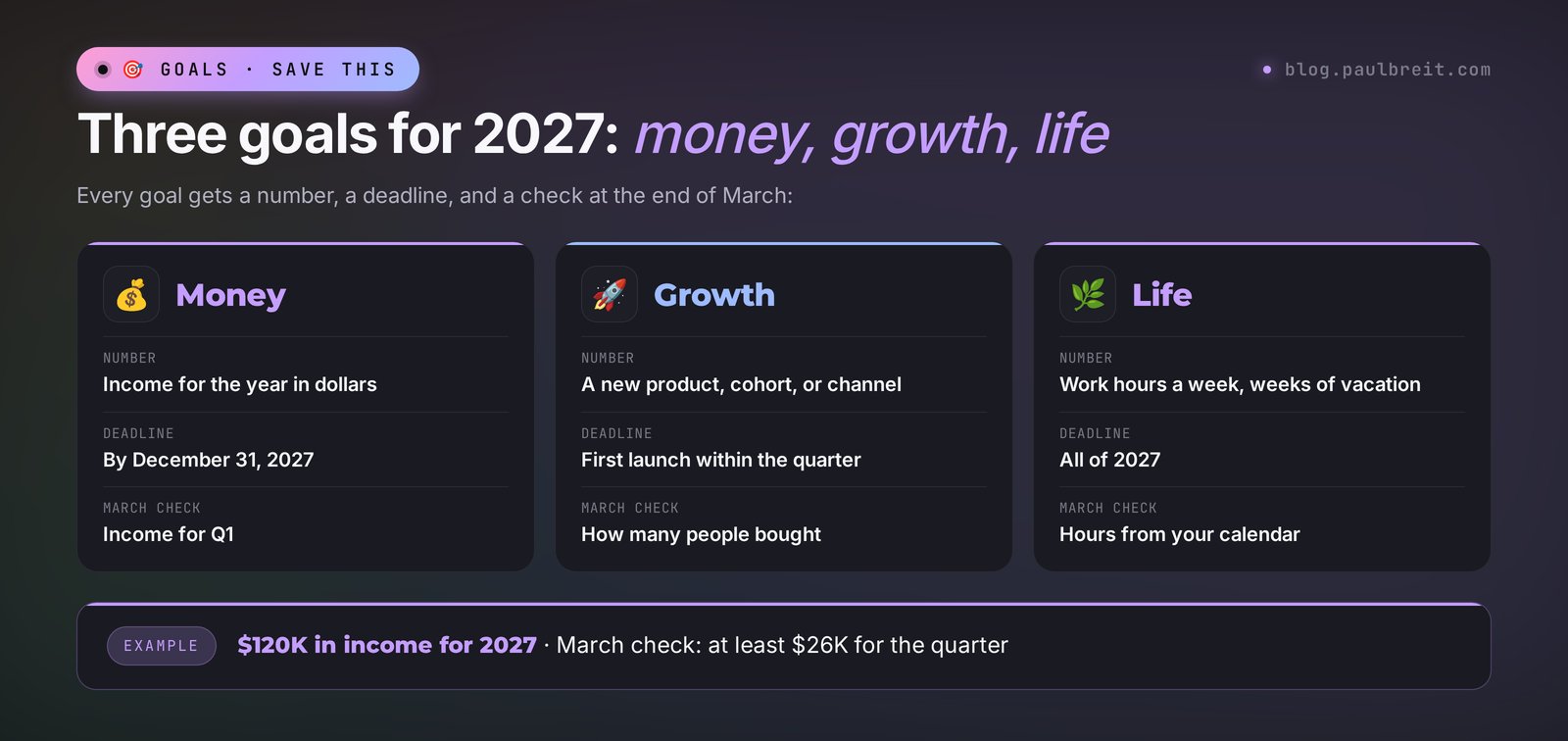
Now that you can see what worked, it's time to set your 2027 goals. The main rule: three at most. One about money, one about growth (a product, a skill, a channel), one about life (health, rest, the people you love). With five goals, none of them gets proper attention.
The prompt:
Help me set goals for 2027. Base them on the review above.

First, ask me 5 questions about what I want from 2027,
one at a time.

Then suggest 3 goals: money, growth, life. For each goal:
- a measurable result with a number and a deadline
- why this goal, with a reference to my 2026 review
- the main risk: what will get in my way, judging by last year
- how I'll know at the end of March that I'm on track

The goals should be ambitious but realistic for my pace of work.
If what I want is unrealistic, say so directly.
What a good goal looks like
Compare two versions of the same goal.
Weak: "Earn more in 2027."
Strong: "$120,000 in income for 2027. To get there, raise my session rate from $150 to $200 starting February 1 and run 2 cohorts of my group program with 12 people each. March check: at least $26,000 for the quarter."
The second version has a number, a deadline, a path, and a checkpoint. You can build a plan from it; you can't build one from the first. AI is very good at turning the first kind of goal into the second. Give it your fuzzy goal and ask: "Turn this into a measurable goal with a number, a deadline, and a way to check progress."
Check that your goals get along
A common trap: goals that fight each other. "Double my income" and "work 25 hours a week" can only live together if your prices go up or you move to groups. Ask the AI: "Check whether my goals contradict each other. If they do, suggest which one to sacrifice or how to reconcile them." Better to find out in December than in May.
Section 09Step 5. A plan for Q1 and the first week of January
A yearly goal is too far away to work with. A year is 52 weeks, and in each one you need to know what to do. So we break the goals down: year, then quarters, then the months of Q1, then the weeks of January. The prompt:
Break my 3 goals down into a plan:
1. What needs to be done by the end of each quarter of 2027.
2. A Q1 plan by month: January, February, March.
3. A plan for the first week of January by day: no more than
   2 tasks a day, each taking no more than 2 hours.

Keep in mind: I work about [N] hours a week,
my holiday break lasts until [date], [other constraints: kids, travel,
a day job].

Make it a table. At the end, list separately 3 tasks I need to do
in December 2026 so January starts without a slow warm-up.
That last item about December matters more than it looks. For most people January starts slowly: the holidays, getting back into gear, "I'll start Monday." If you prepare three things in December (say, update the prices on your website, write the announcement for your first launch, and book two live sessions), January gets going on its own.
A sample plan for the first week of January
| Day | Task 1 | Task 2 |
|---|---|---|
| Monday | Update prices on the website and in your social bios | Write a post about your new way of working |
| Tuesday | Message 10 past clients with a January offer | Build a waitlist form for the group program |
| Wednesday | Record a live session about your clients' year in review | Cut 3 short videos from the recording |
| Thursday | Write up 1 case study from last year | Publish the case study on your channel |
| Friday | Check the week against the plan in your AI chat | Set the tasks for next week |
Notice that every task is concrete and doable in two hours. "Work on marketing" never makes it into a plan like this: the AI will break it into clear actions on its own if you ask that "every task starts with a verb and has a clear result."
If content is part of your plan, the next step is a content plan for a month in one evening. Same logic: the AI breaks your goal down into topics and posts.
Section 10Step 6. Stress-test the plan
A fresh plan always looks great. The stress test is there to find weak spots before they wreck January. Ask the AI to play the critic:
Now play the skeptic. Imagine it's the end of March 2027,
and I didn't hit my Q1 plan.
Name the 5 most likely reasons, based on my 2026 review.
For each reason, suggest one safeguard I can build
into the plan right now.
This technique is called a pre-mortem. It works because imagining a failure after the fact is much easier than predicting it ahead of time. Typical answers from the AI:
- "New clients at the old price." Safeguard: write into the plan the date after which old prices no longer apply, plus the exact sentence you'll use when someone asks.
- "The group launch got postponed again." Safeguard: set the date of the first session and open the waitlist in January, before the program is fully ready.
- "A slump after vacation, like summer 2026." Safeguard: prepare content in advance for the weeks you're away.
- "Too many tasks in the first week." Safeguard: cut it down to one main task a day.
- "Stopped checking in with the plan." Safeguard: a recurring calendar reminder every Friday.
Add the safeguards to the plan and ask the AI to assemble the final version as one document: 2026 by the numbers, the stop list, three goals, the quarterly plan, the first-week plan, and the safeguards. Copy it into your notes app or Google Docs and pin it somewhere you'll see it every week.
Section 11A worked example: a nutritionist's year in review
To see the whole picture, here's what the full review looks like on a sample case. The person is fictional and the numbers are for illustration, but the situation is typical for anyone who works with clients one on one.
What she brought to the review
A nutritionist in her third year of working online. She runs one-month coaching and sells a nutrition guide. She has an Instagram account with 2,400 followers. She barely tracks money; all she has is the payment history in her banking app.
The numbers the AI pulled together
| Metric | 2026 |
|---|---|
| Income for the year | $94,890 |
| One-month coaching ($800) | 96 clients, $76,800, 81% |
| Nutrition guide ($67) | 270 sales, $18,090, 19% |
| Repeat coaching purchases | 31 of 96 clients |
| Where clients came from | Instagram – 55%, referrals – 35%, ads – 10% (estimate) |
| Work hours | about 45 a week |
| Days off | 12, estimate |
What the AI found
- A third of her clients come back for a second month. That's a strong signal she could sell coaching as a 3-month package from the start.
- Each coaching client takes about 2 hours of messaging a week. With 8 clients at a time, that's 16 hours a week on chats alone.
- Ads brought 10% of clients, about $7,700 in coaching revenue, but cost $9,000 and a lot of stress.
- The contradiction: she wants to work 30 hours a week, yet she didn't raise her price once all year.
Her goals for 2027
- Money: $135,000 for the year. A 3-month coaching package for $2,400, and the one-month price goes up to $950 on February 1.
- Growth: a "30 Days of Eating Well" group cohort for 15 people once a quarter at $450 each, with the first cohort in March.
- Life: no more than 32 work hours a week and 4 weeks of vacation. March check against her calendar.
Three items went on her stop list. No more ads without a funnel behind them. Client messages after 8 p.m. wait until morning. Anyone who comes back for a second month is offered the 3-month package right away.
Look at how the goals grew out of the numbers. Not one of them came "out of her head." Repeat purchases suggested the 3-month package, chat overload suggested the group, and the money-losing ads went to the stop list. That's exactly how a review is supposed to work.
Section 12Ready-made intros for different niches
The interview prompt has a line that says "I am [who you are and what you do]." How precisely you fill it in shapes the quality of the questions. Here are ready-made options: copy the one that fits and add your details.
| Niche | How to introduce yourself to the AI | What to ask it to pay attention to |
|---|---|---|
| Therapist | Private practice online, one-on-one sessions, occasional groups | Weekly hours booked, burnout, share of long-term clients |
| Coach | One-on-one programs and group coaching | Average sale, client sources, share of clients who finish the program |
| Tutor | Online lessons, school students, test prep | Seasonality, moving to small groups, hourly rate |
| Fitness trainer | Online coaching and challenges | Repeat purchases, seasonal launches, how many people reach their result |
| Designer, freelancer | Done-for-you projects for businesses | Clients with the best budgets, projects that lose money per hour, repeat clients |
| Course creator | An online course with cohort launches | Launch conversion, cost per lead, completion rate, renewals |
| Consultant, lawyer, accountant | One-off consultations and monthly retainers | Share of retainer clients, the real value of an hour, where clients come from |
If you have a regular job and you're doing a personal review, write something like: "I work as [role] at a company, and I want to review my year across work, money, health, and relationships." The structure of the review stays the same; instead of products and clients, you'll talk about projects, skills, and income.
If you want to turn your year in review into a post
A bonus: a year in review makes a great post. Ask the AI: "Based on the review, write a 2026 year-in-review post for my Instagram, newsletter, or LinkedIn. No bragging, one honest mistake from the year, and one takeaway that's useful to my readers. Use only the numbers I approve." Posts like that get read and shared in December, and an honest mistake earns more trust than a list of wins. To make it sound like you, check out the guide on how to teach AI to write in your voice.
Section 13Step 7. How to keep the plan alive past February
The most common fate of yearly goals is to fade quietly by mid-February. The only thing that saves them is a regular check-in. Here, too, AI is useful: a check-in takes 15 minutes a week.
The weekly check-in
Every Friday, go back to the same chat where you did the review and type:
Weekly check-in [date].
Done: [list].
Not done: [list] – why: [briefly].
Numbers this week: [income, inquiries, clients].
Compare this with the plan, tell me whether I'm on track for my
Q1 goal, and suggest the 3 most important tasks for next week.
The AI remembers the whole review, so its answer takes your goals and stop list into account. If the chat gets too long and the AI starts forgetting the beginning, ask: "Write a short summary: goals, stop list, quarterly plan, what's done so far," and start a new chat with that summary.
The monthly review
On the last day of the month, go a bit longer, about 30 minutes. Ask the AI to compare the month with the plan, name what's going better than expected and what's lagging, and suggest what to change in next month's plan. Your plan is a living document. Changing it based on facts is normal and healthy. The one thing that kills it is when you stop looking at it.
A tracker so you don't have to keep it all in your head
If you want to see your progress at a glance, build yourself a simple goal tracker. It takes one evening with Claude and zero coding: an app with your goals, weekly check marks, and a chart. The step-by-step guide is in build a habit tracker with Claude. And if routine eats a chunk of your week, take a look at 10 working combos to automate your routine with AI: the hours you free up are the hours that go to your goals.
Section 14If something goes wrong
The AI dumps all its questions at once. Type: "Stop. Ask strictly one question at a time and wait for my answer." If it keeps happening, add this to the top of the prompt: "This is the main rule: one question per message."
The answers are too upbeat and full of praise. Type: "Don't comfort me and don't praise me. I need an honest review, like one from a strict financial advisor." The tone changes immediately.
The AI forgot what I said at the beginning. Long conversations sometimes go past the chat's memory. Ask for a summary of the whole conversation, check it, start a new chat with that summary, and keep going.
There are almost no numbers; I never tracked anything. That's normal for a first review. Work with estimates, and make simple tracking your first task for 2027: one spreadsheet where you log income and client source once a week. A year from now, your review will be many times more accurate.
I hit the free-tier limit. Split the evening in two: the interview and numbers on the first day, goals and the plan on the second. Or move the conversation to another AI: ask for a summary, paste it into a new chat in DeepSeek or Gemini, and keep going there.
The goals feel like someone else's. If the AI suggests something that doesn't resonate, say so directly: "I don't like this goal because..." The explanation of why you don't like it often turns out to be your real goal.
I feel down after the review. It happens, especially after a hard year. Ask the AI: "From our conversation, make a list of everything that went well in 2026, even the small things." It's almost always longer than you expect.
Section 157 year-in-review mistakes
- Starting with goals. Goals without a review come out of thin air and repeat last year's. Numbers and conclusions first, goals second.
- Remembering only the last few months. Memory serves up fall and December. Your calendar and photos, month by month, give you back the whole year.
- Setting five or more goals. Spreading yourself thin guarantees none of them gets done. Three at most.
- Goals without numbers and deadlines. "Grow my blog" can't be achieved or failed. "3,000 followers by June 30" can.
- Skipping the stop list. New goals need time that's already taken by something. Without a stop list, the plan physically won't fit into your week.
- Letting the AI fill in the blanks. Without the line "don't invent anything I didn't say," your table may end up with a nice-looking fiction.
- Never coming back to the plan. A review without a weekly check-in is just a pleasant evening. Fifteen minutes on Friday decide whether the year actually happens.
If one of your 2027 goals is to get properly fluent with AI tools, there's a ready-made route for that too: how to learn AI without courses in 30 days. And for any other task on your plan, the AI prompt library has 100 ready-made prompts you can paste straight into the same chat.
Section 16The whole evening in one minute
- Pick your AI: Claude or ChatGPT for the longest, most careful conversation, Gemini or DeepSeek for generous free use.
- Spend 30 minutes gathering raw facts: money, clients, calendar, content, last year's goals, photos.
- Step 1: the interview. The AI asks one question at a time across ten areas, for about an hour.
- Step 2: a table of the year's numbers, with "estimate" and "no data" labels.
- Step 3: the top 3 things that worked, the top 3 time-wasters, the contradictions, and a stop list.
- Step 4: three goals for 2027 – money, growth, life. Each with a number, a deadline, and a March check.
- Step 5: a plan by quarter, Q1 by month, the first week of January by day, plus three tasks for December.
- Step 6: the pre-mortem "imagine I failed the plan by March," then add safeguards to the plan.
- Step 7: a 15-minute check-in every Friday and a 30-minute monthly review, in the same chat.
FAQFrequently asked questions
How do I do a year in review with AI?
Open Claude, ChatGPT, Gemini, or DeepSeek and ask it to interview you about your year: one question at a time, across areas like money, clients, marketing, health, rest, and family. Then ask it to turn your answers into a table of numbers, point out what worked and what ate your time, and use that to set up to three goals for next year with a plan for the first quarter.
What questions should I ask myself in a year in review?
The most useful ones: how much did I earn and what was left after expenses, which product brought in the most money, where did my best clients come from, where did most of my time go, which task did I put off all year, what am I proud of, which decision would I undo, and which of last year's goals did I hit and why I missed the rest. The full list of 25 questions is in the article above.
How long does a year in review with AI take?
About 3 hours: 30 minutes to gather facts, an hour for the interview, an hour for goals and the plan, and 30 minutes to stress-test the plan. On a free plan it's easier to split it across two evenings: the interview and numbers on the first, goals and the plan on the second.
Which AI is best for a year in review and 2027 goals?
For a long conversation, Claude and ChatGPT work best: they keep the whole dialogue in memory and build clean tables. Gemini is handy if your numbers already live in Google Sheets, and DeepSeek offers generous free use. Any of the four will get the job done.
How many goals should I set for the year?
No more than three: one about money, one about growth (a product, a skill, or a channel), and one about life (health, rest, the people you love). Each needs a number, a deadline, and a checkpoint at the end of the first quarter. Five or more goals scatter your attention, and none of them gets enough time.
How do I write a 2027 goal that actually works?
A goal needs a measurable result, a deadline, a path, and a checkpoint. Example: "$120,000 in income for 2027 by raising my session rate to $200 on February 1 and running two group cohorts of 12 people; March check – at least $26,000 for the quarter." AI can rewrite a fuzzy goal into this format for you.
Is it safe to tell an AI about my income?
Amounts and dates for the review are fine. Don't paste passwords, card or account numbers, Social Security numbers, or clients' personal data – names, phone numbers, message details. Refer to clients generically, and strip account details and last names from bank statements before uploading them.
How do I keep my yearly goals from fizzling out by February?
Check in every week: 15 minutes on Friday in the same chat where you did the review. Write what's done and what isn't, and get three tasks for the next week. Once a month, do a 30-minute review and adjust the plan based on the facts. A simple goal tracker you can build with AI in one evening helps too.