AI Business Analytics: an AI agent sends your sales report every morning
An AI analyst agent pulls yesterday's numbers from your payments, leads, channel, and ads on its own, and by 8 AM it sends a short summary to Telegram: how much you made, where things dipped, and what to do today. You build it through an ordinary chat with an AI, with no code and no analyst on the payroll. Below: the full build step by step, ready-to-paste instructions, and a breakdown for different niches.
The simplest way to launch AI business analytics is an AI analyst agent. It's a small program on your own server that Claude builds from your description in a chat. Every morning at 8:00 it pulls yesterday's data from your payment processor, your lead spreadsheet, Google Analytics 4, your Telegram channel, and your ad account, compares it with your average over the past weeks, and sends a 10 to 15 line summary to Telegram with a takeaway and one task for the day. It costs about twenty dollars a month for Claude plus a few dollars for the server. The build takes one evening.
Friday evening. You finally sit down to see how the week went. You open Stripe, then the lead spreadsheet, then your channel stats, then the ad account. Forty minutes later you discover that leads almost stopped on Tuesday, while your ads kept dutifully burning money all week. Three days of budget gone, and you had no idea.
I know this picture painfully well. When you spend around $8,000 a month on ads, you need yesterday's numbers this morning, or a mistake has time to eat a serious chunk of money. Nobody keeps up with that by hand every morning, believe me, I tried. So the numbers have to come from someone who never gets lazy, never forgets, and never gets tired of spreadsheets.
You'll read this in 25 minutes. You'll build it in one evening. After that, every morning you wake up already knowing how much you made yesterday, where people came from, and where to put your energy today.
📋 What's inside
- What AI business analytics is, in plain words
- Why you don't look at your numbers, and what it costs you
- What the morning report looks like: a full example
- Try it in 10 minutes without a server
- Where the agent gets the numbers
- What you'll need to launch it
- Building the analyst in one evening, step by step
- Ready-to-paste instructions for the agent
- Alarm bells: when the agent messages you mid-day
- Talking to your numbers: ask the agent in words
- If something goes wrong
- What to track in your niche
- Access and security
- What it costs and whether it pays off
- The whole path in a minute
In a handful of regions Claude won't open directly, and you'll need a VPN set to a US or EU location. Anthropic keeps a short list of unsupported countries, so pick a mainstream location and sign up with a regular Gmail or iCloud address. If you're in the US or EU, skip this note: everything below works out of the box. Payment options are covered in how to pay for Claude.
Section 01What AI business analytics is, in plain words
The word "analytics" is scary. You picture dashboards with forty charts, attribution systems that cost thousands, and a person in glasses spending a week setting up reports. An online school with thousands of sales a month might need that. For a coach, a therapist, a tutor, or a small team, it's using a sledgehammer to crack a nut.
What you actually need is simpler. In the morning you open Telegram and see one message that says, in human language: yesterday you got 14 leads, a third more than usual, three people paid a total of $1,160, the post about objections worked best, and your Meta ads got more expensive for the second day in a row. And at the bottom, one line: today, call the two people who left a request and never heard back.
That's AI business analytics at a sensible size. An AI analyst agent is a small program on your server. On a schedule it visits your tools, grabs fresh numbers, compares them with the past, and the AI turns the table into clear text with conclusions. You don't open anything or calculate anything. You just read.
How is it different from a regular export or a tool's built-in report? It has three strengths.
- It puts everything in one place. Payments live in one tool, leads in another, views in a third. The agent brings them into a single message, and for the first time you see the connection: a post goes out, the next day leads come in, three days later the payments arrive.
- It compares and explains. A bare "12 leads" tells you nothing. The agent says whether that's good or bad for your business, because it knows your average over the past weeks.
- It tells you what to do. Every report ends with one action for today. Exactly one, so you actually do it.
If the term "AI agent" still sounds foggy, take a look at what an AI agent is. It explains, in simple terms, how an AI turns into a digital employee who works without you.
Section 02Why you don't look at your numbers, and what it costs you
Let me be honest: almost nobody who sells their own services looks at their numbers regularly. And laziness has nothing to do with it. The numbers are scattered across five tabs, each one wants a password, and building the full picture takes half an hour. Half an hour every morning adds up to two and a half work weeks a year. Of course you push it to Friday. And on Friday you're tired, so you push it to Monday.
Here's what happens in practice. See if this sounds familiar.
- Ads burn money for nothing. An ad burned out, the cost per lead tripled, and you find out a week later, when the budget is already gone.
- Leads sit unanswered. Someone left their contact on Tuesday, and you saw it on Thursday. In those two days they already bought from whoever replied first.
- Checkout broke. The payment link stopped working, people click "pay" and leave. Revenue is zero, and you think it's just a quiet week.
- You don't know what sells. You write posts at random, because nobody connected for you which post brought leads and which one just collected likes.
Every one of these holes costs money. One broken payment link over a weekend can take a week's revenue with it. One burned-out creative eats, in a week, a budget that could have brought you a dozen clients. An analyst who puts the facts in front of you every morning closes these holes within the first day.
There's a second side people rarely talk about. When the numbers come to you on their own, you stop worrying. The anxious "how are things going, really" that many people fall asleep with goes away. You know how things are going. Every day. And you make decisions based on facts, without guessing.
Section 03What the morning report looks like: a full example
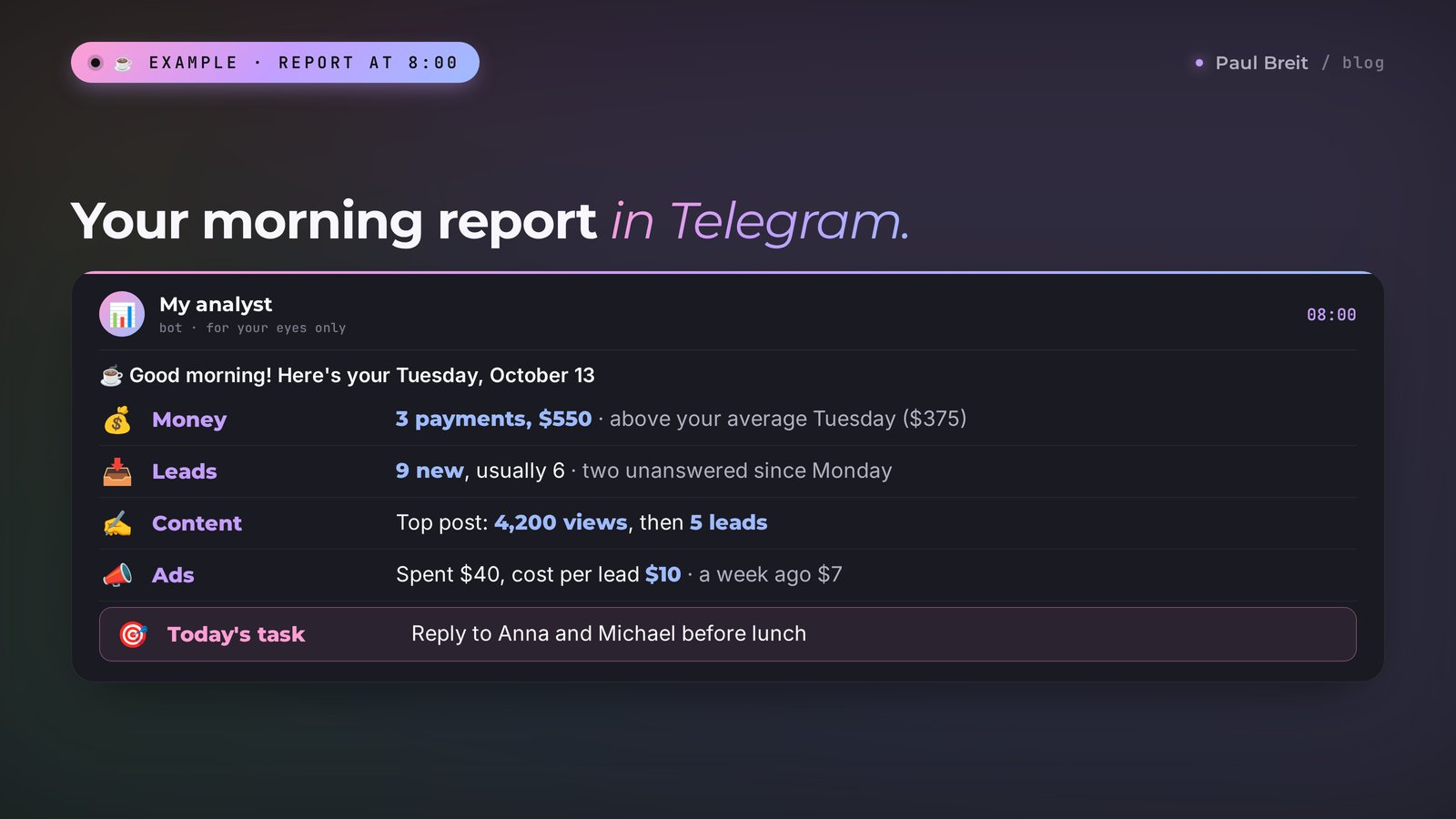
Before building anything, look at the result. Here's the message the agent sends at 8:00. This example is for a therapist who sells sessions and a small course through a Telegram channel.
💰 Money. 3 payments for $550: two sessions and one course. That's above your average Tuesday ($375). Month to date: $4,160. Your goal is $8,000, so $3,840 to go, which means a pace of about $215 a day.
📥 Leads. 9 new, usually 6. Seven came from the channel, two from the website. Two leads from Monday are still unanswered: Anna and Michael.
✍️ Content. Top post: "Why you snap at your loved ones in the evening": 4,200 views, 61 shares, 5 leads after it. The channel gained 38 followers, 11 unsubscribed.
📣 Ads. Spent $40, 4 leads, $10 per lead. A week ago it was $7. The cost has been rising three days in a row, so the ad looks like it's burning out.
🎯 Today's task. Reply to Anna and Michael before lunch, they've been waiting since Monday. Second, swap the image in your ad.
Look at what's happening here. Every number sits next to a comparison, so you instantly know whether to celebrate or worry. Revenue is tied to the monthly goal, and you see the pace you need. The post is linked to leads, so you know what to write next. The ad is flagged before it had time to swallow the budget. And at the end there's one task you can realistically finish before lunch.
There are no charts or forty-row tables in the report. It's fifteen lines you can read in a minute. If you want details, ask the agent in words; more on that below.
The report should land where you already are every morning. Email gets opened every other day, and a dashboard is forgotten within a week. You open Telegram before you brush your teeth, so the summary is sure to catch your eye.
Section 04Try it in 10 minutes without a server
Not sure you need this? Test it the quick and dirty way. Right now, with no server, bots, or setup. Claude can read the spreadsheets and files you upload into a chat and do the math on them.
Download an export
Almost every tool can hand you its data as a file. In Stripe, Kajabi, or Teachable it's the list of payments or orders for the month; in Google Sheets it's "File → Download → Excel"; in Google Analytics 4 it's the share/export button above the report. Take whichever one holds your money or your leads.
Upload the file to a chat with Claude
Go to claude.ai, click the paperclip, and attach the file.
Ask for a breakdown
Copy the message below and send it along with the file.
Claude: Done. For the month: 47 payments totaling $8,165, average order $174. The best days are Tuesday and Wednesday, which bring 41% of revenue. Saturday is the weakest: two payments all month. The course sells twice as often as sessions, but sessions bring in 58% of the money. Takeaway one: your money comes from sessions, and the course works as an entry point...
If a breakdown like this lights you up, congratulations, you're ready for an analyst that does it on its own every morning. A one-off breakdown is nice, but in a month the file is stale. Automation is what keeps the numbers fresh without your involvement. More tricks for working with spreadsheets in a chat are in AI for spreadsheets.
Section 05Where the agent gets the numbers
The agent can reach almost any tool that has a door for programs. Technically it's called an API: a special entrance through which a service hands over data in exchange for a key. You don't need to understand how it works. Your job is to get the key and give it to Claude; the AI connects everything else on its own.
Here are the most common sources and what to pull from them.
| Source | What the agent pulls | How it connects |
|---|---|---|
| Stripe | Every payment: amount, product, time | Stripe sends a webhook for each payment to your server; you paste the webhook address in the Stripe dashboard |
| Kajabi, Teachable | Orders and payments for the day | An API key or webhook from the settings |
| PayPal | Payments and refunds | App credentials from the developer dashboard |
| Google Sheet of leads | New rows for the day, statuses | Access to the sheet for the agent; Claude will tell you how |
| HubSpot, Pipedrive | New deals, stages, who's stuck | An integration key from the CRM settings |
| Google Analytics 4 | Visits, sources, conversion to lead | Access for a service account, granted in a couple of clicks |
| Telegram channel | Followers, post views, shares | An admin bot for followers, a second account for views |
| Meta Ads, Google Ads | Spend, clicks, leads, cost per lead | Access to the ad account API |
A couple of details so nothing surprises you later.
- Telegram post views are invisible to a regular bot; it only knows the follower count. For the agent to read views and shares, it logs into the channel through your second Telegram account. Claude starts the login itself, and all you do is forward the code that arrives in Telegram. That's it.
- Google Ads grants API access through an application, and approval can take a few days. While you wait, the agent can take spend from Google Analytics 4 if your Ads and Analytics accounts are linked.
- If a tool has no API, it almost always sends notifications by email or to Telegram. The agent can read those too. Tell Claude which emails arrive, and it will figure out how to pull the numbers out of them.
Start with two sources: money and leads. That's the skeleton of any report. Add content and ads a week later, once you're used to the morning summary. Don't try to connect everything on the first evening; it's easier to catch mistakes this way.

Section 06What you'll need to launch it
You'll need three things. None of them requires technical skills; I'll walk through each one.
1. A Claude account
This is the analyst's brain. It builds the agent from your words and writes the report text every morning. Sign up at claude.ai; you'll need the paid Pro plan, about twenty dollars a month. It includes Claude Code, the mode in which the AI builds programs on a server by itself. A few practical tips:
- Sign up with an email you'll keep for the long run, such as Gmail or iCloud. That's where receipts and login links will go.
- Use the same account on your laptop and on the server, so everything you build stays under one roof.
- If you're outside the regions Claude supports, turn on a VPN set to the US or EU before you open the site.
- Card and payment options are collected in how to pay for Claude.
2. A Telegram bot
This is the mail carrier that delivers the report. You create it in a minute through Telegram's official service, @BotFather: you message it, choose a name, and get a long key called a token. The token is the bot's password; you'll give it to Claude and nobody else.
3. Your own server
The report has to be built at 8 AM even when you're asleep, on a plane, or your laptop is closed. So the agent needs a computer that's always on and always online. That's a small server on the internet, also called a VPS, and it costs a few dollars a month. The simplest plan is plenty for an analyst: it works for a couple of minutes in the morning and rests the rest of the time.
For an agent like this you don't need anything powerful. Any mainstream cloud host works, for example DigitalOcean or Hetzner: pick the smallest Ubuntu instance, and you're set in a couple of minutes. The cheapest tier easily handles a morning analyst.
And one important principle. Get your own server for the analyst. Don't park the agent on a friend's or a contractor's server "just for now." Your money, your leads, and your clients' contacts pass through the agent. Data like that should live on your own land, under your own lock.
Section 07Building the analyst in one evening, step by step
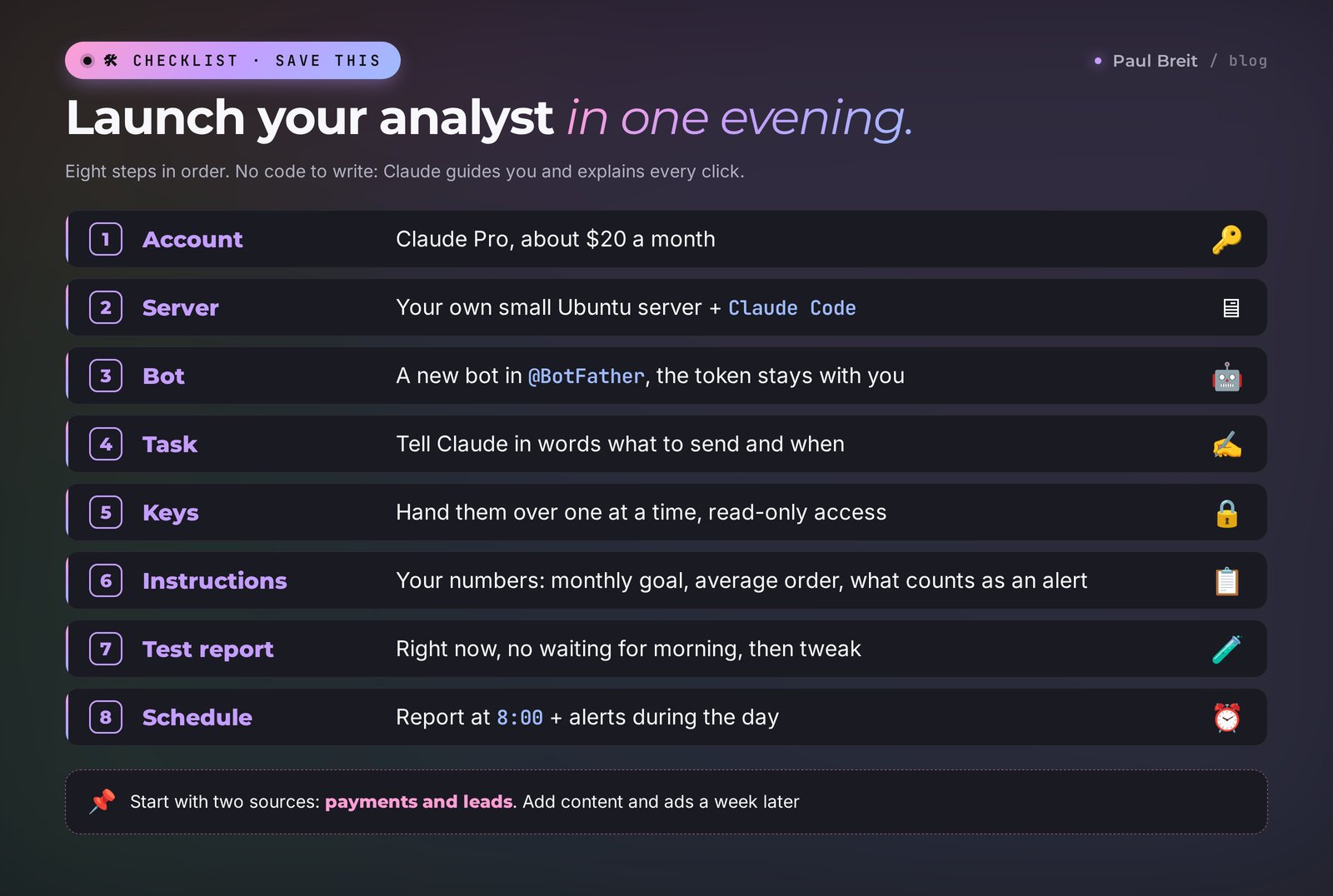
Now for the fun part. I'll lay out the build in enough detail that someone hearing the word "server" for the first time can handle it. Every step is a couple of clicks or a sentence you say to the AI.
Sign up for Claude and get Pro
Go to claude.ai, sign up with Gmail or iCloud, and pay for the plan. About fifteen minutes if you already have the email.
Rent a server and install Claude Code on it
Spin up the simplest Ubuntu server. I showed how to install Claude Code on it and log into your account, step by step with screenshots, in how to use Claude Code. It takes about twenty minutes and you do it once for the whole life of the server.
Create a bot for the reports
In @BotFather, create a new bot, for example "My Analyst." Copy the token. Then send your bot any word so it knows where to send messages.
Give Claude the task
Open Claude Code on the server and describe the task in your own words. Here's a message you can start with:
Claude: Great, getting started. I found your chat with the bot and sent a test message, check whether it arrived. Now let's connect Stripe. I've set up an address on the server where Stripe will send a notification for every payment. Open your Stripe dashboard, go to Developers → Webhooks, and paste this address as a new endpoint...
Hand over the keys one at a time
Claude will ask for access one tool at a time and explain where to click each time. You copy the key or the sheet address and paste it into the chat. Once a source is connected, ask for a check right away: "show me what you see for yesterday." If the numbers match what you see in the tool, move on to the next one.
Explain how to read your business
This is the most important part. The agent has to understand what's good and bad for you: your monthly goal, your typical order, your main products, what counts as an alarm. Ready-to-paste instructions are in the next section. Just copy them, plug in your numbers, and send.
Ask for a test report right now
Don't wait for morning. Say: "send me the report for yesterday right now." Read it and adjust in words: "move the ads block up," "write shorter," "add how much is left to the monthly goal." Three or four rounds and the report will be exactly how you like it.
Set the schedule
The last message: "Set it up so the report arrives every day at 8:00 Eastern Time, and on Mondays also include a summary of last week. Make sure everything still works after the server reboots." Claude sets up the schedule on the server and checks it. Tomorrow you'll wake up to your first summary.
The whole thing usually takes two to three hours, most of it spent connecting sources. If you want to understand more deeply how helpers like this are built, I have a general guide: how to build an AI agent without code.
Section 08Ready-to-paste instructions for the agent
Without instructions the agent will count honestly, but blindly. It doesn't know that 5 leads is a disaster for you and a celebration for your neighbor. It doesn't know your monthly goal or that weekends are always quiet for you. So explain your business to it once. Copy the text below, fill in your details in the square brackets, and send it in the chat with Claude.
You are my analyst. Every morning you write me a short report about the previous day. I am a [who you are: therapist / coach / online school / tutor] and I sell [your products and prices].
My benchmarks: monthly goal is $[amount]. On a typical weekday I get [number] leads and [number] payments. Average order is $[amount]. Weekends are slower, that's normal, so compare Saturday with previous Saturdays.
Report structure: money, leads, content, ads, today's task. Compare every number with my average over the last 4 weeks and say whether it's higher or lower. Tie revenue to the monthly goal: how much is in, how much is left, and what daily pace I need.
Write briefly, no more than 15 lines, in plain words, no jargon. If a source had no data yesterday, say so, and never make up numbers.
Always end with one task for today, the one that matters most for the money. Priority: unanswered leads, broken payments, expensive ads, then content.
Alarm: if leads are under half the usual, if there are zero payments in a workday when I usually get [number], or if the cost per lead rises more than 1.5 times, message me right away without waiting for the morning.
Here's why the instructions are built this way.
- Comparing with four weeks smooths out flukes. One lucky day doesn't raise the bar, and one bad day doesn't scare you for nothing.
- Saturday against Saturday, or else the agent will sound the alarm every weekend, and two weeks later you'll stop reading it.
- "Never make up numbers" is critical. An AI that runs short of data may fill the gap with a plausible invention. A direct ban cuts that off: if a tool didn't respond, the agent says so.
- One task instead of a list of five. You'll put the list off. One task you'll finish before lunch.
- Task priority is ranked by money: a person waiting for a reply is worth more than any post.
You can change the instructions at any time with the same kind of message: "update the analyst's instructions: the monthly goal is now $10,000." If you want to learn to write texts like this for any task, Claude prompts has a formula and 25 examples.
Section 09Alarm bells: when the agent messages you mid-day
The morning report shows yesterday. But some things you need to know within the hour, because waiting until tomorrow is too expensive. For those the analyst has a second mode: it checks the key numbers several times a day and writes only when something has gone wrong. On a normal day you don't hear from it. On a bad day it saves you a lot of money.
Here are the alarms worth turning on from day one.
| What happened | Rule for the agent | What you do |
|---|---|---|
| Payments stalled | Zero payments in 6 working hours when there are usually 2 or 3 | Go through checkout yourself with your own link and see if it works |
| Ads are burning | More than $25 spent with zero leads | Pause the ad and see what broke |
| A lead is going cold | A lead has gone unanswered for over 2 hours during business hours | Reply to the person while they're still warm |
| A post took off | Views in the first hour are 2 times above the average | Pin the post and add a call to action in the comments |
| A wave of unsubscribes | More than 1% of the channel unsubscribed in a day | Check which post it happened after |
Notice the fourth row. An alarm can be good news too. A post that's spreading through shares opens a window of a couple of hours when it's worth pinning it and adding a call to action. Most people find out about such a post in the evening, when the wave has already passed.
To turn on alarms, tell Claude: "Add an alarm mode. Check every half hour from 9 AM to 9 PM Eastern and message me right away if one of these rules fires." Then paste the rules from the table with your own numbers.
Five alarms is good. Fifteen is bad. If your phone beeps at every sneeze, within a week you'll start swiping notifications away without looking and miss a real problem. Start with three: payments, ads, unanswered leads.
Section 10Talking to your numbers: ask the agent in words
This is where the magic starts. The morning report is only the tip of the iceberg. The agent remembers every number it has collected, and you can ask it questions in plain words right in the chat with the bot. Ask Claude to turn on this mode: "Let the bot answer my questions about the numbers it has collected."
Examples of questions that really help.
Analyst: September had almost as many leads: 142 vs 151. What dropped was conversion to payment: 11% vs 17%. Course payments fell the most, while sessions held steady. In August the course sold after three breakdown posts; in September there were two such posts, and both went out on Friday evening, when your views are at their lowest.
Analyst: The top three: "Why you snap at your loved ones in the evening" with 5 leads, "How I stopped rescuing everyone around me" with 4, and a breakdown of a follower's letter with 4. All three are stories about a specific real-life situation. List-style advice posts brought one lead in total for the whole month.
See what just happened? You got an answer that used to take an hour of digging through spreadsheets. And the answer turns straight into action: more stories, fewer lists, breakdown posts off Friday evenings.
More questions worth asking in the very first week:
- On which days and at what hours do people pay most often?
- How long does it take on average from lead to payment?
- Who left a request more than a week ago and still hasn't bought?
- Which ad channel gives the cheapest paying customer, counting by payments?
- If I keep the current pace, how much will I make by the end of the month?
The last question is especially useful mid-month. An answer like "at this pace you'll hit $6,300 out of $8,000" gets you moving better than any motivational video. You see right away that you need a launch, a promo, or at least a pass through your old leads.
Once a week, on Mondays, the agent sends a weekly summary: what went up, what went down, which three posts and which two ad channels worked best. It's a ready-made five-minute team meeting. You can forward it to your team if you have one.
Section 11If something goes wrong
Everything breaks sometimes. The good news: almost everything here is fixed with one sentence in a chat with Claude. Here are the common situations and what to say.
The report didn't arrive in the morning
Open Claude Code on the server and write: "The analyst's report didn't arrive today. Figure out what's wrong, fix it, and send me yesterday's report right now." Most often the cause is mundane: the server rebooted, a key expired, or a tool didn't respond overnight. While you're at it, ask: "If the report fails to build, send me at least a short message saying what broke." Then silence will never be a mystery again.
The numbers don't match the tool
This happens more often than you'd think. For example, the agent counts payments in your local time, while the tool uses its own time zone, and a couple of late-night payments land on a different day. Or refunds weren't subtracted. Write: "Yesterday Stripe shows 4 payments for $700, but you counted 3 for $550. Find where the difference comes from and fix the calculation." The agent will compare and explain.
The agent made up a number
If a number appears in the report that isn't in any source, that's serious. Say: "The report shows 6 leads from the website, but they're not in the sheet. Where did that number come from? Add a rule: take every number only from a source, and if there's no data, write 'no data.'" After that, double-check the next couple of reports by eye.
The report is too long
The first reports are almost always bloated: the AI tries to please and dumps everything on you. Cut boldly: "Shorten it to 12 lines. Keep the content block to one line: top post and follower growth."
Alarms come too often
That means the thresholds are too low. "The ads alarm fires every day. Raise the threshold to $40 with no leads and check no more than once every two hours."
A tool changed its settings and a source dropped off
Tools sometimes change their access rules, and a key stops working. The agent will notice the empty data and mention it in the report. You go to Claude Code: "Data from Google Analytics stopped coming in, reconnect it." Claude will tell you where to get a new key.
Section 12What to track in your niche
The skeleton of the report is the same for everyone: money, leads, content. But the key numbers differ from niche to niche. Here are some hints on where to start.
| Niche | Key numbers | An alarm worth turning on |
|---|---|---|
| Coach, mentor | Call bookings, how many showed up, how many bought afterward | Calls are booked but there have been no payments for three days |
| Therapist | New clients, repeat sessions, who disappeared after the first meeting | A client hasn't rebooked in 2 weeks |
| Online school | Payments by plan, installment plans, students who reached lesson three | An installment payment failed |
| Tutor | Lessons this week, cancellations, trial lessons that turned into paid ones | More than two cancellations in a day |
| Fitness trainer, nutritionist | Renewals, memberships ending, new trials | A client's membership ends in 3 days |
| Designer, freelancer | Incoming requests, quotes sent, quotes accepted | A quote has gone 5 days without a reply from the client |
| Creator with sponsors | Reach, growth, sponsorship inquiries, paid placements | Reach dropped by a third in a week |
Notice that in many niches the main alarm is about people who drift away: they forgot to rebook, renew a membership, or reply to a quote. That's the cheapest money in business. The person already knows you; they just need a question asked at the right time. An agent that reminds you every morning, "here are three people it's time to message," pays for itself in the first week.
If you sell through calls, also take a look at analyzing sales calls with AI. The analyst shows how many calls didn't turn into payments. The call analysis explains why. Together they close the hole completely.
Section 13Access and security
Your money and your clients' contacts flow through the agent. Take it seriously; there are only five rules.
- Grant read-only access. Many tools let you choose permissions when you create a key. The analyst needs to look, and it has nothing to change. Tell Claude: "I only want keys with view permissions, show me where to choose that."
- Keep the keys on the server. Pasting them into Claude Code on your own server is fine. Posting them in channels, sending them to contractors, or putting them in shared documents is off limits.
- The bot answers only you. Ask: "Make the bot respond only to my messages and ignore everyone else." Otherwise anyone who finds the bot could ask it for your revenue.
- Keep personal data to a minimum. A client's first name is enough for the report. Phone numbers, emails, and amounts per person can stay in the CRM.
- The server is yours and yours alone. I said it above and I'll repeat it: no "let it sit on my programmer friend's server for now."
More on how not to open the door to attackers when you work with AI agents is in protecting yourself against AI hacking.
Section 14What it costs and whether it pays off
Let's count honestly. There are two expenses, both small.
- The Claude plan is about twenty dollars a month. It builds the agent and writes the reports. One morning message and a couple of alarms a day barely touch the plan's limits, so there's plenty left for other tasks.
- The server starts at a few dollars a month. The analyst doesn't need horsepower, so the simplest plan is fine. Later you can run other AI agents on the same server.
All in, it's about the price of a couple of lunches out. Now the other side. A freelance analyst who pulls your numbers into a weekly report charges several hundred dollars a month. And sends the report once a week, when the ads have already burned through the budget. Full attribution analytics with setup costs even more and needs someone who understands it.
The biggest payoff, though, is somewhere else. Work out what one lost lead costs you: your average order times the share of people who buy. For most people who sell services and courses, that's somewhere between fifty and a few hundred dollars. An agent that reminds you every morning about two forgotten leads earns back its yearly cost in the first week. And one broken checkout or burned-out ad caught in time pays for it a year ahead.
The analyst is just one role you can take off your plate. On the same server, the same way, you can build an assistant for your DMs, a chat moderator, or a content helper. An overview of setups that really take routine off your hands is in automate your routine with AI. And if you'd first like to understand which AI tools to use for which tasks in 2026, start with the best AI tools of 2026.
Section 15The whole path in a minute
- AI business analytics is an AI agent that gathers your numbers every morning and writes you a clear report in Telegram.
- The report has five blocks: money, leads, content, ads, and one task for today. Every number comes with a comparison.
- You can test the idea in 10 minutes: upload a payments export to a chat with Claude and ask for a breakdown.
- For everyday use you need three things: a Claude plan, a Telegram bot, and your own simple server.
- The build is eight steps in one evening. Start with two sources: payments and leads.
- The ready-made instructions explain your business to the agent: monthly goal, typical numbers, what counts as an alarm.
- Alarms arrive mid-day when payments stall, ads burn money, or a lead is going cold.
- You ask the bot about your numbers in words and get an answer in seconds.
- Read-only keys, a bot that answers only you, and a server of your own.
- It costs about a couple of lunches a month and pays off with the first lead it saves.
So, ready to stop guessing how things are going? One evening of work, and tomorrow morning the numbers will come to you on their own, together with your coffee ☕
FAQFrequently asked questions
What is AI business analytics, in plain words?
It's when an AI gathers your business numbers from different tools on its own, compares them with past periods, and writes a clear takeaway in human language. The most convenient way to do it is an AI analyst agent: every morning it sends you a Telegram report on yesterday's money, leads, content, and ads, with one task for the day.
Do I need to know how to code to build an AI analyst agent?
No coding needed. Claude builds the agent from your description in a chat. Your job is to explain in words what to count and to hand over access keys for your tools one at a time. The AI tells you where to click to get each key.
Which tools can the agent pull data from?
Almost any tool with an API or notifications: Stripe, PayPal, Kajabi, Teachable, Google Sheets, HubSpot, Pipedrive, Google Analytics 4, a Telegram channel, Meta Ads, and Google Ads. It's best to start with two sources: payments and leads.
Can I try AI analytics without a server?
Yes. Download an export of your payments or leads, upload it to a chat with Claude, and ask it to calculate revenue by week, your best day, your average order, and give you three takeaways. It takes ten minutes. You need a server once you want the report to arrive automatically every morning.
Why does an AI analyst agent need its own server?
The report has to be built at 8 AM even when you're asleep or your laptop is closed. That takes a computer that's always on, which means a small server on the internet for a few dollars a month. Your money and your clients' contacts flow through the agent, so the server should be your own.
Won't the AI make up numbers in the report?
That risk exists when data is missing. That's why the instructions include a direct ban: take every number only from a source, and write "no data" when a source is empty. It's worth checking the first few reports against your tools by eye.
How safe is this for my clients' data?
It's safe if you follow five rules: keys with view-only permissions, keys stored on your own server, a bot that answers only you, a minimum of personal data in the report, and a server that belongs to you and nobody else.
How much does an AI analyst agent cost?
A Claude Pro plan at about twenty dollars a month plus a simple server from a few dollars. Together it's about the price of a couple of lunches out. It pays off with the first lead the agent keeps you from forgetting.