Brand Positioning: How to Stand Out From Competitors
Positioning is your answer to the client's question "why you?" With no answer, people compare you on price and pick the cheapest. This guide covers what positioning means in plain words, how to build yours in one evening with a five-part formula, how to find your difference from competitors with AI, and 36 ready-made examples for 12 niches.
Brand positioning is a short statement that explains who you work with, what problem you solve, what result you lead people to, and how your approach differs from everyone else's. To stand out from competitors, write down the promises of 10 competitors and find what they all say the same way, then collect 10–20 reviews from your own clients and find what people praise you for specifically. Combine it into one sentence with the formula "I help [who] [get what result] [in what time frame or by what method], [what makes me different]." Test it on five people from your audience, then put it in your profile bio, at the top of your website, and in your answer to "so what do you do?"
Positioning stands on a niche. If you haven't decided who you work with yet, start with the guide to choosing your niche in 5 steps, then come back here. Once your positioning is ready, it takes about half an hour to turn it into an offer people pay for.
What's inside
- What positioning means in plain words
- Why, without positioning, you get compared on price
- 5 signs you don't have positioning yet
- The five-part positioning formula
- 7 ways to stand out from competitors
- A competitor teardown in one evening
- Building your positioning in 6 steps
- 7 AI prompts
- A sample conversation with AI
- 36 positioning examples for 12 niches
- Where to show your positioning
- How to test positioning on real people
- 8 positioning mistakes
- If something goes wrong
- When to change your positioning
- A 7-day checklist
- The whole path in one minute
Open any social network and search for "therapist" or "nutritionist." You'll see hundreds of profiles, and most of them say the same thing. "Helping you find balance." "An individual approach." "10+ years of experience." "I work with requests of any complexity." A person scrolls through them for a minute, they all look alike, and then they do the most logical thing: message three of them and pick the cheapest.
It hurts when that happens to you. You studied for years, you have client results, you really are good at what you do. From the outside, though, nobody can tell you apart from the person next door who finished a course last month.
Positioning solves exactly this problem. A logo, a profile color, and nice words in your bio have nothing to do with it. Positioning is the answer a client gets in three seconds: "Okay, this is for me, and here's why I'm going to this particular person."
This article goes step by step: what positioning is and how it differs from a niche and an offer, the five-part formula, seven ways to stand out, a step-by-step competitor teardown with AI, ready prompts, a live sample conversation, 36 statements for 12 niches, and a test on real people. Read it top to bottom or jump around with the table of contents.
Section 01What positioning means in plain words
The word itself came from advertising. In 1972, American marketers Al Ries and Jack Trout published a series of articles called "The Positioning Era," and in 1981 they released the book "Positioning: The Battle for Your Mind." Their core idea is simple: for every category, a person has a few shelves in their head, and the winner is whoever takes a shelf first and clearly. When you think "safe car," one brand pops into your head. When you think "fast food delivery," another one does.
The same mechanics work for people who sell services, courses, and consulting. When someone has back pain after giving birth, she looks for a specialist. And if her head already holds "that woman from Instagram who gets moms back in shape after childbirth in 8 weeks," she'll go to her. Even if a fitness trainer with more years of experience is right next door.
Positioning is the place you hold in the client's head. You can't just announce it. You build it out of three things:
- who you help – a specific person in a specific situation;
- what the client gets – a result they can see, count, or feel;
- why you – how your road to that result differs from everyone else's.
Three other words always get mixed up with positioning. Let me sort them out so we don't trip over them later.
| Term | What question it answers | Example |
|---|---|---|
| Niche | Who you work with and on what topic | A nutritionist for women over 40 |
| Positioning | Why a client picks you over everyone else in that niche | A nutritionist for women over 40 who removes sugar cravings with no bans and no calorie counting |
| Offer | What exactly a person buys right now, and on what terms | The "Minus 11 lbs in 8 Weeks" program: 4 calls, a support chat, $300 |
| Personal brand | What people think and say about you when you're not around | "She's the one who explains nutrition without being boring and actually lives that way" |
A niche is the field. Positioning is your spot on that field. An offer is the specific product you sell from that spot. A personal brand is the reputation that grows when you hold one positioning consistently for a long time.
So the order goes like this: niche first, then positioning, then the offer. Skip positioning and your offer comes out generic, and you'll have to sell it with discounts.
Section 02Why, without positioning, you get compared on price
Imagine you're choosing a tutor for your kid. You open three profiles. All of them say "8 years of experience, individual approach, SAT and ACT prep." How do you choose? The only thing that differs between those profiles is the price per lesson. So that's what you look at.
Now a fourth profile: "I prep teens for the SAT who freeze up on test day. First we take the fear out of timed sections, then we add points. Last year 9 out of 11 of my students scored 1400+." This tutor charges more. But you've stopped comparing prices. You're comparing "the one who gets my kid" with "everybody else."
Here's what strong positioning gives you:
- Price stops being the main argument. When there's nobody to compare you with head to head, the client thinks about the value for them, and other people's price lists fade into the background.
- The sale gets shorter. People arrive already thinking "this is about me." You don't have to prove on a call that you know your stuff.
- Word of mouth gets more precise. A happy client can sum you up in one sentence: "If your mom's knees hurt, go see Olga, that's exactly what she works on." Nobody can retell "a specialist with an individual approach" that way.
- Content gets easier to write. Once it's clear who you're for and what your point of view is, post topics show up on their own. Every post strengthens the same idea.
- Ads get cheaper. An ad with a clear sentence hits the right people, and the same budget brings more qualified inquiries.
And the flip side. Without positioning, you compete with everybody at once: with people who've been around longer, people who are louder, and people who are cheaper. You can't beat all of them at the same time.
Section 035 signs you don't have positioning yet
Take a quick self-check. If you recognize yourself in at least two of these, the building section below is definitely for you.
People often ask "how much?" and then disappear
Price is the first question when a person sees no difference between you and the others. They're collecting price lists to pick the cheapest. With strong positioning, the first question is more often "how do you work?" or "would this work for me?"
You can't answer "what do you do?" in one sentence
If that question kicks off a two-minute story starting with "well, I'm basically a therapist, but I also do…," the other person walks away with nothing in their head. Positioning you can't say in 10 seconds doesn't work.
Your bio could be pasted into a competitor's profile
Try a simple experiment. Copy your profile description and mentally paste it into the profile of a colleague in your niche. If nothing breaks and it's all still true, there's nothing of yours in that description.
The "wrong" clients keep showing up
You wanted to work with business owners, and students write to you. You wanted adults, and parents with teenagers come in. That means nobody can tell from your messaging who you're for, so everyone reads their own thing into it.
You keep bringing up price and giving discounts
If people won't buy without a discount, they don't see what they'd be paying more for. Discounts treat the symptom. The cause is almost always that the client doesn't understand what makes you different.
Section 04The five-part positioning formula
The classic positioning template comes from Geoffrey Moore's 1991 book "Crossing the Chasm." He wrote it for tech companies, but simplified, it fits services, courses, and consulting just as well. In working form it looks like this:
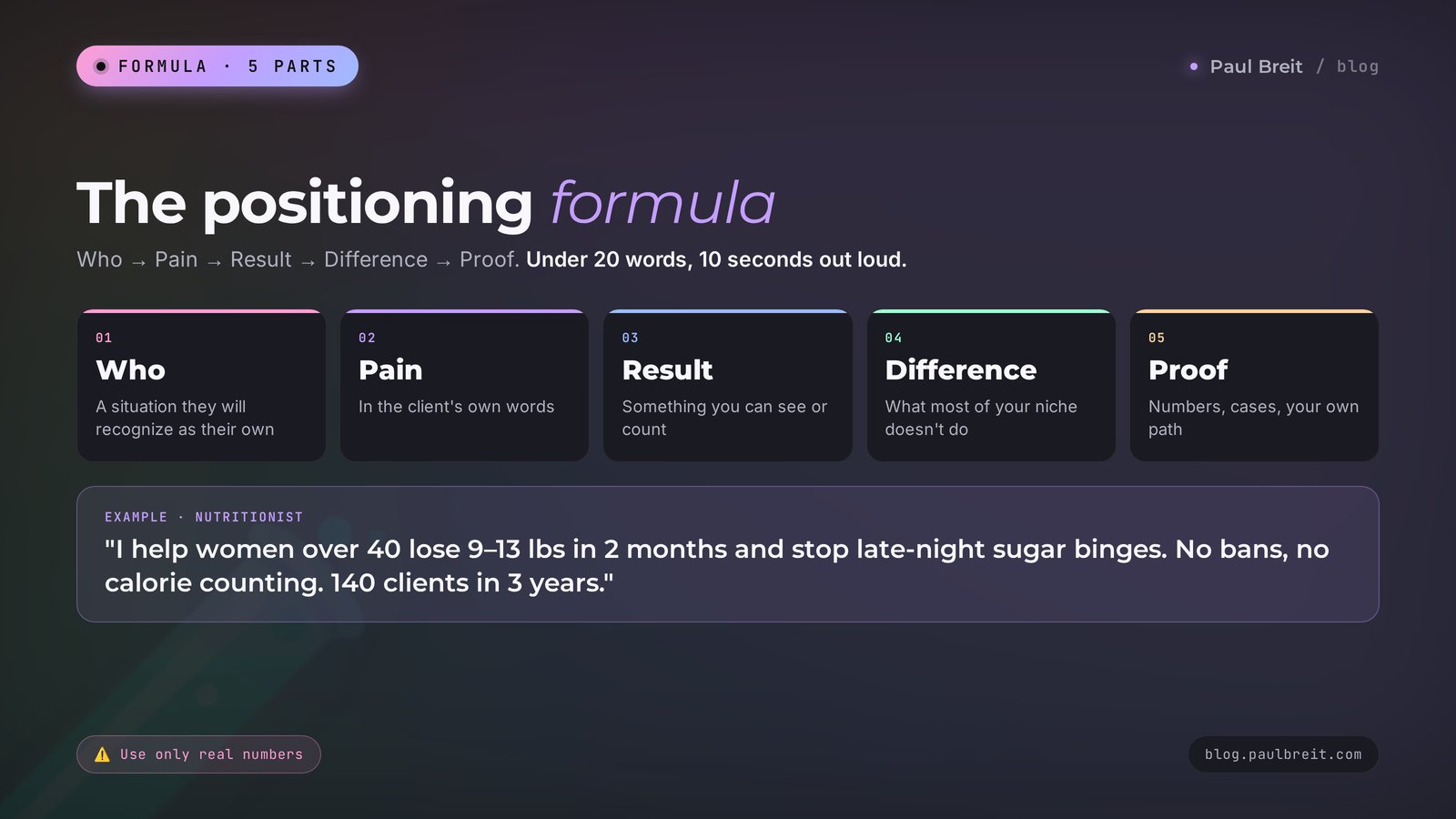
Who it's for + what pain or task they have + what result you deliver + how your approach is different + how you'll prove it.
Let me walk through each part and what goes in it.
1. Who it's for
Describe the person so they recognize themselves. Gender and age are the weakest option. A situation works much better: "moms on maternity leave who want to get back to work," "salon owners whose stylists quit after six months," "therapists who've been blogging for a year and still get no inquiries."
The test: someone from your audience should read it and say "that's me." Someone outside your audience should understand "this isn't about me." Both reactions are equally useful.
2. Pain or task
What's getting in the way of this person's life or work right now. Write it in the client's own words, the way they'd say it themselves. A client won't say "my eating regulation is disrupted." She'll say "I hold it together all day and then binge on sweets at night." The most accurate wording lives in your client messages, their questions, and their reviews.
3. Result
What changes for the client after working with you. A good result is something you can see or count: "your first 3 inquiries from your blog," "minus 11 lbs," "calm in a job interview," "taxes filed with no penalties." If the result is hard to measure, describe what the person will start doing differently: "you stop fighting about money," "you fall asleep in 15 minutes."
4. How your approach is different
The hardest part and the most valuable one. This is what you have and most people in your niche don't. A method, a format, speed, experience in a neighboring field, your own story, a guarantee. Seven places to look for it are covered in the next section.
5. Proof
Why the client should believe parts 3 and 4. Result numbers, case studies, client count, reviews, your own journey. Without proof, positioning sounds like an ad. With proof, it sounds like a fact. If you don't have many case studies yet, see how to write up a client case study so that even one result works for your sales.
Here's how it all fits together, using a nutritionist as the example:
- who: women over 40 who've been on diets many times;
- pain: they binge on sweets at night and gain back everything they lost;
- result: minus 9–13 lbs in 2 months and a calm relationship with food;
- difference: no bans and no calorie counting, through sleep habits and protein at breakfast;
- proof: 140 clients over 3 years, and they keep the weight off a year after the program.
That turns into a sentence for your profile bio: "I help women over 40 lose 9–13 lbs in 2 months and stop late-night sugar binges for good. No bans, no calorie counting. 140 clients in 3 years." All the numbers in this example are made up for illustration: plug in your own, and only real ones.
Don't invent numbers for your positioning. One lie in your bio, and a client who catches it stops believing everything else too. If you don't have numbers yet, use what you do have: years of practice, education, your own experience, your work process.
Section 057 ways to stand out from competitors
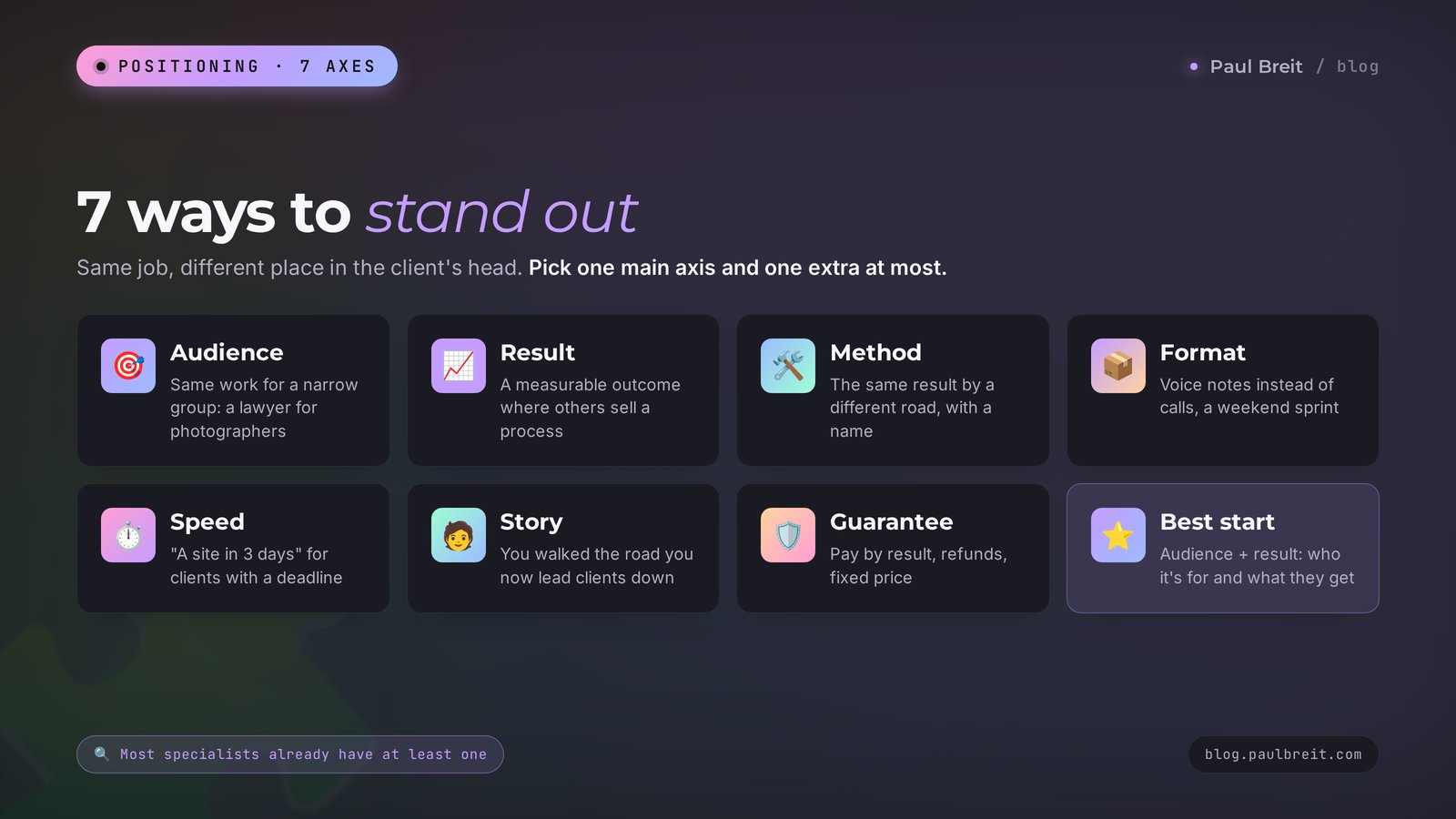
The difference is part four of the formula, and that's exactly where most people get stuck. It feels like everything has already been said and there's nothing left. The good news: you can stand out along seven axes, and almost every specialist already has at least one of them. You just need to see it.
1. Audience
The simplest and the strongest way. You do the same thing others do, but for a narrow group. A lawyer for photographers. A bookkeeper for nail techs. A therapist for software engineers. A fitness trainer for people with a herniated disc. Once you narrow your audience, you automatically become "one of us" for those people: you know their vocabulary, their problems, their typical mistakes.
Example: "I build websites" drowns among thousands. "I build websites for dental practices that bring in bookings for first appointments" sticks right away.
2. Result
You promise a specific, measurable result while everyone else promises a process. Competitors write "marketing consulting," and you write "your first 10 leads from Instagram in 30 days." Competitors "help with English," and you "get you ready for a job interview at an international company in 6 weeks."
One important rule: promise only what your clients achieve regularly. A single lucky case can't be your positioning.
3. Method
You get to the same result by a different road. A running coach who fixes technique by reviewing video of every workout. A coach who works through walks instead of an office. A math teacher who explains through games. A method can have a name, and that makes it more memorable: "the three-notebook method," "the 15-minutes-a-day system."
4. Format
You change the packaging of the work. Voice-note reviews throughout the day in place of hour-long calls. A weekend intensive in place of a three-month course. One-on-one work with daily check-ins in place of a group program. A format fits people for whom the usual way is inconvenient: busy people, shy people, people living in other time zones.
5. Speed and time frame
You do it faster. "A website in 3 days," "a course launch in 2 weeks," "a tax return in 24 hours." Speed is especially valuable when the client's house is on fire: a deadline, a season, an urgent problem. But keep your time promise ironclad, or it will hit you first.
6. Personality and story
You've walked the road you're offering the client. A nutritionist who lost 65 lbs herself. A financial advisor who paid off $25K of debt himself. A marketer who grew his own channel to 20,000 subscribers. A personal story gives you something nobody can copy: the trust of "he's been through this." Values and style belong here too: some people talk tough and direct, some gently, and the audience picks "their" person.
7. Payment model and guarantee
You take the risk off the client. Payment in installments tied to results. A refund if it isn't a fit after the first week. A fixed price instead of hourly. Payment per client found. When everyone in the niche asks for full prepayment for the whole course, a guarantee sets you apart more than any words.
Don't take all seven. Pick one main axis and one extra at most. The strongest combination for a start is audience plus result: "who it's for" and "what they get." The other axes get added as you gain experience and case studies.
Section 06A competitor teardown in one evening
To find your difference, you first need to understand what everyone else is saying. This kind of teardown used to take a week. With AI, it fits into an evening. Any strong AI will do: Claude, ChatGPT, or Gemini. If you're not sure which one to pick, check the roundup of the best AI tools of 2026.
Sign up at claude.ai with Google or your email. The free plan is enough for the whole teardown. The paid plan becomes worth it once you hit message limits or want to keep everything about your business in one Project.
Find 10 competitors
Search Instagram, LinkedIn, or Google for the phrase a client would use to find you: "anxiety therapist," "SAT tutor," "bookkeeper for freelancers." Write down the 10 profiles or websites that show up first. These are the people a client sees next to you. Take both big names and people roughly at your level.
Copy their promises
From each profile, take three things: the bio or description, the headline at the top of their website, and the description of their main service. Paste everything into one document, one after another, labeled with whose it is. If they don't have websites, take a pinned post or a channel description. It's mechanical work, 30–40 minutes.
Hand the text to AI for analysis
Paste the document into the chat and use prompt #2 from the section below. The AI will find the repeats: what everyone promises, in what words, to whom. The picture is usually like this: 7 out of 10 promise "an individual approach," 6 out of 10 talk about years of experience, and almost nobody names a specific result and time frame.
Find the empty spots
Ask the AI to build a map: which audiences nobody has clearly picked, which results nobody promises, which formats nobody offers. These are the free shelves in the client's head. One of them could become yours.
Look at what competitors' clients complain about
Open reviews of your competitors, comments under their posts, discussions in niche communities. Look for phrases like "too bad that…," "I was missing…," "I thought it would be…." Every client disappointment is a hint at how you can be different. If competitors give a lot of theory and little practice, your difference could sound like "pure practice from the first session."
If you'd rather not redo this teardown by hand every month, you can put it on autopilot: the article on the AI competitor spy shows how AI can watch competitors' channels on its own and bring you a summary.
Section 07Building your positioning in 6 steps
The competitor teardown showed what other people say. Now we look for what you have. Set aside 2–3 hours with no distractions.
Collect your clients' words
Pull together 10–20 reviews, thank-you notes, and messages from happy clients. Screenshots of chats work too: you can give them to the AI as images. Look for repeats: what people praise you for, which words come up most often, what changed for them. You'll often find you're valued for something completely different from what you consider your main thing. If you don't have many reviews, here's a system for collecting reviews that works with no awkward asks.
Pick your three best clients
Think of three people who were easy to work with, got a great result, paid without haggling, and brought friends. Describe each one: who they are, what situation they came in with, what worried them, how they found you, what changed after working together. These three are your audience. Your positioning is written for them.
Write down what you do differently
Answer these questions: what do I do that colleagues usually don't? Which step of my work do clients find most useful? What experience do I have from another field? What have I been through myself? Which result do my clients reach faster than usual? Write down everything, even small things. "I reply in the chat within an hour" can turn out to be a difference too, if everyone else replies once a day.
Lay your list over the competitor map
Take the empty spots from the competitor teardown and compare them with your list of differences. Where they match, that's your positioning: a free shelf you can honestly claim. If there are several matches, pick the one you'd most enjoy doing for years.
Assemble the sentence with the formula
Plug everything into the template: "I help [who] [get what result] [in what time frame or by what method]. [Proof]." Make 10 versions with prompt #4. Don't choose right away, sleep on it.
Cut it down to 10 seconds
In the morning, read the versions out loud. Keep the one you can say in one breath and actually want to say. If the sentence is longer than 20 words, cut it. If words like "quality," "effective," or "personalized" are still in it, replace them with a fact. Test the final sentence on people, as described in section 12.
Section 087 AI prompts
These prompts work in Claude, ChatGPT, and Gemini. Copy one, replace the text in square brackets with your own, and send. The more detail you give about yourself in the first prompt, the more precise the answers to all the others will be. More ready commands for different tasks live in the prompt library.
1. Introducing yourself to the AI
I'm a [profession] and have been working for [how many years]. I help people with [what]. My clients are usually [who they are and what situation they come in with]. Work format: [calls, a course, ongoing support]. Average price: [amount]. My best client result: [describe it]. Remember this. Next, we're going to work out my positioning together. Ask me 10 clarifying questions that will help you understand how I'm different from my colleagues. Ask them one at a time.Why it works: questions asked one at a time make you remember details you don't consider important. That's usually exactly where your difference is hiding.
2. Competitor teardown
Below are descriptions of 10 specialists in my niche: [paste the texts]. Analyze them and build a table: who their audience is, what they promise, how they prove it, what format they offer. Then, as a separate list: 1) which promises most of them repeat, 2) which words and phrases come up most often, 3) which audiences, results, and formats nobody has claimed.3. Review analysis
Here are reviews from my clients: [paste the texts or screenshots]. Find the recurring themes: what they praise me for, which results they mention, which words they use. Write out the 10 strongest client phrases word for word. Tell me what difference from other specialists shows up in these reviews, even if the clients don't name it directly.4. Ten versions of the statement
Based on everything you know about me, my competitors, and my reviews, write 10 positioning options using the formula: who it's for + result + how my approach is different + proof. Each option must be 20 words or fewer. Make them varied: 3 built on audience, 3 on result, 2 on method, 2 on my personal story. Use simple words, with no "quality," "effective," or "individual approach."5. Critique through the client's eyes
You are my ideal client: [describe them from step 2]. Read these 3 positioning options: [paste them]. For each one, answer honestly: is it clear this is for you? Do you believe the promise? What makes you doubt it? Would you message a specialist like this? Rate each from 1 to 10 and explain the score.Why it works: AI playing your client notices what you miss because you know your own work too well. It won't replace real people, but it will weed out weak options before the real test.
6. Positioning for different places
Here's my positioning: [sentence]. Adapt it for five places: 1) an Instagram bio, up to 150 characters, 2) a LinkedIn headline, up to 220 characters, 3) the headline and subheadline at the top of my website, 4) a spoken answer to "so what do you do?" at a meeting, 2 sentences, 5) the first paragraph of a pinned post. Same meaning everywhere, words fitted to each place.7. Content topics from your positioning
Here's my positioning: [sentence]. Come up with 20 post topics that strengthen exactly this positioning. 5 topics about my audience's pain, 5 about my method, 5 about mistakes people make without me, 5 about client results. For each topic, add one line on why it supports the positioning.Once the topics are ready, spread them across the calendar: the article on a month-long content plan in one evening shows how to do it with the same AI.
Section 09A sample conversation with AI
Here's what the conversation looks like if you go through the prompts in order. As an example, take a hypothetical therapist who works with anxiety and feels lost among colleagues. The conversation is shortened, but the substance of every line is real.
You: I'm a therapist, 6 years in practice. I work with anxiety. My clients are mostly women aged 28–40. Format: one-hour online sessions once a week. Average price per session is $50. Best result: a client stopped waking up at night with panic after 2 months. Ask me 10 questions, one at a time.
AI: Question 1. Think of your last five clients. What do they do for work, and what triggered their anxiety?
You: Three work in tech, one is a sales manager, one is on maternity leave. For the tech folks and the manager, the anxiety started at work: deadlines, fear of making a mistake, calls with their boss.
AI: Question 2. What do you do in the first session that other therapists usually don't?
You: I give homework right after the first session. A short 3-minute breathing technique and an anxiety journal in the phone's notes app. A lot of my colleagues spend the first sessions only gathering history.
AI: Question 3. How long does it usually take with a client before they feel noticeable relief?
You: Usually 8–10 sessions. People notice the first changes after 2–3 weeks.
After ten questions and the competitor teardown, the AI pulls it all together:
AI: I see three strong differences. First: most of your clients are women in tech and managers, and their anxiety is tied to work. Among the 10 competitors we reviewed, nobody singles out work anxiety. Second: you give a tool in the first session, while competitors promise "deep work," and the client waits a long time to feel any benefit. Third: you have a clear time frame – 2–3 weeks to the first changes. Positioning options:
- "I help women in tech stop panicking before deadlines and calls. The first technique comes in our very first session."
- "A therapist for managers and women in tech with work anxiety. First changes in 2–3 weeks, 6 years of practice."
- "I remove the anxiety that starts at work and keeps you up at night. Online, one hour a week, tools from the first session."
You: Now become my ideal client – a 32-year-old team lead in tech who can't sleep before releases. Rate these three options.
AI: The first one gets 8 out of 10. I recognize myself, but "women in tech" sounds a bit narrow, I'm a team lead and haven't written code in a long time. The second gets 9 out of 10: "work anxiety" is exactly me, and the 2–3 week time frame removes the fear that this takes years. The third gets 6 out of 10: it's clear, but anybody could have written it.
The outcome of the conversation is the second option, which still needs testing on real people. The whole path from the first prompt to this point takes about an hour and a half.
Section 1036 positioning examples for 12 niches
For each niche, three options built on different axes: audience, result, method or format. The numbers in the examples are illustrative. Take the structure and plug in your own facts.
| Niche | Built on audience | Built on result | Built on method or format |
|---|---|---|---|
| Therapist | A therapist for managers with work anxiety | Calm sleep back in 6 weeks | Therapy by text: write when it hits, I reply within an hour |
| Nutritionist | Nutrition for women over 40 after a dozen diets | Minus 9–13 lbs in 2 months, and it stays off | No calorie counting: we change breakfast and sleep habits |
| Fitness trainer | Workouts for people with a herniated disc | 5 pull-ups in 3 months, starting from zero | 20 minutes at home, no gym, no equipment |
| Tutor | SAT prep for teens who freeze up on test day | A 1400+ SAT score | Practice turned into games and 15-minute daily drills |
| Coach | A coach for burned-out business owners | Income up 30% in six months without working more hours | Sessions on a walk, over video |
| Lawyer | A lawyer for photographers and creators | I get you paid for stolen content | A contract for your service in 24 hours |
| Bookkeeper | Bookkeeping for self-employed beauty pros | Zero IRS penalties all year | Everything in one chat, reports sent as voice notes |
| Designer | Websites for dental practices and clinics | A site that brings in first-visit bookings | A finished site with copy in 5 days |
| Marketer | Marketing for therapists and coaches | Your first 10 leads from Instagram in a month | An AI-powered funnel that runs without you |
| Stylist | Wardrobes for women going back to the office after maternity leave | 30 outfits from 15 pieces | A wardrobe review from photos, no home visit |
| Astrologer or tarot reader | Readings for people deciding whether to move | Clarity on your choice in one session | A 20-minute voice-note reading within 24 hours |
| Course creator | A drawing course for adults who "can't draw" | Your first portrait in 14 days | 15 minutes a day, assignments with feedback |
Notice what's missing from the table: "quality," "professional," "with heart," "individual approach." Everybody writes those words, so they set nobody apart. Each of them can be swapped for a fact: "a program built around your schedule and lab results" in place of "individual approach," "6 years and 300 clients" in place of "experienced."
Section 11Where to show your positioning
Positioning that lives only in your head doesn't work. The client should run into the same idea everywhere they cross paths with you. Here are the main touchpoints and what to put in each.
| Where | What to put there | Example |
|---|---|---|
| Name and profile header | Who you are + who it's for, short | Anna · therapist for managers with anxiety |
| Profile or channel description | The full formula sentence + a call to action | I remove work anxiety in 8 sessions. 6 years of practice. Book via DM |
| Top of your website | A headline with the result, a subheadline with the difference and proof | Calm sleep in 6 weeks. Online, tools from the first session |
| Pinned post | The story of why you work this way, and for whom | How I stopped treating "everything" and why I only work with work anxiety now |
| Answer to "what do you do?" | One spoken sentence, 10 seconds | I help managers stop waking up at night because of work |
| Email and messenger signature | A short version of your header | Anna Miller, work anxiety therapist |
| Ads and promotions | The pain from your positioning in the headline | Can't sleep before deadlines? That's fixable in 8 sessions |
The main rule is sameness. If your profile says "anxiety therapist," your website says "relationship specialist," and your ads say "productivity coach," the client meets three different people and remembers none of them. Go through every touchpoint in a single day and bring them all to one sentence.
From there, your positioning has to live in the sale too. On a call you repeat the same idea: who you're for, what result, how your path is different. How to build that kind of conversation is covered in the sales call script.
Section 12How to test positioning on real people
AI weeds out weak options, but people make the final call. Here's a test that takes one day.
Find 5 people from your audience
Followers who haven't bought from you yet, members of niche communities, friends of friends all work. Don't use relatives or close friends: they love you and will rate the sentence more kindly than it deserves.
Show the sentence for 5 seconds
Send the sentence and ask them to read it once. Then ask three questions: "Who does this person help?", "What do they promise?", "How are they different from other specialists in this area?" Let them answer in their own words.
Compare the answers with what you meant
If 4 out of 5 correctly named the audience and the result, the sentence works. If the answers vary, the sentence is fuzzy. See which question trips people up and fix that part specifically.
Ask the control question
"If you had this problem, would you message this person?" If the answer is "maybe," ask what's missing. Most often it's proof: a number, a case study, a time frame.
The second test is the market. Put the new sentence in your bio and pinned post for 2–3 weeks and compare with the previous period: how many people message you, what they ask first, how many inquiries come from the right clients. If the questions shift from "how much?" to "how do you work?", your positioning is working.
Section 138 positioning mistakes
1. Positioning for everyone
"I help people become happier" fits everyone and hooks no one. Fear of narrowing down is the most common one. It feels like you're losing clients. In reality, the only people who leave are the ones who wouldn't have bought anyway. The ones who stay see you as their specialist.
2. Pretty words with no facts
"Harmony," "transformation," "mindfulness," "quality." These words sound pleasant, but they paint nothing in the client's head. The test is simple: can you see it or count it? If you can't, look for specifics.
3. A difference nobody cares about
"I have two degrees" or "in practice since 2015" are facts, but clients rarely care about them. A difference has to change something for the client: faster, simpler, cheaper in the end, more reliable, clearer. Ask yourself, "So what does the client get from that?" If there's no answer, it's no difference.
4. A promise you won't keep
"Results guaranteed for everyone" or "first clients within a week." A loud promise brings people in and then lets them down. A disappointed client will talk about you more eagerly than a happy one. Promise what most of your clients actually achieve.
5. Copying the leader of your niche
The best-known specialist in your niche has already taken their shelf. If you talk in their words, you become their pale copy. Their success is worth studying, but your position has to be found nearby, in a free spot.
6. Different positioning in different places
Covered in detail in section 11. One sentence, one idea, the same everywhere.
7. Positioning your content doesn't back up
Your bio says "work anxiety therapist," while your channel is full of posts about relationships, kids, and travel. A client won't believe your bio if your content says something else. At least 7 out of 10 posts should directly support your positioning.
8. Endless polishing
Some people spend months polishing the wording and never show it to anyone. Only the market can test positioning. It's better to put up a good sentence today and adjust it in a month based on how people react than to spend half a year searching for the perfect one.
Section 14If something goes wrong
The AI keeps giving generic options. That means it doesn't have enough facts about you. Go back to prompt #1 and answer its questions in more detail: with specific situations, numbers, client examples. You can also add: "Rewrite this without any words that would fit any specialist in my niche."
You can't find a difference. Go back to your reviews. If you have few of them, call three past clients and ask: "Why did you pick me?" and "What was most useful in our work?" The answers often surprise. If that doesn't help either, your audience can become your difference: choose the group of people you most enjoy working with and become the specialist for them.
You're scared to narrow down in case you get fewer clients. Narrow your positioning in your bio and content, and keep taking good-fit clients outside that focus. A narrow message attracts more than the target group: people nearby also see you as a specialist who knows the subject deeply. After a couple of months, look at the flow of inquiries and decide by the numbers.
People in the test read the sentence differently. Most likely there are two promises in it at once, or a word that's too general. Remove one promise and replace general words with specific ones: "salon" in place of "business," "30% more bookings" in place of "improve."
You have positioning, but no inquiries. Check three things. Does a new person see it within three seconds in your profile bio? Is it backed by your content? Is there a clear next step: where to write, what they'll get? Sometimes the positioning is fine, and the person simply has no path from interest to inquiry. That's when you need a sales funnel.
A competitor copied your wording. Words are easy to copy. Your story, your clients, and your case studies can't be copied. Strengthen the proof part: more case studies, more specific numbers, more real client stories. In a couple of months, the copy will sound unconvincing next to you.
Section 15When to change your positioning
Positioning isn't carved in stone. You change it when you change or the market does. Here are the signs it's time:
- You've grown. You used to help beginners, and now people come to you with experience and harder requests. The old sentence scares off exactly the people you want.
- The market filled up. Ten more people have taken your shelf, and the difference has worn off. Time to look for a new axis: method, format, guarantee.
- You're bored. If working with your current audience brings you no joy, you'll do the work worse. Your positioning should lead where you want to be three years from now.
- Clients come for something else. You write about one thing, and people buy another from you. That's a strong signal: the market is pointing to where your real value is.
How to change without losing your audience. Don't do it in one day. First, add topics from the new positioning to your content and watch the reaction. Then tell your followers honestly why you're shifting focus. Then update your bio, website, and pinned post. People take changes well when they see the logic and your growth behind them.
Sometimes new positioning brings a new product with it. If you've decided to add a course to your services, see how to do a fast launch to your own audience and test demand before you invest in recording.
Section 16A 7-day checklist
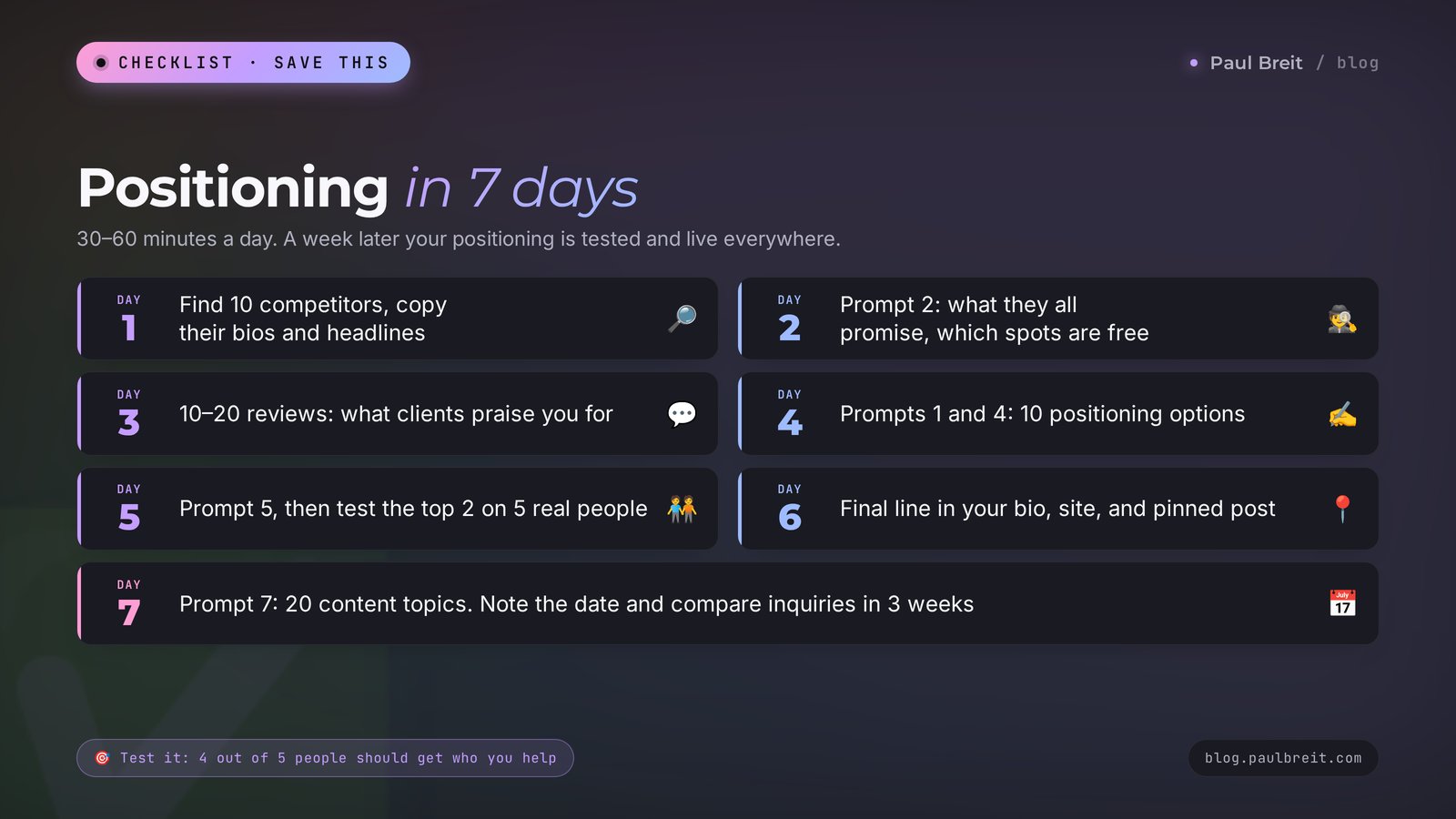
30–60 minutes a day, and a week from now you'll have tested positioning on every platform.
- Day 1. Find 10 competitors and copy their bios, website headlines, and service descriptions into one document.
- Day 2. Prompt #2: the competitor teardown. Write down what everyone promises and which spots are free.
- Day 3. Collect 10–20 reviews and use prompt #3 to find what people praise you for specifically. Describe your three best clients.
- Day 4. Prompt #1 with the questions one at a time, then prompt #4: 10 positioning options.
- Day 5. Prompt #5: critique through the client's eyes. Keep the 2 best options and show them to five people from your audience.
- Day 6. Choose the final sentence. Prompt #6: adapt it for your bio, description, website, pinned post, and spoken answer. Update everything in one day.
- Day 7. Prompt #7: 20 content topics for your positioning. Put the first 7 posts on the calendar and write down today's date so you can compare inquiries in 3 weeks.
Section 17The whole path in one minute
- Positioning is your place in the client's head. The answer to "why you?" in three seconds.
- The order: niche, then positioning, then the offer.
- The formula: who it's for + pain + result + how your approach is different + proof.
- Seven axes of difference: audience, result, method, format, speed, personality, guarantee. Pick one main one.
- Tear down 10 competitors with AI and find the free spots.
- Find in your reviews what people praise you for specifically.
- Cut the sentence down to 20 words and 10 seconds out loud. Replace general words with facts.
- Test it on five people from your audience: 4 out of 5 should understand who you help and what you promise.
- Put the same sentence everywhere: bio, description, website, pinned post, your answer at a meeting.
- Back it up with content: 7 out of 10 posts support your positioning.
Start today with step one: open search and write down 10 competitors. A week from now, you'll stop being "just another specialist" in your client's feed.
FAQFrequently asked questions
What is brand positioning in plain words?
Positioning is the place you hold in the client's head. It's a short answer to "why you?": who you work with, what result you deliver, and how your approach differs from others. If a client can sum you up in one sentence and choose you without comparing prices, you have positioning.
How is positioning different from a niche?
A niche answers who you work with and on what topic, for example a nutritionist for women over 40. Positioning answers why a client picks you over everyone else in that niche, for example no bans and no calorie counting, minus 9–13 lbs in 2 months. You choose the niche first, then build positioning inside it.
How do I write my own positioning statement?
Collect five parts: who you work with, what pain the person has, what result you deliver, how your approach is different, and how you'll prove it. Combine them into the sentence "I help [who] [get what result] [in what time frame or by what method]" and add the proof. The sentence should fit into 20 words and take 10 seconds to say out loud.
How do I stand out from competitors if everyone does the same thing?
Write down the promises of 10 competitors and find what they all say the same way. Then collect your clients' reviews and find what they praise you for specifically. Look for your difference along seven axes: audience, result, method, format, speed, personal story, payment model or guarantee. The simplest way is to narrow your audience and become the specialist for a specific group of people.
Can I build my positioning with AI?
Yes. AI quickly tears down competitors' copy, finds repeats and free spots, analyzes reviews, suggests 10 versions of the statement, and critiques them through the client's eyes. Claude, ChatGPT, or Gemini all work. Still test the final sentence on five people from your audience.
Will I lose clients if I narrow my positioning?
Usually no. A narrow message filters out people who wouldn't have bought anyway. Target clients see you as their specialist and haggle less. People close to the target group come too, because they see depth. Narrow your message in your bio and content, keep taking good-fit clients outside that focus, and decide based on inquiries after 2–3 months.
How do I know my positioning is working?
Show the sentence to five people from your audience and ask who you help and what you promise. If 4 out of 5 answer correctly, the sentence is clear. In the market, the signs are: the right people message you, their first question is "how do you work?" with price coming later, and they ask for discounts less often.
How often should I change my positioning?
Only when there's a reason: you've grown and want to work with different clients, your shelf in the market has filled up with competitors, working with your current audience has stopped being enjoyable, or clients buy something different from what you write about. Change it gradually: content first, then an explanation to your followers, then your bio and website.