AI Trainer Jobs: What They Pay in 2026 and How to Get Hired
An AI trainer is the person who teaches a model to answer like a sensible human: checks its replies, catches what it makes up, writes model answers, and picks the best of several drafts. Platforms like Outlier, DataAnnotation, Mercor, and Alignerr hire for this remotely, generalist tasks are listed at up to $15–50 an hour depending on the platform, experts in coding, medicine, law, and finance get $50 and up, and you don't need to write a line of code. Here's what the job really involves, who gets hired, how to pass the test task, and how to prepare for free in two weeks.
An AI trainer is a specialist who grades and edits AI answers so the model becomes more accurate and more useful. In 2026 the work mostly runs through platforms like Outlier, DataAnnotation, Mercor, and Alignerr: generalists are listed at up to $15–50+ an hour on paper (closer to $22 in practice), experts in coding, STEM, medicine, law, and finance earn $40–200. You don't need a course: hiring runs through a test task, so the best prep is two weeks of practice in fact-checking, comparing answers, and writing model answers. You can train for free with Claude.
Copywriters and editors whose clients drifted to AI. Teachers, tutors, and journalists who want remote work with clear pay. Doctors, lawyers, accountants, and engineers who'd like to earn on the side from home with what they already know. And anyone who's been eyeing AI for a while and wants to step in with a paycheck while figuring out the rest.
What's inside
- What an AI trainer is, in plain words
- What an AI trainer does: 5 task types
- How much AI trainers make in 2026
- Who hires AI trainers
- Who gets hired and who the job suits
- How hiring and the test task work
- Where to learn to be an AI trainer
- Practice in Claude: the test before the test
- How to become an AI trainer from scratch
- Resume and application: what to write
- If something goes wrong
- Pros and cons, honestly
- AI trainer vs prompt engineer vs AI assistant
- Where to grow next
- Checklist before you apply
- The whole path in a minute
- FAQ
Section 01What an AI trainer is, in plain words
Remember when everyone was writing the obituary for copywriters? AI writes faster, cheaper, and never calls in sick, so people who work with words are done. A couple of years later something funny turned up: somebody has to teach that same AI how to write. And that somebody turned out to be the same copywriters, editors, teachers, and journalists. Only now they get paid by the hour to do it.
Here's how a language model gets trained. First it's fed a huge pile of text from the internet and learns to continue sentences. After that it still can't answer questions politely, accurately, and to the point. It may invent a fact, get rude, wander off topic, or produce three screens of text where one sentence would do. To fix that, you need people who look at thousands of answers and say: this one's good, this one's lying, and here's what it should have said.
Those people are AI trainers. Job posts also call them "AI data trainer," "AI writing evaluator," "RLHF annotator," or "AI tutor." Same idea every time: a human grades the model's work, and the developers retrain it on those grades. Engineers call this reinforcement learning from human feedback, or RLHF. You'll need that term exactly once, on your resume.
A good analogy is an intern at a newsroom. The intern writes fast and a lot, but keeps mixing up dates and inventing quotes. Next to them sits a seasoned editor who fixes every piece and explains what went wrong. Six months later the intern writes noticeably better. An AI trainer is that editor, except they have millions of interns, and all of them are the same model.
It's worth separating this from data labeling. A data labeler does simple micro-tasks: draw a box around a car in a photo, mark a review as positive or negative. Anyone can do it without prep, and it pays pennies. An AI trainer works with text and meaning: reads a full answer, checks every claim against sources, decides whether the answer actually helps a person, and writes a justification. The bar is higher, and so is the pay.
Section 02What an AI trainer does: 5 task types
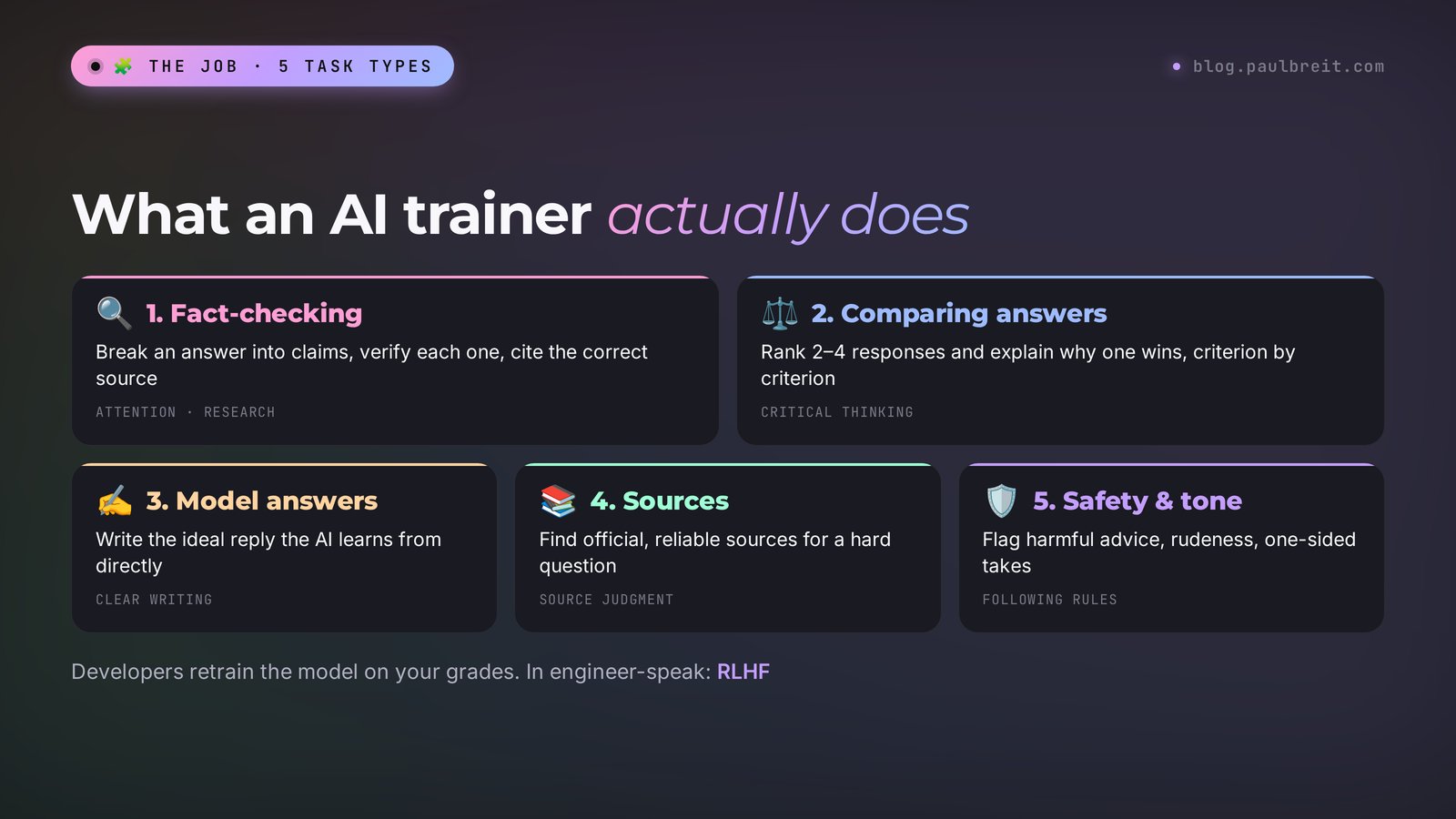
An AI trainer's day is made of similar tasks that arrive on a dedicated platform. Each one takes anywhere from five minutes to an hour. Here's what they usually look like.
1. Fact-checking
The model answered a question, and your job is to break the answer into individual claims and check each one. A company's founding year, a drug dosage, a legal rule, a formula. Find an error, flag it, and point to a source with the correct data. This is the most common task type in the industry, because invented facts are the model's weakest spot. The topic is important enough that I wrote about it separately: why AI makes things up and how to protect yourself.
2. Comparing answers
For one question the model produced two, three, or four versions. You pick the best one or rank them and explain why. The guidelines spell out the criteria: accuracy, completeness, usefulness, tone, length, safety. Sounds simple until you get a pair where the first is more accurate and the second is easier to understand. Making a well-argued call in exactly those gray cases is what you're paid for.
3. Model answers
You get a user's question and write the ideal answer yourself, the way you'd want the AI to answer. This is the most creative and the hardest part of the job. The answer has to be correct, clear, free of filler, and in the right format. The model learns from these texts directly, so the standards are strict.
4. Finding sources
A user asked something complicated, and your job is to find reliable sources to build an answer on. Official websites, laws, research papers, reference works. Blogs and forums usually don't count. Telling a solid source from junk in a few seconds is the whole game here.
5. Safety and tone review
The model must not help with dangerous things, be rude, or push an opinion where reasonable people disagree. A share of tasks is about exactly that: you read an answer and mark whether it breaks the rules. Sometimes it flips, and you have to come up with a tricky question the model might trip over.
| Task type | Example | Skill it tests |
|---|---|---|
| Fact-checking | Find the wrong number in an answer about the home office deduction | Attention, research |
| Comparing answers | Pick the most accurate and safest of three recipes | Critical thinking, argument |
| Model answer | Explain to a child why the sky is blue | Clean, clear writing |
| Finding sources | Find the primary source for a question about the statute of limitations | Search skills, judging reliability |
| Safety and tone | Flag an answer that gives dangerous advice about medication | Knowing the rules, following guidelines |
Section 03How much AI trainers make in 2026
The most common question, so let's start there. The numbers below come from the platforms' own sites and 2026 reviews as of fall 2026. They change, so always check the current listing before you apply.
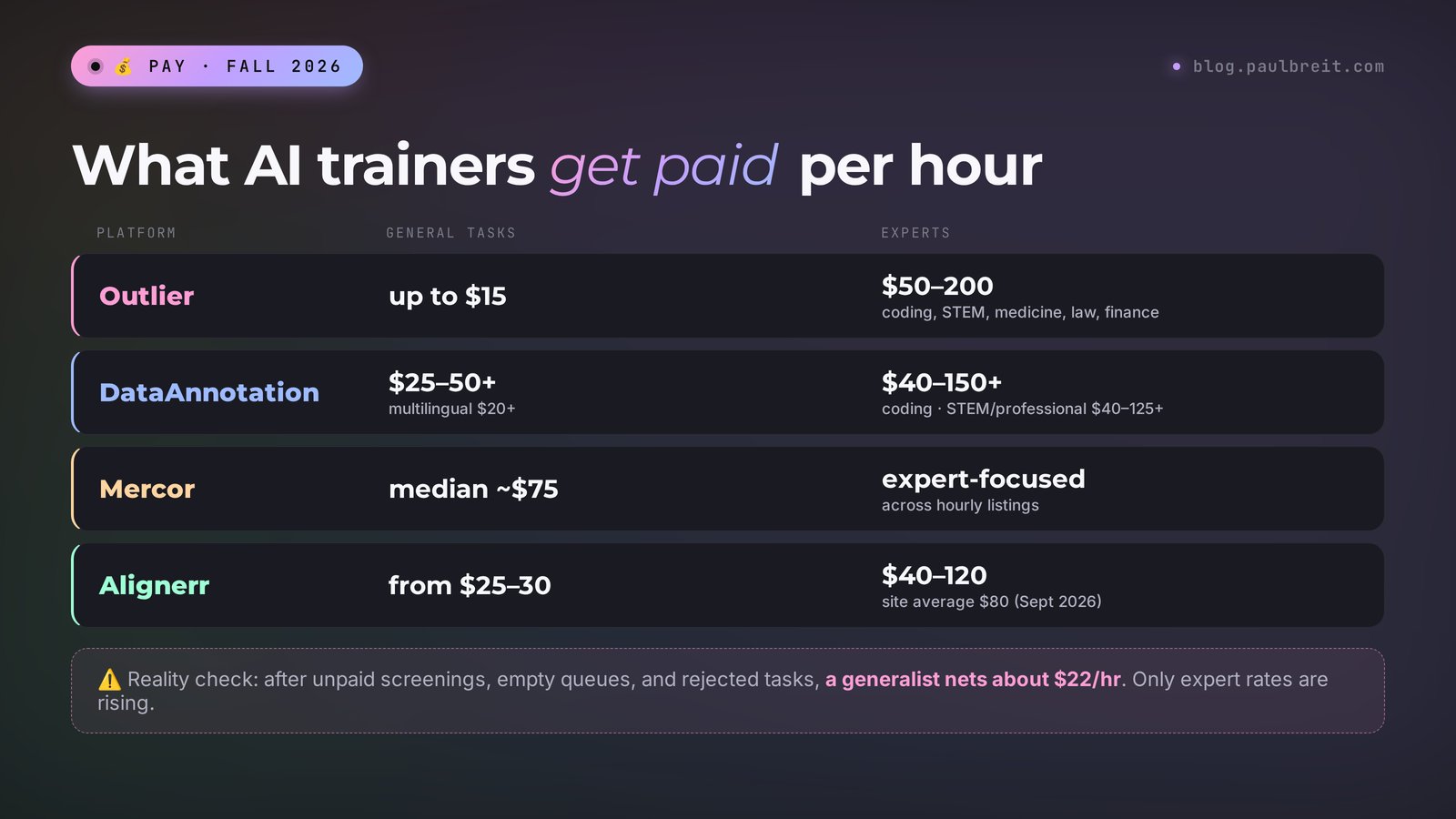
Pay is hourly, in dollars, and the spread is huge. The pattern is the same everywhere: general tasks pay the least, and rates jump once the platform needs a specialist.
| Platform | General tasks | Experts (coding, STEM, medicine, law, finance) |
|---|---|---|
| Outlier | up to $15/hr | $50–200/hr |
| DataAnnotation | $25–50+/hr, multilingual $20+/hr | coding $40–150+/hr, STEM and professional $40–125+/hr |
| Mercor | median about $75/hr across hourly listings, built around experts | |
| Alignerr | roles from $25–30/hr | $40–120/hr; site average in September 2026 was $80/hr |
Now the hard truth about those dollars. Reviewers who tracked their actual earnings report the same thing: after unpaid screenings, empty task queues, and rejected work, a person without a narrow specialty ends up around $22 an hour. Rates for generalists keep sliding. Only expert rates are going up.
Why the gap between the listing and reality? Three things eat your hourly number. Qualification tests and onboarding are often unpaid. The queue can be empty for days, and an empty queue pays nothing. And a task the reviewer rejects may not count at all. None of this is a scam, it's how contract platforms work, but it means you should treat the top of any range as a ceiling, not a promise.
The takeaway is simple. A generalist AI trainer in 2026 is a decent remote side income, roughly the level of freelance editing. The real money in this field starts where text skills meet genuine expertise: medicine, law, finance, programming, engineering, the hard sciences.
Section 04Who hires AI trainers
The demand comes from companies building their own large language models. Most of them don't hire trainers one by one; they buy the work through specialized platforms that recruit, test, and pay thousands of contractors. That's why, for most people, "getting a job as an AI trainer" means getting accepted on a platform.
Outlier. One of the best-known platforms. The split between generalist and expert work is sharp here: general tasks top out around $15 an hour, while experts in coding, STEM, medicine, law, and finance are listed at $50–200. If you have a profession, this is where it pays off the most.
DataAnnotation. Broad mix of work: general writing and evaluation tasks at $25–50+ an hour, multilingual tasks from $20+, coding from $40 to $150+, and STEM and professional tracks at $40–125+. A good place to start if your strongest skill is writing.
Mercor. Built around experts. The median across its hourly listings is about $75. Expect the screening to focus on your professional background.
Alignerr. In September 2026 the site showed an average of $80 an hour, with roles starting at $25–30 and expert roles at $40–120.
The same profession exists far beyond the US. In other countries, companies with their own models hire trainers directly: in Russia, for example, Yandex and Sber run their own AI trainer programs. The work is the same everywhere; only the language changes.
Where to look: the careers pages of the platforms above, plus job boards like LinkedIn and Indeed with searches such as "AI trainer," "AI data trainer," "AI writing evaluator," and "RLHF." Add your field to the search ("AI trainer chemistry," "AI trainer legal") if you're aiming at an expert track.
Section 05Who gets hired and who the job suits
The first thing to throw out: "I'm not a tech person, they won't take me." Generalist AI trainer roles don't ask for coding. Engineers are needed only on tracks where the model's code gets evaluated. Everyone else needs something different.
Here's what generalist listings typically ask for, if you put the common requirements together:
- excellent written English, with no "close enough" grammar;
- experience with text: copywriting, editing, journalism, content work, teaching;
- the ability to get up to speed on an unfamiliar topic fast and verify facts;
- the discipline to follow guidelines exactly, even when you think you know better;
- the ability to explain your decision briefly and logically;
- for many roles, a college degree, and for expert roles, a degree in the field.
Expert tracks add professional experience on top. Typically that means a relevant degree, years of practice, and the ability to read research papers and judge evidence. A nurse, a CPA, a paralegal, a software engineer, a chemistry PhD: each of these is a separate, better-paid lane.
Now about people. Who slides into this job most naturally:
| Who you are now | Your edge | Where to aim |
|---|---|---|
| Copywriter, editor | A feel for text, speed, used to edits | Generalist roles, model answers |
| Teacher, tutor | Explaining simply and grading other people's answers | Math, language, education tasks |
| Journalist | Fact-checking and working with sources | Fact-checking, finding sources |
| Doctor, nurse, licensed therapist, dietitian | Domain expertise | Expert medical tracks |
| Lawyer, accountant, finance pro | Knowing laws, taxes, and calculations | Law, finance |
| Engineer, programmer | Technical expertise | Coding, engineering, code evaluation |
Who will struggle? People who hate repetition. AI training is hundreds of similar tasks, and each one has to be done at a high level. If you're bored by the third similar piece of text, think honestly about whether this is for you.
Section 06How hiring and the test task work
Details vary by platform, but across the industry the path usually has three steps:
Application
You tell them about yourself, your education and experience, and pick a track. This is where people without the right background for a specific role get filtered out.
Assessment, or test task
The main filter. You get a few real work tasks: check a model's answer, compare versions, write your own answer. They look at how you follow the guidelines, how precisely you find errors, and how you phrase your conclusions.
Interview
Some platforms add a short interview. Expect questions about your experience and a walkthrough of your test. Be ready to explain why you gave a particular grade.
What gets evaluated is pretty consistent across the industry: depth of knowledge in your field, following instructions, checking facts, arguing a position logically, and writing clearly.
Where people fail the test most often:
- They skimmed the guidelines. Guidelines can run several pages, and they contain the very nuances the test is built around. For example, that a long answer counts as worse than a short one when both are equally accurate. Didn't read it, got it wrong.
- They graded by feel. "The second answer is better, it just feels nicer" won't fly. Name the criterion: the second answer has the wrong date, the first one is accurate.
- They trusted pretty prose. AI writes confidently, and an invented fact looks convincing. Check every number, name, and date, even when you're "sure."
- They wrote the model answer like an essay. Long, with an intro and a conclusion. A model answer must be precise and exactly as long as the person needs.
- They cited a weak source. A blog post or forum thread always loses to an official government or institutional site.
Section 07Where to learn to be an AI trainer
Here's what schools selling paid courses in this field won't love hearing. The application has no box for "course certificate." The test task decides. So learn what the test checks, and learn it through practice.
What you need to get good at:
- How AI works from a user's seat. Why it makes things up, why the answer depends on how you phrase the question, how models differ. A couple of evenings is enough. Start with 30 AI terms in plain English and the roundup of the best AI tools of 2026.
- Fact-checking. The habit of checking every claim and tracking down the primary source. You only build it on real texts.
- Comparing and arguing. Quickly saying which answer is better and explaining it in two or three sentences, criterion by criterion.
- Short, precise writing. A model answer with zero filler. If you're a copywriter, you'll have to drop some habits: a model answer has one job, to answer the person's question accurately.
- Working with guidelines. Reading a long rulebook and then applying it without drifting.
Paid courses exist, and some are solid. But before you buy, ask yourself one question: will this course get me through the test better than two weeks of practice on my own? If the syllabus is lectures about the history of artificial intelligence, you have your answer. For a framework to compare options, see how to choose an AI course and not overpay.
The free path I recommend rests on one tool. The very AI you'll be training is great at helping you prepare. That's the next section.
Section 08Practice in Claude: the test before the test
The idea is to have the AI generate practice tasks in the format of real ones and then grade your answers. You get a trainer that works any time of day and never gets tired of explaining. I do all of it in Claude: it holds long instructions well and is honest when it picks apart your mistakes.
Go to claude.ai and sign up with your email or Google account. The free plan is enough for practice.
Prompt 1. Fact-checking trainer
You write to Claude: I'm preparing for an AI trainer assessment. Generate an AI answer to an everyday personal finance question, 150–200 words long. Hide 3 factual errors of different difficulty in it. Don't show me the errors. I'll find them and send them to you, then you check me and tell me what I missed and why.
What Claude replies: a question, say, about deducting medical expenses on your federal taxes, and a confident answer with three hidden errors. Then it waits for your review.
You write: Error 1: wrong income threshold for the deduction. Error 2: wrong filing deadline. Couldn't find the third.
What Claude replies: confirms the two you found, reveals the third, explains how you could have caught it, and suggests where to verify numbers like these.
Switch topics every time: medicine, law, history, geography, cooking. It's especially useful to pick topics you're shaky on. That's exactly what will show up on the real test.
Prompt 2. Comparing two answers
You write to Claude: Give me a user's question and two AI answers to it. Make the choice non-obvious: one more accurate, the other clearer, or one more complete but with a small error. I'll pick the better one and justify it by these criteria: accuracy, completeness, usefulness, clarity, safety. Then grade my justification from 1 to 10 and show me how a strong AI trainer would have written it.
What Claude replies: a pair of answers, for example on how to get a red wine stain out, where the second answer includes dangerous advice to mix cleaning products. After your pick it checks whether you caught the main issue and gives a sample three-sentence justification.
Prompt 3. Model answer
You write to Claude: Give me 5 questions a real person might ask a voice assistant. I'll write a model answer to each. Then check each one for accuracy, no filler, the right length, and clarity for someone with no background. If an answer is too long, show me what to cut.
What Claude replies: five different question types: a factual one, a practical tip, a term to explain, a comparison of two things, and a contested question where you need to present different views carefully.
Prompt 4. Working by the guidelines
You write to Claude: Write a short one-page guideline for people who grade AI answers, with 5–6 non-obvious rules. For example, how to grade answers that are too long, or answers on contested topics. Then give me 4 tasks where the correct grade depends on one of those rules. I'll grade them, and you tell me which rules I broke.
What Claude replies: the guideline and a set of trap tasks. This is the best attention training there is, because real tests catch people on small details in the rulebook.
Prompt 5. Sources
You write to Claude: Give me a question about US law or medicine. I'll find 3 sources for the answer and send you the links with a note on why I trust each one. Grade my choice: which sources are reliable, which are weak, and what an experienced fact-checker would have used.
Prompt 6. Mock interview
You write to Claude: Run a mock interview with me for an AI trainer role on a large AI training platform. Ask one question at a time, wait for my answer, then give short feedback and the next question. 8 questions total. At the end, tell me where I sounded unsure and what I should prepare.
One practice session takes 20–40 minutes. Do one a day, and in two weeks you'll handle these tasks with noticeably more confidence, and it will show on the test. For more ready-made phrasing to work with AI, see Claude prompts: a formula and 25 examples.
Section 09How to become an AI trainer from scratch: step by step
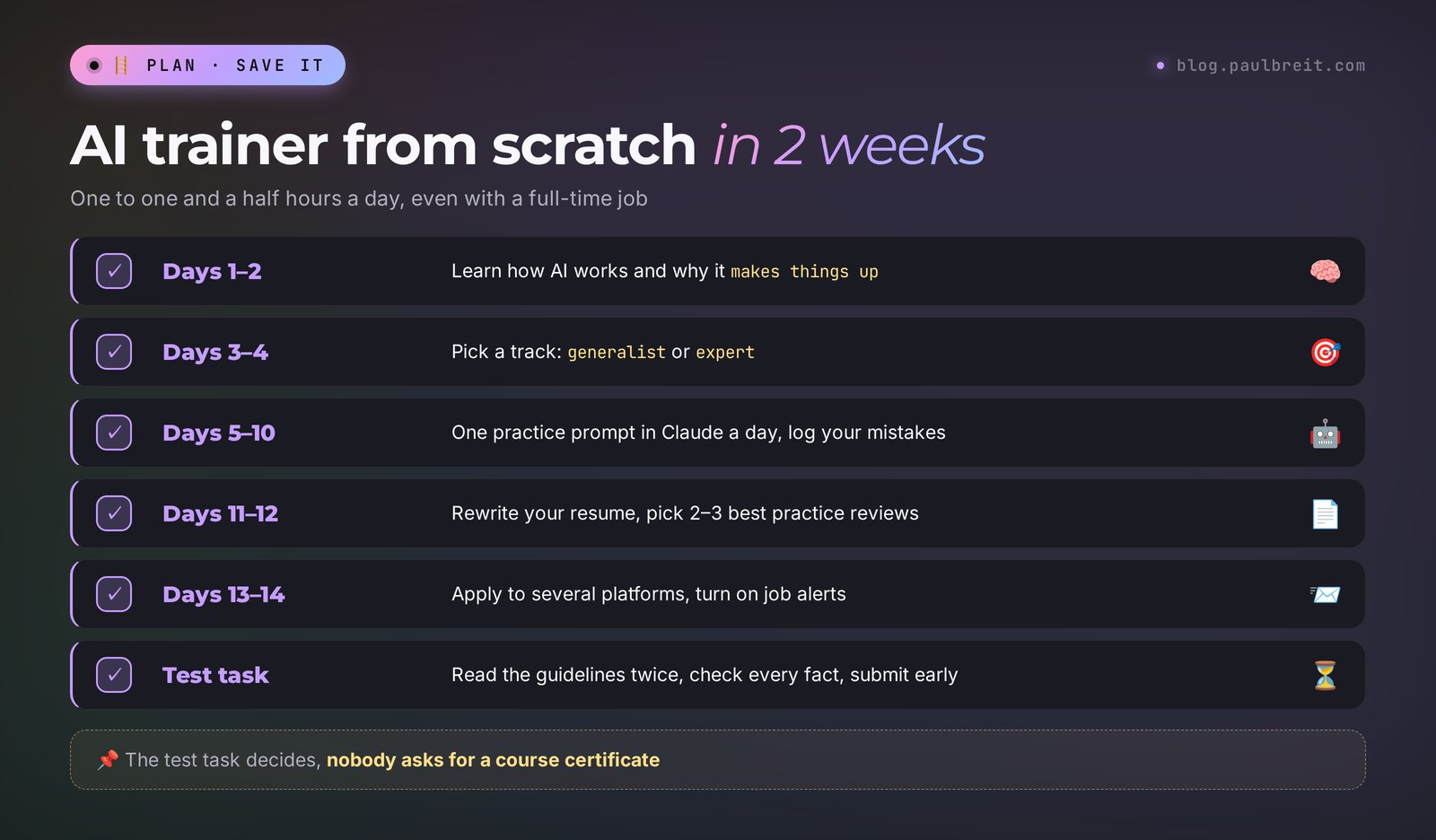
Here's everything as a two-week plan. It assumes an hour to an hour and a half a day, in case you have another job right now.
Days 1–2: understand how AI works
Read up on the core terms and on why models make things up. Ask the same question to two or three different AI tools and compare the answers. That's an AI trainer's first exercise, and you can do it today.
Days 3–4: pick a track
If you have a degree and experience in medicine, law, finance, programming, engineering, or the sciences, aim for an expert track: less competition, higher pay. If your strength is writing, go for generalist roles.
Days 5–10: practice every day
One prompt from Section 08 a day, rotating task types. Keep your mistakes in a notes file: within a week you'll see where you trip up consistently.
Days 11–12: build your resume and samples
Rewrite your resume for the role, as described in the next section. Pick 2–3 of your best practice reviews: they'll come in handy at the interview.
Days 13–14: apply
Apply to several platforms at once, not just one, and run job board searches for "AI trainer" and "AI data trainer." Turn on alerts for new listings: projects open in waves.
The test: take your time
When the assessment arrives, read the guidelines in full twice first. Write their key rules on a separate sheet. Check every fact, even the obvious ones. Submit a couple of hours before the deadline so you have time to reread.
Section 10Resume and application: what to write
AI trainer resumes are read by people who go through hundreds of applications a day. In thirty seconds they need to see three things: you can work with text, you're careful with facts, and you've already worked with AI.
What to put up top:
- Headline – "AI Trainer" or "AI Writing Evaluator." No "exploring new opportunities."
- Writing experience with numbers. "Edited 40 articles a month for a health website" reads far better than "experience working with text."
- Fact-checking. If you've ever checked facts, links, or quotes, say so directly.
- Domain expertise. Degree and years in your field, if you're going for an expert track.
- AI experience. Which tools you use and for what. You can mention that you trained specifically on answer-evaluation tasks.
You can ask Claude to draft a cover letter, but only with your real facts. Here's the wording:
You write to Claude: Write a cover letter for an AI trainer role, 120–150 words, plain language, no hype. About me: 6 years as an editor at a news outlet, checked facts and quotes, for the last six months I've used AI tools at work and compared their answers. The job description is pasted below. Highlight what matches their requirements.
Before you send it, read the letter out loud. If even one phrase sounds like a vacuum cleaner ad, rewrite it in your own words. In a job where people grade text quality for a living, an AI-polished cover letter looks a little silly.
Section 11If something goes wrong
Failed the assessment. Happens to almost everyone the first time. Ask for feedback; sometimes you'll get it. If not, review your work with Claude: paste the task and your answers and ask it to find the weak spots. After a month of practice, apply again or try a different track or platform.
The platform says there's no work. On contract platforms the flow is feast or famine. If you need steady income, keep this as a side gig next to your main job, and stay active on two or three platforms so one empty queue doesn't zero out your week.
Getting low quality scores. Reread the project guidelines: the cause is almost always a rule you're applying your own way. Compare your grades to the examples in the guidelines and, if the platform has reviewers or a support channel, ask where you diverge.
Burning out on repetitive tasks. Work in 45–50 minute blocks with breaks, and switch task types if the platform allows it. Quality drops with fatigue, and quality is exactly what you're paid for here.
I don't understand the task topic. That's normal; you don't have to know everything. The professional skill is finding reliable sources and getting your head around a topic in 10 minutes. If the topic is completely foreign and the platform lets you skip, skip it honestly: a bad grade hurts more.
Claude won't open. In the US and EU it works directly. If you're outside the US/EU, check that your country is on Anthropic's list of supported regions, and try opening the site in a private browser window.
Section 12Pros and cons of the job, honestly
Pros:
- remote work and a flexible schedule you often set yourself;
- you can get in without a technical degree and without programming;
- hourly rates are listed upfront, and expert rates are genuinely high;
- you see from the inside how AI works, and that experience pays off in any AI work later;
- a doctor's, lawyer's, or engineer's expertise turns into well-paid work from home.
Cons:
- repetition, hundreds of similar tasks;
- an income ceiling: the hourly rate is the rate, you won't jump above it;
- an unstable task flow on platforms, and unpaid screenings;
- strict quality standards, where grading mistakes quickly hurt your standing;
- generalist rates are already falling, and as a contractor you get no benefits.
My take: an AI trainer job is a great entry into the world of AI with income from the first month. As a lifelong career, it's debatable. Models get smarter, and simple tasks leave humans first. What stays is hard, expert work. So if you go into this field, think about where you'll grow from day one.
Section 13AI trainer vs prompt engineer vs AI assistant
People mix up these three jobs all the time, even though the work is different.
| AI trainer | Prompt engineer | AI assistant | |
|---|---|---|---|
| What they do | Grades and edits model answers so the model can be retrained | Writes prompts and workflows so a model solves business tasks | Does work for clients with AI: copy, images, automation |
| Who they work for | A company that builds a model, usually via a platform | A company that uses models | Business owners, coaches, consultants, small businesses |
| Format | Contract work on a platform | More often a staff job | More often freelance or your own business |
| Income ceiling | The hourly rate | Higher, grows with experience | Depends on number of clients and price |
| Barrier to entry | Writing and attention to detail | Needs experience with models | Need to land your first clients |
More on the neighboring jobs: what a prompt engineer does and how much they make, the AI assistant career: where it pays and how to start. For the wider market, see the jobs AI will create.
Section 14Where to grow next
Inside the profession the path is clear: AI trainer, then reviewer or senior trainer who checks a group's work, then project lead. In parallel you can move into expert projects where rates are higher.
There's a more interesting path, though. Six months as an AI trainer teaches you more about AI than most people around you know: where it's strong, where it lies, how to ask so the answer comes out accurate. That's exactly the skill business owners, coaches, consultants, and small companies pay for today. They need people who can build copy, a content plan, a funnel, a bot with AI. And there's no hourly ceiling there: take on more clients, earn more.
I see this all the time with my clients. Someone shows up with "I'm good with text and AI," and a couple of months later they have their own clients and an income they control themselves. If that direction appeals to you, start with making money with AI from scratch: first income in 30 days and the overview of 7 ways to make money with AI, no code needed. A free guide on this topic is in the block at the end of the article.
Section 15Checklist before you apply
- I understand how an AI trainer differs from a data labeler and a prompt engineer.
- I've picked a track: generalist or expert.
- I've done at least 10 practice sessions in Claude across all five task types.
- I know my typical mistakes and have written them down.
- My resume opens with the "AI Trainer" headline and writing experience in numbers.
- I have 2–3 examples of my reviews ready for the interview.
- I've applied to several platforms and turned on job alerts.
- I'm ready for the test: read the guidelines twice, check every fact, submit early.
Section 16The whole path in a minute
An AI trainer checks and improves a model's answers: finds errors, compares versions, writes model answers. The work runs mostly through platforms: Outlier pays generalists up to $15/hr and experts $50–200, DataAnnotation $25–50+ for general tasks, Mercor's median is about $75, Alignerr averages $80. In practice a generalist nets about $22/hr, and only expert rates are growing. No programming required; you need clean writing, fact-checking, and discipline with guidelines. Hiring is application, assessment, interview. Prep for two weeks in Claude with the six prompts in this article, rewrite your resume, and apply to several platforms at once.
Start today with one action: open Claude, copy Prompt 1 from Section 08, and find the three hidden errors. In 20 minutes you'll know whether you like this kind of work.
FAQFrequently asked questions
What is an AI trainer and what do they do?
An AI trainer checks and improves a model's answers: finds factual errors, compares several versions of an answer and picks the best one, writes model answers, and finds reliable sources. Developers retrain the model on these grades, and it starts answering more accurately and more usefully.
How much do AI trainers make in 2026?
On paper: Outlier pays generalists up to $15/hr and experts $50–200/hr; DataAnnotation lists $25–50+ for general work, $20+ for multilingual, $40–150+ for coding, and $40–125+ for STEM and professional tasks; Mercor's median is about $75/hr; Alignerr showed an $80/hr average in September 2026. In practice, after unpaid screenings, empty queues, and rejected tasks, a generalist nets about $22/hr.
Do I need to know how to code to become an AI trainer?
No. Generalist roles don't require programming. You need excellent written English, experience with text, fact-checking skills, and the discipline to follow guidelines exactly. Programmers are needed only on tracks where the model's code is evaluated, and those pay more.
Where can I learn to be an AI trainer?
Nobody asks for a course certificate; the test task decides. So the best prep is practice: fact-checking, comparing answers, writing model answers, and working by guidelines. You can practice for free with Claude: it generates tasks in the format of a real test and breaks down your mistakes. Two weeks at an hour a day is usually enough to improve noticeably.
How does the AI trainer hiring process work?
Across the industry it's usually three steps: an application, an assessment or test task, and sometimes an interview. They evaluate depth of knowledge in your field, following instructions, checking facts, arguing a position logically, and writing clearly.
Who hires AI trainers?
Companies that build large language models, mostly through specialized platforms such as Outlier, DataAnnotation, Mercor, and Alignerr. Look on the platforms' careers pages and on job boards with searches like "AI trainer," "AI data trainer," and "AI writing evaluator."
Can I work as an AI trainer remotely and part-time?
Yes. Platform work is remote and usually contract-based, with a flexible schedule. The flip side: task volume isn't guaranteed, queues can run empty, and as a contractor you don't get benefits. Many people keep it as a side gig next to a main job.
Is AI training a good long-term career?
As an entry point, yes: income from the first month and an inside view of how AI works. As a lifelong job, it's debatable for generalists: their rates are already falling while expert rates grow. Plan your next step early, either into an expert track or into AI work for your own clients.
How is an AI trainer different from a prompt engineer?
An AI trainer works for a company that builds a model and teaches the model to answer better. A prompt engineer works for a company that uses AI and writes prompts and workflows so the model solves business tasks. The barrier to entry is lower for an AI trainer; the income ceiling is higher for a prompt engineer.