Jobs of the Future: the work AI will create
Jobs of the future are already today's job postings: in one large job market, listings that ask for AI skills grew 2.7x in a single year. Here's which jobs are growing and which are shrinking, 15 directions with a clear way in, future-proof jobs that need no coding, the skills that will pay the bills for the next ten years, and how to pick your own direction with the help of AI. At the end you'll find a 90-day plan from the first step to the first paycheck.
Jobs of the future include data and AI specialists, cybersecurity, software developers, green energy engineers, plus everyday jobs supercharged by AI: client manager, digital marketer, content manager, designer, online store manager, AI agent operator, online mentor, healthcare and care work. According to the WEF, 170 million new jobs will appear by 2030, and 39% of today's core skills will change. Employers pay a premium for AI skills: in one market tracked by job boards hh.ru and Avito Jobs, AI-skill postings grew 2.7x in a year, and marketing roles with AI skills offered about 77% more pay. You can get in without coding by adding AI to the experience you already have.
For anyone worried that AI will take their job and who wants to get ready ahead of time. For people thinking about a career change, looking for a second income from home, or choosing what to study. For parents of teenagers trying to figure out what to steer their kids toward. And for everyone who sells services, courses, and consulting and wants to stay in demand now that clients can ask AI themselves.
What's inside
- What's really happening to work
- Which jobs are shrinking and why
- 15 jobs of the future, broken down
- Jobs of the future without coding
- Skills that will pay for the next 10 years
- How to pick your path: a 5-question test
- Let AI map your transition
- Your own business: services that grow with AI
- Jobs of the future for kids and teens
- 7 mistakes when choosing a future-proof job
- The 90-day plan
- If something goes wrong
- The whole path in a minute
Want to know the question almost every conversation with new people starts with these days? "Paul, is AI going to replace me?" Bookkeepers ask it, copywriters, designers, salespeople, therapists, tutors. Parents ask it while their ninth grader picks classes for next year. And almost everyone has the same thing in their voice: anxiety, and a feeling that the train is leaving and they don't have a ticket.
I get that feeling. When AI started writing better than the average copywriter in 2023, I was uneasy too: I've made my living in marketing and content for years. Three years later my work is still here. It got faster and more interesting, and AI agents now handle part of the routine for me. Over 10,000 graduates have gone through my school, and I keep seeing the same picture: the winners are the people who picked up AI earlier than others and built it into their work.
In this article I've pulled together everything you need to know about jobs of the future for 2026 and beyond: numbers from major studies, a list of jobs with a clear way in, the skills that are rising in value, and a step-by-step way to pick your direction. No robot horror stories, no "master a new career in a week" promises. Read it in order or jump to the section you need from the table of contents.
Section 01What's really happening to work
I'll start with numbers, because without them any talk about the future turns into fortune-telling. The biggest regular study on this topic is the World Economic Forum's Future of Jobs Report. The latest edition came out in January 2025 and surveyed more than a thousand large employers across dozens of countries. Here are the headlines:
- By 2030, 170 million new jobs will appear and 92 million will disappear. Overall, the labor market gains 78 million jobs, about 7% of total employment.
- About 22% of today's jobs will change in some way over five years: some will get new tasks, some will become a different role entirely.
- On average, 39% of a worker's skills will become outdated or change by 2030.
- 63% of employers name the skills gap as the main barrier to growing their business.
Now a look at one specific job market, because it shows how fast this moves on the ground. In Q1 2026, employers in Russia posted more than 16,500 openings on the job board hh.ru that required working with artificial intelligence. That's 2.7 times more than a year earlier, according to hh.ru and the agency PR DEV. AI skills were most often requested for client managers (18% of these postings), followed by digital marketers, financial analysts, content managers, and programmers, at roughly 5% each.
Avito Jobs, another major board there, ran the numbers on its own database and got a similar picture: in the first half of 2026, postings with AI skills grew 37%. They were most often aimed at graphic designers, online marketplace managers, content managers, and social media specialists. And here's the number that explains why any of this matters. In marketing, advertising, and PR, a specialist who knows AI was offered on average 77% more per month than one without those skills. In legal work the gap was 32%.
| Field | With AI skills | Without AI skills | Premium |
|---|---|---|---|
| Marketing, advertising, PR | ~$1,400/mo | ~$800/mo | +77% |
| Legal | ~$1,070/mo | ~$810/mo | +32% |
| Insurance | ~$930/mo | ~$780/mo | +20% |
Source: Avito Jobs, H1 2026, local salaries converted at about 75 rubles to the dollar. The absolute figures reflect that market; the premium is the part that travels.
So what follows from all this? Work as a whole keeps growing – there's even more of it. What changes is the set of tasks inside each job. Companies are hunting for people who do the same work faster and better with AI, and they're willing to pay extra for it. Meanwhile, resumes that mention AI skills make up only 2.8% of all resumes on hh.ru. Competition in this niche is still small, and that's a window of opportunity for the next couple of years.
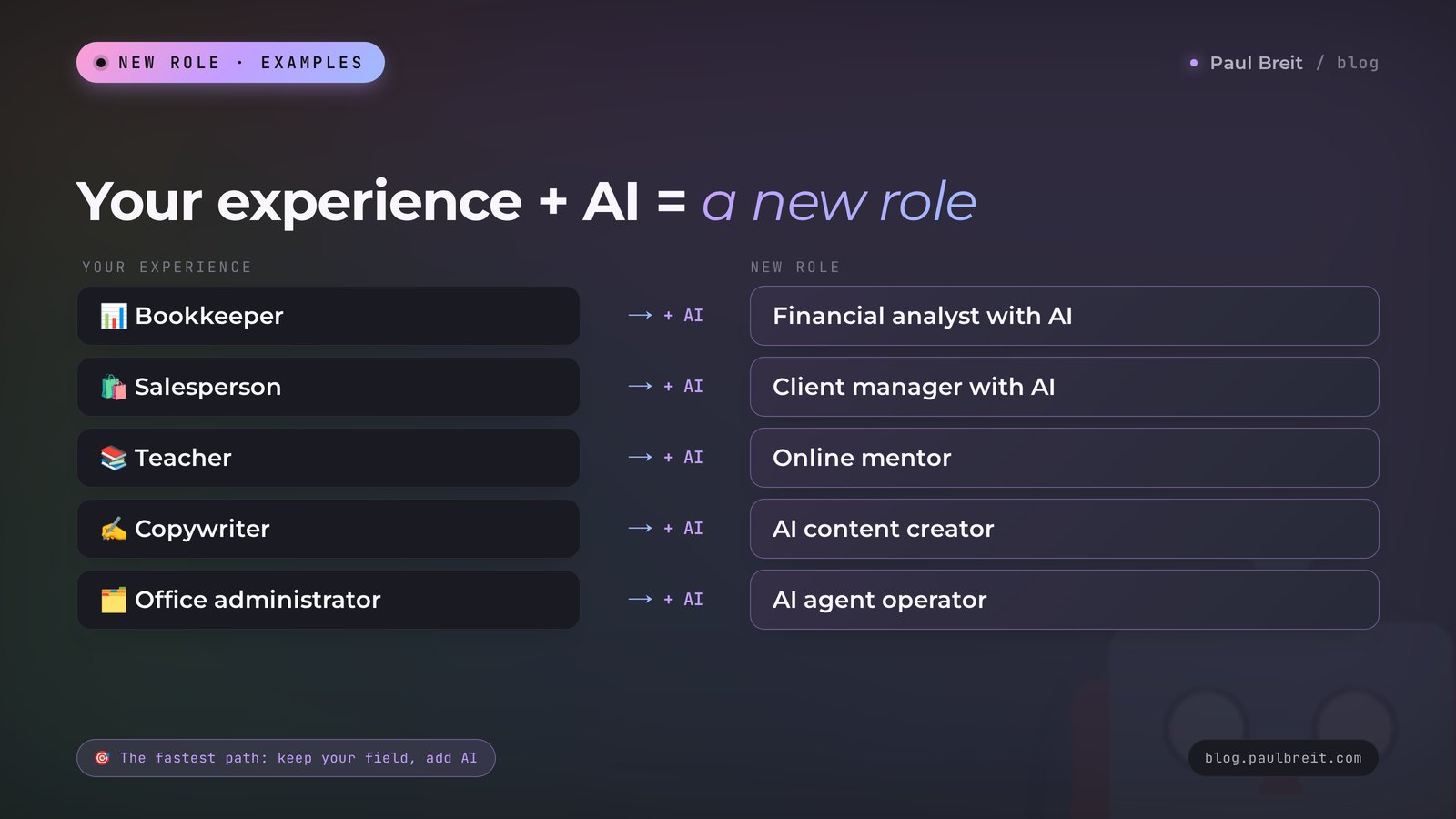
A job of the future most often looks like your current job plus AI. A bookkeeper who hands reconciliations and reports to AI. A salesperson whose AI drafts replies to clients. A tutor who builds a personalized course in one evening. That's the fastest and cheapest path, and below I'll show you how to walk it.
Section 02Which jobs are shrinking and why
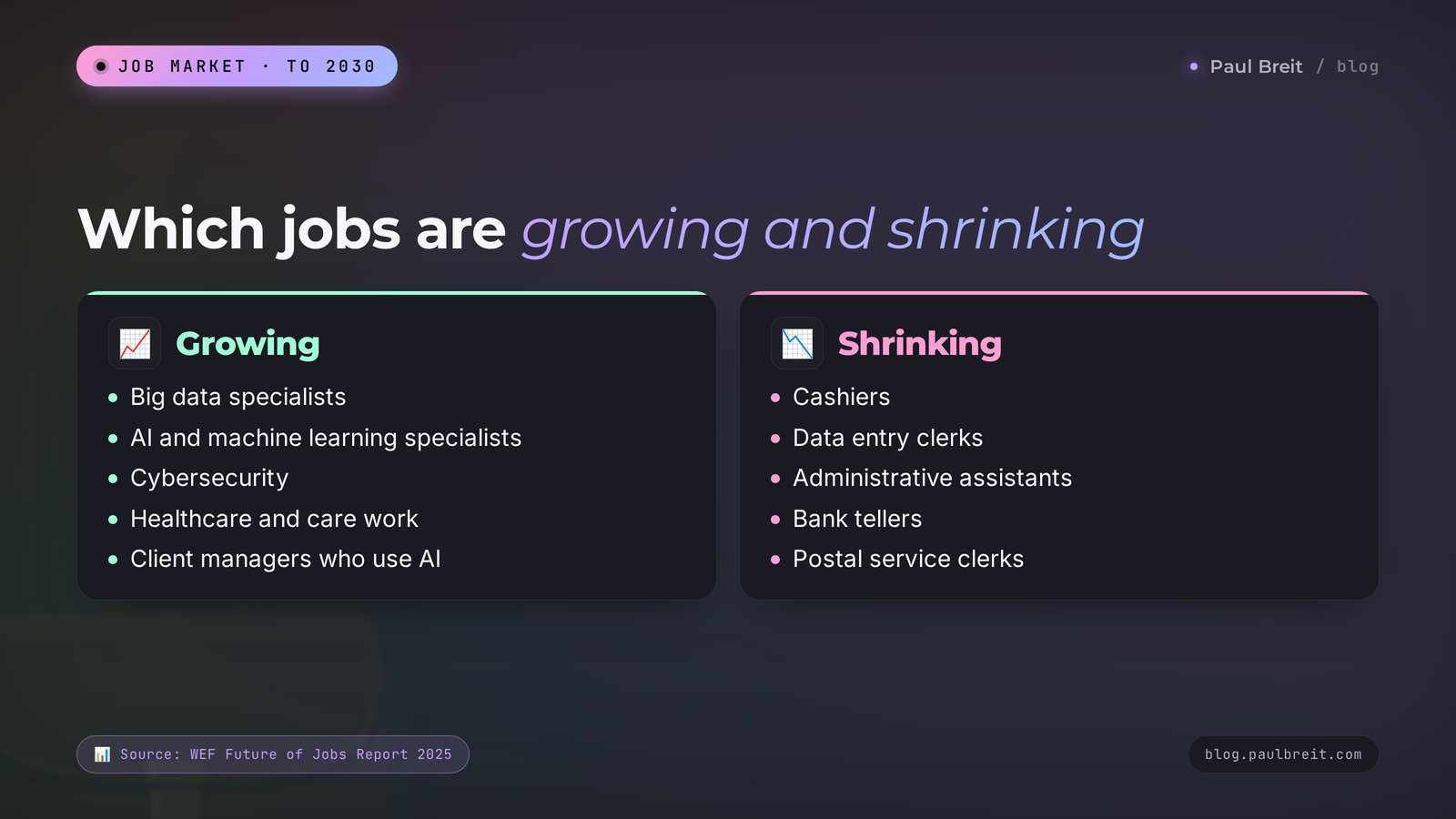
This part is unpleasant to talk about, but staying quiet is worse. The same WEF report lists the fastest-declining jobs. At the top: postal service clerks, bank tellers and related clerks, data entry clerks, cashiers and ticket clerks, administrative assistants and executive secretaries, printing workers, accounting and bookkeeping clerks, material-recording and stock-keeping clerks. To many people's surprise, graphic designers made the same list.
Look closely at what these jobs have in common. In each of them, most of the working day goes to repetitive operations with clear rules: move numbers from one spreadsheet to another, ring up a product, fill out a standard form, draw the twentieth banner from the same template. Those are exactly the operations that AI and software already do faster than a person and almost for free.
And here's an interesting twist with designers. The global forecast lists them as declining, while Avito Jobs puts graphic designers at the top for demand for AI skills. There's no contradiction. What's getting cut is manual work from someone else's brief – that twentieth banner from a template. Demand is growing for designers who use AI to do a week's worth of work in a day and understand why a business needs the image in the first place. The same story plays out in copywriting, translation, bookkeeping, and customer support.
| Job under pressure | What automation takes over | Where to grow with that experience |
|---|---|---|
| Data entry clerk | Moving and reconciling data | Data analyst, AI agent operator |
| Secretary, office administrator | Calendar, standard emails, meeting notes | AI-powered virtual executive assistant, project manager |
| Junior bookkeeper | Source documents, reconciliations, standard reports | Financial analyst, tax consultant for small businesses |
| Cashier, salesperson | Ringing up, routine questions | Client manager, online store manager |
| High-volume copywriter | Standard copy and product descriptions | Content strategist, editor, AI content creator |
| Template designer | Look-alike banners and covers | Designer with AI, UX designer, art director |
| Call center agent | Scripted answers | Sales manager, chatbot setup specialist |
If you found yourself in the left column, don't panic. These cuts take years, and you have time. What matters is to start moving now, while you still have a paycheck and can learn calmly, without the pressure of "next month I can't pay rent." The right column shows that your experience doesn't vanish: someone who spent ten years processing source documents understands better than any newcomer what questions to ask AI about a company's finances.
AI makes mistakes, invents facts, and takes no responsibility for the result. That's why almost every job keeps a person who sets the task, checks the answer, and answers to the client. The people at risk are those doing work nobody checks and nobody is accountable for. Your job is to move closer to setting the task and owning the result.
Section 0315 jobs of the future, broken down
Below are 15 directions that are growing both in global forecasts and in real job postings. I've split them into three groups: technical jobs, everyday jobs supercharged by AI, and human jobs where the machine helps but can't replace the person. For each one: what the person does, who it suits, and where to start.
Technical jobs
Data specialist and analyst
Collects company data, finds patterns in it, and answers business questions: why sales dropped, what to stock, which customers are leaving. According to the WEF, big data specialists are the fastest-growing job through 2030. You can start as an analyst in Excel and Google Sheets – today AI writes formulas and pivot tables from a plain request; more on that in AI for spreadsheets. A good fit for people who love numbers and order.
AI and machine learning specialist
Trains and tunes models and builds them into company products. The third fastest-growing job in the WEF report. The barrier to entry is high: you need math, Python, and an understanding of how neural networks work. This path is for people ready to study for a year or two who enjoy technical problems. In return, the pay here is among the highest on the market.
Software developer
The WEF also ranks developers among the fastest-growing jobs, even though it seems AI writes code on its own. It does, and that's exactly why one developer now ships in a week what used to take a team. Demand has shifted toward people who can brief the AI, review its code, and assemble the pieces into a working product. A beginner should start by working in tandem with AI from day one.
Cybersecurity specialist
Protects company data and systems from breaches and leaks. The more business moves online and plugs in AI, the more holes appear. The WEF report puts two roles from this field among the fastest-growing: security management specialists and information security analysts. A fit for careful people who enjoy hunting for vulnerabilities and thinking like an attacker.
Green energy and electric vehicle engineer
Solar and wind farms, energy storage, electric transportation. In the global forecast, renewable energy engineers, environmental engineers, and autonomous and electric vehicle specialists are in the top twenty growing jobs. This path is for people who love physics and hardware, and it usually requires a degree in the field.
Everyday jobs supercharged by AI
Client manager with AI
Looks after a company's customers: answers questions, sells, retains, gathers feedback. In the Russian data this job had the most postings requiring AI skills – 18% of all such listings. AI drafts replies, analyzes conversations, and flags which clients it's time to reach out to. A fit for anyone who's good with people; you can get in with no experience.
Digital marketer
Makes sure the business gets leads: ads, content, funnels, analytics. With AI, one marketer covers the work of a whole department: writes copy, makes banners, builds landing pages, analyzes ad results. This is the field where the pay gap between people with and without AI skills is close to double. I'm a marketer myself, and I can honestly say there's been noticeably more work in this field over the past three years.
Content manager and social media specialist
Runs social media and Telegram channels for companies and individual pros. AI generates ideas, post drafts, Reels scripts, and covers, while the person owns the meaning, the brand voice, and the result. According to hh.ru, postings with AI requirements in copywriting, social media, PR, and marketing grew 141% in a year. A fit for people who love writing and know their way around social platforms. I showed what this looks like in practice in AI for Reels scripts.
Designer and video producer with AI
Creates visuals for businesses: covers, banners, slide decks, videos. AI cuts production time many times over, so the winner is whoever understands the client's goal and can take an image all the way to a result. In design, social media, and video production, postings with AI skills grew 2.3x compared with 2024.
Online marketplace manager
Runs sellers' stores on marketplaces like Amazon, Etsy, or Walmart: listings, photos, prices, reviews, ads. Avito Jobs names this job among the leaders in demand for AI skills: AI writes descriptions, edits photos, and replies to reviews. The barrier to entry is low; you can learn the basics in a month. More in AI for marketplaces.
AI agent operator and automation specialist
A brand-new job that simply didn't exist three years ago. This person sets up AI and simple automations for a company or a solo pro: a chatbot that answers clients, an agent that collects leads into a spreadsheet, a workflow that prepares a report every morning. You don't need to code for this – you need to explain the task to the AI clearly. The same family includes AI assistants and prompt engineers.
UX designer and product specialist
Makes sure a website, app, or service is easy to use. UI and UX designers are in the WEF's top ten fastest-growing jobs. AI helps with prototypes and interface copy, while understanding people and their behavior is still the human's job.
Human jobs where AI helps
Healthcare and care work
Nurses, social workers, caregivers, rehabilitation specialists. Populations are aging, and the WEF forecast singles out growth in care jobs. AI takes over paperwork, reminders, and a first pass at lab results, while helping a living person stays with a person.
Therapist, coach, consultant
Psychologists and counselors are also named in the global forecast among growing care jobs. People need support and a conversation with a real specialist, and AI can't give them that. It can save the specialist hours, though: it prepares client materials, keeps notes, and writes blog posts. I covered exactly how in AI for coaches.
Online mentor and course creator
Teachers, tutors, trainers, course authors. People keep learning, and AI makes it possible to build personalized programs, quizzes, and homework reviews many times faster. A mentor who knows how to teach with AI serves more clients without losing quality.
Section 04Jobs of the future without coding
Most of my readers don't want to learn Python, and that's fine. The good news: almost half of the list above is open to you without code. Here's a table that makes it easy to see where to head from your starting point.
| Job | Barrier to entry | Time to first income | What AI does | Who it suits |
|---|---|---|---|---|
| Client manager | Low | 2–4 weeks | Reply drafts, conversation analysis | Salespeople, administrators, call center agents |
| Online marketplace manager | Low | 1–2 months | Descriptions, photos, review replies | People who like retail and numbers |
| Content manager, social media | Low | 1–2 months | Ideas, posts, scripts, covers | People who love writing and social media |
| AI assistant | Low | 1–2 months | Email, documents, spreadsheets, research | Secretaries, administrators, parents on leave |
| AI agent operator | Medium | 2–3 months | Chatbots, automations, reports | People who like figuring out apps and tools |
| Digital marketer | Medium | 2–3 months | Copy, banners, landing pages, analytics | People who want high income and growth |
| Designer with AI | Medium | 2–3 months | Image generation, slide decks, video | People with taste and a good eye |
| Online mentor | Expertise needed | 1–2 months | Programs, quizzes, materials | Teachers, trainers, experienced specialists |
How to read this table. "Time to first income" is a realistic timeline for someone who puts in an hour to an hour and a half a day while looking for first gigs or a job. If you only work on it on weekends, double it. If you already have experience in a related field, cut it in half: a former salesperson can become a client manager with AI in a couple of weeks.
One more thing to notice. All of these jobs can be done remotely. That means you're not limited to openings in your city and can take work from anywhere in the country. I covered where to find this kind of work and how to apply in remote jobs in 2026.
For every job in the table, two or three general-purpose AI tools are enough: one for writing and analysis, one for images, sometimes one for video. A task-by-task comparison is in the best AI tools of 2026, and where to start without paying is in free AI tools.
Section 05Skills that will pay for the next 10 years
Job titles change faster than colleges can update their programs. Skills last longer. In the WEF report, employers named the skills that will grow in value through 2030. I've translated that list into plain language and added how to build each skill with AI.
| Skill | What it means in practice | How to build it with AI |
|---|---|---|
| AI and big data | Briefing AI and checking its answers | Solve one real work task with AI every day |
| Analytical thinking | Breaking a problem into parts and finding the cause | Ask AI to ask you clarifying questions about the task |
| Resilience and flexibility | Relearning calmly when the tools change | Once a month, try a new tool on your own task |
| Creative thinking | Coming up with solutions no template contains | Ask for 20 versions of an idea, then pick, combine, refine |
| Technological literacy | Knowing which tool is for what | Keep a list of tools mapped to your tasks |
| Curiosity and lifelong learning | Learning fast and on your own | Make AI your personal tutor on a new topic |
| Leadership and influence | Negotiating, leading people and projects | Rehearse hard conversations with AI playing the other side |
The most underrated skill on this list is setting a clear task. A person who spends two minutes explaining to the AI what's needed, for whom, and in what format gets a result on the first try. A person who types "write a post about discounts" gets fluff and decides AI is useless. This is a technique, and you can learn it in a week. I broke down the formula for a good prompt in how to write prompts.
The second underrated skill is checking. AI can confidently write something false: invent a law, a number, or a quote. The specialist of the future always checks facts, numbers, and conclusions before handing work to a client or a manager. That responsibility is what you get paid for.
If you'd rather learn on your own without courses, I have a step-by-step 30-day plan: with it you can learn AI from scratch in a month, spending an hour a day.
Section 06How to pick your path: a 5-question test
The most common mistake is picking a job from a list of "the highest-paying." Someone sees that AI specialists earn a lot, goes off to study math, and quits two months later because it bores them. It's far more reliable to start with yourself. Answer five questions honestly, ideally in writing.
What do I already do better than most people?
Write down 3–5 things you've been praised for at work or that friends ask you for help with. Selling, explaining, organizing paperwork, coming up with ideas, figuring out tech. That's your starting capital.
What do I like working with: people, words, numbers, or visuals?
Pick one main and one secondary. A client manager works with people, an analyst with numbers, a content manager with words, a designer with visuals. If you pick something that bores you, no amount of money will keep you in that job longer than a year.
How much time am I ready to put into learning?
An hour a day for three months is one story. Full-time for a year is a completely different one. If time is tight, choose the low-barrier jobs from the table in Section 04.
What matters more to me: stability or freedom?
Stability means a salaried job with paid time off. Freedom means freelancing or your own business, where income is higher but the first months are uneven. Your answer decides where you'll look for your first money.
What income do I need a year from now?
Name a specific number. Say, $800, $1,600, or $4,000 a month. Each number has its own path: almost any job on this list covers the first, while the third usually takes your own business or rare expertise.
Your answers to these questions are already half the choice. The other half is easiest to do together with AI: it knows the market, the jobs, and what postings require, and in ten minutes it will put together options you wouldn't have thought of. I'll show you how in the next section.
Section 07Let AI map your transition
Any strong AI for text will work for this exercise. I use Claude: it holds a long conversation well and writes in a natural, lively way. You can sign up at claude.ai. If Claude isn't available where you live, the same prompt works in other AI chats – see the comparison in the best AI tools of 2026.
Copy the prompt below, fill in your answers to the five questions from the previous section, and send it.
Help me choose a job of the future where AI will work alongside me.

About me:
– current job: [title and field, years of experience]
– things I do better than most: [3–5 items]
– I like working with: [people / words / numbers / visuals]
– I'm ready to study: [hours per week, how many months]
– what matters more to me: [stability or freedom]
– income I want a year from now: [amount per month]

Do this:
1. Ask me 3–5 clarifying questions if anything is missing.
2. Suggest 5 jobs where my experience gives me an edge. For each: what the person does, what AI does in it, typical pay in my country in 2026, and how long it takes to get in.
3. Mark which of the five fits me best and why.
4. For that job, lay out a 90-day plan week by week: what to learn, which AI tools to master, which 3 portfolio pieces to make, where to look for first gigs or openings.
Keep it simple and concrete, mark salary figures as rough estimates, and tell me where to verify them.
Here's what a conversation like that looks like in practice. The example is based on a typical situation people often bring to me: a 38-year-old woman who has worked as a front desk administrator at a dental clinic for eight years and fears her job will soon be taken by online booking with a chatbot.
You: (send the prompt above with your answers: clinic administrator for 8 years, good at calming upset patients, managing bookings and working with suppliers, love people and order, ready to study 7 hours a week, stability matters, want to earn noticeably more than now)
AI: A couple of follow-ups. Have you worked with a CRM or patient scheduling software? Have you ever written replies to the clinic's online reviews? Are you open to remote work?
You: I use the scheduling software every day, and I sometimes answer reviews on the clinic's map listings. I'd like remote work, but it's not a must.
AI: Then here are five directions where your experience works for you: client manager at a medical clinic with AI, reviews and reputation specialist, online booking and chatbot coordinator for a clinic, AI-powered executive assistant, and student success coordinator at an online school for medical professionals. The first one fits you best: you already know how to talk to patients, you know the scheduling tools, and AI will add speed to your replies and to analyzing requests...
Next, the AI will lay out the plan week by week. Notice one important detail: the woman in the example keeps her familiar field, where her eight years are an advantage, and adds AI on top. A move like that takes months. A move like "administrator becomes a programmer" would stretch over years.
To get the most out of the conversation, use three follow-up prompts after the first answer:
Find the weak spots in this plan. What could go wrong for someone with my background, and how do I get ahead of it?Write 10 questions I'll be asked in an interview for this role, and suggest how to answer them using my experience.Come up with 3 portfolio pieces I can make at home in a week to show an employer my AI skills.AI quotes salaries from its own data, and they can be out of date. Before you decide, open LinkedIn or Indeed, search for the job title, and look at 20–30 fresh postings: what they pay, what they require, how many are remote. That's 15 minutes that can save you from a mistake.
Section 08Your own business: services that grow with AI
Besides a job, there's a second path, and many of my clients have taken it: selling your own services, consulting, or courses. For this road, AI has turned out to be a real gift. A solo pro used to need a copywriter, a designer, a marketer, and an assistant; now AI does most of that work.
Here's what it looks like for different people:
- A therapist used to spend weekends on posts and client materials. Now AI drafts the posts, exercises, and handouts, and they've freed up time for 5–6 more sessions a week.
- A tutor builds a personalized program and quizzes for every student in one evening. They take on more students without burning out and can raise their rate for the personal approach.
- A nutritionist hands meal-plan calculations and food diary reviews to AI. A review that used to take an hour now takes fifteen minutes.
- A freelance marketer runs five projects instead of two, because AI produces copy, banners, and reports for each client many times faster.
There's also a brand-new niche: helping others adopt AI. Small businesses want to save time but don't know where to start. Someone who can set up a chatbot for a salon, automate reports for a shop, or teach a team to use AI is in high demand today. I explained how to package this service in how to sell AI implementation, and gathered all the ways to earn in make money with AI from scratch.
Your own business has the highest income ceiling, but it requires learning to promote yourself and sell. The good news is that here, too, AI does the heavy lifting: writes content, builds funnels, answers client questions. What's left for you is what a machine can't do: your expertise, your decisions, and real conversations with clients.
Section 09Jobs of the future for kids and teens
Parents ask me this almost as often as they ask about being replaced by AI. A child who is 12–15 today will enter the job market in the early 2030s. Nobody can say for sure which jobs will exist then: half of today's job titles didn't exist ten years ago. So it's smarter to bet on a foundation that will be useful in any job.
| What to develop | Why | How to help your child |
|---|---|---|
| Math and logic | The base for data, AI, engineering, and finance | Puzzles, chess, coding for kids |
| Writing and speaking clearly | Briefing AI and people, selling ideas | A personal blog, presentations, retelling what they've read |
| A second language | Access to global knowledge and clients | Movies, games, and conversation in another language |
| Working with AI | The main tool of any job | Joint projects: a book, a game, a cartoon made with AI |
| Independent learning | Relearning several times over a lifetime | An AI tutor on a topic the child actually cares about |
| Empathy and teamwork | What a machine can't replace | Team sports, volunteering, projects with friends |
My advice to parents: instead of banning AI "because it's cheating," teach your child to use it as a tutor. Let them ask AI to explain a topic in different words, quiz them, and walk through mistakes in their work. A kid who knows how to learn with AI at 14 will pick up any profession faster than their peers ten years from now. I covered how to set up a tutor like that in a personal AI tutor.
If we're talking specific directions for a teen who's already choosing a track, I'd look at four: IT and data, engineering and energy, medicine and biotech, and creative jobs that meet technology (design, video, games). All four are growing in global forecasts, and in all of them AI will become an everyday tool.
Section 107 mistakes when choosing a future-proof job
Choosing by salary rankings
The high salary in a ranking is what an experienced specialist earns. A beginner in the same job gets several times less. Choose something where you'll enjoy growing for years; the money will catch up.
Throwing away your experience
Someone with ten years in sales drops everything and goes to learn design from zero. A year later they're a junior with a junior's pay. Had they added AI to sales, in three months they'd be a valuable specialist with a raise.
Waiting for things to settle down
The tools will always keep changing. People who started working with AI in 2023 are ahead today. People waiting for stability will be playing catch-up.
Learning without practice
Five courses in a row without a single real task give you certificates and zero skill. From week one, solve your real work tasks with AI and build a portfolio.
Buying expensive training blind
Before you pay for a course, try the job for free: do 2–3 tasks from it with AI. If you like it, keep learning. I explained how to choose a course without overpaying in how to choose an AI course.
Believing "a new career in a week" promises
In a week you can find out whether you like a direction. First income takes 1–3 months of regular practice. Anyone promising faster is selling a dream.
Learning tools instead of tasks
Tools change every six months. Learn to solve tasks: write sales copy, analyze sales, make a slide deck. Then switching tools will take you one evening.
Section 11The 90-day plan
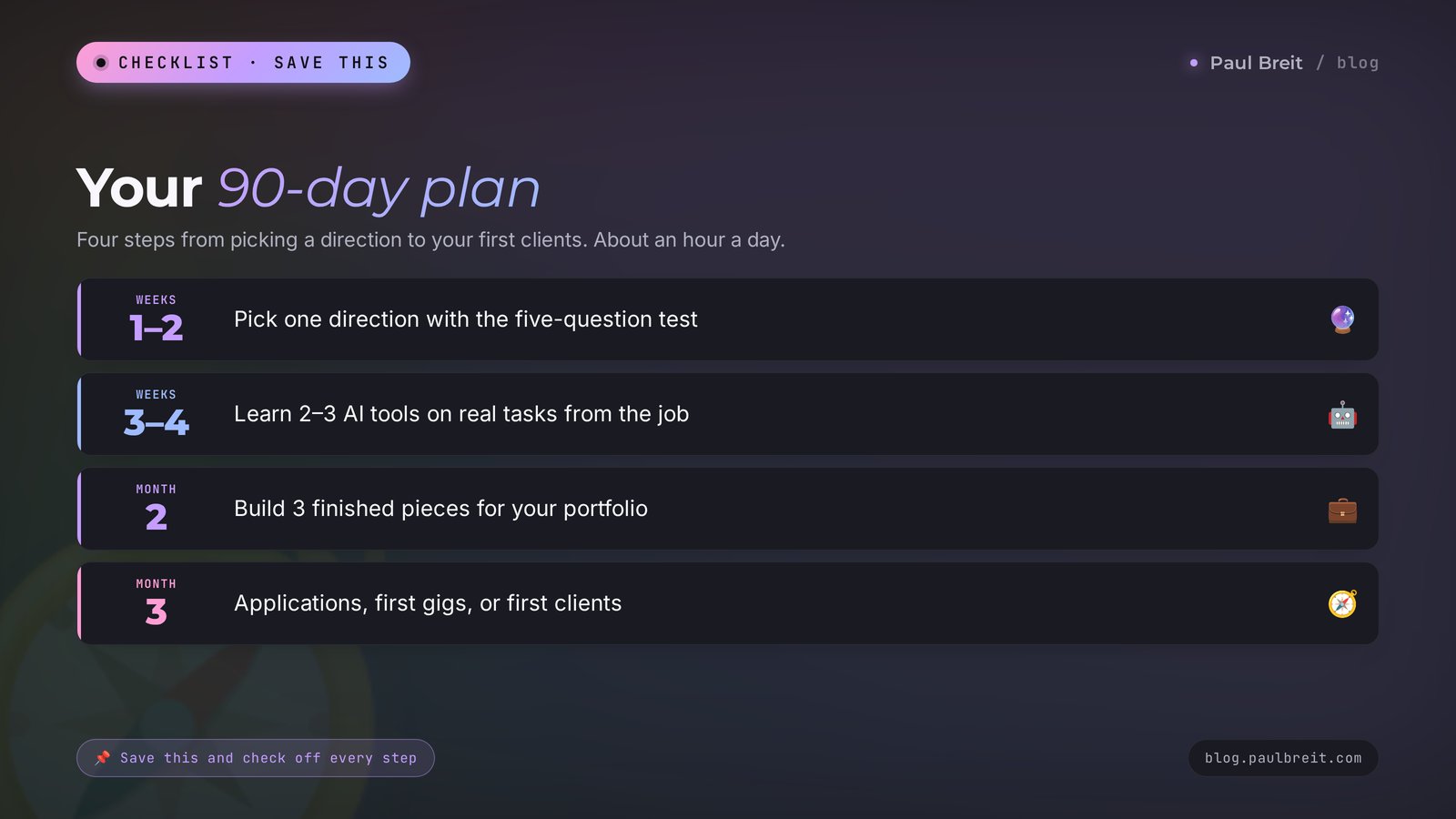
Here's a plan that takes you from "I want a job of the future" to your first income. It's built for an hour to an hour and a half a day.
Weeks 1–2: choose a direction
- Answer the five questions from Section 06 in writing.
- Run the AI conversation from Section 07 and get 5 job options.
- For each option, look at 20 fresh postings on LinkedIn or Indeed and write down the requirements that keep repeating.
- Pick one direction. One, not three.
Weeks 3–4: core tools
- Learn the 2–3 AI tools your chosen job needs: one general-purpose tool for writing and analysis, the rest for the job's specifics.
- Every day, solve one real task from the job with AI.
- Build your own library of prompts that work; our AI prompt library is a good place to start.
Month 2: portfolio
- Make 3 finished pieces that show results: product listings, a content plan with posts, a data report, a chatbot for a business you know.
- Ask two or three entrepreneurs you know for a real task, free or for a token fee, in exchange for a testimonial.
- Update your resume or profile: describe experience through results and put your AI skills in a separate section.
Month 3: first income
- Every day, send 5–10 personalized applications to job postings or proposals on freelance platforms.
- Tell people about your new service on social media and in person: first clients often come from your own circle.
- After every rejection, ask AI to review your application and improve it.
Section 12If something goes wrong
The AI gives generic advice instead of a concrete plan. Add more facts about yourself to the prompt: city, age, years of experience, how much you're willing to spend on learning. And ask: "Keep asking me questions until you fully understand my situation." The more the AI knows, the more precise its advice.
All the options look equally interesting. Test each one in a single evening: ask the AI for a typical task from that job and do it. After three evenings it's usually clear what lights you up and what makes you yawn.
No time to study. Build AI into the job you have now. The report, email, or spreadsheet you'd do anyway – do it with AI. That way you learn on work time and save hours right away.
Nobody replies to your applications. Most likely the application is generic or your resume doesn't show AI skills. Show the AI the posting and your resume and ask it to rewrite the resume for that posting. Add a link to a portfolio with three pieces.
You're afraid it's too late at your age. Employers increasingly value experience and responsibility, and AI evens out the speed of younger and older workers. Many of my clients started after 40 and 50, and their life experience helped them understand clients better than people in their twenties.
The AI is unavailable or slow. Keep a second AI in reserve. Options that cost nothing are in free AI tools.
Section 13The whole path in a minute
- By 2030 the world will gain 170 million new jobs and lose 92 million, and 39% of skills will change.
- Employers pay a premium for AI skills: in one tracked market, AI-skill postings grew 2.7x in a year.
- Jobs built on repetitive operations are shrinking: cashiers, data entry clerks, administrative assistants, bank tellers.
- Growing: technical jobs, everyday jobs supercharged by AI, and care jobs.
- Open without coding: client manager, online marketplace manager, social media, AI assistant, AI agent operator, marketer, designer, mentor.
- Choose your job through your experience and interests; AI will help you find options and build a plan.
- Key skills: briefing AI, checking its answers, learning for life.
- 90 days: choose, learn the tools, build a portfolio, earn the first money.
FAQFrequently asked questions
Which jobs will be in demand in the future?
According to the WEF, the fastest-growing jobs through 2030 are big data specialists, fintech engineers, AI and machine learning specialists, software developers, cybersecurity specialists, green energy engineers, and UX designers. Job boards show the most AI-skill postings for client managers, marketers, content managers, designers, and online marketplace managers. Care jobs are growing too: nurses, psychologists, social workers.
Which jobs will AI replace?
The jobs shrinking fastest are built on repetitive, rule-based operations: data entry clerks, cashiers, bank tellers, administrative assistants, postal service clerks, bookkeeping clerks. Very few jobs disappear completely; more often their tasks change, and the people who start working alongside AI come out ahead.
Which jobs of the future don't require coding?
Client manager with AI, online marketplace manager, content manager and social media specialist, AI assistant, AI agent operator, digital marketer, designer with AI, online mentor. The barrier to entry is low or medium, and first income is realistic within 1–3 months.
How much more do people with AI skills earn?
Job board data from Avito Jobs for the first half of 2026 shows marketing, advertising, and PR specialists with AI skills were offered about 77% more per month than those without. In legal work the premium was 32%, in insurance 20%. Exact pay depends on your market, so check fresh postings where you live.
How does an adult choose a job of the future?
Start with your experience and interests: what you do better than most, what you like working with, how much time you can put into learning, and what income you need a year from now. Then ask AI to suggest 5 jobs where your experience gives you an edge and to build a 90-day plan. Check the options against fresh postings on LinkedIn or Indeed.
Which jobs of the future should a child aim for?
Nobody knows the exact list ten years out, so the foundation matters more: math and logic, clear writing and speaking, a second language, working with AI, independent learning, and teamwork. Growing directions include IT and data, engineering and energy, medicine and biotech, and creative jobs that meet technology.
Can I move into a job of the future after 40?
Yes. The fastest path is to add AI to a job you already have experience in. Your experience and understanding of clients become an advantage, and AI evens out your speed with younger specialists. A transition usually takes 2–3 months at an hour a day.
Where do I start learning AI for a new job?
Pick one general-purpose AI for writing and analysis and solve one real task from your current or future job in it every day. Along the way, learn the formula for a good prompt and build a library of prompts that work. After a month, add tools for the job's specifics: images, video, or spreadsheets.