Storytelling with AI: Stories People Read to the End
Storytelling is the skill of telling a story so a person reads it to the end, remembers it, and wants to come to you. Most posts labeled "a story" turn out to be reports: "I did this, I realized that, I recommend it." People scroll past them by the second line. Below is a breakdown of how a story people actually finish is built: five must-have elements, seven proven structures, examples for different niches, and 9 ready-made prompts that help AI pull stories out of you and tell them well.
Storytelling is a way to get an idea across, sell a product, or explain a concept through a story with a hero, a conflict, and a resolution. A story that works rests on five elements: the hero, what the hero wants, an obstacle, a turning point, and a change at the end. AI helps with every step: it interviews you and builds a story bank, picks a structure for your goal, offers a dozen hooks, asks about the details of the scene, and rewrites the draft in your voice. The facts, emotions, and details always come from your life and your clients' lives.
Everyone who sells services, courses, and consulting and runs a blog or a social account. The therapist who is afraid to talk about clients and doesn't know how to do it with care. The nutritionist and the trainer who have hundreds of before-and-after stories, yet their posts come out as dry advice. The tutor, coach, and mentor who need to warm up an audience before a launch. The freelancer who wants a client to choose them from a single portfolio post. And anyone just starting out who thinks they have nothing to tell yet.
What's inside
- What storytelling is, in plain words
- 5 elements every story needs
- 7 storytelling structures
- Types of stories for your blog and sales
- A storytelling example: breaking down one of my stories
- Story starters for 6 niches
- Which AI to use and how to start
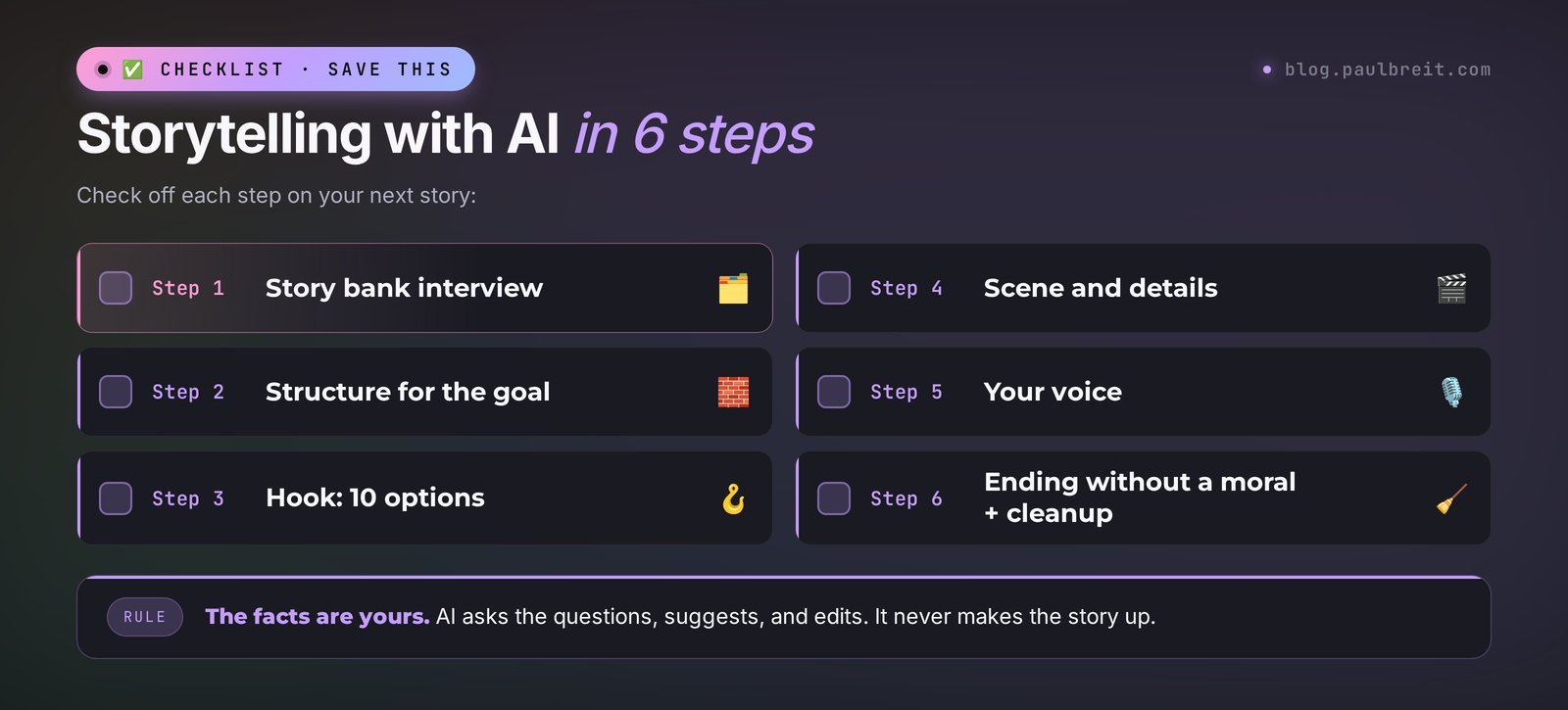
- Step 1. A story bank: AI interviews you
- Step 2. Pick a structure for the goal
- Step 3. The hook: your first two lines
- Step 4. Scene and details
- Step 5. Your voice instead of the AI's
- Step 6. The ending and the cleanup
- A live example: from a raw fact to a post
- Storytelling in posts, reels, emails, and launches
- If something goes wrong
- 9 storytelling mistakes
- The whole path in a minute
Here's how it usually goes. You sit down to write a post, remember that "stories sell," and write: "Today I want to tell you a story. A client came to me recently wanting help with her relationships. We worked through her beliefs, and three months later she got married. If you want the same…" You publish it. Three reactions, zero inquiries. And you conclude that storytelling is for charismatic influencers and just isn't for you.
The trouble is that what you wrote is a summary: who came in, what you did, how it ended. There's no person to root for, no moment where everything could have gone wrong, not a single detail you can picture. The reader has no time to feel anything, because you gave away the ending right at the start.
The good news: storytelling is a craft, and a craft can be learned. Every story people finish has the same skeleton. You can take it apart, learn it in an evening, and then build stories from a template. AI takes over the most tedious part: it pulls details out of your memory, suggests a structure, and drafts options for the first line. It won't write stories for you out of thin air, and that's how it should be. I'll explain why below.
Section 01What storytelling is, in plain words
Storytelling is getting an idea across through a story instead of stating it head-on. Instead of "consistency beats motivation," you tell how you waited three months for inspiration to start your blog, while a colleague who had none at all gained two thousand followers in that time, simply because he posted every day at 9 a.m. Same idea. You'll forget the first sentence in a minute. The second one you'll remember, and maybe forward to a friend.
In marketing, storytelling does three jobs:
- It grabs attention. The feed is packed with tips and lists. A story with a lively opening stands out, and people start reading.
- It builds trust. Anyone can give advice. A story about how you got it wrong yourself, or how a client went from a problem to a result, shows that you've been through it and know what you're talking about.
- It sells without pressure. When a person recognizes themselves in the hero, you don't need to prove the product will help. They fill in the rest on their own: "that's me, so it'll work for me too."
Why do people finish stories and scroll past advice? Someone reading a story wants to know how it ends. Until they know, a small open question hangs inside them and pulls them further down the text. A list of tips doesn't create that question: you read the first item, get the idea, and leave. The whole technique of storytelling comes down to opening that question in the first line and closing it in the last.
One more thing. Storytelling doesn't have to mean a long text. A good story fits into five sentences of a post, thirty seconds of a reel, one paragraph of an email. The platform sets the length. The skeleton stays the same everywhere.
Section 025 elements every story needs
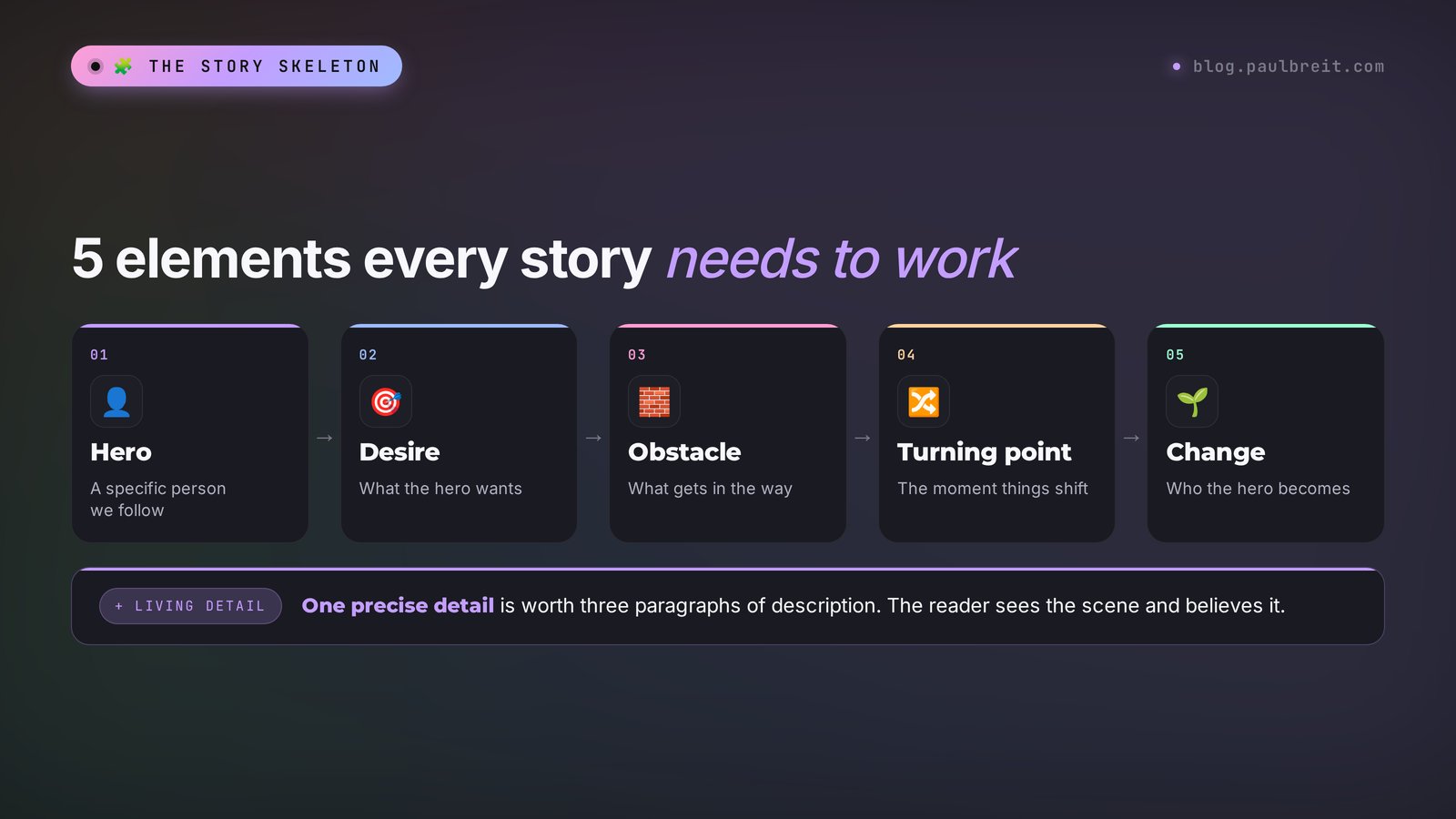
Take any story that hooked you: a movie, a joke, a friend's tale over dinner. You'll find five things in it every time. Take away even one, and the story collapses into a list of events.
1. The hero
The person we follow. It can be you, your client, someone you know, even your reader if you write in the second person. What matters is that it's a specific person with a name, or at least a recognizable detail: "Marina, an accountant who'd spent three years promising herself she'd switch to nutrition coaching." "One of my clients" works too, but then the detail has to show up in the very next sentence, or the hero stays invisible.
2. Desire
What the hero wants. Without a desire the story has no direction, and the reader can't tell what to root for. "She wanted to reach $1,300 a month so she could quit her job by summer," "he wanted just one post to bring in one inquiry." The desire should be clear to the reader and, ideally, match their own. Then they look at the hero and see themselves.
3. The obstacle
What stands in the way. This is the heart of the story. If the hero wanted something and got it right away, the reader sees an ad and leaves. The obstacle can be external (no money, no clients, a competitor undercutting prices) or internal (fear of being seen, the feeling of "I'm no expert," burnout). The strongest stories are built on an internal obstacle, because everyone recognizes it.
4. The turning point
The moment something shifts. The hero learns something new, makes a decision, makes a mistake, meets someone, tries a different approach. In sales storytelling, the turning point is almost always tied to your method or product: "and then we did the one thing she'd been putting off for three years." The turning point should be a concrete action that the reader can repeat, or want to repeat with you.
5. Change
How it all ended and who the hero became. Change can be external (the first three inquiries in a week, 18 pounds down, 2,000 followers) or internal (she stopped being afraid to name her price, took her first vacation in a year). The pairing works best: a number plus how life changed. "She got to $1,600 a month and in May, for the first time in five years, went to the beach on a weekday."
There's a sixth element that isn't part of the skeleton but brings the story to life: the detail. The smell of coffee at 6 a.m. A text from her husband: "So, when are we seeing results?" The expense spreadsheet she's scared to open. One precise detail is worth three paragraphs of description. The reader sees the scene and believes it really happened.
A quick check for any draft: read it and answer five questions. Who is the hero? What did they want? What stood in the way? What changed, and why? Who did they become at the end? If a question has no answer, you've found a hole. Usually it's the obstacle that's missing: authors are shy about showing that things were hard, so they write "she came in, we did the work, it worked."
Section 037 storytelling structures
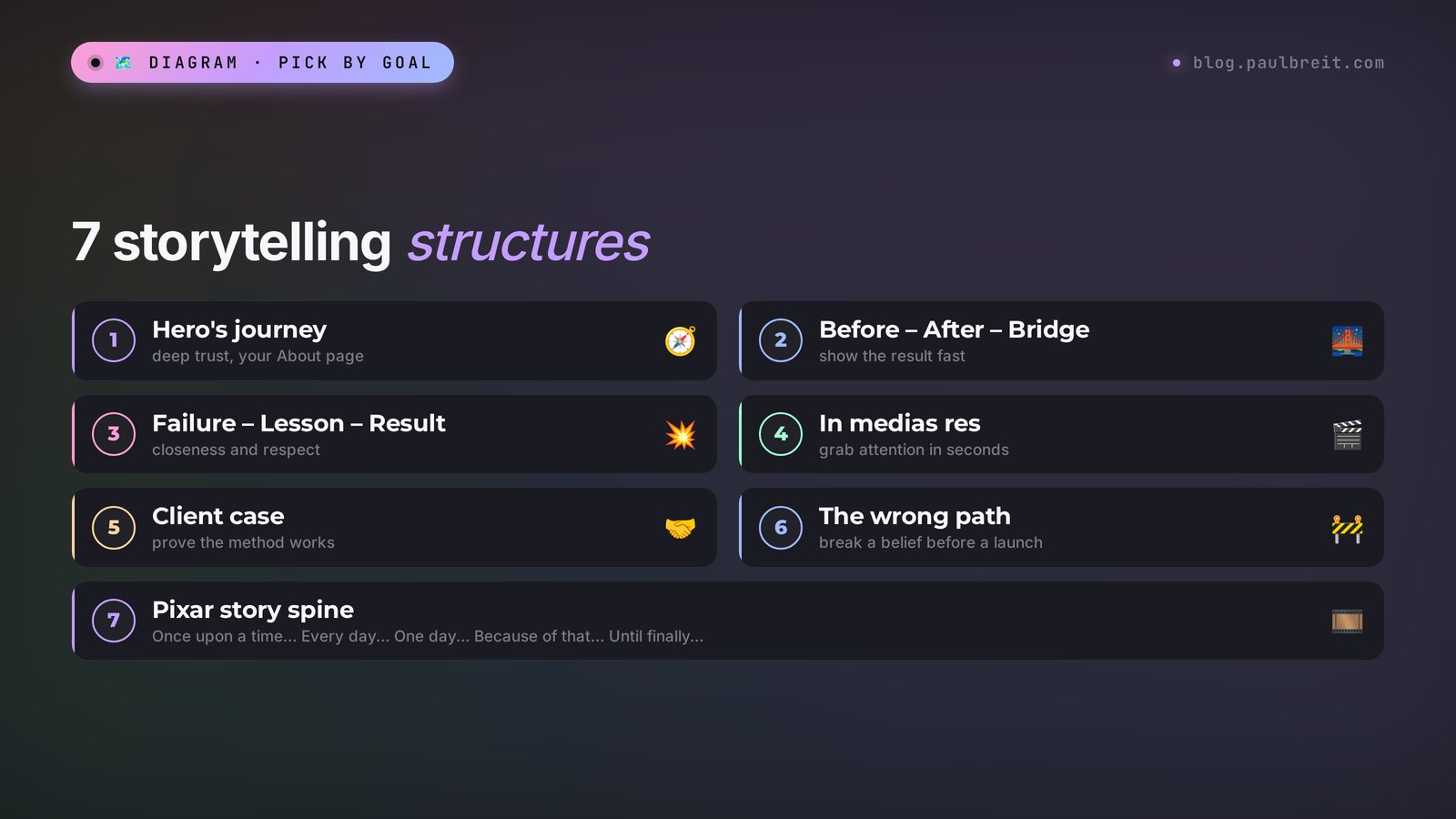
A structure is the order in which you lay out the five elements. The same plot can be told in different ways, and the order decides whether people read to the end. Here are seven structures that cover almost every blogging and sales task.
1. The hero's journey
The classic, described by mythology scholar Joseph Campbell and later adopted by Hollywood. The full version has more than a dozen stages; for a blog, the simplified one is plenty: ordinary life → a call to action → resistance and doubt → a mentor or a new approach → trials → victory → coming back a different person. It fits big stories: how you got into your profession, a client's story over six months of work, a long introduction post, your About page.
2. Before – After – Bridge
Three parts: how bad it was, how good it got, and what helped bridge the gap. It's the shortest sales structure, and advertisers love it. "For six months I posted into the void: 40 views and not one inquiry. Now every post brings 2–3 DMs. One thing changed: I started every post with a client story." It fits ad copy, short posts, photo captions, and the first three seconds of a reel.
3. Failure – Lesson – Result
You tell how you messed up, what you realized, and what you changed. The strongest structure for trust: people like authors who admit mistakes, and that brings them closer than any credentials. "I spent $2,700 on ads for a launch that didn't sell a single spot. The lesson turned out to be simple and painful…" It fits a personal blog, launch warm-ups, and introduction posts.
4. In medias res
You open with the sharpest moment and then rewind: "I was standing at the airport with my phone in my hand, staring at an empty wallet." The reader is dropped right into the action and needs to know how the hero got there. Film people call this in medias res, Latin for "into the middle of things." It fits reels, where you have three seconds to earn attention, and posts that need to stand out in the feed.
5. The client case
A version of the hero's journey where the client is the hero and you're the mentor. Point A with a specific number and pain, what they tried before you and why it didn't work, what you did together, point B with a number and a timeframe, and a quote from the client. The main rule: the method is yours, the client put it to work. There's a detailed guide on packaging a case in the article on how to write a case study.
6. The wrong path
The hero spends a long time walking down the wrong road, sure it's the right one. They do what everyone does: discounts, free challenges, yet another course. And it doesn't work. Then it turns out the problem was somewhere else entirely. This structure sells well, because the reader recognizes themselves on the wrong path and wants to find out where the right one was. It fits a warm-up before a launch and posts that break common beliefs.
7. The Pixar story spine
A template that spread around the world thanks to Pixar's storytelling rules. Five sentence starters: "Once upon a time… Every day… One day… Because of that… Until finally…" It's the simplest way to put together the skeleton of any story fast. Fill in the five blanks and your draft is ready. It fits beginners and short stories for Instagram Stories.
| Structure | Goal | Where it works best | Length |
|---|---|---|---|
| Hero's journey | Deep trust, getting to know you | Introduction post, About page, webinar | Long |
| Before – After – Bridge | Show the result fast | Ads, short post, reel | Short |
| Failure – Lesson – Result | Build closeness and respect | Personal blog, warm-up | Medium |
| In medias res | Grab attention | Reel, first post in a series | Any |
| Client case | Prove the method works | Sales post, landing page, follow-up | Medium |
| The wrong path | Break a belief, lead to the product | Warm-up before a launch | Medium |
| Pixar story spine | Build a skeleton fast | Stories, a draft for any story | Short |
Section 04Types of stories for your blog and sales
Structure answers the question "in what order do I tell it." The type of story answers "what is it about." For anyone who sells services, courses, and consulting, five types work, and a good blog rotates between them.
- The personal story. Your path, your mistakes, your odd habits, things that happened to you. It answers "who are you, and why should I trust you." Without it you stay a faceless specialist among a hundred lookalikes.
- The client story. The journey of someone who came to you with a problem. It's the strongest proof, because another person's result speaks for you. Therapists and doctors need to be careful here: change names and any details that could identify the person, and ask for permission.
- The product story. Why you created this course or service, what about your market made you angry, which gap you're filling. It works well at the start of a launch.
- The observation. A scene you witnessed: a conversation in a café, a friend's text thread, something that happened in line. From it you draw an idea that's useful to the reader. It's a lifesaver for people who think nothing interesting ever happens to them.
- The reader's story. You tell the story in the second person: "You wake up at seven, grab your phone, and see…" The reader becomes the hero. It works in ads and warm-ups, but the trick wears thin quickly, so keep it to one post in ten.
And an important note on honesty. All five types are built on real events. A made-up client story, even a "composite" one, will surface sooner or later: someone asks for the client's contact, someone recognizes the wording from another person's post. After that, people stop believing your real cases too. If you need to change a story for anonymity, change the name, city, and profession, and keep the substance and the numbers.
Section 05A storytelling example: breaking down one of my stories
It's better to take apart one real text than to retell the theory ten times. Here's a story I told on my blog at the end of 2020. The headline of the post was:
"I lost $52,000 to a hack and didn't notice for 2.5 years."
Here's what happened, briefly. In 2015 a friend told me about bitcoin, and I bought a little at $250 a coin. I didn't dig into it and decided to trust my friend. To spread the risk, I opened three wallets on different exchanges and promised myself not to touch them for five years, the same way I do with stocks. In July 2018 someone hacked one of the wallets and withdrew 1.8 bitcoin. I didn't notice. In December 2020 the five years were up, bitcoin had grown a hundredfold, I logged in to sell, and found an empty wallet. At that point those 1.8 bitcoin were worth about $52,000.
Now look at how it breaks down into elements.
| Element | What's in the story | Why it's there |
|---|---|---|
| Hook | "Lost $52,000, noticed 2.5 years later" | A number plus an absurdity: how can anyone miss that kind of money? The question is open, and you want to keep reading |
| Hero | Me, a person who considered himself careful | The reader recognizes themselves: we all think we've covered our bases |
| Desire | To earn money calmly, without stressing every day | Clear and familiar to everyone |
| Obstacle | Overconfidence: I didn't do my homework and trusted a friend | An internal obstacle, which people recognize more strongly than an external one |
| Turning point | An empty wallet in December 2020 | The very moment people read to the end for |
| Change | The takeaway: crypto plays by different rules than stocks | The reader leaves with a lesson they can apply to their own life |
| Detail | Three wallets "for safety" and a promise not to touch them for five years | The irony: it was the caution itself that kept me from noticing |
The post ended with a question: "Have you ever lost money? Or am I the only lucky one here?" It's a simple question that people want to answer, and the comments turn into a continuation of the story, told by the readers this time.
And now the most interesting part: what this story taught me six years later. In the summer of 2026 I retold it from memory and got almost everything wrong: the year I bought, the price, where the money was when it was stolen, and how long I didn't know. In my memory I had inflated the amount almost twofold. And I was sure I remembered it exactly. What saved me was the post I'd written while it was still fresh.
Memory rewrites stories, and most often it rewrites them toward drama. If you tell stories about your clients and yourself from memory a year later, the numbers will drift, and one day someone will notice. Write stories down right away, while they're fresh: the date, the numbers, the exact words. In Step 1 below, I'll show you how to do it with AI in five minutes a week.
Section 06Story starters for 6 niches
The most common storytelling complaint goes like this: "I don't have any stories." You do. You just find them boring, because you see them every day. Here are starters that almost everyone in each niche has. They're hints about where to look; you'll write the actual text yourself. Plug in your own real case.
| Niche | A mistake story | A client story | An observation |
|---|---|---|---|
| Therapist | How you put off seeing a therapist yourself for years, even though you knew you needed to | A client came in with one issue, and the real problem turned out to be somewhere else | A phrase you overheard in a café that gives away learned helplessness |
| Nutritionist | Your first diet, the one you broke after a week | The client who stopped weighing herself and finally started losing weight | What's in the cart of the person ahead of you at the grocery store |
| Fitness trainer | The injury you got because you trained through pain | The client who went to the gym for six months with no results until he changed one thing | A beginner at the gym doing an exercise the way you did when you started |
| Tutor | Your worst lesson and what you changed after it | The student who was scared of math and aced her final exam | Parents talking about grades and tutors outside the school |
| Coach, mentor | The launch that didn't sell, and why | The client who kept hitting an income ceiling and broke through it | A colleague's post that got a thousand reactions, and what made it work |
| Freelancer | The project where you lost money because you had no contract | The client who came to you after three failed contractors | A job posting that reveals what clients actually want |
See what they have in common? None of these stories requires a heroic feat, a move to Bali, or a million in the bank. All it takes is an ordinary work situation and honesty about what was hard. Those are exactly the stories readers recognize, because the same thing happened to them.
Section 07Which AI to use and how to start
For storytelling, you need AI in the role of an editor and an interviewer. Two things matter: how naturally it writes, and how well it holds a long conversation where you keep adding details. Here's what I'd pick in 2026.
| AI | Strength for stories | Price |
|---|---|---|
| Claude | The most natural, human-sounding text; picks up your voice from examples better than the rest; holds a long conversation | Free plan available, Pro about $20 a month |
| ChatGPT | Good at generating hook and structure options, cycles through ideas quickly | Free plan available, Plus about $20 a month |
| Gemini | Works alongside Google Docs and Gmail, handy if your drafts already live there | Free plan available, paid plans for heavier use |
| Microsoft Copilot | Convenient for quick edits right inside Word and on your phone | Free plan available, paid plans for heavier use |
My pick for stories is Claude. It slips into a slick "advertising" tone less often than the others and adapts to your style best once you show it five to ten of your posts. The prompts below work in any of these tools, so start with whichever one you already use. There's a closer look at which model writes the most natural text in the best AI for writing, and a full roundup for different tasks in the best AI tools of 2026.
How to start with Claude
Open claude.ai and sign up. A Google account or an email address is enough. There's also a mobile app if you'd rather dictate your stories on the go.
Start on the free plan. For storytelling, it's enough for a few stories a day. If you end up writing every day, the Pro plan costs about $20 a month.
Keep your stories in one place. On a paid plan you can create a project and store your story bank and sample posts there, so you don't have to paste them in every time. If you're brand new to Claude, the guide Claude from scratch walks you through the basics.
Section 08Step 1. A story bank: AI interviews you
The main mistake almost everyone makes: opening an AI chat and typing "write me a sales story for a therapist." The AI dutifully invents Anna, 34, who "found harmony." The reader smells something fake by line two, because there was no Anna, and every detail in the text is generic, like a brochure.
The right order is the reverse. First, AI pulls stories out of you by asking questions, and only then does it help you tell them. You'll be surprised how much you remember when someone asks the right questions. Open a new chat and paste:
You're an experienced editor and interviewer. Help me build a bank of
real stories for my blog. I'm [who you are and what you do, e.g.: a
therapist, I work with anxiety, 6 years in practice].

Ask me questions one at a time, wait for my answer, and only then ask
the next one. Ask about:
- my mistakes and failures at work;
- clients who got a noticeable result (I'll change their names);
- moments when I wanted to quit;
- strange and funny things that happened at work;
- what drives me crazy in my niche.

If my answer is vague, dig deeper: when it happened, what the numbers
were, what exactly the person said, how I felt. Don't make anything up
for me. After 10 questions, put my answers into a table: story, date,
numbers, an exact quote, and the idea this story could get across.
Then the conversation starts. Here's what it looks like in practice (a sample exchange with Claude):
Claude: Tell me about the client with the most unexpected result. The one even you didn't see coming.
You: There was a woman who came in with panic attacks. A couple of months later they were almost gone.
Claude: What was unexpected about it? Do you remember your first session: what she said, how she looked, what her first sentence was?
You: She started by apologizing for taking up my time. She said, "Other people have real problems, and here I am with my silly stuff." The unexpected part was that the attacks went away once she stopped apologizing at work. We never even planned for that.
Claude: That's a strong detail. How much time passed between your first session and the moment she noticed it? And what exactly did she stop doing at work?
Feel the difference? "Came in with panic attacks, two months later they were gone" turned into a story with a heroine who apologizes for existing and a turning point nobody expected. Now that's something you can tell. And not a single made-up detail.
Do this once a week for 15–20 minutes. Save the story table in a separate document, or in a Claude project if you're on a paid plan. In a month you'll have 30–40 stories, and "what do I post about" stops being a question. If you want to tie your story bank to a publishing plan, take a look at the article on a month's content plan in one evening.
The second prompt: stories from old conversations
For many people, the best stories are sitting in their messages with clients, in reviews, and in voice notes. Pull a few reviews or screenshots of conversations (with contact details removed), paste them into the chat, and ask:
Here are reviews and excerpts from my conversations with clients.
Find 5 stories in them that I could tell on my blog. For each one,
write down:
- the problem the person came with (in their own words);
- the moment everything changed;
- the result with a number, if there is one;
- one exact quote from the client that hits hardest.
If something is missing for a complete story, tell me what question
to ask the client to find out. Don't fill in any gaps yourself.
Section 09Step 2. Pick a structure for the goal
You've got a story. Now decide why you're telling it. The same story about the client with panic attacks could become an introduction post, a pre-launch warm-up, or a short reel, and each goal needs its own structure. Ask the AI to choose:
Here's my story: [paste a story from your bank with dates, numbers,
and exact quotes].

Goal of the post: [e.g.: warm up my audience before launching a group
program on anxiety / introduce myself to new followers / get
consultation requests].
Platform: [blog / Instagram / newsletter / reel].

Suggest 3 storytelling structures that fit this goal (hero's journey,
Before – After – Bridge, Failure – Lesson – Result, in medias res,
client case, the wrong path, Pixar story spine). For each one, show
the skeleton of my story in 5–6 lines: what comes first, where the
turning point is, how it ends. Tell me which one you'd pick and why.
The AI will show you three skeletons. Pick the one you yourself want to read to the end. It's the best test: if a skeleton bores you, it'll bore the reader twice as much.
A couple of tips if you're unsure. For reels, in medias res almost always wins, because the first seconds decide whether people keep watching. For a pre-launch warm-up, the wrong path and Failure – Lesson – Result work best: they lead to the idea that a different approach is needed. For the sales post on opening day, use a client case. How to build a whole series out of stories like these is covered in detail in the warm-up series: 5 nurture posts in one evening with AI.
Section 10Step 3. The hook: your first two lines
The hook is the first sentence, and it decides the fate of the entire story. On LinkedIn people see two or three lines before "see more," on Instagram just one or two. If those lines don't grab them, nobody sees the rest of the text, however brilliant it is.
A good hook opens that same unanswered question. Here are the mechanics that work:
- A number and an absurdity. "I lost $52,000 to a hack and noticed 2.5 years later." The number makes it concrete, and the absurdity raises the question "how is that even possible?"
- A confession. "I'm about to say something that works against me." The reader wants to know why the author is going against his own interest.
- Someone else's words. "A client opened our first session with: other people have real problems." Direct speech builds a scene instantly.
- The middle of the action. "I deleted a channel with 3,000 subscribers at 2 a.m." The reader is already inside the story and needs to know how it came to that.
- A hit to a belief. "My best-selling posts were written in ten minutes in the back of a cab." It argues with what the reader believes.
Ask the AI for options, and always more than three. Its first ideas, like a person's, are the most predictable. The best ones show up around option seven to ten.
Here's a draft of my story: [paste].
Come up with 10 options for the first line (the hook). Requirements:
- 15 words or fewer;
- the hook includes a number, the hero's exact words, or the sharpest
  moment of the story;
- after reading it, you want to know what happened next;
- no "Did you know…?" questions and no words like "story" or "I want
  to tell you";
- only facts from my story, don't invent anything.
Mark the three strongest and explain what question each one opens up
in the reader's head.
Out of ten options, pick the boldest one, the one that makes you a little uncomfortable. If you catch yourself thinking "that's too much," it's probably the hook that works. A bland hook you'd never be embarrassed by usually goes unnoticed. More first-line examples are collected in social media prompts.
Section 11Step 4. Scene and details
This is where most stories die. The author knows how it all happened and can see the picture in their head, yet all that makes it onto the page is a dry "it was hard, but I got through it." The reader sees nothing, so they feel nothing.
The rule is simple: show the scene and let the reader see it for themselves. Instead of "I was really nervous before my first livestream," write "an hour before the livestream I moved my laptop onto a stack of books for the third time, because from below I seemed to have two chins." Instead of "the client was desperate," write "he texted me at 11:40 p.m.: 'If this doesn't work either, I'm shutting the project down.'"
Where do the details come from? From your memory, but memory needs to be stirred with questions. That's a job for AI:
Here's my story: [paste the draft].
Find 5 places where I describe feelings or events in general terms
(it was hard, I was worried, the client was happy). For each place,
ask me 2–3 questions that will help me remember a specific detail:
what I saw, what I heard, what was in my hands, what time of day it
was, what was said word for word. Ask about one place at a time.
After I answer, show me how that place reads with the detail added.
Take details only from my answers.
One or two strong details per post is enough. Cram a detail into every sentence and the text gets heavy, like a bad novel. You need details at two points: at the start, so the reader sees the hero, and at the turning point, so they feel that something has changed.
Dialogue instead of summary
Another way to bring a scene to life is to let the characters speak. One line of direct speech is stronger than a paragraph of summary. Compare: "My husband didn't believe in my project" and "My husband looked at my spreadsheet of ad spend and asked, 'So when does all this start paying off?'" In the second version you hear the tone, see the spreadsheet, and understand that the heroine felt awful in that moment. Just remember: use real lines, from memory or from your messages. If you don't remember the exact words, paraphrase them.
Section 12Step 5. Your voice instead of the AI's
You have the story, the structure, the hook, and the details. Now you can ask the AI to put together a draft. But if you just type "write the post," you'll get a smooth, correct, and completely foreign text. People spot it by the stiff transitions, the even rhythm, and the moral at the end. Your followers know how you write, and they'll sense the swap.
For AI to write in your voice, it needs samples. Gather 5–10 of your own posts that you like, and paste them at the start of the conversation:
Here are 7 of my posts. Study how I write: sentence length, the words
I like, how I open and close, how I joke, where I use emoji.
[paste posts]

Now turn this story into a post for my blog:
[paste the story with details]
Structure: [the structure and skeleton you chose in step 2].
Hook: [the hook you chose in step 3].

Rules:
- write in my voice, like in the samples;
- address the reader as "you";
- short paragraphs of 2–3 sentences;
- don't add facts, numbers, or quotes that aren't in the story;
- end without a moral: an action, a question, or a fact;
- no stiff transitions and no advertising clichés.
If you write often, do this properly once: ask the AI to build a "voice profile" from your posts and save it. A detailed walkthrough of the 30-post method is in the article how to teach AI to write in your voice.
Section 13Step 6. The ending and the cleanup
The ending is the second most important point of a story after the hook. It's also where things most often go wrong: people tack on a moral. "So, friends, it's important to believe in yourself." "This story teaches us that…" The reader already got the idea while reading, and a moral at the end sounds like a teacher explaining a joke. A strong story ends in one of three ways:
- With a fact. "A month later she doubled her price. Everyone on the waitlist signed up."
- With an action for the reader. "If this sounds like you, DM me the word ANXIETY and I'll tell you where to start."
- With an inviting question. "Have you ever lost money? Or am I the only lucky one here?"
Once the draft is ready, it needs a cleanup. Even with voice samples, AI leaves traces: a rhythm that's too even, lists of three, contrasts, stiff transitions. Run the draft through this prompt:
Review this post like a strict editor. Find and list:
1. Phrases that sound like an ad or like AI-written text.
2. A moral or takeaway at the end that could be cut.
3. Places where the reader could get confused: who said this, who
   "she" refers to, where a number came from.
4. Sentences without details that can be cut with no loss of meaning.
5. The same word repeated in neighboring sentences.
For each finding, suggest a rewrite in my voice.
Don't change facts or numbers.
[paste the draft]
And one last thing: read the text out loud. Really, out loud, even in a whisper. Wherever you stumble, the text is clumsy. Wherever you got bored, cut. This check takes two minutes and catches what no editor sees. The full list of markers readers use to spot AI writing is in the article on how to remove AI traces from your writing.
Section 14A live example: from a raw fact to a post
Now I'll show you the whole path on a single example. Let's take a nutritionist who runs a blog and is getting ready to launch a group coaching program. Below is how the work with AI goes, step by step. The numbers and quotes in this example are for illustration; you'll plug in your own real ones.
The source: what the author had
After the interview with AI, the story bank has this entry: "Client, 41, accountant. Came to me after five diets. Lost weight, slipped, gained it back. The first thing I did was ban her from weighing herself for a month. She cried. A month later, down 6.5 pounds; four months later, down 24. She said: 'For the first time, I eat without feeling like a criminal.'"
Step 2: structure
The AI suggested three options, and the author picked the wrong path: five diets are the wrong road his followers will recognize, and the ban on the scale is the unexpected turning point that leads to his method. This is a warm-up post, two weeks before sales open.
Step 3: hook
Out of the AI's ten options, the author picked this one: "The first thing I did with a client who wanted to lose weight was take away her scale. She burst into tears."
Step 4: details
Answering the AI's questions, the author remembered: the scale sat in her bathroom, she weighed herself every morning before coffee, and the number decided whether the day was "good" or "bad." She handed the scale to her husband, and he hid it in the garage. Those two details went into the text.
Steps 5 and 6: draft, voice, and cleanup
The AI assembled a draft based on the author's sample posts. The first version ended with "Remember: health starts with loving yourself." The editor prompt flagged it as a moral, and the author replaced it with an action. Here's the final result:
The first thing I did with a client who wanted to lose weight was take away her scale. She burst into tears.
She's 41, an accountant, and by the time we met she had five diets behind her. Keto, intermittent fasting, counting calories in an app, and two more trendy plans. On every one she lost weight, slipped, and gained it back, sometimes even more.
The scale sat in her bathroom. Every morning before coffee she stepped on it, and the number decided what kind of day it would be. Down half a pound – a good day. Up half a pound – a bad one, and she might as well stop trying, the day was ruined anyway.
I asked her not to weigh herself for a month. At all. She handed the scale to her husband, and he hid it in the garage.
A month later we weighed in together: down 6.5 pounds. Four months later, down 24. Without a single diet, eating the same regular food she cooked for her whole family.
At our last session she said: "For the first time, I eat without feeling like a criminal."
If you also step on the scale every morning and let the number decide whether it's a good day, DM me the word SCALE. I'll tell you where to start without another diet.
Take apart what's working here. A hook with an action and an emotion in the first line. A heroine with an age, a profession, and five diets, whom readers recognize. A wrong path familiar to anyone who's ever tried to lose weight. The detail of the scale in the bathroom and the "good" and "bad" days. A turning point you'd never expect from a nutritionist. A result with two numbers and timeframes. The client's exact words. And an action-based ending that brings us back to the scale from the opening. Not one moral, not one "it's important to understand."
The whole path from the story bank entry to the finished post took the author about 25 minutes. Without AI it would have taken an evening, and most likely the result would have been a summary instead of a story: "client lost 24 pounds without dieting."
Section 15Storytelling in posts, reels, emails, and launches
The skeleton of a story is the same everywhere, but each platform sets its own length and pace. Here's how to adapt one and the same story.
A post on your blog or social media
The most comfortable format for stories: people read here and take their time. Aim for 150–300 words, paragraphs of 2–3 sentences, and a hook in the first two lines, because those are what people see before "more." One story per post. If you have two stories, that's two posts.
Reels and short videos
Here you have seconds, so in medias res almost always works: open with the sharpest moment, then quickly rewind. A script for a 30–60 second reel is roughly 80–150 words. Write the way you speak: short sentences, nothing convoluted. Ask the AI to cut your post down into a script while keeping the hook, the turning point, and the ending. You can build a month of ready-made scripts with the article on AI for reels.
Here's my post: [paste].
Turn it into a script for a 40-second reel, about 100 words.
Start with the sharpest moment of the story, then briefly explain how
it got there, then the turning point and the ending. Write in
conversational language, the way people talk out loud, in short
sentences. Don't change the facts.
Email newsletter
In an email, the story sits right at the start and pulls the reader toward the link or offer at the end. The subject line works as the hook: it opens a question whose answer is inside the email. "She burst into tears when I took her scale" gets opened; "Why diets don't work" doesn't. How to build emails like this is covered in detail in email newsletters that get read to the end.
Warm-up before a launch
A warm-up is a series of stories where each one has its own job. The first is a failure or a wrong path in which your audience recognizes their problem. The second is a client case that proves there's a way out. The third is the story of how your product was created, explaining why it's built the way it is. The stories don't repeat each other in heroes or in openings. Ask the AI to assign roles to the stories in your bank:
Here's my story bank: [paste the table from step 1].
In two weeks I'm opening sales for [product, price, who it's for].
Pick 4 stories from the bank for a warm-up series:
1. A wrong path or failure in which my audience recognizes their
   problem.
2. A client case with numbers.
3. A story that removes the buyer's main fear.
4. The story of how the product was created.
For each one, say which structure fits and what idea it should leave
the reader with. The stories shouldn't repeat each other.
Webinars and live talks
On a webinar you need a story in the first five minutes, or people wander off to make tea. Your own failure story works best, using Failure – Lesson – Result: it explains why you have the right to teach this topic at all. Save the second story, a client case, for right before the pitch. How to build a full webinar script is covered in the article on a sales webinar with Claude.
| Format | Story length | Best structure | Where the hook goes |
|---|---|---|---|
| Blog or social post | 150–300 words | Any, most often a failure or a case | First 2 lines |
| Reel | 80–150 words | In medias res, Before – After – Bridge | First 2–3 seconds |
| 200–400 words | In medias res, client case | Subject line | |
| Warm-up | 3–5 stories of 200–300 words | Wrong path → case → product story | Each post on its own |
| Webinar | 2–3 minutes per story | Failure – Lesson – Result | First minute |
Section 16If something goes wrong
The AI invents details that never happened. This happens when the prompt doesn't forbid it. Add a line to every prompt: "use only facts from my text; if something is missing, ask me." If an invention still slips through, write: "The text contains details that weren't in my story. List them and remove them."
The story comes out too long. Ask: "Cut it to 200 words. Remove whole details and keep the sentences complete. Keep the hook, the turning point, the numbers, and the ending." Cut by ideas, otherwise the text turns choppy and dry.
The text is smooth and dull, even though all the elements are there. Usually what's missing is conflict: the obstacle is shown too gently. Ask the AI: "Find the hardest moment in the story and ask me what I felt then and what I almost did." An honest answer to that question brings the whole post to life.
It feels like you have no stories at all. Start with an observation: what did you see this week from clients, colleagues, in group chats? Or run the interview prompt from Step 1 and answer the questions honestly. Almost nobody reaches the tenth question without at least three ready stories.
You're afraid to talk about clients. Ask for permission, change the name, city, and profession, and remove any details that could identify the person. Show the client the text before you publish it. Most people agree and are even glad, especially when the story is about their win.
People read the stories but don't buy. Check the ending. If there's no action at the end, the reader closes the post with a nice feeling and leaves. Add a specific call to action with a code word, and check that the story's turning point is connected to what you sell.
Claude says it isn't available where you are. Anthropic serves most countries, though not every one. If yours isn't on the list, work in ChatGPT or Gemini for now: every prompt in this article works there too.
Section 179 storytelling mistakes
- Opening with "I want to tell you a story." That phrase eats your most valuable first lines and opens nothing. Start right with the event.
- Giving away the ending at the start. "How my client lost 24 pounds": the question is closed, there's no reason to read on. Put the question at the start and the answer at the end.
- Hiding the obstacle. A story with no struggle looks like an ad. Show where it was hard and where everything could have fallen apart.
- Making yourself the hero of every story. If you're always the one saving the day, the reader gets tired. Rotate: your failures, your clients' wins, observations.
- Writing in generalities. "It was hard," "I was really worried," "a great result." Every one of those spots is asking for a detail or a number.
- Tacking on a moral. If the idea is clear from the story, a takeaway at the end sounds like a lecture. End with a fact, an action, or a question.
- Asking AI to make up a story. Invented Annas and Marinas are obvious right away, and they kill trust in your real cases. AI interviews and edits; the facts are yours.
- Telling stories from memory a year later. The numbers drift and the details get swapped. Write stories down right away, with dates and exact quotes.
- Not connecting the story to the product. The turning point of a sales story should lead to your method. Otherwise you've just entertained the reader, and they go buy from whoever explained how to solve the problem.
Section 18The whole path in a minute
- Storytelling is delivering an idea through a story. It grabs attention, builds trust, and sells without pressure.
- Every story rests on five elements: hero, desire, obstacle, turning point, change. Plus one or two living details.
- Pick a structure for the goal: the hero's journey, Before – After – Bridge, Failure – Lesson – Result, in medias res, the client case, the wrong path, the Pixar story spine.
- Step 1: once a week, a 15-minute interview with AI; stories go into the bank with dates and numbers.
- Step 2: AI suggests three story skeletons for your goal and platform.
- Step 3: ten hook options, and you take the boldest.
- Step 4: AI asks about the details, and you remember the scene.
- Step 5: a draft based on your sample posts, in your voice.
- Step 6: an ending without a moral, a cleanup with the editor prompt, and a read-through out loud.
- One story can be told in a post, a reel, an email, a warm-up, and a webinar; only the length and the hook's position change.
FAQFrequently asked questions
What is storytelling, in simple terms?
Storytelling is a way to get an idea across through a story instead of direct advice. A story has a hero, what the hero wants, an obstacle, a turning point, and a change at the end. People read this kind of text to the end because they want to know how it turns out, and they remember it better than a list of tips.
What storytelling techniques and structures are there?
For blogging and sales, seven structures are used most often: the hero's journey, Before – After – Bridge, Failure – Lesson – Result, in medias res, the client case, the wrong path, and the Pixar story spine: "Once upon a time… Every day… One day… Because of that… Until finally…" Each one fits its own goal: trust, showing a fast result, grabbing attention, or warming up an audience before a launch.
Can AI write a story for me?
It can, but that story will be made up, and readers will sense it's fake. A better way is to use AI as an interviewer and editor: it asks questions and draws real stories and details out of you, picks a structure, suggests hooks, and rewrites the draft in your voice. The facts, numbers, and quotes come from your life and your clients' lives.
Which AI writes the best stories?
Right now Claude writes the most natural, human-sounding text and matches an author's style from examples best. ChatGPT is good at cycling through hook and structure options. Gemini and Microsoft Copilot are handy if your drafts already live in Google Docs or Word. The prompts in this article work in any of them.
Where do I find stories if it feels like I have nothing to tell?
Everyone has stories: your mistakes at work, clients with noticeable results, moments when you wanted to quit, funny things that happened at work, observations of people. Run a ten-question interview with AI, and by the end you'll almost always have three to five ready stories. Another source is reviews and conversations with clients.
How long should a story in a post be?
For a blog or social post, 150–300 words is ideal; for a 30–60 second reel, 80–150 words; for a newsletter email, 200–400 words. The platform sets the length, and the five-element skeleton stays the same everywhere. Shorten a story by cutting whole details, keeping the hook, the turning point, the numbers, and the ending.
How do I use storytelling in sales?
In a sales story, the turning point is tied to your method or product: the hero tried the usual approaches, they didn't work, and what helped is what you teach. Client cases with numbers and timeframes, wrong-path stories, and your own failures sell best. At the end of the story you need a specific call to action, for example asking people to DM you a code word.
Can I share client stories without their consent?
It's best to always ask for permission, and for therapists, doctors, and lawyers it's a must. Change the name, city, and profession, remove any details that could identify the person, and show the text to the client before publishing. Keep the substance and the numbers real: made-up cases undermine trust in all your other ones.
How is storytelling different from a regular case study?
A regular case study is a summary: point A, what was done, point B. A case told as a story shows the hero, what they wanted, the struggles, the turning point, and the change, with living details and the client's exact words. The reader lives through the story with the hero and recognizes themselves in it, so a case like this sells better.