Personal Brand From Scratch: a Step-by-Step Plan for 2026
A personal brand is when people know you by name, understand what to come to you for, and message you on their own, without any persuading. In 2026 you can build one from zero in 90 days and 20 minutes a day, as long as AI takes over the writing, the ideas, and the routine. Below is the whole path, step by step: positioning, stories, platforms, your profile, content, first followers, and first leads, with ready-to-paste prompts and a three-month plan.
Here's how to build a personal brand from scratch: write your positioning in one sentence (who you help and what result you deliver), collect a bank of 30 personal stories with AI, pick one main platform, set up your profile (name with your niche, a real photo, a clear bio, a pinned intro post, a booking link), post 4–5 times a week from a plan, bring in your first followers through contacts, collabs, and ads, collect reviews and turn them into case studies, and invite people to a specific offer in every fifth post. It takes 90 days and about 20 minutes a day if AI writes the drafts in your voice.
Everyone who sells their knowledge and time: a therapist, a coach, a tutor, a nutritionist, a personal trainer, a lawyer, a bookkeeper, a designer, a stylist, a brow artist, a course creator. And anyone who is just getting ready to earn money online and already senses that without a name, clients don't come to a beginner.
What's inside
- What a personal brand is, in plain words
- How I built a brand while I was camera-shy
- Step 1. Positioning in one sentence
- Step 2. A story bank in one evening
- Step 3. Where to build a personal brand in 2026
- Step 4. Your profile
- Step 5. Content in 20 minutes a day
- Step 6. Your voice in AI
- Step 7. Your first followers
- Step 8. Case studies and reviews
- Step 9. From brand to leads
- The 90-day plan
- Personal branding in different niches
- If something goes wrong
- How to tell your brand is working
- The whole path in a minute
- FAQ
Section 01What a personal brand is, in plain words
Here's how it usually goes. There are two therapists with the same training and the same price per session. The first one gets a referral about once a month and spends every evening scrolling through group chats, wondering where to find clients. The second one hears from strangers every week: "I've been reading your posts for six months, I'd like to work with you." There's only one difference between them. People know the second one.
A personal brand is what people think and say about you when you're not in the room. In short, it's your name plus your topic plus trust. Someone hears "Anna, the nutritionist who helps new moms get their energy back without strict diets," and instantly knows whether they need Anna or not. They've seen her posts, read her clients' stories, and already trust her a little, even though they've never spoken to her.
It sounds like something for celebrities and influencers with a million followers, but small businesses need a personal brand the most. A company can buy trust with ads and a storefront sign. A solo specialist has no sign, so their face, voice, and stories do that job. When someone chooses who to trust with their mind, body, money, or child, they go to someone they already know.
What a personal brand gives you in practice:
- Leads come to you. People read first, then reach out. You don't have to knock on doors and pitch yourself in group chats.
- You can raise your prices. People haggle less with someone they know, because reviews and the hours they spent reading your posts have already voted for you.
- Sales get shorter. The person who books a call already agrees with your approach. Instead of convincing them, you talk about when to start.
- You survive platform shifts. A network gets blocked, reach drops, algorithms change, and your people follow you wherever you go.
Now, honestly, about timing. A brand doesn't appear in a week. My clients usually get their first leads from content in the second month and a steady flow by the end of the third, as long as they kept posting and bringing in traffic the whole time. The good news: in 2026, the most labor-intensive part, the writing and the ideas, goes almost entirely to AI. A personal brand used to eat three hours a day. Now it fits into 20 minutes.
Section 02How I built a brand while I was camera-shy
Let me tell you about myself, because my story shows where a personal brand really starts. When I began, I had no team, no studio, and no confidence. I was painfully shy about myself and my own voice. Taking photos for a blog felt like something a teenager would do, not a serious adult, and I cringed every single time.
When the first people asked me to teach them how to run ads, I kept saying no, thinking, "who am I to teach anyone?" About 20 people signed up for the first cohort, I got scared, and instead of teaching live I made a pre-recorded course. I took every negative comment as a personal insult.
I shot my first YouTube video sitting on the floor across from the bathroom door, because that was the only plain stretch of wall in the apartment. No lights, no microphone. The video got more than 80,000 views, and after it I launched a course on targeted ads for VK, a Russian social network. Over the following years, more than 10,000 graduates went through my school.
One more detail. In 2014 I started a public page called "Goal: 2 million rubles in a year while traveling" and posted there every day: what worked, what failed, how much I earned. First my friends joined, then friends of friends, then complete strangers. Back then I didn't call it a personal brand. I just showed my path honestly and regularly. Later it turned out that this was the core of the brand.
Three lessons from this hold up the whole article:
- Confidence comes after the first posts. Waiting until it stops being scary is pointless. Everyone you read was scared too.
- Consistency beats production quality. The bathroom-door video worked because it was useful, and because I posted the next one.
- Never keep your brand on one platform. When Instagram got blocked in Russia in 2022, I closed the school that depended on it overnight. The people who knew me from other channels stayed with me.
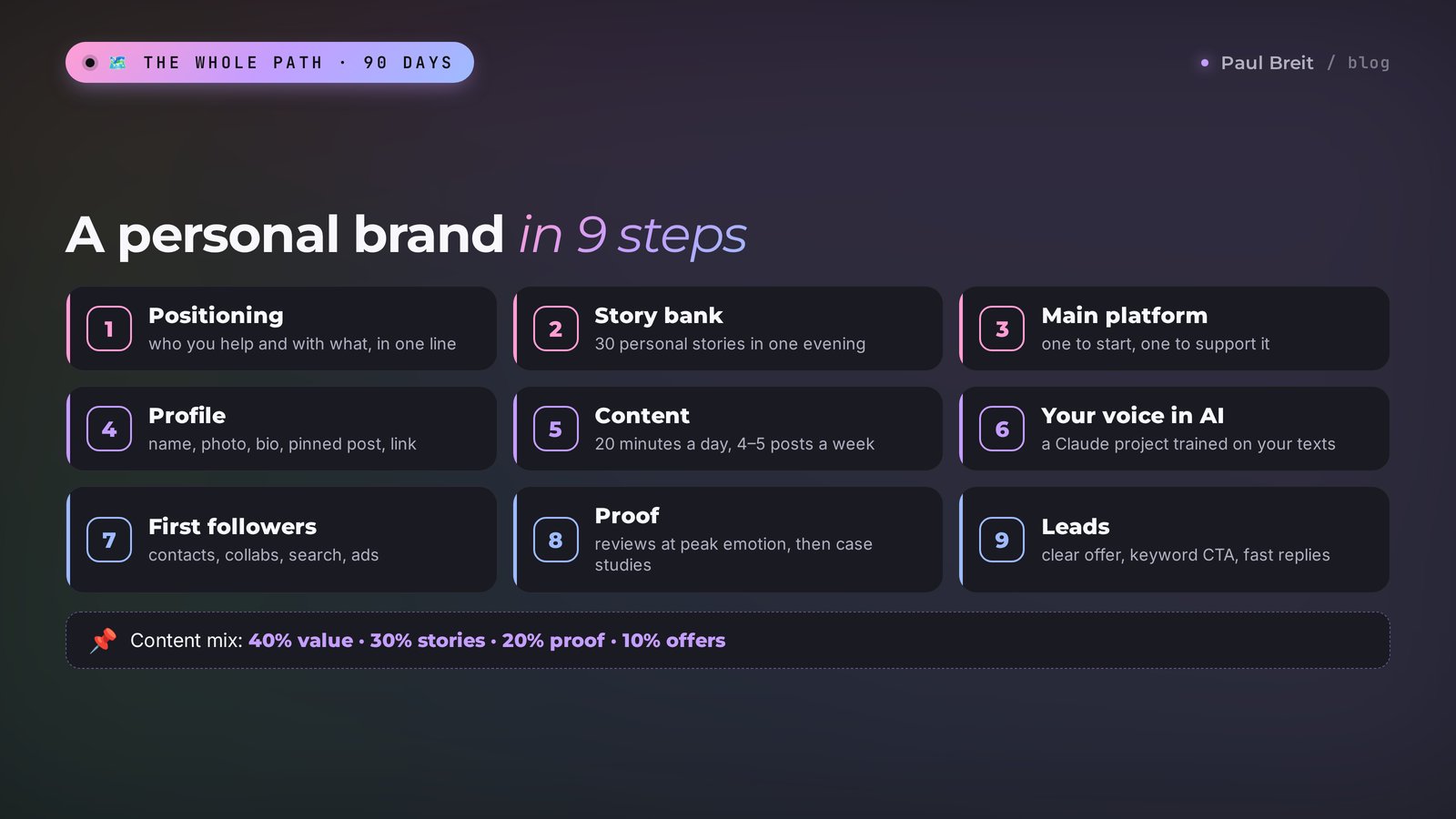
Below is the whole map. After it, I'll walk through every step in detail, with prompts and examples.
Section 03Step 1. Positioning in one sentence
Positioning is the answer to the question "why you?" Until you have it, your account turns into a collection of helpful tips that people read, like, and forget who wrote. People remember a person who helps specific people with a specific problem.
The formula my clients use fits on one line:
I help [who] get [what result] in [time frame or method], even if [the main doubt these people have].
What this looks like in real life:
- Tutor: "I help high school juniors raise their SAT math score by 100 points in 4 months, even if fractions still confuse them."
- Therapist: "I help women after divorce stop blaming themselves and start dating again, in 10 online sessions."
- Personal trainer: "I help office workers over 40 get rid of back pain in 6 weeks of 20-minute home workouts."
- Lawyer: "I help owners of small online schools set up their terms of service and refund policy so refunds don't eat their profit."
The most common fear at this step goes like this: "if I narrow down, everyone else will stop coming." They won't. Narrow positioning works like a storefront sign: it attracts your people and doesn't push anyone else away. The SAT tutor still happily takes eighth graders. It's just that on social media, they talk to one audience, and that's why people hear them.
How to write your positioning with AI
It's hard to see your own strengths: from the inside, everything feels obvious. That's why I hand this step to AI. Claude, ChatGPT, or Gemini will all do the job, but Claude writes the most natural, human-sounding text, so all the examples below use it.
If you haven't used Claude yet, sign up at claude.ai with your email or Google account. The free plan is enough for this step. I covered the first setup in detail in Claude from scratch for non-techies.
Then copy this prompt and send it in a new chat:
You are an experienced marketer. Help me write the positioning for my personal brand.
Ask me 10 questions, one at a time: what I do, who I enjoy working with most, what results my clients have gotten, what people come to me with most often, what sets me apart from colleagues, what doubts people have before they buy.
Wait for my answer to each question before asking the next one.
After my answers, suggest 5 positioning options using the formula: "I help [who] get [result] in [time frame or method], even if [doubt]."
For each option, describe exactly who will respond to it and where to find those people.
Answer by voice if that's easier: the Claude app has a microphone button. The more real details you share about your clients, the sharper the options get. Out of the five, pick the one that lights you up. You'll be working with that audience for years.
Testing your positioning is simple. Read it aloud to a friend who works in a completely different field and ask, "who do I help, and with what?" If they answer in their own words without hesitating, it's ready. If they ask you to repeat it, cut the extra words. I go deeper into this in brand positioning: how to stand out from competitors.
Section 04Step 2. A story bank in one evening
A brand runs on stories. Everyone has helpful tips; you can find them with any search engine. But how you left banking for therapy at 30, how your first client cried with relief in your third session, how you yourself spent three years on diets and fell off the wagon: only you have those. Stories like these turn "yet another specialist" into a person people want to read.
The problem is that when you sit down to write a post, no story comes to mind. So you collect your stories into a bank once and draw from it for months. This is called unpacking, and with AI it takes one evening.
Interview me to unpack my personal story for my content. Ask me one question at a time on each topic:
1. How I got into my profession and what I did before.
2. My failures and mistakes that I'm not ashamed to talk about.
3. My most vivid client stories: what they came with, what changed.
4. What I believe in my field and what I disagree with.
5. My habits, hobbies, travels, funny moments.
6. The questions clients ask me most often.
For each topic, ask 3–5 follow-up questions and pull out details: where it happened, what I felt, what words were said.
At the end, build a story bank: 30 short stories, each with a title, the gist in 2 sentences, and the point it supports.
A tip from practice: answer the way you'd tell a friend over coffee. Don't polish. "I was crying in my car in the office parking lot" is worth more than "it was a difficult period." AI will weave the details into a post neatly later. Dry answers just give it nothing to work with.
Save the finished bank in a separate document or in a Claude project (more on that in Step 6). Thirty stories last about two months if you use one in every third post. A detailed walkthrough of unpacking, with questions by level, is in unpack your expertise with AI. And if you want to learn how to turn a story into a post people read to the end, see my guide to storytelling.
A separate word about personal topics. Decide in advance what you never write about. For me, family and loved ones are off limits. A line you draw once saves you from awkward posts on a day when you "really want to share something personal but have no ideas."
Section 05Step 3. Where to build a personal brand in 2026
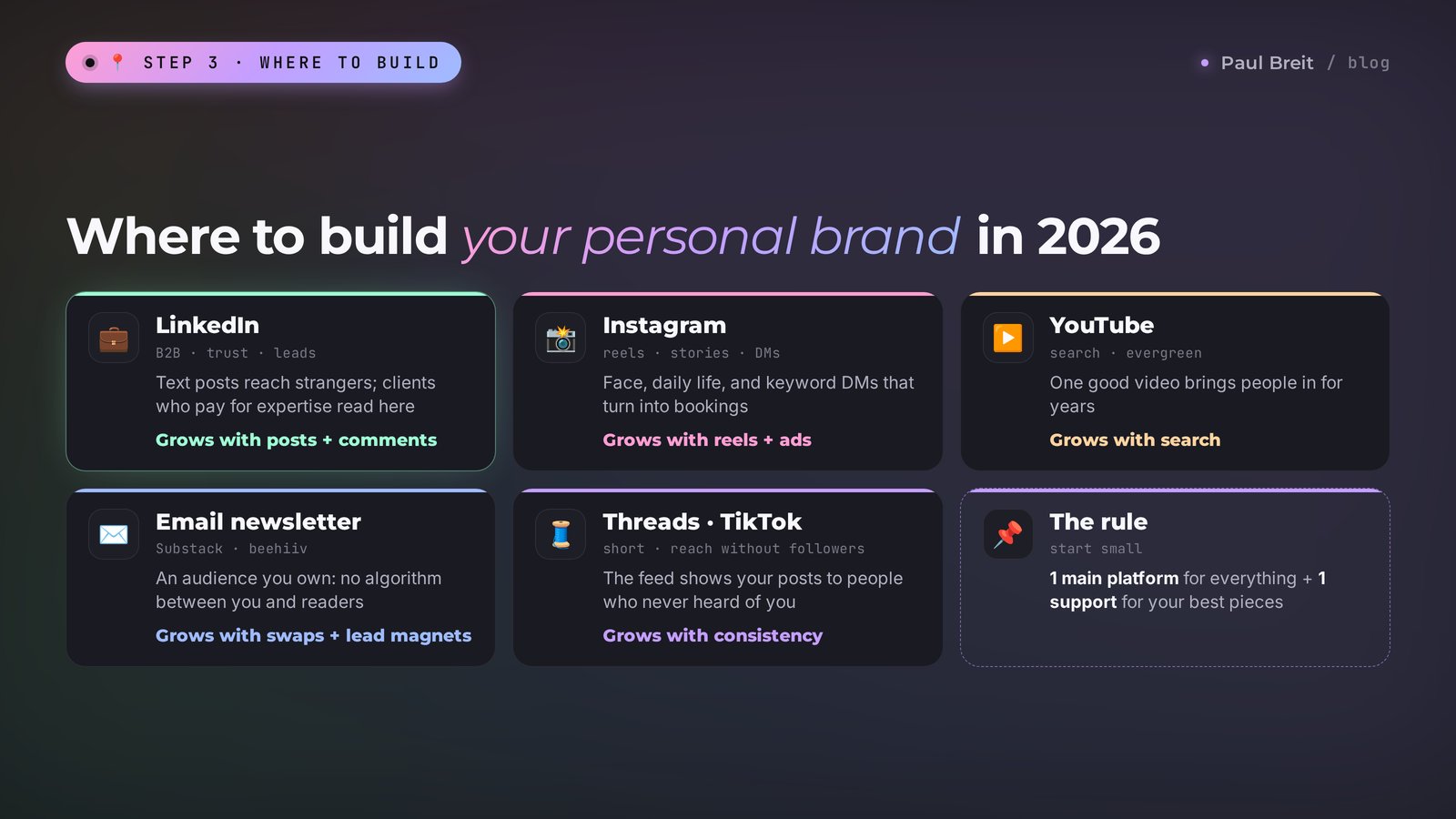
The most expensive beginner mistake is starting on five platforms at once. A month later the person burns out and drops all five. The right way is one main platform where you publish everything and one supporting platform where you repost your best pieces.
Here's how the main platforms for an English-speaking audience look as of fall 2026:
| Platform | Best for | How you grow there | Who it fits |
|---|---|---|---|
| Trust, B2B clients, high-ticket services | Regular text posts, thoughtful comments on bigger accounts, LinkedIn ads | Consultants, coaches, lawyers, bookkeepers, anyone who sells to businesses or professionals | |
| Face, everyday life, reels, sales in DMs | Reels shown to non-followers, collabs, Meta ads | Therapists, nutritionists, trainers, stylists, beauty pros, course creators | |
| YouTube | Videos that collect views for years | Search and recommendations | Anyone comfortable talking on camera |
| Email newsletter (Substack, beehiiv) | The audience you own, trust, and sales | Almost no discovery by default: grows through lead magnets, recommendations, swaps, and sponsorships | Almost everyone who sells services, courses, and consulting, as a second platform |
| Threads | Short text, reach without followers | The algorithm shows posts to strangers | People who write short and punchy |
| TikTok | Short video with huge reach | The For You feed, trends, consistency | People who like to film and have a younger audience |
How to choose your main platform
Ask yourself three questions. Where do your clients spend time right now? Ask your last five clients whose content they follow in your field, and you'll be surprised how similar the answers are. Which format is easy for you? If you enjoy writing but freeze on camera, start with text: LinkedIn, Threads, or a newsletter. Where will your first people come from? A newsletter with no traffic grows slowly, while YouTube and search-friendly articles can bring people in for free.
For most of my clients, the combination that works is "one social platform plus an email list." The social platform (LinkedIn or Instagram, depending on the niche) brings in new people. The newsletter holds your warm audience, the people who trust you and buy. Every post on the social side gently points to the newsletter. And if you like writing long, add articles that rank in search; I explain how in SEO for your blog.
About disclosures. Once brands start paying you for mentions, or you post affiliate links, the FTC expects you to clearly disclose that connection, for example with "#ad" or "paid partnership" right in the post. This doesn't affect you at the start, but keep it in mind as you grow.
Section 06Step 4. Your profile
Someone who lands on your profile for the first time decides in a few seconds: follow or leave. In those seconds they see your name, photo, bio, and pinned or featured posts. If none of that makes it clear who you are and why you're useful, they leave, even if brilliant posts are waiting inside.
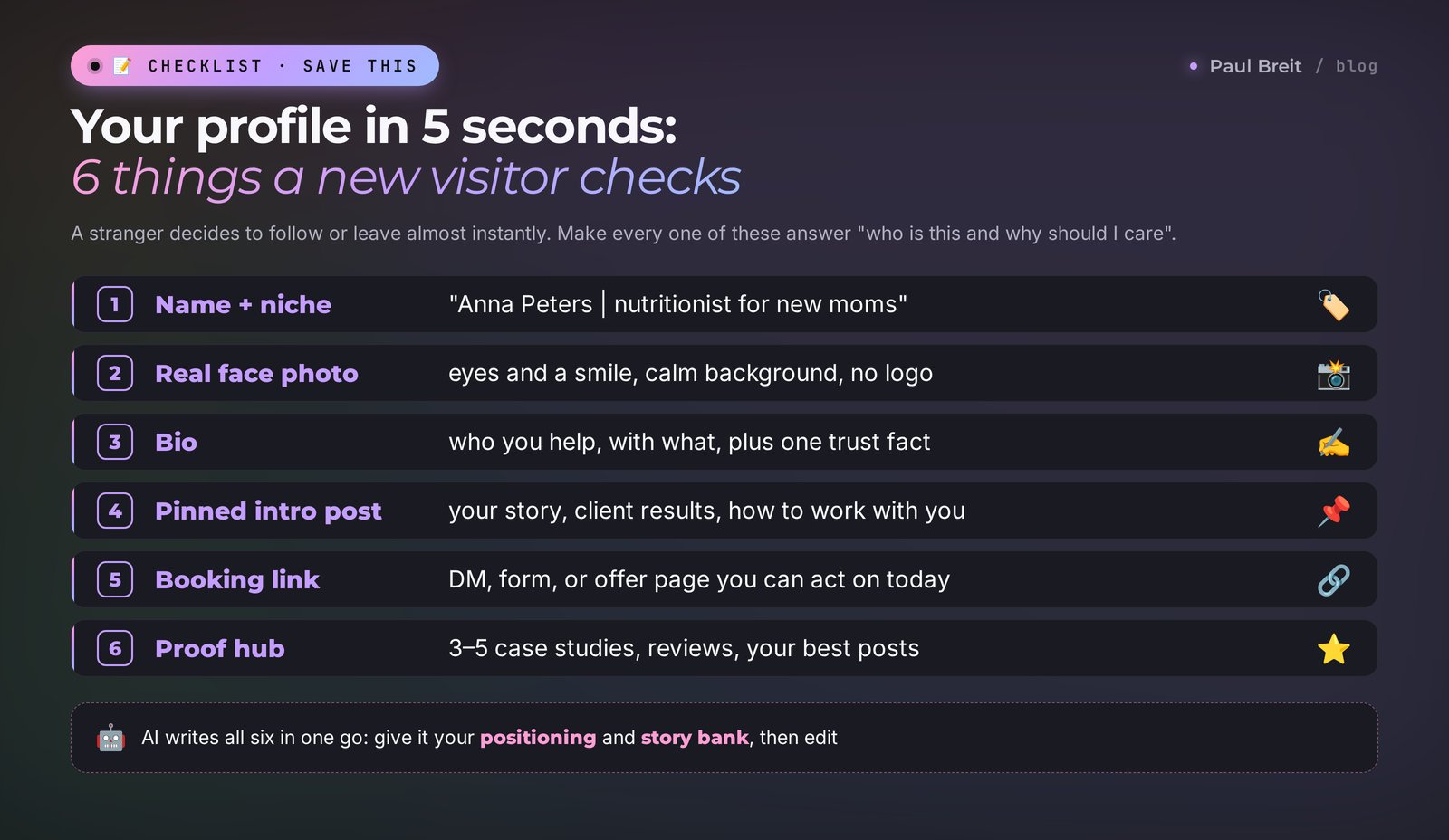
Go through these six points:
Name and niche
Write "Anna Peters | nutritionist for new moms" instead of "Energy of Life" or "Annie." People will find you by name in search, and the niche instantly answers "what is this about." Pretty, abstract names are neither remembered nor searched for. On Instagram, the name field is searchable, so put your niche there; on LinkedIn, the niche goes into your headline.
A real photo of your face
Pick a photo where people can see your eyes and smile, against a light or calm background. A logo, a flower, or a sunset instead of your face kills the word "personal" in personal brand. You don't need a studio shoot: a phone by a window on an overcast day gives you beautiful soft light.
Bio: who you help and with what
Two or three lines based on your positioning from Step 1, plus one trust fact: years of experience, number of clients, credentials. For example: "Helping new moms get their energy back without strict diets. 7 years in practice, 400+ clients. Book a consultation below."
A pinned intro post
It's the first thing a new follower reads. Who you are, how you got into your profession (one story from your bank), who you help, what results clients have had, what people will find on your page, and how to work with you. On Instagram, pin it to the top of your grid; on LinkedIn, put it in the Featured section. Update it once a quarter.
A booking or lead link
Your bio needs a link people can use to start working with you right now: DMs, a booking form, a calendar, an offer page. Without a link, your hottest readers leave to "think about it" and never come back.
A hub for case studies and reviews
A separate post or highlight with links to your best material: 3–5 client case studies, a collection of reviews, your most useful posts. You can pin or feature it too. A new visitor covers in five minutes the path that took longtime followers months.
AI writes the text for all six points in one go. Give it your positioning and story bank and ask:
Here is my positioning and my story bank (pasted below).
Write for my Instagram and LinkedIn profiles:
1) 5 name/headline options in the format "First Last | niche for whom";
2) an Instagram bio up to 150 characters and a LinkedIn "About" section up to 1,000 characters: who I help, with what, one trust fact, a call to click the link;
3) an intro post of 250–350 words: start with a vivid story from the bank, then who I help, client results, what people will find on my page, how to work with me.
Write conversationally, in short paragraphs, no hype and no corporate jargon.
Section 07Step 5. Content in 20 minutes a day
Content is the fuel of your brand. Without regular posts, people forget you after just a couple of quiet weeks. But consistency always breaks on the same thing: every day you sit down and have no idea what to write about. The cure is a system, and mine has three parts: a content mix, a content plan, and a daily ritual.
The content mix: 40/30/20/10
I tested it on my own channel for years, and it works for my clients too:
- 40% value. How-tos, breakdowns, checklists, answers to frequent client questions. This is why people follow and save.
- 30% life and stories. Your day, failures, funny moments, travels, opinions. These posts turn a specialist into a real person.
- 20% proof. Case studies, reviews, client results, behind the scenes. They remove the main doubt: "will this work for me?"
- 10% offers. A direct invitation to a specific product with a price, a deadline, and a link.
Sell more often, and people get tired and unfollow. Sell less often, and readers enjoy your free value for years without ever knowing you have something to buy.
A monthly content plan in one evening
Once a month, you sit down with AI for an hour and get a plan for 20 posts. Here's what that conversation looks like:
You type: I'm a therapist who helps women after divorce believe in themselves again. My story bank and positioning are below. Make a content plan for November: 20 posts, 5 a week, using the mix 40% value, 30% stories, 20% case studies, 10% offers. I'm selling a package of 10 sessions, enrollment closes November 25.
Claude replies: Done. Week 1. Monday, value: "5 things you tell yourself after divorce that keep you stuck, and what to say instead." Tuesday, story: how you packed up boxes of someone else's things in the first week after your husband left (story #4 from the bank). Wednesday, value: "Why you want to text your ex at 2 AM and how to get through that night." Thursday, case study: Marina, 43, went on her first date six months after her divorce. Friday, value with a question for readers: "What was hardest in the first month?"... Week 4 ends with a sales post about the session package and the enrollment deadline.
You type: Great. Write out Tuesday's post in full, about 200 words.
Claude replies: sends a finished post, which you tweak for a couple of minutes and publish.
More templates and a full sample plan are in a month of content in one evening.
The 20-minute daily ritual
Here's what a day looks like once the plan exists:
- 5 minutes. Open the plan, take the topic of the day, and record a voice note with a few thoughts or a moment from yesterday's work.
- 5 minutes. AI turns it into a post in your voice (how to teach it that is the next step).
- 7 minutes. You read it, fix a couple of phrases, and add a detail only you know.
- 3 minutes. Publish and reply to comments under yesterday's post.
My own rule is the same: posts take me about 20 minutes a day. I'm not willing to live for my blog and film every breakfast, and you don't have to either. Consistency and usefulness build a brand.
Video and reels
If the camera doesn't scare you, add short videos: they bring in new people better than anything else on Instagram, YouTube Shorts, and TikTok. AI writes scripts the same way it writes posts. Start with one video a week on the topic of the week's most popular post. You can put together a month of ready scripts with my guide to AI reels scripts.
Section 08Step 6. Your voice in AI
The main complaint about AI goes like this: "it writes smoothly, but it isn't me." Readers sense that kind of text right away, and trust in your brand drops. The fix is to teach AI your style once, so every post after that sounds like you.
Claude has projects for this. A project is a folder that holds your materials and instructions, and every new chat inside it already knows everything about you.
- In Claude's left menu, open "Projects" and create a project called "My content."
- Upload your positioning, story bank, and 20–30 of your best texts to the project knowledge: posts, emails to clients, voice note transcripts. Even long messages to friends about work will do; they carry your real voice.
- Paste the text below into the project instructions.
You write posts for my social media in my voice.
Before each post, reread my texts in the project knowledge and match my style: sentence length, pet phrases, humor, the way I talk to readers.
Write in short paragraphs of 2–4 sentences, conversationally, the way I'd tell a friend.
Start every post with a vivid scene, a question, or a number. End with an action or a question for readers.
Use stories from the bank and tell me which one you used.
Never: corporate jargon, hype, clichés, long em dashes, hashtags.
If you lack details for a post, ask me 2–3 questions first.
Edit the first 5–7 posts carefully and tell the AI what's off: "this is too formal," "I don't say that, I say 'okay, look.'" It remembers this within the chat, and you add the most important corrections to the project instructions. In a couple of weeks, drafts start coming out almost ready to publish. The full method with examples is in teach AI to write in your voice.
For this step you'll need the Pro plan at $20 a month: on the free plan, message limits run out fast, and projects with lots of knowledge work best on a paid plan.
Section 09Step 7. Your first followers
This is where most people break. Someone sets up their profile, writes 30 great posts, and 40 people read them, 35 of whom are friends and relatives. A month later they decide that "personal branding doesn't work" and quit.
The hard truth: a newsletter has almost no organic discovery, and a brand-new account on LinkedIn or Instagram reaches very few people at first. Nobody finds you by accident. Waiting doesn't cure a small account; traffic does. So you have to bring in your first people, and here are the proven ways, from free to paid:
Free
- Your own contacts. Send a personal message to every acquaintance and past client: "I've started posting about this, I'd love it if you followed and shared it with anyone who needs it." That's your first 100–200 people.
- Collab lives and guest posts. Find 5–10 people in neighboring niches with a similar audience (a nutritionist and a trainer, a therapist and a divorce lawyer) and go live together on Instagram or LinkedIn, or swap guest posts. Both audiences get to know you both.
- Search. YouTube videos and articles on your own blog or Medium bring people from Google for months after you publish. One article answering a frequent client question can bring followers for years.
- Comments on big accounts. A useful, thoughtful comment under a post by a bigger creator in your field sends people to your profile. Stay on topic, no links and no pitching.
- Newsletter recommendations. Substack lets newsletters recommend each other to new subscribers, and swapping recommendations with a newsletter of a similar size costs nothing.
Paid
- Meta ads (Instagram and Facebook). Precise targeting by interests and location, and you can send people straight to your profile, a lead magnet, or your newsletter signup. Start with $50–100 a week and test one audience at a time.
- LinkedIn ads. More expensive per click, but precise targeting by job title and industry. It makes sense if your clients are businesses or professionals and your services are high-ticket.
- Newsletter sponsorships and swaps. Buy a mention in a newsletter with a similar audience, or use paid recommendation networks like beehiiv Boosts. For a newsletter, this is the fastest way to your first 1,000 subscribers. Test newsletters one by one and measure the cost per subscriber.
A step-by-step plan for your first thousand without fake followers is in your first 1,000 followers, and ideas for using AI to speed it up are in get followers with AI. And one warning: never buy bots or fake engagement. Dead followers kill your reach, scare off real people and partners, and bring zero value.
Your posts aren't wasted while traffic is low. Every new person who arrives a month from now will scroll back and read them. So it's worth reminding readers of your best posts now and then with a link in new ones.
Section 10Step 8. Case studies and reviews
A follower can read you for a year and never buy, because a doubt sits inside: "it worked for others, but it won't work for me." Stories of people like them remove that doubt best. That's why case studies and reviews make up 20% of your content and deserve a separate system you set up from your very first client.
How to collect reviews
Ask for a review at the moment the client gets their first result and is still riding the emotion, right after the win: they passed the exam, lost the first 5 pounds, had a calm conversation with their mom for the first time. By the end of the work, everything feels normal and the emotion has cooled. Ask three questions: what was it like before, what changed, who would you recommend me to. A voice message works too: AI will turn it into clean text, and you get the client's approval. A ready-made system is described in how to collect client reviews.
How to turn a review into a case study
A review says "I liked it." A case study shows the path: what the person came with, what you did together, what was hard, and what the result was in numbers or facts. A case study sells harder because readers try it on for themselves. Ask AI:
Here is a client review and my notes about working with them (pasted below).
Write a case study of about 250 words with this structure: who the person is and what they came with (with one vivid detail), what held them back before, what we did step by step, where it got hard, what the result was and how long it took, a client quote at the end.
Don't exaggerate the result and don't add any facts that aren't in my notes.
The last line of the prompt matters. A made-up result in a case study surfaces one day, and after that nobody believes your brand at all. How to format a case study so the result sells on its own is covered in how to write a client case study.
Section 11Step 9. From brand to leads
It happens: someone has a beautiful account, thousands of followers, warm comments, and almost no leads. Usually there's one reason. The reader doesn't understand what they can buy, how much it costs, or how to sign up.
For your brand to bring in money, you need three things.
1. A clear product ladder
At least two levels: something affordable to get acquainted and your main product. For a nutritionist, that might be a diet review for $40 and a month of coaching for $330. The affordable product lets people try working with you without much risk. After a good review, they ask about coaching on their own.
2. A call to action in every fifth post
You can add a soft call to action more often: "if this sounds like you, DM me the word MEALS and I'll send you where to start." A keyword works better than a link, because the person starts the conversation themselves, and it's easier for you to continue it. A direct sales post with a price and a deadline goes out once every two weeks, within that 10%.
3. Fast replies in your DMs
A lead goes cold within a few hours. If someone messages you in the evening and you reply two days later, they've already found someone else. If you can't reply fast, set up an AI agent that answers DMs in your voice and books calls. I show how to build one in an AI agent in your DMs; the same logic works on other messaging platforms.
And now the nicest part. Once these three things work, your brand starts selling quietly: someone reads you for six months without a word, then shows up saying "I want your biggest package." You don't have to convince these clients of anything. If you want to sharpen the offer itself, start with how to write an offer.
Section 12The 90-day plan
I put all the steps into a calendar. It's built for 20–40 minutes a day and a start from absolute zero.
| When | What you do | Result by the end |
|---|---|---|
| Week 1 | Positioning with AI, a bank of 30 stories, choosing your main platform | You know who you help, and you have topics for two months |
| Week 2 | Profile setup, intro post, newsletter signup page, a "My content" project in Claude with your texts | Your profile is ready to show, AI writes in your voice |
| Weeks 3–4 | 10 posts from the plan, invitations to contacts and past clients, first comments on bigger accounts | Your first 100–200 followers, a daily writing habit |
| Month 2 | 20 posts, 2–3 collab lives, first ads at $50–100 a week, 2 articles or videos for search | 300–700 followers, first questions in your DMs |
| Month 3 | 20 posts, 3 case studies, a reviews hub, an affordable intro product, a sales post every two weeks | Up to 1,000 followers and your first leads from content |
Follower numbers depend heavily on your niche and budget, so treat them as a rough guide. Two things matter most: you never skipped a week, and every month you tried at least one new traffic source. If you have no leads after 90 days, see the troubleshooting section below. The cause almost always takes an hour to find.
Section 13Personal branding in different niches
The principles are the same, but every profession has its own emphasis. Find your row:
| Niche | What works best | What to avoid | Main platform |
|---|---|---|---|
| Therapist | Recognition stories ("maybe this is about you"), situation breakdowns, answers to anonymous questions | Client stories without consent, diagnosing people in comments | Instagram plus a newsletter |
| Tutor | Problem walkthroughs, exam results, tips for parents | Writing for kids when the parents are the ones paying | Instagram and YouTube |
| Nutritionist | Simple recipes, before-and-afters with consent, myth busting | Promises to lose weight in a week, medical advice | Instagram with reels, a newsletter |
| Personal trainer | Short exercise videos, home workouts, client transformations | Only photos of your own body with no value | Instagram reels, YouTube, TikTok |
| Lawyer, bookkeeper | New rules explained in plain language, checklists, stories of client mistakes | Dry retellings of the law | LinkedIn plus articles for search |
| Coach, mentor | Your own path with failures, client case studies in numbers, opinions | Motivational quotes with nothing concrete | LinkedIn or Instagram plus a newsletter |
| Designer, photographer | Before-and-after work, process, how you think through a project | A bare portfolio with no stories | Instagram and LinkedIn |
If your niche isn't in the table, ask AI: "I'm a [niche], I help [whom]. Which 10 post topics build the most trust in my niche, and which topics should I avoid?" The answer will be more precise than any general table, because it takes your audience into account. There are also dedicated guides for coaches, tutors, and nutritionists.
Section 14If something goes wrong
Here are the problems people bring to me most often, and what to do about them:
| What happened | Why | What to do |
|---|---|---|
| Followers aren't growing | No traffic source, the account is waiting to be found | Launch one paid source (Meta ads or a newsletter sponsorship) and one free one (collab lives or articles) |
| People read but don't reach out | No call to action and no clear product | Add a keyword to every fifth post and a post with a price every two weeks |
| Posts sound like AI | Too few of your texts in the project, no corrections | Upload 15 more of your texts and edit the first posts with notes like "I don't talk like that" |
| Nothing to write about | No story bank and no plan | Do the unpacking from Step 2 and the monthly plan from Step 5 |
| Scared to show up | Fear of judgment from people you know | Start with text and voice, add your face a month later when the first warm comments come in |
| Haters show up | Your brand became visible | Answer real questions, delete insults without replying, and don't take them personally |
| No time | Posts are written from scratch | The 20-minute ritual: voice note, AI draft, edit, publish |
| Claude hits its limits mid-month | Free plan, very long chats | Upgrade to Pro and start a new chat inside your project for each task |
A word about haters. When I started my blog, people mocked me for the way I pronounce my r's, and said that if I had money to travel, I must be a scammer. Back then it hurt. Now I understand that hate only comes to people who have become visible. If strangers start attacking you, your brand has outgrown the sandbox.
Section 15How to tell your brand is working
Likes and views feel nice, but they say little about money. Once a month, check five numbers:
- Follower growth and where people came from. This shows which traffic source works and where to add budget.
- Engagement. Reactions, comments, saves, and shares divided by views. If it's growing, your content is landing.
- DMs. How many people messaged you on their own, without an invitation. This is the main sign that your brand works.
- Leads and sales from content. Ask every new client how they found you, and write the answer down.
- Cost per follower. What you spent on ads divided by the number of people who came. It helps you compare ad audiences and newsletters.
You don't need to crunch these numbers by hand. Once a month, export your account stats and ask AI: "Here are my stats for the month. Find the 5 posts with the highest engagement, explain what they have in common, and suggest 10 new topics in the same spirit." After three of these reviews, you'll know exactly what your audience loves.
Section 16The whole path in a minute
Write your positioning with AI: who you help, what result, in what time frame, despite what doubt. Collect a bank of 30 personal stories in one evening of unpacking. Pick one main platform (most often LinkedIn or Instagram) and one supporting one (usually an email newsletter). Set up your profile: name with your niche, a real photo, a bio, an intro post, a booking link, a hub of case studies. Post 4–5 times a week using the mix of 40% value, 30% stories, 20% proof, and 10% offers, spending 20 minutes a day with AI trained on your voice. Bring in your first followers through contacts, collabs, search, and ads. Collect reviews at peak emotion and turn them into case studies. Create an affordable intro product, add a keyword to every fifth post, and reply to DMs fast. In 90 days you'll have up to 1,000 followers and your first leads from content.
FAQFrequently asked questions
What is a personal brand, in plain words?
It's what people know and say about you: your name, your topic, and their trust in you. Someone sees your profile and understands within a minute who you are, who you help, and why they can trust you. That's why clients reach out on their own, without any persuading.
How long does it take to build a personal brand from scratch?
The first leads from content usually come in the second month and a steady flow by the end of the third, as long as you post 4–5 times a week and bring in traffic the whole time. With AI, running your brand takes about 20 minutes a day.
Where do I start a personal brand if I have no followers?
Start with one-sentence positioning: who you help and what result you deliver. Then collect a bank of 30 personal stories, choose one main platform, and set up your profile. Your first 100–200 followers come from personal invitations to people you know and past clients.
Which platform should I choose for a personal brand in 2026?
For most people who sell services, courses, and consulting, the main platform is LinkedIn (if clients are businesses or professionals) or Instagram (if clients are individuals), plus an email newsletter on Substack or beehiiv as the audience you own. YouTube fits people who are comfortable on camera, and Threads and TikTok give reach without followers.
Can I build a personal brand without showing my face or making videos?
You can start with text and voice notes and add your face later, once the first warm responses come in. But a real photo as your profile picture is needed from day one: without a face, the brand stops being personal, and people trust the profile less.
How does AI help with a personal brand?
AI interviews you and builds a story bank, suggests positioning options, writes your bio and intro post, creates a monthly content plan and post drafts in your voice, turns reviews into case studies, and analyzes your account stats.
How much does it cost to grow a personal brand?
You can get your first followers for free through people you know, collab lives, comments, and articles in search. For faster growth, $50–100 a week on Meta ads or newsletter sponsorships is enough to start. Claude Pro for writing in your voice costs $20 a month.
How does a personal brand turn into leads and money?
You need three things: a clear product ladder with an affordable intro product and a main one, a call to action with a keyword in roughly every fifth post, and fast replies in your DMs. Then readers who have trusted you for months turn into clients.