Make Money Online in 2026: 10 Honest Ways
You can make money online in 2026 without any schemes: people take projects on freelance marketplaces, work remote jobs, teach over video calls, and sell their own services and products. Below are 10 honest ways with the barrier to entry, the time to your first dollars, and the income ceiling for each, a comparison table, three questions to pick your path, a list of traps, the tax basics, and a 30-day plan.
Ten honest ways to make money online in 2026: freelancing on marketplaces (Upwork, Fiverr, Contra), a remote job (LinkedIn Jobs, Indeed, We Work Remotely), online tutoring and consulting, AI-powered services, selling your own services through social media and a newsletter, selling on Amazon, Etsy, or eBay, a blog and content, digital products, microtasks, and your own online course. With no money to invest, start with freelancing, a remote job, or AI-powered services: first income there is realistic in one to four weeks. Any "work from home" offer that asks you to pay for access, hand over your bank details, or like posts for hundreds of dollars a day is a scam.
People looking for a side income next to a day job, parents at home with kids, students, people in small towns with few local jobs, specialists who want to move their work online, and anyone who already sells services, courses, and consulting and wants to see where to grow next. If you're looking specifically for an employee role, I have a separate breakdown: remote jobs in 2026 – where to look and what to know.
What's inside
- What honest online income actually is
- 10 ways in one table
- Way 1. Freelancing on marketplaces
- Way 2. A remote job
- Way 3. Tutoring and consulting online
- Way 4. AI-powered services
- Way 5. Your own services through social media
- Way 6. Selling on Amazon, Etsy, and eBay
- Way 7. A blog and content
- Way 8. Digital products
- Way 9. Microtasks
- Way 10. Your own online course
- Pick your way in 3 questions
- Traps where people lose money
- Taxes and paperwork in the US
- A 30-day plan
- When something goes wrong
- The whole path in a minute
Search "make money online" and you'll see two extremes. On one side, loud promises: "$10K a month from your phone," "passive income in 15 minutes a day." On the other, tired comments: "it's all a scam, there's no real money online." The truth, as usual, sits in the boring middle.
I've earned my living entirely online for many years. In that time I've traveled to 40 countries, my team has never once gathered in the same office, and more than 10,000 graduates have gone through my online school. So I'll say it straight: there is money online, and plenty of it. It just pays for the same thing it pays for offline – value. A solved problem, time spent, a product somebody needs.
In this article I've collected 10 ways that actually work in 2026. For each one I'll cover what you need to know, where to find your first clients, how long until the first money, and where the ceiling is. I'll also show you how to pick your path with three questions, how to handle taxes so the IRS has no surprises for you, and how to spot a scammer from the first message. Read in order or jump to what you need through the table of contents.
Section 01What honest online income actually is
Let's start with a definition. Honest online income means you hand over something of value and get paid for it. There are only three things you can sell online:
- Time. You work for someone on a schedule: support agent, virtual assistant, account manager. The income is steady, but capped by the hours in a day.
- Skill and result. You do a specific piece of work: copy, a website, a design, a lesson, a consultation. Here the price depends on how valuable the result is to the client.
- Product. You sell goods, a template, a course, or ad space in your blog. Made once, sold many times. The highest ceiling, and the longest ramp-up.
If a "make money online" offer contains none of these three, be careful. When someone promises money just for signing up, inviting friends, liking posts, or "invest now and get three times back," you're being invited into a scheme where someone else makes the money. Usually at your expense.
And the second thing the ad headlines never mention. Your first money online is almost always small. Your first freelance gig might be $10–30, your first online tutoring session $25–40. That's normal. The point of the first month is to collect your first reviews, learn the process, and believe that it works. Prices grow with experience after that.
For each way I give you four things: what you need to know, where to find your first clients, when to expect the first money, and where the ceiling is. The timelines assume 2–3 hours a day. If you have an hour a week, stretch them accordingly.
Section 0210 ways in one table
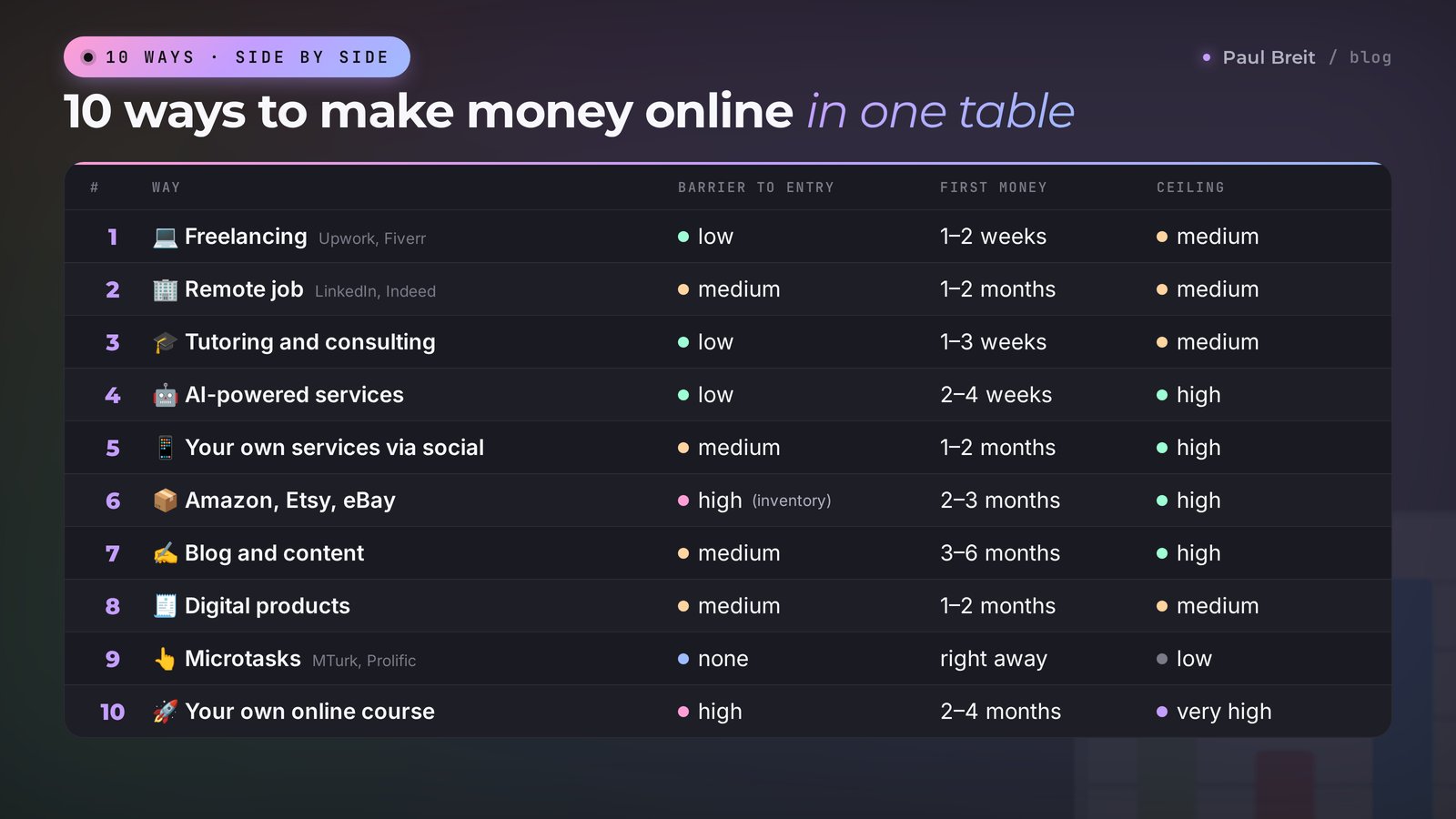
Before we go through each way, look at the whole picture. Barrier to entry means how much you need to know and invest to get started. First money is a realistic timeline with daily work. Ceiling is where the way can grow in a year or two.
| Way | Barrier to entry | Investment | First money | Ceiling |
|---|---|---|---|---|
| 1. Freelancing on marketplaces | Low | $0 | 1–2 weeks | Medium |
| 2. A remote job | Medium | $0 | 1–2 months | Medium |
| 3. Tutoring and consulting | Low, if you have the knowledge | $0 | 1–3 weeks | Medium |
| 4. AI-powered services | Low | $0–20/month for a subscription | 2–4 weeks | High |
| 5. Your own services via social media | Medium | $0 | 1–2 months | High |
| 6. Amazon, Etsy, eBay | High | Hundreds to thousands of dollars | 2–3 months | High |
| 7. A blog and content | Medium | $0 | 3–6 months | High |
| 8. Digital products | Medium | $0 | 1–2 months | Medium |
| 9. Microtasks | None | $0 | Right away | Low |
| 10. Your own online course | High | $0 at the start | 2–4 months | Very high |
Notice the pattern: the faster the first money arrives, the lower the ceiling. Microtasks pay right away, but barely enough for a coffee. Your own course takes months to ramp up, but can eventually earn more than any salary. That's why the strategy that works best for a beginner looks like this: take one fast way for the first money and build one slow way in parallel.
Section 03Way 1. Freelancing on marketplaces
Freelancing means you take one-off projects from different clients and set your own price. A freelance marketplace works like a market: clients post jobs, freelancers send proposals or list ready-made services with a price. It's the most common entry point for beginners, and for good reason: no degree, no résumé of past employers, and no investment required.
What you need to know
At least one thing someone will pay for. The list is wider than you think: writing copy and product descriptions, building slide decks, editing short videos, designing graphics in Canva, transcribing audio, filling in spreadsheets, research, running social media accounts, setting up simple sites on website builders. If you don't have any of those skills yet, look at way 4: AI shortens the path to your first sellable skill dramatically.
Where to find work
Upwork
The classic marketplace: clients post projects, you submit proposals. Projects tend to be larger and competition is higher. Submitting a proposal costs "Connects," Upwork's internal credits, so pick jobs where you're a real fit instead of spraying proposals everywhere.
Fiverr
You list ready-made services, called gigs, with a fixed price that starts at $5. Convenient for a beginner: no haggling, the client picks your service from the catalog and pays upfront through the platform.
Contra
A newer platform built around a portfolio profile. You show your work, clients reach out or hire you for projects, and you can share the profile link anywhere. Good for designers, writers, and anyone whose work is easy to show.
TaskRabbit
Small tasks for an hour or two, many of them local and in person: assembling furniture, running errands, helping with a move. Not strictly "online," but a quick way to earn your first money and first reviews while you build a digital skill on the side.
How to land the first gig with zero reviews
The main pain of a beginner on a marketplace: clients pick freelancers with reviews, and reviews don't appear without gigs. Three things break the loop. First, a narrow, clear service: "I'll write 5 Amazon product descriptions in 24 hours" sells better than "I write any kind of copy." Second, 2–3 work samples, even practice ones. Make them yourself for an imaginary store – that's honest as long as you label them that way. Third, a personal proposal: in the first line, show that you've read the job post and suggest a specific move.
If you plan to offer AI-assisted work on marketplaces, the step-by-step for getting the first paying client is in making money with AI from scratch.
First gigs of $10–30 are realistic within one to two weeks of daily proposals. The ceiling of freelancing is your time: once every hour is booked, your income hits a wall. From there you grow by raising prices, keeping repeat clients, and moving to way 5, your own services outside the marketplace.
Section 04Way 2. A remote job
If stability matters to you, a remote job is the calmest option. You're an employee, you have a contract, a regular paycheck, and often benefits and paid time off. You just work from home. The one downside is competition: remote roles draw applicants from the whole country, sometimes from the whole world, so every posting gets a crowd.
That's why the person who applies carefully wins. Twenty identical applications in an evening bring silence. Five personal applications, where you show that you've read the posting and understand the job, bring interview invitations.
Where you can start with no experience
Beginners most often get in as customer support agents, sales development reps, virtual assistants, content moderators, social media or content coordinators, and student success staff at online schools. Demand is also growing for people who know how to work with AI: I wrote about that role in the AI assistant career.
Where to look
On LinkedIn Jobs, set the "Remote" filter and, if you have no experience, "Entry level." Save the search and turn on alerts, and fresh postings will land in your inbox every morning. Indeed has the same remote filter. We Work Remotely lists only remote roles, mostly in tech, marketing, and support. FlexJobs hand-screens remote and flexible listings but charges job seekers a subscription – decide for yourself whether that's worth it, the free boards cover a lot. Also check the careers pages of companies you like directly: some post remote roles only there.
How to build a résumé and cover letter with AI, how to handle a video interview, and what to watch for in a remote offer – all of that is in remote jobs in 2026. I won't repeat it here.
From the first application to the first paycheck usually takes one to two months: searching, interviews, onboarding, and then the pay cycle. The ceiling is medium: you grow with your title, but jumping far above market rate as an employee is hard.
Section 05Way 3. Tutoring and consulting online
This one is for people who know something better than others. High school math, a foreign language, SAT prep, guitar, bookkeeping for small businesses, wellness coaching, nutrition, career advice. If you have education or real experience in a topic, you can sell your time over video calls this week.
Here's the key point. The market for tutors and consultants moved online a long time ago, and the client doesn't care what city you live in. A specialist from a small town gets access to clients in big cities, where rates are higher.
Where to find your first clients
- Wyzant. A large US marketplace for tutors. You build a profile, set your hourly rate, and students find you. The platform takes a commission, so factor it into your price.
- Preply. Strong for languages, with students from all over the world. The first lesson with each new student goes to the platform as commission, which is worth knowing upfront.
- Thumbtack. Clients describe what they need, and you pay to reach out to the leads that fit. Choose leads carefully, where you know you can help.
- Word of mouth. Message people you know that you now teach math or consult on bookkeeping. The first clients often come from right here.
- Your own Instagram, newsletter, or Facebook group. That's already a move toward way 5, and it's worth starting in parallel. A simple post on Facebook Marketplace or in a local group also works for in-person lessons.
The market will tell you what to charge: open Wyzant or Preply, find your subject, and look at the rates of tutors with your level of experience. Start a bit below the middle, then raise your price after 5–10 reviews.
AI is great at preparing lesson materials: practice problems at the student's level, quizzes, summaries, course plans. What used to take an evening takes 15 minutes. I broke it down with ready prompts in AI for tutors.
A first paid session is realistic in one to three weeks. The ceiling is your hours, just like freelancing. Growth from there comes through group sessions, packages of 10 meetings, and your own course (way 10).
Section 06Way 4. AI-powered services
The youngest way on the list and, in my opinion, the most underrated. In 2026 AI writes copy, generates images, edits video, builds slide decks, transcribes calls, and answers customers in chat. Businesses need all of this, but owners have no time to figure it out. That's where you come in.
What you can sell after a couple of weeks of learning:
- copy for websites, product listings, and social media, drafted with AI and edited by you;
- images and covers for posts, banners, illustrations for articles;
- short videos and captions for Reels and TikTok;
- listings and descriptions for Amazon and Etsy sellers – there's a separate article on that, AI for marketplace sellers;
- a content plan and a month of posts for a small business;
- a chatbot that answers customers' frequent questions.
Here's what matters. AI doesn't do the whole job for you. It produces a draft in a minute, and your value is in setting the task right, filtering out the nonsense, and finishing the result. That's exactly what clients pay for.
What the work looks like in practice
Say the owner of a small nail salon asks for 12 posts for the month. You open the AI and write:
You're an experienced social media manager. Build a one-month
content plan for a nail salon in Austin, Texas.
Audience: women 25–45 who value neat work and hate waiting.
I need 12 posts: 4 helpful, 4 showing the artists' work,
2 with reviews, 2 inviting people to book.
For each post give a topic, the opening line, and an image idea.
Write in a lively voice, no corporate filler. If you're missing
something about the salon, ask me questions.
AI: To make the posts sound like your salon, tell me: which services are most popular, is there something you do that competitors don't, and what does a basic manicure cost?
You: Most popular is a gel manicure. Our edge – same-day booking and done in an hour. Price is $35.
AI: Great, then the theme of the month is "a manicure in an hour, no waiting." First post: "Booked in the morning, fresh nails by evening. Here's how we fit it into an hour without cutting corners..."
Then you edit the copy into natural speech, pick the images, and deliver. Without AI this would take a couple of days, with it a couple of hours. More ready prompts are in my AI prompt library.
Which AI tools to use
In the US every major tool is available without workarounds. Claude and ChatGPT are the strongest for writing; Claude holds a voice especially well in longer copy. You sign up for Claude at claude.ai, and the free tier is enough to learn on. Gemini from Google and the image tools fill in the rest. A full overview is in the best AI tools of 2026 and free AI tools.
Two weeks to learn, another one or two to land the first clients. The ceiling is high: once you build whole working systems for a business out of copy, images, and bots, your price per project multiplies. I broke down every model in this direction in how to make money with AI.
Section 07Way 5. Your own services through social media
This is the next step after freelancing and consulting. On a marketplace the platform brings the client and takes a commission, and competition in the catalog dictates your price. When clients come to you directly from your account, newsletter, or referrals, you decide what your work costs.
This is how thousands of people who sell services, courses, and consulting work: therapists, nutritionists, designers, lawyers, marketers, coaches. Each of them has a place where people discover them and a clear path that leads a person to a purchase.
What this system is made of
A clear service with a price
One sentence: who you help, with what problem, and what result they get. If you can't say it in 10 seconds, the client won't get it either.
A place where people find you
Instagram, a newsletter on Substack, YouTube, LinkedIn, short videos. One platform is enough at the start, as long as you post on it regularly.
A bridge from follower to inquiry
A free consultation, a checklist, a mini-lesson. The person gets value and messages you directly.
A conversation that sells
A call or a chat where you find out the problem and offer a solution. I laid out how to run that conversation in the sales call script.
It sounds harder than freelancing, and it is. But every new follower keeps working for you for months. You can grow your first followers with no budget using the steps in your first 1,000 followers, and you can assemble the link between your account, a free resource, and a sale with a sales funnel in 3 days.
If you already have contacts and followers, a first sale can happen in a couple of weeks. From zero it usually takes one to two months. The ceiling is high: you control both the price and the flow of clients.
Section 08Way 6. Selling on Amazon, Etsy, and eBay
Amazon, Etsy, eBay, and your own Shopify store reach millions of buyers. They're often pitched as easy money, and this is where I'll be honest to the point of being boring. E-commerce is a business with inventory, storage, shipping, ads, and returns. People make money there, and people lose it too.
What you need to start
- Money for inventory. The first batch, packaging, photos, shipping to the warehouse if you use Amazon's fulfillment. Usually that's hundreds to a few thousand dollars at minimum.
- The right platform for your product. Etsy is built for handmade, vintage, and craft supplies: candles, knitwear, jewelry you make yourself. Reselling factory goods is Amazon, eBay, or your own Shopify store.
- Category rules. Some Amazon categories are gated and need approval before you can sell in them. Check your category before you buy stock. Also check whether you need to collect sales tax in your state.
- Time for research. What people search for, what competitors charge, what the platform fee is, how much goes to ads and returns.
If you don't have money for inventory but this world interests you, there's a workaround: work for sellers. Make their listings, photos, and descriptions, run their analytics, and answer reviews. That's really way 1 or 4, just in the e-commerce niche. Demand for these specialists is strong, and you don't have to invest anything.
Courses that promise "launch on Amazon from zero and make a million" often sell the dream itself. Before you buy any stock, do the math on paper: unit cost, shipping, platform fees, ads, returns, taxes. If what's left is less than a third of the selling price, think again.
From buying stock to the first payouts usually takes two to three months. The ceiling is high, but so is the real risk of losing what you put in.
Section 09Way 7. A blog and content
A blog earns money in two ways. The first is advertising and sponsorships: once you have an audience, brands and other creators pay for posts about them. The second, and for most people more profitable, is selling your own services and products to your readers. A newsletter with 3,000 subscribers who trust the author can pay better than a channel with 100,000 followers living on ads.
Where to run a blog in 2026:
- A newsletter. Substack or any email tool. A warm audience that reads you personally, plus built-in paid subscriptions. Convenient for selling your services.
- YouTube. Videos that keep getting found through search for years, plus the YouTube Partner Program once you meet its requirements.
- Instagram and short video. Reels, TikTok, and Shorts deliver fast reach to new people.
- Long-form articles. Medium and your own blog bring readers from search. More on this in Medium for business.
The hard truth about blogs: they ramp up slowly. For the first three months you're writing almost into the void, and that's exactly where most people quit. One simple shift helps: treat the blog as the storefront for your services. Then even 300 followers bring in money, because a few of them book a consultation or order your work.
AI covers the most tedious part: topics, post drafts, video scripts, captions. You add your stories and opinions. That way one evening a week produces content for the whole week.
Ad money appears after six months to a year. Selling your own services through the blog – after one to three months. The ceiling is one of the highest on the list.
Section 10Way 8. Digital products
A digital product is made once and sold as many times as you like. No warehouse, no shipping, no returns of damaged boxes. Here's what people buy:
- templates for social media, slide decks, and stories;
- spreadsheets for budgeting, finances, workouts, meal plans;
- planners and habit trackers in PDF;
- guides and checklists on your topic;
- collections of ready AI prompts for a specific profession;
- photos, illustrations, presets for photo editing.
The trap here is that many people make a product and wait for someone to find it. Nobody will. A digital product sells where your audience already is: in your account, through referrals, through partners with a similar audience. Marketplaces like Etsy and Gumroad help with payments and a bit of discovery, but they rarely do the selling for you. That's why this way works great together with ways 5 and 7 and poorly on its own.
How to launch your first digital product without wasted spending:
Ask what hurts
Ask your audience or friends what they struggle with most. The answers are your product topic.
Build the minimum version in an evening
One spreadsheet, one template, one 10-page guide.
Announce it before it's perfect
If nobody buys at a low price, the topic is wrong, and you've just saved weeks.
Set up payments
Stripe, Gumroad, or Etsy take the payment and keep a clean record of every sale, which makes taxes easier at the end of the year. Step by step in how to accept online payments.
A first sale, if you have any audience at all, takes a month or two. The ceiling is medium: digital products are usually cheap, their strength is in volume and in leading people to your more expensive services.
Section 11Way 9. Microtasks
This is what people most often mean when they search "make money online with no investment": short tasks for small payments. Rating whether an image matches a search query, transcribing a short audio clip, taking a survey, testing an app or a website and talking through your impressions.
Where to get these tasks: Amazon Mechanical Turk, Prolific for academic research studies, UserTesting for website and app tests, and legitimate paid survey sites.
I'll tell it like it is. This is a side hustle, not a living. An hour of microtasks pays less than even the most modest freelancer's hourly rate. But microtasks have two upsides: the money comes right away, and you get used to working online, to cashing out, to the discipline. For a student or someone who needs a little extra pocket money each month, that's a fine option.
Real microtask platforms don't charge for access and don't promise hundreds of dollars a day. If someone offers "$300 a day for liking videos and writing reviews," pays you a few dollars at first, and then asks you to "deposit money to unlock the next level," that's fraud – a pattern the FTC regularly warns about as task scams. More in the traps section.
Money right away. A low ceiling. Use it as a launchpad, not as your main income.
Section 12Way 10. Your own online course
The most demanding and the most scalable way. You package your experience into a program that takes a person from a problem to a result, and sell it to many people at once. Your income stops depending on the hours in a day: ten people in a group or a hundred, you spend almost the same amount of time.
This is the field I've worked in myself for many years, so I'll name the main mistake. People start by recording video lessons, editing, and picking a pretty platform. They spend months, and then it turns out nobody needs the course. The right order is the reverse.
Sell the service one-on-one first
Until you've helped 5–10 people individually, you don't know which path to the result actually works.
Fill the first group before recording anything
Sell a 4-week program and run it live over video calls. You get both the money and a test of the content.
Record what already worked
After 2–3 cohorts you have a proven course, testimonials, and a clear picture of who your client is.
Build a flow of inquiries
A blog, a free lesson, a funnel, a sales call or a webinar. Without a flow, even the best course stands still.
How to build a program that actually delivers results, I covered in how to create a course that works.
If you have experience and at least a small audience, you can fill the first group in two to four months. The ceiling is the highest of all ten ways.
Section 13Pick your way in 3 questions
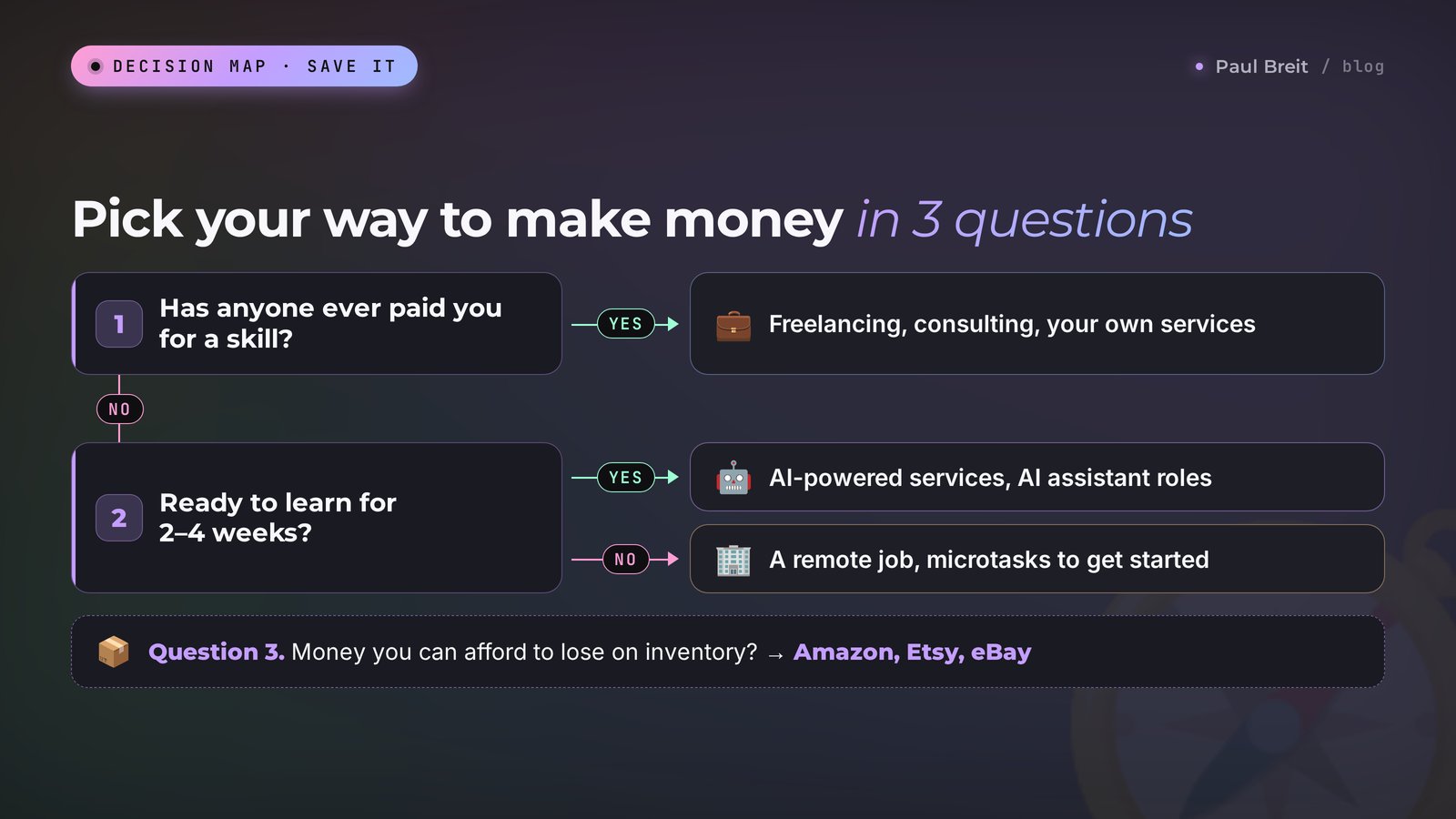
Ten ways is a lot. To avoid spending a month just choosing, answer three questions honestly.
Question 1. Do you have a skill someone has already paid you for?
Everything counts: your profession, side gigs, paid favors for friends, a hobby people asked you to "do one for me too." If yes, start with freelancing, consulting, or your own services (ways 1, 3, and 5). You already have something that sells – you just need to find buyers online.
Question 2. Are you ready to spend 2–4 weeks learning something new?
If you have no skill yet but have time, the shortest path to a sellable service in 2026 goes through AI (way 4). In parallel, you can apply for AI assistant roles. If there's no time to learn right now and you need money urgently, take a remote job or microtasks to get started (ways 2 and 9).
Question 3. Do you have money you can afford to lose?
If you have spare money and an interest in physical products, look at Amazon, Etsy, or eBay (way 6), but run the numbers first. If you don't have that money, choose the ways with no investment – there are eight of them on the list.
And a word about the long game. Whichever fast way you choose, start a blog, a newsletter, or an account on your topic in parallel (way 7). At least two posts a week. Six months from now it will become your main source of clients, and you'll depend far less on marketplaces and employers.
Section 14Traps where people lose money
"Make money online" is one of scammers' favorite search terms. They know the person searching needs money, and they aim right at that pain. Here are the most common schemes of 2026.
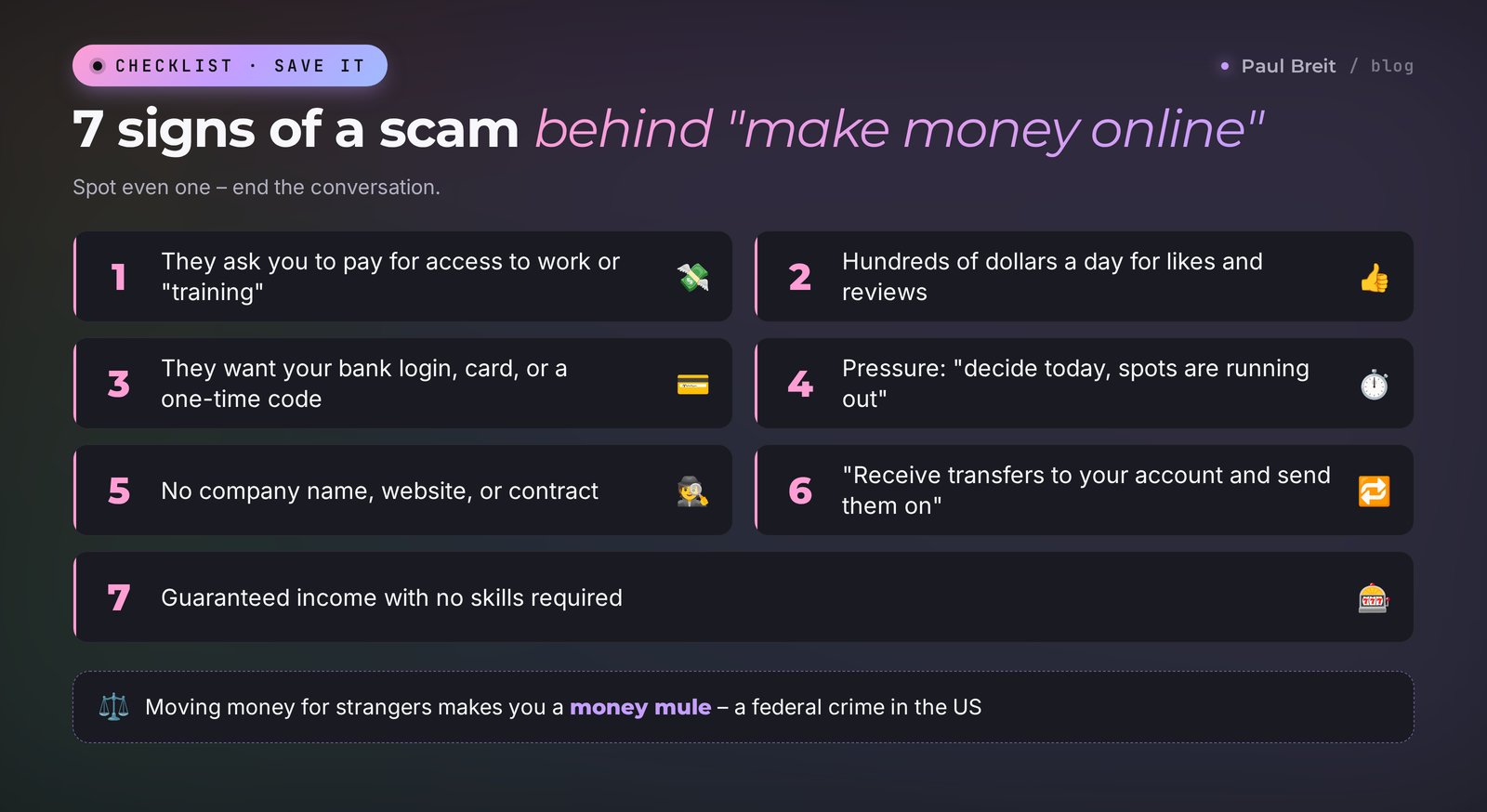
- Pay to get in. "Pay for training, access to the job database, or a registration fee, and we'll give you work." A real employer doesn't charge you for the chance to work. A known job board with a subscription is a different thing – you're buying a service, not a job.
- Likes and reviews for hundreds a day. For the first couple of days they really do pay a few dollars so you believe it. Then they ask for a deposit or for you to buy a product to review, and the money disappears.
- Moving money through your account. "Just receive transfers to your bank account and send them on for a percentage." That's a money mule scheme, and it isn't a gray area: knowingly moving money for fraudsters is a federal crime in the US, and your bank account gets frozen along the way.
- Fake checks. A "client" or "employer" sends you a check, asks you to deposit it and send part of the money back or to a "supplier." The check bounces days later, and you're on the hook for the full amount.
- Guaranteed returns. "Invest $500, get $1,500 in a week." There's no such thing as a guaranteed outsized return – it's a pyramid.
- Bring your friends. If your income depends on how many people you recruit and there's barely a product, you're in a pyramid again.
- Urgency. "Spots are running out, decide now." Time pressure exists so you don't have time to think and check.
- No company and no contract. The company won't name itself, has no website, no address, and no reviews on independent sites.
Search the company name together with the words "scam" and "reviews." Look the company up in your state's business registry and on the Better Business Bureau. Ask for a video call. A scammer usually refuses both the call and any official paperwork. And the main rule: never share a one-time code from a text message and never give anyone your bank login, no matter who asks. If you've already run into a scheme, report it at reportfraud.ftc.gov.
Section 15Taxes and paperwork in the US
Many people put off the paperwork "until later" while the income is small. But getting it right from the start makes life much easier: clients take you more seriously, your records are clean, and April doesn't bring an unpleasant surprise. Online income is taxed just like any other income. Here are the common setups. This is general information, not tax advice – check your situation with a tax professional.
| Setup | Who it fits | Tax basics | What to do |
|---|---|---|---|
| Sole proprietor (self-employed) | Freelancers, tutors, consultants, people selling their own services and products | Income tax plus 15.3% self-employment tax on net earnings, reported on Schedule C | Nothing to register at the federal level; keep records, pay quarterly estimated taxes |
| W-2 employee | A remote job | The employer withholds income tax and payroll taxes | Fill out a W-4 when you're hired |
| Independent contractor (1099) | Project work for a company | Same as self-employed: nothing is withheld, you pay it yourself | Clients may send you a 1099-NEC; report all income either way |
| Single-member LLC | Growing income, e-commerce, hiring help, wanting liability protection | By default taxed like a sole proprietor; other options exist | Register with your state, check your state's fees and rules |
For most of the ways in this article, operating as a sole proprietor is enough at the start. Keep a simple record of every payment and every business expense, set aside a share of each payment for taxes, and pay estimated taxes quarterly. Many payment services and freelance platforms give you an annual summary that makes filing easier.
Business expenses – part of your software, equipment, courses related to your work – can reduce your taxable income. When income grows, you start hiring help, or you sell physical products, it's time to talk to an accountant about an LLC and state requirements. Not urgent at the start, but keep it in mind.
Section 16A 30-day plan
Theory without action is worth nothing, so here's a concrete plan for the month. It assumes 2–3 hours a day and fits the ways that need no investment.
Choose
Answer the three questions from section 13. Pick one fast way for the first money and one slow way for growth. Write down exactly which service you'll sell.
Package
Make 2–3 work samples, fill out your profile on one marketplace like Upwork, Fiverr, or Wyzant, and write a service description with a price. Ask AI to review the description through a client's eyes.
First proposals
5–10 personal proposals a day. In parallel, message 10–20 people you know about what you now do. No pushiness, just tell them.
First gig
Do it conscientiously, a little better than asked. Ask for a review right after delivery. Start a simple income and expense log and set aside a share for taxes.
The long game
Start an account, a newsletter, or a page on your topic. Write the first 4 posts: who you are, how you help, one breakdown, one work example.
Debrief
Count it up: how many proposals, how many replies, how many gigs, how much money. Keep what worked. Change what didn't: the proposal text, the price, or the platform.
Here's a prompt that helps AI build a plan tailored to you:
Help me start making money online.
About me: [age, where I live, how many hours a day I can spend].
What I can do: [job, education, hobbies, what friends thank me for].
How much I want to earn in 3 months: [amount].
Investment: [ready / not ready].
Suggest 3 ways to make money that fit me specifically, and for
the best one lay out a day-by-day 30-day plan.
If you're missing information, ask questions, don't make things up.
Section 17When something goes wrong
Getting stuck at the start is normal. Here are the most common situations and what to do about them.
| What's happening | Why it happens | What to do |
|---|---|---|
| Nobody answers your proposals | The proposals are generic or the service is vague | Narrow the service to one task, open the proposal with the client's problem, add a work sample |
| They reply but don't hire | Price or timeline scares them, no trust yet | Offer a small first stage, show samples, name an exact deadline |
| There are gigs, but they pay pennies | You're competing on price with hundreds of beginners | After 5–10 reviews raise the price by 20–30%, move into a narrow niche |
| Not enough time | Everything is done by hand | Hand drafts to AI, build templates for replies and documents |
| The client doesn't pay | Work without a deposit or clear terms | Work through the marketplace's payment protection or with a 50% deposit |
| Motivation is gone | You expected fast big money | Go back to the 30-day plan, count small wins: a proposal, a reply, a review |
Jumping between ways every week. Freelancing today, Amazon tomorrow, a blog the day after. No way gets time to produce a result, and it feels like nothing works. Give the path you chose at least 30 days of honest work.
RecapThe whole path in a minute
- Honest online income means selling time, a skill, or a product. Everything else is almost always a scheme.
- Fast money with no investment: freelancing, a remote job, tutoring and consulting, AI-powered services.
- High ceiling: your own services through social media, a blog, an online course. They take two months and more to ramp up.
- Amazon, Etsy, and eBay need investment and math; microtasks only give pocket money at the start.
- Pick one fast way for the first money and one slow way for growth.
- Never pay for access to work, never move money for strangers, never share one-time codes.
- Track your income from day one, set aside money for taxes, and check the details with a tax professional.
- 30 days on a plan almost always bring the first money and a clear idea of where to go next.
Start today with the simplest step: write down everything anyone has ever thanked you or paid you for. Your first way to make money is almost always already on that list.
FAQFrequently asked questions
How do I start making money online with no investment?
Pick one skill you can sell and one platform. With no money down, freelancing on Upwork, Fiverr, or Contra works, so do remote jobs through LinkedIn Jobs and Indeed, tutoring and consulting over video calls, and services built with free AI tools. At 2–3 hours a day, the first money is realistic within one to four weeks.
What is the fastest way to make money online?
Microtasks pay fastest, but only enough for small extras. Of the ways that can actually support you, freelancing on marketplaces, tutoring, and consulting are the quickest: a first paid gig is possible within one to two weeks of daily proposals.
Can I make money online with no experience?
Yes. Remote employers hire beginners as support agents, virtual assistants, moderators, and content coordinators, and on marketplaces you can start with simple tasks. The shortest path to a sellable skill in 2026 is learning AI tools in 2–4 weeks and using them to produce copy, images, and content for businesses.
What online side hustle works for students and stay-at-home parents?
Anything with a flexible schedule: freelancing on Fiverr or Upwork, tutoring on Wyzant or Preply, AI-powered services, running social media for a small business, and microtasks for a start. The key is to take work you can do in short blocks of time and not agree to a rigid schedule you can't keep.
How do I tell a legitimate online job from a scam?
Scammers ask you to pay for access to work or training, promise hundreds of dollars a day for likes and reviews, ask for your bank login, card, or a one-time code, ask you to move money through your account, rush your decision, and won't name their company. A legitimate employer or client never charges you, agrees to a video call, and works through a contract or a platform.
Do I have to pay taxes on money I make online?
Yes, online income is taxed like any other income. Freelance income in the US is usually self-employment income: you report it on Schedule C, pay income tax plus a 15.3% self-employment tax on net earnings, and typically make quarterly estimated payments. Clients may send you a 1099-NEC. Check your situation with a tax professional.
How much can you make online?
It depends on the way. Microtasks give pocket money, freelancing and remote jobs at the start are comparable to a regular paycheck, and your own services, a blog, and an online course have no hard ceiling. Income is usually small in the first months and grows with reviews, skill, and price.
Does AI help you make money online?
Yes, in two ways. AI-powered services are in demand on their own: copy, images, video, content plans, chatbots for businesses. And AI speeds up every other way: it drafts proposals, prepares lesson materials, and writes post drafts. What used to take a day takes an hour.