How to Find Clients: 12 Ways That Work in 2026
Every niche has clients. Right now they're simply buying from the people they can see. Here are 12 ways to find clients for your services, courses, and consulting in 2026: from a message to people you know all the way to Google and Meta ads. For each one you get the cost, how fast it brings inquiries, ready-to-send scripts, and AI prompts that do half the work for you.
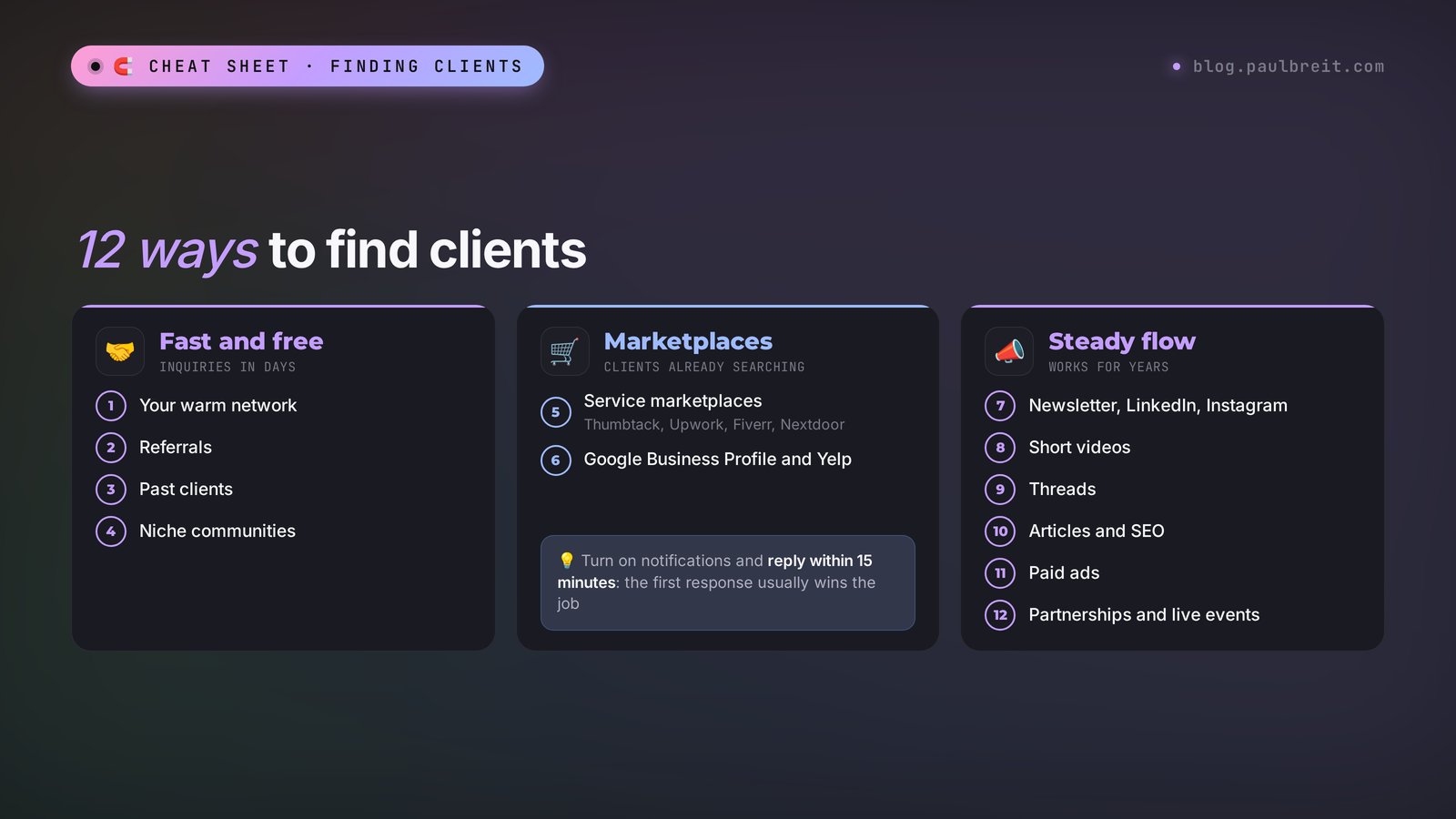
In 2026 you can find clients in twelve ways: your warm network, referrals, repeat sales, service marketplaces (Thumbtack, Upwork, Fiverr, LinkedIn ProFinder, Nextdoor), Google Business Profile and Yelp, niche communities, an email newsletter or social profile, short videos, Threads, articles and SEO, paid ads, and partnerships. If you have zero clients, start with your network and marketplaces: they bring inquiries within days. At the same time, build your content and a simple funnel with a free resource: in 1–3 months it starts bringing clients without you. You can write the messages, proposals, and posts for every method with AI.
Everyone who sells services, courses, and consulting: therapists, coaches, tutors, nutritionists, designers, marketers, lawyers, trainers, and freelancers. If you're still picking a direction, start with how to choose your niche, and if you're after your first online gigs, see honest ways to make money online.
What's inside
- Three questions before you look for clients
- 12 ways in one table
- Way 1. Your warm network
- Way 2. Referrals and word of mouth
- Way 3. Past and current clients
- Way 4. Thumbtack, Upwork, and marketplaces
- Way 5. Google Business Profile and Yelp
- Way 6. Niche communities and groups
- Way 7. A newsletter, LinkedIn, or Instagram
- Way 8. Short videos
- Way 9. Threads
- Way 10. Search: articles and SEO
- Way 11. Paid ads
- Way 12. Partnerships and live events
- How to turn attention into an inquiry
- AI finds clients with you: 6 prompts
- Which way to pick at your stage
- Do the math on how many people you need
- 7 mistakes that leave you without clients
- If something goes wrong
- A 30-day plan
- The whole path in one minute
Here's the hard truth: you have no clients because people don't know you exist. The economy, competitors, and an "oversaturated niche" have nothing to do with it. Someone with exactly your client's problem is scrolling their feed right now, asking in a neighborhood group, searching Google – and finding anyone but you.
I started on an online classifieds site, the local equivalent of Craigslist. My first sale on the internet was a scooter, handed over to a guy by a subway station in Novosibirsk. Then came a social media group selling G-Shock knockoff watches for 999 rubles (about $13), and the day after launch my phone wouldn't stop ringing. In 2014 I charged $30–40 to set up someone's ads, got turned down, and landed on blacklists. A year later, in Phuket, I was running 32 clients at once and leaving the house a couple of times a week to get food.
There was no magic between those two points. There was a choice: where are my clients right now, and how do I make sure they see me. That's what we'll work on.
Below are 12 ways. Some bring money this week, others build a flow for years. I'll break each one down: what it costs, how long until results, who it fits, what exactly to do, and what text to send. At the end you'll find a 30-day plan and prompts that take half the busywork off your plate.
Section 01Three questions before you look for clients
The most expensive mistake is chasing traffic when you can't explain in ten seconds how you help. People land on your page, read "therapist, I work with a variety of concerns," and leave. You pay for ads, spend your evenings on posts, and get zero inquiries.
Before you pick a method, answer three questions in writing.
- Who do you help? One clear group of people with a shared pain. "Moms on maternity leave who want to get back to remote work" is clearer than "women."
- What result will they get? In their own words, with a clear timeframe. "In 6 weeks you'll build a portfolio and land your first client" instead of "I'll teach you design."
- Why you? Your experience, case studies, method, numbers. Even if you've had three clients, that's three stories with results.
Your answers add up to one sentence you'll repeat everywhere: in your profile bio, in your Upwork proposal, in a message to friends, and in your ads. The formula is simple: "I help [who] get [result] in [timeframe] through [your method]."
Before: "Nutritionist. Healthy eating, balance, energy." After: "I help working women over 35 lose 10–15 pounds in 2 months without starving or counting calories." The second sentence filters out the wrong people on its own and pulls in the right ones.
If the wording won't come, that's normal. Hand it to AI: prompt #1 in Section 16 builds a client profile and five versions of the sentence in a couple of minutes. I wrote in detail about standing out among similar specialists in the article on brand positioning, and about an offer people actually pay for in how to write an offer.
Section 0212 ways to find clients in one table
So you don't have to keep it all in your head, here's the summary. "Speed" is how long it usually takes to get the first inquiry if you follow the steps. "Money" is whether you need a budget to start.
| # | Way | Speed | Money to start | Fits best |
|---|---|---|---|---|
| 1 | Warm network | 1–7 days | None | Anyone with zero clients |
| 2 | Referrals and word of mouth | 1–4 weeks | None | People who already have 2–3 happy clients |
| 3 | Past and current clients | 1–7 days | None | Anyone in business for six months or more |
| 4 | Thumbtack, Upwork, Fiverr, other marketplaces | 1–14 days | Small, for leads, bids, or commissions | Tutors, trainers, designers, lawyers, freelancers |
| 5 | Google Business Profile and Yelp | 2–4 weeks | Free, ads are paid | Anyone with an office, studio, or on-site service |
| 6 | Niche communities and groups | 1–3 weeks | None | Therapists, coaches, marketers, lawyers |
| 7 | Newsletter, LinkedIn, or Instagram | 1–3 months | None, or a small ad budget | Everyone who sells services, courses, and consulting |
| 8 | Short videos | 2–8 weeks | None | Those ready to show their face or process |
| 9 | Threads | 2–6 weeks | None | Those who like writing short posts |
| 10 | Articles, Medium, SEO | 2–6 months | None | Those ready to invest for the long run |
| 11 | Paid ads | 1–7 days after launch | From $150–200 for a test | Those with a ready funnel and a clear price |
| 12 | Partnerships and live events | 2–4 weeks | None | Those who work alongside related specialists |
The timeframes are my own benchmarks from practice; nobody can guarantee them. In a niche with hot demand it all happens faster, in a narrow and expensive one, slower. Ad and listing prices change, so check the platform's current pricing before you pay.
Section 03Way 1. Your warm network: message people you know
The most underrated method. People feel awkward and think of it as "being pushy." Then they spend a month without a single inquiry, paying for ads that never pay off.
Someone once asked me what I'd do if everything reset to zero tomorrow: the blog, the money, the clients. I have the answer ready. I'd message everyone I know and offer ad setup, websites, AI implementation – everything I can do, for minimal money, just to start earning. And I'd start a blog. Not a second of panic.
Why it works: the people you know already trust you. They don't need to read twenty posts to believe you're a decent person. Even if they don't need you themselves, each of them has a coworker, a sister, or a neighbor with exactly that problem.
How to do it in one evening
- Open the contacts in your phone, your email, LinkedIn, Facebook, and Instagram. Write down 50–100 people you've had at least one real conversation with.
- Mark the ones who could be clients themselves and the ones with a wide circle: managers, organizers, people with big families.
- Message each one personally. No mass blast and no single post in a group chat: one person at a time, by name.
- In the message: what you do now, who you help, a concrete starter offer, and a request to pass it on if someone comes to mind.
A script you can send today:
Hi Anna! It's been a while – how are you?
I'm now helping [who] [get what result]. I'm taking my first 5 clients at a reduced rate – [price] instead of [regular price] – in exchange for an honest review.
If it's not for you, maybe you know someone who could use it? I'd really appreciate it if you passed this along.
Out of 50 messages, more than half usually get a reply. Some will say "no thanks," some will forward it to a friend, and some will buy themselves. Your first 2–3 clients from your network also bring reviews and case studies, and without those everything else works worse.
Don't copy-paste the same text into a hundred chats at once, and don't add people to groups without asking. It's annoying, and platforms lock accounts for mass messages to strangers. A personal message with a name and one request is normal. Spam isn't.
Section 04Way 2. Referrals and word of mouth
Word of mouth works for everyone, but for most people it happens by accident. A happy client might recommend you to a friend, or might forget. Your job is to turn that accident into a system.
Three rules for word of mouth on purpose
- Ask at the peak. The best moment is right after the client gets a result and writes "thank you, this is amazing." Right then: "So glad! If you think of anyone with a similar goal, feel free to pass along my contact – I'd be very grateful."
- Give a reason and a reward. For example, for every client someone refers: a free session, a discount on next month, or a gift. The new client who comes by referral gets a nice bonus too. Then recommending you pays off for both sides.
- Make it easy to forward. Prepare a short blurb about yourself and a link the client can send in one tap. The less they have to think, the more likely they'll do it.
Collect reviews and case studies separately. "He's great" works weaker than a screenshot saying "down 13 pounds in two months" or "first $500 project three weeks in." I covered how to package these so the story sells on its own in how to write a client case study and how to collect reviews.
Section 05Way 3. Past and current clients
Getting a new client always costs more than selling to someone who already trusts you. Every marketer knows this, and almost nobody uses it.
Go through the list of everyone who's ever bought from you and figure out what to offer them now:
- A next step. They had a consultation – offer a month of ongoing support. They finished a course – offer the next level or help with implementation.
- A repeat. You built a website – offer an update in six months. You reviewed someone's diet – offer a seasonal adjustment.
- A related service. If you do design, offer copy together with a copywriter. If you're a therapist, offer a group format.
- Waking up "dormant" clients. Message the people who bought a year ago and went quiet: how are they, what has changed, do they need help now.
A message to a dormant client:
Hi Marina! A year ago we worked on [what you did together]. How's the result holding up?
I've launched a new format – [briefly what it is and who it's for]. You came to mind because back then you asked about [a detail from your past work].
If you're interested, I'll tell you more. If not – I'd just be happy to hear how you're doing.
The detail from your past work is the key part of this text. It shows you remember the person, so the message doesn't read like a mass email.
Section 06Way 4. Thumbtack, Upwork, Fiverr, and other marketplaces
On these platforms people are already looking for someone to hire. You don't have to explain why they need the service: they came for it, ready to pay. Your job is to stand out from the other profiles.
| Platform | What sells there | How you pay |
|---|---|---|
| Thumbtack | Local services: tutors, trainers, photographers, wellness, home services, events | You pay for leads and contacts from customers |
| Upwork | Project freelance: design, copy, development, marketing, AI work | Service fee on earnings, paid credits for proposals |
| Fiverr | Packaged digital services: design, writing, video, ads, AI | Commission on each order |
| LinkedIn ProFinder | Professional services: consulting, coaching, accounting, design, marketing | Check current terms in your LinkedIn account |
| Nextdoor and Craigslist services | Local services for your neighborhood or city | Free business page or listings; ads and some categories are paid |
Platform terms change, so check the exact pricing in each platform's section for pros or freelancers.
How to build a profile people click on
- A headline with a result. "SAT Math Tutor: +100 points in 3 months" instead of "Math Tutor."
- A real photo. Your face or the result of your work. Stock images lower trust.
- A price or a "from" price. People skip profiles without one: they're afraid it'll be expensive.
- A description that follows a structure. Who you help, what the client gets, how the work goes, what it costs, why you. Five short paragraphs.
- Your first reviews. Without them your profile sinks. Ask your first clients from your network to leave a review right on the platform.
- Response speed. On marketplaces, whoever replies first usually wins. Turn on notifications and reply within 15 minutes.
A proposal for a posted job is its own craft. A bad one: "Hello, I'm ready to take this on, 5 years of experience." A good one shows you've actually read the brief:
Hi Oliver! I read your brief: you need a landing page for your photography course, ready for the November 1 launch.
I built a similar one for [whom] – here's the link. Here's my plan: in 2 days I'll put together the structure and copy and show it to you; once you approve, I'll do the design and build in 5 days.
The cost is [amount]. I can jump on a 10-minute call today and ask 3 questions about your audience.
Marketplaces bring quick money, but they have a downside: you compete on price and depend on someone else's rules. Use them to get started and earn your first reviews, and build your own channels at the same time.
Section 07Way 5. Google Business Profile and Yelp
If you work in person – a therapy office, a studio, a massage room, a classroom, or you travel to clients – maps bring people searching "near me." The competition there is often lower than you think.
What to do:
- Create a free Google Business Profile and claim your business on Yelp. You'll need an address or service area, phone, hours, and business category. Apple Business Connect adds you to Apple Maps the same way.
- Upload 10–15 real photos: the entrance, your office, the work in progress, you.
- List your services with prices. The more complete your profile, the higher it ranks in map search.
- Ask every happy client to leave a review. A profile with 30 reviews and a 4.9 rating beats the neighbors with three.
- Reply to every review, including the bad ones. Calmly and to the point: future clients read these.
If you only work online, skip this one: without a location, maps won't help.
Section 08Way 6. Niche communities and groups
Your clients hang out somewhere: in local moms' groups, founder communities, groups for people relocating to another country, new creators, ecommerce sellers. That's where they ask questions you know the answers to.
The strategy is simple and takes patience. You join 5–10 of these communities and spend two or three weeks simply answering questions helpfully. No links and no "DM me." Detailed, to the point, with an example. After a while people start recognizing you and reach out on their own: "saw your answer, can I work with you?"
Where to find these communities
- Facebook group search by niche and city keywords: "small business owners Denver," "moms in Austin," "expats in Lisbon."
- Subreddits on your topic. Reddit is strict about self-promotion, which makes genuinely useful answers stand out even more.
- LinkedIn groups and Slack or Discord communities in your field.
- Communities around events, conferences, and courses where your audience learns.
Read each group's rules. Where ads are banned, don't advertise at all. One pushy message and you're out, and in a small community your reputation won't recover. A helpful answer sells better than a direct pitch.
Section 09Way 7. An email newsletter, LinkedIn, or Instagram
This is an asset you own. Readers who've followed you for months buy more willingly, and at higher prices, than people from marketplaces. In 2015 I started a public page called "Goal: 2,000,000 rubles (about $27K) in a year while traveling" and posted there every day. First friends joined, then friends of friends, then strangers. I beat the goal.
Where to build your audience in 2026:
- An email newsletter. The list belongs to you, and no algorithm decides who sees your message. Substack, beehiiv, or Kit get you started for free. But nobody discovers a newsletter on their own – you have to bring people in.
- LinkedIn. The algorithm shows posts beyond your connections, and it's the natural home for consultants, coaches, and B2B services.
- Instagram. Reels reach new people, and posts, stories, and DMs keep the relationship going. Good for a broad audience and visual niches.
- Facebook groups. Your own group around a topic can become a community that buys from you.
If you already post in one place, you can simply repurpose the content to a second one. You don't need to choose "the one right platform."
What to post so your content sells
Beginners post nothing but tips and then wonder why nobody buys. Your reader needs to see value, you, your results, and how to work with you. A simple guideline for a week of five posts:
- 2 value posts: a breakdown of a common mistake, a step-by-step guide, a checklist;
- 1 client case study: before, what you did, after;
- 1 personal post: a story, an opinion, behind the scenes;
- 1 post with an offer: a free call, a spot in a group, a new service.
I broke down how to get your first thousand readers with no budget, step by step, in your first 1,000 followers, and how to write emails people actually read in email newsletters with AI. If you want your posts to come together faster, see a content plan in one evening.
Section 10Way 8. Short videos
Instagram Reels, TikTok, YouTube Shorts. Short video is the only format where a hundred thousand strangers can see you with no ad budget. The algorithm shows your clip to people who watch similar ones to the end, and nobody cares how many followers you have.
What to film if you sell services:
- One question, one answer. "Why your kid won't do homework" – 40 seconds with one takeaway.
- A mistake and the fix. "You're drinking water like this – and that's a mistake."
- Your process. What your session looks like, how you design, the before and after.
- Myth versus truth. Bust a popular misconception in your niche.
The first seconds decide whether people keep watching. Open with a conflict or a painful question. "Hi, my name is" in the first second kills the video. At the end, one action: follow, comment a keyword, or visit your profile link.
You can write scripts together with AI: a ready approach is in AI for Reels: 30 scripts a month.
Section 11Way 9. Threads
Threads is Meta's text-based social network. Its algorithm shows posts to people who don't follow you, so even a new account can pull thousands of views on one good post. If you write better than you film, this is a strong channel.
How to use it:
- Write short posts of 2–5 lines: an opinion, an observation, a provocative question on your topic.
- Reply to other people's popular posts on your topic – that's how new people see you.
- In your profile: your "who and what" sentence and a link to your newsletter or free resource.
- Post every day: on Threads, consistency decides.
I run Threads on autopilot: AI finds posts on my topic that took off, rewrites them in my own words, and publishes on a schedule. I explained how to build the same setup in Threads on full autopilot with Claude.
Section 12Way 10. Search: articles, Medium, and SEO
The slowest method and the most rewarding. Someone searches "how to prepare my kid for the SAT math section," finds your article, reads for 15 minutes, and arrives ready to buy. An article works for years and doesn't need a budget for every view.
Options to start with:
- Medium and Substack. Free platforms that rank in Google and have their own recommendations. You can start from zero without your own website.
- A blog on your own site. It takes longer to gain traction, and everything belongs to you. That's exactly how this blog works.
- AI answers. ChatGPT, Perplexity, and Google's AI Overviews increasingly answer questions with links to articles. A good article gets into both search results and AI answers.
Write about the real questions your clients ask: what they ask on calls is what they type into Google. Detailed guides are in Medium for business, SEO for your blog, and how to show up in ChatGPT and AI search.
Section 13Way 11. Paid ads
Ads are the fastest way to get inquiries every day. And the fastest way to burn money if you send people nowhere. Before you launch, you need: a clear offer, a page or automated flow where people land, and a way to sell to them next.
The main options in the US:
| Channel | How it works | When to choose it |
|---|---|---|
| Google Ads | Ads on search queries, plus YouTube and the display network | When people search for your service in their own words |
| Meta Ads (Facebook, Instagram) | Targeting by interests, age, location, lookalike audiences; Reels and feed placements | A broad audience, growing your list, collecting inquiries |
| LinkedIn Ads | Targeting by job title, industry, company size | B2B services, consulting, high-ticket offers |
| Newsletter sponsorships | Buying a mention or a dedicated email in someone else's newsletter | Quickly reaching a ready, engaged audience in your niche |
Here's how client acquisition works for me. Search ads lead to a free resource: a mini course or a guide. The person lands on an opt-in page and chooses where they want to receive it. Then a bot delivers the resource, my content warms them up, and after that the person comes to a free strategy call, which is where the sale happens. I have more than 18 of these opt-in pages, each free resource has its own ads with its own angle, and they all flow into one funnel.
Three rules so you don't burn your budget:
- Test small. Launch 3–5 different ads on a small amount, keep the best ones, turn off the rest.
- Track cost per inquiry and cost per sale. Cost per click and likes tell you nothing. Look at what one client cost you and how much they brought in.
- Play by the rules. Ad platforms reject and restrict accounts for exaggerated promises and claims they can't verify. If you pay a newsletter or creator for a mention, the post must be clearly labeled as sponsored.
Section 14Way 12. Partnerships, live sessions, and speaking
Your client works with other specialists too. A nutritionist's client also sees a personal trainer and an esthetician. A designer's client also hires a copywriter and a marketer. A therapist's client works with a coach. You serve the same people from different angles, which means you can send them to each other.
Partnership formats:
- Mutual referrals. Agree with a related specialist to recommend each other, sometimes with a referral fee.
- A joint live session. An hour of live conversation for two audiences at once. Each of you gets new followers.
- A guest post. You write a useful piece for someone else's newsletter or blog with a link back to you.
- Speaking. Conferences, business breakfasts, online summits. I once spoke at a digital marketing conference in front of 800 people, and talks like that build trust no ad can buy.
How to pitch a partnership:
Hi Emily! I read your fitness newsletter, and I especially liked your piece on [topic].
I'm a nutritionist working with a similar audience: women 30–45 who want to get in shape.
I'd love to do a joint live session on "nutrition or training: what matters more for results." One hour, questions from your readers, each of us covering our side.
If you're interested, suggest a date that works for you – I'll adjust.
A specific topic, a specific benefit for the partner, and minimal effort on their side – that's what makes a pitch easy to say yes to.
Section 15How to turn attention into an inquiry
The twelve ways bring attention. But attention isn't a client yet. Someone saw your video, read your post, clicked your ad. If at that moment there's no small next step to take, they'll leave and forget you within an hour.
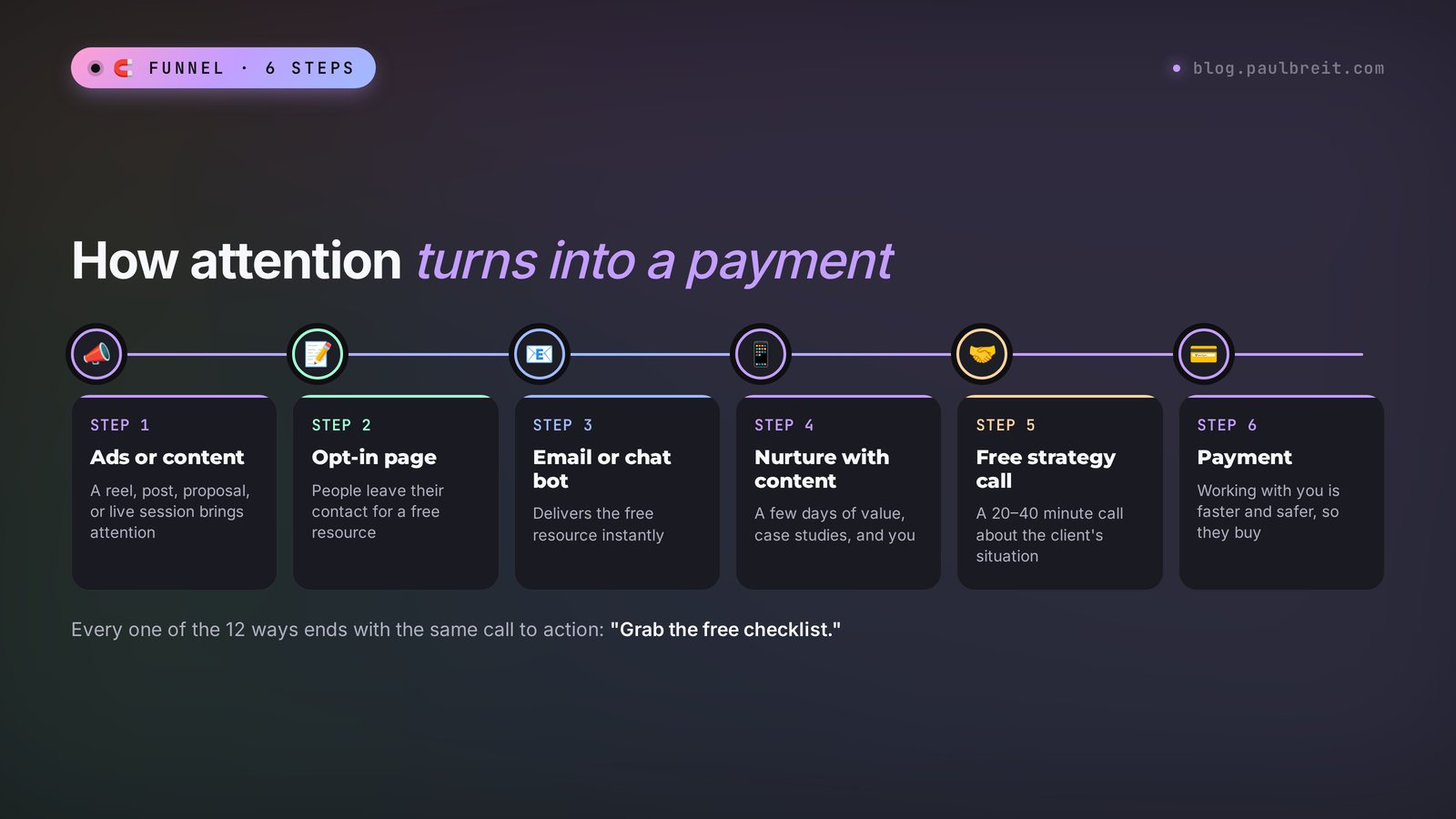
That's why all the methods should lead to one place – a simple funnel. Its minimal version looks like this:
- A free resource. A checklist, a mini course, a guide, or a curated list that solves one specific client problem in 10 minutes.
- A page or a bot. The person leaves their email or starts a chat bot and gets the resource.
- A series of emails or messages. Over a few days you show value, case studies, and yourself.
- An invitation to a call. A free 20–40 minute call where you help them sort out their situation.
- The sale. On the call the person sees that working with you is faster and safer, and buys.
Then every method on the list – a reel, a community answer, a proposal, an ad, a live session – ends with the same call to action: "comment CHECKLIST and I'll send it to you." From there the funnel works without you: at night, on weekends, on vacation.
You can put this together in a few days with AI. The free resource – with the guide a lead magnet with AI in an hour, the whole chain – with a sales funnel in 3 days, and an assistant that answers clients and books calls – with an AI consultant on your site. How to run the call itself so it ends with a payment, I covered in the sales call script.
Section 16AI finds clients with you: 6 prompts
Half the work of finding clients is writing: your pitch, proposals, messages, posts, ads. AI writes a draft in a minute, and you edit it to sound like you. Claude, ChatGPT, or Gemini will all do. I work in Claude: it keeps a natural, human tone better.
You can sign up for Claude at claude.ai – the free plan is enough to try every prompt below. If you're just starting, the complete walkthrough is in Claude from scratch.
Prompt 1. Client profile and your "who and what" sentence
You are a marketer with 10 years of experience. I'm a [profession], and I help [who, as I currently understand it].
My best clients looked like this: [2–3 short descriptions: who they were, what they came with, what they got].
1. Describe my ideal client: who they are, what they fear, what they want, what words they use to describe the problem, where they spend time online.
2. Suggest 5 versions of the sentence "I help [who] get [result] in [timeframe] through [method]." No jargon, in the client's own words.
3. Tell me which version is strongest and why.
What AI will roughly give you: a half-page profile with the client's pains and words, five sentences, and a recommendation. For an English tutor, for example: "I help professionals who froze up in meetings for years start speaking confidently on calls in 3 months." Then you pick one and fine-tune it.
Prompt 2. Messages to your warm network
Write 3 versions of a personal message to people I know, saying that I now [what I do, for whom].
Terms: I'm taking my first 5 clients at [price] instead of [regular price] in exchange for a review.
Friendly tone, no pressure, under 400 characters. End with a soft request to pass it on to anyone who could use it.
Versions: for a close friend, for a former coworker, for someone I haven't talked to in a long time.
Prompt 3. A marketplace profile and proposals
Create a service profile for [Thumbtack / Upwork / Fiverr].
Service: [what you do]. Client: [who]. Result: [what they get]. Price: [from ...]. Experience and case studies: [briefly].
Give me: 5 result-driven headline options under 50 characters, a description in 5 short paragraphs (who it's for, what you'll get, how the work goes, what it costs, why me), and a proposal template where the first line restates the client's task.
Prompt 4. A community answer that sells without selling
In [which group or subreddit] someone asked: "[question]".
I'm a [profession]. Write a helpful answer of 100–150 words: one concrete tip, an example, one common mistake.
No links, no invitation to DM, no ads. The answer should show I know my stuff so the person wants to talk to me on their own.
Prompt 5. A week of posts
I post on [my newsletter / LinkedIn / Instagram] for [whom]. My service: [what].
Create a plan for a week of 5 posts: 2 value posts, 1 client case study, 1 personal, 1 with an invitation to a free strategy call.
For each: a hooky first line, the main idea in 2–3 sentences, and a call to action at the end.
Here's my real case for the case-study post: [before – what we did – after].
Prompt 6. Five ads for a test
Write 5 ads for [Google Ads / Meta Ads / LinkedIn Ads].
They lead to a free resource: [name and what's inside]. Audience: [who].
Give each ad its own angle: pain, result, mistake, curiosity, a number.
Fit the headline and text length to the platform's limits. No strings of exclamation points and no promises I can't keep.Give AI real details: your case studies, numbers, and the words clients use in messages. The more real material you feed it, the less generic the answer. And if the copy comes out flat, teach it to write in your voice with the guide how to teach AI to write in your voice. A hundred more ready-made prompts are in the AI prompt library.
Section 17Which way to pick at your stage
Doing all twelve at once is a sure way to burn out in a month without finishing a single one. Pick 2–3 methods for your stage.
| Your stage | Main methods | What to build alongside |
|---|---|---|
| Zero clients | Warm network, service marketplaces, niche communities | Content on one platform, first reviews |
| 3–10 clients, but irregular | Referrals, repeat sales, content, short videos | A free resource and an automated follow-up |
| A steady flow, and you want more | Paid ads, partnerships, live sessions | Articles and SEO, a second platform, automated replies |
The logic is simple. At the start you need money and reviews fast, so you take the methods where people are ready to buy or already trust you. Once your first clients show up, you build what brings people in without your daily involvement. Once there's a flow, you scale it with money.
One more observation from practice: price affects your search too. When I was setting up ads for clients, I started at about $40 per setup. Then I nervously raised it to around $65, and once I named about $130 just to get rid of a client – and he agreed. I got to around $330: the price grew 8 times, and I didn't end up with 8 times fewer clients. Sometimes, instead of looking for new clients, you need to find the nerve to name a fair price to the ones who already came.
Section 18Do the math on how many people you need
Many people drop a method after a week because "it doesn't work." It did work – too few people went through it to see a result. So do the math up front.
A sample calculation, the numbers are illustrative – plug in your own:
- Goal: 5 new clients a month.
- About one in three people on a free call buys – so you need 15 calls.
- About one in ten people who grabbed the free resource books a call – so 150 people need to grab it.
- If ads bring in one person for $2, then 150 people cost about $300 a month.
This shows you where the bottleneck is. Too few calls – work on your nurture sequence and your invitation. Calls but no sales – work on the call itself and your offer. Nobody takes the free resource – change it or the ads. Each step gets fixed separately, which is much easier than "nothing works."
My own numbers changed like this over several years: my average sale grew from about $800 to about $5,300, and my close rate went from 10% to 60%. I started with small numbers because I undervalued myself. Tracking your funnel is worth it if only to watch it grow.
Section 197 mistakes that leave you without clients
- "I help everyone." When your service is for everyone, it's for no one. A person should recognize themselves in your very first sentence.
- Jumping between methods. A week of reels, a week of Upwork, a week of groups – and none of them got enough people through for a result. Pick 2–3 methods and stick with them for at least a month.
- Traffic to nowhere. Ads and posts lead to a profile with no offer and no next step. The person came, looked around, and left.
- Being shy about selling. Content that's all value without a single offer. Your followers honestly don't know what they can buy from you.
- Slow replies. The inquiry came in the morning, you replied in the evening – the client already bought from someone else. The first 15 minutes decide.
- No reviews or case studies. Without proof, even a hot lead hesitates. Collect them starting with your very first client.
- A price that's too low. Cheap doesn't mean attractive: it often reads as a lack of confidence. And it leaves you no money for ads and growth.
Section 20If something goes wrong
People read your message and stayed silent. That's normal; not everyone replies right away. After 5–7 days, send those who read it one short note: "Not trying to bother you – just a reminder in case someone came to mind." Don't send more than one reminder.
Nobody views your Thumbtack or Fiverr profile. Change the headline and photo – they're the first thing people see in the results. Make sure your price is listed and isn't higher than competitors with no reviews. Ask your first three clients to leave a review.
Nobody replies to your Upwork proposals. Reread your proposal: the first line should restate the client's task. Apply in the first minutes after a job is posted: a few hours later, the client has already picked someone.
You get kicked out of groups. That means your answers look like ads. Remove the links and invitations, and answer only on substance. Let people come to your profile on their own.
You post, but there are no followers. On a newsletter, and often on LinkedIn, followers rarely show up by themselves. You need a source: ads, cross-promotions with other creators, guest posts, videos that link to your newsletter. Content keeps people around; traffic brings them in.
Your videos don't get views. Look at retention in the first seconds. If people leave immediately, redo the opening: name the pain or the conflict in your first line. Film 10 videos before drawing conclusions.
Ads eat money, and there are no inquiries. Pause and check step by step: are people clicking the ad, filling out the form, starting the bot? If it breaks at the click, change the ad. If it breaks on the page, change the page and the offer. Don't add budget until you've found the leak.
Inquiries but no sales. The problem is on the call or in the offer. Listen to recordings of your calls – AI will help you find where you lose the client, with the guide analyze sales calls with AI.
AI writes generic copy. Give it more real material: your old posts, client quotes, real numbers. Ask it to rewrite "simpler, the way I'd say it to a friend." Delete everything from the text that you'd never say out loud.
Section 21A 30-day plan
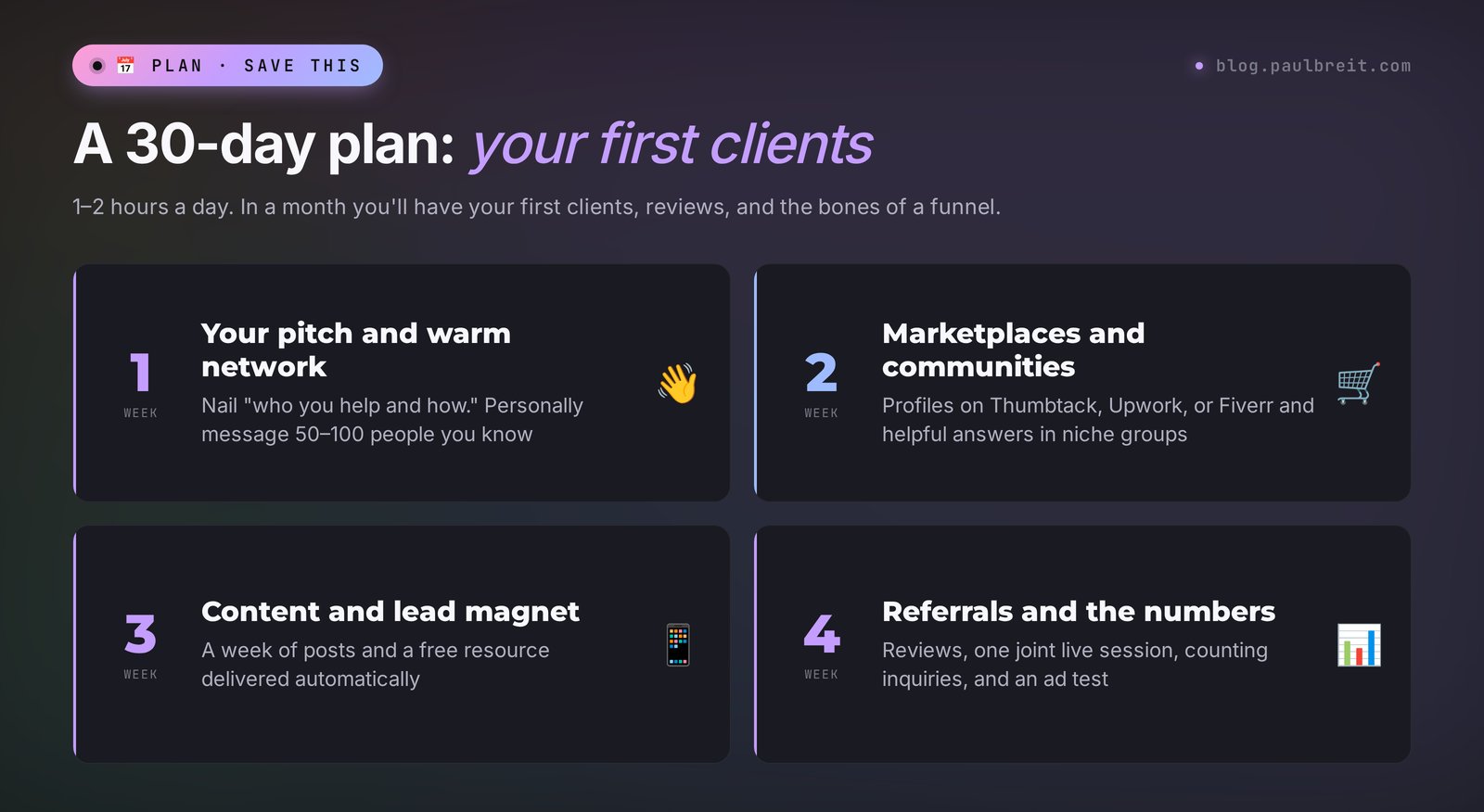
1–2 hours a day. In a month you'll have your first clients, reviews, and the bones of a funnel that will keep working on its own.
- Days 1–3. Answer the three questions from Section 1. Run prompt #1 and pick your "who and what" sentence. Put it in your bio on every platform.
- Days 4–7. Write down 50–100 people you know and message each one personally using prompt #2. Offer your first five clients a reduced rate in exchange for a review.
- Days 8–10. Create profiles on 1–2 service marketplaces with prompt #3. Turn on notifications and reply within 15 minutes.
- Days 11–14. Find 5–10 niche communities. Give 2–3 helpful answers every day with prompt #4.
- Days 15–18. Start or revive your newsletter, LinkedIn, or Instagram. Publish a week of posts with prompt #5, including your first case study.
- Days 19–22. Put together a free resource and an automated way to deliver it. Add the link to your profiles, marketplace listings, and posts.
- Days 23–26. Ask all your happy clients for referrals. Set up one joint live session or guest post.
- Days 27–30. Count where your inquiries and clients came from. Keep the two strongest methods and decide whether you're ready to test ads with prompt #6.
Section 22The whole path in one minute
- First comes your sentence: "I help who, get what result, in what timeframe." Without it, every method works poorly.
- Fast methods: warm network, repeat sales, service marketplaces, niche communities. They bring inquiries within days.
- Methods for a steady flow: a newsletter, LinkedIn, or Instagram, short videos, Threads, articles and SEO. They kick in after 1–6 months and then work for years.
- Scale: Google Ads, Meta Ads, LinkedIn Ads, newsletter sponsorships, and partnerships.
- Pull all the attention into one funnel: a free resource, an automated follow-up, content, a call, a sale.
- Track your funnel step by step and fix the place where people drop off.
- AI writes the copy for every method using six prompts; you add the real-life details.
- Pick 2–3 methods for your stage and stick with them for at least a month.
Open your contacts today and message five people you know, using the script from Section 3. That's ten minutes. And your first client may well show up this week.
FAQFrequently asked questions
How do I find my first clients with no experience or reviews?
Start with your warm network: personally message 50–100 people you know about what you do now, and offer your first five clients a reduced rate in exchange for an honest review. At the same time, set up a profile on Thumbtack, Upwork, or Fiverr. Your first 2–3 clients give you reviews and case studies, and with them every other method works far better.
Where can I find clients for free?
Free methods include your warm network, referrals, repeat sales, niche communities, an email newsletter, LinkedIn or Instagram, short videos on Reels, TikTok, and YouTube Shorts, Threads, articles on Medium or your own blog, and partnerships with related specialists. You pay with time instead: fast methods bring inquiries within days, content-based ones within 1–3 months.
What is the fastest way to find clients?
The fastest are messages to people you know, offers to past clients, and service marketplaces where people are already looking to hire. First inquiries there usually come within 1–14 days. Paid ads also bring inquiries in the first days, but only if your offer and the page or automated flow people land on are ready.
How do I find clients for my services online?
Spell out who you help and with what result, then pick 2–3 channels: service marketplaces (Thumbtack, Upwork, Fiverr, LinkedIn ProFinder), content on a newsletter or social platform, niche communities, or ads. Send all the attention to one place: a free resource and an automated follow-up that delivers it and invites people to a call.
How much does it cost to get a client through ads?
It depends on your niche, price, and platform, so there's no exact figure. Start with a test of $150–200, calculate your cost per inquiry and per sale, and compare it with your price. If one client costs less than a third of what they pay you, the ads are worth scaling.
Is it okay to message strangers to offer my services?
Mass messaging strangers in their DMs is spam: people report it, and platforms lock accounts. What works: personal messages to people you know, proposals on posted jobs, helpful answers in communities, and partnership pitches to a specific person with a clear benefit for them.
How does AI help you find clients?
It drafts almost all the writing: your client profile and your who-and-what sentence, messages to people you know, marketplace profiles and proposals, community answers, posts, and ads. You add your own case studies and numbers and edit to sound like you. Six ready prompts are in Section 16 of this article.
Where should a therapist, coach, or tutor look for clients?
Tutors do well on Wyzant, Thumbtack, and Google Business Profile if they have a physical location. Therapists can add a Psychology Today profile; therapists and coaches both benefit from niche communities, a newsletter or LinkedIn, short videos, and partnerships with related specialists. All three should create a free resource and invite people to a short free call: that's where most sales happen.