How to Run a Blog in 2026: a 30-Minute Daily System
How to run a blog when you sell services, courses, or consulting and you have no spare hour, no team, and no wish to live inside your phone. This guide covers where to blog in 2026 and how an email newsletter, LinkedIn, Instagram, YouTube Shorts, and a blog on your own site compare, how to set it all up in one evening, what to write about, how to build your day so the blog takes 30 minutes, ready AI prompts, which numbers to watch, how to turn readers into clients, and a detailed plan for your first 30 days.
To run a blog without burning out, you need a 30-minute daily system. Choose one platform (usually an email newsletter or LinkedIn), set it up in one evening: a clear name, a photo, a "who I help and with what" description, and a pinned or welcome post. Once a week, spend 40 minutes planning 4-5 topics from your idea bank. Every day, spend 5 minutes picking the topic, 15 on a draft (AI can help), 5 on edits, and 5 on replies to comments and messages. Alternate value, stories, cases, and offers, invite readers to a consultation once a week with a specific phrase, and feed audience growth with ads or cross-promotion.
Everyone who sells services, courses, and consulting and wants clients to come from their blog. The therapist who has been "about to start writing" for three months. The coach with 300 subscribers whose last post went out in August. The nutritionist who writes beautifully, but once every two weeks. Tutors, fitness trainers, lawyers, designers, mentors, and freelancers whose client work eats the whole day and leaves only crumbs of time for the blog.
What's inside
- Why blog if you sell services
- Where to blog in 2026: platforms compared
- Set up your blog in one evening
- What to write: 4 post types
- The 30-minute daily system
- An idea bank that never runs dry
- How to write a post in 15 minutes
- AI as your helper: 7 prompts
- How often to post
- Stories and short videos without the pain
- Which numbers to watch
- How to turn readers into clients
- Where new subscribers come from
- The fears that stop you from starting
- 10 blogging mistakes
- When something goes wrong
- Your plan for the first 30 days
- The whole path in a minute
I've been blogging for 12 years. I published my first post in December 2014, and my Telegram channel has collected more than three thousand posts since 2017. And I'll be honest: I have never lived for my blog. My working routine is about 20 minutes a day on posts. The rest of my time goes to clients, products, and life.
There was also a failure worth knowing about in advance. When everyone moved to short videos and stories, I kept writing long text posts on the social network where my audience lived back then, because that was more comfortable for me. Reach and sales dropped. Readers don't care what's comfortable for the author. Your blog has to live where your people are right now, in the format they consume right now.
The system I break down below grew out of those 12 years. It fits a person who has a job, clients, a family, and half an hour a day at most. If you need to build your first thousand followers from zero, read the breakdown on your first 1,000 followers with no budget after this one. This article is about running a blog day after day and not quitting after a month.
Section 01Why blog if you sell services
A blog run by a coach, a therapist, or any specialist solves one problem. A stranger needs to read you for a couple of weeks and trust you enough to send a message or fill out a form. Everything else, reach, likes, a pretty feed, is just a tool for that job.
Look at how a person becomes a client. They see your ad, a post shared by a colleague, or an article in Google. They land on your blog. They read three or four posts in a row and think: "This person seems to know their stuff, and they talk like a normal human." They subscribe. For the next two or three weeks they see your posts in their inbox or feed. One day a post describes their exact situation. That's the day they write to you.
That path is what your blog serves. It leads to three conclusions that change how you run it:
- You don't need millions. An audience of 500-1,500 real readers from your niche can bring inquiries every week. One of my clients, Olga Ofitserova, ran her mentorship launch through a series of posts in a Telegram channel with 1,500 subscribers, and it brought in about $20,000.
- Consistency beats genius. An average post that goes out four times a week earns more than a masterpiece once a month. People need to keep seeing you.
- Every post has to be about the reader. Your workday, your thoughts, your trip are interesting exactly to the degree they carry something useful or familiar for the person reading.
Arseniy Klementyev, who sells sales training through his Telegram channel, took a simple path: he polished his channel's setup, ran ads to it, started posting regularly, and gently invited people to fill out a pre-registration form. Then came calls and about $23,000 in sales. Rinat Galiev, who works in the investing niche, started posting steadily, added ads and free financial checkups where he got to know people, and that's how his sales started. None of them had a huge audience. They all had one thing in common: the blog came out on schedule, and it offered a clear step toward a conversation.
Stop measuring your blog by follower count. Measure it by how many people messaged you after your posts this month. That number grows with consistency and with how closely your posts match the situations your readers are in.
Section 02Where to blog in 2026: platforms compared
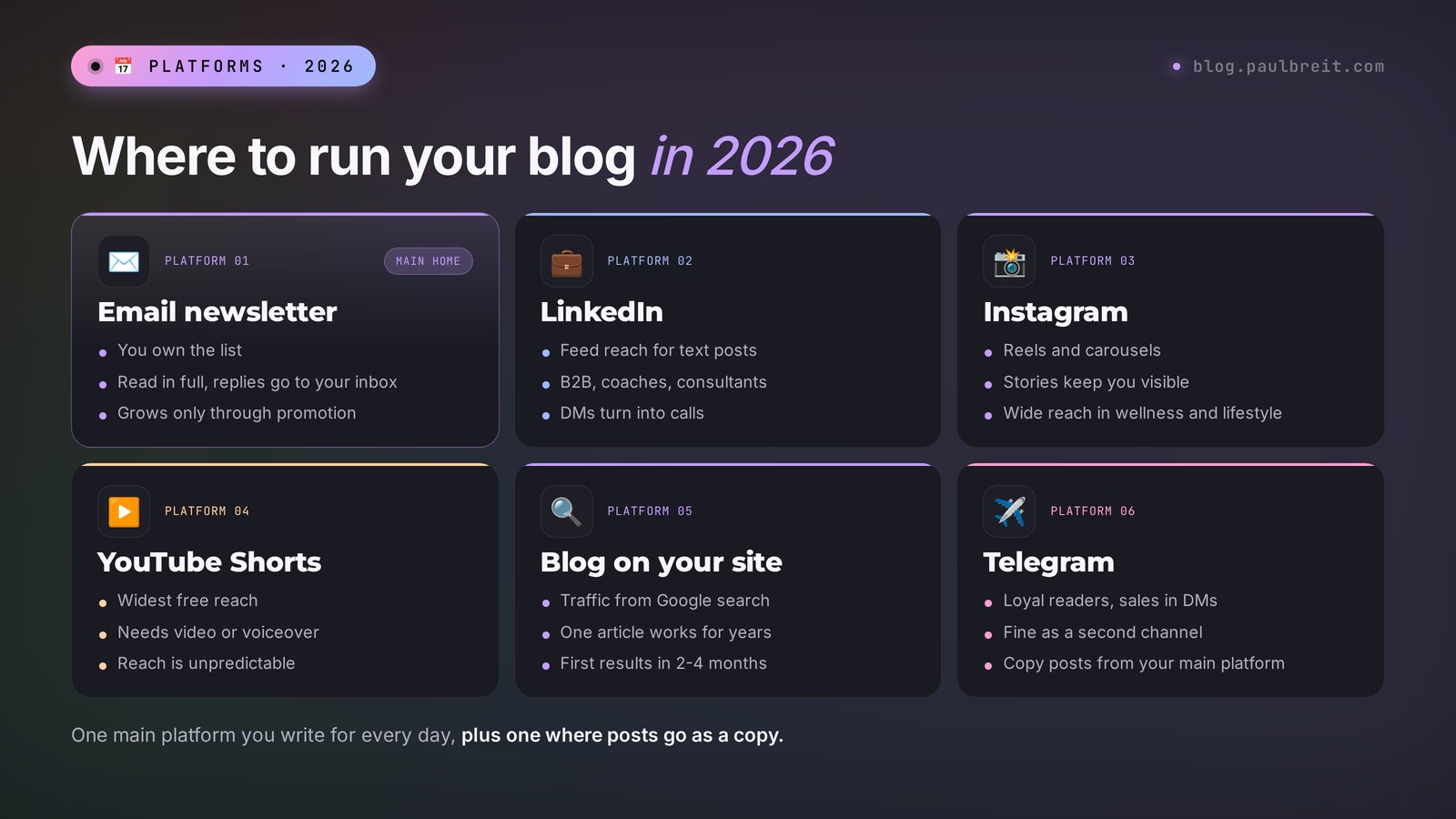
The first question many people get stuck on for a month: where should I blog? The answer is simpler than it looks. Blog where your clients already read, and where you can write without forcing yourself. Below is an honest comparison of the platforms that work for an English-speaking audience in 2026.
| Platform | Strength | Weakness | Best for |
|---|---|---|---|
| Email newsletter (Substack, Beehiiv, Kit) | You own the list, readers open posts in full, replies land in your inbox and turn into conversations | Almost no discovery on its own: new readers come through ads, cross-promotion, and links | Nearly everyone who sells consulting, mentoring, and courses |
| The feed still pushes text posts to new people, comments and DMs lead straight to calls | The audience is mostly professional, so personal-life niches get less traction | Coaches, consultants, B2B services, career and business topics | |
| Reels, carousels, and stories reach new people, DMs are a natural place to sell | You need several formats: posts, reels, stories | Wellness, fitness, nutrition, beauty, local services | |
| Blog on your site | Traffic from Google search, one article brings people for years | First results take 2-4 months, you need a website | People ready to invest for the long run |
| Short videos (YouTube Shorts, Reels) | The widest reach to new people with zero budget | You have to film or assemble videos, reach is unpredictable | People who aren't afraid of the camera or will make videos with voiceover |
| Telegram channel | A very loyal audience, posts get read in full, easy to sell in DMs | A small share of English-speaking clients use it, organic growth is near zero | A second channel if part of your audience is already there |
My recommendation for getting started is simple. Take one main platform where you write every day, and one secondary platform where your posts go as a copy. For most people selling services to an English-speaking audience, that's an email newsletter plus LinkedIn, or an email newsletter plus Instagram. Repurposing is enough on the second platform: a newsletter issue becomes a LinkedIn post or a carousel, and you don't write anything twice. If part of your audience already reads Telegram, a channel there works the same way, as a copy of your main posts.
A blog on your own site is its own story. It takes longer to gain momentum, but an article that ranks on the first page of Google brings people for free for years. If you want this channel, read the breakdown on SEO for your blog, which walks through writing articles for search step by step. If you like long-form writing but don't have a site yet, look at Medium for business: articles there also get picked up by search.
Starting a blog on five platforms at once "to reach everyone." Three weeks later the person burns out and drops all five. One platform that's alive brings more than five half-dead ones.
Section 03Set up your blog in one evening
A person who lands on your blog for the first time decides in a few seconds whether to subscribe or close the tab. They look at four things: the name, the photo, the description, and the first post they see. Set those up in one evening, and every post after that will work harder.
Name: your name plus the benefit
The formula that works best is "Name | what the blog is about." For example: "Anna Smith | A therapist on anxiety and burnout" or "Mike Bell | Fitness for busy founders." Creative names like "Soul Kitchen" can't be decoded in a second, so people scroll past.
Photo: your face, up close
You need a photo where your face is clearly visible, a light background, a slight smile. No logos, cats, or landscapes. People buy from people, so a face in your profile picture is already half the trust. For a long time I was shy about taking photos for my blog and thought it wasn't serious. That was a mistake: a real photo sells better than any logo.
Description: who you help and with what
Three lines. The first says who you help and what result they get. The second is your main proof: experience, number of clients, a strong case. The third says what to do next: "To book a consultation, send me a DM" or "Reply to any email and I'll answer personally." Example: "I help new moms get their energy back without strict diets. 6 years of practice, 400+ clients. Free nutrition review: reply with the word ENERGY."
Pinned or welcome post: introduction and navigation
This is the first post a new person sees. On LinkedIn and Instagram it's the featured or pinned post, in a newsletter it's the welcome email. Keep it short: who you are, what you help with, 2-3 client results, links to your 3-5 best posts, and how to reach you. Update it every couple of months as new cases come in.
Lead magnet: a gift for subscribing
Something useful a person gets for free: a checklist, a guide, a mini-lesson, a review. It turns a random visitor into a subscriber and gives them a reason to write to you. You can put one together in an hour, and the step-by-step process is in the article on a lead magnet with AI in an hour.
If you can't put into words who you help and with what, the problem runs deeper than setup. Sort out your positioning first: the articles on brand positioning and unpacking your expertise with AI will help. People read a blog without a clear "what it's about" only out of politeness.
Section 04What to write: 4 post types
When someone sits down to write without a plan, their hand reaches for one type of post. The therapist writes only tips, the coach only motivation, the trainer only workout photos. The blog turns monotonous and readers stop noticing the posts. The fix is to rotate four types, and each one has its own job.
| Post type | Share | What it does | Example topics |
|---|---|---|---|
| Value | ~40% | Shows you know your field and gives people a reason to save and share | A how-to, a breakdown of a mistake, a checklist, an answer to a common question |
| Stories and life | ~30% | Makes you a real person people can like | Something from your day, a failure and the lesson, your take on a debated topic, behind the scenes |
| Cases and reviews | ~20% | Proves your method works for people like the reader | A client story "before, what we did, after", a review screenshot with a breakdown |
| Offers | ~10% | Moves ready people into a conversation and a payment | An invitation to a consultation, open enrollment for a group, an answer to "how do I work with you" |
The proportions are approximate. A week with five posts might look like this: Monday is value, Tuesday a story, Wednesday value, Thursday a case, Friday value with a soft invitation at the end. A launch week will have more offers, a vacation week more stories. Keep the balance over a month.
Here's how the same expertise splits into four types across different niches:
| Niche | Value | Story | Case | Offer |
|---|---|---|---|---|
| Therapist | 3 signs you're close to burnout | How I missed my own warning signs in 2023 | A client went back to work after 2 months | I've opened 4 consultation spots in November |
| Nutritionist | What to eat for breakfast so you don't crave sugar at 4 PM | My failed attempt at intermittent fasting | Down 15 pounds with no binges: a meal plan breakdown | Enrollment for a 4-week support group |
| Tutor | How a child can learn 20 words in a week | The kid who cried over English homework | From a C to an A in one semester | A free trial lesson this Saturday |
| Coach | Why yearly goals don't work and what to do instead | How I abandoned a project halfway | A client changed jobs and raised their income | Strategy session: 3 open slots |
| Fitness trainer | A 15-minute workout for people who sit all day | How I hurt my back and what it taught me | A founder got back in shape in 3 months | Online coaching starts on the 1st |
| Lawyer | What to check in a lease before you sign | The case I almost lost over a tiny detail | We got a client's $1,600 security deposit back | A contract review within 24 hours |
The numbers in the table are sample wording. In your posts, numbers should only be real: from your practice, reviews, and conversations. People spot a made-up case faster than you'd think, and it costs you their trust.
For how to build content in several layers, from pain points to the sale, read the meaning pyramid. And the breakdown on storytelling teaches you to write stories that hook people.
Section 05The 30-minute daily system
This is the heart of the whole article. People quit blogging for one reason: every post starts with a blank page and the question "what do I write about today?" That question eats more time than the text itself. The system removes it from your day completely.
It has two parts: a short weekly planning session and a daily half hour.
Once a week: 40 minutes to plan
Pick a fixed day and time, say Sunday evening or Monday morning. Put a recurring event in your calendar. In those 40 minutes you do four things:
- 10 minutes: review last week's numbers. Which post got the most reactions, shares, and direct messages. That's your hint for what to write next.
- 15 minutes: pick 4-5 topics for the week from your idea bank using the mix from Section 04: value, story, case, value with an invitation.
- 10 minutes: write one line for each topic: the main idea and the example that goes with it. For example: "Why anxiety gets worse at night, with the client who couldn't fall asleep until 2 AM."
- 5 minutes: lay the topics out by day in your notes or a spreadsheet.
After those 40 minutes, you know every morning what you're writing about. The hardest part of blogging is covered a week in advance.
Every day: 30 minutes for the post and for people
| Minutes | What you do | Why |
|---|---|---|
| 5 | Open your plan, reread the topic and the idea line. Recall a real example | You come to the text warmed up, with no blank page |
| 15 | Write a draft yourself, or dictate it and ask AI to assemble the text | The bulk of the work, no polishing yet |
| 5 | Edit: cut the fluff, check the first line and the action at the end, read it out loud | The post reads easily and leads to a step |
| 5 | Publish and reply to comments and messages from the last 24 hours | Conversations with people are where inquiries come from |
Pay attention to those last 5 minutes. Many people treat replying to comments as optional courtesy. In fact it's the part of the blog that makes the most money: a person who asked a question in the comments and got a real answer is already halfway to becoming your client.
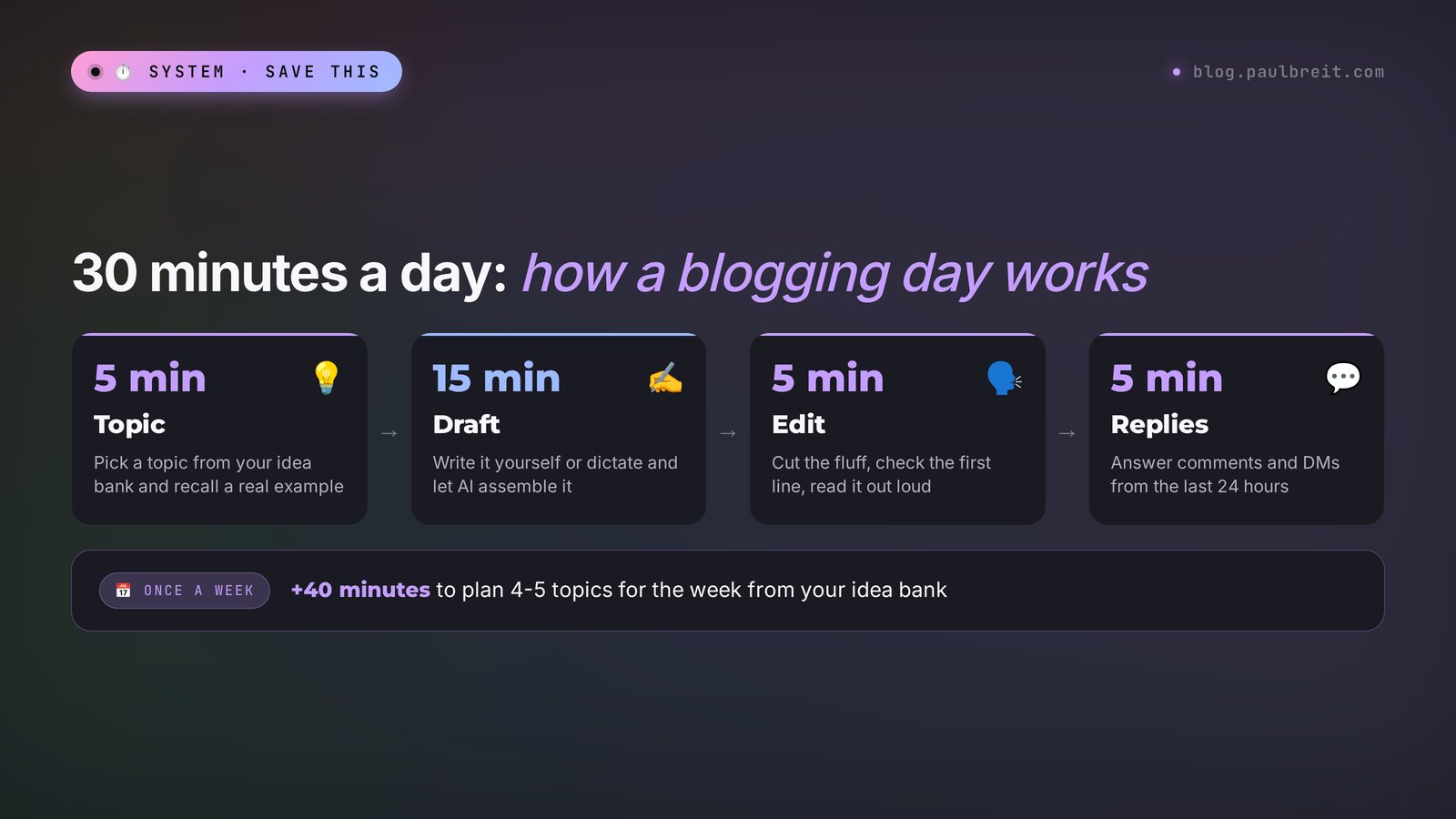
Three rules that hold the system together
The same time every day. Write your post at the same time each day, ideally in the morning before your main work. A habit runs on its own once it has an anchor: coffee, laptop, 30 minutes. In the evening after clients, there's usually no energy left for writing.
A buffer of 2-3 posts. Whenever you have a free hour, write a couple of posts ahead and schedule them. LinkedIn, Instagram, newsletter tools, and Telegram all let you schedule a post for a set time. You get sick, you travel, clients pile up, and the blog keeps going out.
Done beats perfect. A post you polish for three days never goes out. Set a timer. After 30 minutes the post gets published as it is. In a couple of months you'll be surprised how much better you've gotten: quality grows with the volume you write.
I spend about 20 minutes a day on posts. That works because my topics are always written down in advance, AI helps me put together the draft, and I sit down to write on schedule even when inspiration is nowhere around. A slow writer who follows the plan beats an impulsive genius, and that rule holds for blogging too.
Section 06An idea bank that never runs dry
An idea bank is a single note or spreadsheet where you drop post topics throughout the day. A thought came to you in the shower, a client asked an interesting question, you saw a controversial post from a colleague: straight into the bank, one line each. On Sunday, at your planning session, you just pick from what's already there.
Where to find topics so the bank never empties:
- Client questions. Every question from a consultation or a DM is a ready topic. If one person asked it, a hundred more are wondering the same thing in silence.
- Objections. "It's too expensive," "it won't work for me," "I've already tried that." Each objection becomes a post that answers it before the conversation even starts.
- Your own messages. Scroll through your replies to clients from the past month. That long explanation you wrote to someone is almost a finished post.
- Comments. Under your posts and under your colleagues' posts. Especially questions and arguments.
- Colleagues' and competitors' channels. See which of their posts get the most reactions, and write on that topic from your own position with your own examples. Copying the text is off limits. Taking the topic is fine.
- Your life. Something that happened at the store, a conversation with a cab driver, a renovation gone wrong. Many stories connect to your topic with a single takeaway.
- News in your niche. A new law, a study, a trend. Your opinion on it is a ready post.
- AI. In a couple of minutes it gives you 50 topics for your niche. More on that in Section 08.
Keep at least 20 topics in your bank. When there are fewer than 10, set aside 15 minutes and restock. If you want fresh topics to show up on their own every morning, see how the AI Client Hunter works: an AI agent collects the posts that took off in your niche and suggests topics.
Section 07How to write a post in 15 minutes
Speed shows up when your post has a skeleton. You don't need to invent a structure every time: take one working template and fill it in. Here is a template that fits 80% of posts.
The first line hooks
It shows up in the preview, in the feed, and in the email subject line, and it decides whether people open the post. What works: a painful question ("Why do clients disappear after the first consultation?"), a number ("14 inquiries in 3 months from a list of 600 people"), an unexpected statement ("I stopped giving clients homework, and their results went up"), the start of a story ("Yesterday a client burst into tears on our call").
The reader's situation
Two or three sentences where the person recognizes themselves. "You ran a consultation, the person nodded, thanked you, promised to think it over. And vanished."
The idea and an example
The main content of the post: an explanation, steps, a story. One idea per post. Always a real example: a client, an incident, a number from your practice. Without an example, a post reads like a textbook.
The takeaway in one sentence
What the person should walk away with. Short, and without a "remember, friends" moral.
One action at the end
What to do right now: save the post, answer in the comments, send a code word in a DM, try the exercise. One action, not three.
Example: before and after
The draft a lot of people write:
Today I want to talk about an important topic: procrastination. Procrastination is one of the main problems of modern people. It keeps us from reaching our goals and growing. There are many ways to fight it. Tell me in the comments if you've ever dealt with procrastination!
The same topic, following the template:
Have you been putting off the same task for three days straight and calling yourself lazy?
Last week a client told me she hadn't been able to sit down and write a report for a month. Every morning she opened the file, stared at it for five minutes, and closed it. We dug into it, and laziness had nothing to do with it: the task was too big and too vague, and her brain simply couldn't see where to begin.
We cut the report into 15-minute steps. The first step was just to write down the section headings. The next day she messaged me: "Got half of it done in one evening."
When a task has been hanging over you for more than three days, shrink the first step to 15 minutes.
What task are you putting off right now? Tell me in the comments, and I'll help you cut it into first steps.
You can see the difference right away. The second version has a person, a situation, a specific technique, and a clear takeaway. And the closing question invites a conversation that can grow into a consultation.
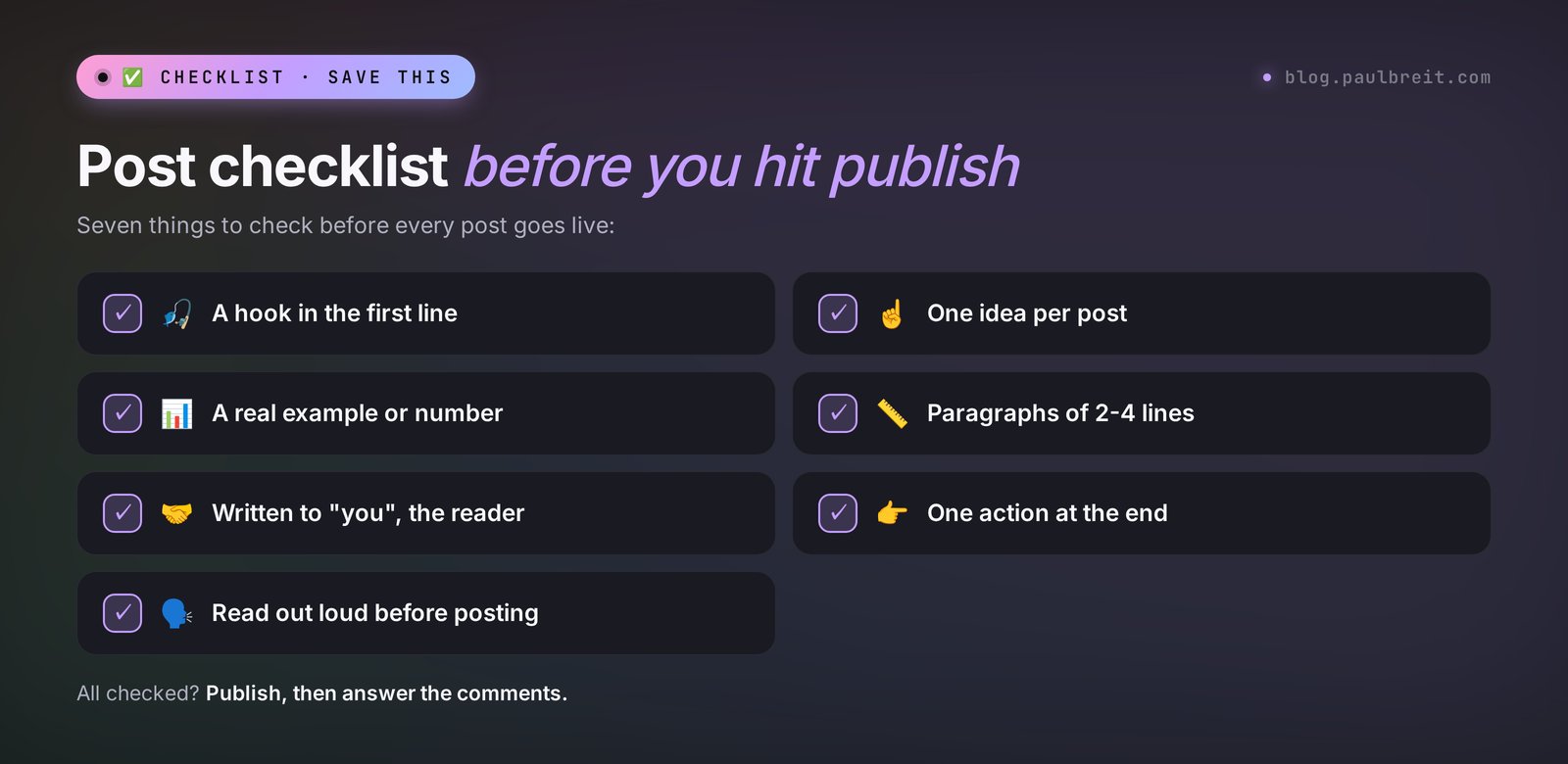
Before you publish, run through the checklist in the image above. A separate word about paragraphs: people read posts and newsletters on their phones, so keep paragraphs to 2-4 lines. A solid wall of text on a phone screen scares people off, and they scroll past it.
Section 08AI as your helper: 7 prompts
AI saves the most time at three stages: the topic bank, the draft, and the edit. Your voice, your examples, and your meaning stay yours. Without them, posts turn into faceless text that readers recognize from the first line.
For writing I use Claude: it writes more naturally than the others and holds the author's style better. You can sign up at claude.ai with any email. The free plan is enough for a few posts a day. If you're still choosing a tool, the honest breakdown is in Claude vs ChatGPT and in the roundup of the best AI for writing.
Prompt 1. A bank of 50 topics
I'm a [who you are: therapist / nutritionist / coach], I help [whom] get [what result].
My clients most often complain about: [3-5 pain points in your own words].
Write 50 post topics for my newsletter and LinkedIn, split into 4 groups:
value (20), personal stories (15), client cases (10), offers (5).
Each topic is one line, specific, no generic phrases.
For stories and cases, phrase each topic as a question to me, so I recall a real situation.
Prompt 2. Your blog's voice
Here are 10 of my posts that readers liked most: [paste the texts].
Describe my style: sentence length, how I address the reader, favorite words and phrases,
how I start and end posts, where I joke.
Keep this description: write every post from now on according to it.
Run this prompt once and save the answer. In Claude it's handy to create a separate project and put the style description there, so you don't have to paste it into every chat. The setup is covered in the article on Claude Projects, and for a deeper dive into style training, see how to teach AI to write in your voice.
Prompt 3. A draft from a voice memo
Below is a transcript of my voice memo on [topic].
Turn it into a post in my style:
a hooking first line, paragraphs of 2-4 lines, one idea,
keep my example as is, end with one action for the reader.
Don't add facts or numbers that aren't in the transcript.
This is my favorite method. You're walking the dog or riding in a taxi, and you talk into your phone for 2-3 minutes about the topic, the way you'd tell a friend or a client. Your phone or an AI tool handles the transcript, and Claude puts the rest together. The real examples and the tone of the voice memo survive, so the post sounds like you.
Prompt 4. Cut the fluff
Edit this post: remove fluff, jargon, and generic phrases,
cut it by 30%, keep all my examples and numbers.
Show me a list of exactly what you removed.
Prompt 5. Five first lines
Here's my post: [text].
Suggest 5 options for the first line: a painful question, a number,
an unexpected statement, the start of a story, a direct promise of value.
Each no longer than 12 words.
Prompt 6. A plan for the week
Here's my topic bank: [list]. Here are last week's stats: [which posts
got the most reactions and messages]. Make a plan for 5 posts:
2 value, 1 story, 1 case, 1 value post with a soft invitation to a consultation.
For each topic, one line: the main idea and which example I should recall.
Prompt 7. An offer post without pressure
Write an offer post for my blog. Product: [what I sell, format, price, number of spots].
Who it's for: [who it fits]. Client result: [a real case].
Structure: the reader's situation, what changes after working with me,
the case, the terms, one action: reply with the word [CODE WORD] in a DM.
Calm tone, no caps lock, no pressure.
What working with Claude looks like
You: here's the transcript of my voice memo. Topic: why clients disappear after a free consultation. Turn it into a post in my style.
Claude: Done. First line: "They said 'thanks, I'll think about it' and vanished. Sound familiar?" Then your example about the client who came back six months later, and the three reasons you named. At the end I suggested an action: tell me in the comments at which stage your clients most often disappear.
You: the second reason sounds too clever, rewrite it simpler, the way I'd say it to a client.
Claude: Rewritten: "You told them what to do, but you didn't tell them what to do tomorrow morning. They left with a head full of ideas and no first step."
See how much of the work here is yours? The topic, the example, and the final call on "does this sound like me or not." AI assembles and polishes, and you're responsible for the meaning. If your texts come out sounding plastic, read how to make AI write like a human, which has a list of words that give AI away and a ready prompt. And you can build a month-long content plan with the article on a content plan in one evening.
Section 09How often to post
Short answer: 3-5 posts a week on your main platform. More often is fine if you can keep it up without losing quality. Below three a week, readers start to forget who you are and why they subscribed. For an email newsletter the numbers are lower: one or two issues a week is a healthy rhythm, and your daily writing time can go to LinkedIn or Instagram posts that later get collected into the issue.
| Frequency | What happens | Who it suits |
|---|---|---|
| 1-2 a week | The blog is barely alive, readers forget you between posts | Only if you're very active on another channel at the same time, for example short videos, or if this is your weekly newsletter |
| 3 a week | The minimum for a living blog | People with very little time |
| 4-5 a week | The best rhythm: you're always in the feed, but you don't wear people out | Most people who sell services |
| Daily or more | Trust grows faster, but the risk of burnout and unfollows from overload goes up | People with a stock of topics and help from AI |
The main rule of frequency is consistency. Three posts a week for a whole year beats daily posts for two weeks followed by a month of silence. Gaps kill trust faster than infrequent posting: someone opens your profile, sees the last post was last month, and decides you've closed shop.
Pick your posting time from your own stats. To start, try mornings (8-10 AM in your audience's time zone) and evenings (7-9 PM). After a month, look at which posts got the most views in the first 24 hours and lock in that time.
Section 10Stories and short videos without the pain
In 2026 a text blog works best with video alongside it, and I learned that from my own mistake. Video gives what text can't: your voice, your face, your emotion. A person who has seen you on video trusts you faster.
The minimum set that fits into the same system:
- Stories 2-3 times a week. No editing: 3-5 short clips of what you're doing right now. Preparing for a consultation, the book you're reading, a question to your followers with a poll. It takes 5 minutes, and you can borrow them from the "replies to people" block.
- One video a week. Take your best post of the week and turn it into a 30-60 second video for Reels or YouTube Shorts. Talk to the camera or lay your voice over a cut of footage. AI will turn a post into a script in a minute, and the details are in the article on AI for Reels scripts.
- Quick talking-head clips. One minute on camera about the thought of the day. It's the fastest way to show you're a real person, with no editing and no prep.
If you're shy about the camera, start with your voice. A voiceover on top of footage of your work, your desk, or a walk also shows you as a living person. Over time the camera stops being scary.
Section 11Which numbers to watch
Once a week at your planning session, look at five numbers at most. The rest of the stats are a distraction and change nothing about what you do.
| Number | How to calculate | What it shows |
|---|---|---|
| Engagement rate (ER) | (reactions + comments + shares) / views × 100% | How well the post landed with the people who read it |
| Shares and saves | The number in the post's stats | The post is useful enough that people pass it on. The strongest signal |
| Direct messages and replies | How many people wrote to you after posts this week | The blog's main money metric |
| New subscribers and unsubscribes | Weekly growth and which posts caused unsubscribes | Whether your audience is growing and what pushes people away |
| Views (or opens) to subscribers | Average post views or email opens / number of subscribers × 100% | What share of your audience actually sees your posts |
An email newsletter and a Telegram channel have no algorithmic feed the way LinkedIn and Instagram do. So the reach of an issue barely depends on its quality: it gets seen by the people who open it. On those platforms, a post's quality shows best in engagement relative to opens or views: clicks, replies, forwards. If a post's ER is noticeably above your average, the topic hit, and it's worth developing into a series. On LinkedIn and Instagram, strong engagement in the first hour also pushes the post to new people.
Keep a simple spreadsheet: date, topic, post type, views, reactions, shares, messages. After a month you'll see which topics and post types start conversations, and you'll start writing more of them.
Section 12How to turn readers into clients
The most common complaint: "I post, people read and like, but nobody buys." The reason is almost always the same: the blog has no clear next step. The person is ready but doesn't know what to do, so they put it off.
Here's what works for people who sell services:
A code word instead of "message me if you're interested"
"Send me the word REVIEW in a DM and I'll send you a checklist and offer a free call" works many times better than a vague "feel free to reach out." A specific action removes the awkwardness: the person doesn't have to figure out what to write.
A soft invitation at the end of value posts
Once a week, add one line to a value post: "If you'd like to go over your situation personally, write to me: this week I have 3 slots for free consultations." It doesn't push, and it keeps reminding people they can work with you.
A direct offer post every 1-2 weeks
Describe who the product is for, what changes, a case, the price or terms, and a specific action. Don't be afraid to sell: if there are no offers on your blog at all, readers don't know you offer anything.
A free consultation as the bridge
For services above $150-200, it's hard for someone to buy straight from a post. A free 30-40 minute consultation or review is the middle step where you get to know each other, help, and offer to work together. How to run that call so it ends with a payment is covered in the article on the sales call script.
A post series before a launch
Every 1-2 months, run a small launch: 5-7 posts over a week that build interest in the product, with enrollment at the end. Most of my clients sell this way, and it works even with small audiences. You can put the series together in one evening with the article on a warm-up series with AI.
If selling on your blog feels awkward, that's normal, almost everyone goes through it. One simple thought helps: you're telling people who chose to subscribe to you that you can help them. Anyone who doesn't need it will scroll past. Anyone who does will write to you and say thank you.
Section 13Where new subscribers come from
Here's an honest thing people rarely say out loud: regular posts on their own bring almost no new people. Especially in an email newsletter or a Telegram channel, where organic growth is close to zero. Posts keep and warm up the people who have already arrived. Traffic brings new ones.
Methods that work, from free to paid:
- Your network and clients. Tell current and past clients about your blog, mention it on your personal social accounts and in your email signature. The first 100-200 subscribers often come from here.
- Mutual recommendations. Agree with 3-5 colleagues in neighboring niches with a similar audience: you recommend them, they recommend you. A nutritionist and a fitness trainer, a therapist and a coach, a lawyer and an accountant. Newsletter platforms have built-in recommendation features for exactly this.
- Useful comments. Leave substantial comments under big posts and in the communities of your niche, on LinkedIn especially. People click through to the profile of whoever said something smart.
- Short videos. YouTube Shorts and Instagram Reels reach new people with zero budget if the video hooks.
- Articles in search. A blog on your site brings people from Google. Slowly, but for free and for a long time.
- Paid placements. Buying a mention in someone else's newsletter or channel. This is the fastest way to grow a newsletter. If part of your audience is on Telegram, the same mechanics there are covered in buying Telegram channel ads.
- Targeted ads. Meta ads (Instagram and Facebook), LinkedIn ads, and newsletter-platform ad networks. If you're testing Telegram as a channel, start with the breakdown on Telegram Ads from scratch.
You don't need a big budget to start advertising. Around $25-50 a week is enough for a test: it tells you what a subscriber costs in your niche and whether it pays off. If you already have a blog and a posting system, ads start working right away: new people land in a living blog and warm up.
Section 14The fears that stop you from starting
Most people don't start a blog for reasons that have nothing to do with time. I'll go through the four most common ones. I've been through every one of them myself.
"I have nothing to say, it's all been said"
It may all have been said, but your readers haven't heard it from you. People subscribe because of how you explain things, which examples you use, how you see the world. Thousands of therapists write about "how to cope with anxiety," and your approach and your client stories exist only with you. Open the idea bank from Section 06: there are already 20 topics in it.
"Friends and colleagues will judge me"
My fear of looking stupid was very strong, especially at the start. When I began, there were few travel bloggers around, and the comments said all kinds of things: from nitpicking about the way I pronounce my R's to "he travels and earns money online, so he must be a scammer." Over time it let go. My logic is simple: I make content and live the way I want, while the people writing those comments sit and watch from the sidelines. The acquaintances who smirk today will be asking you how you did it a year from now.
"I'm not expert enough"
You don't need to be the best in your niche to blog. It's enough to know more than your reader and to share your experience honestly. Someone who just started losing weight will find a nutritionist with clear explanations more useful than a professor with a shelf of academic papers.
"I have so few subscribers, it's embarrassing to write into the void"
Even 50 readers is a full room at your talk. Write for them. A list of 200 subscribers where every post helps and there's an invitation to a consultation once a week can already bring inquiries. The cure for a small blog is traffic. Waiting doesn't help.
Section 1510 blogging mistakes
- Writing only for colleagues. Professional jargon and debates about methods interest your peers, but clients don't follow them and leave.
- Writing only about yourself. "I had three consultations today" with no takeaway for the reader is a diary. Every personal story needs something useful or familiar in it.
- Nothing but value. A textbook blog gets read, saved, and its author forgotten. Without stories and cases, people never warm to you.
- No offers. Writing useful posts for months and never once saying how to work with you. Readers won't guess on their own.
- Long gaps. Two weeks of silence, then five posts in a day. Readers lose the rhythm and get used to life without you.
- Made-up cases and numbers. One exposure costs all the trust you built over months.
- Copying other people's posts. Borrowing topics from colleagues is fine, borrowing their text is off limits. It shows, and readers don't forgive it.
- A post written entirely by AI with no edits. Readers recognize those texts by the first lines and stop reading.
- Ignoring comments and DMs. A person who didn't get an answer won't write a second time.
- Waiting for growth without traffic. A great blog with no ads, paid placements, or recommendations takes years to grow.
There's a separate detailed breakdown of AI mistakes in writing: 10 beginner mistakes with AI. It also covers how to check the facts AI sometimes invents.
Section 16When something goes wrong
I post regularly, but views are dropping
Check three things. First lines: if they're boring, people don't open the post. Monotony: if every post is the same type, people stop noticing them. Unsubscribes: see after which posts people left. Change the format for 2 weeks: more stories and cases, stronger first lines.
People read, but nobody reacts
End the post with a simple question that's easy to answer with one word or an emoji. "Do you more often put off work or rest?" Reply to everyone who writes: that's how people learn that commenting on your posts is worth it.
No inquiries
Count how many times in the last month you invited people to take a specific action. If it's fewer than four, that's the problem. Add a code word, soft invitations once a week, and a direct offer every two weeks.
People unsubscribed after an offer post
That's normal and even useful: the people who left would never have bought. If there are a lot of unsubscribes, check your balance: maybe there are now more offers than value. Go back to the 40/30/20/10 ratio.
I've run out of ideas
Run Prompt 1 from Section 08 and get 50 topics in a couple of minutes. Reread your messages with clients from the past month. Take your three best posts from the last six months and write a follow-up to each.
The AI writes like plastic
Give it 10 of your best posts as samples (Prompt 2), work through voice memos (Prompt 3), and forbid it to add facts that aren't in your text. Always do the final edit yourself, reading out loud.
I'm burned out and don't feel like writing
Cut the frequency to three posts a week, but don't stop. Write posts ahead on good days. Switch to voice memos, they come easier than typing. And remember why you're blogging: count how many clients came from it in the last six months.
I skipped two weeks and I'm embarrassed to come back
Just come back. Write an honest post: where you were, what you realized in that time, what's coming next. Posts like that usually get a warm response, and you're back in rhythm.
Section 17Your plan for the first 30 days
So the system doesn't stay an article in your bookmarks, here's a step-by-step plan for the month. Each week adds one new skill.
| Week | Tasks | Result by the end of the week |
|---|---|---|
| 1. Foundation | Choose your main platform. Set it up: name, photo, description, pinned or welcome post. Build a bank of 30+ topics with AI. Describe your style (Prompt 2) | The blog is ready to welcome people, and you have topics for a month |
| 2. Rhythm | Your first 40-minute planning session. Three posts with the 30-minute system: value, story, value. Replies to every comment | The first posts are out, the habit is running |
| 3. Momentum | Four posts, including your first case. A couple of posts scheduled ahead. Your first stories or short talking-head clips. A numbers spreadsheet | A buffer of posts and your first stats |
| 4. First inquiries | Five posts, including a soft invitation and an offer post with a code word. Set up mutual recommendations or launch your first ads at $25-50 | Your first direct messages and new subscribers |
By the end of the month you'll have a living blog with 15-17 posts, a clear 30-minute-a-day rhythm, a spreadsheet of numbers, and your first conversations with potential clients. From there you simply repeat week after week, and once a month you check which topics and formats work best.
Section 18The whole path in a minute
- Your blog exists so a stranger starts trusting you and writes to you. Measure it in inquiries.
- One main platform (usually an email newsletter or LinkedIn) and one for repurposing (Instagram, YouTube Shorts, or Telegram). A blog on your site is for search traffic from Google.
- Setup in one evening: "Name | what the blog is about," a photo of your face, a "who I help and with what" description, a pinned or welcome post, a lead magnet.
- Four post types: value ~40%, stories ~30%, cases ~20%, offers ~10%.
- Once a week, 40 minutes to plan from your idea bank. Every day, 30 minutes: 5 for the topic, 15 for the draft, 5 for edits, 5 for replies.
- Fill your idea bank all day: client questions, objections, your messages, comments, AI.
- A post by template: a hooking first line, the reader's situation, an idea with an example, a takeaway, one action.
- AI gathers topics, builds drafts from voice memos, and cuts the fluff. The meaning, the examples, and the final edit are yours.
- 3-5 posts a week, steadily, with a buffer of 2-3 scheduled posts.
- A soft invitation once a week, a direct offer with a code word every 1-2 weeks, a launch series every 1-2 months.
- Traffic brings new people: recommendations, comments, short videos, paid placements, ads from $25-50 a week.
Start today with one step: open your notes and write down the 10 questions clients ask you most often. Those are your first 10 posts ✍️
FAQFrequently asked questions
How do I run a blog if I have no time at all?
Work by a system: 40 minutes once a week to plan 4-5 topics, 30 minutes a day for one post and replies to people. Build drafts with AI from voice memos, and in your free hours write 2-3 posts ahead and schedule them.
How many times a week should I post?
The best rhythm is 4-5 posts a week on your main platform, with three as the minimum. For an email newsletter, one or two issues a week is enough. Consistency matters more: three posts a week for a whole year will give you more than daily posts for two weeks and then a month of silence.
Where is the best place to blog in 2026?
For people who sell services, courses, and consulting to an English-speaking audience, the strongest pairing is usually an email newsletter or LinkedIn as the main platform, plus Instagram or YouTube Shorts for reach. Add a blog on your own site if you want traffic from Google search. Telegram works as a second channel if part of your audience is already there.
What should I write about if it feels like everything has already been said?
Write about your clients' questions and objections, break down situations from your practice, tell personal stories with a takeaway for the reader, and publish cases. Rotate four post types: value, stories, cases, and offers. You can build a bank of 50 topics with AI in a couple of minutes.
Can I write my posts with AI?
Yes, and you should, for drafts, the topic bank, and editing. The pairing that works best: you talk through an idea in a voice memo, AI builds the post based on your best posts, and you edit it and add real examples. Readers recognize a post written entirely by AI with no edits and stop reading.
When will my blog start bringing in clients?
The first direct messages usually show up in the first month if your posts include a specific action: a code word or an invitation to a free consultation. A steady flow of inquiries builds up after 2-3 months of regular posts with traffic switched on.
How do I get my first subscribers?
The first 100-200 people come from your network: current and past clients, your personal social accounts, colleagues. After that, mutual recommendations with neighboring niches, useful comments under big posts, short videos, paid placements in other newsletters, and targeted ads from $25-50 a week do the work.
What if nobody reads my posts?
Check your first lines, the variety of post types, and how consistent you are. If views are low because your audience is small, you need traffic: regular posts keep people, but they bring almost no new readers, especially in an email newsletter or a Telegram channel, where organic growth is close to zero.